18 August 2009

No new Hospital for the Northeast by 2015

Today the Health Service Executive (HSE) has confirmed that the planned new regional hospital for the Northeast of Ireland is "unlikely to be built for several years".

It had been expected that a new 750-bed hospital would be up and running in Navan, Co. Meath by 2015. But this target will now not be met.

When the HSE published a report in 2006 on the provision of hospital services for the Northeast of Ireland, one of its core recommendations was the construction of a new regional hospital, which the HSE had included in its National Development Plan for 2009 to 2013.

In the meantime, many services were to be moved from smaller hospitals to the larger medical institutions in the area.

However, "given the current economic climate", the HSE says now that it will "not go ahead during the lifetime of this plan", but is "likely to be included in the next plan after 2013".

A spokesperson for the HSE said its current focus is to advance the controversial plan to move all acute services into Cavan General Hospital and Our Lady of Lourdes Hospital in Drogheda, Co. Louth. It has already moved services from Monaghan General Hospital to Cavan.

Does Ireland need an Army?

Ever since Colm McCarthy's 'Special Group on Public Service Numbers and Expenditure Programmes' - commonly referred to as 'An Bord Snip (Nua)' - suggested to cut the Defence Budget by € 53 million and to reduce the strength of the Irish Defence Forces (IDF) by 520 (see my entry of July 16th), a debate about the structure and duties of our military is going on.

The Naval Service, which has a total strength of 1144 and currently operates eight corvettes of various sizes and ages, is getting a relatively easy time of it. Everyone realises that - as an island nation - we really need it. In fact, we could well do with some additional vessels, but during a recession this is obviously not going to happen.

In contrast, the Aer Corps, with 939 serving members the smallest part of the IDF, is getting a lot of flak. The main criticism is that there is no longer any airborne defence system in operation and the Aer Corps is now "reduced to be the air taxi service for the government".
There is little one can offer in argument against that. Indeed, the Irish Aer Corps has not a single fighter, fighter-bomber or bomber aircraft in service. There is a handful of helicopters, a couple of fixed-wing aircraft, and the two government jets (which are operated by military pilots).

One has indeed to ask if this organisation, which once operated a complete squadron of fighters, is still fit for purpose.
Perhaps not, and one should seriously contemplate a merger of Naval Service and Aer Corps into an efficient Coast Guard.

There is also a significant question mark hanging over the Army, with about 8,500 personnel the largest of the three IDF branches. People usually know that several units of the Irish Army are serving with UN peacekeeping forces in various parts of the world. They have been doing this since 1960, when a large Irish contingent (from the 32nd Battalion, commanded by Lt.Col. Murt Buckley) was sent to the newly established African state (and former Belgian colony) of Congo (Leopoldville)*.
Over the decades Irish troops, serving with the UN and wearing its blue helmets and berets, have become very popular and respected in the areas they policed. This goes especially for Cyprus and South Lebanon, where IDF contingents served under UN command for many years.

More recently Irish peacekeepers were sent to the newly independent East Timor (1999-2000) and to Liberia (2003-2006). In both deployments the Army Ranger Wing - Ireland's 50-strong special forces unit - played a significant role in operations.

And for the past two years up to 500 Irish soldiers - 17% of the entire army - have been the core unit of EUFOR Chad/CAR, the EU peacekeeping and peace-enforcing command based in Chad, which is controlled directly by the European Union and in support of multi-national humanitarian operations in both Chad and Darfur (a large province of Sudan). Until his recent retirement, Lt.Gen. Pat Nash (above) - formerly GOC of the 1 Southern Brigade in Cork - was the overall commander of this force.

But as much as Irish troops have established a good name for themselves and for Ireland in far-away places, one has to ask if the only duty of our Army is to provide soldiers for the UN? Or is there a further and deeper purpose for the Army, much closer to home?

Well, as far as the general public knows, the only visible duty our Army performs inside the country is armed escort for private money transports (aka 'cash in transit'). One can see the olive-green range-rovers packed with armed men in battledress almost everywhere in Ireland when a bank receives a delivery of money.
Apart from that the Army is pretty invisible and absent from most people's minds. Unless one lives in a garrison town and close to the barracks, one has hardly ever any contact with the military.

Like most countries without a national service, Ireland has a small professional defence force, entirely staffed by volunteers, for whom this is a job like any other. Well, perhaps not like any other, but the attitude here is that it is a job, and not a national duty.

The only people who know what is going on inside the IDF are those who belong to the service, plus their families and relatives, who usually get at least some idea. For the rest of the country, the vast majority of the Irish nation, the IDF, its structure, mission and duties are a complete enigma.

There are even people who wonder if Ireland needs an army at all. Well, the questions makes some sense, since we are an island nation with - at present - no hostile neighbours and no main threat against us from anywhere. We are simply much too nice a people to become targets for wars or invasions now.

This was of course not always so. During the 9th and 10th centuries the Vikings raided the island regularly, before deciding that it is actually a great place to settle. In the late 12th century the Normans invaded us and took over the country. Their control led to the rule of the English, and thus to 750 years of foreign occupation and oppression.

And it is only 40 years that 'the Troubles' in the North began, leading to massive deployments of British troops and to more than 3000 people killed on both sides of the conflict.

Nowadays we don't think of that much longer. Now we have the 'peace process' and a power-sharing administration in Belfast.
Well, I often wondered what a 'peace process' actually is, apart from a nice sounding word. It is a bit of a contradiction, because either there is peace, or not. In the latter case we are at war. But a 'peace process'? That's neither fish nor flesh, not here nor there, and as impossible as being 'a little bit pregnant'.

Personally I think and believe that there is little chance for a return of widespread violence to the Six Counties. The period of ceasefires and power-sharing has lasted too long now, and too many people from both communities are too much involved. They, and many more, would have to pay a price much too high to contemplate if they would return to civil war and street fighting.

So, what is the Army of the Republic for? We have no longer any enemies, and no-one is planning to invade us. Maybe the pacifists are right, and we could as well abolish our Army under these circumstances?

Well, if the current government and its advisors keep going along the road they have been travelling on for nearly two decades, the Irish Army will eventually disappear quietly.
20 years ago its strength was roundabout 16,500. Then a 'defence review' reduced it to first 14,000 and eventually 12,500.
Not long after that the then Minister for Defence Michael Smith (Fianna Fáil) had the idea of employing a company of civilian consultants to 're-structure and reform' the Army. The result was a White Paper which insulted every serving Irish soldier, and which cut the Army's strength even further, to 9,500 (and thus for the first time below the crucial 10,000-mark).

Meanwhile we stand at a grand total of 8,500. In practical terms this means that at any given time less than 5,000 soldiers would be available to defend the country or deal with a major emergency, if it occurred. (The rest of the Army is either serving abroad, in transit, in training for a foreign mission, on special courses, on holidays or on sick leave.)

If the government follows the recommendations of 'An Bord Snip (Nua)', then we will soon be below 8,000 active Army personnel, which means that just a little over 4,000 soldiers would be on stand-by in Ireland, in case they are needed. This is slightly more than one brigade. (The current Army structure has three brigades.)

Most people may think that this is still more than enough in a country with no threat or enemy, but in fact it is not. Armies have a peculiar structure, which means that their efficiency depends on a 'critical mass' of soldiers in a state of permanent readiness. The larger the overall force is, the easier this 'critical mass' can be achieved. But when the strength of an army falls below the 'natural defence level', which is a quarter of one percent of the population, it is very difficult and almost impossible to achieve efficient defence readiness.
With Ireland's population - not counting foreigners for this purpose - at about 4 million, the 'natural defence level' of our Army is 10,000. For more than a decade we are already 15% below this level, and now it is supposed to be cut even further.

Which means that the Irish Army is now only useful for UN operations abroad, for which the relevant units undergo a special training. But at home we have an Army only by name, but not a force that could act and react with efficiency and expectation of success.
For the past twenty years successive Fianna Fáil governments have reduced the Irish Army more and more, to the point that it is becoming useless. Perhaps not quite as useless as the government, but coming close.

Since our soldiers and officers are better paid than their comrades in many other countries, and our Chief of Staff gets more money than his counterpart in the UK, the Army would indeed be a great cost-cutting chance in a recession. If the government indeed does not want an army - and all the indications point in this direction - then it would be only fair to say so openly.

Costa Rica and Iceland, two other neutral countries with small populations, have not had an army for decades and are doing fine. They have not been attacked, invaded or drawn into a war.

We could save a large amount of money if we would abolish the Army - and the Department of Defence with it - and be as peaceful and neutral as we always pretend to be. Naval Service and Aer Corps could be amalgamated into a new and strengthened Coast Guard, which could also have some land-based units. It should be governed by a restored Dept. of the Marine, which should also get responsibility for Fishing and Natural Resources.

I bet a good sum of money that - if we would go ahead and abolished the Army - hardly anyone in Ireland would miss it. The places where it would be missed are the UN HQ in New York and the deserts and refugee camps of Chad and Sudan.

The Emerald Islander


* After being renamed Zaire (by President Mobuto) for some time, the country has changed its name again and is now known as the 'Democratic Republic of Congo' (DRC).
After nearly 50 years of nominal independence, it is still one of the most unstable and war-torn countries on Earth, and still has a large UN force stationed there. However, at present Ireland is not contributing to this force.

17 July 2009

You don't get much Sleep at Sea

Fatigue has become a major issue in the shipping industry, and it has been a contributory factor in too many maritime accidents. Some of them were very serious and have cost lives, or done major damage to the environment.

The European Maritime Safety Agency (EMSA) reported that 754 vessels were involved in 670 accidents last year alone, and 82 seafarers lost their lives as a result.

There is almost no day in the year without some shipping accident somewhere on this planet. Fortunately the majority of them are minor incidents that never make the headlines. But those who do are usually shocking, and would often have been avoidable.

The European Commission has now launched a major research project to study the effects of fatigue on seafarers.

This research will take two-and-a-half years to complete and cost € 4 million, a rather small sum I would think, if one keeps in mind how large the costs of major shipping accidents are.
Scientists and maritime experts will now study in detail the work and rest patterns of deck officers, engineers and all other members of ships' crews, concentrating in particular on watch-keeping, which has become an increasing concern.

Having spent many years at sea myself, I know only too well that this is a very important and crucial element. Most naval vessels operate a two-watch system, which means that at any given time about half of the crew is on duty - running the ship and operating all its departments and elements - while the other half is off duty, with free time for rest and recreation.
Every four hours they change roles (with the exception of two 'dog watches' in the late afternoon and early evening, which last only two hours and have the purpose to prevent the same people from being on duty always at the same hours each day).

This means that the longest period of uninterrupted sleep any crew member in a naval vessel at sea can enjoy is about 3 1/2 hours. In comparison, most people on dry land have - and need - at least 8 hours.
So the matter of tiredness, often combined with lack of attention and concentration deficit, is a well-known problem at sea. And the longer a ship or vessel is away from a port, the more fatigue has been identified as a major safety issue.

Many civilian vessels and merchant ships do not (or no longer) operate two-watch systems with four-hour-long watches. They have adopted more sleep-friendly systems, such as watches of six or even eight hours duration, especially on very large vessels like the modern super tankers. This sounds almost like a working day on shore, except that being at sea is a lot more demanding than sitting in an office on dry land. (Being at sea - a constantly moving surface - demands an extra 2000 calories of energy in 24 hours from every person, regardless what kind of work is done.)

Seafaring has also other special elements not found in land-based jobs. Crews work and rest in the same space, which is usually quite small. And being at sea also limits the amount of possible activities a person can have. There is a considerable strain on every sailor's social life, which also has affects on people's mental and emotional conditions.

There are increasing demands from trade unions and safety organisations that the problems created by fatigue and long watch duties must be addressed.
The increasing concerns about safety have now brought ship owners, trade unions, marine insurance companies and safety organisations throughout Europe together into a joint venture operation. They all are supporting the 30-month-long EU research project, and one can only hope that the findings will lead to improvements and eventually enable modern seafarers to live a more 'normal' life than hundreds of generations of sailors before them.

I never slept more than 3 1/2 hours at one time when I was at sea (often even less) and rarely managed to have more than one spell of sleep within 24 hours (being first in charge of signals and later executive officer and captain). Somehow I was lucky that it did not affect me in a negative way. In fact, even now - many years after I retired from the Navy - I sleep not more than 3 or 4 hours each night. Over all the years at sea my biological clock got set to that, and my body is used to it. For me it is rather beneficial, giving me more time than most people have, time to do things like writing this weblog.

But I also know people, among them a good friend of many years, who found service at sea extremely difficult. They were often tired, fatigued and lacked concentration, and some of them even developed further illnesses due to lack of energy reserves.

71% of our planet is covered by oceans and seas, and shipping is still the most important kind of mass transport in the world. Until engineers develop a way to sail ships automatically, by remote control and without the need for a crew, there will always be seafarers.
Although their number is now much smaller than it was during earlier centuries, when we had huge fleets under sails, seafarers are still a large and important group of people. We depend on them and their ships for many of our daily supplies (which is even more important for an island nation like Ireland). So we should perhaps take a little more notice of the seafaring community, and I am glad that the EU is doing it with the research into fatigue at sea.

The Emerald Islander

16 July 2009

1 Million People in Ireland may get 'Swine Flu'

The Department of Health is warning that up to 1 million people in Ireland could become infected with influenza A (type H1N1) - popularly called 'swine flu' - over the autumn and winter of this year.

The department's Chief Medical Officer, Dr. Tony Holohan (left), has sent a letter to all GPs and other medical professionals, alerting them to the fact that up to 25% of the population could catch the virus.
This would put significant strain on Irish family doctors, hospitals and intensive care facilities.

The letter was co-signed by Dr. Patrick Doorley, the National Director of Population Health, who told a conference in Dublin today that the anti-viral medicine 'Tamiflu', which is used to treat 'swine flu' symptoms, will be available in pharmacies in Ireland from tomorrow.

So far 144 people in Ireland are known to have contracted 'swine flu', which began to spread in Mexico during April of this year. (for more information see my entry of May 3rd)

The World Health Organisation (WHO) is meanwhile warning that the flu virus is "unstoppable" and its Director General, Dr. Margaret Chan (right), indicated that the availability of a vaccine may be further away than had been anticipated.
Information from clinical trials is expected not to be available for another two or three months, and experts say that a new vaccine for the H1N1 influenza may not be ready until October.

Apart from Mexico, where the current epidemic started, the most affected countries so far are the USA and Britain.
I am no medical expert, but I wonder if the unhealthy living conditions and the very unhealthy lifestyle in the English-speaking countries might be contributing factors.

I am also trying not to make jokes in bad taste. But if Ireland would indeed see one in four of its residents being infected with 'swine flu' this year, the long-established nick name of our Minister for Health would become even more fitting than it is already.
Mary Harney (above) is for many years known as 'Miss Piggy'.

The Emerald Islander

'Bord Snip' - The List of Recommendations

The 'Special Group on Public Service Numbers and Expenditure Programmes' has identified € 5.3 billion in potential public sector savings. The group's full report, which fills 80 pages - plus over 200 pages of appendices - has just been published. It recommends 17,300 job cuts in Ireland's public services, a 5% reduction of all social welfare payments and a lot more.

'An Bord Snip (Nua)', as the group of four experts is popularly called, was chaired by the economist Prof. Colm McCarthy (photo, with the report) of University College Dublin (UCD), who said today that the Irish government was currently borrowing € 400 million per week and having to pay a substantial rate of interest on those borrowings. This could not continue.

The complete report, with all details and appendices, can be seen on the official website of the Department of Finance (which has already crashed owing to massive interest in the matter) or accessed through the website of Ireland's national broadcaster RTÉ (www.rte.ie).

In order to keep things to a manageable size, I will list here only the main proposals of 'An Bord Snip (Nua)', grouped together under each government department. This will give you the bulk of the recommendations.

Dept. of Social & Family Affairs
* Cuts to all social welfare payments by 5% - Saving: € 850 million
* Reduction and changes to child benefit - Saving: € 513 million
* An end to receiving two welfare payments - Saving: € 100 million
* An end to payments for Community Employment Schemes for those already on benefits - Saving: € 100 million
* Cutting benefits for dental, optical and hearing services - Saving: € 92 million
* Grading of jobseekers allowance by age - Saving: € 70 million
* Cutting the Family Support Agency - Saving: € 30 million
* Changing eligibility for Family Income Supplement - Saving: € 20 million
* Taxing household benefits package - Saving: € 11.6 million

Staff cuts: none - Total savings: € 1.8 billion

Dept. of Health and Children
* Reduce the size of the Department by 10% per year over the next three years - Saving: € 11 million
* Reductions of HSE staff - Saving: € 391.3 million
* Revise the income guidelines for the Medical Card to the basic rate of social welfare, which is the jobseekers allowance - Saving: € 100 million
* Increase the threshold for the Drugs Payment Scheme from € 100 to € 125 a month - Saving: € 37 million
* Those previously receiving free prescriptions must now pay € 5 for each prescription - Saving: € 70 million
* Hold an open competition to provide services under the General Medical Services scheme - Saving: € 370 million
* Increase Hospital Charges - Saving: € 6 million
* Increase charges for private facilities in public hospitals by 20% - Saving: € 50 million
* Hospitals and clinicians must provide generic medicines, off-patent drugs and value-for-money treatments - Saving: € 30 million
* Changes to agencies and organisations in the disability and mental health area which receive State funding - Saving: € 50 million
* Changes to the Fair Deal scheme with the individual to contribute more to nursing home care from their own residence - Saving: € 50 million
* Means test for Homecare packages - Saving: € 24 million

Staff cuts: 540 - Total savings: € 1.2 billion

Dept. of Education & Science
* Staff and pay cuts in primary and post primary schools - Saving: € 150 million
* Staff cuts at third level - Saving: € 140 million
* Cuts to number of special needs assistants and English language support teachers - Saving: € 81 million
* Increased pupil teacher ratio at primary and post primary - Saving: € 80 million
* Change to student support grant - Saving: € 70 million
* Cuts to capitation grants for primary and post primary schools - Saving: € 25 million
* Cuts to research and development - Saving: € 27.5 million
* Cuts to grants for private schools - Saving: € 25 million
* Merging of smaller primary schools - Saving: € 25 million
* Cuts to school transport - Saving: € 25 million
* Integration of senior travelling training - Saving: € 25 million
* Cuts to third level structures - Saving: € 23.7 million

Staff cuts: 6,390 - Total savings: € 746 million

Dept. of Agriculture
* Reduce expenditure on the Disadvantaged Area Compensatory Allowance Scheme by 30% - Saving: € 66 million
* Terminate the Suckler Cow Scheme - Saving: € 44 million
* Close REPS 4 and no rollover from REPS 2 and 3 into REPS 4 - Saving: € 80 million
* Reduce Teagasc staff numbers, rationalise Teagasc and Dept. offices - Saving: € 37 million

Staff cuts: 1,140 - Total savings: € 305 million

Dept. of Enterprise, Trade & Employment
* Merge the regional offices and shared services of Enterprise Ireland, IDA and FÁS - Saving: € 87 million
* A single reduced funding stream for all science, technology & innovation activities across all departments - Saving: € 53 million
* Streamline all support of Irish enterprises and marketing functions in Enterprise Ireland - Saving: € 10 million
* Stop funding the FÁS Services to Business and Skillnets programmes - Saving: € 27 million
* Cuts to training allowances for the unemployed - Saving: € 24.5 million

Staff cuts: 594 - Total savings: € 237.7 million

Dept. of Community, Rural & Gaeltacht Affairs
* Cuts to Community Services Programmes - Saving: € 64 million
* Cuts to Gaeltacht Schemes - Saving: € 20.8 million
* Cuts to islands infrastructure - Saving: € 20 million

Staff cuts: 196 - Total savings: € 151 million

In a separate suggestion it is recommended to abolish this department and allocate its functions to other government departments.

Dept. of Environment, Heritage & Local Government
* Cuts to local government including an end to 12 county or town councils - Saving: € 100 million
* Further efficiencies - Saving: € 30 million

Staff cuts: 30 - Total savings: € 130 million

Dept. of Transport
* Efficiencies among CIE companies - Saving: € 55 million
* Cuts to road maintenance - Saving: € 20 million
* Cuts to regional air services - Saving: € 15 million
* Axing the Rural Transport Scheme - Saving: € 11 million
* Outsourcing of driver and vehicle testing - Saving: € 10 million
* Cuts to the Road Saferty Authority - Saving: € 4.2 million
* Merging the National Roads Authority and the Railway Procurement Agency - Saving: € 3 million
* Merging the National Vehicle and Driver File into the Road Safety Authority - Saving: € 2 million

Staff cuts: 80 - Total savings: € 127.1 million

Dept. of Arts, Sports & Tourism
* Cuts in allocation to tourism and marketing - Saving: € 27 million
* Cut in grant to Sports Council - Saving: € 17.7 million
* Cut allocation to Horse and Greyhound Fund - Saving: € 16.4 million

Staff cuts: 170 - Total savings: € 104.8 million

Dept. of Justice, Equality & Law Reform
* Cuts to pay and allowances for justice sector staff - including Gardai - Saving: € 65 million
* Cuts to the courts service - Saving: € 13.5 million
* Cuts in immigration staff - Saving: € 10 million
* Transfer disability functions of department to Department of Health - Saving: € 2.6 million
* Cuts to Youth Detention Centres - Saving: € 2.5 million

Staff cuts: 540 - Total savings: € 136.4 million

Dept. of Communications, Energy & Natural Resources
* Cuts to energy efficiency schemes run by Sustainable Energy Ireland - Saving: € 40 million
* Cuts to direct funding to TG4 - to be partially funded from licence fee - Saving: € 10 million

Staff cuts: 106 - Total savings: € 65.6 million

Dept. of Defence
* Measures including a reduction in Defence Forces personnel by more than 500

Staff cuts: 520 - Total savings: € 53 million

Dept. of Finance
* Cuts to the Office of Public Works - reducing spare capacity and rental costs - Saving: € 21 million

Staff cuts: 660 - Total savings: € 82.8 million

Dept. of Foreign Affairs
* Cuts to overseas missions - Saving: € 15 million
* Cuts to overseas aid - Saving: € 14.8 million
* Cuts to Support for Irish Emigrants - Saving: € 1 million

Staff cuts: 65 - Total savings: € 41.7 million

Houses of the Oireachtas Commission
* Changes to some operations - Saving: € 6 million
* Cuts to Oireachtas Allowances and Benefits - Saving: € 1.5 million

Staff cuts: 42 - Total savings: € 7.8 million

National Treasury Management Agency
* Reduce staff and other administrative costs - Saving: € 5.3 million
* Changes at the State Claims Agency, including payment schemes, legal fees and risk management services

Staff cuts: 40 - Total savings: € 5.3 million

Dept. of the Taoiseach
* An end to the National Economic & Social Development Organisation - except for the National Economic & Social Council - Saving: € 4 million
* Axing the Law Reform Commission - Saving: € 2.8 million
* Cuts to the cost of Census 2011 - Saving: € 2.2 million

Staff cuts: 77 - Total savings: € 17.5 million

Total staff cuts: 17,300 - Total savings: € 5.3 billion

These are the facts and figures, for everyone to see and to peruse. I am going to read the whole document now again, analyse the details, and will later provide you with my comments and suggestions.

The Emerald Islander

ESRI sees Scope for Public Sector Pay Cuts

The Economic & Social Research Institute (ESRI) in Dublin has stated that there is "scope for further pay cuts in the public sector" in Ireland.

In its latest quarterly study, the ESRI forecasts that the Irish economy will contract by 9% this year, and by a further 2.3% in 2010.

The national rate of unemployment will average 12.5% this year and is expected to soar to over 16% next year.

Unemployment among foreign-national workers has also risen sizeably, particularly compared to Irish workers, but a substantial number are nevertheless choosing to remain in Ireland.

ESRI analysts Alan Barrett, Ide Kearney and Jean Goggin expect that while the economy "may stop contracting in mid-2010", a return to growth will be "anaemic".

However, the grim report is not as bad as earlier forecasts, due to an estimated 40,000 people emigrating and others withdrawing from the labour force, possibly into education.

On pay, the ESRI says there is "scope for further public sector pay cuts", which were preferable to cutting jobs or services. It concludes that the recession will last until the end of next year.

Public sector unions have rejected the findings of the ESRI report.

Jack O'Connor (right), the General President of Ireland's largest trade union SIPTU, said "the ESRI has become a mouthpiece for the policies of the establishment".

In a statement, he argued that "pay cuts will solve nothing". "They will actually exacerbate the downward trend by further reinforcing the deflationary spiral," he added.

'Bord Snip' Report to be published today

The full report of the 'Special Group on Public Service Numbers and Expenditure Programmes', set up by the Irish government to identify possible savings in the public service, will be published at 2pm today.

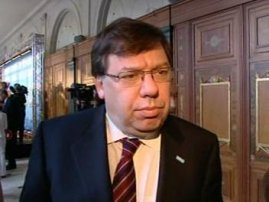
The Minister for Finance Brian Lenihan (left), who commissioned the spending review, submitted its recommendations to the Cabinet yesterday (see yesterday's entry below) and the minsters had a brief discussion on details.
But there were no decisions on the implementations of the report made at yesterday's government meeting.

Lenihan, who is looking for savings of up to € 5 billion in next year's Budget to balance his books, is optimistic that the recommendations of 'An Bord Snip (Nua)' - as it is popularly called - will help him to reach this target.

He said yesterday that "the report will give an exact figure for the number of surplus staff in the public service", and that they "can be dealt with over time with minimal disruption".

There have already been plenty of leaks regarding the actual recommendations, and Ireland's three national daily newspapers have long articles on the matter.

One of the core points mentioned is the abolition of the Department for Community, Rural and Gaeltacht Affairs, which would be a very reasonable step and long overdue. Ireland must be the only country in the world with the senseless luxury of having a full government department for an arcane and unpopular fringe language that is hardly ever used by anyone in daily life (despite the fact that every Irish child is forced to learn it in school for 12 years).

Other elements from the report mentioned in newspapers this morning are the suggestions to merge local government authorities, in particular the County Councils of counties Carlow and Kilkenny, and counties Sligo and Leitrim.

RTÉ Radio 1 will extend its 1pm news programme (normally 45 minutes long) today until 3pm, in order to cover the publication of the report and offer a first analysis and discussion of its many recommendations. (People who live abroad and are interested in listening to this programme are able to access it online, via the RTÉ website at www.rte.ie)

I will also write a further entry on this matter and offer my own analysis and comments as soon as all the facts and details are public knowledge. So you might want to come back this evening for more material on 'An Bord Snip (Nua)'.

The Emerald Islander

15 July 2009

Family Tragedy on the West Cork Coast

Divers from the Irish Naval Service, searching for a missing Polish man and his 13-year-old son off the coast of West Cork, have found and recovered a body near the Natural Arch, just south of Cod's Head.

The body has meanwhile been identified as that of the missing man, 40-year-old Piotr Latek. His son Matthias is still missing, and there is little hope to find him alive. The search for him has now been suspended for the night and will resume tomorrow morning.

Mr. Latek had been living in the area for about two years and was employed as a baker at the Breadcrumb Bakery in Kenmare, Co. Cork, while his wife and only son Matthias had remained in his native Poland.

A few days ago Matthias had arrived in Ireland to spend the summer holidays with his father. According to local sources, the two left Kenmare on Sunday morning in Mr. Latek's car to go on a fishing trip to the West Cork coast.

It is believed that they first did some fishing close to Kenmare, but then drove further down the coastal road towards Castletownbere and later to Allihies.

When local people noticed that they had not returned, an alarm was raised yesterday morning. Gardaí, the Coast Guard, lifeboats and local emergency services began a search of the area and soon found Mr. Latek's car, empty and parked at the entrance to a pathway, leading towards the dangerous rocks at Cod's Head, a very remote and exposed part of the rugged coastline.

Later some angling equipment - identified as belonging to Mr. Latek - was found on the rocks. But there was no sign of the missing father and son.

The search continued all day yesterday, but the Coast Guard became ever more doubtful that they would find the two missing Poles alive, two days after they had disappeared.

It is thought the father and son may have been swept from the rocks at Cod's Head in high winds and rough sea conditions.

John Falvey of the Coast Guard station on Valentia Island said that Gardaí and the emergency services were only alerted on Tuesday morning, and that on Sunday the conditions in the Cod's Head area were "windy, with strong gusts and high seas".

This morning a team of divers from the Naval Service joined the search and found the body of Mr. Latek in the water.
They will continue looking for 13-year-old Matthias Latek in the morning, but with almost no hope now to find him alive after four days.

The tragic death of Piotr Latek and presumed death of his young son has deeply shocked the local community in Kenmare and along the coast of West Cork. Accidents like this are quite rare, but they do occur from time to time, mostly when people unfamiliar with the terrain and the rough conditions on the rugged coastline are surprised by severe weather.

Meanwhile the dead man's father has arrived in Ireland, and his wife is expected tomorrow.

ECA accepts Pay Rise for Electricians

The Irish Electrical Contractors' Association (ECA) has decided to accept the Labour Court's recommendation in the dispute between electricians and their employers.

The court recommended a 4.9% phased increase in pay, which would be phased in by means of a 2.5% increase in September, with the remaining 2.4% introduced on January 1st, 2010.

The Association of Electrical Contractors of Ireland (AECI), which represents around 200 smaller electrical contractors, is due to meet in Portlaoise, Co. Laois on Saturday to consider its response to the recommendation.

Around 10,000 electricians returned to work on Monday after a week-long nation-wide strike that disrupted work at hundreds of construction sites in Ireland. (see also my entries of July 6th & July 13th)

Cabinet is discussing 'Bord Snip' Report

Today the Irish Cabinet is discussing the long awaited report from the Special Group on Public Service Numbers and Expenditure Programmes, which is looking for possible cuts in the public sector, in order to overcome the current financial crisis and state deficit.

The four-men-strong team - popularly called 'An Bord Snip (Nua)', is led by the well-known economist Colm McCarthy (left) of University College Dublin (UCD), who has headed a similar review group in the past (under the then Taoiseach Charles J. Haughey) and contributed greatly to the cost-cutting and streamlining measures made then.

Individual ministers have already an idea how the report, which was originally expected at the begin of the month, will affect their departments. But once the Cabinet has seen and discussed it, the likelihood is much greater that details from the report could be leaked to the media.

So a decision to publish the report in full within days seems to be a foregone conclusion, despite worries about the effect it might have on public opinion in general and on a special Green Party conference to be held this weekend in particular.

Possible recommendations by 'An Bord Snip (Nua)' could include the break-up of the long obsolete Department of Community, Rural & Gaeltacht Affairs - currently headed by Eamon Ó Cuív (right), the last member of the De Valera clan with Cabinet rank - and the redistribution of other ministerial responsibilities.

This would not only make sense, it would be - in my opinion - an already overdue step to reform the structure of our government. We also need a reform of the Civil Service and of the whole political and voting system.

Trying to solve the problems of the 21st century with the tools and methods of the 20th - and even 19th - century will not work and only lead to more problems and further decline. The current government is very unpopular, and for good reasons. But if it has the courage to tackle the problem of political and system reform head-on, it might gain new and strong support, some of it from perhaps unexpected quarters.

The Emerald Islander

Seanad passes Criminal Justice Bill

Ireland's new Criminal Justice (Amendment) Bill, which has been criticised by various opposition politicians and members of the legal profession, has passed all stages in the Seanad last night.

The Bill, which - among other elements - introduces new forms of non-jury trials for members of organised crime gangs and excludes lawyers from certain procedures, was debated in the Upper House of the Oireachtas for eight hours yesterday and finally passed at 11.30pm.

Despite objections from Fine Gael at the handling of the Bill from the outset, they supported its passage in the end, while the Labour Party, Sinn Féin and some Independent Senators opposed it.

Of the 58 Senators (two seats are currently vacant) only 42 voted on the Bill, and the result was 37:5 in favour.

In an unexpected and rather surprising move, the two Green Party Senators Dan Boyle and Déirdre de Búrca - who are part of the government and were appointed to the Seanad by Bertie Ahern as part of the coalition agreement - abstained during the final vote.
Earlier, they also voted against a government motion to proceed with the report stage last night.

Dan Boyle (left), who is also party president of the Greens, had previously expressed reservations about the Bill, but he told the Seanad that he "reluctantly" supported it.
Nevertheless Boyle and his colleague decided at the last minute to abstain.

In a statement issued this morning, Eamon Ryan - Minister for Communication, Energy & Natural Resources - has supported the abstention of his two party colleagues, without going into further details on the matter.

I wonder if last night's decision by the Senators not to support the government of which they are part is the first public sign of the end of the coalition.
As the Bill was supported by Fine Gael, the government was not in danger to lose the vote. So the abstention of the two Green Senators made really no difference to the result and could be seen as a rather cheap option for them.
However, there has been serious Green rumbling, especially from Dan Boyle, in recent months and the condition of the government coalition is anything but sound or healthy.

Speaking after the Seanad vote, the Minister for Justice Dermot Ahern (right) said it was important that "the Bill the people support" was passed before both Houses of the Oireachtas go on holidays. He hopes the Bill will be signed into law "in the not too distant future".

If this is going to happen remains to be seen, as it has been suggested that President Mary McAleese might refer it to test its constitutionality.

There is also a strong possibility that a group of lawyers, who are unhappy with parts of the Bill, might challenge it in the Supreme Court on grounds of being unconstitutional.

While the people who suffer on a daily basis at the hands of organised crime gangs - especially in parts of Dublin and in Limerick - cannot wait to see the Bill becoming law, one should not ignore the concerns of legal experts and professionals, who have to deal with it in practice.
There is no doubt that we need to tackle the ever growing problem of organised crime in Ireland, but it has to be done properly, within the framework of the law and without turning to draconian and unconstitutional measures.

There has always been crime in Ireland, as everywhere else. And some of it has been organised in various ways.
But during the eleven years Bertie Ahern (left) was Taoiseach, the number of crime gangs in Ireland has risen massively and their activities have reached unseen and unacceptable dimensions.
Ahern's ignorance and his reluctance to even go near the problem is one of the reasons for the spreading and influence of organised crime in Ireland.
There are many people who regard Bertie Ahern as a crook and even a criminal, so one has to wonder if his own problems with legal matters of various kinds might have prevented him from being tough on organised crime...

I am not a lawyer, but fairly familiar with matters of the State. And I wonder why the already existing 'Offences against the State Act', which was introduced to face the threat from politically motivated terrorist groups, could not be extended and used against those who terrorise people and threaten the existence of the State through purely criminal acts, motivated by greed and selfishness.

The Emerald Islander

13 July 2009

Green Party wobbles over third-level Fees

Ireland's Green Party has denied that it has done a U-turn on the issue of third-level education fees.

The junior partner in the current government coalition responded to an accusation from the Labour Party's education spokesman (and former Minister for Finance) Ruairi Quinn (above left), following the comments the Minister for Communication, Energy & Natural Resources (and Green Party TD) Eamon Ryan (below right) made on the RTÉ programme 'The Week in Politics'.

After a day with various conflicting statements from the Green Party, an official spokesperson at their head office said tonight that they were "still opposed to the return of fees", but that they would "look at the Minister for Education's proposals as outlined in a document for the Cabinet".

In the RTÉ interview Eamon Ryan had indicated his support for the return of third-level fees that would involve a loan scheme for students.
Under this scheme, graduates would pay back a portion of their college fees once their income is above a set limit.

The Education Minister Batt O'Keeffe (left), a staunch and quite old-fashioned Fianna Fáil politician and uncritical supporter of Taoiseach Brian Cowen, is expected to outline several options for third-level education funding shortly.

But whatever he will propose, it means a big step backwards in the national education system.
And if the Green Party is really going to support the proposal, it also means another breach of their promises to the Irish voters.

It is a long time now that the Green Party was a sensible force for change and promoter of many worthwhile alternative policies. They have sold their soul, principles and beliefs for two seats in the cabinet and a junior minister's job, and in only two years they mutated from Fianna Fáil's harshest critics to Fianna Fáil's tame poodles. What a change... and so typically Irish!

A phrase by the great satirist, Dean Jonathan Swift, comes to mind: "Any Irishman will happily sell his mother for a shilling and throw his sister into the bargain for sixpence..."

The Emerald Islander

Irish School Bus Fees to rise by 79%!!!

Bus Éireann, our inefficient and state-owned national bus company, has announced an increase of their school bus fares by a staggering 79% (!!!) from the start of the new school year. This is another outrage in a long list of scandals involving public transport in this country.

Until June the annual fee for secondary school pupils who use the official school bus service was € 168 a year, which is already more than enough, since the scheme is supported by the Department of Education. The new rate will now be € 300 (!!!) per school year, which is indeed and rise of 79% (!!!) in one step. And this comes during the worst recession the country has ever experienced in its 90-year history under various forms of self-rule (since 1919).

What might be the justification for such an enormous increase? There is none.

But the scandalous decision shows once more that the incompetent and overpaid management of Bus Éireann lives on an entirely different planet, a place I call 'Planet Greed'.
I think they need their mental capacity examined by a good psychiatrist!


And who made the decision? Surely the relevant ministers - Batt O'Keeffe (Education - left) and Noel Dempsey (Transport - below right) - must have been involved in a step of such magnitude.

Both ministers are not seen as competent and effective leaders of their departments, and this is only another example how the Irish state robs and rips-off its citizens in the most shameless and scandalous way wherever and whenever possible.

Parents affected by this official highway robbery should protest immediately and - if the rise is not cancelled - they should boycott the scheme and keep their children at home.

When one is faced with a completely incompetent but immensely greedy government that clings to power at all costs in times of severe economic depression and serious financial crisis, the only way to achieve some change is people power. If we don't use it, we will be robbed ever more, while the country as a whole goes to the dogs.

The Emerald Islander

Irish Electricians return to Work

Thousands of Irish electricians have returned to their work this morning after the Labour Court recommended that they should receive a 4.9% pay rise.

The Technical, Engineering & Electrical Union (TEEU), which represents most of the electricians, suspended its week-long strike after holding an executive meeting at their head office in Dublin yesterday.

Last Monday morning at 5.30am the strike began with TEEU pickets (photo left) being placed at hundreds of construction sites all across the country. (see my entry of July 6th)
The industrial action, which was the first major strike in Ireland in years, disrupted the work on many buildings, including landmark projects such as Terminal 2 at Dublin Airport and the new national Football and Rugby stadium on Dublin's Lansdowne Road. And - to the delight of the local Shell to Sea protest group - there were TEEU pickets also at the controversial Shell gas refinery at Bellanaboy in northern Co. Mayo.

There was strong support for the strike from almost all Irish electricians, and also a predominantly positive reaction to it from the media and the general population. Only the leaders of employers' organisations, such as former PD party president and junior minister Tom Parlon (photo right), who became the Director General of the Construction Industry Federation (CIF) only weeks after he lost his seat in the Dáil (and with it his ministerial job) in the 2007 general election, were strongly opposed to the electricians' strike. Tom Parlon used the most offensive language of all the industry leaders, calling the TEEU "a bunch of lunatics" in an interview with Pat Kenny on RTÉ Radio 1.

Now that the Labour Court has spoken, the dispute should be settled. But the employers, whose attempt to con the electricians out of an agreed deal and impose a 10% pay cut on top of it, have not yet responded to the Labour Court recommendation. It will be their decision if normality is to return to the industry, or if there will be more industrial action.

The TEEU has warned that it will consider reintroducing the strike if employers do not accept the pay rise. And in my opinion they are quite right to keep this option open. We have seen what the likes of Tom Parlon have done to the country, and now they want to do even more damage by reducing workers' pay, while they themselves go home with large salaries each month. There is already a deep divide between rich and poor in Ireland, and if we let the employers make this rift even wider, all we will get in return is more unemployment and considerable social unrest.

The Emerald Islander

06 July 2009

Over 10,000 Irish Electricians on Strike

Today more than 10,000 Irish electricians have followed a call from the Technical, Engineering & Electrical Union (TEEU) and went on strike in a dispute over pay.
The action follows the collapse of talks at the Labour Relations Commission over the weekend.

At 5.30am this morning pickets have been placed on hundreds of construction sites around the country, including some of the most high-profile projects such Terminal 2 at Dublin Airport, the Lansdowne Road stadium in Dublin and the Corrib gas pipeline in Co. Mayo.
The TEEU says that the drivers of many trucks have refused to cross the picket lines.

About 200 TEEU members are also picketing the building site of the large Shell gas refinery complex at Bellanaboy, Co. Mayo (right), which has seen many demonstrations in the ongoing dispute over the Corrib gas project for more than seven years.
(for details see my entries of April 28th, July 24th, September 14th, 19th & 24th, November 7th, 2008 and May 10th, 2009)

Electricians say they are looking for an 11% increase in pay, which is due to them since the peak of the economic boom four years ago.
The employers argue that this claim is "unrealistic in the current economic climate" and demand a 10% pay cut from the electricians.

A spokesman for the TEEU explained this morning that the combined affect of the employers' recent demands and their persistent refusal to honour the long agreed 11% pay rise would mean a "de facto pay cut of 21% for electricians".
"This would put an unacceptable burden on Ireland's electricians", he added, "more than twice as much as the 10% pension levy imposed on civil servants."

There have been several efforts to avoid a strike in recent weeks, involving the Labour Court and the Labour Relations Commission. But since both sides stuck firmly to their positions, no compromise was found and the TEEU proceeded with the strike action it had threatened for some time.

Besides the TEEU, which represents the majority of the country's electricians and engineers, Ireland's largest trade union SIPTU is backing the strikers as well.
In a statement SIPTU's general president Jack O'Connor (left) said that "the electricians must be supported by workers, because the employers' objective of cutting pay reflects the aim of the wealthy to protect their assets and privileged positions at the expense of the working people".

In an already turbulent and recession-hit economy, this strike - the first major industrial action in Ireland for a long time - will certainly increase tensions in employer-union relations. It will also put further pressure on the already hapless and beleaguered government, which has so far kept quiet on the issue in public, but sides clearly with the employers behind the scenes.

It can be expected that both sides will watch carefully how the strike is progressing and what the public reactions will be.
If participation stays as high as it is on day one and there is no substantial public outcry against it, it is only a question of time when the employers will return to the negotiating table with an improved offer. From today's perspective the TEEU and their members seem to be clearly in the stronger position.

The Emerald Islander

02 July 2009

Gilmore speaks up against Cowen's 'Guillotine'

Eamon Gilmore (photo), the leader of Ireland's Labour Party, has accused the government of "riding rough-shot over the Irish people and their elected representatives".

He deserves a strong round of applause for this statement, and all the support we - the people of Ireland - can give him.
Why? Because Gilmore stood up and defended the interests of us, the people, and of Democracy against an ever more dictatorial and arrogant government.

Eamon Gilmore objected strongly to the way the Taoiseach and his ministers are pushing bills though the Dáil without having a full and proper debate over them.

This procedure - in parliamentary slang called 'the guillotine' - is an arcane relic from colonial times and part of the British political system. And one has to wonder why it is still practised in Ireland, after 90 years of self-rule.

The Labour leader told the Dáil that the government has taken the use of the 'guillotine' on bills "to a new level of ridiculousness", pointing out that twelve bills are about to be 'guillotined' next week on top of those that were dealt with today.
"It is not unusual for this government to use the guillotine to push through legislation, just to get it out of the way or to minimise the amount of public attention that it will get," Gilmore said.

Another reason for using the 'guillotine' method is usually that a government is 'running out of time' on a bill, which means that the amount of days and hours allocated to it has been used up before a bill reaches the stage of the final vote. In Britain this happens regularly towards the end of the parliamentary year. And in order to avoid that the same bill has to go through all its stages again in the new parliamentary year, the government applies the so-called 'guillotine'.

But here in Ireland we do not have a 'parliamentary year' which is opened ceremonially by a monarch.
Our Dáil is elected for a maximum period of five years. So bills should never 'run out of time' here, and thus there should be no need for the 'guillotine' method.

If a bill 'runs out of time' in Ireland, it is usually because of bad planning or mismanagement by the government. And using the 'guillotine' method to push it through without proper debate and discussion shows indeed a great disrespect for the people of Ireland - in whose name the laws are made - and for the TDs, who are the people's elected deputies.
The 'guillotine', in its parliamentary sense, is in fact an instrument of dictatorship, as much as its namesake was an instrument of terror during the French Revolution.

There would be an easy way to avoid any bills 'running out of time', regardless for what reasons: The Dáil should simply sit and debate on more days than it does now. There is no justification for a three-month-long summer holiday and all the other holiday 'recesses' our parliament grants itself. On average the Dáil only sits between 70 and 75 days in each full calendar year.
This is unacceptable, and it would not be tolerated in any other institution or sector.

The amount of parliamentary holidays should be reduced to the same amount of days that an average industrial worker is entitled to. And one should also look at the current three-day week of the Dáil. If our TDs would work five days a week like anyone else in the country (some people, like yours truly, even work six or seven days a week), there would be no bill 'running out of time' and no point in the 'guillotine' method.

To my knowledge there are only very few countries where this method is accepted at all. It is of course practised in Britain, the country that invented it, and in some Commonwealth countries that still follow their masters in every way. And - to my astonishment - in Ireland as well, as if we were still part of the British Empire.
I know of no other European country where such a procedure exists, and I doubt that it would be accepted or tolerated by the politicians there. Only the people and politicians of Britain and of her still obedient servant Ireland are treated by their governments in such an unacceptable and dictatorial way.

It is well over time already to abolish such an arcane and offensive parliamentary instrument, and to make it illegal in Ireland. I encourage Eamon Gilmore and the Labour Party to make this point a part of their next election manifesto.

The Emerald Islander

EPA threatens Legal Action over Sewerage

Ireland's Environmental Protection Agency (EPA) promised to take legal action against the country's local authorities, unless there is an improvement in the operation and monitoring of sewerage works.

The EPA's latest report focuses on waste water discharges from Ireland's cities and towns during 2006 and 2007.

Of the 192 treatment plants tested, 51% did not meet EU standards because "they were not operating properly or were overloaded".

At least 20 areas in Ireland do not have secondary treatment, which means effluent is being released into the sea.

These include Bray in Co. Wicklow, Clifden in Co. Galway, Killybegs in Co. Donegal and Kinsale in Co. Cork.

EPA enforcement officer Dara Lynott stated that new licensing powers will result in enforcement action, including prosecutions, being taken against failing local authorities.

Environment Minister John Gormley (right) said it was "quite unacceptable" that a quarter of non-compliance levels can be attributed to the insufficient levels of sampling by the local authorities.

Local authority officials are among the best-paid people in Ireland, and their jobs are among the safest in the country. But it appears that they are either unwilling or unable to do their jobs properly. One of the main reasons for that is the still rampant nepotism that rules Ireland. People are appointed to positions or given certain jobs not on the basis of their qualifications and skills, but on the basis of their personal connections. Often membership of a political party or family ties play a role as well.
The result is widespread sloppiness, shoddy workmanship and carelessness in many areas. Combined with the general lazy and laid-back attitude of many Irish people, it creates a climate of incompetence and mismanagement.

So the threat of legal action from the EPA is a step in the right direction that will - hopefully - wake up the sleeping local councillors and their officials. However, there is one little flaw in the concept: If a local authority would be found guilty of breaking EU regulations or having acted negligant, the worst that can happen to it is a fine. No council official will go to prison for water pollution.
And who do you think will provide the money to pay the fine? Yes - you guessed correctly: We, the taxpayers and ratepayers will foot the bill.

As much as I welcome the more forceful approach of the EPA, I think that the agency needs a lot more powers. Only then will it be taken for serious by local authorities who need to get their houses in order and their sewage systems and treatment plants working properly and according to EU regulations.

The Emerald Islander