Showing posts with label water. Show all posts

27 May 2009

Quality of East Coast Beaches "disappointing"

The quality of Ireland's east coast bathing water has deteriorated significantly last year, with a doubling of the number of beaches failing to provide 'minimum mandatory standards'.

A new report from the Environmental Protection Agency (EPA) says that even though beaches on Ireland's west coast performed well, the east coast experienced major difficulties, particularly around Dublin.

While the EPA points out that Ireland's bathing waters "remain of a high quality", the sad fact is that more than 20% of them failed to pass two EU quality tests.

Nine bathing areas - out of a total of 131 tested - were found to have failed even the most basic 'minimum mandatory standards'.

Four of the bathing areas were identified in just one local authority area - Fingal County (which is part of the Greater Dublin area).
They are the beaches of Balbriggan, Loughshinny, Malahide and Portrane.

Of the 14 beaches within the Dublin local authority areas, only three were found to have passed both EU mandatory values and the stricter analysis known as 'EU guide values'.

"Poor weather conditions during last summer are partly responsible", explains Dr. Michael Lehane of the EPA. But he describes the test results as "disappointing", and adds that "unless all necessary actions are undertaken", the problems will reoccur.

As things are right now - with our economy in recession, the whole country in turmoil, our incompetent government in chaos, and money being short everywhere - it is rather unlikely that much attention will be paid to the specific conditions of our beaches. Which means that probably even more of them will fail the EU tests next year.

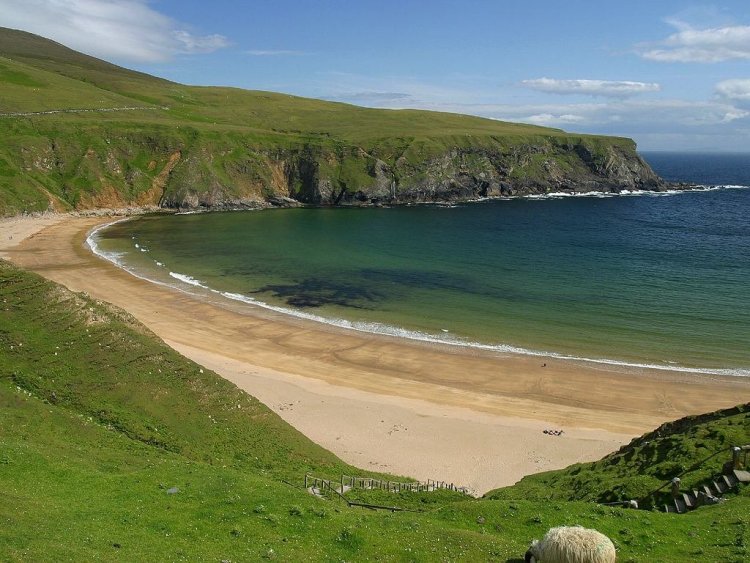
While the east coast, and in particular the Dublin Bay area, are getting the black mark, Ireland's west coast appears to be in good condition.
All of Co. Donegal's 19 official beach areas, as well as the 15 beaches each in Counties Mayo and Kerry, passed both EU tests.

So, if it is a beach holiday you have in mind for this summer, forget the east coast and go bathing in the West.

The Emerald Islander

08 May 2009

The Answer is blowing in the Wind

For centuries Ireland was a poor and backward country, left quite deliberately undeveloped as a purely agrarian nation by its English masters. After we achieved home rule and established the 'Free State', our resources were scarce and development of infrastructure and industry was an extremely slow process. (And this process is still ongoing.)

When Ireland joined the EU (then called EEC) in 1973, we were regarded as the least developed country in the union (of then nine members), and thus we qualified for enormous payments from the European Development Fund (EDF).
Over the years billions were flowing into Ireland, donated by our European partners, to help us with our domestic development. Without these financial donations the Republic of Ireland would most likely still be a country of small farmers and widespread poverty, with bad roads, donkey carts, appalling communication systems and massive emigration of the brightest and best who could not find suitable jobs in their own country. To put it bluntly: Ireland would still be very much like it is portrayed in John Ford's famous film 'The Quiet Man' (starring John Wayne in the title role).

But, as we all know, Ireland has changed a lot since this film was produced in Co. Mayo in 1952. In fact it has changed beyond recognition, even to a point that some people think we have gone too far down the road of modernisation. However, despite all the breath-taking development over more than three decades, there are still many things not right in Ireland.
Much of this has to do with factors we cannot change, such as our location, our geology, our size, and the size of our population (less than 4 million people, not counting recent immigrants from all over the world).

Apart from peat and some natural gas off the West coast (which our feckless, careless and totally incompetent government has given away as a present to Shell, with not a penny in return), we have almost no natural resources, ores or minerals.
We currently import 98% of our energy, and the prices charged for energy in the Republic of Ireland are now the highest in Europe.

The country is still dominated by agriculture, and our economy is totally dependent on exports. More than 80% of what we produce here - predominantly food and other agricultural products, and more recently also computers, software and technology - are exported, while we still import most of the consumer goods for our own needs.
For decades successive Irish governments (of various political parties) have spent vast sums of taxpayers' money to attract foreign investments - mostly from the USA - into the country, and thus we are now completely dependent on the grace and good will of the Americans.

In economical terms we are not an independent country at all (and probably never were), and despite our nominal sovereignty as a republic and our membership of the EU, we are de facto more the 51st state of the USA than anything else.

This is not a healthy condition, and if we have not noticed it that much in the past, we are certainly feeling it now, as Ireland is not only suffering from the fall-out of the big global financial crisis, but also from an even more serious domestic recession, which is a direct result of colossal mismanagement by our government, our banks and parts of our own economy (in particular the construction industry and so-called 'property developers').

If we do not find a solution for this massive crisis, which is by far the most serious challenge to Ireland's existence in economical as well as in political terms since the foundation of the state, we will find ourselves soon as a poor third-world country, controlled by the International Monetary Fund (IMF) and with no more say in our own affairs, domestic or otherwise.
Which ever party (or parties) would be in government then would be of little consequence, as the Taoiseach and his ministers would be reduced to the value of glove puppets. And the members of both Dáil and Seanad would be not more than over-paid and functionless bystanders.

If that is what we desire, then all we have to do is to sit back and watch how Fianna Fáil and the Green Party destroy the little that is left of our national wealth, economy and independence.

But, we don't have to go down that road of collective self-destruction, if we use our brains and skills, and have the courage to take a big step forward into the future.

We are fortunate to have still a large number of bright and well-educated people in Ireland, and also highly intelligent and skilled foreigners who live and work here.
Some of them, from different backgrounds, but all with plenty of ideas and experience, came together about six months ago and formed a private initiative. Quite fittingly they called their group Spirit of Ireland, and the plan they have developed since and presented to the Irish nation yesterday is brilliant, fascinating, breath-taking and - most importantly - absolutely realistic and feasible.

The team includes very experienced engineers, academics, architects, geologists, construction experts and consultants, as well as legal and finance professionals. They have worked intensively - and completely free of charge - on the initial design and costing of hydro-storage reservoirs, wind farms and the power networks necessary to connect them to the National Grid.

According to Spirit of Ireland the solution to our current economic crisis may lie in harnessing Ireland’s huge and constant wind energy potential. Or, to say it with the words of Bob Dylan, who gave one of his amazing live performances in Dublin on Tuesday: The Answer is blowing in the Wind.

The first phase of the suggested project promises energy independence for Ireland within five years, with a € 10 billion boost for our economy.
The second phase would see energy exports from Ireland to Europe, creating additional revenue in the range of € 3-5 billion per annum (in years six, seven and eight) and up to € 50 billion over the following ten years.

If you think this is just theory or science fiction, then wake up, realise that we live in the 21st century, and think again. All the details of this plan have been worked out thoroughly, and they have been tested and costed. This is not some pipe dream. This is reality, ready to happen, if the government and the people of Ireland want it.

The proposal is based on using natural coastal valleys to provide hydro-storage reservoirs. Wind farms would be built and used to pump sea water into these reservoirs, and the stored water can then be passed through turbines, generating massive amounts of electricity.

As well as producing excess energy for export, the project would also create many new jobs in Ireland and cut our carbon dioxide emissions significantly.

A similar model has been adopted successfully in Japan, and senior executives and engineers visiting from Japan confirmed the validity of this approach for Ireland.

To achieve energy independence and save € 15 billion in fossil fuel imports over five years, only two hydro-storage reservoirs (at a cost of € 800 million each) would be required. Wind farms - already existent ones as well as newly created installations - would then be connected to the reservoirs.
Speaking on the Today programme with Pat Kenny on RTÉ Radio 1 yesterday, the group's initiator Graham O’Donnell explained that the project could start "very soon", since "all the conditions are right". He also said that no new technology is needed and materials and machines required to make it happen are "available in Ireland, off the shelf".

And Mr. O’Donnell knows a few things about energy and how to create it. He is an electrical and electronics engineer with more than 20 years experience in the control and communications area of international power networks. During his career he worked on project management of water, gas and energy facilities in Ireland, Europe and Asia, before founding his own company, which specialised in control of power networks and high voltage substations, in 1988. It was responsible for the design of 400kv grid synchronisation equipment for National Grid UK, remote substation grid control for Scottish Power, and other large power utilities in the UK.
Graham O’Donnell also developed power network control systems in Dubai, Abu Dhabi, Qatar, Saudi Arabia and Bahrain.

His principal partner in developing the new idea is Prof. Igor Shvets (left), one of Ireland's most eminent and innovative modern physicists. Originally from the Ukraine, Professor Shvets works at Trinity College in Dublin since 1990, teaching science and engineering students at both undergraduate and postgraduate levels.
He leads the Energy Group within the School of Physics and has also established the Cleaner Energy Laboratory of Trinity College; he regularly publishes papers in the world’s leading journals for Applied Physics, and in addition, Igor Shvets is probably Ireland’s most prolific inventor with over 50 patents and patent applications to his name.

However, the key inspiration for the new energy project came to him not in a laboratory, but in his spare time. Professor Shvets likes to keep fit and does a lot of walking, especially hill walking, around the country.
And while out on his walks, he noticed that many of our hills and valleys - created during the last Ice Age - are "perfectly shaped", as he explained to Pat Kenny. This makes them most suitable for the creation of hydro-storage reservoirs.

Meanwhile Prof. Shvets and his team have identified "about 50 suitable locations in Ireland", mostly in the West, but to make it all work and economically successful only two are needed.
It was mentioned that, at a later stage, more hydro-storage reservoirs could be built to increase the production of energy for export, but that would be far down the lane.

Spirit of Ireland proposes to establish a public company in the form of a national energy co-operative, in which anyone (including very small investors) could buy shares.
This business model would give the people of Ireland real and direct ownership of the project and thus create a true national treasure.

As we all know, there is never a shortage of wind in Ireland, and we are surrounded by plenty of water. Using these natural resources to our benefit would create proper and continuous wealth, and it could be the key to achieve at long last our economic independence, to go hand in glove with our political sovereignty.

Over the past ten to fifteen years we were told of a mythical creature called the 'Celtic Tiger', which would make us all rich beyond imagination. No-one I know ever saw this 'tiger', and only a few people benefited from the hype people created around him.
We now know that it was all an artificial bubble, mostly based on over-inflated and unsustainable property deals, financed with immense sums of borrowed money. And as a result of this we find ourselves close to the edge of the abyss, just a few steps away from long-term poverty, hardship and damnation. On top of that we are also becoming ever more the laughing stock of the 'global village'.
The pot of gold that greedy 'property developers' and criminal bankers apparently found was only fool's gold, and the 'rainbow' they followed was not more than a strip of coloured paper.

We should learn our lessons from this, step away from gangsters and charlatans (and from the stupid and incompetent politicians who supported them and made their deeds possible) and turn to our oldest and closest friend and ally - Nature - to build the new Ireland.

The Spirit of Ireland group is showing us the way and is willing and able to lead us into a future with new hope, new jobs, 'green' and cheap sustainable energy, technological innovation and eventually economic independence. Only a nation of complete fools and clinically insane people would reject such an offer.

Let us therefore embrace the Spirit of Ireland, as our ancestors have done it many times over the centuries. But this time let us make it last, let us produce clean energy and let it flow all over Europe, day and night, as steady as the wind blows over our green and beautiful island.

The Emerald Islander


P.S. - For more information about the group Spirit of Ireland and their proposals you should visit their interesting website at http://www.spiritofireland.org/

18 November 2008

Dirty bottled Water - guaranteed Irish

The Irish Food Safety Authority (FSAI) has confirmed that - back in 2007 - a survey found that 1% of samples of bottled water in Ireland contained E. coli bacteria, which can be fatal.
A further 6.3% of water was found to have coliform bacteria, indicating possible faecal contamination.

Wayne Anderson, the FSAI Chief Specialist in Food Science, declared that the level of this contamination was "unacceptable" and that any problems found were corrected immediately.

He also said that "consumers should not be concerned about the quality and safety of bottled water on the market today".

It was found that one in every 11 of Irish produced bottled water was contaminated - which is nearly 10% - compared to one in 119 of imported water.
The study also found that over 7% of bottled water was in breach of Irish or EU guidelines.

Is there actually anything we can get right and do well, or does being Irish always mean messing things up?

Bottling water - despite certain hygienic requirements, which we seem to breech a lot more often than others - is not rocket science! But I suppose the "I don't care" attitude that has been one of the hallmarks of Irish society in recent years, comes to the fore everywhere now, even in water bottles.

Personally I never buy bottled water, as tap water is at least as good - perhaps even better - than the bottled liquid. And it is - still - free of charge. So why spend good money on bad bottled water?

Since bottled water became fashionable in Ireland about 20 years ago, it has risen steadily in price, but obviously not increased in quality. In most pubs bottled water costs almost the same as a pint, in some places even more. And someone told me last week that in a certain Dublin establishment he had paid more than € 8 for a bottle of branded water.
I told him that he must either be mad or in possession of too much money, and he replied that it had "gone on expenses". Which means he had not to pay it himself, but it still does not make it right.
I would never spend such a sum on a bottle of water. In fact, I boycott bottled water even in public and always ask for tap water. Over € 8, just think about it... that would have bought you ten Bank of Ireland shares this morning.

The Emerald Islander

30 September 2008

Bad Tap Water - It's not just Galway

Last week we heard a lot about the problems with contaminated water supplies in Galway City, and especially about the high lead content in the communal tap water. (see my entries of September 23rd, 24th and 27th)

It now emerges that Galway is not the only place in Ireland with such problems of water quality.

Eleven local authorities from all over the country have now officially contacted the Irish Environmental Protection Agency (EPA) because they have also detected lead levels above the acceptable limit in a total of 23 public water supply systems across the country.

According to the EPA, so far four public health notices have been issued. The affected areas are: Old Mervue in Galway City, Mallow in Co. Cork, Ballintra in Co. Donegal and Bruff in Co. Limerick.

The other local authorities that have contacted the agency revealing higher than acceptable levels of lead in their water supplies are Co. Carlow, Co. Kerry, Co. Leitrim, Co. Longford, Co. Tipperary (North Riding) and Co. Wicklow.

Somehow I have the strange feeling that this represents only the tip of the proverbial iceberg...

The EPA says it is to liaise with the Health Service Executive (HSE) over the coming days to establish the true extent of the problem.
It advises as "best practice" for local authorities that detect levels of lead higher than the safe standard that follow-up tests should be carried out to establish the true extent of the problem.

That's not more than common sense, and it is somehow alarming that the EPA has to point it out to the local authorities.

It is not yet known if secondary tests have been conducted in the 23 identified water supply areas, but the EPA hopes that a more detailed picture will emerge over the coming days.

Meanwhile Cork County Council says that work on replacing a lead-lined water pipe in Mallow should begin before the end of this week.
It comes after it emerged that some residents have been told not to drink their water after more than three times the safe amount of lead was detected in supplies in the town.

The local authority is in the process of arranging for 450 metres of pipeline, and connections to some 60 premises, to be replaced.
Last Friday residents in the Beecher Street area of Mallow were notified that - following routine testing - "elevated levels of lead" were found in the drinking water in one house in the street. Follow-up tests by the HSE identified two other premises.
As a precaution, Cork County Council has advised all people in Beecher Street not to drink, boil or use the water supply in food preparation until further notice. The water is apparently safe for bathing, washing dishes and clothes.
Two temporary safe drinking water supply taps have been put in place at the northern end of the street for residents' use.

One wonders how long the various County Councils have known about the lead contamination in their area, but said nothing. Only after the recent scandal in Galway City made national headlines, they came out of their cosy cocoons and made their problems known to the EPA.

I think there are way too many incompetent and complacent people in responsible positions in local government, and the up-coming local elections next year should be used to make serious changes.

The Emerald Islander

27 September 2008

"Appalling and totally unacceptable"

Emergency water supplies being provided for residents in the Old Mervue area of Galway city had to be suspended because high levels of lead were found in it overnight.

Galway City Council says it is "disappointed" at this latest development and is making arrangements to provide an alternative supply for containers.

The Mayor of Galway, Pádraig Conneely (Fine Gael), says the situation is "appalling and totally unacceptable".

The street taps (photo) at the centre of this latest scare were installed on Wednesday and Galway Corporation assured the about 1000 residents who live in Old Mervue that the water was safe to drink.
However, last night one of two tests carried out on the water showed that it contained over four times the acceptable level of lead.

The City Council says it immediately suspended this emergency service and is awaiting the result of further analysis which will be available on Monday.
In the meantime it is arranging to have safe drinking water provided from containers which will be located around the estate.
A spokesman said the city administration was "disappointed" with the result of the test and it apologised to the residents.

Mayor Pádraig Connelly admitted that he was "shocked" by the news. He said it was now time for Environment Minister John Gormley (Green Party) to come to Galway and appoint a senior official from his department to take charge of the city's water services.
He said the most worrying thing was the effect drinking the water might have had on residents.

Councillors in Galway met for almost five hours last night to discuss lead contamination in part of the city's water supply. They were told that short and long term solutions were being examined in an effort to resolve the issue. But the city's Mayor said that not enough was being done to restore public confidence.

There were heated exchanges at the meeting between officials and elected representatives, with Padráig Conneely describing an action plan to deal with the latest problem as "pathetic".
The Mayor told the meeting that he had "no confidence in the City Manager and the Council's Director of Services".

He said the way the authorities had dealt with lead contamination in the water supply was not acceptable. The city management was "trying to spread the blame for the contamination of the water supply with excessive lead content". But, he said, that blame lay squarely with those responsible for water services at Galway City Council.

City Manager Joe McGrath said he was "shocked and horrified" by the allegations made against his management team. He had always treated the Council with respect and was endeavouring to answer all questions relating to the lead contamination.
He said that it was "a load of nonsense to suggest that the authorities were operating under a veil of secrecy" and added that the problem with the water supply had been identified because of action by Galway City Council and the HSE.
He was trying to provide leadership to solve the latest crisis, but he needed the backing of Council members to achieve this.

The City Manager stated that the Council was not trying to spread the blame and would not hand over management of the water services to any individual. He accepted that confidence in the water supply had been damaged, but stressed that the Council was "doing everything it could to solve the problems caused by excessive lead content" and that "a number of potential solutions are being looked at". These include an adjustment of ph levels in the water, additional treatment measures and - eventually - the replacement of a lead distribution pipe in the Old Mervue part of the city. However, this could take up to two years to complete.

Earlier, the Council's Director of Services, Ciaran Hayes, told the meeting that the water in Galway was "of the highest quality" and that the latest problems stemmed from the use of lead piping in some parts of the city. He added that short, medium and long term solutions were being initiated to address the issue.

In the meantime, residents in the areas affected by the contamination will meet Council officials over the next fortnight. It was agreed that free bottled water will be provided to elderly residents in the affected areas with two-for-one promotions available to other residents in those areas.

Well, here we are, eight years into the 21st century, and after a decade of unprecedented social and economic boom that brought Ireland massive wealth. And we cannot even give the people of the country's fourth-largest city decent drinking water. It beggars belief and only shows the high level of incompetence present in the 'city of tribes'.

Instead of being "shocked" and making a spectacle of themselves in public, both the Mayor and the City Manager should resign, together with all the other Councillors and directors of the city's administration (and they would, if they had any decency).

And next summer, when we have local elections, the good citizens of Galway - or at least those who are still alive by then - will surely give the current Council and administration a suitable answer for their series of blunders.

The Emerald Islander

24 September 2008

Galway Water Problems

Council engineers in Galway have begun work on providing safe drinking water for up to 1000 householders in the Old Mervue area of the city, where supplies have been contaminated by lead.

One of the first actions engineers will take over the next few days will be to add lime to water in the city's main reservoir to reduce its acidity, and hopefully the corrosion which is taking place in the old lead pipes. The residents have been advised not to drink tap water until further notice.

There has also been concern about the lead levels found in three other areas of the city - Bohermore, Shantalla and the Claddagh.
Residents in these areas say they should be told immediately how long they have been drinking water which could be a threat to their health.

Further details are expected to emerge later today on the extent and the seriousness of Galway city's latest water contamination problems.

Cllr. Declan McDonnell (PD) said the City Council had been told that boiling the water did not remove the lead, meaning it would be dangerous to drink it or to use it in cooking.

An emergency meeting convened by Galway's Mayor, Cllr. Pádraig Conneely (FG), briefed councillors on the situation last night. (see my entry from yesterday)

Cllr. McDonnell said he was concerned at what he believed was "a failure to communicate the problem to residents".

In reply, the Mayor said he had called a public meeting for Friday night at which he hoped more precise details of the level of contamination will be available.
Installing taps on the cast iron mains will bypass the lead pipes which are at the centre of this latest health alert and should ease the inconvenience to residents, city officials said earlier.

What the council is not saying is what has caused this latest alert or just how serious the lead contamination is.

Under existing legislation drinking water which has more than 25 micrograms of lead per litre is regarded as unsafe to drink.
Tests by council engineers and Health Service Executive inspectors in several areas of the city have recorded levels in excess of this, but so far they have refused to disclose what those levels are.

One wonders why these details have not been given to the concerned residents, whose health is once again put at risk, while officials are trying to work out why they cannot do their jobs properly.

After more than a decade of massive economic boom with plenty of money available, Ireland is waking up to the reality that many parts of this country are not better than the underdeveloped 'third world' on which we so often look down. Before we offer any more help to the 'third world', we should first get our own country in order.

The Emerald Islander

23 September 2008

Lead contaminates Water in Galway

Yesterday I wrote that there is no day without seriously bad news these days in Ireland. Well, I am not happy to be right again with that.

Today we have learned that water supplies in more than half of the houses surveyed in Galway city (photo) show a high level of lead!

A recent report by the Health Service Executive (HSE) shows that four areas of the city have contaminated water supplies.

The issue prompted an emergency meeting of Galway City Council tonight. The Mayor, Cllr. Padraig Conneely (Fine Gael), said he had been contacted by City Manager Joe McGrath concerning "lead-related problems in older pipes", especially in houses built before 1970.

This latest development follows Galway's cryptosporidium outbreak in March of last year, when 240 people fell seriously ill and thousands more reported feeling unwell. A notice to boil all tap water remained in place for five months.
The outbreak was the most serious of its kind in Ireland and led to major political rows over the failure to replace the old treatment plant at Terryland before the emergency arose.

Galway's water supplies were declared safe again in August 2007, but it appears that the water contamination problems of this beautiful city in the west of Ireland are far from over.

The Emerald Islander