Showing posts with label schools. Show all posts

22 November 2008

25,000 protest in Cork against Education Cuts

Today about 25,000 Irish people have been marching through the streets of Cork city in protest against the government's cuts in the education budget.

The march was part of a series of protest demonstrations organised by the Irish National Teachers' Organisation (INTO), which says that children should not be made to pay for the current difficulties in our economy.

It was the third time since mid-October that teachers, pupils and their parents have taken to Ireland's streets, protesting against education cutbacks.
INTO's General Secretary John Carr (right) declared that the marches will continue until the cuts are reversed.

Meanwhile the Minister for Education, Fianna Fáil's Batt O'Keeffe (left) who comes from Cork, said that he "simply does not have the funds" to reverse the cuts. This is his mantra ever since the major education debate in the Dáil on October 29th/30th. And unlike other ministers, who have been busy looking for extra money or alternative ways of saving on expenses, O'Keeffe has just remained stubborn, repetitive and inflexible like a stick in the mud.

Many in the education sector, who welcomed the appointment of the former teacher at first, think now that he is not really up to the job of heading the Department of Education.

The Emerald Islander

29 October 2008

Massive Protest against Education Cuts in Dublin

In freezing cold temperature and rain approximately 12,000 teachers and parents turned out this evening to demonstrate against the education cuts announced in the 2009 Budget. (This figure is according to official sources, while the organisers of the protest say that they brought 20,000 people to Dublin.)
The rally outside Leinster House coincided with a Dáil debate on a Labour Party motion calling for the increase in class sizes to be reversed. It was addressed by several union leaders, parent representatives, school managers and politicians.

John Carr (right), General Secretary of the Irish National Teachers' Organisation (INTO), described the budget as "an act of educational sabotage".
He said the people were there to protest in the strongest possible terms about it, adding that they would not allow the educational system to be destroyed by the people inside Leinster House.
He urged the people to "stand and fight, shoulder to shoulder, against the most savage cuts ever taken against children in this country".
The cutbacks represented one broken promise too many, he added.

John White (left), General Secretary of the Association of Secondary Teachers Ireland (ASTI), said the cuts would affect every single school in the country.
He urged those at the rally to go back to their communities and ascertain what the effect of the cuts will be on their local schools, and then tell their local representatives.

Ferdia Kelly (right), the General Secretary of the Joint Managerial Body (JMB), which represents the Boards of Management of more than 400 Secondary Schools in the Republic of Ireland, warned that from January children may have to be sent home from schools, or schools may even be closed for a time, because of the proposed cutbacks on substitute teachers.
For generations, he said, teachers, parents and management had worked hard to keep Ireland near to the top of the international league on education.

Áine Lynch of the National Parents Council Primary (NPCP) said the increase in the capitation grant announced in the Budget will not even cover the rise in fuel prices and other day-to-day running costs of schools. The NPCP now fears that the cost of the deficit of running schools will be passed onto parents.
It also expressed concern about the reintroduction of the ceiling on language support teachers.

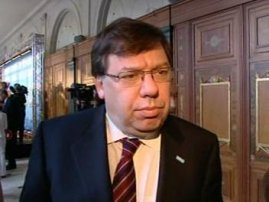
Meanwhile in the Dáil chamber this evening, the Taoiseach Brian Cowen (left) warned that "even with the Budget economies and cutbacks, the country will still run a deficit which will have to be tackled in the years ahead".

He was responding to questions from opposition leaders, including Fine Gael leader Enda Kenny.

Labour's education spokesman (and former leader) Ruairi Quinn (right) described the government's Budget as "an act of social vandalism which attacks children".
Introducing the Labour Party's motion seeking the reversal of the education cuts, he said that one effect of the cuts would be "to push young, shy children into classes of over 30 other children".

Education Minister Batt O'Keeffe (left), who is becoming increasingly rude and aggressive, accused the opposition of "hysterical claims and scaremongering" in the debate.
He described the changes as "a measured adjustment" and told TDs it was "not credible to claim that the primary school system will be in crisis next year as a result". It was pretty obvious that he was not comfortable in his role and stumbled through his speech in a very bad way, not to be seen from him often.

Fine Gael's Education spokesman Brian Hayes (right) said it was "stomach churning" to hear the Green Party justifying their support for the government cutbacks.
He predicted the controversy would prove "the Green's Stalingrad", claiming that the Green Party would never recover from the serious damage caused by breaking their pre-election promises.
Deputy Hayes emphasised that Minister Batt O'Keeffe "has no credibility in the education sector", describing him as "Brian Cowen's puppet".

Sinn Fein's Caoimhghín Ó Caoláin (left) called the Budget cuts a "callous attack on Irish children" and - reaching out across the party lines - urged "all members of the Dáil, regardless of allegiance" to join him in the "defence of our young, our schools and our education system".
Deputy Ó Caoláin, himself a teacher by profession, arrived a few minutes late and entered the Dáil chamber while Ruairi Quinn was already speaking.
He came directly from the mass demonstration outside the parliament and introduced himself to the debate as "a messenger of thousands of teachers and parents gathered outside in outrage and anger over the government's onslaught on the education and future of our children".

A nasty incident overshadowed the debate for a while and raised the political tempers even further. Conor Lenihan (right), Minister of State for Integration and brother of Finance Minister Brian Lenihan, shouted across the Dáil chamber during the speech of a Fine Gael TD and called Dr. Leo Varadkar (left) - Fine Gael's spokesman for Enterprise, Trade and Employment - "a fascist".
Lenihan augmented that outrageous statement with
giving the Nazi salute, which caused uproar on the opposition benches and led to the intervention of Leas-Cheann Comhairle Brendan Howlin, who chaired the session in the absence of Cheann Comhairle John O'Donoghue.

The debate, which saw spirited exchanges between speakers from all parties, has now adjourned until tomorrow morning.

The Emerald Islander

09 October 2008

Taliban destroys Irish-run School in Pakistan

A group of fighters from the Islamic fundamentalist Taliban movement has attacked and destroyed a girls' school run by Irish Presentation Sisters in the Swat district (on the map coloured yellow) of North-West Frontier Province (tinted grey) in Pakistan.

Fortunately no-one was killed or injured in the onslaught, and it is understood that during the time of the attack none of the Irish sisters were actually present in the compound.
There were both Muslim and Christian students enrolled at the school, which was established by the order of Catholic nuns in 1965 and had in more than 40 years not encountered any hostility.

But this unprecedented aggression against a western and Christian institution highlights the increased tension in Pakistan, whose government is an uneasy ally of the West (and in particular the USA) in the fight against its own radical Muslim groups, most of which have their bases in the semi-autonomous and traditionally unruly North-West Frontier Province.
This area on the border to Afghanistan is populated by various mountain tribes that have - since the days of Alexander the Great - never accepted the full authority of any central government. During the British Raj in India the region was a constant source of rebellion and instability, and this has not changed since the partition of India and the foundation of Pakistan in 1947.

Analysts have observed that significant numbers of Taliban fighters have moved into this area since they are under regular attack by US, British and NATO forces in neighbouring Afghanistan. Some intelligence services even believe that Osama bin Laden might be living in hiding there, though so far no evidence for that assumption has been found.

The Taliban movement of radical Islamic scholars originated in Pakistan during the time of the Soviet occupation of Afghanistan (1979-1989) and received massive funding as well as military training and weapons from the USA (and further support from Pakistan and Saudi Arabia).

In 1990 their fighters moved into Afghanistan and participated in the civil war that erupted after the withdrawal of the Soviet troops. By 1996 the Taliban controlled most of the country and formed a new fundamentalist Islamic government in Kabul. At that time they still received political backing, substantial funds, weapons and military support from Pakistan and the USA.

But in 2001 - after the terror attacks of September 11th - their American allies turned against the force they helped to create and began to call the Taliban fighters "terrorists".
Their regime was defeated by US troops and forces of the 'Northern Alliance' of tribal warlords in late 2001 and has been fighting back ever since.

Ideologically the Taliban are radicalised fundamentalist Muslims. During the time they ruled Afghanistan (1996-2001) they imposed a medieval Islamic regime, which forced all men to have long bushy beards and all women to wear the full-body cover known as the Burka. They closed most libraries and bookshops, forbade the playing of and listening to music, and closed all schools for girls. Employment of women and education of girls became illegal, and breaches of that law were punished by death. This archaeic and violent ideology explains the destruction of the girls' school in Swat, though it does of course not justify it.

Micheál Martin (photo), Ireland's Minister for Foreign Affairs, has described the attack as "an enormous setback for the girls and families of the area around Sengota and in the whole Swat district".

Given the current political instability in Pakistan and the insecurity in the area it is doubtful that the school will be rebuilt any time soon. One has in fact to admire the determination and courage of the Presentation Sisters to establish the school at all in such a dangerous and volatile area.

The Emerald Islander

11 April 2008

Invasion of the Smurfs

Being somewhat a creature of habit, I usually do my weekend grocery shopping Thursday evening or Friday afternoon. But today, due to other commitments in the afternoon and evening, I had to go shopping earlier.

When I entered my local supermarket at about 12.30, I was quite surprised to see it overrun by a large number of smallish people, all wearing light blue outfits. There were at least 200 of them, and they were everywhere: down various aisles, forming a large queue at the deli counter, and smaller queues at the check-outs. What was going on? For some reasons the Smurfs had invaded Ireland, and of all the possible places to gather they chose a normally quiet medium-size supermarket in Waterford City...

I was really puzzled, and it took me a while to realise that those light blue people were 1) all female, 2) did not wear white classic Phrygian caps but mostly unattractive hairstyles, and 3) had not light blue bodies, but all wore jumpers of that colour. They were in fact pupils of a nearby girls' secondary school, wearing their school uniforms. But what on Earth were they all doing in the supermarket? Was there any special promotion on I had not heard of?

One of the shop assistants opened my eyes completely. There was nothing special about the girls and their time of appearance, I was told. This happens every weekday - Monday to Friday - at the same time, when the girls have their lunch break. I thanked the assistant, whom I know for many years, for enlightening me, but I was still bewildered. Why do they not have lunch in their school? Are there no longer dining facilities and meals served every day? In my school days that was normal, and no one needed to go out to a supermarket for lunch.

And if there is no longer a working kitchen in the school, why don't the parents give their girls a decent lunch packet? Are the mothers of our time not even able to make sandwiches anymore?
It is none of my business what other people eat and how they behave, and I am not sitting here in judgment over anyone. But I could not help noticing that not one of the girls was buying any healthy food. All they bought was fast food, fizzy drinks, crisps, chocolates and sweets. Not one bought fruit, not one anything else that would have given them a nutritious meal. This shocked me somehow.

I wonder how many of the girls' parents are aware of their unhealthy eating habits, and if they do, how many really care. Many parents these days seem to believe that all they need to do is to give a teenager enough money and then let the teenager do what she or he wants. This is neither education, nor proper upbringing. It borders in fact on child abuse and certainly is a form of bad child neglect.

After what I saw today, I am no longer surprised that a large proportion of Irish teenagers are overweight or even obese, have serious medical problems and are less physically fit than previous generations. I am also not surprised that ever more young mothers give birth to children with birth defects. We are what we eat, and if we systematically destroy our bodies - or allow our children to do it - we will have to live with the serious consequences, even though we might not live very long and happy. One also wonders why the school is no longer providing meals for their pupils.

If we continue to run this country on the largest possible amount of ignorance and the smallest possible amount of common sense, we could as well all turn into little blue people and live in a world of fiction. It would not be much different from the world in which those schools girls I saw today live already. These are supposed to be the mothers of tomorrow... But how will they ever be able to fulfill this role if no one even bothers to educate them now as responsible young adults? It is sad, but not really that surprising if one thinks how silly and irresponsible most people have been living their lives for the past fifty years or so...

The Emerald Islander

04 January 2008

Aethelred and other Unreadies

Today the rain is back, and with a vengeance. Augmented by regional snowfalls (especially in the North) and gale-force winds in all coastal waters around the island, rain and sleet is gashing down as if someone above the clouds was dashing it out with large buckets. An extremely unpleasant day, and one of those when one will avoid leaving the house if it is at all possible.
The cat, wise creature that she is, had one brief look out the window in the morning, then turned around and went back before the fireplace, which has been blazing red-hot all day, in order to keep the little old house we inhabit warm and comfortable.
I had to go out eventually, to the bank and for some shopping, but I left it until after lunch. By that time conditions in our area had somewhat improved, the wind had calmed a bit and the rain actually stopped for about half an hour. I managed to get out and back before the rain started falling again, so on a personal note the day was not too bad after all for me.

Others were not so lucky. Over large areas of Ireland, especially in the West and North, the weather was so atrocious that the local authorities decided to close schools and a number of roads on grounds of safety.
Some roads, including a stretch of the main national road to Cork, were covered with ice and a number of accidents occurred before the Garda Siochana (Ireland's Police) issued closing orders in the West.
In the North, which is still occupied and ruled by the British, many schools were closed after a sudden and unexpected snowfall had made many roads impassable. Thousands of motorists got stranded, with large amounts of man-hours being lost to the economy, Belfast's airport closed as well and life in general was seriously disrupted.

This sort of thing happens almost every Winter here, and in some years more than once. And each time the authorities in charge of maintaining (and clearing) the roads are found wanting and unprepared! I wonder why it is that they are never able to cope with the relatively mild and uncomplicated winter conditions here, while at the same time the authorities in other European countries, where the Winters are much longer and harder than here, have no such problems. In Northern, Eastern and Central Europe, where snow and ice is present for months each Winter, all major (and even many minor) roads are cleared every day, and if necessary several times a day, railways function and school closures are unheard of.

As a historian this reminds me of a famous - or rather infamous - medieval King of England, who ruled our neighbour island from the late 10th to the early 11th century. His name was Aethelred and the ineptness of his government earned him the by-name "the Unready".
I know that some of those names attached to ancient rulers can be a bit crude, but in this case it is well deserved and speaks for itself. To be fair to Aethelred (whose portrait you see here), he had not an easy start, succeeding to the throne at the tender age of 10, at a time when England was regularly attacked by Danish Viking armies. So some of the unreadiness associated with him must have been a result of incompetent advisers and court officials. (Not much has changed in Britain since, and many dithering boards and committees there are still responsible for a whole range of mishaps, procrastination, failures and scandalous disasters...)
For all of his adult years Aethelred was faced with the ever more hostile Danes, who had since the 9th century ruled a significant part of North and North-East England (known as Danelaw or Danelagh), but lost control of it shortly before Aethelred became King. Understandably, the Danes wanted their lands back, and having a large supply of well-trained and heavily armed Viking warriors at their disposal, they kept trying to achieve their goal almost every year.
Having not enough soldiers and pretty poor commanders, Aethelred realised that he could not match the Danish armies in battle. So he decided to introduce the force of monetary power into English politics and paid the Danes large sums of money for not attacking and ravaging his frail kingdom. The clever Danes took the money and withdrew, but only to come back the next year, demanding more. This went on for almost a quarter of a century, and the amount of money paid to the Viking raiders grew larger each time.
Neither Aethelred nor his kinsmen, advisers and military commanders seem to have considered to prepare for another Danish attack, build defences and raise an army strong enough to meet and beat the Vikings next time they appeared on England's shores. So even the Danes came back as regular as the seasons, every time the English were unprepared for it, not ready to fight and could only hope another and even larger payment would save them again.
Eventually the Vikings grew tired of the game, and in 1013 (one year before Ireland's High King Brian Boru defeated the Vikings of Dublin in the Battle of Clontarf) King Sveyn I "Forkbeard" of Denmark chose blood over silver, invaded England in force and drove Aethelred and his court into exile. Sveyn had not much joy with his victory, because he died only five weeks later. His successor, King Canute the Great (best remembered for ordering the tide to turn back into the sea), was officially proclaimed King of England in 1014. A year later Canute moved South and broke the last English resistance Aethelred and his kinsmen could muster against him. Having lost his kingdom and everything, Aethelred died as a sick and broken man in London in 1016, aged 48, entering history books as the most inept Anglo-Saxon ruler of England, forever marked as "the Unready".

Even though he achieved little and eventually lost everything, he left some legacy that continues to have influence on England and Britain even today. He was the first English ruler to use large sums of money as means of major policy, he began the long-standing (and often tragic) English tradition of dithering and ignoring foreign threats, and - probably most significant - he was the indirect cause for the Norman invasion of 1066, as his second marriage to Emma of Normandy established a claim to the English throne, used 50 years after Aethelred's death by his wife's grand-nephew, Duke William of Normandy (later King William I "the Conqueror" of England), as the excuse to invade England.

Another century later the Normans moved on to invade and conquer Ireland, and their legacy is still present and has influence on both parts of Ireland today. And so has - sadly - Aethelred's practice of dithering, ignorance, incompetence and procrastination. On a day like today many of Ireland's people feel and encounter the results of that, even though most of them might never have heard of Aethelred the Unready. History has a long arm, and it strikes all of us, the ready and the unready, the educated as well as the ignorant.

From a safe chair in front of a nicely burning fire I wish you all a pleasant weekend, hoping you are ready and prepared for more bad weather, as it is fore-casted for tonight.

The Emerald Islander