skip to main |
skip to sidebar
 Ian Paisley Sr. (left), the former First Minister in the North and leader of the DUP (Democratic Unionist Party), has clashed with the former Taoiseach Bertie Ahern over the devolution of policing and justice powers to the Northern government at Stormont.Paisley, who retired from frontline politics in June, spoke out after Bertie Ahern said that Unionists were "stepping outside the terms of the St. Andrews Agreement" of 2006.The row between Sinn Féin and the DUP over policing and justice threatens the future of their power-sharing government. (see my entry from September 21st) Now Ian Paisley ignores his retirement and criticises the former Taoiseach for effectively blaming Unionists for the deadlock.The two men had helped to negotiate the St. Andrews Agreement that paved the way for power-sharing, and more recently had become very friendly with each other. This culminated in a joint appearance of both leaders on the site of the historic Battle of the Boyne (see my entry from May 6th), where both treated each other with the utmost courtesy and even signs of friendship.
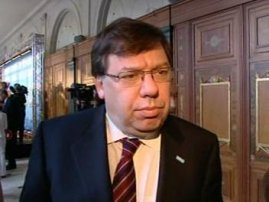
 But now Bertie Ahern (right) has commented on the current Northern stalemate and said that the recent DUP demands for the disbandment of the Provisional IRA's ruling Army Council were not part of the St. Andrews deal."I have to restate it again, because it was part of these discussions and talks, the devolution of policing was not predicated on the Army Council doing this, that or the other," Bertie Ahern said."It was not on that. It was a solemn agreement that the Irish Government and the British Government were engaged and involved in. It said we would have the devolution of policing, that was the effect of it."The Provisional IRA has long now decommissioned its weapons and ended its violent campaign, but the DUP is still seeking a formal disbandment of its ruling Army Council. This is nothing new, as the DUP have always been very good at shifting political goal posts, thus changing the sense and meaning of the agreements they signed, at least from their point of view. It appears that after all those years of talks and negotiations they still can't or won't grasp the nettle of true power-sharing. So one has to wonder how serious they can be taken as a political party and how trustworthy they are as a partner in any agreement.After the Independent Monitoring Commission (IMC) recently ruled the Provisional IRA to be 'redundant' and said that their Army Council was not meeting, the DUP called once again for Republicans to pledge that the IRA was 'gone for good'.This is just another of the DUP's triumphalist attitudes, as their minds are so deeply occupied with conflict and controversy that a time of real peace and growing prosperity appears strange to them.It came however as a surprise that Ian Paisley spoke out over the former Taoiseach's suggestion that Unionists were stalling on the transfer of policing powers from Westminster to Stormont."We are not time-bound by any commitment," the former First Minister and long-time DUP leader said. "And Mr. Ahern is well aware of that.""The party (DUP) has correctly judged that the devolution of policing and justice powers can only occur at such a time as when there is sufficient confidence within the community that allows for the unlocking of the triple lock. That is the position that I and my colleagues negotiated at St. Andrews and it remains the DUP position today," he added.Paisley stated that after the 2006 negotiations he had publicly proclaimed his party's success in achieving a 'triple-lock', giving the DUP effective control over when the policing powers would be devolved."The DUP position is totally unchanged from the time of St. Andrews. No commentary from Bertie Ahern after the event will ever alter that," he said.The St. Andrews Agreement set May of this year as a target date for the devolution of policing powers and the prospect was key to persuading Sinn Féin to accept Northern policing structures.After the publication of the IMC report, its spokesman, the former Alliance Party leader Lord Alderdice, said the IRA had "left the stage", but he speculated it would not formally announce its final disappearance, for fear of rival Republicans opposed to the peace process taking on its mantle.The whole dispute is fruitless and will help no-one, including the DUP. As May 2008 was agreed as the time for the transfer of policing powers and control of the Justice Department (which are both in the hands of the UK Northern Ireland Office), the power-sharing executive should have proceeded to do it.However, May saw a change of leadership in the Republic and in the North, with both Bertie Ahern and Ian Paisley Sr. stepping down as the leaders of government and leaders of their parties. So the matter of transferring policing and justice powers was quietly pushed into the background. Then came the long summer recess of both parliaments, a time that is traditionally void of major political decisions.So the DUP has managed to postpone this important matter for four months and was hoping it might be forgotten for some more, as the world - including the two parts of Ireland - is shaking under the largest economic crisis since 1929.However, this is not going to happen, as Sinn Féin, the main partners of the DUP in government, are determined to get those powers transferred to Stormont. For Republicans it is not more than a final step of normalisation and a further reduction of direct British influence on the affairs of the Six Counties.I am sure that a solution will be found, and that - despite ongoing DUP blocking attempts - the agreement of St. Andrews will eventually be implemented completely. Even though they are the most intolerant and sectarian hard-liners in the North, the DUP must know and understand that the alternative would be the fall of their joint government and the end of the power-sharing agreement. Having grown fond of power and actually running real government departments by now, they will not risk to loose all that over one matter they have agreed on already in principle.The Emerald Islander
 The past few days have been very busy and eventful for me, and thus I did not have the chance to write entries on Friday and Saturday. I have just returned from a visit to Belfast, where I had the opportunity to meet Morgan Tsvangirai (photo), the leader of the Movement for Democratic Change (MDC) in Zimbabwe.
The MDC, Zimbabwe's largest opposition party, has won the parliamentary elections held on March 29th, thus ending a long and dominant majority of ZANU-PF, the party of President Robert Mugabe. In the presidential election, held on the same day, Mr. Tsvangirai also emerged as the clear winner, although it is disputed that he won more than 50% of the popular vote, as the MDC has claimed on the basis of the added-up results from all local polling stations in the country.
After an unprecedented delay of more than four weeks, the Electoral Commission of Zimbabwe, which is in charge of holding elections and declaring the results, has eventually said that Morgan Tsvangirai did indeed win the presidential election, but that he fell short of an outright majority (of more than 50%). Under the electoral rules of Zimbabwe this requires a second round, where a simple majority will decide who is the next president.
The MDC and many international observers, analysts and commentators - myself included - are certain that the result of the presidential election on March 29th has been manipulated during the month of political limbo. According to reports from inside Zimbabwe the current government printed three million more voting papers than there are voters in the country. During the long and protruded counting process, which was the longest known in any election, it is alleged that ZANU-PF manipulated the result by adding fake ballot papers in favour of Robert Mugabe and ZANU-PF. There were also reports of 'phantom polling stations' in tents on empty fields, to which ZANU-PF was bringing supporters to vote a second time.
As nobody in Zimbabwe would believe a result that declares a win for Robert Mugabe, ZANU-PF have stuffed ballot boxes only to the extent that Morgan Tsvangirai lost his outright win of the presidency in the first round.
Mugabe and his strategists in ZANU-PF have since embarked on a massive campaign of terror and intimidation against politicians and supporters of the MDC, and observers doubt that the second round of the election can be held under fair and democratic conditions.
The government campaign of terror, supported by police and the Zimbabwean army, reached a level of unprecedented intensity in recent weeks. Thus the MDC decided that it was currently not safe for Morgan Tsvangirai to stay in the country. The opposition leader has therefore spent a couple of weeks in neighbouring South Africa (whose President Thabo M'beki has so far - to the anger and annoyance of his own ANC party - taken the side of Mugabe and excused any crime and terror he is responsible for) and also visited Botswana, Namibia and Angola, where he had political consultations with the presidents of those countries and other politicians.
Before he returns home to Zimbabwe and prepares himself for the now once again postponed second round of the presidential election, Morgan Tsvangirai added another surprise visit to his busy schedule. He attended the 55th Congress of Liberal International in Belfast and addressed the gathered delegates from more than 100 liberal parties from around the world.
The annual congress of the world's liberal parties was for the very first time held in the North of Ireland, and the small local liberal party - the non-confessional and cross-community Alliance Party - was the proud host of the event.
In his address to the conference, which welcomed him as their guest of honour with a standing ovation, Morgan Tsvangirai gave a brief report about the catastrophic situation in Zimbabwe (where - due to Mugabe's rule of terror and incompetence - unemployment is now at 80% and inflation has reached the all-time world record of 250,000%) and outlined his own political plans.
"I must return to Zimbabwe to be with our people and to lift them out of the darkness," he said.
"On the 29th of March the people of Zimbabwe voted. Mugabe lost that first round. 57% of the people who cast their vote did not vote for him. I am so confident that in spite of the violence, come the second round they will reconfirm that rejection."
Mr. Tsvangirai denied reports that he was in exile and urged President Mugabe to peacefully accept the verdict of the second round vote.
"I did not run away, and I am not in exile," he emphasised. "It was for strategic reasons that I left the country for some time. We had to engage with all the African leaders about the crisis."
Former Alliance Party leader Lord Alderdice, currently the President of Liberal International, said it was a special honour that Morgan Tsvangirai attended the congress. The same warm welcome was also extended to the President of Senegal, Abdoulaye Wade.
Alliance Party leader David Ford said: "Getting the chance to host this congress is a massive boost for Belfast. This is the first time that Northern Ireland has ever hosted the prestigious gathering of Liberal International. It gives us the chance of a lifetime to showcase Northern Ireland to politicians and power brokers from across the whole globe."
Even though I am neither a politician nor a power broker, and not member of a liberal party, the congress was very interesting and inspiring for me, too. One does not often have the chance to speak with politicians from so many different countries, among them government ministers and opposition leaders of great significance. However, the highlight of the gathering was without any doubt the presence of Morgan Tsvangirai, his impressive speech and the chance to meet him in person afterwards.
I never had the chance to meet Nelson Mandela, but in the past I was one of the many activists in the long campaign for his release from prison. Time has moved on, history has restored Nelson Mandela to his rightful place and rewarded him with the South African presidency and many international honours.
But there is still a lot of terror and injustice in Africa. And even though the continent has many decent people who struggle for freedom and democracy, there is currently no-one who is more prominent in this fight for political rights, fairness and true democracy than Morgan Tsvangirai, who - in my opinion - would be a very deserving candidate for the Nobel Price for Peace. I feel privileged and honoured that I had the chance of a brief meeting with this exceptional man, and I wish him all the best for the future - personally as well as politically.
The Emerald Islander
 Ian Paisley Sr. (left), the former First Minister in the North and leader of the DUP (Democratic Unionist Party), has clashed with the former Taoiseach Bertie Ahern over the devolution of policing and justice powers to the Northern government at Stormont.
 But now Bertie Ahern (right) has commented on the current Northern stalemate and said that the recent DUP demands for the disbandment of the Provisional IRA's ruling Army Council were not part of the St. Andrews deal.