It is a cold and unfriendly morning in December, just after breakfast time. Gaspar Arcanjo de Lima (photo above) - a 49-year-old Brazilian - leaves his home and walks the short distance to the town square to look for casual work. He does this six times a week - every day but Sunday - and the local people are well used to seeing him there."I used to get work three or four days each week here," he says, looking serious. "But if I get one day a week now, it's a lot."Gaspar is not the only one offering himself for hire in the central urban spot of this small rural community. Each weekday more than a dozen men - aged between early twenties and early fifties - gather there in the morning and hope that someone in town, or perhaps a local farmer from the surrounding area, needs an extra pair of hands for a day or two.However, Gaspar and the other men are not standing on a town square in Brazil. They are standing in Gort, a rural Irish market town in the southern part of Co. Galway, not far from the border with Co. Clare.Even though rather small and of no great importance these days, Gort is a place with a long history that goes back to Guaire Aidhneach, the sixth century King of Connacht, who had a reputation for generosity. The lore has it that his right arm, the giving arm, was longer than his left.
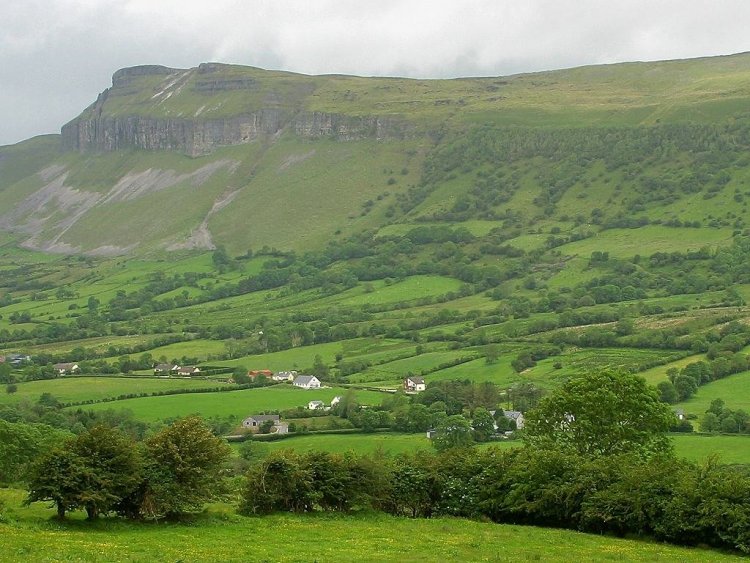
 One legend tells the story how King Guaire was sitting down for dinner when mysteriously the plates with the food disappeared out the windows. He quickly followed them on horseback and soon met St. Colman, a pious monk who had just finished a seven-year fast and was so in need of sustenance that the King's food literally flew to him, so he could eat. King Guaire was impressed by Colman and granted him lands at Kilmacduagh, where he built a famous monastery (photo above), which is one of the oldest in Europe.The town's modern Irish name An Gort (the meadow) is only used in official documents, while the locals still refer to their town as Gort Inse Guaire, thus keeping in touch with the distant past and King Guaire.In the Middle Ages the Ó Seachnasaigh (O'Shaughnessys), chiefs of Cinél Aedha na hEchtghe (a clan descended from Guaire Aidhneach), had their principal stronghold in Gort.At the end of the seventeenth century all the O'Shaughnessy lands were confiscated by the English crown and later granted as a favour to Sir Thomas Prendergast, whose grandson was John Prendergast-Smyth, the first Viscount Gort.
 The best-known member of that family was Field Marshal Lord Gort, VC (pictured here on the left with the famous US Lieut. General George S. Patton in North Africa).During World War I this distinguished Anglo-Irish officer won the Victoria Cross (VC) - Britain's highest gallantry award - as well as three times the Distinguished Service Order (DSO) and the Military Cross (MC).Between the wars he rose to the Army's top position - Chief of the Imperial General Staff - and in 1939 he was commander-in-chief of the British Expeditionary Forces in France. Later in World War II he also served as the Governor of Malta and High Commissioner for Palestine & Transjordan.Another resident of the area was Lady Augusta Gregory, the famous dramatist, co-founder of Dublin's Abbey Theatre and close friend of William Butler Yeats. She lived at Coole Park, only a short distance away from Gort.The O'Shaughnessy's old stronghold in Gort was turned into an English cavalry barracks, which was used by troops until modern times.In 1831 the market town had 563 houses and a total population of 3627. But then the Great Famine of the mid 1840s set in and devastated the population and future of Gort, as it did with so many towns in the west of Ireland.After many decades of a sleepy existence, Gort has grown by nearly 50% in recent years and has now about 3000 inhabitants. But it was not an influx of Irish people that made Gort almost a little boom town, it was a large number of Brazilians that arrived and settled here since 1999.What attracted them to Ireland and to Gort especially?Well, the unexpected economic boom - known as the 'Celtic Tiger' - that started under the 'Rainbow coalition' government in the mid-1990s created more jobs in Ireland than could be filled by Irish workers. Many unfilled vacancies began to attract foreign workers. While the vast majority of migrant labourers came from eastern Europe and especially Poland, there were also many from further abroad, including plenty from Brazil.There are long-established links between the Irish meat industry and the producers of beef in South America, especially in Argentina and Brazil.Vacancies in booming Irish abattoirs and meat processing plants, which are the predominant business in and around Gort, soon attracted the first Brazilians to southern Galway. They sent happy letters - and plenty of money - home to their families, and thus ever more of their fellow countrymen arrived.
Meanwhile more than a third of the whole population of Gort is Brazilian. This has of course changed the life in the sleepy little market town in many ways. Sunday Mass in the local Catholic church is now said not only in English, but also in Portuguese.
There are special Brazilian shops, restaurants and services in Gort, including a food store, a hair dresser and a money transfer office. The latter provides the Brazilians in Ireland with a vital link to their homeland and families, many of which depend entirely on money sent from Ireland. (It is amazing how things can change, as until not so long ago many Irish families lived on money they were sent by a relative working in the UK, the USA or Australia.)
There is now also a strong Brazilian element in Gort's school, and in every other aspect of the local community and culture.
Surprisingly no incidents or cases of racism or xenophobia have been reported, which proofs that even a rural community can absorb a large amount of strangers, as long as they are peaceful, able to work and willing to integrate themselves as much as it is possible.
Overall the new residents of Gort are well integrated. Many of them live in comfortable new homes, built during the economic boom. They are more modern than those they could afford back home in Brazil, and even more modern than the houses of most Irish residents of Gort.
But there seems to be no envy or animosity. The Brazilians were welcomed by the locals as friendly, warm-hearted people who are as Catholic and easy-going as they are themselves.
The local St. Patrick's Day parade has probably benefited the most from the South American influence and is now quite close to the carnival parade of a Samba school in Brazil. In fact, it has been said that Gort has meanwhile some of the best Samba dancers in the whole of Ireland.
But despite the positive example of integration, all is not well in Gort a week before Christmas. Like everywhere in Ireland, the boom times are over in Gort, too.
A fall in people's buying power has led to a reduction of production and the loss of many jobs. And the rule in Gort is not different from elsewhere: Last in - first out. There is now a great shortage of jobs, in Galway and Ireland as a whole, with plenty of Irish and foreign workers on the dole.
For the Brazilians in Gort things are especially difficult. When they came here, they thought to have found their little piece of paradise, where they could stay and work, earn good money and live a life in happiness and comfort, perhaps forever.
For most of the past five or six years work has indeed been plentiful and there was everything else one could only dream of in Brazil. Some of the workers even brought their wife and family to Ireland, while most were sending money to their families at home. They still do, but now things have changed and the money transfers are less frequent.

Simonsen Miller Silva (above right), who runs Gort's Brazilian-owned money transfer service, knows exactly what the downturn is costing his community.
"People send anything from € 350 to € 650 back home," he says. "That is the same as ever. They are just doing it less often."
Most of the Brazilians still send money about three times a month. "For many," the transfer agent explains, "it is a commitment. They have to provide for their family, to pay for schooling or for healthcare."

"Four years ago it was a lot easier to find a job and to send money home," says Miro Pires (photo left), who transfers up to € 1000 from Ireland to Brazil every 40 days.
"Now I wait until the exchange rate reaches at least three Reals before I send anything. Although it's harder now, I'm going to wait at least another year before going back. The situation is difficult now everywhere."
The good news for Miro is that despite our recession the Euro is still gaining in value. Yesterday it stood at more than 3.40 Reals, which means that his family in Brazil will have a very happy Christmas with the money from Ireland.

26-year-old Raquel Samuels (above top left), one of the many Brazilian women who followed the male workers to Gort, is co-owner of Real Brazil, one of the Brazilian shops in town.Amid piles of cassava beans, sugary sweets and many other kinds of imported food she sits with mixed feelings and hopes the Brazilians can tough out Ireland's recession."This town would be like a ghost town, without the Brazilians being here," she says with amazing frankness. "Many Irish are like sticks in the mud." During the boom times jobs in cleaning, cooking, catering and shop work were easy to find for Brazilian women, even if their English was often poor. The newly rich Irish did not care, as long as the work was done. No one was hiring a cook or cleaner for conversational skills.But now fewer Irish families employ home helpers or cooks. It is one of the first luxuries people let go when the money gets tight for them. So many Brazilian women - who do not stand in the town square seeking work like the men - are finding jobs and cash ever harder to come by.Some of the women have left Gort already, with the intention to return to Brazil. But rumour has it that at least some of them only went as far as Dublin and are now working there in the growing lap dance and sex industry.
 At Gort's Brazilian hair salon (left) fewer customers are now styled, but there is still plenty of gossip."It's really very difficult for everyone now, so people take whatever work they can get," says Simone Bueno Marques, the 30-year-old hairdresser who runs the salon.Although her husband and two children live with her in Ireland now, she still sends € 700 each month to Brazil, to support her mother and pay for a house."It's a little bit of a problem," she admits. "Sometimes I miss Brazil, but I don't want to go back - not yet, anyway."Once her Brazilian house is paid for, she might change her mind, especially if Ireland is then still in recession.
 27-year-old Sandro Santana Mendes (photo right) tells me that he "enjoyed the good times in Ireland". But he has bought a ticket and will go home for Christmas. He has not seen his four-year-old son for three years."I've been in Europe seven years now," he explains. "I liked it, but it is not a place to stay forever. Too cold for me, and I don't mean only the climate."Then he shows me a large brown envelope filled with banknotes."I have € 2000," he says with a smile. "That's enough to live for a whole year in Anapolis [his home town in Brazil]."Others are preparing to leave Gort and Ireland as well. To go home for Christmas is the main reason, but some are already sure that they will not be back in January.
 "I've been very happy here. It's been good," says Joao Luis da Silva Costa (left, watching TV with his son in his house in Gort), another 27-year-old Brazilian meat-plant worker who is preparing to leave."But I'm not earning enough money any more in Ireland, so I'm going home. I've done my time. It's enough."In the town square the mood is mixed this morning. Few Galway farmers have turned up, looking for handymen, and most of the Brazilians look gloomy in the cold.Gaspar Arcanjo de Lima was lucky and has found work. But his companion Antonio Galdecio da Silva (photo below right) has not. Eventually he calls it a day just before noon."I come here every day, looking for work," he says. "But I've not sent any money home for three months."
 Antonio is 50 and tells me about his hard and eventful life. Back in Brazil he has no less than eleven children, and was hoping to bring some of them to Ireland for better education and jobs.But that was during the good times. He is realistic enough to see that Ireland is no longer a place that could offer a future to him or his children. "Now I'm just trying to work enough to buy myself a ticket home," he says with a sigh and leaves the square with some of his compatriots.It appears that for Gort in Co. Galway the Samba days are over.The Emerald Islander
 Ireland's Environmental Protection Agency (EPA) promised to take legal action against the country's local authorities, unless there is an improvement in the operation and monitoring of sewerage works.
 Environment Minister John Gormley (right) said it was "quite unacceptable" that a quarter of non-compliance levels can be attributed to the insufficient levels of sampling by the local authorities.