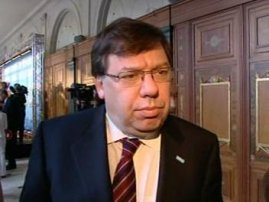
Earlier this week Ireland's national broadcaster RTÉ has announced that the 35-year-old Ryan Tubridy (photo above) will be the new host of the station's flagship TV programme, the 'Late Late Show'.
The announcement was apparently "a surprise" for may people in Ireland, and in particular for the Irish bookmakers, who had the 49-year-old TV presenter and mother of eight Miriam O'Callaghan listed as favourite for the job, ever since the show's present host Pat Kenny (photo below) announced his intention to step down at the end of the current series.

Since I dislike television, never watch it on purpose, and not even own a TV set, I am probably not the most qualified person to write about this. But even I know enough about the show and the people involved, and occasionally I have seen bits and pieces while I was in other people's houses. So I will share my views with you, as usual, and invite you to comment or engage with me in debate (below) if you agree or disagree with me.
The really important thing is that the 'Late Late Show' is the longest-running television chat show in the world. Having started in 1962, originally as a short-time filler programme for the summer months, the show is now in its 47th year and - to my amazement - still immensely popular with the nation's TV audience.
In the early years it began at half past eleven on a Friday evening, which was more than late for Irish people in the Sixties and gave the show its name. (There was also already a 'Late Show' on the BBC, which can be received easily in Ireland, and the producers did not want to confuse their viewers, nor get into copyright troubles with their British colleagues.)
Despite its age, the show had so far only three regular hosts. And one of them, Frank Hall, did the job only for a little over a year (1968-69) and is hardly remembered for it.
 The man who comes first to most people's mind when the 'Late Late Show' is mentioned is undoubtedly Gabriel Mary 'Gay' Byrne (left), who more or less single-handedly created, shaped and established the programme as a TV mainstay. He hosted the show for 37 years, which must make him one of the most consistent TV presenters in the world (if not the longest-serving).
Gay Byrne, by nature rather a light-hearted man, was always more an entertainer than a dry and factual journalist. He very much enjoyed the light and glossy character of the show, which - at times - also has very serious moments.
In fact, no other modern media element had so much direct influence on the Irish society in recent times. Many movements, ideas and trends of the late 20th century began for Ireland on the 'Late Late Show'. Ever so often the programme was truly controversial and caused upset and outrage in various quarters, from the hierarchy of the Catholic Church to the staunchest Protestant Unionists in the North.
Way back in the early 1960s Gay Byrne was probably not more than a very lucky man among Irish TV journalists. If RTÉ had chosen someone else to host the show, who knows what might have become of young Mr. Byrne. And who knows what might have become of the programme. Perhaps it would have been not more than a short summer filler (as originally intended) and we would not even know or remember its name by now.
But, as always in life, when the right person comes to a cross-road and makes the right choice, big things can wait further down the road. Gay Byrne became not only Ireland's most popular and successful broadcaster, he also made the 'Late Late Show' a household name in Ireland and beyond. And this is meant literally, as Byrne was not only host of the show, but also directed and produced the two-hour-long weekly live programme with great skill and inspiration.
Being well-connected in Dublin's political and society circles, Byrne used his influence and made things possible that without him (and his contacts) would have been hard to imagine. And even now, ten years after his official retirement from the show and from RTÉ, he is still a very active man at the age of 74.
As chairman of the national Road Safety Authority (RSA) the former biker is now a frequent promoter of safety and common sense on Irish roads, and besides that he still finds enough time for special programmes on radio and TV. (For example, his series of erudite studio talks about the four main characters of Jesus' passion - which was broadcast earlier this year, in the week before Easter, on RTÉ Radio 1 - was among the best intellectual radio programmes I have heard in all my life.)
When Gay Byrne decided to retire in 1999, there was for a while great consternation in RTÉ. Who could fill the very big shoes of a man like 'Gaybo'? Was there actually anyone who would even dare to try?
Well, yes, there was. And after contemplating for some time to retire the whole show with Gay Byrne, the RTÉ bosses decided against it. They knew only too well that a programme that big, that popular and so well-established could never be replaced with 'something else'. Not even to mention the nice income from advertisement and sponsorship revenue the 'Late Late Show' generates every week.
So the programme was handed to Pat Kenny, who had made a name for himself already with a number of smaller chat shows and had a considerable track record in traditional journalism and current affairs.
But in contrast to Gay Byrne the new presenter was not a show man. So there were soon critical voices, saying that Kenny's interview style was "too serious", "wooden" and "lacking humour", especially when he was talking to more light-hearted and non-intellectual people like show stars, actresses, models, dancers and some popular singers.
From the few bits and pieces I have ever seen of the show I would agree with those comments, but I would not hold it against Pat Kenny. He is a serious man, with a good journalistic mind, and he demonstrates his interview skills every week from Monday to Friday (10 am to 12 noon) on RTÉ Radio 1.
The light-hearted and glitzy show biz chat on the 'Late Late Show' delighted Gay Byrne, but it bores Pat Kenny, who is interested in real and bigger things.
But I suppose the show was too good a plum to refuse, when RTÉ offered it to Kenny. After all, hosting the station's flagship TV programme made Pat the best-paid person in RTÉ (with more than € 850,000 per annum). I don't think there are many who would say no to such an offer, when it comes their way.
However, after a decade of crafted performances and mixed experience as a would-be showman, Pat Kenny has enough. He probably longs for more reality and serious subjects, and plans to present a new current affairs programme on TV as soon as he ends his ten-year tenure of the 'Late Late Show'. And I have to say that I look forward to that very much. (Even though I won't see the programme, as I don't watch TV, I will hear and know of it, and of the subjects it tackles.)
So now the entertainment gurus at Donnybrook had to find someone new again. As soon as the word was out, some well-known names were mentioned as possible successor for Pat Kenny.
 Gerry Ryan (right), one of the biggest beasts in the jungle of RTE's Radio 2 fm (which is aimed at young and less intellectual people), was in the frame right away. He had a little head start, as he stood in for Pat, presenting the 'Late Late Show' on October 24th, 2008, when Kenny took time off after the sudden death of his mother.
But despite his well-known interview skills, Ryan did never have a realistic chance to inherit the programme. Many see him as a lazy slob, and the very public break-up of his marriage did surely not enhance his image either.
 Derek Mooney (left), who is now rather a light-weight presenter and works on both radio and TV, was mentioned for the 'Late Late Show', too. He started his career as a RTÉ child performer, but is best known for his excellent and long-running series about animals and wildlife. However, this was before he received big pay cheques from RTÉ. Since he began presenting some of the National Lottery's silly and utterly brainless game shows on RTÉ TV, Mooney comes across quite shallow and artificial. Sad really, but what can one do...?
Ryan Tubridy, who is not unlike Mooney - except that he is not homosexual and has no special interest in wildlife - was in my opinion the 'dark horse' in this race right from the start. Although many regard him as "too flippant and too young" (he is 35, but looks at least ten years younger), I thought that he is the one to watch. Why? Because - like Gay Byrne - Tubridy has the right political and social connections.
What many who watch his TV show and listen to his radio programme seem not to know is that - despite the name Tubridy - Ryan is (through his mother) a member of the prominent Andrews family and thus part of the inner circle of Fianna Fáil's small elite.
Two of his uncles are former TDs, and two of his first cousins are currently members of the Dáil. His grandfather was a close associate and confidant of Eamon de Valera. One of Ryan's uncles - David Andrews - has been the Minister for Foreign Affairs and Minister for the Marine. He now heads the Irish Red Cross. And Ryan's cousin Barry Andrews is Minister of State for Children in the current government.
Even though Ryan is apparently "the non-political one" in his clan and seen by some as "a bit of a clown", he should not be underestimated. During his student years at University College Dublin (UCD) he was a very active member of Ogra Fianna Fáil (the youth wing of the party), and when he speaks about politics or interviews people with a political background, I can hear that his interest is deep and sincere, and based on actual knowledge.
 But, for whatever reasons, Ireland's media and bookmakers rated Miriam O'Callaghan (right) as the favourite to succeed Pat Kenny as host of the 'Late Late Show'.
The 49-year-old co-presenter of RTÉ's current affairs magazine 'Prime Time' and mother of eight children was the only female candidate. And as we now live in an age of rampant feminism, most women in RTÉ took it for granted that the job would automatically go to a woman, as it often is these days (while many men are regarded as surplus to requirement).
Fellow RTÉ broadcaster Marian Finucane even said on air that "the job is as good as Miriam's already". Well, you probably know what they say in Rome. The one who goes into a conclave as papabile does usually come out a cardinal.
To make it quite clear, I have nothing personal against Miriam O'Callaghan. But I am awfully glad that she was not chosen to host the 'Late Late Show', and it appears that I am not alone with this opinion. "Thank God, it's not Miriam!" said a friend of mine, who does watch the show every week. "I don't think I could bear her fishwife slang for two hours."
As usual, my friend does not mince his words. And he puts the main point right on the spot. No matter what else Miriam O'Callaghan is or does, she has by far the most unpleasant and vulgar Dublin accent on RTÉ. Sometimes one has even problems to understand her at all. (Many other famous people had similar problems, but they overcame them by taking elocution lessons and speak now perfectly well and understandable. Why Miriam O'Callaghan never took such lessons is puzzling and hard to fathom. Since she is paid more than € 250,000 per annum, a shortage of funds can certainly not be the reason. Perhaps she just does not care and does not mind sounding like a low class washerwoman. But in no other country I know would a person with a comparable accent to the one of Miriam O'Callaghan ever come even near a microphone or TV camera!)
If anyone abroad might wonder how on Earth such a person could get a job as a TV presenter in Ireland in the first place, then I recommend to have a closer look at our country and structure. The political system here is supposed to be Democracy, but in fact it is Nepotism. And it does not limit itself to politics. Everything here is based on who you know, not what you know and can do. Thus we have many unqualified people in prominent positions, and Miriam O'Callaghan is only one of them.
She studied Law and worked briefly as a solicitor in Dublin. But she soon figured out that it is a boring job and looked - as young girls do - for something more glamorous and exciting. Aged 20 she met through her work the journalist and broadcaster Tom McGurk, who is 14 years her senior and worked already for RTÉ. Three years later they married and moved to London. And, despite having no journalistic training and instead one of the world's most awful accents, Miriam soon began working for British TV, but mostly behind the scenes.
Ten years later the couple and their four daughters returned to Ireland. Tom McGurk worked for RTÉ again in various departments, and soon after Miriam was there as well. One would think that having to bring up four daughters would be more than enough work for a mother, but then again, there are different types of mothers...
After 13 years the marriage failed. McGurk and O'Callaghan separated and got divorced later. But both continued to work for RTÉ, and Miriam soon picked up her second media husband, the producer and documentary maker Steve Carson, with whom she has now also four children.
But despite her responsibility for a family of ten, Miriam O'Callaghan seems to increase her screen presence rather than to reduce it. Had she been given the 'Late Late Show', this would have been even more the case.
But she did not get it, and one should be grateful for small mercies.
Although I do not watch television, the idea of having the nation's flagship TV show hosted by a lawyer with no journalistic training who married her way into broadcasting - twice - and cannot even speak clear, proper and understandable English, fills me with strong resentment. It is bad enough that most of our government consists of morons, and we should not do any more damage to Ireland's public image.
So from September on Ryan Tubridy will be the fourth host of the 'Late Late Show'. Hard to say what to expect, and I don't really have much personal interest in it.
But it is significant that at a time when Fianna Fáil - and the government led by the party - are extremely beleaguered and unpopular, the national broadcaster appoints a member of one of the most prominent Fianna Fáil dynasties as the host of the country's most popular entertainment show.
As regular readers of this weblog know, I am not a friend or supporter of Fianna Fáil. And I do not know what - if any - political allegiance Miriam O'Callaghan has.
But when it comes to broadcasting and presenting television programmes, political background or party membership are not the priority. The first element I look at is the qualification for the job, and the ability to do it.
And here the facts and the candidates - literally - speak for themselves: Ryan Tubridy in clear and understandable English, and Miriam O'Callaghan in a slang one might expect from Molly Malone, but not from a woman on RTÉ television.
Some feminist groups are already muttering of "unfair treatment" and "discrimination" (which is as ridiculous as feminism itself), but I think RTÉ has made the right decision.
There are quite a lot of traits Ryan Tubridy and (the then younger) Gay Byrne have in common. I would not be surprised to see the 'spirit of Gaybo' that was clearly absent from the show during the Kenny years return with Ryan Tubridy. And there is another little extra: Should the show be ever short of studio guests, Ryan could just ask a member of his extended family to come in. The Andrews clan could easily fill a whole show with their own movers and shakers alone.
The really important thing is that the 'Late Late Show' is the longest-running television chat show in the world. Having started in 1962, originally as a short-time filler programme for the summer months, the show is now in its 47th year and - to my amazement - still immensely popular with the nation's TV audience.
In the early years it began at half past eleven on a Friday evening, which was more than late for Irish people in the Sixties and gave the show its name. (There was also already a 'Late Show' on the BBC, which can be received easily in Ireland, and the producers did not want to confuse their viewers, nor get into copyright troubles with their British colleagues.)
Despite its age, the show had so far only three regular hosts. And one of them, Frank Hall, did the job only for a little over a year (1968-69) and is hardly remembered for it.
 The man who comes first to most people's mind when the 'Late Late Show' is mentioned is undoubtedly Gabriel Mary 'Gay' Byrne (left), who more or less single-handedly created, shaped and established the programme as a TV mainstay. He hosted the show for 37 years, which must make him one of the most consistent TV presenters in the world (if not the longest-serving).
Gay Byrne, by nature rather a light-hearted man, was always more an entertainer than a dry and factual journalist. He very much enjoyed the light and glossy character of the show, which - at times - also has very serious moments.
In fact, no other modern media element had so much direct influence on the Irish society in recent times. Many movements, ideas and trends of the late 20th century began for Ireland on the 'Late Late Show'. Ever so often the programme was truly controversial and caused upset and outrage in various quarters, from the hierarchy of the Catholic Church to the staunchest Protestant Unionists in the North.
Way back in the early 1960s Gay Byrne was probably not more than a very lucky man among Irish TV journalists. If RTÉ had chosen someone else to host the show, who knows what might have become of young Mr. Byrne. And who knows what might have become of the programme. Perhaps it would have been not more than a short summer filler (as originally intended) and we would not even know or remember its name by now.
But, as always in life, when the right person comes to a cross-road and makes the right choice, big things can wait further down the road. Gay Byrne became not only Ireland's most popular and successful broadcaster, he also made the 'Late Late Show' a household name in Ireland and beyond. And this is meant literally, as Byrne was not only host of the show, but also directed and produced the two-hour-long weekly live programme with great skill and inspiration.
Being well-connected in Dublin's political and society circles, Byrne used his influence and made things possible that without him (and his contacts) would have been hard to imagine. And even now, ten years after his official retirement from the show and from RTÉ, he is still a very active man at the age of 74.
As chairman of the national Road Safety Authority (RSA) the former biker is now a frequent promoter of safety and common sense on Irish roads, and besides that he still finds enough time for special programmes on radio and TV. (For example, his series of erudite studio talks about the four main characters of Jesus' passion - which was broadcast earlier this year, in the week before Easter, on RTÉ Radio 1 - was among the best intellectual radio programmes I have heard in all my life.)
When Gay Byrne decided to retire in 1999, there was for a while great consternation in RTÉ. Who could fill the very big shoes of a man like 'Gaybo'? Was there actually anyone who would even dare to try?
Well, yes, there was. And after contemplating for some time to retire the whole show with Gay Byrne, the RTÉ bosses decided against it. They knew only too well that a programme that big, that popular and so well-established could never be replaced with 'something else'. Not even to mention the nice income from advertisement and sponsorship revenue the 'Late Late Show' generates every week.
So the programme was handed to Pat Kenny, who had made a name for himself already with a number of smaller chat shows and had a considerable track record in traditional journalism and current affairs.
But in contrast to Gay Byrne the new presenter was not a show man. So there were soon critical voices, saying that Kenny's interview style was "too serious", "wooden" and "lacking humour", especially when he was talking to more light-hearted and non-intellectual people like show stars, actresses, models, dancers and some popular singers.
From the few bits and pieces I have ever seen of the show I would agree with those comments, but I would not hold it against Pat Kenny. He is a serious man, with a good journalistic mind, and he demonstrates his interview skills every week from Monday to Friday (10 am to 12 noon) on RTÉ Radio 1.
The light-hearted and glitzy show biz chat on the 'Late Late Show' delighted Gay Byrne, but it bores Pat Kenny, who is interested in real and bigger things.
But I suppose the show was too good a plum to refuse, when RTÉ offered it to Kenny. After all, hosting the station's flagship TV programme made Pat the best-paid person in RTÉ (with more than € 850,000 per annum). I don't think there are many who would say no to such an offer, when it comes their way.
However, after a decade of crafted performances and mixed experience as a would-be showman, Pat Kenny has enough. He probably longs for more reality and serious subjects, and plans to present a new current affairs programme on TV as soon as he ends his ten-year tenure of the 'Late Late Show'. And I have to say that I look forward to that very much. (Even though I won't see the programme, as I don't watch TV, I will hear and know of it, and of the subjects it tackles.)
So now the entertainment gurus at Donnybrook had to find someone new again. As soon as the word was out, some well-known names were mentioned as possible successor for Pat Kenny.
 Gerry Ryan (right), one of the biggest beasts in the jungle of RTE's Radio 2 fm (which is aimed at young and less intellectual people), was in the frame right away. He had a little head start, as he stood in for Pat, presenting the 'Late Late Show' on October 24th, 2008, when Kenny took time off after the sudden death of his mother.
But despite his well-known interview skills, Ryan did never have a realistic chance to inherit the programme. Many see him as a lazy slob, and the very public break-up of his marriage did surely not enhance his image either.
 Derek Mooney (left), who is now rather a light-weight presenter and works on both radio and TV, was mentioned for the 'Late Late Show', too. He started his career as a RTÉ child performer, but is best known for his excellent and long-running series about animals and wildlife. However, this was before he received big pay cheques from RTÉ. Since he began presenting some of the National Lottery's silly and utterly brainless game shows on RTÉ TV, Mooney comes across quite shallow and artificial. Sad really, but what can one do...?
Ryan Tubridy, who is not unlike Mooney - except that he is not homosexual and has no special interest in wildlife - was in my opinion the 'dark horse' in this race right from the start. Although many regard him as "too flippant and too young" (he is 35, but looks at least ten years younger), I thought that he is the one to watch. Why? Because - like Gay Byrne - Tubridy has the right political and social connections.
What many who watch his TV show and listen to his radio programme seem not to know is that - despite the name Tubridy - Ryan is (through his mother) a member of the prominent Andrews family and thus part of the inner circle of Fianna Fáil's small elite.
Two of his uncles are former TDs, and two of his first cousins are currently members of the Dáil. His grandfather was a close associate and confidant of Eamon de Valera. One of Ryan's uncles - David Andrews - has been the Minister for Foreign Affairs and Minister for the Marine. He now heads the Irish Red Cross. And Ryan's cousin Barry Andrews is Minister of State for Children in the current government.
Even though Ryan is apparently "the non-political one" in his clan and seen by some as "a bit of a clown", he should not be underestimated. During his student years at University College Dublin (UCD) he was a very active member of Ogra Fianna Fáil (the youth wing of the party), and when he speaks about politics or interviews people with a political background, I can hear that his interest is deep and sincere, and based on actual knowledge.
 But, for whatever reasons, Ireland's media and bookmakers rated Miriam O'Callaghan (right) as the favourite to succeed Pat Kenny as host of the 'Late Late Show'.
The 49-year-old co-presenter of RTÉ's current affairs magazine 'Prime Time' and mother of eight children was the only female candidate. And as we now live in an age of rampant feminism, most women in RTÉ took it for granted that the job would automatically go to a woman, as it often is these days (while many men are regarded as surplus to requirement).
Fellow RTÉ broadcaster Marian Finucane even said on air that "the job is as good as Miriam's already". Well, you probably know what they say in Rome. The one who goes into a conclave as papabile does usually come out a cardinal.
To make it quite clear, I have nothing personal against Miriam O'Callaghan. But I am awfully glad that she was not chosen to host the 'Late Late Show', and it appears that I am not alone with this opinion. "Thank God, it's not Miriam!" said a friend of mine, who does watch the show every week. "I don't think I could bear her fishwife slang for two hours."
As usual, my friend does not mince his words. And he puts the main point right on the spot. No matter what else Miriam O'Callaghan is or does, she has by far the most unpleasant and vulgar Dublin accent on RTÉ. Sometimes one has even problems to understand her at all. (Many other famous people had similar problems, but they overcame them by taking elocution lessons and speak now perfectly well and understandable. Why Miriam O'Callaghan never took such lessons is puzzling and hard to fathom. Since she is paid more than € 250,000 per annum, a shortage of funds can certainly not be the reason. Perhaps she just does not care and does not mind sounding like a low class washerwoman. But in no other country I know would a person with a comparable accent to the one of Miriam O'Callaghan ever come even near a microphone or TV camera!)
If anyone abroad might wonder how on Earth such a person could get a job as a TV presenter in Ireland in the first place, then I recommend to have a closer look at our country and structure. The political system here is supposed to be Democracy, but in fact it is Nepotism. And it does not limit itself to politics. Everything here is based on who you know, not what you know and can do. Thus we have many unqualified people in prominent positions, and Miriam O'Callaghan is only one of them.
She studied Law and worked briefly as a solicitor in Dublin. But she soon figured out that it is a boring job and looked - as young girls do - for something more glamorous and exciting. Aged 20 she met through her work the journalist and broadcaster Tom McGurk, who is 14 years her senior and worked already for RTÉ. Three years later they married and moved to London. And, despite having no journalistic training and instead one of the world's most awful accents, Miriam soon began working for British TV, but mostly behind the scenes.
Ten years later the couple and their four daughters returned to Ireland. Tom McGurk worked for RTÉ again in various departments, and soon after Miriam was there as well. One would think that having to bring up four daughters would be more than enough work for a mother, but then again, there are different types of mothers...
After 13 years the marriage failed. McGurk and O'Callaghan separated and got divorced later. But both continued to work for RTÉ, and Miriam soon picked up her second media husband, the producer and documentary maker Steve Carson, with whom she has now also four children.
But despite her responsibility for a family of ten, Miriam O'Callaghan seems to increase her screen presence rather than to reduce it. Had she been given the 'Late Late Show', this would have been even more the case.
But she did not get it, and one should be grateful for small mercies.
Although I do not watch television, the idea of having the nation's flagship TV show hosted by a lawyer with no journalistic training who married her way into broadcasting - twice - and cannot even speak clear, proper and understandable English, fills me with strong resentment. It is bad enough that most of our government consists of morons, and we should not do any more damage to Ireland's public image.
So from September on Ryan Tubridy will be the fourth host of the 'Late Late Show'. Hard to say what to expect, and I don't really have much personal interest in it.
But it is significant that at a time when Fianna Fáil - and the government led by the party - are extremely beleaguered and unpopular, the national broadcaster appoints a member of one of the most prominent Fianna Fáil dynasties as the host of the country's most popular entertainment show.
As regular readers of this weblog know, I am not a friend or supporter of Fianna Fáil. And I do not know what - if any - political allegiance Miriam O'Callaghan has.
But when it comes to broadcasting and presenting television programmes, political background or party membership are not the priority. The first element I look at is the qualification for the job, and the ability to do it.
And here the facts and the candidates - literally - speak for themselves: Ryan Tubridy in clear and understandable English, and Miriam O'Callaghan in a slang one might expect from Molly Malone, but not from a woman on RTÉ television.
Some feminist groups are already muttering of "unfair treatment" and "discrimination" (which is as ridiculous as feminism itself), but I think RTÉ has made the right decision.
There are quite a lot of traits Ryan Tubridy and (the then younger) Gay Byrne have in common. I would not be surprised to see the 'spirit of Gaybo' that was clearly absent from the show during the Kenny years return with Ryan Tubridy. And there is another little extra: Should the show be ever short of studio guests, Ryan could just ask a member of his extended family to come in. The Andrews clan could easily fill a whole show with their own movers and shakers alone.
The Emerald Islander