Showing posts with label UNITE trade union. Show all posts

15 May 2009

Tánaiste ambushed by Waterford Protesters

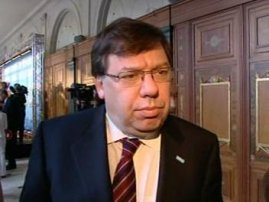
The Tánaiste (Deputy Prime Minister) Mary Coughlan (photo), who is also Minister in charge of Enterprise, Trade and Employment, was visiting Waterford this afternoon to attend a business conference in a city centre hotel.
But when she arrived, she was confronted by a large group of local protesters, most of them former
Waterford Crystal workers.

After some pathetic attempts to ignore the angry crowd, Coughlan agreed eventually - and reluctantly - to meet a delegation of the workers and listen to what they had to say. This meeting took place after she had attended the business conference.

Hours before Coughlan arrived in Waterford, around 70 former employees of Waterford Crystal and their supporters from the UNITE trade union had gathered outside the hotel in the centre of the city to protest against their loss of pensions and the non-payment of redundancy monies for workers of the once world-renowned flagship business.

At first the Tánaiste pretended not to notice the protest. She entered the hotel by the back door and went straight to the conference she had come to attend. But by that time a group of former Waterford Crystal workers had made their way into to hotel's foyer and thus could no longer be ignored or overlooked.

Later, after frantic mobile phone calls had been made and whispers were exchanged between the minister's assistant and hotel staff, Mary Coughlan agreed to meet a delegation of the protesters in a room upstairs.

The former Waterford Crystal employees had by this time brought their protest inside the hotel and refused to leave until their delegation had met with the Tánaiste. So she did not have much of a choice, really.
She listened to the workers, did not promise anything, did not say much, and what she said did not make much sense. But that's just Mary Coughlan, so no-one should be surprised (and no-one in Waterford was).

After the forced meeting with reality a flustered woman looking like Mary Coughlan left the hotel - again via the back door - and rushed back to Dublin in her large chauffeur-driven Mercedes.

The protestors, who were still assembled outside the hotel (and some inside the foyer) were then addressed by trade union representatives and informed about the meeting with the Tánaiste. There were some mutterings, and clear signs of disappointment, but then the group dispersed peacefully. Some went straight home to their anxious families, while a few others were drowning their sorrows in nearby pubs.

As things are, there is little hope for the now empty shell of Waterford Crystal, and even less hope for the hundreds of workers who gave many years of service to the company and are now left with nothing.
It also says quite a lot about the state of a country and its government when the Deputy Prime Minister can no longer enter a prominent hotel through the front entrance and has to sneak in and out by the back door instead.

The Emerald Islander

17 November 2008

ICTU accepts new National Wage Agreement

Today a Special Delegate Conference of the Irish Congress of Trade Unions (ICTU) has voted to accept the new National Wage Agreement negotiated in September and signed on September 17th. (see my entry of that day)

The president of the country's largest union, SIPTU, called on the Irish government to withhold state contracts from employers who fail to comply with the new agreement.
Speaking at the conference, Jack O'Connor (photo) said that employers who reneged on their obligations were "guilty of nothing short of national sabotage".

Last Friday it was clear that the vast majority of Irish trade unions had given the green light to the new National Wage Agreement - albeit reluctantly - and even its strongest advocates acknowledged its shortcomings. (see my entry of November 15th)

The country's second largest trade union, UNITE (formerly AGTWU), which voted against the agreement, blamed inadequate provisions on pay pensions and union negotiating rights.

However, speaker after speaker acknowledged that in the current economic climate there was no prospect of securing anything better outside national partnership negotiations. Unions will now push for full speedy implementation of every promise - particularly on employment rights.

The Irish Business & Employers' Confederation (IBEC) will endorse the deal later today, though the Construction Industry Federation is still not guaranteed to accept it at all.

Meanwhile the Irish Small & Medium Enterprises Association (ISME) has called on the government to suspend the national pay terms, in the interests of the economy.

ISME warned that it was "self-evident that wage increases will exacerbate an already perilous economic situation and, if granted, will drive companies to enforced closure, condemning more people to redundancy".
It is more than unlikely that their arguments will find much support and that the government will follow their advice.

15 November 2008

Most Unions accept new Wage Agreement

Most Irish trade unions have now accepted the draft national wage agreement which was agreed upon by the Social Partners in Dublin on September 17th. (see my entry of that day)

Yesterday SIPTU, Ireland's largest union, voted to accept and earlier members of ten other trade unions also voted in favour of the new agreement as well.
IMPACT and Mandate meanwhile confirmed that their members voted overwhelmingly for the proposed deal, too.

The Irish Nurses' Organisation (INO) announced that its members, who are employed throughout the public health service, have voted in favour, and so has the construction sector trade union UCATT, whose members voted by a margin of five to one to accept the terms of the draft agreement.

To no-one's surprise the Association of Higher Civil & Public Servants, which represents 3300 members, accepted the deal with a majority of 93%.
And the National Union of Journalists (NUJ) followed closely with 90% in favour.

However, the country's second-largest union UNITE (formerly AGTWU), which represents many members across a wide range of sectors including transport and public services, voted with a clear majority to reject the offer.
UNITE is affiliated to the largest UK union of the same name. What consequences their rejection will have is at this time not certain.

05 October 2008

Two Unions call for Rejection of Pay Deal

The Civil and Public Services Union (CPSU), which represents 13,000 lower paid civil servants, is to recommend that its members vote to reject the new National Pay Agreement when they ballot on it over the coming weeks.

The executive of the union voted to recommend rejection of the deal narrowly by a margin of nine votes to eight.
General Secretary Blair Horan (photo) had wanted the deal put to members without any recommendation, but the executive overruled his view.

It is understood that the CPSU executive were concerned about the low level of the pay increase of 6% over 21 months, the 11-month pay pause and the linking of general increases to change and modernisation.

Blair Horan acknowledged that the pay deal was "far from ideal", but said he believed it was "the best deal that could be negotiated in the current difficult circumstances".

Ireland's second largest trade union, UNITE, has already recommended that its members should reject the deal.
However, the largest public service union IMPACT has recommended acceptance.

It remains to be seen whether members will vote to accept or reject the deal in light of the ever worsening economic situation.

17 September 2008

Agreement reached in National Pay Talks

This morning - after months of general talks and weeks of intensive negotiations - the Social Partners have eventually reached a new National Wage Agreement for the Republic of Ireland.

The last session with representatives of employers and all Irish trade unions went on for 22 hours and all through the night. Negotiators on both sides realised that they were already into the third day over the deadline set by the Taoiseach, and that might have helped their minds to sharpen and reach an agreement.

The result of the long and tedious talks is a pay increase of 6% for all workers, to be paid over 21 months.
The pay rise will be applied in two phases, with a 0.5% increase at the end of the agreement for workers earning less than € 430.49 per week, or around € 22,463 per annum.

All private sector workers will have a three-month pay pause. They will then receive a 3.5% increase over six months and a further 2.5% for the following year.

Public sector workers will have an 11-month pay pause from the last module of the Towards 2016 programme.
They will then receive 3.5% for the next nine months (commencing September 1st, 2009) and a further 2.5% for the remainder of the agreement.
The agreement also contains commitments on public service modernisation to reflect the latest OECD report.

Brian Cowen explained that the new agreement would include provisions to prevent employers using temporary agency workers to break strikes.
There will also be a statutory prohibition on victimisation of trade union members, and on inducements to encourage trade union members to leave their unions.

"The new National Pay Agreement will give a sense of confidence and stability in the challenging period ahead," the Taoiseach said earlier in Dublin.
"Even though the negotiations were very lengthy and complex, the Social Partners made commendable efforts to enable the terms of a draft Agreement to be identified."

Trade union leaders and the representatives of the employers' organisations are now putting the new draft agreement before their members for approval. There will be internal discussions and a detailed examination of the agreed terms, and a result is expected in about two weeks.

"This has been a long and arduous process, played out against a background of rapidly changing economic reality for workers and the economy as a whole," said Jimmy Kelly, Regional Secretary of Ireland's second-largest trade union UNITE, after the talks had ended and rows of exhausted negotiators emerged from Government Buildings in Dublin.
Turlough O'Sullivan, Director General of the employers' lobbying group IBEC, said there were "many positives in the deal".

The Emerald Islander
23 June 2008

580 Irish Office Jobs will be shifted to India

580 jobs are to be lost at the Irish insurance group Hibernian, as part of a three-year restructuring programme.

The Irish jobs will be transferred to Bangalore in India, where Hibernian's British parent company Aviva has offices and facilities already.

It is expected that most of the jobs will be 'phased out' at the Hibernian's head office in Dublin and most of the jobs concerned will be in back office and support services.

The process will start in the first three months of next year, when the work of 80 Irish people will be shifted to India.

Hibernian's Chief Executive Stuart Purdy said the company "hopes to mitigate the impact by offering staff re-deployment and re-training".

However, the UNITE trade union, which represents most of the workers, has expressed shock and anger. The union's national officer Jerry Shanahan said his organisation had not accepted the proposal and would be challenging the Hibernian's case for the restructuring.

Hibernian insurance, which in its advertisements always emphasises that they are an Irish company, currently employs 2200 people.

06 May 2008

TEEU and CPSU take opposite Views on Lisbon

Two of Ireland's largest trade unions have announced their official positions on the Lisbon Treaty, where they support opposite sides of the argument and advise their member to vote accordingly.
The Technical Engineering and Electrical Union (TEEU) has said it is advising members to vote 'No', while the Civil and Public Service Union (CPSU) has said it will be calling for a 'Yes' vote.

The national executive of the TEEU, which is the country's largest craft union, has joined the 'No' camp and advises its 45,000 members to reject the Lisbon Treaty on June 12th.
It says it favours a social Europe, but points out that recent key judgments by the European Court of Justice show that the pendulum has swung clearly against workers' rights and in favour of big business.

The CPSU, which has about 13,000 members, has said it will be calling for a 'Yes' vote.
This is not such a surprise, as most members of the CPSU are employees of government departments and state agencies, and as such not entirely free and objective in their views on a treaty that is so heavily promoted by the government they serve.

Of course the official advise of the trade unions is not binding for their members, and everyone is free to vote according to their own views and decision.

The UNITE trade union (formerly called ATGWU) has already declared its opposition to the Lisbon Treaty some time ago, predominantly on the same grounds as the TEEU, and joined the 'No' campaign.
And while SIPTU is still weighing the pros and cons of the treaty internally, many SIPTU members - including local organisers and shop stewards - are already actively campaigning against the acceptance of the Lisbon Treaty.

The two recent judgments in the European Court, based on the new positions the Lisbon Treaty has created, are indeed alarming for workers in Ireland and all over Europe, as well as for trade unions.
As a spokesman of the Swedish trade union council put it quite clearly after the first judgment: "A few more decisions like this, and the European trade union movement will be dead and workers' rights will be the playing ball of big industry."

The Emerald Islander

14 April 2008

SIPTU meets over Pay Talks Strategy

Around 500 delegates from Ireland's largest trade union SIPTU are meeting in Dublin to decide whether to enter talks on a new national wage agreement. They will set out an agenda for the negotiations, including pay increases well ahead of inflation, along with legislation on agency workers and union recognition.

SIPTU delegates representing over 200,000 members are expected to support entering the next pay talks. They want concrete measures to prevent exploitation of agency workers, which they blame for the so-called 'race to the bottom' in employment standards.

The delegates also want action on union recognition rights. However, for most delegates the priority is pay. Towards 2016 promised increases worth 10% over 27 months, but inflation has meanwhile eroded most if not all of that.

Workers' fears will be fuelled by a report published today by the UNITE trade union. It claims Irish private sector wages are now 25% below average wages for the top ten EU member states. Like SIPTU, it wants pay increases substantially ahead of inflation, just as employers complain they are facing a global downturn.

11 February 2008

British Embassy Strike continues

Workers at the British Embassy in Dublin will take to the streets for a second one-day strike next Wednesday, February 20th.
At lunchtime today a general meeting of the more than 40 members of the Unite trade union voted unanimously to take this next step in support of three colleagues who face compulsory redundancy.

Pickets will again be placed outside the Embassy on Merrion Road in Ballsbridge and at the British Ambassador’s residence in Glencairn. “There is a real sense of purpose among the Embassy workers,” said Unite Regional Officer Colm Quinlan after the meeting. “They are determined to support their colleagues and to stand firm with regard to their own future security of employment.”

Over 40 members of Unite, including trade and industry staff, passport section workers, administration officials and household staff from the Ambassador’s residence picketed the British Embassy in a first one-day strike on Thursday, February 7th, after Ambassador David Reddaway refused to attend the Labour Relations Commission for talks. A skeleton staff of British diplomats manned the headquarters in Ballsbridge as their colleagues took to the streets with banners.

Derek Simpson
, General Secretary of the Unite Union which has over 2 million members in Britain and Ireland, has written personally to the British Foreign Secretary David Milliband, MP, asking for his intervention and for "common sense to prevail".

Dublin is the only British embassy worldwide that recognises trade union membership, and there has been a positive and agreed set of procedures dealing with issues and disputes since 2003.

The decision on the compulsory redundancies, which is understood to have originated in London, falls outside those agreed procedures. The individuals affected are locally recruited managers, dealing with UK trade and investment matters in Ireland. Between them they have 20 years of service at the Embassy.

It has also emerged that embassy staff members have lodged a claim for up to € 500,000 in unpaid PAYE allowances, to which they were entitled over the last eight years. The British Embassy - like many others - claims it is not obliged to pay PAYE, because of its diplomatic status. But Unite says other embassies pay money in lieu of the allowance, which the British Embassy stopped doing eight years ago.

Members of the embassy staff are officially registered as "self-employed" and pay and declare their own taxes. Although their employer deducts PRSI, it has never paid PAYE, meaning staff are not eligible for the allowance. Unite has estimated that employees are due a cumulative bill of up to € 10,000 per staff member, amounting to a total bill of between € 250,000 and € 500,000.

Last week the Tanaiste (Deputy Prime Minister) and Minister for Finance, Brian Cowen, TD said that his department had "encouraged" all foreign missions in Ireland to operate the PAYE system for locally hired staff in June 2005.

The Irish Congress of Trade Unions (ICTU) said that the British Embassy should "come to its senses". It accused the embassy of "failing to abide by agreed procedures" by forcing redundancies.
"I find it rather disappointing that the embassy should see fit to ignore the established industrial relations procedures and machinery of this State," said ICTU General Secretary David Begg.

British Embassy staff cannot speak publicly about the dispute, because they are bound by the UK Official Secrets Act. So once again we can see how - after more than 86 years of nominal Irish independence - British laws and rules have still influence on this country and some of its citizens.

The Emerald Islander