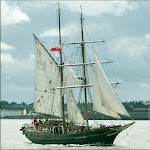
According to several experts in traditional ship and boat building, a possible replacement for the sail training vessel Asgard II (archive photo left), which sank off the coast of France on September 11th (see my entry of that day), could be built in Ireland with existing Irish skills and craftsmanship.Michael Kennedy and Bill Crampton, the two shipwrights who led the construction of the replica famine ship Dunbrody - a three-masted barque now moored as a museum vessel in New Ross, Co. Wexford - have told the Irish Times that their entire team is "still alive and well" and "available for such a project", should it become necessary.A suitable premises for building a new vessel may also be available in the south-east of Ireland - most likely the place in New Ross where the Dunbrody was built - to ensure that it would be ready in time for the next Irish hosting of the International Tall Ships' Race, in 2011 here in Waterford.
 Ireland's Minister for Defence Willie O'Dea, who is also chairman of Coiste an Asgard, had expressed concern about the availability of skills in Ireland to build a replacement, if such a decision was taken.O'Dea was commenting after the sinking of the 27-year-old brigantine in the Bay of Biscay, but before an inspection of the vessel had taken place.Now Coiste an Asgard is hoping to raise and repair the sunken vessel, which has meanwhile been inspected and found widely intact, sitting upright on the seabed, with only minor visible damage to the hull. (see my entry of October 3rd)Insurers are assessing the situation, and an investigation into the cause of the sinking is still being conducted by Irish and French maritime authorities.A spokeswoman for the Department of Defence said that it was "still too early to say whether any attempt would be made to salvage the Asgard II", lying in 80 metres of water, or rather build a replacement.The beautiful green-painted brigantine, designed and built in 1980-81 by Jack Tyrrell of Arklow, Co. Wicklow, was insured for € 3.8 million. The Dunbrody construction team said this could provide "vital seed capital" to build a new training ship for the Irish State.Up to 65 people worked on the construction of the Dunbrody in New Ross, Co. Wexford, which was launched by former Taoiseach Bertie Ahern in February 2001. The project was initiated by Seán Reidy of the John F. Kennedy Trust, and based on the design of an emigrant ship built in Quebec/Canada for a New Ross merchant family in 1845.Over the ten years it took to build the replica Dunbrody (in the foreground below), extensive skill training took place at the wharf, and the national training authority FÁS was heavily involved in it as well. The building of the Dunbrody cost a total of € 6 million, including FÁS labour, whereas the Kerry-built replica famine ship Jeanie Johnston (in the background below) ran well over budget and cost eventually € 15.8 million.
Michael Kennedy said that - in addition to his own team - several craftsmen involved in the construction of the Jeanie Johnston also had sufficient skills to work on a new vessel, and he hoped that the maritime sector would co-operate on such an initiative if it was approved by the Irish government.
"We've had a sail training ship since the foundation of the State, starting with the original Asgard," he explained, "and it would be a terrible pity if we did not have one in future."
Bill Crampton added that proposals to hire the
Jeanie Johnston to continue the sail training programme "might meet a short-term need, but it would not be a suitable successor to the
Asgard II".
I completely agree with both statements, as I have already expressed in previous articles here. And I would even suggest that building a new (second) sail training vessel for the State should be considered, even if the
Asgard II can be salvaged and put back into service.
In the 1980s, when she was constructed, the interest in sail training was very limited in Ireland. The
Asgard II was purpose-built as a brigantine to fulfil the Irish need and demand of the time. But now her limited capacity of only 20 trainee places is almost too small for the meanwhile increased interest in sailing and sail training here.
Especially in recent years - due to the great success of the annual
Tall Ships' Race and other major sailing regattas and events for tall ships - the idea of sailing and using tall ships for training and team building exercises for young people has become very popular.
Being an island nation with a long and considerable seafaring tradition, Ireland could well afford and sustain two sail training vessels.
The element of
costs will of course be a major argument in the current times of recession and global financial crisis. But I would not worry about that. If organised properly, the money for a new vessel could be raised through
public subscription. There are many wealthy people in Ireland and around the world, and many of them are sailing enthusiasts.
I would be prepared, willing and more than happy to organise the fund-raising activity for a new Irish sail training vessel and have in fact already made some contacts with other people in the sailing community about it. The reactions I received are all very positive, so now it is up to the government and
Coiste an Asgard to make a decision.
The Emerald Islander
 Robert 'Bobby' Molloy (photo left), a former Irish Minister for Defence, is supporting calls for the raising of the Asgard II from the seabed in the Bay of Biscay, where she sank in the early hours of September 11th. (see my entry of that day)
 In an interview with Ireland's national broadcaster RTÉ, Mr. Molloy said that the Asgard II (archive photo right) had made "a huge contribution to the nation, training thousands of young people and helping to formulate their characters".
 Willie O'Dea (photo left) said that Coiste an Asgard, the committee which runs the vessel's operations (and which he chairs), has also been looking at a possible replacement to continue national sail training, but has not yet made a decision.