Showing posts with label Central Statistics Office. Show all posts

29 May 2009

CSO says: Export and Import Levels are falling

Preliminary figures show that goods to the value of € 7.28 billion were exported from Ireland in March of this year. This is a 6% drop from February.

The Central Statistics Office (CSO) in Dublin states that imports into Ireland were unchanged at a value of € 4.14 billion. The figures are adjusted to take seasonal variations into account.

Detailed figures for the first two months of 2009 show that imports slumped by 25% to the value of € 10.7 billion, as spending power in the Irish economy weakened, with imports of road vehicles plummeting by 74%.

Imports of computer equipment were down 34%, while imports of all types of machinery were "down sharply".

There was a 4% fall in exports in the first two months of 2009, compared with the same period last year, to the value of € 13.9 billion, with electrical machinery down 40% and computer equipment down 29%.

Exports to China were down 24% in the first two months of this year, while exports to Britain fell by 6%. But exports to the USA were 6% higher than in the same period of last year.

Huge Increase in Working Days lost

Official figures also show a sharp increase in the number of days lost to industrial disputes in the first three months of this year.
The CSO says that 11,327 working days were lost in that period, compared with only 1,477 days in the same period of last year.
However, these figures come from only three industrial disputes, and the main factor was a one-day strike by civil servants over the pension levy in February.

11 December 2008

CSO reports the lowest Inflation Rate in Years, but there is little Evidence in the Shops yet

The annual rate of inflation in Ireland has eased sharply in November, falling to 2.5% from 4% in October. This is the largest reduction since monthly records began.

According to the Central Statistics Office (CSO) in Dublin, the overall cost of living fell by almost 1% during November alone.
Lower mortgage repayments, as well as petrol and diesel price cuts were the main reasons for the reduction. However, there are no signs of food prices coming down. They are still as high as they were last month, and in some cases one can even see further rises, even though not as much as they rose throughout the first half of the year. (see also my entry of February 28th)

2.5% is the lowest inflation rate Ireland had for three years, and many economic indicators suggest that further reductions are likely in the months ahead.

The key factors behind the reduction are global, including a sharp interest rate reduction by the European Central Bank (ECB) in October, as well as rapid cuts in international oil prices due to mounting evidence that the global economy has entered recession.

Today's figures show average mortgage repayments fell by 8.4% in November, as banks began to pass on to borrowers the first of three interest rate reductions. Rents also fell by 6.1% during the month.

There was also a sharp reduction in the cost of home heating oil, which was down by more than 10% in November.
Since I heat my little house with peat and wood, that does not help me. The price for fire wood rose by 20% this year, and peat went up 12.5%. (This came on top of similar rises in 2007.)

Petrol prices were down 7.3% and diesel by almost 10%, as international oil price speculation rapidly unwound. Nevertheless people in Ireland still pay a lot more at petrol stations than anyone else in Europe. Only a few days ago Fine Gael's deputy leader and Finance spokesman Richard Bruton stated that petrol is 24% more expensive in Ireland, while diesel costs 18% more than in the other 26 EU countries. (see my entry of December 3rd)

With further interest rate and oil price cuts still to be passed on to consumers, all the signs suggest that inflation will ease further in the months ahead. There is also likely to be significant downward pressure on inflation coming from the strength of the Euro, which hit another record high of 88.8 pence against the British Pound Sterling today. This would be the equivalent of the old Irish Punt being worth almost £ 1.13, its highest value ever.

At least the currency value proves that adopting the Euro was a good and sensible decision, even though there were plenty of critics and grumblers during the first few years. But that has eased now.

Overall, today's figures are a little bit of good news from the CSO, which has delivered only bad news to us for most of the year.
However, for people like me, who don't have a mortgage and don't drive a car, the fall in inflation is only another number. I watch very closely the prices in the shops, and there have been no reductions at all. The whole of 2008 has seen an ever further rice in prices for even the most basic food and consumer goods. It will be interesting to see if the apparent fall of the inflation rate will reach the shops before Christmas. I somehow doubt it, with the exception that probably pork and products made with pork will be offered at reduced prices as soon as they are back on the shelves.

But that will have nothing to do with inflation. It will be an attempt to make good for the losses shops as well as producers made due to the recent contamination scandal and the subsequent food scare.
Being a vegetarian, this will not do me any good either. So, as much as I welcome the CSO's news of falling inflation, I have not seen or experienced any of its benefits yet.

The Emerald Islander

03 December 2008

Unemployment Rate in Ireland reaches 7.8%

The latest unemployment figures from the Central Statistics Office (CSO) show another record number of Irish people signing on to the Live Register in November.

16,900 people signed up for unemployment payments or Social Welfare credits last month. This brings the total to 277,200 - the highest level since September 1996.

In the year to November, the Live Register saw an unadjusted increase of 106,864 - a jump of 66.1%. This compares with an unadjusted increase of 94,502 or 60% in the year to October.

The figures released today show that another 13,600 men signed on the Live Register in November, reflecting the ever slowing construction industry. There was also an increase of 3,300 women.

The CSO says that the standardised unemployment rate in November rose to 7.8% from a rate of 7.4% in October.

22 November 2008

FÁS warns of a serious Employment Crisis while the Taoiseach keeps waffling on as usual

Ireland's self-serving and pompous training and employment authority FÁS is warning that "the number of people employed in Ireland could fall by more than 100,000 next year".

And what is FÁS doing about it? Absolutely nothing!

As long as unemployment rises, their own jobs are by far the safest in the whole country and they can keep enjoying their cosy existence as a well-financed State agency, which spends close to half a million Euros on 'away weekends' for its staff and nearly € 150,000 on office flowers. But then again, with an annual budget of over € 1 billion only the best is good enough for the well-paid, but entirely useless administrators of the nation's unemployed.

The figures suggested by FÁS would be four times more than the annual fall in employment registered in the Quarterly National Household Survey of the Central Statistics Office (CSO). (for details see my earlier entry below)

Commenting on the economic situation, FÁS economist Brian McCormick has said that "the 'credit crunch' is now beginning to hit employment in the financial sector, while the slowdown in consumer spending has adversely affected job prospects in the retail sector". (Now, there is a rare pearl of wisdom! One cannot help but wonder what FÁS needs an economist for in the first place. They are not a bank or financial institution.)
FÁS also says that the rate of unemployment could exceed 8.5% next year. (How fortunate for them. They will be really busy in 2009.)

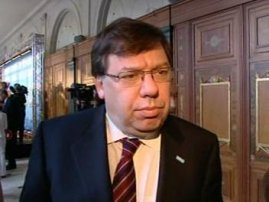
Meanwhile, Taoiseach Brian Cowen (photo) said it was "obvious there is a very difficult economic situation that is affecting our economy the same as others".
But he and the government were "trying to minimise job losses".

One has to congratulate the Taoiseach on his quite exceptional observation and perception skills. He has indeed noticed that we are in "a very difficult economic situation". Well, well... I suppose they do have a newspaper in Co. Offaly after all.

But with the "minimisation of job losses" he seems not to be up to date.

Only yesterday it became known that thanks to his new regulations and Brian Lenihan's budget cuts Donegal County Council alone will have to sack 238 of their workers, and not only the 71 which were already told about it the day before. (see my entries of November 20th & 21st)

I have a very simple solution for the problem, and a suggestion that would indeed minimise job cuts in Ireland. If Brian Cowen and his government would resign (and call a general election), there would only about 45 jobs lost, but the whole country - and with it many thousands of jobs - could be saved.

The Emerald Islander

A Bag full of bad News from the CSO

There was a massive fall of 25,000 in the number of people employed in Ireland in the twelve months to August this year, according to the latest Quarterly National Household Survey from the Central Statistics Office (CSO).

This is the first annual fall in employment recorded by the CSO since 1991. The figures also show that unemployment increased by 60% during the same period.

It is the first time for 25 years that this combination of a sharp fall in employment as well as a sharp rise in unemployment has been recorded in official figures.

Men are doing particularly poorly, with the number of employed males down by 32,000 over the year, while women are faring much better, with a gain of 7,000 in employment during the year.

This shows once again and very clearly that the whole structure of the Irish labour market is changing and shifting from a male to a female dominance. There are three reasons for that:
1) The fact that most women are still earning less than a male equivalent doing the same job. Thus it is cheaper for companies to employ women.
2) The massive increase in low-skilled service jobs, which are predominantly filled with women, while there is a clear decline in manufacturing and other skilled jobs, usually held by men.
3) The ever more aggressive implication of so-called 'equality', which over-proportionally favours women and makes it increasingly more difficult for men to get a fair treatment and a proper job.

The collapse in construction has been one of the biggest drivers of the trend, with the numbers of those engaged in house building down by 40,000 compared with this time last year.
Other areas of construction expanded a little, providing some cushion for builders with a gain of 14,000 jobs on infrastructure and commercial building projects.

Employment in manufacturing is down 9,400, while the contraction in the 'leisure industry' has made another 5,400 people redundant in hotels and restaurants over the 12-month period.

It appears that the job losses are more severe for Irish nationals, as the overall employment of foreign workers is unchanged from last year.
However, the flow of non-Irish nationals into the country has slowed down to just one-sixth of the level of last year. This is not surprising. We were only attractive for migrant workers - most of them from eastern Europe - as long as there were more jobs than we could fill ourselves and more money than anywhere else. In fact, I expect that a good number of Poles will return home for the Christmas and New Year celebrations and not come back, because while Ireland is now in rapid decline, Poland shows the first signs of economic flourish and is tipped to be the next boom country in Europe.

The Emerald Islander

01 October 2008

Record Rate of Unemployment

New figures published today show that the number of people signing on the Irish Live Register (to receive unemployment benefit) increased at a record rate of almost 50% in the year to September.

The Central Statistics Office (CSO) in Dublin said that the seasonally adjusted figure for September 2008 was 244,500, an increase of 9,400 from August.

The unadjusted figure fell back by just over 7,000 to 240,217, but the September figure usually drops as students return to college. The unadjusted figure is up 49.5% since the same period last year, beating the previous month's record rise of 42%.

The unemployment rate moved up from 6.1% in August to 6.3%. The monthly increase in the seasonally adjusted figure was made up of 5,800 men and 3,500 women.

Reacting to these figures, the Tánaiste and Minister for Enterprise, Trade & Employment Mary Coughlan (photo) said "the downturn in the economy inevitably leads to an increase in the number of unemployed".

(Well, such pearls of wisdom I would not have expected from her...)

She said that the national employment and training authority FÁS - which is still under investigation for imprudent use of money and overspending on their budget - would have to be "refocused to allow people who fall into unemployment to immediately sign up to training services with the agency".

She stressed that the "job pipeline" looked good with new announcements to be made in the coming weeks, adding that the measures being taken this week by the government will copper fasten the country's position and create a sustainable economy.

Foreign direct investment would continue to remain strong and see "greater growth between now and the end of next year", the Tanaiste said.

She described the government's support for banks as a bold move which would send out a strong message to the world. New opportunities across the globe were continually being examined and the latest move by the government was "a clear signal that Ireland is still very much open for business".

Well, these are nice words, but we have heard the likes of them before. What we now want to see is a realistic policy towards greater prosperity and higher levels of employment. The widespread policy of 'outsourcing' work to the lowest bidder (which is often in China or some other Asian country) is destroying not only many jobs, but also undermines the skill level in this country. We have to realise that getting things made for the cheapest price might not be the best solution and only creates more costs for the whole of society.

We should have pride in our skills, experience, artisanship and inspirations. And if producing the things we need at home makes them a little bit dearer, so be it. We have at least jobs that way in our country and economy, and that means also stability, prosperity and happiness.

A Chinese worker cares for China and not for Ireland. He is paid little to work fast and fearless, and European quality levels are not on his mind. So he will produce what we need, but the level of product quality is falling steadily throughout our markets since the 'outsourcing' began. Let's be sensible and make sure we have an industry and economy left when the recession is over.

The Emerald Islander

05 April 2008

Unemployment rises to 5.5%

Ireland's unemployment rate has risen from 5.2% to 5.5%, a figure not seen since June 1999.
The information from the Central Statistics Office (CSO) show an increase of 8,507 to 197,992, beating February's record rise of 8,000. This represents a 27% increase on the same month last year, the biggest monthly percentage rise since March 1983.

The seasonally adjusted Live Register figure rose by 12,000 from February to reach 199,900.
This is the biggest rise on record.

More worryingly, the increase in March has been evenly split between men and women, suggesting wider deterioration in the labour market beyond the construction sector. This differs from recent months, when men made up most of the rise.

The figures were higher for all Irish regions, with the biggest percentage increase of 7.2% coming in the South-East.

As the jobless figure is rising, the Central Bank says that the problems in the global banking sector are proving to be more prolonged and far-ranging than had been hoped. So the bank expects Irish GNP to increase by just 2% this year, down from a rise of 4.5% in 2007.

07 March 2008

Most new Jobs are for Women

Women have been more than twice as successful as men in finding a job in the Irish labour market over the past year. According to the latest Quarterly National Household Survey from the Central Statistics Office (CSO) in Dublin, new jobs for women were responsible for almost 70% of the growth in employment.

The CSO reports that a total of 66,800 new jobs were created in the Republic of Ireland during the analysed 12-months period ending last November. However, the picture is not as positive as it might look at first sight.
More than half of the new jobs offered only part-time employment, and 60% of them resulted from a surge in self-employment (which is encouraged and promoted by several government agencies and the Department of Social and Family Affairs).

In the same time period the number of men employed in Ireland fell by almost 10,000. This is the alarming part of the statistic, as it shows that the number of traditional jobs for Irish men, mostly in manufacturing and transport, is still in a steady decline.
Long-established Irish businesses have closed over the past few years - even during the boom time of the "Celtic Tiger" - or transfered their manufacturing jobs to the low-wage countries in the so-called "third world". Despite the happy sunshine talk from the government, Ireland is losing its competitiveness, and subsequently many skilled workers lose their job.

Many of the new jobs created - often with massive public announcements and huge PR - are in fact only low-paid part-time positions, predominantly in retail, service and food businesses. They are specifically tailored for unskilled or low-skilled labour and prefer to employ women, who are much easier willing to take part-time jobs than men.

Even though the country is still awash with surplus money and most people think that we never had it so good, the clouds of economic decline have been gathering over Ireland already for the past three years. The recently published employment data from the CSO underline this trend with clear figures, and it remains to be seen if the government will react in a positive way and make sure that there is enough employment for skilled Irish men (as well as for the women).

The Emerald Islander