Showing posts with label Pat Kenny. Show all posts

09 September 2009

Micheál Martin's Woolly Waffling

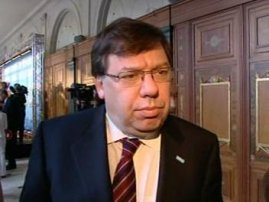
Until this morning I thought that Micheál Martin (photo) is Ireland's Minister for Foreign Affairs.
But since his appearance on the Today programme with Pat Kenny on RTÉ Radio 1 earlier today, I have my doubts.

The 'performance' Martin gave this morning in relation to the Lisbon Treaty makes him more qualified as the Minister for Woolly Waffling, and that is exactly what he does now for quite some time. He tries to pull the wool over the eyes of the Irish people, while he waffles on about "being at the heart of Europe" and how important it is to please everyone else in the EU.

When he took his oath of office as a Minister, he swore to act at all times in the interest of Ireland and the Irish nation.
This he most certainly does not when he performs cheap advertisement stunts for the Lisbon Treaty.
Instead of doing his best to protect the nation in whose government and parliament he serves, Martin signs away ever more of our rights, ignores the democratic will of the Irish people - as expressed very clearly in last year's referendum - and turns himself and the Irish government into weak push-overs for unelected but ambitious EU bureaucrats.

This is more than disappointing. In fact, it comes dangerously close to treason.

And this is the man whom quite a lot of Irish people would still regard as a possible Taoiseach in waiting.
Well, if he does not change his tone and attitudes very soon and very drastically, I cannot see him progressing any further. He will most likely end up on the large dust heap of Irish history, together with the majority of arrogant, useless, clueless and incompetent Fianna Fáil politicians.

The Emerald Islander

14 May 2009

Thank God, it's not Miriam!

Earlier this week Ireland's national broadcaster RTÉ has announced that the 35-year-old Ryan Tubridy (photo above) will be the new host of the station's flagship TV programme, the 'Late Late Show'.
The announcement was apparently "a surprise" for may people in Ireland, and in particular for the Irish bookmakers, who had the 49-year-old TV presenter and mother of eight Miriam O'Callaghan listed as favourite for the job, ever since the show's present host Pat Kenny (photo below) announced his intention to step down at the end of the current series.

Since I dislike television, never watch it on purpose, and not even own a TV set, I am probably not the most qualified person to write about this. But even I know enough about the show and the people involved, and occasionally I have seen bits and pieces while I was in other people's houses. So I will share my views with you, as usual, and invite you to comment or engage with me in debate (below) if you agree or disagree with me.

The really important thing is that the 'Late Late Show' is the longest-running television chat show in the world. Having started in 1962, originally as a short-time filler programme for the summer months, the show is now in its 47th year and - to my amazement - still immensely popular with the nation's TV audience.
In the early years it began at half past eleven on a Friday evening, which was more than late for Irish people in the Sixties and gave the show its name. (There was also already a 'Late Show' on the BBC, which can be received easily in Ireland, and the producers did not want to confuse their viewers, nor get into copyright troubles with their British colleagues.)

Despite its age, the show had so far only three regular hosts. And one of them, Frank Hall, did the job only for a little over a year (1968-69) and is hardly remembered for it.

The man who comes first to most people's mind when the 'Late Late Show' is mentioned is undoubtedly Gabriel Mary 'Gay' Byrne (left), who more or less single-handedly created, shaped and established the programme as a TV mainstay. He hosted the show for 37 years, which must make him one of the most consistent TV presenters in the world (if not the longest-serving).
Gay Byrne, by nature rather a light-hearted man, was always more an entertainer than a dry and factual journalist. He very much enjoyed the light and glossy character of the show, which - at times - also has very serious moments.
In fact, no other modern media element had so much direct influence on the Irish society in recent times. Many movements, ideas and trends of the late 20th century began for Ireland on the 'Late Late Show'. Ever so often the programme was truly controversial and caused upset and outrage in various quarters, from the hierarchy of the Catholic Church to the staunchest Protestant Unionists in the North.

Way back in the early 1960s Gay Byrne was probably not more than a very lucky man among Irish TV journalists. If RTÉ had chosen someone else to host the show, who knows what might have become of young Mr. Byrne. And who knows what might have become of the programme. Perhaps it would have been not more than a short summer filler (as originally intended) and we would not even know or remember its name by now.

But, as always in life, when the right person comes to a cross-road and makes the right choice, big things can wait further down the road. Gay Byrne became not only Ireland's most popular and successful broadcaster, he also made the 'Late Late Show' a household name in Ireland and beyond. And this is meant literally, as Byrne was not only host of the show, but also directed and produced the two-hour-long weekly live programme with great skill and inspiration.

Being well-connected in Dublin's political and society circles, Byrne used his influence and made things possible that without him (and his contacts) would have been hard to imagine. And even now, ten years after his official retirement from the show and from RTÉ, he is still a very active man at the age of 74.
As chairman of the national Road Safety Authority (RSA) the former biker is now a frequent promoter of safety and common sense on Irish roads, and besides that he still finds enough time for special programmes on radio and TV. (For example, his series of erudite studio talks about the four main characters of Jesus' passion - which was broadcast earlier this year, in the week before Easter, on RTÉ Radio 1 - was among the best intellectual radio programmes I have heard in all my life.)

When Gay Byrne decided to retire in 1999, there was for a while great consternation in RTÉ. Who could fill the very big shoes of a man like 'Gaybo'? Was there actually anyone who would even dare to try?
Well, yes, there was. And after contemplating for some time to retire the whole show with Gay Byrne, the RTÉ bosses decided against it. They knew only too well that a programme that big, that popular and so well-established could never be replaced with 'something else'. Not even to mention the nice income from advertisement and sponsorship revenue the 'Late Late Show' generates every week.

So the programme was handed to Pat Kenny, who had made a name for himself already with a number of smaller chat shows and had a considerable track record in traditional journalism and current affairs.
But in contrast to Gay Byrne the new presenter was not a show man. So there were soon critical voices, saying that Kenny's interview style was "too serious", "wooden" and "lacking humour", especially when he was talking to more light-hearted and non-intellectual people like show stars, actresses, models, dancers and some popular singers.
From the few bits and pieces I have ever seen of the show I would agree with those comments, but I would not hold it against Pat Kenny. He is a serious man, with a good journalistic mind, and he demonstrates his interview skills every week from Monday to Friday (10 am to 12 noon) on RTÉ Radio 1.

The light-hearted and glitzy show biz chat on the 'Late Late Show' delighted Gay Byrne, but it bores Pat Kenny, who is interested in real and bigger things.
But I suppose the show was too good a plum to refuse, when RTÉ offered it to Kenny. After all, hosting the station's flagship TV programme made Pat the best-paid person in RTÉ (with more than € 850,000 per annum). I don't think there are many who would say no to such an offer, when it comes their way.

However, after a decade of crafted performances and mixed experience as a would-be showman, Pat Kenny has enough. He probably longs for more reality and serious subjects, and plans to present a new current affairs programme on TV as soon as he ends his ten-year tenure of the 'Late Late Show'. And I have to say that I look forward to that very much. (Even though I won't see the programme, as I don't watch TV, I will hear and know of it, and of the subjects it tackles.)

So now the entertainment gurus at Donnybrook had to find someone new again. As soon as the word was out, some well-known names were mentioned as possible successor for Pat Kenny.

Gerry Ryan (right), one of the biggest beasts in the jungle of RTE's Radio 2 fm (which is aimed at young and less intellectual people), was in the frame right away. He had a little head start, as he stood in for Pat, presenting the 'Late Late Show' on October 24th, 2008, when Kenny took time off after the sudden death of his mother.
But despite his well-known interview skills, Ryan did never have a realistic chance to inherit the programme. Many see him as a lazy slob, and the very public break-up of his marriage did surely not enhance his image either.

Derek Mooney (left), who is now rather a light-weight presenter and works on both radio and TV, was mentioned for the 'Late Late Show', too. He started his career as a RTÉ child performer, but is best known for his excellent and long-running series about animals and wildlife. However, this was before he received big pay cheques from RTÉ. Since he began presenting some of the National Lottery's silly and utterly brainless game shows on RTÉ TV, Mooney comes across quite shallow and artificial. Sad really, but what can one do...?

Ryan Tubridy, who is not unlike Mooney - except that he is not homosexual and has no special interest in wildlife - was in my opinion the 'dark horse' in this race right from the start. Although many regard him as "too flippant and too young" (he is 35, but looks at least ten years younger), I thought that he is the one to watch. Why? Because - like Gay Byrne - Tubridy has the right political and social connections.
What many who watch his TV show and listen to his radio programme seem not to know is that - despite the name Tubridy - Ryan is (through his mother) a member of the prominent Andrews family and thus part of the inner circle of Fianna Fáil's small elite.
Two of his uncles are former TDs, and two of his first cousins are currently members of the Dáil. His grandfather was a close associate and confidant of Eamon de Valera. One of Ryan's uncles - David Andrews - has been the Minister for Foreign Affairs and Minister for the Marine. He now heads the Irish Red Cross. And Ryan's cousin Barry Andrews is Minister of State for Children in the current government.
Even though Ryan is apparently "the non-political one" in his clan and seen by some as "a bit of a clown", he should not be underestimated. During his student years at University College Dublin (UCD) he was a very active member of Ogra Fianna Fáil (the youth wing of the party), and when he speaks about politics or interviews people with a political background, I can hear that his interest is deep and sincere, and based on actual knowledge.

But, for whatever reasons, Ireland's media and bookmakers rated Miriam O'Callaghan (right) as the favourite to succeed Pat Kenny as host of the 'Late Late Show'.
The 49-year-old co-presenter of RTÉ's current affairs magazine 'Prime Time' and mother of eight children was the only female candidate. And as we now live in an age of rampant feminism, most women in RTÉ took it for granted that the job would automatically go to a woman, as it often is these days (while many men are regarded as surplus to requirement).
Fellow RTÉ broadcaster Marian Finucane even said on air that "the job is as good as Miriam's already". Well, you probably know what they say in Rome. The one who goes into a conclave as papabile does usually come out a cardinal.

To make it quite clear, I have nothing personal against Miriam O'Callaghan. But I am awfully glad that she was not chosen to host the 'Late Late Show', and it appears that I am not alone with this opinion. "Thank God, it's not Miriam!" said a friend of mine, who does watch the show every week. "I don't think I could bear her fishwife slang for two hours."

As usual, my friend does not mince his words. And he puts the main point right on the spot. No matter what else Miriam O'Callaghan is or does, she has by far the most unpleasant and vulgar Dublin accent on RTÉ. Sometimes one has even problems to understand her at all. (Many other famous people had similar problems, but they overcame them by taking elocution lessons and speak now perfectly well and understandable. Why Miriam O'Callaghan never took such lessons is puzzling and hard to fathom. Since she is paid more than € 250,000 per annum, a shortage of funds can certainly not be the reason. Perhaps she just does not care and does not mind sounding like a low class washerwoman. But in no other country I know would a person with a comparable accent to the one of Miriam O'Callaghan ever come even near a microphone or TV camera!)

If anyone abroad might wonder how on Earth such a person could get a job as a TV presenter in Ireland in the first place, then I recommend to have a closer look at our country and structure. The political system here is supposed to be Democracy, but in fact it is Nepotism. And it does not limit itself to politics. Everything here is based on who you know, not what you know and can do. Thus we have many unqualified people in prominent positions, and Miriam O'Callaghan is only one of them.
She studied Law and worked briefly as a solicitor in Dublin. But she soon figured out that it is a boring job and looked - as young girls do - for something more glamorous and exciting. Aged 20 she met through her work the journalist and broadcaster Tom McGurk, who is 14 years her senior and worked already for RTÉ. Three years later they married and moved to London. And, despite having no journalistic training and instead one of the world's most awful accents, Miriam soon began working for British TV, but mostly behind the scenes.
Ten years later the couple and their four daughters returned to Ireland. Tom McGurk worked for RTÉ again in various departments, and soon after Miriam was there as well. One would think that having to bring up four daughters would be more than enough work for a mother, but then again, there are different types of mothers...

After 13 years the marriage failed. McGurk and O'Callaghan separated and got divorced later. But both continued to work for RTÉ, and Miriam soon picked up her second media husband, the producer and documentary maker Steve Carson, with whom she has now also four children.

But despite her responsibility for a family of ten, Miriam O'Callaghan seems to increase her screen presence rather than to reduce it. Had she been given the 'Late Late Show', this would have been even more the case.
But she did not get it, and one should be grateful for small mercies.

Although I do not watch television, the idea of having the nation's flagship TV show hosted by a lawyer with no journalistic training who married her way into broadcasting - twice - and cannot even speak clear, proper and understandable English, fills me with strong resentment. It is bad enough that most of our government consists of morons, and we should not do any more damage to Ireland's public image.

So from September on Ryan Tubridy will be the fourth host of the 'Late Late Show'. Hard to say what to expect, and I don't really have much personal interest in it.
But it is significant that at a time when Fianna Fáil - and the government led by the party - are extremely beleaguered and unpopular, the national broadcaster appoints a member of one of the most prominent Fianna Fáil dynasties as the host of the country's most popular entertainment show.

As regular readers of this weblog know, I am not a friend or supporter of Fianna Fáil. And I do not know what - if any - political allegiance Miriam O'Callaghan has.
But when it comes to broadcasting and presenting television programmes, political background or party membership are not the priority. The first element I look at is the qualification for the job, and the ability to do it.
And here the facts and the candidates - literally - speak for themselves: Ryan Tubridy in clear and understandable English, and Miriam O'Callaghan in a slang one might expect from Molly Malone, but not from a woman on RTÉ television.

Some feminist groups are already muttering of "unfair treatment" and "discrimination" (which is as ridiculous as feminism itself), but I think RTÉ has made the right decision.
There are quite a lot of traits Ryan Tubridy and (the then younger) Gay Byrne have in common. I would not be surprised to see the 'spirit of Gaybo' that was clearly absent from the show during the Kenny years return with Ryan Tubridy. And there is another little extra: Should the show be ever short of studio guests, Ryan could just ask a member of his extended family to come in. The Andrews clan could easily fill a whole show with their own movers and shakers alone.

The Emerald Islander

08 May 2009

The Answer is blowing in the Wind

For centuries Ireland was a poor and backward country, left quite deliberately undeveloped as a purely agrarian nation by its English masters. After we achieved home rule and established the 'Free State', our resources were scarce and development of infrastructure and industry was an extremely slow process. (And this process is still ongoing.)

When Ireland joined the EU (then called EEC) in 1973, we were regarded as the least developed country in the union (of then nine members), and thus we qualified for enormous payments from the European Development Fund (EDF).
Over the years billions were flowing into Ireland, donated by our European partners, to help us with our domestic development. Without these financial donations the Republic of Ireland would most likely still be a country of small farmers and widespread poverty, with bad roads, donkey carts, appalling communication systems and massive emigration of the brightest and best who could not find suitable jobs in their own country. To put it bluntly: Ireland would still be very much like it is portrayed in John Ford's famous film 'The Quiet Man' (starring John Wayne in the title role).

But, as we all know, Ireland has changed a lot since this film was produced in Co. Mayo in 1952. In fact it has changed beyond recognition, even to a point that some people think we have gone too far down the road of modernisation. However, despite all the breath-taking development over more than three decades, there are still many things not right in Ireland.
Much of this has to do with factors we cannot change, such as our location, our geology, our size, and the size of our population (less than 4 million people, not counting recent immigrants from all over the world).

Apart from peat and some natural gas off the West coast (which our feckless, careless and totally incompetent government has given away as a present to Shell, with not a penny in return), we have almost no natural resources, ores or minerals.
We currently import 98% of our energy, and the prices charged for energy in the Republic of Ireland are now the highest in Europe.

The country is still dominated by agriculture, and our economy is totally dependent on exports. More than 80% of what we produce here - predominantly food and other agricultural products, and more recently also computers, software and technology - are exported, while we still import most of the consumer goods for our own needs.
For decades successive Irish governments (of various political parties) have spent vast sums of taxpayers' money to attract foreign investments - mostly from the USA - into the country, and thus we are now completely dependent on the grace and good will of the Americans.

In economical terms we are not an independent country at all (and probably never were), and despite our nominal sovereignty as a republic and our membership of the EU, we are de facto more the 51st state of the USA than anything else.

This is not a healthy condition, and if we have not noticed it that much in the past, we are certainly feeling it now, as Ireland is not only suffering from the fall-out of the big global financial crisis, but also from an even more serious domestic recession, which is a direct result of colossal mismanagement by our government, our banks and parts of our own economy (in particular the construction industry and so-called 'property developers').

If we do not find a solution for this massive crisis, which is by far the most serious challenge to Ireland's existence in economical as well as in political terms since the foundation of the state, we will find ourselves soon as a poor third-world country, controlled by the International Monetary Fund (IMF) and with no more say in our own affairs, domestic or otherwise.
Which ever party (or parties) would be in government then would be of little consequence, as the Taoiseach and his ministers would be reduced to the value of glove puppets. And the members of both Dáil and Seanad would be not more than over-paid and functionless bystanders.

If that is what we desire, then all we have to do is to sit back and watch how Fianna Fáil and the Green Party destroy the little that is left of our national wealth, economy and independence.

But, we don't have to go down that road of collective self-destruction, if we use our brains and skills, and have the courage to take a big step forward into the future.

We are fortunate to have still a large number of bright and well-educated people in Ireland, and also highly intelligent and skilled foreigners who live and work here.
Some of them, from different backgrounds, but all with plenty of ideas and experience, came together about six months ago and formed a private initiative. Quite fittingly they called their group Spirit of Ireland, and the plan they have developed since and presented to the Irish nation yesterday is brilliant, fascinating, breath-taking and - most importantly - absolutely realistic and feasible.

The team includes very experienced engineers, academics, architects, geologists, construction experts and consultants, as well as legal and finance professionals. They have worked intensively - and completely free of charge - on the initial design and costing of hydro-storage reservoirs, wind farms and the power networks necessary to connect them to the National Grid.

According to Spirit of Ireland the solution to our current economic crisis may lie in harnessing Ireland’s huge and constant wind energy potential. Or, to say it with the words of Bob Dylan, who gave one of his amazing live performances in Dublin on Tuesday: The Answer is blowing in the Wind.

The first phase of the suggested project promises energy independence for Ireland within five years, with a € 10 billion boost for our economy.
The second phase would see energy exports from Ireland to Europe, creating additional revenue in the range of € 3-5 billion per annum (in years six, seven and eight) and up to € 50 billion over the following ten years.

If you think this is just theory or science fiction, then wake up, realise that we live in the 21st century, and think again. All the details of this plan have been worked out thoroughly, and they have been tested and costed. This is not some pipe dream. This is reality, ready to happen, if the government and the people of Ireland want it.

The proposal is based on using natural coastal valleys to provide hydro-storage reservoirs. Wind farms would be built and used to pump sea water into these reservoirs, and the stored water can then be passed through turbines, generating massive amounts of electricity.
As well as producing excess energy for export, the project would also create many new jobs in Ireland and cut our carbon dioxide emissions significantly.

A similar model has been adopted successfully in Japan, and senior executives and engineers visiting from Japan confirmed the validity of this approach for Ireland.

To achieve energy independence and save € 15 billion in fossil fuel imports over five years, only two hydro-storage reservoirs (at a cost of € 800 million each) would be required. Wind farms - already existent ones as well as newly created installations - would then be connected to the reservoirs.
Speaking on the Today programme with Pat Kenny on RTÉ Radio 1 yesterday, the group's initiator Graham O’Donnell explained that the project could start "very soon", since "all the conditions are right". He also said that no new technology is needed and materials and machines required to make it happen are "available in Ireland, off the shelf".

And Mr. O’Donnell knows a few things about energy and how to create it. He is an electrical and electronics engineer with more than 20 years experience in the control and communications area of international power networks. During his career he worked on project management of water, gas and energy facilities in Ireland, Europe and Asia, before founding his own company, which specialised in control of power networks and high voltage substations, in 1988. It was responsible for the design of 400kv grid synchronisation equipment for National Grid UK, remote substation grid control for Scottish Power, and other large power utilities in the UK.
Graham O’Donnell also developed power network control systems in Dubai, Abu Dhabi, Qatar, Saudi Arabia and Bahrain.

His principal partner in developing the new idea is Prof. Igor Shvets (left), one of Ireland's most eminent and innovative modern physicists. Originally from the Ukraine, Professor Shvets works at Trinity College in Dublin since 1990, teaching science and engineering students at both undergraduate and postgraduate levels.
He leads the Energy Group within the School of Physics and has also established the Cleaner Energy Laboratory of Trinity College; he regularly publishes papers in the world’s leading journals for Applied Physics, and in addition, Igor Shvets is probably Ireland’s most prolific inventor with over 50 patents and patent applications to his name.

However, the key inspiration for the new energy project came to him not in a laboratory, but in his spare time. Professor Shvets likes to keep fit and does a lot of walking, especially hill walking, around the country.
And while out on his walks, he noticed that many of our hills and valleys - created during the last Ice Age - are "perfectly shaped", as he explained to Pat Kenny. This makes them most suitable for the creation of hydro-storage reservoirs.

Meanwhile Prof. Shvets and his team have identified "about 50 suitable locations in Ireland", mostly in the West, but to make it all work and economically successful only two are needed.
It was mentioned that, at a later stage, more hydro-storage reservoirs could be built to increase the production of energy for export, but that would be far down the lane.

Spirit of Ireland proposes to establish a public company in the form of a national energy co-operative, in which anyone (including very small investors) could buy shares.
This business model would give the people of Ireland real and direct ownership of the project and thus create a true national treasure.

As we all know, there is never a shortage of wind in Ireland, and we are surrounded by plenty of water. Using these natural resources to our benefit would create proper and continuous wealth, and it could be the key to achieve at long last our economic independence, to go hand in glove with our political sovereignty.

Over the past ten to fifteen years we were told of a mythical creature called the 'Celtic Tiger', which would make us all rich beyond imagination. No-one I know ever saw this 'tiger', and only a few people benefited from the hype people created around him.
We now know that it was all an artificial bubble, mostly based on over-inflated and unsustainable property deals, financed with immense sums of borrowed money. And as a result of this we find ourselves close to the edge of the abyss, just a few steps away from long-term poverty, hardship and damnation. On top of that we are also becoming ever more the laughing stock of the 'global village'.
The pot of gold that greedy 'property developers' and criminal bankers apparently found was only fool's gold, and the 'rainbow' they followed was not more than a strip of coloured paper.

We should learn our lessons from this, step away from gangsters and charlatans (and from the stupid and incompetent politicians who supported them and made their deeds possible) and turn to our oldest and closest friend and ally - Nature - to build the new Ireland.

The Spirit of Ireland group is showing us the way and is willing and able to lead us into a future with new hope, new jobs, 'green' and cheap sustainable energy, technological innovation and eventually economic independence. Only a nation of complete fools and clinically insane people would reject such an offer.

Let us therefore embrace the Spirit of Ireland, as our ancestors have done it many times over the centuries. But this time let us make it last, let us produce clean energy and let it flow all over Europe, day and night, as steady as the wind blows over our green and beautiful island.

The Emerald Islander


P.S. - For more information about the group Spirit of Ireland and their proposals you should visit their interesting website at http://www.spiritofireland.org/

30 October 2008

Differences between Austria and Ireland

Vienna - October 28th, 2008
  • A 35-year-old tram driver in the Austrian capital Vienna was bidding farewell to the passengers of his tram with the spoken Nazi-era salute "Sieg Heil!" (meaning: Hail Victory!).
  • The incident was widely ignored, but reported in a Jewish newspaper.
  • When questioned by his bosses, the driver did not deny using the words. But he said "it was just a joke".
  • Vienna's Public Transport Authority took action and sacked the driver with immediate effect and without any severance pay.
  • A spokesman for the public prosecutors' office in Vienna said the driver could face prosecution, as any use of Nazi symbols and phrases is a criminal offence in Austria.
  • If found guilty, the man could face a jail sentence of up to ten years.
Dublin - October 29th, 2008
  • Conor Lenihan, TD, the 45-year-old Minister of State for Integration, called Fine Gael TD Dr. Leo Varadkar in the Dáil "a Fascist" and gave the physical Nazi salute (outstretched arm).
  • The incident was widely reported in all Irish media.
  • When questioned this morning by Pat Kenny on RTÉ Radio 1, he did not deny the incident.
  • After trying to wriggle himself out of the situation verbally by stating that "it was just a joke", he eventually withdrew his remark under pressure from Pat Kenny and Fine Gael TD Simon Coveney.
  • He did not say that he was sorry, nor did he apologise to Dr. Leo Varadkar.
  • Conor Lenihan remains a Fianna Fáil TD and Minister of State for Integration.
  • No further action is taken, and no criminal prosecution will take place.
I do not think that any comment from me is needed on this. The facts speak for themselves.

The Emerald Islander

10 March 2008

Foreign Accents and Irish Hyper-Xenophobia

I was listening to Pat Kenny again this morning, and one of the items on the programme today was the ongoing protest against the M 3 project, attempting to build a motorway through the Skryne Valley close to the ancient Hill of Tara, a protected site and for centuries the seat of the Ard Ri, the High King of Ireland.

Despite the fact that the site is indeed protected, on a United Nations list of endangered heritage sites and under a preservation order from the Minister of the Environment, road contractors working in the pay of the National Road Authority (NRA) did last Thursday move heavy machinery close to Rath Lugh, the ancient fort that protected Tara, and tried to begin work on the esker (a rounded high ridge made up of ancient river sediments - mainly sand, gravel and small rounded pebbles, though boulders and thin layers of silt also occur - dating back to the last ice age) underneath. Would they do that, the sand from the esker would run out and the whole esker - with the fort on top - would collapse.


So thankfully protesters who are camping close to the site were making noise and alerted Meath County Council as well as the media. And thanks to them the fort still stands as I write this.

But what annoyed me this morning was a significant amount of comments from people who phoned, texted and e-mailed Pat Kenny in the studio, complaining that one of the Tara protesters, named Ciaran, has an English accent. So? What does that have to do with the matter at hand?

Maybe he is English. So what? But with a name like Ciaran he is more likely from an Irish family living in England. But it does not really matter. As far as I am concerned, he could be from Kells or Kaliningrad, Tuam or Timbuktu. What does matter is that he stands up for our ancient heritage, which is under severe threat from the current government and its friends in the construction industry.

There were more comments on Pat's programme, suggesting even that Seamus Heaney, our greatest living poet and winner of the Nobel Prize for Literature, was apparently "not really Irish" (since he was born in the North). I could not believe my ears. Who are these little Irelanders? Are they 26-county-fetishists?
Their ridiculous racism and hyper-xenophobia does even exclude the population of the six counties, who are Irish by blood, heritage and by right. I would recommend that those who sent such silly comments read Bunreacht na hÉireann, the Constitution (of the 26-county Republic) of Ireland.

But I am not really sure if these comments were actually real, or just part of a subtle campaign against the Tara protest, orchestrated by some people who have a financial interest in building the motorway, no matter what the price for the nation and our heritage would be.

How come that some of our people have suddenly problems with a man with an English accent protesting against the M 3 motorway, when they are happy with English accents in all other areas of modern Ireland, from business and trade to music, art, film and sports. If you take out all players with an English accent, there will be no Irish Soccer team left.

I can understand that some, especially elderly people who might still remember the atrocities of the Black-and-Tans from own experience, might react a little allergic to English accents. But in general there is in my opinion no place for such petty-nationalistic hyper-xenophobia in Ireland.
Not seldom such expressions are completely misguided. Two of my neighbours have very heavy Cockney accents, and one could well think they were English. Nevertheless, they are as Irish as the shamrock. Both were born here, but had to emigrate as children with their parents to London. They spent most of their lives there, and of course picked up the Cockney accent. But as soon as the "Celtic Tiger" gave them a chance to come home, they did. So what would the 26-county-fetishists say to them and their accent?

It is also interesting that certain people's xenophobia seems to be limited to the British and - in some places - also the Germans. They seem to have no objections to Dutch and French, Italians and Spanish, nor any other nationality. No problems with hundreds of thousands of Poles and Russians, Ukrainians and people from the Baltic states who live and work here. And there seems not even to be any prejudice against the now vast number of Africans in Ireland, even though many of them can't speak English and have no links with nor understanding of our country and culture. The only reason they are here is our recently acquired wealth, from which they want a piece for themselves.

So why still this ridiculous xenophobia against people with British accents? Maybe some people need to re-read the history books and check out where many of our great national heroes were born. They will find that a large number of those we revere came from outside Ireland, but gave their lives willingly for our freedom and independence.

I was not born in Ireland myself, and two thirds of my life I spent abroad. But if anyone would question me or my credentials and loyalty, I would tell them that I am as Irish as St. Patrick, Countess Markiewicz and Eamon de Valera. If anyone has a problem with that, or with my accent (which is often thought to be Dutch, even though it isn't and really accumulates various accents I acquired during my lifetime), I would be happy to tell them a thing or two, and show them my very long family tree with Celtic pride.

The Emerald Islander

03 March 2008

Give us a Pause (not Menopause)

As I started writing about RTÉ and Pat Kenny early this morning, I thought I just carry on doing it. Just joking. But I am actually listening to his radio show right now while I write this (as I do quite often in the morning). And two things I heard made me start this post.

On a day when Pat talked a lot about urban renewal and, right now, also about torture, there were suddenly two unusual musical intermezzos, promoting an evening with "Music from the Movies" at the National Concert Hall in Dublin tomorrow night. Alright, it is the
RTÉ Concert Orchestra that is playing there, and RTÉ is always very good at blowing its own trumpet. No problem. So have the promotional message and one piece of music. But two? Within the same hour? They must be very worried about audience numbers at the NCH, otherwise such a heavy promotion would not happen. If the show were sold out (like the one with the Soweto Gospel Choir next Monday), you would hear not a word from Pat or anyone else on air.

So, please,
RTÉ, give us a break from ad breaks and heavy promotions! There is already more than enough commercial advertisement on Irish radio and TV channels. Too much, actually, for my taste. That's why I don't listen as often to RTÉ as I would like to and otherwise would do. But after a few hours I am just so annoyed by the constant ad breaks - even in the main news programmes - that I switch over to the BBC. There the license fee that people in the UK pay for the service guarantees the transmission of ad-free programmes, on all their radio and TV channels.

Here in Ireland we are forced to pay a license fee, and on top of it we are also force-fed a heavy diet of commercials by
RTÉ, whose on-air advertisement is one of the densest in Europe. Not to mention the additional money the ladies and gentlemen in Donnybrook receive from sponsorship deals, as almost every TV programme is now "in association with" one big company or sponsored by another. And some of the radio programmes - like Weekend Sport, for example - are going down the same slippery road. Please, once again, press the button and give us a pause from such heavy bombardment with ads!

But when I say pause I mean just simply that, and not a menopause. The first reason for sitting down in front of my computer and writing this post was another ad during Pat Kenny's radio show this morning, promoting - wait for it - "Menopause - The Musical", starring Twink and Linda Martin. This show has apparently been "very successful in Dublin" and is now sent on tour around the country, so that we - the hicks in the sticks - can get a little glimpse at the capital's glamour, too.

Well, as far as I am concerned, you can keep your musicals in Dublin, and especially one like this. How tacky can you get? And how low must someone be sinking before being associated with this kind of rubbish?
Since I had never heard of it, I did a little research and found out that this "musical" originally comes (like most sub-cultural nonsense) from the USA and was written by one Jenny Linder (never heard that name before either). And yes, it apparently was shown for some time at the Tivoli Theatre in Dublin, which charged
€ 30 for a ticket!

According to its own promotional text, "Menopause - The Musical has been entertaining and inspiring women around the world since 2001, poking fun at hot flashes, memory loss, mood swings, wrinkles, night sweats and eating binges. Set in a department store, it tells the story of four women with nothing in common but a black lace bra and a roller-coaster of hormones".
There must be something wrong with the mindset of people who would pay € 30 to see that!
You could give me a free ticket and I would not go, as I have better and more important things to do with my time.

I am disgusted that RTÉ promotes things like this on air. It is bad enough that it takes place at all, and if female performers of a certain age - like Adele King (known as "Twink") and Linda Martin - can no longer find any other work, it might well be time for them to retire gracefully.

The Emerald Islander

Our Dear Friends in RTÉ

If you thought that Bertie Ahern takes home a very large pay-packet, think again. Since he gave himself (and all his ministers) a hefty rise after winning the last general election, the Taoiseach is now the highest-paid political leader in the world, but he looks still like small fry compared with the three highest earners in our national broadcasting corporation.

Our dear friends in RTÉ, to whose words of wisdom and gossip we listen every day with great awe, are much better paid than our more than well remunerated politicians, without having any of the responsibilities a member of the government has ad officio.
And since we all contribute to these generous pay-packets with our license fee, we are entitled to know all about them. To satisfy our curiosity, RTÉ is obliged to publish a list of its top earners each year. Now that it is out, let's have a look at it.

Top of the list - and not only top o' the morning - is to no one's surprise Pat Kenny (right), whose annual pay-packet from RTÉ is € 849,139. Quite a nice nest egg for ten hours per week on Radio 1, plus the Late Late Show on TV every Friday (except for the long summer break). To be fair, he does have a very interesting radio show every weekday morning, and I often listen to him with great interest. If it however justifies such a large salary could be debatable.

No. 2 in the illustrious list is Radio 2 presenter Gerry Ryan, who takes home € 558,990 a year. Not as much as dear Pat, of course, but Ryan's appearances on TV cannot match those of Kenny, who regularly scores the highest audience numbers, both on radio and TV.

The third highest earner surprised me a little, since Marian Finucane now only works four hours a week - two each on Saturday and Sunday. For that she is paid the princely sum of € 455,190 per annum. (Who says that women are always paid less than men...)

Probably the best value for money is the (No. 4) salary of € 367,804 that RTÉ pays Liveline presenter Joe Duffy (left) every year. Having done some broadcasting myself, I know how stressful it can be to conduct live interviews and conversations over the phone, especially when they are with a lot of different people, most of which have neither radio experience nor speech training. And to make it even harder, many of them are either distressed or have axes to grind. That's a tough job, and Joe handles it really well, five times a week.

Only marginally smaller is the pay-packet for Ryan Tubridy, who comes in at No. 5 with € 346,667 per annum. Once again the money reflects work in both radio and TV, and being still a very young man, his income is likely to rise further in future.

Another surprise for me is the pay of presenter and wildlife enthusiast Derek Mooney (right), who ranks in 6th place with an (compared with some others) almost meager € 242,408 a year. Given the amount of work Mooney does on both radio and TV, I had expected him to be paid more than that, especially when one compares the quality and quantity of his appearances with some of the other top ten. But since he is also still young, he might well work himself further up the greasy pole in years to come.

The remaining four places in
RTÉ's very own Top-Ten-List are occupied by Marty Whelan (No. 7) with an astonishing € 229,056 per annum, given that he has really not much to say, and even that comes across artificial and insincere; Miriam O'Callaghan (No. 8), who should spend some of her annual salary of € 221,383 on a few good speech and elocution lessons (from which we would all benefit by actually understanding what she is saying); John Kelly (No. 9) with € 204,675 a year; and Bryan Dobson (No. 10) whose annual pay-packet of € 193,610 appears almost small compared with some of the higher-ups. Nevertheless, even he would have to look long and hard to find an equally well-paid job elsewhere.

And now, that you know how a good part of your license fee is spent, you will listen to the radio and watch TV with a whole new sense of personal involvement, won't you?

The Emerald Islander

29 February 2008

The Man who cannot be responsible

John Gormley, leader of the Green Party and Minister for the Environment, Heritage and Local Government, is once again washing his hands in a large bowl of innocence and ignorance. In a luke-warm interview with Pat Kenny on RTÉ Radio 1 the once fiery critic of the FF government said this morning that he "cannot be responsible" for actions, policies, mistakes [and the many shenanigans] of Fianna Fáil.

Despite Pat Kenny's best efforts to bring his interview partner to a serious statement on the Taoiseach, Bertie Ahern's unsolved financial irregularities and the revelations at the Mahon Tribunal, John Gormley (photo) weaseled out and produced once again his meanwhile only too well-known excuses. As the "line minister" who is responsible for the Mahon Tribunal in a technical and administrative sense, he pointed out that he could not comment on its procedures. Instead he urged people "to trust in the competence of Mr. Justice Mahon and his excellent team".

No one I know questions the competence and sincerity of Judge Alan Mahon and his tribunal. We all know that it is probably the only way to bring to light the numerous skeletons hidden in the cupboards of Bertie Ahern and Fianna Fáil. But many people here question the sincerity and political judgment of John Gormley and his fellow Green Party TDs.

Of course he is not - and never can be - responsible for Fianna Fáil and their actions. That was a rather cheap excuse from a man whose intelligence is well known and whose opposition speeches I used to read with joy. Nor has he anything to do with Bertie Ahern's financial matters. Of course not! But he and his party are responsible for keeping FF in government and Bertie in charge. No one forced them into the coalition with their once worst political enemy, and no one I know understands why they did it. (I expect that the Irish voters will give them the same kind of message in the next election that they gave the PDs in the last one...)

Like many Irish people I was deeply disappointed by the Greens' abandonment of their long held principles when they crossed the line and joined the government.
But an even deeper disappointment is their silence and self-imposed ignorance on the matters that recently came to light at the Mahon Tribunal. Even the former Tanaiste and PD leader Michael McDowell (whose direct adversary John Gormley was for many years, standing in the same constituency and - by winning his seat - ending McDowell's political career for good) had more critical words for Bertie Ahern when he was his deputy and coalition partner.

It appears that Gormley and his party have adopted a kind of bunker mentality. As long as they don't make any big mistakes themselves, they are save inside the government and getting on with their silent transformation of Ireland into a country that complies with their ideas of green and environmentally friendly.
For that they seem to be willing to close their eyes to everything else and drive their bio-diesel-powered green bulldozer at high speed around the country. One day, however, they might realise that they are driving directly towards the Cliffs of Moher. By then it might well be too late for a U-turn, and 25 years of good policies as a serious and widely respected opposition party will have been wasted, for three men's personal desire of power.

The Emerald Islander

25 January 2008

When God made Time . . .

The weather around Ireland and the British Isles is once again atrocious. Over the past 24 hours a new low front closed in on us, and as I write this, storms of force 10 are blowing in most sea areas. There are even some hurricanes (force 12) reported, but fortunately not in our areas. They are raging further up North, around the Shetland Islands, towards the Faeroes, and all the way to Norway. Tonight my special thoughts go out again to the skippers and sailors who have to master these conditions in order to keep us all supplied with the things we need.

Here on dry land the weather was actually surprisingly pleasant today. We still got some rain and wind, but not a lot. And for a few hours it felt quite mild. Now, that the wind has picked up speed again, it feels more colder and I have lit the fire to keep the house warm. This afternoon the farmer who sells us fire wood called again, so I am well stocked up.
It is never really certain if he comes on Thursdays or Fridays, and sometimes he even appears on a Saturday, after we have been already wondering if something has happened to him. But somehow he always comes, at his own time and pace, and this is so typical for the traditional way of life in Ireland.
When God made time, he made a lot of it - an old saying here - shows the generous attitude the average Irishman has to time in general and appointments in particular. Never expect people to be on time in Ireland, and if they are, they are most likely foreigners or were educated abroad.

It is not unusual that certain people forget appointments altogether, and sometimes a meeting that was set for a particular day and time is moved, postponed and moved again until a really suitable and agreeable time has been found. Or until the matter that was to be discussed is no longer of any relevance.

Subsequently the Irish have a reputation of being lazy, and - in all fairness - there is some real substance for seeing us that way. But the rather liberal attitude Irish people have towards time has several reasons. One is our Celtic heritage. Celts lived close to Nature, in small communities, connected with the traditional way of the seasons, of sowing and planting, growth and harvest, celebration and rest. In those days there were no clocks and watches, and the only "maker" of time was Nature, or God.

Another reason for the Irish reluctance to hurry is the time of occupation and colonialism forced upon the Celtic clans of Ireland. While the initially hostile encounters with the Vikings led soon to a fair co-existence between the two on the Emerald Isle, the Norman conquest in the late 12th century created a two-tier society which has been with us ever since.
Little is there in common between the haves and have-nots, the masters and their servants. So the only way of showing opposition - short of violence and rebellion - was to slow things down in all areas. In their arrogance the Normans and English thought not much about it, as they saw us as inferior beings anyway.

A third reason for the slow pace of life here was - and still is - the strong influence of the Church. Organised Christianity, and especially the Catholic variety of it, puts much emphasis on the "next world", the "life after death" when everything will be much better and we all will be rewarded for our suffering and shortfalls in this life. For the Church this is an easy promise, but it gives many people also the excuse to take this life not so serious.

In modern Ireland there is also an ever-present fourth reason for being late. The ever-growing number of cars on our roads - most of which were designed in the 19th century for a society of less mobile people who used horses, donkeys, carts and coaches - causes massive traffic jams in Ireland every day. It is bad enough on normal days, but let there be foul weather, heavy rain or storm, and things get much worse. This morning thousands of commuters around Dublin spent hours in their cars, waiting for the participant vehicles of a traffic accident to be removed from the M 50 motorway. One of the reasons for taking so long was that the tow-trucks, on their way to the accident, were themselves caught in another traffic jam (until they got a motorcycle escort form the Garda Siochana, our national police).

In all fairness, there are improvements on the way, and especially around Dublin a massive and futuristic looking network of roads and highways is constructed. But some of this construction work leads - inevitably - to more congestion and traffic jams. That Dublin's workers arrived in the city at all this morning is due to the wit and quick reaction of a Superintendent in the Garda Traffic Corps. When he heard of the problems, he literally got on his (motor)bike, went to the scene of the accident and personally organised the removal of the damaged cars from the lanes of the motorway. A couple of patrol cars came to his assistance, and eventually all was well again: the sheer endless motorised columns rolled into the city. However, such unbureaucratic personal initiative by an individual civil servant is rare. So rare in fact, that it landed the Superintendent on "Today with Pat Kenny", the nation's favourite late-morning radio programme.

From the safety of my little house, warmed by the crackling fire in the hearth, I salute the Superintendent for his spirit and initiative, and Pat Kenny for letting us know about it. More of the same is needed, and every good example inspires others. And to those still on the roads and highways of Ireland now I say a gentle Slan abhaile (Safe way home).

The Emerald Islander