Showing posts with label Asgard II. Show all posts

09 November 2008

Was Asgard II missing a 'Sea-Cock'?

Investigators charged with finding the reasons for the sinking of the Irish national sail training vessel Asgard II in the early hours of September 11th in the Bay of Biscay are said to be focusing on the possibility that the absence of a valve or 'sea-cock' could have been responsible for the loss of the brigantine.

Even though an underwater-inspection of the wreck with a remote-controlled camera vehicle has found that one of her hull planks is damaged, it is not thought that the Asgard II collided with a rock or an other object, as none of the five regular crew members and 20 trainees on board reported feeling any bump.

The French and Irish maritime authorities are conducting their separate investigations, trying to find out why the 27-year-old training vessel sank after it was rapidly overcome with an influx of water in the Bay of Biscay, off the French coast south-west of Belle-Île-en-Mer.

The vessel's insurers, who are facing a pay-out of € 3.8 million, are also carrying out their own investigation. As soon as further information is available, I will post it here.

The Emerald Islander

P.S. Those readers who wish to learn more about the loss of the Asgard II and the news that have emerged so far might also be interested to read my earlier entries of September 11th & 13th and October 3rd, 5th, 12th, 18th & 29th.

29 October 2008

Ex-Minister supports the Raising of Asgard II

Robert 'Bobby' Molloy (photo left), a former Irish Minister for Defence, is supporting calls for the raising of the Asgard II from the seabed in the Bay of Biscay, where she sank in the early hours of September 11th. (see my entry of that day)

During his time as Minister for Defence, Robert Molloy approved the original funding to build the brigantine specifically as Ireland's national sail training vessel.

In an interview with Ireland's national broadcaster RTÉ, Mr. Molloy said that the Asgard II (archive photo right) had made "a huge contribution to the nation, training thousands of young people and helping to formulate their characters".

He emphasised that it was "essential for safety at sea to know what has happened to the vessel" and that the State should continue to provide sail training for young people in the future.

Two separate investigations by the Irish Marine Casualty Investigation Board (MCIB) and by the French maritime authorities have not been concluded yet, and the current Minister for Defence Willie O'Dea told the Dáil that tenders for lifting the Asgard II from the seabed will close next Friday.

The costs for a salvage operation are expected to be substantial, but since the vessal was insured for € 3.8 million, that amount of money should be well sufficient to raise and restore her.

Willie O'Dea (photo left) said that Coiste an Asgard, the committee which runs the vessel's operations (and which he chairs), has also been looking at a possible replacement to continue national sail training, but has not yet made a decision.

Mr. Molloy, who retired from politics in 2002, said he had met with the present minister and that many people were concerned about the future of the Asgard II. He called on all sailing people to make their voices heard, in order to get the sunken brigantine salvaged and returned to service.

Regular readers of this weblog will know that I have done this already for the past six weeks, and even made further suggestions. (see also my entries of September 13th and October 3rd, 5th, 12th & 18th)
I will continue to do so and welcome the statement and support of Bobby Molloy. Without his clear vision and determination in the early 1980s the Asgard II might not exist at all, and he is a most welcome ally in the campaign to safe her from an eternal grave beneath the waves.

The Emerald Islander

18 October 2008

Irish Shipbuilding Skills are sufficient for the Construction of a new Sail Training Vessel

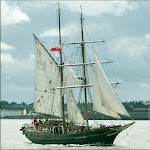
According to several experts in traditional ship and boat building, a possible replacement for the sail training vessel Asgard II (archive photo left), which sank off the coast of France on September 11th (see my entry of that day), could be built in Ireland with existing Irish skills and craftsmanship.

Michael Kennedy and Bill Crampton, the two shipwrights who led the construction of the replica famine ship Dunbrody - a three-masted barque now moored as a museum vessel in New Ross, Co. Wexford - have told the Irish Times that their entire team is "still alive and well" and "available for such a project", should it become necessary.

A suitable premises for building a new vessel may also be available in the south-east of Ireland - most likely the place in New Ross where the Dunbrody was built - to ensure that it would be ready in time for the next Irish hosting of the International Tall Ships' Race, in 2011 here in Waterford.

Ireland's Minister for Defence Willie O'Dea, who is also chairman of Coiste an Asgard, had expressed concern about the availability of skills in Ireland to build a replacement, if such a decision was taken.
O'Dea was commenting after the sinking of the 27-year-old brigantine in the Bay of Biscay, but before an inspection of the vessel had taken place.

Now Coiste an Asgard is hoping to raise and repair the sunken vessel, which has meanwhile been inspected and found widely intact, sitting upright on the seabed, with only minor visible damage to the hull. (see my entry of October 3rd)
Insurers are assessing the situation, and an investigation into the cause of the sinking is still being conducted by Irish and French maritime authorities.

A spokeswoman for the Department of Defence said that it was "still too early to say whether any attempt would be made to salvage the Asgard II", lying in 80 metres of water, or rather build a replacement.

The beautiful green-painted brigantine, designed and built in 1980-81 by Jack Tyrrell of Arklow, Co. Wicklow, was insured for € 3.8 million. The Dunbrody construction team said this could provide "vital seed capital" to build a new training ship for the Irish State.

Up to 65 people worked on the construction of the Dunbrody in New Ross, Co. Wexford, which was launched by former Taoiseach Bertie Ahern in February 2001. The project was initiated by Seán Reidy of the John F. Kennedy Trust, and based on the design of an emigrant ship built in Quebec/Canada for a New Ross merchant family in 1845.

Over the ten years it took to build the replica Dunbrody (in the foreground below), extensive skill training took place at the wharf, and the national training authority FÁS was heavily involved in it as well. The building of the Dunbrody cost a total of € 6 million, including FÁS labour, whereas the Kerry-built replica famine ship Jeanie Johnston (in the background below) ran well over budget and cost eventually € 15.8 million.


Michael Kennedy said that - in addition to his own team - several craftsmen involved in the construction of the Jeanie Johnston also had sufficient skills to work on a new vessel, and he hoped that the maritime sector would co-operate on such an initiative if it was approved by the Irish government.
"We've had a sail training ship since the foundation of the State, starting with the original Asgard," he explained, "and it would be a terrible pity if we did not have one in future."

Bill Crampton added that proposals to hire the Jeanie Johnston to continue the sail training programme "might meet a short-term need, but it would not be a suitable successor to the Asgard II".

I completely agree with both statements, as I have already expressed in previous articles here. And I would even suggest that building a new (second) sail training vessel for the State should be considered, even if the Asgard II can be salvaged and put back into service.
In the 1980s, when she was constructed, the interest in sail training was very limited in Ireland. The Asgard II was purpose-built as a brigantine to fulfil the Irish need and demand of the time. But now her limited capacity of only 20 trainee places is almost too small for the meanwhile increased interest in sailing and sail training here.

Especially in recent years - due to the great success of the annual Tall Ships' Race and other major sailing regattas and events for tall ships - the idea of sailing and using tall ships for training and team building exercises for young people has become very popular.
Being an island nation with a long and considerable seafaring tradition, Ireland could well afford and sustain two sail training vessels.

The element of costs will of course be a major argument in the current times of recession and global financial crisis. But I would not worry about that. If organised properly, the money for a new vessel could be raised through public subscription. There are many wealthy people in Ireland and around the world, and many of them are sailing enthusiasts.

I would be prepared, willing and more than happy to organise the fund-raising activity for a new Irish sail training vessel and have in fact already made some contacts with other people in the sailing community about it. The reactions I received are all very positive, so now it is up to the government and Coiste an Asgard to make a decision.

The Emerald Islander

12 October 2008

Answers to Questions regarding Asgard II

A week ago I wrote my third article about the loss of the Irish sail training vessel Asgard II (seen here moored at Cork in 2003), which sank off the French coast in the Bay of Biscay on September 11th. (see my entry of that day)

One of my readers - Ronnie - has left a comment with this post and asked 5 questions, which I will answer below to the best of my knowledge and ability.

1) Approx How much would it cost to buy the Prince William?

This is a very good question, but at this point in time I don't have a precise answer for it. I will make further inquiries, and should I be given a specific sum, I will come back to you in a later post.

In general, vessels of this kind and size don't come cheap, especially if they are in good condition, which the Prince William certainly is. There is currently another brig on the market - one that is older than the Prince William and based in Germany - and her owners are looking for € 2.4 million. However, if they can get that amount in the present climate of world-wide economic crisis and recession is somewhat doubtful. Like with everything else, the market forces of supply and demand determine the price for a ship or vessel. If an owner is in desperate need of cash, he might sell at a price below the actual value, and a buyer in urgent need of a vessel might pay more than he would under normal conditions. As things are now, it is more a buyer's market. So negotiating and even a bit of haggling might well be worth one's while.

2) Is there superstitions with sailing on a vessel that have sunk before?

There are many people who have superstitions of all sorts and kinds, and the sailing community is no exception to that. However, the kind of superstitions many sailors had in less enlightened times in the past have almost all disappered from today's modern sailing community. At least I have not encountered any of them in more than thirty years at sea.
One might be thinking of things like the 'Klabautermann' or the ship's 'kobold', or perhaps of the old tale of the sacred Albatros, who would bring doom to a ship if he was killed. Very well-known is also the superstition of the 'Jonah', a crew member or passenger on board who brings the ship bad luck.
And there is the even older superstition that a woman on board will attract bad spirits to a vessel and its crew.
All those were the products of times when sailors were widely uneducated and often illiterate, but to a great extend influenced by religious believes and doctrines, superstitions and old sagas and tales. Today's sailors are modern people, and live in a world of information and technology. Thus these old superstitions are gone for good.
This goes especially for the idea that a woman on board means bad luck. There are many women in all sorts of ships and vessels these days, in passenger ships, ferries and cruise liners, and they serve with equal rights in most of the world's navies. (Norway has even a female officer in charge of one of their submarines now.) And on many modern sail training vessels the number of female trainees often exceeds the number of their male crew mates.

However, the superstition you mention in particular still exists to a certain extend, though I would see it more as a fear or general safety concern than a traditional superstition. There are people who would not buy and drive a second-hand car that was involved in an accident, or buy a house damaged by a fire. The same goes for ships. Some people would not sail in a ship that had a fire or major accident, and this goes especially for vessels put back into service after having sunk and being subsequently salvaged and repaired.

Personally I do not share such fears. Modern technology is very advanced, and any vessel that had the bad luck to founder - usually under heavy weather conditons - and is salvaged and repaired, will be as safe as any other. In fact, one can assume that the owners will make sure that all possible safety measures are put in place, perhaps even more than the ship had before, to avoid a repeat of the traumatic event as much as it possible.
There is never a 100% guarantee, and any ship or vessel can get into trouble if the conditions are bad enough. And of course it is a free world we live in, so no-one is forced to sail in a vessel that has sunk before.

3) Is there problems that can occur later after a vessel has been recovered and repaired?

Well, as I said already above, there is never a 100% guarantee, and any ship or vessel can get into trouble if the conditions are bad enough. If a sunken vessel is deemed fit to be raised and repaired, it means that it is still in good enough condition for further service. Otherwise one would not spend the time, energy and money on it.

When repairs are carried out, they are done professionally and to the best of people's ability. Often a salvaged vessel is modernised and further improved in the process of repair, to make it stronger and better and avoid future calamities.
For the general stability and service ability of a ship it also depends to a certain extent on the conditions under which she sank, which parts were damaged, how badly and by what cause.
For example, ships that were torpedoed or ran onto a mine during a war would have substantial structural damage to the hull. Even after proper and professional repair that can mean a certain structural vulnerability of the vessel. Nevertheless many ships who suffered such a fate have been raised, repaired and put back into service, some in their previous role, others were given less hazardous duties (e.g. as training ships, coastal patrol vessels or storage hulks).

In case of the Asgard II it appears that she is still in pretty good shape and almost undamaged. She sits upright on the bottom of the sea, which means that her masts should be alright, too. Inspection has found light damage to one hull panel, but it is not certain if that damage occurred before and was the reason for her sinking, or if it happened when she hit the seabed.
I am no shipwright or engineer, but from what I know a salvage and repair should be possible and not even too difficult. And after a proper repair I would deem her as safe and stable as any other vessel.

4) Why the sailing community would prefer to see her fixed and not replaced with a larger vessel offering greater training opportunities?

The reasons for that are mainly sentimemtal. There are certainly people who would favour a larger vessel as replacement for Asgard II, as it would indeed offer more places for trainees. When Asgard II was built in 1981, sail training - in Ireland as well as anywhere else - was not as popular as it is now. So the vessel was designed for the needs of a small country like Ireland. At the time no-one would have expected that the tall ships would return from the obscurity of history and become very popular again.
If we would build a sail training vessel for Ireland today - and perhaps we still might have to do that if a salvage of Asgard II is not possible or financially not viable - it would naturally be of a larger size, most likely a brig or even a barque instead of a brigantine.

But one should not underestimate the sentimentalities of sailors. As much as superstitions have now disappeared from the seafaring community, we are still quite a sentimental lot. Each ship and vessel has her own personality, almost like a human being, and emotions are invested in the relationships sailors have with their vessel.
Asgard II has always been a 'happy ship' and was very popular with sailors and the general public alike. And this was not limited to Ireland. Quite the opposite. Even though we are an island and thus surrounded by the sea, the sailing community here is still relatively small.
But through her voyages around the world, visits to many foreign ports and participation in the international Tall Ships' Races the Asgard II has made many friends in many countries. They all were saddened by her sinking and would be very happy to see her salvaged and sail again.

There is also one other aspect that has to be taken into consideration. As the cause of the sinking of Asgard II is yet unknown and the circumstances - as far as we know them - are somewhat unusual, a full and close-up inspection of the vessel is very much desired, in order to establish without doubt what actually happened. This could well be attempted by divers, but it would be a lot more thorough when done by experts on the surface. For that a raising of the sunken vessel is a prerequisite.

5) Why do you think building a new vessel is not the favoured option for Coiste an Asgard?

This answer is easy: Money. As the Asgard II is of course insured, the costs for salvaging and repair would be a matter for the insurance underwriters. Thus the State and Coiste an Asgard would get their vessel back into service at almost no expense.
It also makes no sense to leave a perfectly operable vessel with only slight damage to rot at the bottom of the sea, where she would disintegrate over time and be lost forever.

The only real advantage the building or acquisition of a new - and larger - vessel would give is an increased number of training places. And this alone is not a strong argument with Coiste an Asgard.
In case a replacement for Asgard II would be needed, buying an existing vessel - like the above mentioned Prince William - would be preferred to building an entirely new one in Ireland. Again money is the main factor here, and there is also the element of time. Depending on type and size of the new vessel, and the shipyard chosen to build her, it could easily take years before she would put to sea.
This means a loss of income as well as a loss of skills and experience for Coiste an Asgard. And a new construction would undoubtedly be far more expensive than the purchase of an existing vessel, which would be ready to sail almost immediately after acquisition.
Given the current recession and world crisis, with good negotiations one might even be able to obtain a brig like Prince William second-hand for the money the insurance underwriters would have to pay out in case of a total loss.
Nevertheless, the best and also least expensive option remains a salvage and repair, and I am sure that Coiste an Asgard will do that, unless unforeseen technical problems should stand in the way.

Thank you for your questions, and I hope you will find my answers satisfactory. Keep reading this weblog for any further developments regarding Asgard II and other sailing matters. And feel free to ask any questions you have. They are as welcome as you are.

The Emerald Islander

05 October 2008

O'Dea: Asgard's Fate depends on Insurers

It appears that the fate of the sunken Irish sail training vessel Asgard II lies now in the hands of the insurance industry. The thought alone must send shivers down the spine of any decent sailor. It certainly has that effect on me.

An initial inspection and underwater survey of the wreck (for details see my entry of October 3rd) established that the brigantine is in much better condition than many of us expected.
She sits upright on the seabed, in about 80 metres of water, and there appears to be very little visible damage. This suggests that her raising and repair is not only possible, but also advisable.

Ireland's Defence Minister Willie O'Dea (right), who is also chairman of Coiste an Asgard, has said that the question of salvage "depends now mainly on the ship's insurers".
He declared that Asgard II was "well insured for a good deal of money", and that negotiations with the insurance companies over the further procedures are now in progress.

The insurance money could either be used for a salvage operation and subsequent repairs, or alternatively contribute to the building costs of a new vessel. The latter option is currently not favoured by Coiste an Asgard. The sunken brigantine has a unique character and is very dear to many people in Ireland and abroad. So if she can be salvaged and put back into service, this is the preferred option for everyone.

There is also some doubt if the skills to build a similar vessel as replacement still exist in modern Ireland. (The government has indeed done nothing during the past 25 years to train shipwrights and boat-builders which would be needed for such a project.)

Another possible alternative - in case a salvage operation would be ruled out - is to buy an existing vessel as replacement for the Asgard II. This could be done with the insurance money and would be much easier than salvage or building a new vessel.

One possible option for a purchase would be the British brig Prince William (left) whose current owner, the Tall Ships Youth Trust in the UK, is looking for a buyer. She is already well-known in Ireland from numerous visits, and her Master is an Irishman.
So there are good arguments for this option, and the vessel is also substantially larger than the
Asgard II, which would mean more places for trainees.

However, I think that I speak for a majority in the Irish sailing community when I state here that salvaging the Asgard II would be the most preferable option, especially since she is in good shape and condition.

The Emerald Islander

03 October 2008

Wreck of Asgard II found and inspected

Many people in Ireland and abroad will know by now that the beautiful green brigantine Asgard II (archive picture left), our national sail training vessel, sank in the Bay of Biscay off the coast of France on September 11th at about 7.00 am.

Fortunately no life was lost and no-one was injured. All 25 crew on board made it safely into their life rafts and were rescued by the French Coast Guard soon after.

Meanwhile a survey of the wreck of Asgard II has been carried out, in order to establish her present condition.

The vessel was located on the seabed, in some eighty metres of water, close to where she sank.

An initial underwater inspection has been carried out, using a ROV (remotely operated vehicle - a kind of small un-manned submarine). This inspection indicated that she is upright and largely intact (which gives some hope that she could probably be raised and repaired).

Damage to one of the hull planks has been observed, but at this stage it is impossible to say whether this is a result of the impact on the seabed, or if it was the original cause of the sinking. (for details see my entry from September 11th)

Until further investigations are carried out, it is not possible to determine whether Asgard II can be salvaged and put back into service. As soon as I have more news, I will share them with you here.
So, if you are interested in the fate of Ireland, Asgard II and sailing in general, keep reading this weblog.

The Emerald Islander

13 September 2008

Asgard II Crew returns home as Inquiries open

The crew of the Irish brigantine and sail training vessel Asgard II (archive photo above) which was lost at sea off the coast of Brittany on Thursday morning (for details see my entry from September 11th), has returned home to Ireland yesterday evening.
Captain Colm Newport, five regular crew members and twenty trainees who had to abandon ship in pitch-darkness after a sudden ingress of water had turned their vessel into a floating hulk, arrived save and sound at Dublin airport.

After being rescued by the French Coast Guard, they had spent a day on Belle-Île-en-Mer, an island off the southern coast of Brittany, close to the Quiberon peninsula and Quiberon Bay.

Despite the shock and sadness over the loss of the nation's only proper sail training vessel, the good news is that no human life was lost and no-one suffered injuries. Some of the trainees still looked a bit shaken when they landed in Dublin last night, but that will pass. They all behaved in a professional and disciplined way, even under extreme and traumatic circumstances, and that shows that their training has been successful after all.

Meanwhile the Irish Marine Casualty Investigation Board (MCIB) and its French equivalent, the Bureau d'enquêtes sur les événements de mer, have begun their separate inquiries into the circumstances of the sinking of the Asgard II.

As the brigantine is now in waters about 90 metres deep, it is doubtful if an attempt to raise and salvage her can be made or would be sensible. A detailed survey in respect to that and to the vessel's current condition has yet to be conducted and might take a while.

However, the general opinion in Irish maritime and sailing circles is that building a new vessel as replacement for the Asgard II might be the better and more likely option. Unfortunately the loss comes just at the beginning of an economic recession in Ireland, and one has to wonder if Finance Minister Brian Lenihan (who is not the seafaring type) will find enough money in the treasury for such a project.

But all is not lost, even if the Irish government should decide that it has no money for another sail training vessel. We could employ a procedure which has been used with great success in the past, and especially throughout the 19th century (when most people had a lot less money than they have today). I am thinking of Public Subscription, a joint effort of many individuals, putting together as much money as they can afford to give, in order to create a large project. Carlow cathedral, Wellington's obelisk in Phoenix Park in Dublin, and the municipal Clock Tower here on the Quay in Waterford are three examples of works created entirely by using that system.

I am neither a politician, nor rich, so I have neither the power nor the money to start a possible public subscription campaign. But I have pitched the idea already to a cabinet minister and a TD (member of parliament) yesterday, in the hope that it will sink in and influence the government in a positive way.

In less than three years Ireland and Waterford will host the start of the annual International Tall Ships' Race again. It would be very desireable to have a proper national sail training vessel in service again by then.
I still remember how the Asgard II (accompanied by the other two Irish tall ships Dunbrody and Jeannie Johnston) led the Parade of Sails out of our port and down the river Suir in 2005. It was the first and only time that all three Irish tall ships were appearing together.

Speculations that for the time being the Dunbrody and Jeannie Johnston might temporarily be drafted in as sail training vessels might have some substance, but it is doubtful if that would be a good idea and a workable solution. Both barques are replicas of 19th century originals and the main purpose they have is to be a floating museum. The Dunbrody does not even have a full certificate for the high seas, which the Jeannie Johnston was granted after a major struggle with the Irish bureaucracy. Both vessels also operate an extensive programme of corporate entertainment and that provides a significant part of their budget. So it is more than unlikely that they could really function as proper sail training vessels like the Asgard II did.

Having put my idea forward into the political channels, I hope it will be taken up, so that the gap created in the sail training community by the loss of Asgard II will be filled as soon as possible.

The Emerald Islander

11 September 2008

Asgard II lost at Sea

This morning very sad news came across the sea from France, sad for the whole of Ireland, and also for the large community of sailors, seafarers and tall ship fans everywhere.

It has been reported that the Asgard II (photo above), our country's beautiful sail training vessel, was lost at sea at 8.25 am local time (7.25 am Irish time) about twenty nautical miles off the French coast, south of Brittany and southwest of Belle-Île-en-Mer.

The two-masted brigantine had earlier been abandoned after taking on a lot of water, turning her into a floating hulk (see photo right).

The alarm was raised in total darkness shortly before 2.30 am this morning. Shortly after the vessel's Master, Captain Colm Newport, had no choice but to give orders to abandon ship. The five regular crew members and twenty trainees, most of them Irish, transferred to life-rafts (see photo left).

Captain Newport said that the vessel was abandoned in an orderly fashion and with no injuries, and that all 25 people were off the Asgard II in four or five minutes. They stayed alongside the stricken vessel while communicating with the French Coast Guard and sending a distress signal.

Within twenty minutes from the initial alarm, they had to move the life-rafts away from the vessel, which had water up to its deck at that stage.

Crew and trainees were rescued by the French Coast Guard who despatched two lifeboats and two helicopters to the scene.

They were taken to a hotel on the island of Belle-Île-en-Mer.

In an interview with RTE Radio Captain Newport said that he has no idea what caused the ship to sink, adding that it would be foolish to speculate. He explained that there was a "sudden ingress of water", which caused the vessel to lose stability.
All those on board were now in contact with their people at home, were in warm clothes and being looked after well by the people on the French island. However, they had been through a traumatic event. (Being a sailor myself, I can well imagine how traumatic it was, especially for the young and inexperienced trainees...)

The Irish Ambassador to France, Anne Anderson, is traveling from Paris to Belle-Île-en-Mer to meet the crew and trainees.

It is still not clear what caused the loss of the Asgard II, and at this stage it is doubtful if it will be possible to salvage her, even though her last position has been documented. Should a salvage not be possible, it is further doubtful if - in the present recession Ireland experiences - there will be funds to build a replacement. However, the early 1980s were a difficult time for the Irish nation as well, but nevertheless the government still saw fit to build and commission the vessel.

The Asgard II is Ireland's official national sail training vessel. A beautiful traditional brigantine with her hull painted in a deep emerald green, she was designed and built in Arklow, Co. Wicklow by Jack Tyrrell and commissioned in March 1981 by the then Taoiseach Charles J. Haughey. She has a traditional figurehead in the form of a carving of Granuaile.
Her name was taken from the yacht Asgard (now preserved in Kilmainham Jail museum in Dublin), which played a special role in Irish history, in particular as the vessel that brought rifles for the Irish Volunteers from Germany to Ireland in preparation of the 1916 Easter Rising.

Owned by the Republic of Ireland, the Asgard II is a civilian-run training vessel and managed by Coiste an Asgard (chaired by Minister for Defence Willie O'Dea, TD), which is also a founding member of Sail Training International (STI), the organisers of the annual International Tall Ships' Race.

It fills me with great sadness to learn of her loss, as I remember her very well from many happy encounters at sea and here in the port of Waterford.
Three years ago, when Waterford hosted the start of the International Tall Ships' Race, it was the Asgard II (accompanied by the other two Irish tall ships Dunbrody and Jeannie Johnston) who led the Parade of Sails out of the port and down the river Suir to the race's official starting point at Dunmore East. It was a joy for me to see her leading a parade of 88 tall ships and vessels (28 of them large class A ships), as a sailor and as a member of the team that organised and ran the event.

In 2011 Waterford will host the same event again, and should a salvage of the Asgard II not be possible, she will be missed very much by many, including me,

The Emerald Islander.

UPDATE

For an update please see my entry from September 13th