Showing posts with label Eamon Gilmore. Show all posts

27 August 2009

Eamon Gilmore calls again for the temporary Nationalisation of Ireland's major Banks

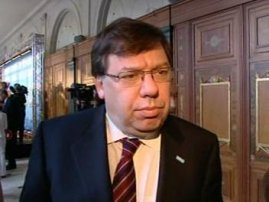
Eamon Gilmore (photo), leader of Ireland's Labour Party, has again called for the temporary nationalisation of the country's main banks "as an alternative to the setting up of the government-proposed National Asset Management Agency (NAMA)".

Speaking on RTÉ News, Gilmore said that "a mechanism should be established to write down bad debts, before returning the banks to the market when they are restored to good order".

The Labour Party leader also emphasised that "it is a necessity to get the banks lending to businesses again".

His proposal was not without cost, Gilmore added, but he claimed it would mean a lot less risk for the taxpayer than the government's plan.

Under the government's proposed legislation, NAMA would be taking over € 90 billion worth of debt away from Irish banks, so that they can start lending again.

The amount NAMA would pay for the debt has yet to be decided. But in an article, published in yesterday's edition of The Irish Times, 46 economists warned that NAMA might pay too much and thus create an extra burden for Ireland's taxpayers. (see yesterday's entry below)

Fine Gael has already stated that it will oppose the government's NAMA plan when the Dáil debates the legislation next month. Since Sinn Féin, which demands a referendum on NAMA, is against it as well, this means that all opposition parties in parliament are united on the matter, even though they do not agree on the details of possible alternatives.

The Green Party, who is the junior partner in the government coalition, will hold a special conference to debate the plan. (see my entry of August 25th)
The outcome of this conference is far from certain, and neither is the continuous support of the Green Party for the current government.

As things stand at present, anything is possible. A temporary nationalisation of our major banks - as demanded today and previously by Eamon Gilmore and his party, as well as by Sinn Féin and the Socialist Party in separate statements - would in my opinion be the safest and least costly option.

We can expect that the government will not listen and stick to its original plan. So I suggest that now is a good time to contact your local TDs, especially those from Fianna Fáil, and tell them in no uncertain terms what you think of NAMA. It might also be helpful to mention that their own seat will be in serious danger if they ram through a legislation that no one in the country really wants, but for which everyone would have to pay severely over decades to come.

The Emerald Islander

02 July 2009

Gilmore speaks up against Cowen's 'Guillotine'

Eamon Gilmore (photo), the leader of Ireland's Labour Party, has accused the government of "riding rough-shot over the Irish people and their elected representatives".

He deserves a strong round of applause for this statement, and all the support we - the people of Ireland - can give him.
Why? Because Gilmore stood up and defended the interests of us, the people, and of Democracy against an ever more dictatorial and arrogant government.

Eamon Gilmore objected strongly to the way the Taoiseach and his ministers are pushing bills though the Dáil without having a full and proper debate over them.

This procedure - in parliamentary slang called 'the guillotine' - is an arcane relic from colonial times and part of the British political system. And one has to wonder why it is still practised in Ireland, after 90 years of self-rule.

The Labour leader told the Dáil that the government has taken the use of the 'guillotine' on bills "to a new level of ridiculousness", pointing out that twelve bills are about to be 'guillotined' next week on top of those that were dealt with today.
"It is not unusual for this government to use the guillotine to push through legislation, just to get it out of the way or to minimise the amount of public attention that it will get," Gilmore said.

Another reason for using the 'guillotine' method is usually that a government is 'running out of time' on a bill, which means that the amount of days and hours allocated to it has been used up before a bill reaches the stage of the final vote. In Britain this happens regularly towards the end of the parliamentary year. And in order to avoid that the same bill has to go through all its stages again in the new parliamentary year, the government applies the so-called 'guillotine'.

But here in Ireland we do not have a 'parliamentary year' which is opened ceremonially by a monarch.
Our Dáil is elected for a maximum period of five years. So bills should never 'run out of time' here, and thus there should be no need for the 'guillotine' method.

If a bill 'runs out of time' in Ireland, it is usually because of bad planning or mismanagement by the government. And using the 'guillotine' method to push it through without proper debate and discussion shows indeed a great disrespect for the people of Ireland - in whose name the laws are made - and for the TDs, who are the people's elected deputies.
The 'guillotine', in its parliamentary sense, is in fact an instrument of dictatorship, as much as its namesake was an instrument of terror during the French Revolution.

There would be an easy way to avoid any bills 'running out of time', regardless for what reasons: The Dáil should simply sit and debate on more days than it does now. There is no justification for a three-month-long summer holiday and all the other holiday 'recesses' our parliament grants itself. On average the Dáil only sits between 70 and 75 days in each full calendar year.
This is unacceptable, and it would not be tolerated in any other institution or sector.

The amount of parliamentary holidays should be reduced to the same amount of days that an average industrial worker is entitled to. And one should also look at the current three-day week of the Dáil. If our TDs would work five days a week like anyone else in the country (some people, like yours truly, even work six or seven days a week), there would be no bill 'running out of time' and no point in the 'guillotine' method.

To my knowledge there are only very few countries where this method is accepted at all. It is of course practised in Britain, the country that invented it, and in some Commonwealth countries that still follow their masters in every way. And - to my astonishment - in Ireland as well, as if we were still part of the British Empire.
I know of no other European country where such a procedure exists, and I doubt that it would be accepted or tolerated by the politicians there. Only the people and politicians of Britain and of her still obedient servant Ireland are treated by their governments in such an unacceptable and dictatorial way.

It is well over time already to abolish such an arcane and offensive parliamentary instrument, and to make it illegal in Ireland. I encourage Eamon Gilmore and the Labour Party to make this point a part of their next election manifesto.

The Emerald Islander

29 May 2009

Latest Poll shows Labour Party gaining Support

With just one week to go to the European and local elections, the latest national opinion poll indicates that Fianna Fáil is still on course for disastrous results on June 5th.

The TNS/MRBI poll, published in today's edition of The Irish Times, shows that the Labour Party is the only party with significant improvements since the last poll a fortnight ago.

If Fianna Fáil were hoping for a late surge in support as this election campaign enters its final week, there is no sign of it so far.
The poll shows the party's support at just 20%, down one point since the last poll two weeks ago. (see my entry of May 15th)

Fine Gael are down two points, to now 36% support. But they are still by far the biggest party, and 16 points ahead of their arch rivals.

As mentioned above, Labour are the only point gainers in this poll. They are up three points to 23%, which puts them nationally in second place, after Fine Gael and ahead of Fianna Fáil.

The Green Party, which is now not much more than the outdoors and gardening department of FF, stands unchanged at 3%. This indicates that their core support still exists, but that no-one else will touch them with a barge pole.

Sinn Féin have dropped one point and stand on 8%, while Independents 'and others' (which includes Libertas) are up one point to now 10%.

However, with separate questioning - focused only on the local elections - Independents 'and others' are getting 19%, almost twice their average national support.

This is no surprise, as the amount of independent candidates or smaller parties and groups (such as the Socialist Party, the Workers' Party, the Socialist Workers' Party and 'People before Profit') is very different from one constituency to the next.*
And it is of course in the nature of independent candidates that each one of them has a different personality and thus will appeal to the electorate in a different way.

Overall satisfaction with the Irish government is - surprisingly - up slightly, but by only two points to a still disastrous 12%. The vast majority of the Irish electorate - now 84% - remains dissatisfied with the government's shambolic performance.

Satisfaction with the Taoiseach is also up - by three points - but at 21% he still has the lowest satisfaction rating of all party leaders. (He is even beaten into last place by his coalition partner, as the Greens' leader John Gormley comes in on 25% support.)

Labour Party leader Eamon Gilmore retains the nation's highest satisfaction rating, with now 49%, which is two points lower than his amazing 51% a fortnight ago.

The Emerald Islander


* For example: The Socialist Party and the Workers' Party are both nominally parties with a nation-wide attitude and ambition. And they both have members in different parts of the country.
However, regarding actual strong support and thus any chances for electoral success, the Socialist Party is limited to the northern half of Dublin (city and county), while the last - and currently only - Irish constituency with elected representatives from the Workers' Party (which was founded as a break-away group from the old Sinn Féin) is Waterford City.

15 May 2009

A new Poll puts Fine Gael in a commanding Lead, and Eamon Gilmore is the most popular Politician

A new TNS/MRBI poll, published in today's edition of the Irish Times, shows the support for Fine Gael at a new all-time high of 38%.
This gives the largest Irish opposition party a 17-point lead over the main government party Fianna Fáil, which dropped by one point to 21%, its worst rating since the party was founded in 1926 by Eamon de Valera.

The poll also shows a further drop in satisfaction with the government as a whole, and in particular with Taoiseach Brian Cowen, whose personal approval rate has sunk to 18%.

In comparison, Fine Gael leader Enda Kenny gets the thumbs-up from a third of the voters (33%), but the darling of the electorate is currently Labour Party leader Eamon Gilmore, with an approval rate of 51%.
I cannot think of any time in the past when the leader of the third-largest party in Ireland had such a high approval rate, in fact outclassing both the Taoiseach and the leader of the majority opposition.

Rather surprisingly the Labour Party has dropped four points in public support since the last poll and now stands on 20%.

With the (European and local) election campaigns now under way, the Green Party begins to feel the pinch and to pay the price for its participation in a government coalition led by Fianna Fáil.
In today's poll the Greens are down one point to 3%, which in a football league would clearly be inside the relegation zone.

Sinn Féin, the only parliamentary party that opposed the Lisbon Treaty, remains unchanged on 9% of public support.
The numerous independents and 'others' (which still includes the new Pan-European party Libertas) are also unchanged at 9%.

Predictably Enda Kenny and members of his front bench welcomed the poll with enthusiasm, while the reaction of the Labour Party was rather mixed.

And Fianna Fáil, to no-one's surprise, is still completely in denial.
Minister for Justice Dermot Ahern (left) tried to put the massive unpopularity of his party down to "the tough decisions we have to make in these difficult times", and to an extent he is certainly right with this assessment.
But what Fianna Fáil is unable - or unwilling - to recognise is the fact that it was no-one but themselves who created this situation. Somehow FF politicians still think that they can and will get away with it (again), without losing votes on a massive scale.

Perhaps on June 6th, which is rather appropriately the 65th anniversary of D-Day, things will be a lot clearer for Ireland and our government. Just as they were for the German government on June 6th, 1944.

The Emerald Islander

26 April 2009

Latest Poll shows Fianna Fáil in Melt-Down

Every month the Red C polling organisation produces a nationwide political poll for the Sunday Business Post, Ireland's leading economical weekly.
The latest of these polls, published in today's edition of the paper, must make grim reading for the Irish government and especially for its majority party Fianna Fáil.

Being in power (with support from the Progressive Democrats and - since 2007 - the Green Party) since her rather surprising election win in 1997, Fianna Fáil enjoyed an unprecedented decade of widespread public support, riding on the wave of the unexpected economic boom known commonly as the 'Celtic Tiger'.
This boom was - as we now know - nothing but an artificial bubble, created by a relaxed and incompetent government, irresponsible banking, criminal speculations and a mad drive to build ever more houses and apartments without having a real demand for them.
When the bubble eventually burst last year, we found ourselves close to national bankruptcy and the unbelievable incompetence of both our government and our banks was exposed for everyone to see.

Although unrelated, the burst of the bubble happened shortly after the Irish electorate defeated the government - and all opposition parties except Sinn Féin - by rejecting the Lisbon Treaty.

Bertie Ahern, who was Taoiseach (Prime Minister) since 1997 and must surely have known only too well what was coming down the political and economical road, had jumped ship just in time to leave his successor (and previously deputy) Brian Cowen in complete charge of the developing political crisis and financial melt-down.

Ever since the once high popularity of Fianna Fáil has been in freefall. The government's 2009 Budget - brought forward to October 2008 - did further damage to the party, and the various forced additions to it made things even worse. The latest - the 'supplementary' or 'emergency' Budget presented by Finance Minister Brian Lenihan less than three weeks ago - seems to have delivered the final devastating blow to Fianna Fáil and its political future.

Today's Red C poll shows the party in complete melt-down, with only 23% of the electorate still supporting the faltering Fianna Fáil, whose incompetence and arrogance are creating ever more and ever widespread anger in all sections of the Irish population. This is the lowest rating of public support for Fianna Fáil in the party's history.

Not surprisingly the biggest winner is Fine Gael, Ireland's largest opposition party, which has been on the rise since last Autumn and gained a further two points this month, bringing it to an unprecedented 33%, ten percentage points ahead of Fianna Fáil.

The Labour Party, second-largest force in opposition and the potential coalition partner for Fine Gael, also improved her rising support by another two points to now 19%. This is clearly a reaction to the excellent parliamentary performance of party leader Eamon Gilmore and his deputy (and spokesperson on Finance) Joan Burton.

The Green Party, in coalition with Fianna Fáil since 2007 and facing internal opposition from a growing group of its traditional members and supporters ever since, seems so far unscaved by the government's massive unpopularity and remains unchanged on 7%. But this figure could be deceptive. The party has no chance to win a seat in the European election in June, and it is more than doubtful that it can perform well in the Local Government elections held on the same day. In recent months the Greens have lost two of their most prominent local councillors, and in some constituencies their previous candidates have decided not to stand for the party this year.

Sinn Féin, the smallest of the three opposition parties in parliament, gained one point in this month's poll and now stands on 8%, moving slightly ahead of the Green Party. It is perhaps a surprise that Ireland's oldest political party (and the only one active in the North as well as in the Republic) is not receiving more public support in the wake of the Fianna Fáil melt-down. There are several reasons for this, but the most significant is that - despite its now totally peaceful and democratic approach and its leading participation in the power-sharing government in the North - Sinn Féin is still not making inroads into Ireland's middle classes. This could change if the party can win stronger support from younger people, especially the growing student population, which is so far still predominantly non-political and more interested in 'fun' and an easy life. Increasing hardship and the expected re-introduction of fees for third-level education could change that.

The group listed in the Red C poll as 'Independents and others', which includes a number of smaller parties without parliamentary representation, remains - again - unchanged on 10% of public support. It is not clear if the poll has taken into account a number of newly formed groups, many of which have nominated candidates for the Local Government elections in June. They are so far a widely unknown quantity, but could attract a significant percentage of protest votes.

For the first time the poll features the new pan-european party Libertas, which emerged out of the prominent Anti-Lisbon campaign group with the same name and intends to have candidates for the European Parliament in all 27 member states of the EU. The poll registers so far only 2% of public support for Libertas in Ireland, which seems a very low figure, given the strong and effective campaign the organisation mounted in their successful defeat of the Lisbon Treaty.
But it is not unusual that polling organisations need a certain amount of time to assess the true strength of new parties.

Based on today's figures one can however be certain that Fianna Fáil will suffer serious losses in both the European and Local Government elections on June 5th. There is also no doubt that the two up-coming Dublin by-elections for the Dail will not produce any new Fianna Fáil TD.

Depending on the severity of their losses in June, Fianna Fáil could well face a leadership crisis or even an internal rebellion during the summer. The position of Brian Cowen, who was elected as party leader and Taoiseach without contest last May, is far from secure now. There is still the traditional and rather stubborn loyalty to a leader for which Fianna Fáil has always been known, but ever since the (now independent) Wicklow TD Joe Behan left the party last year, there is a slowly but steadily widening crack developing between the cabinet and the backbenches.
An even wider gap exists now between most Fianna Fáil politicians and the people of Ireland, and the future of our main government party is very bleak, to put it mildly.

The Emerald Islander

18 February 2009

Heated Dáil Debate over Banking Scandals

While more than 4000 civil servants and public sector workers - including Gardaí - were protesting outside Leinster House against the proposed new pension levy today (see entry below), a heated debate was going on inside the Dáil chamber.

Taoiseach Brian Cowen (left) angrily denied suggestions that he was attempting to protect anyone involved in the Anglo Irish Bank share scandal.
He accused Fine Gael leader Enda Kenny of "impugning his reputation", a charge vehemently rejected by the Mayo TD and most senior deputy in the Dáil .

Cowen told the Dáil that his government was "determined to ensure that due process is followed" and that - if wrong-doing is uncovered - "people will face the legal consequences".

Minister for Justice Dermot Ahern (right) said that he "would prefer that the ten individuals involved [in the fraudulent share-buying scandal] be revealed", but that "due process must be allowed to take its course".

Meanwhile it has come to light that the annual report of the now nationalised Anglo Irish Bank, which is expected to be published on Friday, will reveal that a property owned by a member of (former bank boss) Sean FitzPatrick's family was rented by the bank. It is understood that this property is in London.

The Taoiseach stated that he regarded regulatory reform of banking as "a top priority".
In relation to the so-called 'Golden Circle' of ten fraudulent share buyers, he said the issue arose because of "due diligence by the government". He explained that the debts remained and his government would ensure that these debts would be collected by the bank.

Fine Gael leader Enda Kenny (left) said the government had been "far too timid" about the situation in Ireland's financial institutions, because it was responsible for the failure to regulate the banks properly.
He asked the Taoiseach if he agreed that "a fraud has been perpetrated on the Irish Stock Exchange".

Labour Party leader Eamon Gilmore (right) asked why Brian Cowen, when he was Minister for Finance, ordered the Revenue Commissioners to reverse its decision to impose stamp duty on Contracts for Difference (CFD).
These are high-risk investment 'products' where investors can bet on the future direction of a stock, without having to actually buy shares.
Eamon Gilmore said Brian Cowen had already confirmed that he had been lobbied about the issue, and asked for the identity of those involved.

In reply the Taoiseach said as far as he recalled, the lobbying came from "a professional body", but he promised to check with the Department and provide details.

Meanwhile the Green Party has said that it "could review its support for the government if politicians are implicated in the latest banking scandal".
"We are still committed to remaining in government, but that is not an open-ended commitment," the party's chairman, Senator Dan Boyle (left), told a news agency.
Remaining questions about the scandals should be answered quickly instead of the recent 'drip-drip' of revelations, so the damage to Ireland's reputation could be repaired, Boyle added.

After the debate Fine Gael Enda Kenny stated that the public deserved to know the names of the 'Golden Circle' members.
Speaking on RTÉ's Six-One TV News, he said the Irish people now own Anglo Irish Bank and "are entitled to know what is going on".

I wholeheartedly agree, as anyone with a sound mind would. And to go one step further: I do not understand why the government appears to know nothing about all these scandals, and still - after the matters have emerged into the public domain - makes no active efforts to find out what was - and is - going on.
Is it the high level of pure incompetence in our government we have to blame for that, or is Fianna Fáil fully aware of more skeletons hidden in the government's cupboards...?

The Emerald Islander

4000 Civil Servants protest at Leinster House

More than 4000 Irish civil servants and public sector employees took part in a rally outside Leinster House in Dublin (Ireland's parliament building) today, protesting against the controversial pensions levy the government is about to introduce.

The protest was organised by the Civil & Public Service Union (CPSU), which will announce the result of a ballot for industrial action within the next 24 hours.
If a majority of CPSU members support further action, it is expected that over 13,000 civil servants will hold a one-day strike on February 26th.

Members of the Garda [police] Representative Association (GRA) also joined the protest outside Leinster House (photo left).
Seeing policemen actively participating in such a protest (rather then accompany and police it) is quite a rarity.
But many Gardaí agree that the proposed pensions levy is unfair and that the burden of dealing with the current crisis and with the measures of economic recovery is not been spread equally across the community.

The protesters were met at the gates of Leinster House by Labour Party leader Eamon Gilmore (left) and his deputy Joan Burton, who is also the party's spokesperson on Finance. Both pledged their support for the concerns of the civil servants.

Meanwhile the legislation to impose a public service pension levy was published this morning. It is to be debated in the Dáil tomorrow and next week, and is due to go to the Seanad on Thursday of next week.

The Financial Emergency Measures in the Public Interest Bill 2009 - as it is called in full - includes provisions allowing public bodies to reduce the professional fees paid by them to external service providers.
It also includes changes in the early childcare supplement and the Farm Waste Management Scheme, which were announced at the same time as the levy.

Looking at the bill's name alone one has to wonder if politicians will ever be able to put things straight and in plain English that everyone can understand. Why is it that most of our laws have odd and longwinded titles and are phrased in a way no-one speaks? Not even politicians talk like that...

On top of the whole Civil Service and public sector, the proposed levy will also apply to all TDs - including Ministers, Ministers of State and the Ceann Comhairle (Speaker) and Leas Ceann Comhairle (Deputy Speaker) of the Dáil - as well as to all Senators, the Attorney General and Members of the European Parliament.
However, due to the provisions of the Constitution, the President and the Judiciary cannot be included in the measure.

If passed by both Houses of the Oireachtas (Ireland's parliament), the levy will apply to all earnings of the people affected by it, including allowances and overtime, from March 1st. The legislation specifies that no extra pension benefit is conferred by the deduction.

In light of today's demonstration and the generally unfriendly reactions the proposal has created in a large portion of civil servants and public sector workers, it remains to be seen if the bill will actually become law in the form and way the government wants. It is a fact that no government could function without the Civil Service and the many areas of the public sector.

Maybe the recent talks of the Social Partners were broken off without an agreement a little bit too hastily. As long as Ireland's rich and super-rich, many of which caused the current crisis, do not contribute their fair share to the recovery programme (and are seen by everyone to do so), the Irish are not in the mood for ever more sacrifices from the ordinary people - in the public as well as the private sector - while selfish and arrogant millionaires keep enjoying the wealth they creamed off the nation over the past decade.

The Emerald Islander

20 November 2008

Brian Lenihan is meeting Irish Bank Executives to sort out the ever more serious financial Crisis

Today chief executives from the six Irish banks and building societies that are covered by the State guarantee scheme have separate meetings with Finance Minister Brian Lenihan (right).

The series of these one-to-one confessional meetings comes in the wake of the Price Waterhouse Cooper report on the future debts and capital requirements for the six Irish financial institutions covered by the scheme, which was announced by the government in September.

The participants in the talks might be especially cautious, as world markets have once again tumbled, following sharp overnight losses on Wall Street, prompted by a fresh wave of jobs cuts in the USA and another gloomy economic outlook.

But - amazingly - Irish bank shares are among the very few that are rising today. However, one should not forget that on Monday and Tuesday of this week they were hitting rock bottom, with both Bank of Ireland and Anglo Irish Bank shares falling below the € 1 mark for the first time ever. On Tuesday Bank of Ireland shares were even close to 80 cents for a while, and I suppose they could not fall much further without the whole business imploding completely. And - as we have seen in recent weeks only too often - short-term gains on the world's stock markets are often followed by further drops in value.

Today's rises are mainly on expectations that the government is edging closer to a refinancing deal for the nation's main financial institutions.

Earlier this week the Taoiseach had told the Dáil that "the often mentioned recapitalisation of banks alone will not solve the issue of access to credit for small businesses".

During leaders' questions Brian Cowen (above left) said that the government was "looking at a range of measures to remedy the liquidity problem", but he was "constrained in revealing what they are at this time". This was another fine example of procrastination in true Offaly style.

Under the bank guarantee scheme, Cowen stated, all covered banks were drawing up business plans, and this process was now "at an advanced stage". He also announced that the Financial Regulator had received a draft report on the banks from the consultants Price Waterhouse Cooper.

Today the government expects to receive the full business plans from the financial institutions.

Brian Cowen said that if these plans did not contain measures to provide adequate lines of credit to businesses, they would be rejected.

Labour Party Leader Eamon Gilmore (right) declared that the government sounded "like helpless bystanders", while Fine Gael Leader Enda Kenny demanded that the banks be recapitalised.
He reminded the Dáil that 10,000 Irish jobs were being lost every month as small businesses got squeezed.

Meanwhile the International Monetary Fund (IMF) has approved a loan of more than $ 2 billion to Iceland, to help it cope with what has been described as "a banking crisis of extraordinary proportions".
The government of Iceland had asked the IMF for help after its banking system collapsed within hours last month. Let's hope that Ireland will be spared such a traumatic experience.

The Emerald Islander

05 November 2008

Meanwhile in Ireland...

While the people of the USA were electing a new President, House of Representatives and a third of its Senators, Ireland was watching with great interest. And what happened here on the Emerald Isle meanwhile looks rather unimportant compared with the American events.

Our small island with little more than 4 million people is in a deep political and economical crisis, and unfortunately we do not have any politician who comes even near a man like Barack Obama.
So all we can do for now is to brace ourselves for the cold winter and the ever colder winds that are blowing over our battered economy and the incompetent government a majority of us has elected 18 months ago.


Unemployment above the Quarter-Million Mark

The number of people out of work in Ireland is now more than 250,000 for the first time in over a decade.
The latest unemployment figures from the Central Statistics Office (CSO) show that the pace of deterioration in the labour market has worsened after the highest ever monthly increase in the numbers signing on the dole.

The Live Register shows a seasonally adjusted increase of 15,800 during October, and the total number of people signing on for unemployment payments or Social Welfare credits has now reached 260,300 - the highest level since March 1997.

This brings the increase in unemployment over the past twelve months to 94,600, the highest annual increase ever recorded.

Men accounted for 72% of this increase.

According to the CSO, Ireland's unemployment rate now stands at 6.7% of the labour force, up from 4.6% this time last year, and more than double the rate recorded in 2001.

Today's numbers show that the numbers on the dole rose by an average of 2347 per week during the month of October, and by an average 1800 per week since this time last year.

Taoiseach Brian Cowen said today that "the economy has to retain its competitiveness" and that "every economy is losing jobs at the moment". That was all he had to offer, and as usual it was a pretty poor statement from the man who is supposed to lead the country.

Irish Labour Party leader Eamon Gilmore (right) accused the government of "abandoning people who are losing their jobs".
He said that the only action taken in the Budget that impacts on unemployed was "to make it more difficult to qualify for job seekers' benefit and to restrict the period for which it is paid".


Relations with the USA under Review

The Irish government has announced that a review of the relationship between Ireland and the USA is to be conducted.

The review, to be carried out by H. E. Michael Collins, the Irish Ambassador in Washington, comes on foot of a request from the Taoiseach earlier this year, in order to see how the 'close ties' between the two countries can be enhanced.

Micheál Martin (left), the Minister for Foreign Affairs, said that the new US President-elect Barack Obama has in the past spoken of his commitment to the Northern Ireland peace process and has signalled that he will appoint a special envoy to Northern Ireland.

Minister Martin, who was addressing an Oireachtas committee, said this was "a positive indication that Barack Obama will be engaged in the issue".

One of the issues that will be addressed during the review is the use of Shannon airport for the so-called 'extraordinary rendition' flights, which transports political prisoners around the world to secret CIA facilities to be imprisoned illegally and tortured.
Amnesty International established that several of these flights landed and refuelled at Shannon.
The Irish government will ask the new US administration to stop the flights, or at least no longer use Irish airspace and airport facilities for them.


Taoiseach congratulates Barack Obama

Meanwhile the Taoiseach has congratulated Senator Barack Obama on his election as the next President of the USA. Brian Cowen also invited Obama to visit Ireland, and in particular the small village in Cowen's home county Offaly, where the US President-elect has distant relatives from his mother's side.

The Emerald Islander

27 September 2008

All is privatised now, says Eamon Gilmore

Ireland's Labour Party has accused the government of privatising debate on the economy after it emerged that senior ministers are to appear at a round table discussion next month for which each normal attendee is being charged the amazing sum of € 1950.

Labour Party leader Eamon Gilmore (photo) said that the Taoiseach Brian Cowen, the Tánaiste Mary Coughlan, the Minister for Finance Brian Lenihan (all Fianna Fáil) and the Minister for Communications, Energy and Natural Resources Eamon Ryan (Green Party) are all due to appear at this seminar, organised by the Economist Intelligence Unit.

The Labour Party has strong reservations about so many government ministers taking part in a commercial enterprise, dressed up as a public forum, especially at a time when the government is refusing a Dáil debate on the economy.

With slight irony Eamon Gilmore asked whether Brian Cowen was now intent on privatising discussions on the national finances as well.

Personally I don't see really a big change in direction here. Irish ministers have always found time to mix and mingle with the rich and powerful, in particular when they get paid for it. This has become even more common since Bertie Ahern became Taoiseach. And Brian Cowen just carries on where Bertie left things in May...
I am however surprised that the Economist Intelligence Unit is interested in the Tánaiste. Even though she is also Minister for Enterprise, Trade and Employment, intelligence is certainly not one of Mary Coughlan's strong sides.

The Emerald Islander

17 June 2008

Dáil debates the Aftermath of the Referendum

Today the Taoiseach has outlined his approach for Thursday's summit of EU leaders in Brussels.

Brian Cowen said during a debate in Dáil Éireann that he will tell his European colleagues the people of Ireland have spoken and he accepts the result.

He told the House that there is a need for the EU and not just Ireland to examine what this vote means, and to find a way forward.

He was replying to questions from Labour Party leader Eamon Gilmore and Fine Gael leader Enda Kenny on whether he had received an agenda for Thursday's summit.

The Taoiseach said that he will be aiming to reflect in Brussels "the range and depth of debate that occurred here".

The Cabinet was earlier briefed by Minister for Foreign Affairs Micheál Martin on the outcome of yesterday's discussions with his EU colleagues in Luxembourg.
He said that all the other states wanted to work with Ireland to find a solution to the situation, and no one had been hostile to him or "pointed a finger of blame towards Ireland".

Tomorrow the Dáil is to debate the Lisbon Treaty for more than five hours. Apart from leader's questions, ministerial questions and private members' business in the evening, the entire Dáil schedule has been cleared to allow members to debate the fallout from last week's referendum.

The European Parliament, sitting in Luxembourg, will also debate the implications of the Irish NO vote tomorrow.

23 April 2008

Dáil Éireann bids farewell to the Taoiseach

Today saw the last appearance of Bertie Ahern as Taoiseach in a full session of the Dáil. As usual on a Wednesday, he took Leaders' Questions. But to no one's surprise today's session was special and lacked the harsh and inquisitive questions normally presented to the Taoiseach by the leaders of the opposition parties. Today Dáil Éireann was bidding a fond farewell to the man who has been our Prime Minister for more than ten years.

In thirteen days - after a visit to the United States where he will address a joint session of both Houses of Congress - Bertie Ahern will tender his resignation as Taoiseach to President Mary McAleese and, bar a miracle, be succeeded by the current Tánaiste and Minister for Finance Brian Cowen.

During the session Fine Gael leader Enda Kenny described the outgoing Taoiseach as having "an unequalled zest for people" and said that the public felt valued and important when they were listened to by him. In a rare statement of praise for his main opponent he added that "Bertie Ahern was popular, and he has always been focused on people of whose needs he was aware".

Labour Party leader Eamon Gilmore declared that today was the end of an era in Irish politics. He said that Mr. Ahern had enjoyed office during a period of sustained growth, which had made his job easier. He acknowledged that many positive things had been done in Bertie Ahern's time in office, but said there were other things he should have done, but failed to do.

Speaking for the Green Party, which is the junior partner in the government coalition, Eamon Ryan, the Minister for Energy and Natural Resources, said Bertie Ahern was "a hard-working politician who has been good at consensus politics".

Sinn Féin's parliamentary leader Caoimhghín Ó Caoláin congratulated Mr. Ahern on his part in the peace process in the North, which "has guaranteed Bertie Ahern's place in history". But he also mentioned that the governments led by Mr. Ahern had failed to deliver an adequate health service.

On behalf of the Progressive Democrats, who were Fianna Fáil's coalition partner during the entire time of Ahern's leadership, Minister for Health Mary Harney said she believed the key to Mr. Ahern's success were his personal qualities, and that he had "embraced impossible tasks and made them happen".

Listening to the various statements in
the Dáil, I could not help but thinking that it was almost like a collection of graveside eulogies, with every speaker being quite cautious not to say anything bad about the deceased. Only Eamon Gilmore and Caoimhghin Ó Caoláin mentioned in sidelines the negative elements of the Ahern era, which is now coming to an early end. No one in the Dáil said a word about the rampant incompetence of the government, the massive waste of money, or the ever rising rate of violent crime in this country.

Well, I can understand that today was probably not the day to present the true balance of the years under Bertie Ahern's leadership. He was undoubtedly a very hardworking Taoiseach and his efforts to bring peace and political normality to the North will always be remembered as the finest hour of his political career. But despite his huge popularity, especially among supporters of
Fianna Fáil, there are many flaws in the man, and even more in his policies. Ireland is today a very affluent country, but it is also full of huge problems which have never been addressed by the governments led by Bertie Ahern. As a historian I look at things from a distance and with a wider perspective than the five-year-cycle of the electoral term. And when the definitive history books on our era will be written, I am certain that the assessment of Bertie Ahern in them will be a lot more critical and less favourable than the words that were uttered in his presence in the Dáil today.

For now all political eyes are already set on the next man, the Taoiseach-in-waiting Brian Cowen. He is in many ways a quite different politician than Bertie Ahern, but he also shares one important element with the outgoing Taoiseach: complete loyalty to
Fianna Fáil. It is therefore quite possible that he will continue the long established FF practice to put the interests of the party (and its friends) before the interests of the Irish nation.
He has, however, also the opportunity to make a truly fresh start, which would have to include a severe clean-up of recent policies and significant changes to the cabinet. In a couple of weeks we will know if he has the guts to be his own man, or if he is just a dour First Lieutenant who takes over command of the ship from a more colourful Captain.

This morning Brian Cowen said that anyone who does not recognise the achievements of Bertie Ahern during his career "is out of touch with the feelings of the Irish people".
He added that he was looking forward to taking on his new role as Taoiseach, but while Bertie Ahern remained in office he enjoyed the full support of his colleagues.

He made the statement as he arrived to address a conference on globalisation hosted by the Irish Congress of Trade Unions (ICTU) in Dublin. The Fianna Fáil leader-designate reiterated his support for the Social Partnership process ahead of new talks beginning tomorrow.
But he warned that whatever deal was eventually agreed on, it would have "to work for all sides and also address key issues, including productivity and competitiveness".

The Emerald Islander

17 April 2008

2008 Michael O'Brien Memorial Lecture

Eamon Gilmore, TD, leader of the Irish Labour Party, gave tonight the 2008 Michael O'Brien Memorial Lecture on the subject of "Education and Sustainable Employment in the South East" at the Waterford Institute of Technology (WIT) in Waterford City.

"Labour is passionate about education, and we always have been," said Mr. Gilmore. "Our vision of society is that of a collective of talents, working for the mutual benefit of each other, and for the generations to come. We seek to build a society where each individual can grow to the fullness of their unique human potential, something which is only possible when we work in collaboration with each other. Education is the key which unlocks the full potential - social, civic, ethical and economic - of the human person. For this very reason, universal education - available to all, for the benefit of all - is at the heart of Labour's vision of society."

The Labour leader pointed out that over the past forty years "education has brought about a revolution in Irish society" and that it has "fundamentally altered the way in which our economy functions and the opportunities which are open to our citizens".
Between 1998 and 2004, for example, admission rates for third level increased by 11%. Most significantly, the proportion of students from the semi- and unskilled backgrounds going to college increased from 23% to over one third, while the number of students from a skilled manual background almost doubled to 60%.
"I am proud to say that the decision of Labour's Niamh Bhreathnach [when she was Minister for Education] to abolish third level fees was a vital part of that process," Eamon Gilmore said.

"Education is also essential to dissent," he continued, "and dissent is something which is essential to any prosperous modern democracy. Our political freedom is built on our right to express opposing views. To challenge the status quo and to demand the creation of something new and better. Without that kind of critique, Ireland would not have made the transition from being a closed, insular conservative society to being the modern open European society that it is today. Dissent is also important for prosperity. Joseph Schumpeter coined the phrase 'creative destruction' to describe entrepreneurial capitalism. Economic growth comes from people having new ideas, and the energy and freedom to bring them into being."

But the Labour leader had also critical words for our education system. "When it comes to solid foundations, Ireland's education system compares poorly to some of our more successful European neighbours," he said. "The seeds of success at school are sown early. Unfortunately, until we have universal pre-school provision, these seeds will continue to depend on family income. Ireland has no public pre-school provision to speak of. In the OECD-wide survey of pre-schools in 2002, they could not even find a graph small enough to chart the 0.007 per cent of GDP Ireland was spending on early childhood education. The situation has not changed significantly since then. This false economy costs us dearly. Studies have shown that investment in universal pre-school is returned up to seven times over. Pre-school gives children the tools to learn, and helps them to get the most out of their crucial primary school years."

"The absence of pre-school provision partly explains why educational disadvantage is still one of the most persistent legacies in Irish society. For example, the child of early school leavers is 23 times more likely to live in consistent poverty than the child of university graduates. Indeed, early school leaving as a whole has remained stubbornly at around 18 per cent since the early 1980s. In some parts of Dublin that figure rises to almost 60 per cent. Every year, about 1000 children do not even make the transition from primary to second level education."

"At second level the picture is more positive. Secondary education is better funded and, for the moment at least, there is no a shortage of school places. But there are considerable challenges, particularly if Ireland aspires to be a high-tech economy. For example, of the Leaving Cert class of 2007, only 6710 students scored grade C or higher on the Honours Maths paper. The problem is that Grade C in higher Maths is the minimum standard for entry to many science, engineering and technology courses at third level. Moreover, one in ten students failed Maths at some level. And only seven per cent of students got honours in Physics. These figures are extremely worrying. It is not simply the knock-on effect on science and technology courses at third level, and our subsequent supply of highly skilled workers. It is also that young people are excluding themselves, or being excluded, at an early age, from careers in growing industries."

Turning specifically to the South East, Eamon Gilmore presented some strong facts which many analysts have been using already for some time. "While income in Waterford itself is just below the national average," he said, "disposable income per capita in Wexford is nearly 11% below the national average, the same is true of Kilkenny, and in Carlow the figure is 12%. The more salient fact is that income per head in the South East as a whole is almost 20% below the Dublin level.
As one might expect, the picture is even starker when we look at productive activity. Again, using the South East region as an example, gross value added per person in 2005 in the South East region was 26% below the national average, and not much more than half of the Dublin level."

So why is the South East, famous for its "sunny" weather, so far behind the national average? It is no secret, and Eamon Gilmore pointed it out very clearly: "Ultimately, regional economies will thrive when they develop a virtuous circle whereby the availability of high quality employment and educational opportunities, attracts people to and retains people in, the region, who in turn create demand for new services, and are also innovators and entrepreneurs themselves. It is that self-reinforcing process, as distinct from a vicious circle of people leaving to find opportunity elsewhere, which will form the basis for sustainable employment in this region, and in other regions across Ireland. Universities are at the centre of the regional system of innovation. They are important in attracting industry to a region, and in persuading young people to stay in the region. Their research capacities are sought after by firms, and the presence of a university is a vital element in attracting firms to invest in the region."

"That is why Labour has been a strong supporter of a university of the South East. We see it as an essential part of any strategy to grow the economy of this region. Last year, in our manifesto for the 2007 General Election, we committed ourselves to a multi-campus university, with its hub in WIT, but also building on other centres of scientific and cultural excellence in the region. It is clear that WIT has the potential to grow from a high performing Institute of Technology to University Status."

Summing up the ideas of his lecture, Eamon Gilmore concluded: "If we want to grow and develop as a knowledge economy, then there are issues in the education system that must be confronted by all: pre-school provision, educational disadvantage and literacy, second level completion, teaching of maths and the take-up of science. The engineering graduate of today is not the product simply of the university years, but of an educational process that begins at pre-school. If we are to build a fairer and more prosperous country, then there is a serious agenda of educational reform that we need to address at all levels. At third level, we need to promote greater connections between the academy and the economy, but we must not loose sight either of the vital role of dissent and original thinking to both the economy and society.
Secondly, as the great boom of Celtic Tiger Ireland comes to an end, we must look afresh as regional economies, not simply from a redistributive perspective, but as a real and viable source of productivity growth.
Thirdly, it follows then, that we need strong educational structures at regional level. It is widely accepted that regional economies need third level institutions to facilitate economic growth. University research is an important source of ideas for industry, and the teaching role of the university is important in supplying skilled and qualified people for the regional economy. The university is also a vital cog in the virtuous circle of which I spoke, of people staying in the region, who generate new economic activity, which in turn makes the region more attractive to others and so on. It is at the centre of the regional system of innovation."

Eamon Gilmore's lecture was introduced by Marie Butler, who - as Secretary of the Waterford branch of SIPTU - inherited the mantle of Michael O'Brien and continues his work. In a brief but poignant impromptu speech she highlighted the major problems of the modern Irish society, and especially of the economical environment in which the individual worker seems to matter less and less, while huge corporations and their bosses do as they please.

The at WIT evening was hosted by Waterford's Labour TD Brian O'Shea, a former teacher who has represented the constituency in Dáil Éireann since 1989. The well attended lecture was another step of hope and encouragement on the long way Waterford and the South East have to go in order to secure a long overdue university for the region.
I am certain that a university will be established at some point in the future, and hopefully before Waterford - the oldest city in Ireland - celebrates her 1100 years of existence in 2014.

The Emerald Islander

13 March 2008

Dáil Éireann is skiving off - again

More and more people here in Ireland - myself included - are wondering what the Oireachtas (our parliament) is really doing all year long. Especially Dáil Éireann - the House of Deputies (above right) - has an appalling work record, sitting on average not more than twenty percent of a year's time. Nevertheless the TDs are not only paid full-time salaries, but in fact earn a lot more than most people in this country who work full-time, and often many hours more than our professional politicians.

To make the bad situation even worse, the Dáil finished its business earlier than usual this afternoon and then closed for an extra three-week holiday over St. Patrick's Day and Easter! This is beyond a bad joke, and a slap in the face of every working person in Ireland. The Dáil had only returned to work on January 30th, after an overly lengthy six-week winter break, and now our TDs are on holidays again until 2.30 p.m. on Wednesday, April 2nd.

To no one's surprise the government, which instigated the extra break for the Dáil, has already been accused of laziness by closing parliament for St. Patrick's Day and Easter.
Opposition parties accepted the need for some ministers to attend events in foreign countries around St. Patrick's Day, as it has become tradition, but suggested some were taking advantage of the situation.

Fine Gael's Richard Bruton said the government had failed to produce new legislation, and was now "taking the first opportunity to skive off".

Eamon Gilmore (left), the leader of the Labour Party, accepted the importance of cabinet ministers attending St. Patrick's Day functions around the world, calling it "a valuable marketing opportunity". But he said that figures on the costs of such trips - revealed yesterday by RTÉ's "Morning Ireland" programme - suggested that some ministers "have been tearing the rear end out of it, and that needs to be looked at".
He added if the government was thinking of beginning the summer recess at the start of July and not returning until the end of September, his party "will make a hell of a fuss".

It might well be helping to promote Ireland abroad if some ministers show up in foreign capitals for St. Patrick's Day, but personally I cannot see the real benefit of it. After all, we do have our ambassadors in those countries, and they could do the same job, without incurring a huge bill for traveling and accommodation.

Apart from that, the promotional trips of certain cabinet ministers do not justify closing down the Dáil for weeks. The parliament is after all the nation's Legislature and should still be able to function when a significant number of the Executive is missing.

If anyone else would be that selfish and lazy, they would long be sacked from their jobs. But the ignorance and complacency of the Irish electorate has prevented that. Most members of the Dáil were re-elected in the general election last May, despite their unsatisfactory performance in previous years. So, I suppose now Ireland is just getting what it deserves.

As the famous Savoyard writer, diplomat and political philosopher Joseph-Marie Comte de Maistre (pictured right) put it so well already in the 18th century: “Every country has the government it deserves.”

Today's new example of extreme parliamentary inefficiency raises once more the question if Dáil Éireann is too large and if the TDs are paid too much for the little part-time work they do. (See also my entry from January 31st)
In my opinion a
Dáil reform is overdue, especially since now about two thirds of all legislation comes from Europe and all the Dáil needs to do is to implement it into Irish domestic law.

There are currently 166 TDs and 60 Senators. This is a large number of professional politicians for a small country like Ireland. The USA, for example, with about 75 times the Irish population, has a mere 400 members in the House of Representatives and only 100 Senators. And New Zealand, a country with similar economic structure and the same population as Ireland, has no upper house at all and a total of currently 121 members of parliament. (A referendum to reduce the number of MPs to 99 was passed, but has not yet been implemented.)

I applaud Eamon Gilmore's statement and hope he will indeed make "a hell of a fuss" when it comes to the length of parliamentary summer holidays later this year. But his words would have even more weight if the Labour Party - perhaps in co-operation with other opposition parties - would come up with a feasible model for the long overdue Dáil reform.

The Emerald Islander