While the people of the USA were electing a new President, House of Representatives and a third of its Senators, Ireland was watching with great interest. And what happened here on the Emerald Isle meanwhile looks rather unimportant compared with the American events.
Our small island with little more than 4 million people is in a deep political and economical crisis, and unfortunately we do not have any politician who comes even near a man like Barack Obama.
So all we can do for now is to brace ourselves for the cold winter and the ever colder winds that are blowing over our battered economy and the incompetent government a majority of us has elected 18 months ago.

Unemployment above the Quarter-Million Mark
The number of people out of work in Ireland is now more than 250,000 for the first time in over a decade.
The latest unemployment figures from the Central Statistics Office (CSO) show that the pace of deterioration in the labour market has worsened after the highest ever monthly increase in the numbers signing on the dole.
The Live Register shows a seasonally adjusted increase of 15,800 during October, and the total number of people signing on for unemployment payments or Social Welfare credits has now reached 260,300 - the highest level since March 1997.
This brings the increase in unemployment over the past twelve months to 94,600, the highest annual increase ever recorded.
Men accounted for 72% of this increase.
According to the CSO, Ireland's unemployment rate now stands at 6.7% of the labour force, up from 4.6% this time last year, and more than double the rate recorded in 2001.
Today's numbers show that the numbers on the dole rose by an average of 2347 per week during the month of October, and by an average 1800 per week since this time last year.
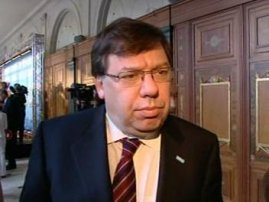
Taoiseach Brian Cowen said today that "the economy has to retain its competitiveness" and that "every economy is losing jobs at the moment". That was all he had to offer, and as usual it was a pretty poor statement from the man who is supposed to lead the country.
 Irish Labour Party leader Eamon Gilmore (right) accused the government of "abandoning people who are losing their jobs".
He said that the only action taken in the Budget that impacts on unemployed was "to make it more difficult to qualify for job seekers' benefit and to restrict the period for which it is paid".
The latest unemployment figures from the Central Statistics Office (CSO) show that the pace of deterioration in the labour market has worsened after the highest ever monthly increase in the numbers signing on the dole.
The Live Register shows a seasonally adjusted increase of 15,800 during October, and the total number of people signing on for unemployment payments or Social Welfare credits has now reached 260,300 - the highest level since March 1997.
This brings the increase in unemployment over the past twelve months to 94,600, the highest annual increase ever recorded.
Men accounted for 72% of this increase.
According to the CSO, Ireland's unemployment rate now stands at 6.7% of the labour force, up from 4.6% this time last year, and more than double the rate recorded in 2001.
Today's numbers show that the numbers on the dole rose by an average of 2347 per week during the month of October, and by an average 1800 per week since this time last year.
Taoiseach Brian Cowen said today that "the economy has to retain its competitiveness" and that "every economy is losing jobs at the moment". That was all he had to offer, and as usual it was a pretty poor statement from the man who is supposed to lead the country.
 Irish Labour Party leader Eamon Gilmore (right) accused the government of "abandoning people who are losing their jobs".
He said that the only action taken in the Budget that impacts on unemployed was "to make it more difficult to qualify for job seekers' benefit and to restrict the period for which it is paid".
Relations with the USA under Review
The Irish government has announced that a review of the relationship between Ireland and the USA is to be conducted.
The review, to be carried out by H. E. Michael Collins, the Irish Ambassador in Washington, comes on foot of a request from the Taoiseach earlier this year, in order to see how the 'close ties' between the two countries can be enhanced.
 Micheál Martin (left), the Minister for Foreign Affairs, said that the new US President-elect Barack Obama has in the past spoken of his commitment to the Northern Ireland peace process and has signalled that he will appoint a special envoy to Northern Ireland.
Minister Martin, who was addressing an Oireachtas committee, said this was "a positive indication that Barack Obama will be engaged in the issue".
One of the issues that will be addressed during the review is the use of Shannon airport for the so-called 'extraordinary rendition' flights, which transports political prisoners around the world to secret CIA facilities to be imprisoned illegally and tortured.
Amnesty International established that several of these flights landed and refuelled at Shannon.
The Irish government will ask the new US administration to stop the flights, or at least no longer use Irish airspace and airport facilities for them.
The review, to be carried out by H. E. Michael Collins, the Irish Ambassador in Washington, comes on foot of a request from the Taoiseach earlier this year, in order to see how the 'close ties' between the two countries can be enhanced.
 Micheál Martin (left), the Minister for Foreign Affairs, said that the new US President-elect Barack Obama has in the past spoken of his commitment to the Northern Ireland peace process and has signalled that he will appoint a special envoy to Northern Ireland.
Minister Martin, who was addressing an Oireachtas committee, said this was "a positive indication that Barack Obama will be engaged in the issue".
One of the issues that will be addressed during the review is the use of Shannon airport for the so-called 'extraordinary rendition' flights, which transports political prisoners around the world to secret CIA facilities to be imprisoned illegally and tortured.
Amnesty International established that several of these flights landed and refuelled at Shannon.
The Irish government will ask the new US administration to stop the flights, or at least no longer use Irish airspace and airport facilities for them.
Taoiseach congratulates Barack Obama
Meanwhile the Taoiseach has congratulated Senator Barack Obama on his election as the next President of the USA. Brian Cowen also invited Obama to visit Ireland, and in particular the small village in Cowen's home county Offaly, where the US President-elect has distant relatives from his mother's side.
The Emerald Islander