While the country as a whole (and especially the South East) is still recovering from yesterday's All Ireland Hurling finals, life goes on, focusing on more serious matters. In Dublin the crucial talks on a new national pay agreement continue in a gloomy atmosphere, overshadowed by the economic recession the country has fallen into after more than a decade of massive boom and excitement.
The employers' lobby group IBEC has eventually decided to join the talks this afternoon, while representatives of the trade unions and the government resumed negotiation this morning.
Going into the talks, some of the unions rejected out of hand the notion of a pay freeze, which has been mooted especially by IBEC (and supported by some members of the government).
Both employers and trade unions are trying to secure a new national pay agreement by Friday, but the signs are not particularly encouraging.
Betty Tyrrell-Collard of the CPSU - which represents lower paid public service workers - declared that a pay pause for her union's members would be "an absolute non-runner".
She said a pay pause for people who earn more than € 50,000 per year would be acceptable. But she added that clerical staff that are low paid and work hard to secure bonuses for higher paid positions could not suffer.
Jack O'Connor, general president of Ireland's largest trade union SIPTU, said he wanted to "make sure a deal could be done". But the unions would "not agree on an exercise to insulate businesses profits".
He refused to reveal details of what SIPTU would be demanding, but said that all unions needed to decide on a way forward.
"There is a broad consensus on a deal that will take the economic condition into consideration and protect lower paid workers," he stated before entering the talks.
John Douglas of the Mandate trade union (which has many members employed in the retail sector) said that "there will be no deal unless the low paid are protected".
He pointed out that the ball was in the court of the employers, and "something will have to be found to deal with the difficult issues for low paid workers, who have not been dealt with fairly in previous agreements". Now more than ever efforts were needed to deal with the low paid.
Larry Broderick of the Irish Bank Officials Association said he was not optimistic heading into the talks, adding that "the government needs to put something constructive on the table if the talks are to be successful".
He emphasised that his staff would not react well to a pay freeze and said that "a new structure is needed and new legislation on constructive bargaining as well". He also suggested a "flexible arrangement on pay at local level, so different approaches can be taken in different companies".
Peter McLoone, general secretary of IMPACT, said he hopes that at the end of the week a clear package for public sector workers will be on the table. What the government has in mind with regard to a public sector pay freeze "must be clear" and "the purchasing power of low paid people within the public sector must be protected".
"It makes no difference what sector you work in when it comes to buying products and trying to live."
Well, Mr. McLoone - as usual - puts things clear and simple as they are. And he is absolutely right with his statement. Given the massive and constant increases in the costs of living, especially the rocketing prices for food, fuel and electricity, this is the most important element in the pay talks for the vast majority of Irish people.
Taoiseach is "available to assist"
Meanwhile Taoiseach Brian Cowen has stated that "all sides in the talks must take account of the changed economic circumstances".
Speaking in Tullamore (in his home county Offally), Cowen said he would be "available to assist the parties on an ongoing basis, as I was indeed in the last phase, which - unfortunately - did not mean that the fact that I was available brought about a successful conclusion".
Asked if he was more optimistic about a successful outcome this time, Cowen declared that there was "a growing realisation that there are a lot of pressures in the economy". He added that the many job losses this year are "a reflection of the downturn in economic activity".
He said that "we do need to come up with an affordable solution for the medium term, so we can find space to bring about changes for the better" in what he called "a very challenging international environment".
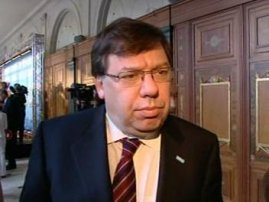
 David Begg (photo right), general secretary of the Irish Congress of Trade Unions (ICTU) described the next 24 hours as "crucial if there is to be any hope of securing a new agreement".