Showing posts with label Labour Party. Show all posts

08 September 2009

Many Critical Reactions to the Commission on Taxation's Recommendations

Irish opposition politicians have said they expect the government to use the report of the Commission on Taxation (see yesterday's entry below) "to tackle the shortfall in the public finances".

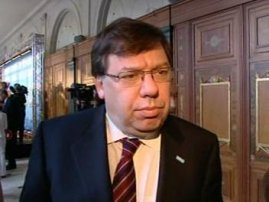
Fine Gael's deputy leader and Finance spokesman Richard Bruton (left) said that Fianna Fáil was "trying to tax its way back to recovery, and that no country has ever managed to do this".

"The last thing families and taxpayers need at this time of deepening economic crisis is dreaming up even more ways to tax them to pay for Ireland's unreformed, often dysfunctional and high-cost public service," Deputy Bruton said.
"No country has ever taxed its way back to recovery, but that is exactly what Fianna Fáil is trying to do."
"Ireland's tax system may need to be redesigned to support employment and investment, but the government's focus should not be on increasing overall tax levels," he added.

Fine Gael's newest TD (and former RTÉ economics editor) George Lee (right) stated that people would have to wait and see whether the report was a fair one. This would depend on what choices the government made from the menu provided by the commission, he said.

Joan Burton (left), deputy leader and spokesperson for Finance of the Labour Party, said she was "amazed that the commission has not tackled the issue of property based tax relief" and claimed that "the dominance of tax lobbyists in the commission's make up contributed to them side-lining this important issue".

Deputy Burton stated that the report would require "careful study" and called for it to be used "to address glaring anomalies in the tax system".
She added that despite the commission's description of the report as "revenue-neutral", it would be difficult not to see some of the new taxes being proposed being used to plug the gap in the public finances.

Sinn Féin's Finance spokesperson Arthur Morgan (right) said he expected the report to be used to increase taxation of ordinary people.
"This report unfairly targets households, as does the McCarthy Report, to pay for the government's mismanagement of the Irish economy," he said.
"It is not a restructuring of the tax system based on fairness - it is an attempt to squeeze even further ordinary people struggling to make ends meet."

Meanwhile the Irish Farmers' Association (IFA) criticised the report's proposals on carbon tax and changes to the capital allowance system.

IFA President Padraig Walshe (left) said he was "very concerned" that a carbon tax will add another cost to the productive, export-driven sectors of the economy and will also discriminate against farmers and rural dwellers who do not have the option of public transport.

He thinks the recommendation to change the capital allowance system will undermine any future investment in farm buildings in Ireland.

Con Lucey, the IFA Chief Economist, was a member of the Commission on Taxation.

Another farm group, the Irish Creamery Milk Suppliers Association (ICMSA), which has demonstrated against low milk prices outside Government Buildings in Dublin only last Friday (see my entry of September 4th), said that the proposal for a new carbon tax would "fall disproportionately on the agri-food sector and considerably worsen Ireland's competitive position".

The Arts Council has said it will make a "strong case" to the government for the retention of the artists' tax exemption scheme.
Its President Pat Moylan said that if the exemption is abolished, Ireland could lose entirely a considerable number of artists, and that this would not be for the public good.
She added that a study had shown that the Exchequer would lose tax revenue if the exemption is scrapped.

The Emerald Islander

29 August 2009

Dublin Protests over Hospital Cutbacks

Angry protests over health cutbacks have taken place outside two hospitals in Dublin today.

More than fifty people have demonstrated outside Our Lady's Children's Hospital in Crumlin this afternoon, while a separate protest took place at the Mater Misericordiae University Hospital (commonly better known as the 'Mater Hospital').

The protesters, most of them current and former patients of the hospital and their relatives, demanded the reopening of a closed operating theatre and a ward at Crumlin (right). They also called for the reversal of other cuts at Ireland's best-known children's hospital.

Meanwhile, the Labour Party said that 120 beds in the Mater Hospital are now occupied by patients whose treatment has ended.
During a party protest at the hospital, Dublin Labour TD Joe Costello said that "60 of those beds have been occupied for 100 days or more".

He explained that "a lack of step-down facilities means patients cannot be discharged" and that this is having "a knock-on effect on the hospital's Accident & Emergency department".

Deputy Costello said his information was based on an official reply to a parliamentary question he had asked recently.

27 August 2009

Eamon Gilmore calls again for the temporary Nationalisation of Ireland's major Banks

Eamon Gilmore (photo), leader of Ireland's Labour Party, has again called for the temporary nationalisation of the country's main banks "as an alternative to the setting up of the government-proposed National Asset Management Agency (NAMA)".

Speaking on RTÉ News, Gilmore said that "a mechanism should be established to write down bad debts, before returning the banks to the market when they are restored to good order".

The Labour Party leader also emphasised that "it is a necessity to get the banks lending to businesses again".

His proposal was not without cost, Gilmore added, but he claimed it would mean a lot less risk for the taxpayer than the government's plan.

Under the government's proposed legislation, NAMA would be taking over € 90 billion worth of debt away from Irish banks, so that they can start lending again.

The amount NAMA would pay for the debt has yet to be decided. But in an article, published in yesterday's edition of The Irish Times, 46 economists warned that NAMA might pay too much and thus create an extra burden for Ireland's taxpayers. (see yesterday's entry below)

Fine Gael has already stated that it will oppose the government's NAMA plan when the Dáil debates the legislation next month. Since Sinn Féin, which demands a referendum on NAMA, is against it as well, this means that all opposition parties in parliament are united on the matter, even though they do not agree on the details of possible alternatives.

The Green Party, who is the junior partner in the government coalition, will hold a special conference to debate the plan. (see my entry of August 25th)
The outcome of this conference is far from certain, and neither is the continuous support of the Green Party for the current government.

As things stand at present, anything is possible. A temporary nationalisation of our major banks - as demanded today and previously by Eamon Gilmore and his party, as well as by Sinn Féin and the Socialist Party in separate statements - would in my opinion be the safest and least costly option.

We can expect that the government will not listen and stick to its original plan. So I suggest that now is a good time to contact your local TDs, especially those from Fianna Fáil, and tell them in no uncertain terms what you think of NAMA. It might also be helpful to mention that their own seat will be in serious danger if they ram through a legislation that no one in the country really wants, but for which everyone would have to pay severely over decades to come.

The Emerald Islander

13 July 2009

Green Party wobbles over third-level Fees

Ireland's Green Party has denied that it has done a U-turn on the issue of third-level education fees.

The junior partner in the current government coalition responded to an accusation from the Labour Party's education spokesman (and former Minister for Finance) Ruairi Quinn (above left), following the comments the Minister for Communication, Energy & Natural Resources (and Green Party TD) Eamon Ryan (below right) made on the RTÉ programme 'The Week in Politics'.

After a day with various conflicting statements from the Green Party, an official spokesperson at their head office said tonight that they were "still opposed to the return of fees", but that they would "look at the Minister for Education's proposals as outlined in a document for the Cabinet".

In the RTÉ interview Eamon Ryan had indicated his support for the return of third-level fees that would involve a loan scheme for students.
Under this scheme, graduates would pay back a portion of their college fees once their income is above a set limit.

The Education Minister Batt O'Keeffe (left), a staunch and quite old-fashioned Fianna Fáil politician and uncritical supporter of Taoiseach Brian Cowen, is expected to outline several options for third-level education funding shortly.

But whatever he will propose, it means a big step backwards in the national education system.
And if the Green Party is really going to support the proposal, it also means another breach of their promises to the Irish voters.

It is a long time now that the Green Party was a sensible force for change and promoter of many worthwhile alternative policies. They have sold their soul, principles and beliefs for two seats in the cabinet and a junior minister's job, and in only two years they mutated from Fianna Fáil's harshest critics to Fianna Fáil's tame poodles. What a change... and so typically Irish!

A phrase by the great satirist, Dean Jonathan Swift, comes to mind: "Any Irishman will happily sell his mother for a shilling and throw his sister into the bargain for sixpence..."

The Emerald Islander

02 July 2009

Gilmore speaks up against Cowen's 'Guillotine'

Eamon Gilmore (photo), the leader of Ireland's Labour Party, has accused the government of "riding rough-shot over the Irish people and their elected representatives".

He deserves a strong round of applause for this statement, and all the support we - the people of Ireland - can give him.
Why? Because Gilmore stood up and defended the interests of us, the people, and of Democracy against an ever more dictatorial and arrogant government.

Eamon Gilmore objected strongly to the way the Taoiseach and his ministers are pushing bills though the Dáil without having a full and proper debate over them.

This procedure - in parliamentary slang called 'the guillotine' - is an arcane relic from colonial times and part of the British political system. And one has to wonder why it is still practised in Ireland, after 90 years of self-rule.

The Labour leader told the Dáil that the government has taken the use of the 'guillotine' on bills "to a new level of ridiculousness", pointing out that twelve bills are about to be 'guillotined' next week on top of those that were dealt with today.
"It is not unusual for this government to use the guillotine to push through legislation, just to get it out of the way or to minimise the amount of public attention that it will get," Gilmore said.

Another reason for using the 'guillotine' method is usually that a government is 'running out of time' on a bill, which means that the amount of days and hours allocated to it has been used up before a bill reaches the stage of the final vote. In Britain this happens regularly towards the end of the parliamentary year. And in order to avoid that the same bill has to go through all its stages again in the new parliamentary year, the government applies the so-called 'guillotine'.

But here in Ireland we do not have a 'parliamentary year' which is opened ceremonially by a monarch.
Our Dáil is elected for a maximum period of five years. So bills should never 'run out of time' here, and thus there should be no need for the 'guillotine' method.

If a bill 'runs out of time' in Ireland, it is usually because of bad planning or mismanagement by the government. And using the 'guillotine' method to push it through without proper debate and discussion shows indeed a great disrespect for the people of Ireland - in whose name the laws are made - and for the TDs, who are the people's elected deputies.
The 'guillotine', in its parliamentary sense, is in fact an instrument of dictatorship, as much as its namesake was an instrument of terror during the French Revolution.

There would be an easy way to avoid any bills 'running out of time', regardless for what reasons: The Dáil should simply sit and debate on more days than it does now. There is no justification for a three-month-long summer holiday and all the other holiday 'recesses' our parliament grants itself. On average the Dáil only sits between 70 and 75 days in each full calendar year.
This is unacceptable, and it would not be tolerated in any other institution or sector.

The amount of parliamentary holidays should be reduced to the same amount of days that an average industrial worker is entitled to. And one should also look at the current three-day week of the Dáil. If our TDs would work five days a week like anyone else in the country (some people, like yours truly, even work six or seven days a week), there would be no bill 'running out of time' and no point in the 'guillotine' method.

To my knowledge there are only very few countries where this method is accepted at all. It is of course practised in Britain, the country that invented it, and in some Commonwealth countries that still follow their masters in every way. And - to my astonishment - in Ireland as well, as if we were still part of the British Empire.
I know of no other European country where such a procedure exists, and I doubt that it would be accepted or tolerated by the politicians there. Only the people and politicians of Britain and of her still obedient servant Ireland are treated by their governments in such an unacceptable and dictatorial way.

It is well over time already to abolish such an arcane and offensive parliamentary instrument, and to make it illegal in Ireland. I encourage Eamon Gilmore and the Labour Party to make this point a part of their next election manifesto.

The Emerald Islander

23 June 2009

State paid € 13.7 Million to political Parties

Latest figures from the Standards in Public Office Commission (SPOC), an independent body established in December 2001, show that the State has provided political parties in Ireland with € 13.7 million of special funding last year.

The parties shared € 5.6 million under the Electoral Acts and € 8.1 million in Party Leaders' Allowances.

In addition, each Independent TD received an allowance of € 41,000, while each Independent Senator got € 23,383.

Money from the state funding cannot be used for electoral or referendum purposes. It has to be accounted for by each party in statements to the SPOC. An exception is made for the Independent TDs and Senators, who do not have to provide Statements of Expenditure.

Last year the various Irish parties received the following sums in state funding:
Fianna Fáil - € 5 million
Fine Gael - € 4.3 million
Labour Party - € 3.1 million.
Sinn Féin - € 800,000
Green Party - € 740,000
Progressive Democrats * - € 450,00
* The Progressive Democrats (PD) are now defunct. But since they still existed last year - at least officially (although they were de facto already a dead party) - they did qualify for the annual state funding.

30 May 2009

Fianna Fáil are likely to lose their Dublin MEP, while Labour Party could win two extra Seats

A new opinion poll, published in today's edition of The Irish Times, suggests that Fianna Fáil is in real danger of losing its European Parliament seat in Dublin.

It shows that public support for the Fianna Fáil MEP Eoin Ryan (left) has slipped by a further two points to now 9%, while his political arch rival, Sinn Féin MEP Mary Lou McDonald (right), is currently down by three points since the last poll and stands on 11%.

However, the Socialist Party's leader and ex-TD Joe Higgins (right) has gained two points and stands now on 9%, level with Eoin Ryan.
With only six days left until election date and public anger growing, Higgins could cause an unexpected upset in the Dublin constituency by winning a seat. (And if he fails, his transfers will certainly help Mary Lou McDonald a lot more than Eoin Ryan.)

The MRBI poll also indicates that the Labour Party might have a realistic chance to gain two extra MEPs.

Senator Alan Kelly (left) in the South and Nessa Childers (right) in the East are believed to benefit from the ever growing national support for Labour. The poll suggests that they are both within reach to win a seat and thus triple the Labour Party's strength in the European Parliament. (At present, Dublin MEP Proinsias de Rossa is the sole representative of his party in Europe.)

A separate TNS-MRBI poll in yesterday's Irish Times showed Labour as the only party to make significant improvements since the last poll a fortnight ago.

I wonder if these latest poll results also indicate that the general mood of the Irish electorate is slowly shifting to the Left, and if this - on the long run - could break the stagnation in Ireland's domestic political system, which has been dominated for far too long by two right-of-centre parties: Fianna Fáil and Fine Gael.

The Emerald Islander

29 May 2009

Latest Poll shows Labour Party gaining Support

With just one week to go to the European and local elections, the latest national opinion poll indicates that Fianna Fáil is still on course for disastrous results on June 5th.

The TNS/MRBI poll, published in today's edition of The Irish Times, shows that the Labour Party is the only party with significant improvements since the last poll a fortnight ago.

If Fianna Fáil were hoping for a late surge in support as this election campaign enters its final week, there is no sign of it so far.
The poll shows the party's support at just 20%, down one point since the last poll two weeks ago. (see my entry of May 15th)

Fine Gael are down two points, to now 36% support. But they are still by far the biggest party, and 16 points ahead of their arch rivals.

As mentioned above, Labour are the only point gainers in this poll. They are up three points to 23%, which puts them nationally in second place, after Fine Gael and ahead of Fianna Fáil.

The Green Party, which is now not much more than the outdoors and gardening department of FF, stands unchanged at 3%. This indicates that their core support still exists, but that no-one else will touch them with a barge pole.

Sinn Féin have dropped one point and stand on 8%, while Independents 'and others' (which includes Libertas) are up one point to now 10%.

However, with separate questioning - focused only on the local elections - Independents 'and others' are getting 19%, almost twice their average national support.

This is no surprise, as the amount of independent candidates or smaller parties and groups (such as the Socialist Party, the Workers' Party, the Socialist Workers' Party and 'People before Profit') is very different from one constituency to the next.*
And it is of course in the nature of independent candidates that each one of them has a different personality and thus will appeal to the electorate in a different way.

Overall satisfaction with the Irish government is - surprisingly - up slightly, but by only two points to a still disastrous 12%. The vast majority of the Irish electorate - now 84% - remains dissatisfied with the government's shambolic performance.

Satisfaction with the Taoiseach is also up - by three points - but at 21% he still has the lowest satisfaction rating of all party leaders. (He is even beaten into last place by his coalition partner, as the Greens' leader John Gormley comes in on 25% support.)

Labour Party leader Eamon Gilmore retains the nation's highest satisfaction rating, with now 49%, which is two points lower than his amazing 51% a fortnight ago.

The Emerald Islander


* For example: The Socialist Party and the Workers' Party are both nominally parties with a nation-wide attitude and ambition. And they both have members in different parts of the country.
However, regarding actual strong support and thus any chances for electoral success, the Socialist Party is limited to the northern half of Dublin (city and county), while the last - and currently only - Irish constituency with elected representatives from the Workers' Party (which was founded as a break-away group from the old Sinn Féin) is Waterford City.

16 May 2009

Fianna Fáil and Fine Gael could lose MEP

Following yesterday's amazing national opinion poll (for details see yesterday's entry below), which gives Fine Gael a commanding lead over Fianna Fáil and lists Eamon Gilmore as the most popular party leader in Ireland, The Irish Times is turning the spotlight on the up-coming European elections.

In today's edition the paper publishes another TNS/MRBI poll, this time for the four European constituencies in Ireland, and the first one in this election campaign.
The big surprise is that - according to this poll - both Fianna Fáil and Fine Gael are apparently "in danger of losing one MEP" on June 5th.

The poll identifies the East constituency as the 'danger zone' for Fine Gael, while Fianna Fáil is in a tight fight with Sinn Féin in Dublin.

In the East, where the veteran MEP Avril Doyle is not standing for re-election, the second outgoing Fine Gael MEP Mairead McGuinness (right) - who was Doyle's surprise running mate five years ago - is rated in the poll on 33% and thus well ahead of her fellow 'blueshirt' John Paul Phelan, who is on 9%.
Unless votes between the two Fine Gael candidates are split in a more equal ratio, the second Fine Gael seat in the East could be lost to the Labour Party's Nessa Childers, daughter of former President Erskine Childers (and until very recently a County Councillor for the Green Party). Fianna Fáil's MEP Liam Aylward is apparently on course to retain his seat.

In Dublin, Fine Gael's veteran MEP Gay Mitchell (left), who is probably the most pro-European politician in Ireland, and Labour's Pronsias de Rossa look at present quite safe. The third seat will be decided between Sinn Féin's Mary Lou McDonald and Eoin Ryan of Fianna Fáil, who are both outgoing MEPs.
As Dublin is losing one of its previously four seats due to the overall down-sizing of the European Parliament, but all four outgoing MEPs are standing for re-election again, one will inevitably lose out.

In the South Fianna Fáil's outgoing MEP Brian Crowley (right), whose personal support clearly outranks that of his party, seems to be certain to return to Brussels and Strasbourg. Fine Gael is likely to win one seat as well, and at present it appears that former GAA President Seán Kelly, parachuted in as a 'celebrity' candidate, has the upper hand over his running mate, the outgoing Fine Gael MEP Colm Burke.
The third seat will be contested by sitting Independent MEP Kathy Sinnot and Toireasa Ferris (daughter of Kerry TD Martin Ferris) of Sinn Féin, with an outsider chance for the Labour Party's Alan Kelly.

The poll also suggests that two of the three seats in the North West would be taken by outgoing MEPs Jim Higgins (left) of Fine Gael and Marian Harkin (Independent), with the third seat going to Pat 'the Cope' Gallagher of Fianna Fáil, who is a former MEP and a sitting TD for Donegal South-West.

If this would indeed be the result on June 5th, it would be a set-back for Declan Ganley (right), the founder and leader of the new Pan-European party Libertas, who also stands as a candidate in the North-West and is confident to be elected.

About 500 people were polled by TNS-MRBI in each of the country's four European constituencies on Monday, Tuesday and Wednesday of this week for what is the first European poll of the campaign.
Although it does show some clear trends already, I think that it is too early in the campaign to make serious predictions. But over the coming weeks there will be more opinion polls, all the way until June 5th, when we will have the one and only poll that really counts: the actual election.

The Emerald Islander

15 May 2009

A new Poll puts Fine Gael in a commanding Lead, and Eamon Gilmore is the most popular Politician

A new TNS/MRBI poll, published in today's edition of the Irish Times, shows the support for Fine Gael at a new all-time high of 38%.
This gives the largest Irish opposition party a 17-point lead over the main government party Fianna Fáil, which dropped by one point to 21%, its worst rating since the party was founded in 1926 by Eamon de Valera.

The poll also shows a further drop in satisfaction with the government as a whole, and in particular with Taoiseach Brian Cowen, whose personal approval rate has sunk to 18%.

In comparison, Fine Gael leader Enda Kenny gets the thumbs-up from a third of the voters (33%), but the darling of the electorate is currently Labour Party leader Eamon Gilmore, with an approval rate of 51%.
I cannot think of any time in the past when the leader of the third-largest party in Ireland had such a high approval rate, in fact outclassing both the Taoiseach and the leader of the majority opposition.

Rather surprisingly the Labour Party has dropped four points in public support since the last poll and now stands on 20%.

With the (European and local) election campaigns now under way, the Green Party begins to feel the pinch and to pay the price for its participation in a government coalition led by Fianna Fáil.
In today's poll the Greens are down one point to 3%, which in a football league would clearly be inside the relegation zone.

Sinn Féin, the only parliamentary party that opposed the Lisbon Treaty, remains unchanged on 9% of public support.
The numerous independents and 'others' (which still includes the new Pan-European party Libertas) are also unchanged at 9%.

Predictably Enda Kenny and members of his front bench welcomed the poll with enthusiasm, while the reaction of the Labour Party was rather mixed.

And Fianna Fáil, to no-one's surprise, is still completely in denial.
Minister for Justice Dermot Ahern (left) tried to put the massive unpopularity of his party down to "the tough decisions we have to make in these difficult times", and to an extent he is certainly right with this assessment.
But what Fianna Fáil is unable - or unwilling - to recognise is the fact that it was no-one but themselves who created this situation. Somehow FF politicians still think that they can and will get away with it (again), without losing votes on a massive scale.

Perhaps on June 6th, which is rather appropriately the 65th anniversary of D-Day, things will be a lot clearer for Ireland and our government. Just as they were for the German government on June 6th, 1944.

The Emerald Islander

11 May 2009

44 Irish Candidates stand in European Elections

More than 500 million people in all 27 countries of the EU are entitled to vote in the European Parliament (EP) elections, which are to take place during the first week of June.
As Europe's nations have traditionally different days of the week for elections, the voting process will be spread over four days, from Thursday, June 4th to Sunday, June 7th.

Britain and the Netherlands hold elections traditionally on a Thursday, and thus they will be the first two countries to go to the European polls on June 4th.

Ireland and the Czech Republic follow on Friday, June 5th (with the Czechs extending their vote to a second day, June 6th).

Saturday, June 6th will be election day in Cyprus, Latvia, Malta and Slovakia, as well as the first of the two days set aside for the polls in Italy.

All the other 18 EU countries - two thirds of the member states with the majority of Europe's population - hold elections traditionally on Sundays. They will vote on June 7th, which is also the second polling day for Italy.

The nine 'early bird' nations - including Ireland - will have to wait until Sunday night before exit polls can be published. Then follows the counting of votes, and the results will be known during the early hours of Monday, June 8th.

Candidate nominations for the European Parliament elections closed at 12 o'clock noon today, and after the deadline had passed, it emerged that a total of 44 individuals will contest the (now) twelve EP seats allocated to the Republic of Ireland.

There are seven political parties contesting the 2009 European elections in the Republic of Ireland: Fianna Fáil, Fine Gael, the Labour Party, the Green Party, Sinn Féin, Libertas and the Socialist Party. Together they are fielding 30 party candidates in the four constituencies, and there are also 14 independent candidates. (For a complete list of all 44 Irish candidates see below, at the end of this article.)


The most remarkable among the Independents are three women: Outgoing North-West MEP Marian Harkin (left), outgoing South MEP Kathy Sinnott (centre), and the political activist and environmentalist Patricia McKenna (right), who has been a Green Party MEP for Dublin from 1994 to 2004. An outspoken campaigner for human rights, the environment and many other issues, McKenna strongly opposed her party's coalition with Fianna Fáil in 2007. For the past two years she was more and more marginalised by the new Green Party leadership and has now left the party to stand in Dublin as an independent candidate for the European Parliament.

In the outgoing European Parliament we had 13 (of the 785) seats, but since the parliamentary reform reduced the overall number of MEPs to 736 for the new five-year session, Ireland lost one seat and retains only twelve, the same amount as Lithuania (and one less than Denmark, Finland and Slovakia). With 99 MEPs Germany has the largest national contingent, and Malta - with only five MEPs - the smallest.

The Irish reduction from 13 to 12 European Parliament seats affects most strongly the Dublin constituency, which is losing one of their currently four MEPs. Like the other three European constituencies in Ireland, Dublin will from now on be a 'three-seater'.
Since the last elections to the European Parliament in 2004 there have also been significant boundary revisions which affect predominantly the North-West constituency. Once covering the province of Connaught and the three Ulster counties in the Republic, this constituency has been enlarged and now also includes counties Clare, Longford, Roscommon and Westmeath. (Thus it is the only of the four constituencies that covers territory in all four Irish provinces.)

Of the 13 outgoing Irish MEPs all but two seek re-election. The retirees are Fine Gael's veteran MEP Avril Doyle (East) and Fianna Fáil's Seán Ó Neachtáin (North-West).
The latter had originally intended to stand again and received the nomination of his party. But then, rather surprisingly, Ó Neachtáin announced only last month that he would not be seeking re-election, apparently on the basis of medical advice he received.

This puts Fianna Fáil in some unexpected extra trouble. After a frantic and secretive consultation process between the party HQ in Dublin and local activists in the constituency, the former Minister of State Pat 'the Cope' Gallagher (left) was hastily appointed as Seán Ó Neachtáin's replacement. Gallagher, currently a Fianna Fáil TD for Donegal South-West, confirmed only this morning - 15 minutes before the deadline for nominations - that he will stand for his party in the North-West, seeking election to the European Parliament.

That the party has chosen him for this task is not a complete surprise, as Gallagher had been an MEP (for the then Connaught-Ulster constituency) from 1994 to 2002 and thus knows the ropes in Brussels. (Between 1981 and 1992 he was a Fianna Fáil TD for Donegal South-West, the same constituency he represents again in Dáil Éireann since 2002.)
From 1987 to 1994 Gallagher was Minister of State for the Marine & the Gaeltacht, and between 2002 and 2004 the No. 2 (junior minister) in the Department of the Environment, Heritage & Local Government.
His last government position was as junior minister in the Department of Health, where he was responsible for 'Health Promotion and Food Safety'. But when Brian Cowen became Taoiseach a year ago, Gallagher was one of the Ministers of State sacked by the new leader.

Speaking on RTÉ's News at One, former Senator (and Fianna Fáil candidate for the European Parliament) Paschal Mooney said that he was "angered by the nomination of Mr. Gallagher", his party comrade, "because both Fianna Fáil candidates are based in the northern part of the constituency".
Mooney explained that when he had been selected at a convention to stand in the north of the constituency, it was to balance the party ticket, with Seán Ó Neachtáin in the south.

Pat 'the Cope' Gallagher said he was standing "for the good of the constituency" and agreed that two weeks ago he had told (the Irish language TV channel) TG4 that if both he and Mr. Mooney were to stand for Fianna Fáil then there would be no balance.

The fact that the - rather popular - Seán Ó Neachtáin is not contesting the elections after all could provide an opening for Declan Ganley, founder and leader of the new Libertas party, who is standing in the North-West.
Based in Galway, Ganley might well be able to fill the political void left by Ó Neachtáin in the southern part of the constituency, while Gallagher and Mooney are chasing the same votes in the northern part. It will therefore be interesting to watch especially the North-West over the coming weeks.

Another hot-spot will be Dublin, where the one-seat-reduction makes this EP election literally a fight for survival for the capital's four outgoing MEPs Mary Lou McDonald (Sinn Féin), Gay Mitchell (Fine Gael), Proinsias de Rossa (Labour Party) and Eoin Ryan (Fianna Fáil).
One of them will be sacrificed on the altar of parliamentary reform, but the quite tricky question is: which one?

I will follow the developments during the campaign and share my analysis and views with you here over the next three weeks. And even though I am based in the South, my consultancy work will lead me all around the country and give me a good overview of trends and tendencies.
Only one year after the Irish rejection of the Lisbon Treaty and with the current Fianna Fáil-led government the most unpopular in the history of the state, this year's European elections promise to be among the most interesting and most unpredictable since 1973, when Ireland joined the EEC.

The Emerald Islander


Complete List of all Irish Candidates for
the European Parliament Election 2009

DUBLIN Constituency
(10 candidates)

Senator Deirdre de Burca - Green Party
Councillor Eibhlin Byrne - Fianna Fáil
Joe Higgins - Socialist Party
Mary Lou McDonald, MEP - Sinn Féin
Patricia McKenna - Independent
Gay Mitchell, MEP - Fine Gael
Proinsias de Rossa, MEP - Labour Party
Eoin Ryan, MEP - Fianna Fáil
Caroline Simmons - Libertas
Emmanuel Sweeney - Independent

* * *

EAST Constituency
(11 candidates)

Liam Aylward, MEP - Fianna Fáil
Thomas Byrne, TD - Fianna Fáil
Nessa Childers - Labour Party
Kathleen Funchion - Sinn Féin
Paddy Garvey - Independent
Micheál E. Grealy - Independent
Mairéad McGuinness, MEP - Fine Gael
Raymond O'Malley - Libertas
Senator John Paul Phelan - Fine Gael
Tomás Sharkey - Sinn Féin
Jim Tallon - Independent

* * *

NORTH-WEST Constituency
(13 candidates)

Pat 'The Cope' Gallagher, TD - Fianna Fáil
Declan Ganley - Libertas
Marian Harkin, MEP - Independent
Jim Higgins, MEP - Fine Gael
John Francis Higgins - Independent
Thomas King - Independent
Councillor Pádraig Mac Lochlainn - Sinn Féin
Noel McCullough - Independent
Michael McNamara - Independent
Paschal Mooney - Fianna Fáil
Susan O'Keefe - Labour Party
Fiachra Ó Luain - Independent
Senator Joe O'Reilly - Fine Gael

* * *

SOUTH Constituency
(10 candidates)

Senator Dan Boyle - Green Party
Colm Burke, MEP - Fine Gael
Brian Crowley, MEP - Fianna Fáil
Councillor Toiréasa Ferris - Sinn Féin
Senator Alan Kelly - Labour Party
Seán Kelly - Fine Gael
Ned O'Keeffe, TD - Fianna Fáil
Maurice Sexton - Independent
Kathy Sinnott, MEP - Independent
Alexander Stafford - Independent

18 February 2009

Heated Dáil Debate over Banking Scandals

While more than 4000 civil servants and public sector workers - including Gardaí - were protesting outside Leinster House against the proposed new pension levy today (see entry below), a heated debate was going on inside the Dáil chamber.

Taoiseach Brian Cowen (left) angrily denied suggestions that he was attempting to protect anyone involved in the Anglo Irish Bank share scandal.
He accused Fine Gael leader Enda Kenny of "impugning his reputation", a charge vehemently rejected by the Mayo TD and most senior deputy in the Dáil .

Cowen told the Dáil that his government was "determined to ensure that due process is followed" and that - if wrong-doing is uncovered - "people will face the legal consequences".

Minister for Justice Dermot Ahern (right) said that he "would prefer that the ten individuals involved [in the fraudulent share-buying scandal] be revealed", but that "due process must be allowed to take its course".

Meanwhile it has come to light that the annual report of the now nationalised Anglo Irish Bank, which is expected to be published on Friday, will reveal that a property owned by a member of (former bank boss) Sean FitzPatrick's family was rented by the bank. It is understood that this property is in London.

The Taoiseach stated that he regarded regulatory reform of banking as "a top priority".
In relation to the so-called 'Golden Circle' of ten fraudulent share buyers, he said the issue arose because of "due diligence by the government". He explained that the debts remained and his government would ensure that these debts would be collected by the bank.

Fine Gael leader Enda Kenny (left) said the government had been "far too timid" about the situation in Ireland's financial institutions, because it was responsible for the failure to regulate the banks properly.
He asked the Taoiseach if he agreed that "a fraud has been perpetrated on the Irish Stock Exchange".

Labour Party leader Eamon Gilmore (right) asked why Brian Cowen, when he was Minister for Finance, ordered the Revenue Commissioners to reverse its decision to impose stamp duty on Contracts for Difference (CFD).
These are high-risk investment 'products' where investors can bet on the future direction of a stock, without having to actually buy shares.
Eamon Gilmore said Brian Cowen had already confirmed that he had been lobbied about the issue, and asked for the identity of those involved.

In reply the Taoiseach said as far as he recalled, the lobbying came from "a professional body", but he promised to check with the Department and provide details.

Meanwhile the Green Party has said that it "could review its support for the government if politicians are implicated in the latest banking scandal".
"We are still committed to remaining in government, but that is not an open-ended commitment," the party's chairman, Senator Dan Boyle (left), told a news agency.
Remaining questions about the scandals should be answered quickly instead of the recent 'drip-drip' of revelations, so the damage to Ireland's reputation could be repaired, Boyle added.

After the debate Fine Gael Enda Kenny stated that the public deserved to know the names of the 'Golden Circle' members.
Speaking on RTÉ's Six-One TV News, he said the Irish people now own Anglo Irish Bank and "are entitled to know what is going on".

I wholeheartedly agree, as anyone with a sound mind would. And to go one step further: I do not understand why the government appears to know nothing about all these scandals, and still - after the matters have emerged into the public domain - makes no active efforts to find out what was - and is - going on.
Is it the high level of pure incompetence in our government we have to blame for that, or is Fianna Fáil fully aware of more skeletons hidden in the government's cupboards...?

The Emerald Islander