Showing posts with label Dermot Ahern. Show all posts

15 July 2009

Seanad passes Criminal Justice Bill

Ireland's new Criminal Justice (Amendment) Bill, which has been criticised by various opposition politicians and members of the legal profession, has passed all stages in the Seanad last night.

The Bill, which - among other elements - introduces new forms of non-jury trials for members of organised crime gangs and excludes lawyers from certain procedures, was debated in the Upper House of the Oireachtas for eight hours yesterday and finally passed at 11.30pm.

Despite objections from Fine Gael at the handling of the Bill from the outset, they supported its passage in the end, while the Labour Party, Sinn Féin and some Independent Senators opposed it.

Of the 58 Senators (two seats are currently vacant) only 42 voted on the Bill, and the result was 37:5 in favour.

In an unexpected and rather surprising move, the two Green Party Senators Dan Boyle and Déirdre de Búrca - who are part of the government and were appointed to the Seanad by Bertie Ahern as part of the coalition agreement - abstained during the final vote.
Earlier, they also voted against a government motion to proceed with the report stage last night.

Dan Boyle (left), who is also party president of the Greens, had previously expressed reservations about the Bill, but he told the Seanad that he "reluctantly" supported it.
Nevertheless Boyle and his colleague decided at the last minute to abstain.

In a statement issued this morning, Eamon Ryan - Minister for Communication, Energy & Natural Resources - has supported the abstention of his two party colleagues, without going into further details on the matter.

I wonder if last night's decision by the Senators not to support the government of which they are part is the first public sign of the end of the coalition.
As the Bill was supported by Fine Gael, the government was not in danger to lose the vote. So the abstention of the two Green Senators made really no difference to the result and could be seen as a rather cheap option for them.
However, there has been serious Green rumbling, especially from Dan Boyle, in recent months and the condition of the government coalition is anything but sound or healthy.

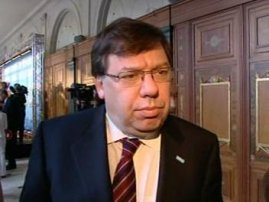
Speaking after the Seanad vote, the Minister for Justice Dermot Ahern (right) said it was important that "the Bill the people support" was passed before both Houses of the Oireachtas go on holidays. He hopes the Bill will be signed into law "in the not too distant future".

If this is going to happen remains to be seen, as it has been suggested that President Mary McAleese might refer it to test its constitutionality.

There is also a strong possibility that a group of lawyers, who are unhappy with parts of the Bill, might challenge it in the Supreme Court on grounds of being unconstitutional.

While the people who suffer on a daily basis at the hands of organised crime gangs - especially in parts of Dublin and in Limerick - cannot wait to see the Bill becoming law, one should not ignore the concerns of legal experts and professionals, who have to deal with it in practice.
There is no doubt that we need to tackle the ever growing problem of organised crime in Ireland, but it has to be done properly, within the framework of the law and without turning to draconian and unconstitutional measures.

There has always been crime in Ireland, as everywhere else. And some of it has been organised in various ways.
But during the eleven years Bertie Ahern (left) was Taoiseach, the number of crime gangs in Ireland has risen massively and their activities have reached unseen and unacceptable dimensions.
Ahern's ignorance and his reluctance to even go near the problem is one of the reasons for the spreading and influence of organised crime in Ireland.
There are many people who regard Bertie Ahern as a crook and even a criminal, so one has to wonder if his own problems with legal matters of various kinds might have prevented him from being tough on organised crime...

I am not a lawyer, but fairly familiar with matters of the State. And I wonder why the already existing 'Offences against the State Act', which was introduced to face the threat from politically motivated terrorist groups, could not be extended and used against those who terrorise people and threaten the existence of the State through purely criminal acts, motivated by greed and selfishness.

The Emerald Islander

15 May 2009

A new Poll puts Fine Gael in a commanding Lead, and Eamon Gilmore is the most popular Politician

A new TNS/MRBI poll, published in today's edition of the Irish Times, shows the support for Fine Gael at a new all-time high of 38%.
This gives the largest Irish opposition party a 17-point lead over the main government party Fianna Fáil, which dropped by one point to 21%, its worst rating since the party was founded in 1926 by Eamon de Valera.

The poll also shows a further drop in satisfaction with the government as a whole, and in particular with Taoiseach Brian Cowen, whose personal approval rate has sunk to 18%.

In comparison, Fine Gael leader Enda Kenny gets the thumbs-up from a third of the voters (33%), but the darling of the electorate is currently Labour Party leader Eamon Gilmore, with an approval rate of 51%.
I cannot think of any time in the past when the leader of the third-largest party in Ireland had such a high approval rate, in fact outclassing both the Taoiseach and the leader of the majority opposition.

Rather surprisingly the Labour Party has dropped four points in public support since the last poll and now stands on 20%.

With the (European and local) election campaigns now under way, the Green Party begins to feel the pinch and to pay the price for its participation in a government coalition led by Fianna Fáil.
In today's poll the Greens are down one point to 3%, which in a football league would clearly be inside the relegation zone.

Sinn Féin, the only parliamentary party that opposed the Lisbon Treaty, remains unchanged on 9% of public support.
The numerous independents and 'others' (which still includes the new Pan-European party Libertas) are also unchanged at 9%.

Predictably Enda Kenny and members of his front bench welcomed the poll with enthusiasm, while the reaction of the Labour Party was rather mixed.

And Fianna Fáil, to no-one's surprise, is still completely in denial.
Minister for Justice Dermot Ahern (left) tried to put the massive unpopularity of his party down to "the tough decisions we have to make in these difficult times", and to an extent he is certainly right with this assessment.
But what Fianna Fáil is unable - or unwilling - to recognise is the fact that it was no-one but themselves who created this situation. Somehow FF politicians still think that they can and will get away with it (again), without losing votes on a massive scale.

Perhaps on June 6th, which is rather appropriately the 65th anniversary of D-Day, things will be a lot clearer for Ireland and our government. Just as they were for the German government on June 6th, 1944.

The Emerald Islander

18 February 2009

Heated Dáil Debate over Banking Scandals

While more than 4000 civil servants and public sector workers - including Gardaí - were protesting outside Leinster House against the proposed new pension levy today (see entry below), a heated debate was going on inside the Dáil chamber.

Taoiseach Brian Cowen (left) angrily denied suggestions that he was attempting to protect anyone involved in the Anglo Irish Bank share scandal.
He accused Fine Gael leader Enda Kenny of "impugning his reputation", a charge vehemently rejected by the Mayo TD and most senior deputy in the Dáil .

Cowen told the Dáil that his government was "determined to ensure that due process is followed" and that - if wrong-doing is uncovered - "people will face the legal consequences".

Minister for Justice Dermot Ahern (right) said that he "would prefer that the ten individuals involved [in the fraudulent share-buying scandal] be revealed", but that "due process must be allowed to take its course".

Meanwhile it has come to light that the annual report of the now nationalised Anglo Irish Bank, which is expected to be published on Friday, will reveal that a property owned by a member of (former bank boss) Sean FitzPatrick's family was rented by the bank. It is understood that this property is in London.

The Taoiseach stated that he regarded regulatory reform of banking as "a top priority".
In relation to the so-called 'Golden Circle' of ten fraudulent share buyers, he said the issue arose because of "due diligence by the government". He explained that the debts remained and his government would ensure that these debts would be collected by the bank.

Fine Gael leader Enda Kenny (left) said the government had been "far too timid" about the situation in Ireland's financial institutions, because it was responsible for the failure to regulate the banks properly.
He asked the Taoiseach if he agreed that "a fraud has been perpetrated on the Irish Stock Exchange".

Labour Party leader Eamon Gilmore (right) asked why Brian Cowen, when he was Minister for Finance, ordered the Revenue Commissioners to reverse its decision to impose stamp duty on Contracts for Difference (CFD).
These are high-risk investment 'products' where investors can bet on the future direction of a stock, without having to actually buy shares.
Eamon Gilmore said Brian Cowen had already confirmed that he had been lobbied about the issue, and asked for the identity of those involved.

In reply the Taoiseach said as far as he recalled, the lobbying came from "a professional body", but he promised to check with the Department and provide details.

Meanwhile the Green Party has said that it "could review its support for the government if politicians are implicated in the latest banking scandal".
"We are still committed to remaining in government, but that is not an open-ended commitment," the party's chairman, Senator Dan Boyle (left), told a news agency.
Remaining questions about the scandals should be answered quickly instead of the recent 'drip-drip' of revelations, so the damage to Ireland's reputation could be repaired, Boyle added.

After the debate Fine Gael Enda Kenny stated that the public deserved to know the names of the 'Golden Circle' members.
Speaking on RTÉ's Six-One TV News, he said the Irish people now own Anglo Irish Bank and "are entitled to know what is going on".

I wholeheartedly agree, as anyone with a sound mind would. And to go one step further: I do not understand why the government appears to know nothing about all these scandals, and still - after the matters have emerged into the public domain - makes no active efforts to find out what was - and is - going on.
Is it the high level of pure incompetence in our government we have to blame for that, or is Fianna Fáil fully aware of more skeletons hidden in the government's cupboards...?

The Emerald Islander

04 December 2008

Cluster Bomb Convention signed in Oslo

An important landmark convention that bans the use of cluster bombs has been signed during a special ceremony in Oslo.

The Minister for Justice Dermot Ahern travelled to the Norwegian capital and signed the convention on behalf of Ireland.

Ireland is one of the - so far - 108 countries who support the international convention, which aims to prohibit the use of weapon systems that disperse large numbers of sub-munitions.

Dropped from aircraft or fired from artillery guns, cluster bombs explode in mid-air to randomly scatter hundreds of so-called 'bomblets', which are miniature mines and can be as small as 8 cm in size.

A certain percentage of the bombs do not explode on impact and remain a threat to soldiers and civilians alike, often long after a conflict has ended.
The small 'bomblets' are an even more serious menace, as they can remain undetected on or in the ground for a long time.

Thousands of civilians who live in former war zones have been killed or seriously wounded by them. Many of those injured are children, as cluster bombs are often mistaken for toys.

The campaign group Handicap International estimates that some 100,000 people have been killed or injured by cluster bombs since 1965.
A number of victims and relatives of the victims of cluster bombs travelled to Oslo as well, to support the treaty and to call for more countries to sign.

However, three of the world's largest producers and stockpilers of cluster munitions - the USA, Russia and China - still refuse to sign the convention.
So is Israel, which dropped more than a million bomblets on Lebanese cities in July and August 2006, an act of unprovoked and criminal aggression that has been condemned by the UN and many countries around the world, but keeps killing and wounding Lebanese civilians almost on a daily basis.

The convention to ban cluster munitions was debated and eventually agreed on during a twelve-day-long conference in May of this year in Dublin. (see my entry of May 19th)
It was the largest international event of its kind ever hosted by Ireland, and the deliberations received much media attention in Ireland and many other countries.

The convention to ban cluster munitions is a large step forward towards world peace, and one hopes that under the up-coming presidency of Barack Obama the USA will join the rest of the civilised world and sign the document as well.

The Emerald Islander

13 October 2008

Arson Attacks on Garda Stations

A Garda station in southern Connemara was extensively damaged in a suspected arson attack. The fire at Carna Garda station (photo left) in Co. Galway broke out at around 10 p.m. last night.
About two weeks ago windows of the same station had been smashed during the night, but no further damage was done at that time. There were also some other acts of vandalism reported in the area in recent weeks.

Only five days ago the Garda station of Blarney (photo right) in Co. Cork was also badly damaged by another fire.
Gardaí
are now attempting to establish a motive for both attacks, but it is not suspected that they are connected.

Arson attacks on Garda stations are fortunately not occurring frequently in Ireland, but there has been a considerable number of such crimes in recent years.

Last year, on March 22nd, 2007, an arson attack was made on the Garda station at Bandon, in the west of Co. Cork. A man walked into the public office of the station at 11 p.m. with a petrol bomb. The spreading fire was quickly extinguished by Gardaí, but there was smoke damage to the floor and walls. A person who had been in the foyer during the attack was treated in hospital as a precaution.

Three years ago the Garda station in Littleton, Co. Tipperary was target of not one but two arson attcks within the short span of 13 weeks. The first took place on July 25th, 2005 and - just as the station had been repaired and refurbished again - a second occurred on November 2nd, 2005.

Six weeks before the first attack at Littleton, in the morning of June 14th, 2005, five petrol bombs were thrown at Blackrock Garda station in Cork city. Two Gardaí, who were in the station at the time, managed to extinguish the fires. There were no injuries and - apart fom burn marks on the outer walls (photo above) - no damage was done to the building.

On
May 3rd, 2004 the Garda station at Carrigbyrne in Co. Wexford was extensively damaged by another serious act of arson.

In the night to Saturday, May 31st, 2003 a 19-year-old woman started at fire at Tallaght Garda station on the outskirts of Dublin.

On February 28th, 2002 a 28-year-old alcoholic from Finglas walked into Ballymun Garda station in Dublin, claiming his brother was missing. He then poured petrol, which he had with him, on the floor of the station's public area and set it alight. The Garda in charge on the night reacted quickly and put the fire out himself, so only € 1000 damage was done in this attack. The man was arrested and on June 19th, 2003 sentenced to three years imprisonment.

The most serious arson attack on Gardaí took place on Wednesday, July 21st, 1999 at Tallaght Garda station. A man entered the station at around a quarter to five in the morning, carrying petrol and some flares. He went into the public office, where the Sergeant and several other Gardaí were on duty, and set it on fire. Then he escaped in a white Ford Sierra car. Extensive damage was done to the station and tragically Sergeant Andrew Callanan, a 36-year-old married man and father of three small children, died from severe burns later in hospital. Several other Gardaí were injured in this outrageous attack.

On April 19th, 1999 another Garda station, this time in Edenderry, Co. Offaly, was set alight in the early hours of the morning. The Sergeant's office was completely gutted and some damage was done to the public office. A Garda patrol car, which was parked at the rear of the station, was burnt-out in the blaze (photo above right), while a second car, owned by a civilian, was also partially damaged.

One wonders why Garda stations around the country are not better protected against such attacks. But then again, many of the stations that suffered arson attacks are in rural areas and not manned around the clock. There is only a Garda present for several hours a day, but never at night. And some smaller rural stations are entirely unattended by now. All they provide for the public is an intercom connection to the next manned station, which is often many miles away.

As a historian I can only reflect on the lessons one can learn about this from history. Whenever the State withdraws its visible presence - which is usually the police - from a local community, it leads to two things: Alienation of people from the State and reduction of their respect for government and authorities; and an increase in crime, vandalism and unsavoury behaviour.

Maybe it is time for the Minister for Justice Dermot Ahern (photo above left) and Garda Commissioner Fachtna Murphy (photo right) to have a closer look at their general strategic policing principles and in particular at the deployment pattern of the Garda Síochána around the country.

The Emerald Islander

13 May 2008

Brian Cowen elected Taoiseach

Well, while I was in hospital for a few days the expected change at the head of the government took place.
I did manage to report the official resignation of Bertie Ahern as Taoiseach on the 6th, but unfortunately I was back in an HSE bed for another few days by the time Dáil Éireann elected the Tánaiste (Deputy Prime Minister) and Minister for Finance Brian Cowen (above) as our new Taoiseach (Prime Minister) in the afternoon of May 7th. So this entry is basically "old news" for most of you, but as it is a very significant event, I decided to mention it here, even though it happened already six days ago.

After being elected with an eight vote majority of in the Dáil, the new Taoiseach went to Aras an Uachtarán (the President's Residence) in Phoenix Park, to present himself to President Mary McAleese and receive from her his seal of office.

Breaking with tradition, Brian Cowen is the first incoming Taoiseach who brought his family along to this important moment. On local level new mayors and county councillors often bring their whole families to their inauguration, but it is a new development on national level. Previously the new Taoiseach always cut a rather lonely figure when he was "going to the Park".
It shows Brian Cowen not only as a family man, but also as a man of rural values. Under his leadership the style of Dublin politics will certainly change.
Unlike his jovial and easy-going predecessor and mentor Bertie Ahern, the new leader is a more serious man who does not suffer fools gladly. Even though he is known for a good sense of humour, he keeps that for more private moments and is a tough man in the corridors of power.

Having not won an election and taking over the ship of state in midstream, he will have to show to the
Dáil and to the whole country that he has the right qualities to lead the government and the country. Only time will tell.

Analysing Cowen's career so far, it is clear that he is a true green party animal, probably even a lot more so than his predecessor, who united Fianna Fáil after the quarrelsome years under the leadership of Haughey and Reynolds. There seem to be two basic camps when it comes to Brian Cowen: those who think he is a 'Biffo' (big ignorant f..... from Offaly), and those who see him - like Dick Roche - as "the biggest brain in
Fianna Fáil".

Well, for Dick Roche almost anyone must seem as intellectually superior, and personally I believe that the brightest mind in contemporary FF belongs to the often overlooked Dr. Martin Mansergh, now a TD for Tipperary and previously a diplomat, special adviser to Taoiseach Bertie Ahern and a Senator. But there is a lot of truth in the rumours of Brian Cowen's intellectual capacity. In his years as Minister for Foreign Affairs hard work and persistence won him a lot of respect from foreign politicians and officials, especially inside the EU. During a major conference in Dublin - at the time when Ireland last had the EU presidency - I remember a very senior European political figure referring to Brian Cowen as "the fellow who looks like cider, but is really champagne".

Cowen's first cabinet is almost the same as Bertie Ahern's last, which indicates his preference for the devil you know.
Promoting Mary Coughlan (right) - the youngest woman in cabinet - to be his Tánaiste did surprise quite a lot of people, myself included. But since she is not in charge of one of the three senior departments - Finance, Justice and Foreign Affairs - it is questionable if this really means that she would be in serious contention for Cowen's succession, whenever that will become relevant. It is more likely that it is a shrewd move to please feminists, a populist media culture and the "politically correct".

As Mary Coughlan comes from Co. Donegal, it is also strengthening rural Ireland's representation in the cabinet further.
To compensate for that, Cowen appointed Brian Lenihan (left) as the new Minister for Finance, less than a year after he joined the cabinet as Minister for Justice.
By moving Dermot Ahern from Foreign Affairs to Justice and replacing him with Micheál Martin, whose portfolio of Trade and Enterprise is now held by Mary Coughlan, Cowen has left the question of succession wide open, with at least four possible and acceptable candidates in waiting. However, as Cowen is only 48 and seems to be in good health, this could well be a very long wait.

There were some other changes to the cabinet, but I will analyse them in detail after the new junior ministers are announced later today. I will provide you with a complete review of the new Cowen administration. Until then I hope you are enjoying the sunshine and make the best of life in a country that had it so good for a dozen years and managed to squander most of that wealth. Now a period of difficult years lies ahead, and one can only hope that the new Taoiseach is as strong and determined as his physique suggests.

The Emerald Islander

01 March 2008

Ireland recognises Kosovo

The Irish government has officially recognised the independence of the Republic of Kosovo. Minister for Foreign Affairs Dermot Ahern, TD (photo) made the announcement, saying he was aware that the matter was painful for Serbs. However, he stressed that Ireland's recognition of Kosovo should not be mistaken for an act of hostility towards Serbia.

On February 17th the national assembly of Kosovo had passed a resolution declaring it was an independent democratic, secular and multi-ethnic republic, guided by the principles of non-discrimination and equal protection under the law. The EU has subsequently sent a group of 2000 policemen, customs officers, judges and prosecutors to Kosovo, in order to help the new republic over its initial security problems and create legal and social stability. The country is also still protected by a multi-national military force, provided by NATO.
A number of other countries have already recognised Kosovo's independence, including the USA, Britain, France, Germany and Italy. More Western countries have declared their intention to follow suit, while Russia - traditionally the closest and strongest ally of Serbia - has condemned Kosovo's declaration of independence.