Showing posts with label Nicolas Sarkozy. Show all posts

04 December 2008

Cowen tours Europe in Search for a Solution to the Lisbon Treaty Deadlock

The Taoiseach has stated that he hopes "to find an acceptable way to break the deadlock over the Lisbon Treaty with his EU partners" ahead of a summit next week.

Brian Cowen (left) is mulling whether or not to call a second referendum on the Lisbon Treaty after its rejection by the Irish voters in June of this year.

"Working closely with my colleagues within the European Council, I'm hopeful that we can identify the elements of an acceptable way forward next week," Cowen said, referring to the EU summit in Brussels next Thursday and Friday.

Speaking in Berlin, he also said that "any resolution to the impasse must address not only the concerns of the Irish public about the charter".
"I'm very conscious that it must also be acceptable to colleague member states who have made clear their desire to see the reforms contained in the Lisbon Treaty enter into force as soon as possible," Cowen declared during a joint press briefing with the German Chancellor Angela Merkel.

Germany was the second stop on Cowen's mini-tour of European capitals to discuss the treaty. He will head to London today to meet Prime Minister Gordon Brown, and to Paris tomorrow for talks with President Nicolas Sarkozy, as France currently holds the rotating EU presidency.

Cowen's first destination yesterday was Luxembourg, where he met Prime Minister Jean-Claude Juncker (right), who - despite the small size of his country - is a very influential European politician and often seen as the éminence grise of the EU. The meeting took place behind closed doors, in an atmosphere of great secrecy, and no details about it have emerged.

Cowen is thought to be considering whether Irish voters would back the Lisbon Treaty in a new referendum, if guarantees were given on key concerns including abortion, corporate tax and the Republic of Ireland's cherished military neutrality.
Government researchers found that those issues, as well as opposition to losing the permanent Irish EU Commissioner in Brussels, were the main reasons for the rejection of the Lisbon Treaty by 53% of Ireland's voters on June 12th.

"The Taoiseach's discussions with his EU counterparts will focus on the situation in relation to the Lisbon Treaty ahead of next week's European Council," Cowen's office said today.
"Other EU issues, notably the climate change and energy package, and the international financial crisis, are also likely to feature."

In 2001 Irish voters rejected the EU's Nice Treaty, but the result was overturned the following year in a second referendum, when clarifying declarations were given by other member states. So Cowen hopes he can orchestrate another U-turn, if he brings the right kind of compromises home from Europe.

Though this calculation has a certain logic, there is a significant difference between then and now. In 2001 Taoiseach Bertie Ahern (left) enjoyed strong support from the Irish electorate, and the first Nice referendum was defeated narrowly, with a very low turnout of voters.

The Lisbon Treaty was rejected by a clear majority, and the turnout of voters was high. And - in contrast to 2001 - the popularity of the government, its main party Fianna Fáil and the Taoiseach himself are now at an all-time low.
So it is more than likely that the Irish electorate would reject the Lisbon Treaty again, should they be forced to vote in a second referendum, by a government that is now loathed throughout the country.

While Brian Cowen flew off to discuss the treaty with his EU counterparts, the opposition leader has pressed for private briefings from the Taoiseach.

Fine Gael leader Enda Kenny (right), whose party supported the treaty even stronger than Fianna Fáil, said that the issue was "a matter of national importance", and that Ireland was now "becoming the butt of some anti-European pressure".

"We need to know what it is that the government proposes to do when the Taoiseach goes out to Brussels next week, to explain to the other heads of government the strategy for Ireland," Enda Kenny demanded.

I am sure that he will be informed about those plans in time, but I doubt that it will help him and his party to be a more effective opposition against an ever more incompetent government.

The cross-party pact in support of the Lisbon Treaty has damaged the standing of both opposition parties that took part in it - Fine Gael and Labour - with a significant section of the Irish electorate.
In order to unseat and replace the current government, the opposition needs to be seen distant from Fianna Fáil and Brian Cowen, and not - once again - as his partners.

The Labour Party seems to have grasped that nettle. At their national conference in Kilkenny last weekend delegates still said that the Lisbon Treaty had "positive elements for the future of Europe", but they also stated clearly that "the decision of the Irish voters should be respected".

This is the right approach. The people have voted - fair and square - and made a decision. If every time a referendum brings a result the government does not like a second round of voting is forced on the nation, it is a clear affront to Democracy and to the people, who after all had a choice and made their decision.

In the current situation of crisis and great instability every Irish politician - regardless of party - should be aware of the public mood and show the electorate more respect. After all, it is the people who elect the TDs. And if they wish to remain TDs, they need to listen carefully to their voters and follow their will.

The Emerald Islander

01 October 2008

Mixed Reactions to Ireland's Bank Guarantee

Taoiseach Brian Cowen (on the left), who is currently on a visit to Paris, has said that his 100% bank guarantee scheme has received the full political backing of French President Nicolas Sarkozy (on the right).

Cowen told reporters he thought that President Sarkozy, whose country holds at present the rotating six-month presidency of the EU, "understood precisely" the reasons the Irish government had to act in such a decisive way.

Shares in Irish banks are continuing to recover from their massive losses, after the government's plan to guarantee their deposits and debts has been published.
Dublin's ISEQ index closed 2.5% higher at 3641, with the banking stocks gaining between 8% and 10.5%. They are not out of the woods yet, but the trend begins to look a little more positive.

In London the FTSE closed 1% higher, and other European stocks mainly rallied as well.

Meanwhile, EU Competition Commissioner Neelie Kroes has appealed to national governments "not to act unilaterally" in the current financial crisis, and to consult the commission especially on the question of offering state aid to financial institutions.
Speaking at a press briefing in Brussels, Ms. Kroes said that the EU Commission is in close contact with several governments, including the Irish, but declined to comment on individual cases.

The British government, which has come under pressure from the public and parts of the media to follow Ireland's example, wants the Irish to look closely at their guarantee to make sure it complies with EU law. This is of course a smoke screen. The real reason for British concern is that savers and investors who have their money in British banks might transfer it to Ireland, where it is now absolutely safe, while Britain still guarantees only a sum of £ 20,000.

Prime Minister Gordon Brown (left) said European governments should make sure that whatever actions they took to tackle the global financial crisis complied with EU competition law.

The President of the EU Commission, Jose Manuel Barroso, said that "the EU needs a shake-up of banking deposit insurance schemes", so that there will be more consistency across the Union.

Currently deposit guarantee schemes vary widely across the EU, with some countries offering much greater protection of depositors' savings than others. So far only Ireland has opted for a full 100% guarantee scheme, but it is possible that other countries might follow suit.

The Emerald Islander

12 September 2008

Pope urges the EU to promote Human Rights

Pope Benedict XVI has said that Europeans would work actively for the EU when they saw and experienced personally that it promoted Human Rights.

Beginning a four-day visit to France - which currently holds the rotating EU presidency - he also told dignitaries his greatest concern was that young people should be encouraged to respect and help others.

Arriving at Orly Airport in Paris, Benedict XVI was welcomed warmly by the French President Nicolas Sarkozy, his wife Carla and senior members of the French hierarchy. The two heads of state then took the salute of a guard of honour, provided by the infantry component of the Garde Républicaine.

At the Élysée Palace the Pope later met Nicolas Sarkozy privately, before addressing ministers of the French government and other dignitaries. He told them that Europeans would work actively for the EU when they saw and experienced personally that it promoted inalienable human rights to free education, to family life and to work as well as religious rights. This, he explained, would allow them to understand fully the greatness of the EU project.
He said his greatest concern was that young people should be soundly educated and encouraged to respect and help others if they are to develop serenely towards an age of responsibility. He also expressed concern for the surreptitious widening of the gap between rich and poor in the West and the state of the planet.

Later the Pontiff delivered a keynote address to hundreds of intellectuals, researchers and artists, before praying with thousands of people at Notre Dame Cathedral.

Tomorrow Pope Benedict will travel to Lourdes to celebrate the 150th anniversary of the apparitions there.

22 July 2008

The Biffo & Sarko Show in Dublin

Originally scheduled already for July 11th, a brief official visit of French President Nicolas Sarkozy (left) to Dublin took place yesterday. In contrast to a state visit, where Sarkozy would come as the French head of state and then be primarily the guest of our President Mary McAleese, this was a short working visit, a political fact-finding mission of the current EU President in the aftermath of Ireland's rejection of the Lisbon Treaty.
So the host was Taoiseach Brian Cowen, who welcomed Nicolas Sarkozy at Government Buildings in Dublin for a conference with selected ministers of his own cabinet. Later Nicolas Sarkozy also met the leaders of the two main opposition parties, Enda Kenny of Fine Gael and Eamon Gilmore of the Labour Party. Despite the fact that both politicians and their parties supported the Lisbon Treaty, they had over the weekend contemplated to snub the French leader, as it was originally planned to give them only a few minutes each with Nicolas Sarkozy.
After a re-arrangement of the time table both were then quite happy to attend the scheduled meeting at Government Buildings.

Even before Sarkozy's arrival in our capital, the visit was overshadowed by various remarks the French President was supposed to have made - though not officially in public - in recent days in Paris. He was alleged to have said that Ireland would have to vote again, which caused a stir and some resentment within the Irish population and especially in the victorious Irish NO camp.

On the other hand, there was an unexpected step forward by Nicolas Sarkozy, who expressed a specific wish to meet not only the leaders of Ireland's largest political parties, who had all been calling for a YES vote in the defeated referendum, but also selected representatives of the Irish NO campaign. As the most significant exponents of the various groups that opposed the Lisbon Treaty, Declan Ganley of the think tank Libertas, former Green Party MEP Patricia McKenna of the People's Alliance, and Richard Boyd Barrett of the People before Profit movement had the opportunity to put their views directly to Nicolas Sarkozy.

It was quite significant that this meeting took place in the French embassy, and thus under strict diplomatic terms on French territory, where Nicolas Sarkozy and not Brian Cowen was the host. Whatever one might think about the French, they are still the masters of diplomacy, whose rules and regulations they developed and shaped way back in the 18th and 19th century.
Besides the three main leaders of the NO campaign, a number of other representatives from the NO camp were present as well. And I have to say that I was rather impressed by the energetic, open and friendly attitude of Nicolas Sarkozy. This was not the French bogeyman, whose mind was set on forcing the Irish into another unpopular vote. Sarkozy came across as a statesman who was willing to listen and learn why Ireland had rejected the Lisbon Treaty.

Even though he did not change his mind visibly and openly there and then in Dublin, there were moments when one could see clearly that he was thinking while listening to the arguments.
It is unlikely that in the remaining five months of the French EU presidency a solution can be found, and even more unlikely that there will be another referendum in Ireland on the Lisbon Treaty. Certainly not before the next elections to the European Parliament, due in a year's time.

In my opinion the most likely offer that might come from Nicolas Sarkozy and the EU is a change to the idea of reducing the size of the EU Commission, which would leave one commissioner from each member state in place as it is now. If this is indeed offered, the whole of Europe will have to thank the Irish voters for preserving everyone's permanent representation in the highest and most powerful organ of the EU structure.
There might also be a new and more acceptable formula for the voting system in the EU Council.

After all the official talks were over, the joint news conference of President Nicolas Sarkozy and Taoiseach Brian Cowen at Government Buildings turned into a deliberately happy demonstration of Franco-Irish friendship and unity. The event was the first episode of a tightly stage-managed "Biffo & Sarko Show", with some elements of the well-remembered "two Ronnies" coming to mind. I am sure there will be more of the same in the future, as both politicians have no choice but to respect each other - as well as the will of the voters - and work together if they want to bring the current stalemate in the EU to an end without offending the people of Ireland and Europe any further.
Sarkozy said that there was "no magic wand available to resolve the Lisbon impasse". He also denied saying that Ireland should hold a second referendum on the treaty. This was important to clarify, and it seems that the French President has now formally and officially accepted what the leaders of the NO campaign told him: After Ireland's NO vote the Lisbon Treaty is dead.

This is also in line with a statement by Sinn Féin President Gerry Adams, who said that "there can be no re-run of the Lisbon Treaty Referendum" and a new deal must be negotiated. Sinn Féin was the only party represented in Dáil Éireann to support the NO campaign, a fact that will not be forgotten by Ireland's voters in coming elections.

Despite being a very short visit that lasted only a few hours, the element of security was very high. Both Irish Gardai and a significant contingent of French security personnel were deployed in quite unusual strength for what was after all only a brief working visit in the capital of a friendly country. It was obvious that the Irish government was not taking any risks, and that French officials had probably overestimated the anger of the Irish people.
There were several demonstrations in Dublin yesterday, both in favour of Nicolas Sarkozy and against him and the EU.

The Irish Farmers' Association (IFA), which had earlier this year filled the streets of Dublin with more than ten thousand angry demonstrators against the WTO talks and decided to support the Lisbon Treaty after all very late in the campaign, was all pro-EU again. As a clear sign of their support for Nicolas Sarkozy they brought a number of tractors - painted in the blue, white and red colours of the French flag - into Dublin's inner city. (No great surprise here, as no-one received and still receives more money and support from the EU than Irish farmers...)

On the other hand, more than 200 fishermen, many of them from Ireland's southern coastlands, were protesting against the ever more restrictive EU regulations for their industry. Highlighting their plight in a peaceful way, they handed out free fish to passers-by on O'Connell Bridge, right in the very centre of Dublin.

A third, and by far the largest demonstration was organised by the Campaign against the EU Constitution (CATEC) on Dublin's Kildare Street, right outside of the Government Buildings.
CATEC, which was very active in the NO campaign, is made up of 15 different groups and organisations, including the Socialist Party and the Peace and Neutrality Alliance. In a news conference their leaders made the clear statement that after rejections by the voters of France, the Netherlands and Ireland the treaty is dead. They said CATEC would "not accept any deals or buy-offs to revive it".

The CATEC demonstration was joined by people from all parts of Ireland who travelled for the day to Dublin to make their point heard and seen by Nicolas Sarkozy and our own politicians. One of the more angry protesters shortened his lunch by throwing two eggs in the direction of Nicolas Sarkozy. Even though he missed the French President, he was immediately lead away by Gardai. But this was the only real "incident" in an otherwise peaceful and well-organised demonstration.

An old friend of mine, Kermit (the frog), who wrote for many years a regular column in Centre Focus, a magazine published by the Council of Trade Unions in Cork, decided to make his point even more visible than most. Dressed appropriately he joined the demonstration and told Nicolas Sarkozy in his usual and poignant way where to go. Despite the well-known French practice of eating frogs' legs, no harm was done to him and while Nicolas Sarkozy returned with deep thoughts to Paris, Kermit is now happily back at the Lough in Cork, where he lives.

And after a long and eventful day (at whose end I was frankly too tired to write this entry right away) I am home again, too. Waterford, for long spells of this 'summer' covered with grey clouds and rather cool, wet and windy, welcomed me with bright and unexpected sunshine. Maybe this is a little omen, a sign that after all the darkness that the Lisbon Treaty was threatening us with, there is new hope on the horizon. For that one has to thank the Irish people, and this we cannot do often enough. However, the struggle for the retention of proper democracy in the EU is far from over. The referendum of June 12th was only the first of many battles. The victory we achieved was great and welcome, but it should not make us complacent. It should wake us up and make us ready for more. Only with good preparation and by keeping up the right spirit will we succeed and keep Europe the homeland of Democracy, the great gift ancient Athens gave to the world.

The Emerald Islander
01 July 2008

Sarkozy postpones Visit to Ireland

Nicolas Sarkozy (left) has decided to postpone a planned visit to Ireland to discuss the Lisbon Treaty.

The French President, who has so far refused to be drawn on whether there should be a second Irish vote on the Lisbon Treaty, was scheduled to visit Dublin on July 11th. He will now come on July 21st, which gives him, his administration and the EU bureaucracy ten more days to think and reflect on the new political situation in Europe after the Irish referendum.

The Elysee Palace cited the President's "heavy schedule" as main reason for the postponement. But political observers in Paris and analysts are certain that the French leader, who took over the rotating presidency of the EU today, wants to avoid a rushed decision over the future course of Europe.


Meanwhile the French Ambassador to Ireland has said that the Lisbon Treaty will not be re-written at the EU Summit in October. Yvon Roe d'Albert told the Dail Committee on European Affairs that "once was enough".


He was responding to a question from Labour TD Joe Costello (right), who said it appeared there was going to be a re-run of the treaty rather than a new treaty. Deputy Costello said it seemed there was one law in Europe for large countries and another for smaller ones. When Ireland rejected the Nice Treaty there was a re-run, but there was no question of a re-run when two larger countries, France and the Netherlands, rejected the Constitutional Treaty in 2005.

The French Ambassador replied that there was no division between large and small countries.
Regarding the Lisbon Treaty, he declared that it was not exactly the same situation, as France and the Netherlands rejected the Constitution, which was "more difficult and involved sovereignty".

Holding the EU presidency, France is expected to come up with proposals for a solution to the crisis the Irish rejection of the Lisbon Treaty has caused. But six months are a very short time in European politics and it is more likely that concrete steps towards the re-organisation of the EU will not be made before January 2009, when the Czech Republic takes over the EU presidency.

The Emerald Islander

20 June 2008

No "quick Fix" for Europe

Taoiseach Brian Cowen (left) has told EU leaders that there is "no quick fix" to resolve the dilemma caused by the rejection of the Lisbon Treaty by Irish voters. Speaking at a press conference after the EU Summit meeting, he made it clear that it is "too early to know how we can move forward at this time".

He said that it has been a busy number of days and that the only potential way forward would need to be acceptable to Ireland and other countries. He added that a number of EU members have indicated that they have no interest in reopening negotiations on the Lisbon Treaty.

When asked about whether a second referendum would be held, the Taoiseach said he could not say whether there would be a further vote on Lisbon. The Irish government could not go beyond where they are at the moment. They are currently analysing the results of the Lisbon Treaty's rejection.

It was also revealed that French President Nicolas Sarkozy will visit Ireland at the beginning of his EU presidency and in the aftermath of Ireland's rejection of the Lisbon Treaty.

Earlier President Sarkozy said he intended to go to Ireland to help finding a solution, but he said he was determined not to re-open the debate on the institutions of the EU.

The French President also declared that the (British) EU's Trade Commissioner Peter Mandelson (right) is partly to blame for Ireland's rejection of the Lisbon Treaty.
Mandelson, a former Northern Secretary, had upset Irish farmers with his strategy at the World Trade Organisation (WTO) talks.

Speaking on the second day of the EU summit in Brussels, President Sarkozy said: "We were going to negotiate, in the case of the WTO, a 20% reduction in European agricultural production. Reducing agricultural production by 20% in a world where there are 800 million people dying of hunger, every 30 seconds a child dies of hunger, is unacceptable."
"Quite honestly," the French President added, "there is one person who is of this opinion, and that is Mr. Mandelson. It is not France's position."

Padraig Walshe, the President of the Irish Farmers' Association (IFA), stated that Mr. Sarkozy was correct in highlighting the damage that Commissioner Mandelson had done to farmers' opinion in the run-up to the Lisbon referendum.

Meanwhile Ireland's Minister for Agriculture, Fisheries and Food rejected comments from Mr. Mandelson that NO campaigners in the Lisbon Treaty campaign were "allowed to spread misinformation".
Speaking at the Farmfest event in Co. Galway, Brendan Smith said the government's focus was now on addressing the issues raised during the campaign, as part of the effort to resolve the difficulties raised by the Irish rejection of the treaty.

The increasing hesitation of the Czech Republic over the Lisbon Treaty was also a point of focus at the EU summit. Ahead of today's session, EU foreign policy chief Javier Solana said he did not think the Czechs would block the treaty. He added that he thought the treaty would be ratified in all the remaining member states.

However, the Belgian Secretary of State for Foreign Affairs Olivier Chastel was sceptical, saying the Czechs were "not willing to listen to reason". This statement coincides with the strong views expressed by the Czech President Václav Klaus three days ago. Klaus had congratulated Ireland on a "victory for democracy against bureaucracy and elitist EU plans". Meanwhile the Lisbon Treaty has been referred to the Czech Constitutional Court for closer examination and a growing number of politicians from the ruling party have expressed their doubts about the value of the Lisbon Treaty for their country and progress in the EU.

Luxembourg has warned that the EU will not be able to enlarge further without the Lisbon Treaty. This is quite a correct analysis, but in my opinion it is actually a good and welcome fact. The EU is already too large and has admitted in recent years new members without proper scrutiny. While - for example - Greece, Portugal and Spain had to wait many years for their EU membership (which was only granted after they had reformed their political systems and laws), Bulgaria and Romania were admitted to the EU after only a few years, without achieving the required and necessary stability and democracy. Bulgaria is virtually run by organised crime gangs, and Romania has still great shortfalls in the fields of economy and political participation.

Slovenia, another new member which currently holds the EU Presidency, said that Ireland's rejection of a new EU treaty should not slow down the process of enlarging the union. This is, however, a minority position.

Separately, the Czech Prime Minister Mirek Topolanek said he expected negotiations with Ireland on what it might do with regards to the rejected Lisbon Treaty would take place in the first half of next year. On January 1st, 2009 the Czech Republic will succeed France (which takes the chair on July 1st) in the rotating six-months EU Presidency.

The Emerald Islander

14 June 2008

More Change is needed in a changed EU

Throughout the Lisbon Treaty campaign and in many of the public meetings organised by the National Forum on Europe representatives of the YES side usually failed to explain the treaty and why it was supposed to be so good for Ireland and Europe. Instead they spent a lot of time telling us how good Europe has been for Ireland - which is true and was never disputed by the NO side - and warning the people of all sorts of terrible consequences (without ever specifying them) which might befall Ireland if the treaty was rejected.

In a public debate at Liberty Hall in Dublin Fine Gael MEP Gay Mitchell even went so far to refer to the Second World War as a reason to vote YES. Maybe he had forgotten that Ireland was not a participant in that war and kept her neutrality, or perhaps he forgot that he was speaking to an audience of Irish people. Being on the continent for some time and being confronted with the many nations who were indeed involved in and damaged by the Second World War might have influenced his thinking and his views on Europe and the EU.

When the first six member states of the EU - Belgium, France, Germany, Italy, Luxembourg and the Netherlands - founded the European Economic Community (EEC) in 1957, the memories of the two World Wars that had ravaged their countries twice within thirty years were still very fresh and present. After all, it was only twelve years after central Europe had been in ruins, literally as well as politically. And it was indeed the desire for peace and peaceful co-operation that led to the formation of the EEC, often also called the Common Market. (Britain had been invited by the six founding nations to join as well, but the government in London showed no interest at the time and was more occupied with its crumbling empire and Anglo-American co-operation in the Cold War.)

But in the 51 years of its existence the structure and character of the European Union has been changed significantly. What began as a loosely organised group of six central European nations is now a very tightly regulated union of 27 countries, including some who are still recovering from their involuntary and painful membership of the Eastern bloc under the leadership of the Soviet Union. The EU now also includes two countries - Bulgaria and Romania - who were not ready when they joined . Their massive internal problems, especially the highly organised crime of their local mafia-style groups, have become problems of the whole EU. Despite heavy words from Brussels there is no change visible, and no solution in sight.

Advocates and supporters of the Lisbon Treaty have often said that the new enlarged EU needs a new structure, one that is different from the framework put in place for a union of six. I agree. This is indeed what we need. But the Lisbon Treaty is not the right answer and did not give Europe the right structures. It has been argued that now with 27 members "everything is so much more difficult". That may also be true, especially if one looks at Bulgaria and Romania.
In fact, the proverbial elephant in the room of the European Council is the rapid enlargement of the EU, which was done as if a race had to be won. But this subject seems to be still taboo.

We have admitted too many new members far too quickly, and now we are facing the mess this haste has created. Wise analysts of European politics have seen this coming and warned about it well in advance. But the political leaders of Europe would not listen. Even now they are unable to see their folly and plan further enlargements. The troublesome nations of the Balkans are now considered as potential new members, and even Turkey - an Asian country with a large Muslim population and an abysmal human rights record - is still on the list of EU membership candidates.

This senseless race for an ever larger and larger EU has to stop. 27 members are already more than the existing system can handle properly. What is needed now is a complete new beginning of discussions and consultations, with active participation of all EU citizens. Before we bring new members into the union, we have to define what kind of union, what type of structure we want for the EU. Ireland's resounding NO to the Lisbon Treaty could lead to such a constructive and enlightening process. But it can and will only happen if the political leaders accept the realities, sit down and give themselves time. And it also needs the active and creative input of the citizens of Europe.

One day after the result of the Irish referendum was announced, the shock in some European capitals is still great. While Germany's Chancellor Angela Merkel said that the Irish decision must be accepted and new ways needed to be explored, the French President Nicolas Sarkozy (above) is obviously less realistic. In a speech earlier today he insisted that "EU member states must continue ratifying the Lisbon Treaty to avoid a crisis". The flamboyant President, a friend of George W. Bush and a supporter of Thatcherite capitalism, seems to overlook that the Lisbon Treaty cannot become EU law, as it needs the ratification of all member states. Ireland has said NO, and that should be the end of that treaty, in the same way as the French and Dutch NO to the European Constitution (96% identical with the Lisbon Treaty) put an end to that. Any attempts to ignore the clear will of the Irish people, which is also reflected in the populations of many other member states who did not have the chance of a referendum, would break the EU's own rules and thus create a real crisis.

In little more than two weeks, on July 1st, France will take over the EU presidency from the current holder Slovenia. And this is the real reason for Mr. Sarkozy's heavy-handed speech. The French President has no interest in spending the six months in the EU chair with a failure. But if he keeps ignoring the facts, this is exactly what might happen.
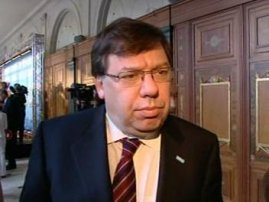
Much will now depend on Taoiseach Brian Cowen (left) and the ministers of his cabinet. In a few days they will have to explain to their EU colleagues why they were not able to bring their nation to accept the Lisbon Treaty. If the Irish delegation will raise the questions which dominated the referendum campaign, they have a realistic chance to trigger the necessary new debate for the whole EU.
Should they fail to do that and behave more like Eurocrats than the elected representatives of the Irish nation, nothing will change and the EU will continue her journey on the wrong tracks.

It is early days yet, the shock effect is still paralysing the clear thinking capacity of many EU politicians, and since there was apparently no "Plan B", all plans have to be returned to the proverbial drawing board. But in the coming weeks and months it will become clear - in Ireland and Europe - which direction our leaders intend to chose. Thanks to the Irish people they have the immense chance to create a new and stable European structure. Should they fail to do that and continue to ignore the will of the people of Europe, the shock experienced yesterday after the referendum in Ireland will be mild compared with the anger the citizens of Britain, France, Germany, Italy and other large countries are able and likely to express.

The Emerald Islander