Showing posts with label shares. Show all posts

19 January 2009

And some good News coming through as well...

In my earlier entry from this afternoon I mentioned that some statisticians regard January 19th as "the most depressive day in the whole year" and indeed plenty of people obliged to make it so. In particular the stock brokers in Dublin and London, who sent the financial markets - but especially bank shares - down into the proverbial cellar.

Despite reassuring words from both governments - in Dublin and London - the world's financial dealers no longer trust us and the value of Irish and UK banks plummeted to another all-time low.
The hurried and quite shambolic nationalisation of Anglo Irish Bank by our government was fuelling the fires of distrust instead of sending the - intended - message of stability and 'business as usual'.
And in Britain the announcement of further billions of taxpayers' money being pumped into the sinking banks did not help them a bit. Quite the opposite. Many international finance houses, especially the cash-rich ones in the Far East on whose willing to lend we now depend more than ever, regard us with great suspicion. Subsequently UK bank shares fell by 68% today, losing over two thirds of the little value they now have in one single day!

The combined forces of government ignorance, regulators' laziness and sleeping on their watch, and bankers' criminal greed have holed both Britain and Ireland in a serious way well below the waterline.
The question by now is no longer when we can stop the ships sinking, but if we can stop them at all.

But even on this "most depressive day in the whole year" there is a little bit of good news as well. Five more directors from the disgraced board of Anglo Irish Bank have today announced their resignation from the board, in order to "make room for a new leadership team".
And not a moment too soon. In my opinion their resignation comes actually quite late, and I have not the slightest bit of empathy for these reckless bankers. They are responsible for the biggest financial and political crisis since the 1930s, and if I had the power, I would send them all to jail and throw away the keys...

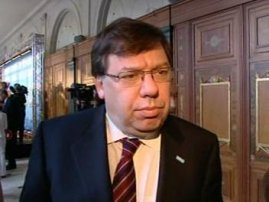
An even better piece of news is that Brian Goggin (photo), the Bank of Ireland's highly incompetent chief executive, is stepping down as well.
The bank announced today that Goggin will retire this summer, a year earlier than planned. The bad news is that by retiring - instead of being sacked for the massive failure he presided over - Goggin will get his full pension, a golden parachute and many other perks he does not deserve and has not earned.

A man who presided over the collapse of a major bank that lost 95% of its value in less than two years deserves to be sacked, flogged and made to pay for his disastrous lack of leadership.
But as corrupt as our system is, this is unlikely to happen. Brian Goggin will go home as a multi-millionaire and enjoy a jet set lifestyle for the rest of his days. The bill for his folly will be paid by us - the Irish tax payers. But given the fact that for more than a decade a majority of us has persistently elected the most incompetent politicians to government again and again, we deserve nothing else. (And anyone who will in future vote for Fianna Fáil or the Green Party deserves that things get a lot worse than they are already...)

I suppose we should be content with the good news that five of the main gangsters from Anglo Irish are gone and that the arrogant fool Brian Goggin is following suit soon. All in a day's work, and not so depressing after all...

The Emerald Islander

The most depressing Day in the Year

This morning someone on the radio made the remark that January 19th is - apparently - "the most depressing day in the year". How they come to that conclusion I do not know, and it was not really explained on the programme either. These days many radio presenters have the habit of throwing in comments, remarks and statements that they have neither researched nor cross-checked.
On the other hand, there are countless statistics nowadays, about anything and everything. So it is quite possible that there is such a statistic and that it puts a black mark on this day - January 19th.

Whatever is the case, the stock brokers in Dublin must have been listening to the programme this morning. And they took it very seriously and decided to contribute to the day appropriately. Subsequently the value of Irish bank shares has dropped to another all-time low.
As I write this, shares in Allied Irish Bank (AIB) dropped by almost 52% to 70 cents, after slumping as much as 60% earlier. Bank of Ireland is down now 20% to 60 cents per share, which is already a recovered value from earlier falls of 47%. And Irish Life & Permanent, who own the permanent tsb bank, tumbled 32% to € 1.49.

Today's falls come in the wake of market suggestions that Bank of Ireland and AIB look unlikely to be able to raise extra cash from private investors to top up a proposed state investment in the banks.

It appears that a statement I made on the BBC's "Any Questions?" programme more than seven years ago was quite correct, and every day this becomes more obvious to everyone.
What I said - back in September 2001, shortly after the airborne terror attacks on New York and Washington - was this:
"It becomes quite clear that conventional capitalism as we know it does no longer work. There are people on this planet who - for whatever reason - no longer want to live and work, inspired by the chance to gain wealth and personal comfort, but prefer instead killing themselves, if they can do serious damage to the capitalist system in the process. This means that no business and no organisation that follows the traditional capitalist system alone will be save and successful in future."
There might well be people who heard my statement then and made changes to their lives and to their business, as I did myself. But the vast majority did not. In fact, here in Ireland the small class of really wealthy people took no notice of it at all, as they have never listened to anyone 'on the outside' ever. They just think that their wealth gives them complete immunity from the rest of the world.
For the past ten years they created an artificial bubble of social and financial illusions that puts the well-known story of The Emperor's New Clothes well into the shadows. In the process they have not only done great damage to themselves and their companies, but to the Irish nation as a whole. Now chicken are coming home to roost on an almost daily basis, and there is for now no end in sight.

As this is supposed to be "the most depressing day in the year", I will oblige and make another statement on this matter.
Not only does conventional capitalism as we know it no longer work in the face of fundamentalist terrorism that has no concern for human lives, it does also no longer work in a globalised world that allows banks to create and gamble with artificial money that does not exist, never will exist, and has no relation to any real values.

For thousands of years people used raw materials, produced something other people wanted, and sold it to them for a price higher than the costs of production. That way they made a profit, and this is the core of old-fashioned capitalism.
Nowadays more and more manufacturing - even the production of the most basic goods - is "outsourced" to low-wage economies, mostly in the Far East. Meanwhile here in the West our apparently so bright and clever people find it more suitable to concentrate on 'financial services', which means in plain English gambling with other people's money and getting paid huge bonuses for it, just like in any casino in Las Vegas. What they really are is not bright and clever at all, but greedy and stupid

If we keep this up and do not learn our economic lessons very quickly, capitalism in any form will cease to exist. Private enterprises and public services alike will collapse, and Ireland - together with many other countries, especially in the English-speaking world - will encounter a period of absolute anarchy, violence and destruction. What ever will emerge from that after some time is anyone's guess and unpredictable, even for someone with a good track record of correct predictions.

There is still time to get things right, but not a lot of it is left. Money and time are literally running out for Ireland. The only way to turn things around is a radical change of direction, under a strong leadership.

Well, perhaps that researcher quoted on the radio this morning was right after all and this is the most depressive day of the year...

The Emerald Islander

02 December 2008

Aer Lingus rejects new Ryanair Take-Over Bid

The board of Aer Lingus has rejected a € 748 million offer by Ryanair to buy and take over their airline.
In a statement, the board strongly advised its shareholders to "take no action" in relation to the Ryanair offer.

An earlier take-over bid by Ryanair, issued more than two years ago, was also rejected and later blocked by the European Union as well.

On October 5th, 2006 - only days after Aer Lingus was floated on the stock market - Ryanair announced it had bought a 16% stake in Aer Lingus and was offering € 2.80 for each of the remaining shares.
After Aer Lingus rejected these advances, Ryanair declared a few hours later that it had raised its stake to 19.2%. The low-cost airline also said it had no problem with the Irish government keeping its 28.3% of shares.

It is no secret that Ryanair's CEO Michael O'Leary (right) has a dream. The maverick entrepreneur who changed the structure, character and costs of European air travel in a few years beyond recognition and forced many other airlines to adopt his concept at least in parts, wants to create a single powerful Irish airline, which could carry over 50 million passengers a year.

Ironically this is exactly the opposite of what he wanted - and did - when he established Ryanair, which was to break the monopoly of Aer Lingus. The new large airline he now envisages would in fact restore the monopoly situation Ryanair has broken.

After the rejection of the 2006 take-over bid, which was criticised by the Irish government and eventually banned on June 27th, 2007 by the EU Commission on competition grounds, some analysts believed that this was the end of it and Ryanair would be content with owning a significant portion of their rival's shares.

But they did not take into account the personality of Michael O'Leary. He is a man used to get what he wants. And when he has set his mind on something, he usually keeps at it like a terrier. Whenever there is a chance, he points out the "unique opportunity" to form a large, competitive and profitable Irish airline.

In a move that surprised most analysts and was announced to the Irish Stock Exchange in Dublin yesterday morning, Ryanair declared it was offering now € 1.40 per Aer Lingus share (exactly half of what they offered two years ago).

It already owns now 29.82% of the former state airline, having bought up more Aer Lingus shares steadily and quietly all the time.

Ryanair says it wants to "merge the two airlines into one strong Irish airline group under common ownership, similar to recent mergers in Europe such as Air France-KLM and Lufthansa-Swiss".
It points out that its proposal represents "a premium of about 28%" over the average closing price (€ 1.09) of an Aer Lingus share in November 2008.
In fact, it also represents an premium of about 25% over the closing price of € 1.12 of an Aer Lingus share on Friday.

Ryanair suggests that both airlines should operate as separate companies and keep their separate brands, but share and combine organisation and facilities (such as maintenance, catering etc.).

It says that if the offer is successful, it will double the size of the Aer Lingus short haul fleet from 33 to 66 aeroplanes over the next five years. And it also promises 1000 new jobs.

But still the board of Aer Lingus is having none of it. For them Michael O'Leary is what the Carthaginian General Hannibal was to the Senate of Rome: the arch enemy "ante portas" (at their gates).

Aer Lingus, previously a fully state-owned company, floated on the Dublin stock exchange only in 2006, after the Irish government had decided on a part-privatisation. Within days Ryanair began snapping up shares, before going public with its take-over interest.
Only outsiders and people who never heard of Michael O'Leary could have been surprised by that.

And O'Leary still keeps trying, now with new arguments. "The world has changed", he says, pointing out the various mergers of other airlines and dwelling gloomily on the recession and global financial crisis.

"Over the past two years, the trading environment for all European airlines has deteriorated dramatically as a result of high oil prices and the global recession," O'Leary states plainly. "And more than 30 airlines have failed this year alone."

He says that the airline has requested meetings with the Ministers for Finance and Transport (Brian Lenihan and Noel Dempsey), the board of Aer Lingus and the airline's ESOT trustees to discuss the latest move.

After the announcement Aer Lingus shares jumped over 16% to € 1.30 on the Dublin stock exchange, while Ryanair shares were down marginally.

As much as one might think that with the formal rejection from the Aer Lingus board this second attempt of Ryanair to swallow their rival has ended in failure, just like the first one more than two years ago, this is not necessarily so.
Michael O'Leary is a man with vision and long-term plans, and as long as there is even the slightest chance of success, he will not give up.

Take-over battles can be lengthy and costly, but Ryanair has deep pockets, filled with plenty of cash, which is becoming ever more scarce elsewhere. I am sure that O'Leary will continue to buy up as many Aer Lingus shares as he can get hold of. And the larger his stake in the company grows, the more likely it is that he might one day succeed with his take-over ambition.

With the Irish government finding itself in ever more financial trouble now, I would not rule out a deal in which Ryanair offers Finance Minister Brian Lenihan a nice lump sum for the 25.1% of Aer Lingus shares that are still in state ownership.
Michael O'Leary has long argued that it is "not the job of a goverment to run an airline". With an increase of the financial crisis and a decrease of government liquidity such an argument could suddenly find new supporters where there were none two years ago.

Only time will tell, but I would advise anyone - in government or private business - never to underestimate Michael O'Leary.

The Emerald Islander


P.S. In a separate development it has been reported that British Airways (BA) are in merger talks with Quantas, the main airline of Australia. If successful, this would create the world's third-largest airline.
In a statement BA says that a merger would be through the creation of a dual-listed company, listed in both London and Australia.
This follows indications from the Australian government that it may be prepared to relax the rules on foreign ownership. Under current Australian law, Qantas must be at least 51% Australian-owned and any individual foreign airline can only own up to 25% of it.

20 November 2008

Brian Lenihan is meeting Irish Bank Executives to sort out the ever more serious financial Crisis

Today chief executives from the six Irish banks and building societies that are covered by the State guarantee scheme have separate meetings with Finance Minister Brian Lenihan (right).

The series of these one-to-one confessional meetings comes in the wake of the Price Waterhouse Cooper report on the future debts and capital requirements for the six Irish financial institutions covered by the scheme, which was announced by the government in September.

The participants in the talks might be especially cautious, as world markets have once again tumbled, following sharp overnight losses on Wall Street, prompted by a fresh wave of jobs cuts in the USA and another gloomy economic outlook.

But - amazingly - Irish bank shares are among the very few that are rising today. However, one should not forget that on Monday and Tuesday of this week they were hitting rock bottom, with both Bank of Ireland and Anglo Irish Bank shares falling below the € 1 mark for the first time ever. On Tuesday Bank of Ireland shares were even close to 80 cents for a while, and I suppose they could not fall much further without the whole business imploding completely. And - as we have seen in recent weeks only too often - short-term gains on the world's stock markets are often followed by further drops in value.

Today's rises are mainly on expectations that the government is edging closer to a refinancing deal for the nation's main financial institutions.

Earlier this week the Taoiseach had told the Dáil that "the often mentioned recapitalisation of banks alone will not solve the issue of access to credit for small businesses".

During leaders' questions Brian Cowen (above left) said that the government was "looking at a range of measures to remedy the liquidity problem", but he was "constrained in revealing what they are at this time". This was another fine example of procrastination in true Offaly style.

Under the bank guarantee scheme, Cowen stated, all covered banks were drawing up business plans, and this process was now "at an advanced stage". He also announced that the Financial Regulator had received a draft report on the banks from the consultants Price Waterhouse Cooper.

Today the government expects to receive the full business plans from the financial institutions.

Brian Cowen said that if these plans did not contain measures to provide adequate lines of credit to businesses, they would be rejected.

Labour Party Leader Eamon Gilmore (right) declared that the government sounded "like helpless bystanders", while Fine Gael Leader Enda Kenny demanded that the banks be recapitalised.
He reminded the Dáil that 10,000 Irish jobs were being lost every month as small businesses got squeezed.

Meanwhile the International Monetary Fund (IMF) has approved a loan of more than $ 2 billion to Iceland, to help it cope with what has been described as "a banking crisis of extraordinary proportions".
The government of Iceland had asked the IMF for help after its banking system collapsed within hours last month. Let's hope that Ireland will be spared such a traumatic experience.

The Emerald Islander

17 November 2008

Bank of Ireland Shares fell below € 1

Bank of Ireland's share price is back above € 1 this afternoon, regaining some value after losing more than 15% this morning.
It was the first time ever in the 225 year-long history of the bank that its shares fell below € 1.

The bank's shares were the subject of a significant sell-off after it had announced it was suspending paying dividends in a results announcement last week.

Back in February 2007 Bank of Ireland was valued at more than € 18 billion and its shares were trading at well above € 18 a share. Today the bank's value is barely € 1 billion.

In recent times the bank has seen a collapse in confidence, aggravated by acute concern over its exposure to property lending here.

After the announcement of a 32% drop in profits in the six months to the end of September and the suspension of dividend payments last week, its share price began to drift lower to finish last week at € 1.08.

This morning that suspension of dividends has seen the sell-off gain momentum, with the share price falling to 99 Cents, then to 97 and 93 Cents, and eventually reaching the bottom at 90 Cents per share, before regaining 15 Cents to stand at € 1.05 this afternoon.

Investment funds, which hold the shares long-term to earn income from dividends, have had no option but to sell. But they are selling into a market with no appetite for Irish banks, and where 'short selling', which encourages investors to buy shares at low prices, is the subject of a ban from the Financial Regulator.

Analysts think that some people and institutions with plenty of cash - especially from the Middle East and Asia - might be picking up some of the Bank of Ireland shares at these bargain prices, hoping to make major gains when the banking crisis will be over in some years' time.

As a result of the great drop in value, Bank of Ireland was taken out of two of the Dow Jones index lists today.

For Ireland as a country and the Bank of Ireland as one of our main financial institutions today's development is a further sign of how far things have gone and how low confidence in Irish banks - and in particular in Bank of Ireland - is now. And given the bank's unwillingness to put all its cards on the table and declare its complete situation, there is no silver lining on the horizon for Bank of Ireland.

Brian Goggin (right), Bank of Ireland's group chief executive since 2004, must be living on an entirely different planet than the rest of us.
In a statement issued on Friday he declared that his bank was "strong, sound and successful" and did not see the need to raise additional capital at the moment. Nevertheless Goggin was more than happy to sign up to the Irish government's - which means the taxpayers' - guarantee scheme. The sooner he is replaced by a more capable man, the better.

It is more than time for the government to intervene, and it would also help if the bank's remaining share holders would show some more responsibility. How a man, whose business has dropped in value from € 18 billion to € 1 billion in 18 months' time can say he is "strong and successful" is beyond me. Perhaps he should see a psychiatrist, as there must be something wrong with his mind.

Irish banks have been run by a bunch of reckless dreamers and fantasists for years, and that is one main reason for the current problem. Only radical change from the top down can bring sense and normality back into our financial institutions.

The Emerald Islander
06 October 2008

Another Black Monday

The world's financial markets have been in a deep crisis for weeks, but today they are in panic.

No other word fits the massive turmoil, chaos and running-about like a bunch of headless chicken. There have been heavy falls on stock markets everywhere, with many exchanges hitting record lows and seeing big sell-offs of bank shares.

Analysts are blaming a lack of certainty about US and European rescue initiatives for the financial sector.
That is quite correct, but it only exposes the high rollers in the world's banks and financial institutions as the incompetent and greedy fools they are.
These brainless wreckers of the economies of many countries, who are unqualified for the overpaid jobs they hold, should be rounded up by the police, interned and charged with collective fraud and high treason.
And the governments of their countries should strip them of every personal asset they have accumulated through their criminal machinations which have pushed the world into the biggest crisis for 80 years.

If you think that I am angry about all this, you are quite right. I am very angry.
And if you think that my suggestions would be an over-reaction to what happened - well, this might be. But if we let these white-collar criminals get away with billions of looted money while we all have to suffer as a result of their enormous blunder, the same thing will happen again in some years from now and no-one will have learned any lessons.

Poor people who steal some food from a super-market are sent to prison. Perhaps rightly so.
But the real criminals who wreck whole nations get - so far - away free and can even keep all their ill-gotten gains.
If we let this happen, we deserve every bit of hardship and suffering that is coming to us.

Today will probably enter the history books as another 'Black Monday'. Despite the more than generous (and in my opinion outright foolish) bail-out programmes that many governments - from Ireland over Germany and other EU countries to the USA - have hastily put in place to save the rotten banks, the international money markets seem to know better. Just have a look at today's reports:

DUBLIN:
The ISEQ index closed nearly 10% lower, with shares in the four main financial stocks falling sharply. Irish Life & Permanent and Anglo Irish Bank were more than 20% lower.

NEW YORK:
The Dow Jones index fell below the key psychological level of 10,000 for the first time since October 2004. It lost as much as 800 points, but recovered later, to close down 'only' 3.3% (340.49 points) at 9,984.89.
The high-tech dominated NASDAQ index fell 4.34% (84.43 points) to 1,862.96.
The Standard & Poor's 500 index lost 3.62% (39.78 points) and closed at 1,059.45.

LONDON:
The FTSE index tumbled nearly 8% to stand at 4589 at the close. Banking stocks were hit particularly hard and a total of over £ 93 billion was wiped off the value of British shares.

FRANKFURT:
The DAX index was down 7% to 5387.

PARIS:
The CAC index sank 9% to stand at 3712, its heaviest one-day loss since its creation in 1988.

MOSCOW:
A 15% dive in share value forced yet another halt to Russian trading today.

And these are only the most important ones. There was a downturn in share value everywhere, with not one single example of an economy moving against the trend.

Iceland, a small country with a population of only 250,000, avoided narrowly a complete collapse. Only through a state of emergency and nationalisation of their banks, augmented with the introduction of draconian government powers, did they avoid the risk of becoming a failed state overnight.

The list could go on and on... and I am sure that we will hear more of the same soon.

But do we get any real solutions from our political leaders? Not a word. All they do is throwing a lot of good money after plenty of bad, blowing up the balloon ever more, until it will eventually burst with a bang so loud and large that no-one - not governments and not the banks - will have a leg left to stand on.

Throughout the years of the 'Celtic Tiger' not one bank in Ireland encouraged people to save money. Interest rates for deposits were so low that they actively prevented any real savings. (The only positive exception was the SSIA scheme introduced by Charlie McCreevy, but as it was running for only a limited time, it had only a limited effect.)

But the banks did not only prevent people from saving money, they aggressively encouraged them to spend and borrow ever more, often way beyond prudence and people's real means. Especially young people were heavily targeted by the financial industry, given two or three credit cards and offered 100% mortgages for over-priced houses as well as loans for cars well above their income level and social status.

Above that, the same banks loaned billions to rival property developers, driving them into a hyped-up construction boom that was unsustainable from the very start. The government, and in particular the majority party Fianna Fáil, gave all this its blessing and supported the bubble with very generous tax conditions for the super-rich and the greedy wannabees riding the 'Celtic Tiger'.

Sadly the opposition did not offer any resistance or alternatives either. Even in the 2007 general election campaign Fine Gael pretended that the economy was sound and the country was not facing any financial problems. They could and should have known better, as many analysts warned already of the imminent end of our economic boom.

But Fine Gael leader Enda Kenny (left) and the American consultants who organised his campaign thought that they might lose votes if they mentioned a potential return to harder times. Well, seldom in Irish history was such a crucial strategic mistake made by a party leader.
Had Kenny attacked the government on the grounds of the already shaky economy and the declining financial reserves, he might well be Taoiseach now, with (the then Labour Party leader) Pat Rabbitte as Tánaiste.

And even if they had failed to form a government, they would now at least stand on the moral and political high ground, from which they could attack the incompetent and failing government. However, as things are, the opposition - with the sole exception of Sinn Fein - is caught in the same net of ignorance and complacency that envelopes the government.

One has to wonder if the Green Party is beginning to regret its decision to join the government in 2007. Usually one can see rats leaving a sinking ship, and not jumping onto one. But what is done is done, and so the once proud standard bearers for political and economical alternatives are no more. They have sold their souls and principles for a short-term taste of power, and now they are locked into the rotten system they started out to reform 25 years ago.

Looking around, there is not much hope for changes. Political and economical lifeboats have been burned on the bonfire of our vanities, and now the Irish nation and most of the world - including children, grandchildren and the yet unborn - have to take on a heavy mortgage for the unstable house of capitalism.

There would be ways out of the crisis, and proper solutions, but those who have the power for now are unable and unwilling to even contemplate real alternatives to the capitalist system. Thus we will have no choice but to prepare ourselves for a long and bleak period of collective suffering, while the rich and super-rich who robbed us of a decent future have a good laugh and continue to live in luxury.

The Emerald Islander

08 July 2008

Irish Shares at lowest Level since 2003

Dublin's ISEQ index of Irish shares has closed today at its lowest level since November 2003, losing more than 4% of its total value. Especially Irish bank shares continued to take a severe beating and were the main cause for the massive fall.

By the close of business ISEQ was down 199 points at 4660, wiping a total of € 2.5 billion off the value of Irish shares.
The drastic decline in values was centred on financial stocks and follows concerns that US banks will reveal further significant losses in the near future.

Bank of Ireland shares lost 11% today, falling to € 4.51, after warning shareholders that the current economic slowdown would hurt its profits this year. It also said there was "too much uncertainty" to give a profits forecast at the moment.
The bank's chairman Richard Burrows conceded that "share performance has been abysmal", but insisted that the bank had been run "prudently".

Irish Life & Permanent, owner of the permanent tsb bank and Irish Life insurance, were recently hit by downgrades from credit rating agencies. Today their shares tumbled more than 13% to € 4.65.

Allied Irish Bank (AIB) shares also fell sharply, ending the day down almost 10% at € 8.10.

Thus Bank of Ireland shares have now lost more than 75% of its value since they reached their peak last year, while Irish Life & Permanent has dropped almost 80%.

Even for people with little or no experience in the financial markets it is quite obvious now that our amazing economic boom is over. And not only that. It is over with a heavy crush, a fall from great height.
One cannot but wonder why hardly anyone saw this coming over the past two years, and why it seems that no-one is prepared for it.

The banks, who for the past ten to twelve years were handing out money to almost everyone, as if there were an endless supply of it somewhere, have to carry the main responsibility for our overblown and out-of-control spending spree during the good years, with no provisions made for possible bad years to come.
During the boom not one Irish bank offered any decent interest rates on their savings accounts, so even people who wished to save money - and some actually did - had absolutely no incentive to do so. In fact, saving money was punished by ridiculously low interest rates that did hardly deserve the name.

In most other European countries banks have always encouraged saving, but not so in Ireland. Here the banks - most of them in foreign (and predominantly British) ownership - prefer to have people in debt to them.

It does not make much commercial or economical sense, and I often wonder if there is a deeper political and philosophical reason behind it. We did achieve national independence in 1922, but so far we are still not really independent financially and treated by international banks like serfs.

In times of major growth and economic boom the banks have made huge profits. Now, that they are in trouble - and most of it due to their own doing - they are crying out for help from various governments. Well, you cannot have it both ways! So if there is any government intervention to bail out the banks, the only logical and sensible consequence has to be nationalisation of the bank (or banks) in question.

On days like today it is visible and must be clear to everyone that uncontrolled capitalism of the western kind does not work! What we need is a proper alternative, and there are several models we could adopt. However, our politicians - in hock to big finance and not the sharpest minds even on good days - will not find a solution on their own. Once again it will be down to the people - to the likes of you and me - to come up with new ideas. So start thinking, don't be afraid of having a brainwave, and when you do, talk to your local politicians!

The Emerald Islander