Showing posts with label finance. Show all posts

08 September 2009

Many Critical Reactions to the Commission on Taxation's Recommendations

Irish opposition politicians have said they expect the government to use the report of the Commission on Taxation (see yesterday's entry below) "to tackle the shortfall in the public finances".

Fine Gael's deputy leader and Finance spokesman Richard Bruton (left) said that Fianna Fáil was "trying to tax its way back to recovery, and that no country has ever managed to do this".

"The last thing families and taxpayers need at this time of deepening economic crisis is dreaming up even more ways to tax them to pay for Ireland's unreformed, often dysfunctional and high-cost public service," Deputy Bruton said.
"No country has ever taxed its way back to recovery, but that is exactly what Fianna Fáil is trying to do."
"Ireland's tax system may need to be redesigned to support employment and investment, but the government's focus should not be on increasing overall tax levels," he added.

Fine Gael's newest TD (and former RTÉ economics editor) George Lee (right) stated that people would have to wait and see whether the report was a fair one. This would depend on what choices the government made from the menu provided by the commission, he said.

Joan Burton (left), deputy leader and spokesperson for Finance of the Labour Party, said she was "amazed that the commission has not tackled the issue of property based tax relief" and claimed that "the dominance of tax lobbyists in the commission's make up contributed to them side-lining this important issue".

Deputy Burton stated that the report would require "careful study" and called for it to be used "to address glaring anomalies in the tax system".
She added that despite the commission's description of the report as "revenue-neutral", it would be difficult not to see some of the new taxes being proposed being used to plug the gap in the public finances.

Sinn Féin's Finance spokesperson Arthur Morgan (right) said he expected the report to be used to increase taxation of ordinary people.
"This report unfairly targets households, as does the McCarthy Report, to pay for the government's mismanagement of the Irish economy," he said.
"It is not a restructuring of the tax system based on fairness - it is an attempt to squeeze even further ordinary people struggling to make ends meet."

Meanwhile the Irish Farmers' Association (IFA) criticised the report's proposals on carbon tax and changes to the capital allowance system.

IFA President Padraig Walshe (left) said he was "very concerned" that a carbon tax will add another cost to the productive, export-driven sectors of the economy and will also discriminate against farmers and rural dwellers who do not have the option of public transport.

He thinks the recommendation to change the capital allowance system will undermine any future investment in farm buildings in Ireland.

Con Lucey, the IFA Chief Economist, was a member of the Commission on Taxation.

Another farm group, the Irish Creamery Milk Suppliers Association (ICMSA), which has demonstrated against low milk prices outside Government Buildings in Dublin only last Friday (see my entry of September 4th), said that the proposal for a new carbon tax would "fall disproportionately on the agri-food sector and considerably worsen Ireland's competitive position".

The Arts Council has said it will make a "strong case" to the government for the retention of the artists' tax exemption scheme.
Its President Pat Moylan said that if the exemption is abolished, Ireland could lose entirely a considerable number of artists, and that this would not be for the public good.
She added that a study had shown that the Exchequer would lose tax revenue if the exemption is scrapped.

The Emerald Islander

07 September 2009

Commission on Taxation presents its Proposals

Ireland's Commission on Taxation has proposed an annual tax on all residential property, water charges and the taxing of child benefit.

The report, which has been published in Dublin today, is part of the Irish government's strategy to shore-up the public finances, with the budget deficit likely to exceed € 20 billion this year.

With Ireland facing its worst financial crisis ever, the government is under huge pressure to restore the public finances.
Step one was the McCarthy Report, which recommended extensive spending cuts across the public sector, and step two is the list of recommendations from the Commission on Taxation.

The commission states that its priority is "to broaden the tax base, rather than merely increasing tax rates".

Commission chairman Frank Daly says the recommendations would "not damage economic growth". All recommendations were "designed to spread the burden of taxation more evenly and to give the government more certainty about its tax revenue".

The report urges the government to focus on raising revenue through property taxes, spending taxes and income taxes - in that order.
The commission also identified 245 tax relieving measures in the Irish tax system.

The main proposals are:
  • An annual property tax on all residential property, excluding social and local authority housing.
  • Child benefit should be a taxable income, with a tax credit to offset the increase in tax for low income earners.
  • A new three-rate income tax system should be introduced to replace the current high and low income tax rates.
  • The health levy should be abolished and integrated into the income tax system when fiscal conditions improve.
  • Rules on residency and tax exemption should be strengthened.
  • Stamp duty on ATM, credit and debit cards should be phased out in the interest of promoting a cash-free society.
  • Removal of tax relief for nursing home expenses once the 'Fair Deal' scheme ends.
  • The current 'Cinderella clause' needs to be supplemented with additional tests and criteria.
  • Additional capital gains tax should apply on windfall gains from property rezoning.
  • Domestic water charges should be phased in, with incentives to install meters and with a waiver for low income households.
  • Carbon tax based in tonnes of carbon should be introduced and collected at the earliest point of supply.
  • VRT should be replaced over ten years by a system based on car usage.
  • Tax relief for pension payments should be replaced with a scheme 'along the lines of the former SSIA scheme'.
  • The first € 200,000 of pension lump sums should be tax-free, with the remainder taxed at standard rate.
  • Ireland's low corporate tax rate should remain in place to support economic activity long term.
  • The artists' tax exemption should end.
  • Expenses of Oireachtas members should be treated in the same way as expenses paid to all other employees, with a limit placed on the dual abode allowance and an end to the flat rate of relief for accommodation.
  • End stock relief for farming business, but continue relief on farm land leasing.
  • Income tax relief for trade union subscriptions should be ended.
As these are so far only recommendations, it will be interesting to see which of the proposals the government will adopt, and in which way they will be implemented.

15 July 2009

Cabinet is discussing 'Bord Snip' Report

Today the Irish Cabinet is discussing the long awaited report from the Special Group on Public Service Numbers and Expenditure Programmes, which is looking for possible cuts in the public sector, in order to overcome the current financial crisis and state deficit.

The four-men-strong team - popularly called 'An Bord Snip (Nua)', is led by the well-known economist Colm McCarthy (left) of University College Dublin (UCD), who has headed a similar review group in the past (under the then Taoiseach Charles J. Haughey) and contributed greatly to the cost-cutting and streamlining measures made then.

Individual ministers have already an idea how the report, which was originally expected at the begin of the month, will affect their departments. But once the Cabinet has seen and discussed it, the likelihood is much greater that details from the report could be leaked to the media.

So a decision to publish the report in full within days seems to be a foregone conclusion, despite worries about the effect it might have on public opinion in general and on a special Green Party conference to be held this weekend in particular.

Possible recommendations by 'An Bord Snip (Nua)' could include the break-up of the long obsolete Department of Community, Rural & Gaeltacht Affairs - currently headed by Eamon Ó Cuív (right), the last member of the De Valera clan with Cabinet rank - and the redistribution of other ministerial responsibilities.

This would not only make sense, it would be - in my opinion - an already overdue step to reform the structure of our government. We also need a reform of the Civil Service and of the whole political and voting system.

Trying to solve the problems of the 21st century with the tools and methods of the 20th - and even 19th - century will not work and only lead to more problems and further decline. The current government is very unpopular, and for good reasons. But if it has the courage to tackle the problem of political and system reform head-on, it might gain new and strong support, some of it from perhaps unexpected quarters.

The Emerald Islander

30 June 2009

150 Years Prison Sentence for Bernard Madoff

Yesterday the disgraced US ex-financier Bernard Madoff (right) has been sentenced to 150 years in prison for fraud. It was the maximum sentence the Judge could impose on the man who has been exposed as the - so far - biggest crook in world history.

There were cheers and applause in the courtroom when the Judge passed sentence, as many of Madoff's victims and former clients were present to follow the trial.
Among those former clients are many Hollywood stars, well-known international financiers and investors, some of the world's most famous banks and plenty of Jewish charities, some of which were forced to close after Madoff's fraudulent 'Ponzi scheme' unravelled.

They all fell for Madoff's charm and chose to believe in the impossible. He promised investors a regular steady return each year, regardless what the markets were doing or how the economy was developing. Anyone with even basic knowledge of mathematics will know that such is not possible. Investments are always subject to fluctuation, because the global markets are quite volatile and hard to predict. Thus there will be great gains in one year, lesser gains in other years, and often enough also losses.
This never happened to Madoff investors. They just received their annual pay-outs as steady and regular as the No. 3 bus, no matter what was going on. And no-one seemed alarmed, or wondered how he could do it. There was no other bank or investment fund that could offer such returns, and some of them began to wonder what was going on inside the Madoff organisation. (These doubts and various complaints, long ignored by the regulatory authorities, led eventually to Madoff's unmasking and downfall.)

Madoff told the court in March that of the billions of dollars which passed through his hands during his three-decade-long scam he never invested one cent in the market. Instead he stashed the funds in a Chase Manhattan bank account. Later he used some of the moneyto pay out 'dividends' to investors.

Investigators do still not know how much money was stolen by Madoff and his family and accomplices. Prosecutors say that $ 170 billion flowed through the principal Madoff account over the decades, and that weeks before the crook's arrest last December the firm's statements showed a total of $ 65 billion in accounts. But the trustee winding down the Madoff operation has so far collected only $ 1.2 billion which should be returned to investors.

Before the big swindle came to light, the investors were just too greedy to even touch the boat, left alone rock it. As long as their cheques were coming in on time, they did not ask any questions.
The fact that most of them were Jewish also played a significant role. There is still this strange myth of 'the chosen people', the belief that 'God' has for some reason selected Jews to rule the world and thus gives them better chances and more skills than other people have.
For years some of the biggest names in American Jewry were queuing to see fellow Jew Bernard Madoff and give him money. There was apparently no-one who knew more about money and investment than he. At least that was the whisper around synagogues, luxury saunas and golf clubs.

Well, 'pride cometh before the fall', as a famous Jewish book - the Bible - tells us. And greed comes before the bust, I hasten to add in the same spirit.

All the people who are now crying for their money, spitting on Madoff and applauding his long jail sentence, are the very same people who were singing his praise up to six months ago, and giving him ever more money 'to invest'.
None of them ever used his (or her) brains and questioned the possibilities of Madoff's steady success. If he could do that, why was no-one else able to do it, too? After all, we live in an open society and there are very few secrets left in the world of business and finance. If someone finds a new way to phenomenal success, there are soon scores of people following the same line. But no-one followed Madoff. This should have made many people suspicious. But their own greed blinded them.

And thus - I have to say - they are at least partly responsible for the big mess they find themselves in now. Without their only too willing co-operation the fraudster and thief Bernard Madoff could not have done it.
So I will not be able to feel sorry for them and see them as the 'poor victims of crime'. They are very rich victims of a crime they helped to commit.

"I leave a legacy of shame to my family. I am responsible for a great deal of suffering and pain. And I live in a tormented state," Madoff told the court. However, it did not make a great impression. His defence lawyers had hoped and argued that "a 12-year sentence would be severe enough", but the Judge was not willing to be lenient in a case of such dimensions.

So the 71-year-old will spend the rest of his life in prison and die there. Which - in my opinion - serves him right and is more than fair. He spent seven decades - the vast majority of his life - in great wealth and luxury. And given his age, he will probably not be incarcerated for too many years.

However, there is one thing in this case that makes no sense. And that is the actual length of the sentence. Anyone knows that the average life expectancy of a human being in the western world is currently somewhere between 70 and 80 years, depending on country, health and other elements. So what is the point of sending someone to prison for about twice the time of his natural life? Are they keeping dead bodies incarcerated in the USA if their sentence is not yet fully served? I doubt it.

So what is the point? Frankly, I cannot see one. Why not just give someone like Madoff a life sentence - without parole - which really means 'imprisonment for life'. Many people - myself included - have problems with taking a legal system (and the country it serves) for serious when it has such irrational and ridiculous sentences.

Bernard Madoff is not the only case where a totally irrational sentence was passed. American jails are full with people on sentences lasting several centuries. People are regularly given multiple life sentences, and even multiple death sentences.

With regards to Bernard Madoff, they can put him in and throw away the key, as far as I am concerned. The man did wrong in a big way and harmed many people in the process. And all for nothing but greed. So he deserves to rot in prison (and afterwards in Hell, if there is such a place).

But in the interest of sincerity and common sense the irrational sentences passed by US courts should be examined and the whole legal system reformed to make it more realistic and believable. As President Obama is a lawyer and Professor of Law, maybe he could bring his influence to bear on this matter. It could do a lot of good to America.

The Emerald Islander

23 June 2009

State paid € 13.7 Million to political Parties

Latest figures from the Standards in Public Office Commission (SPOC), an independent body established in December 2001, show that the State has provided political parties in Ireland with € 13.7 million of special funding last year.

The parties shared € 5.6 million under the Electoral Acts and € 8.1 million in Party Leaders' Allowances.

In addition, each Independent TD received an allowance of € 41,000, while each Independent Senator got € 23,383.

Money from the state funding cannot be used for electoral or referendum purposes. It has to be accounted for by each party in statements to the SPOC. An exception is made for the Independent TDs and Senators, who do not have to provide Statements of Expenditure.

Last year the various Irish parties received the following sums in state funding:
Fianna Fáil - € 5 million
Fine Gael - € 4.3 million
Labour Party - € 3.1 million.
Sinn Féin - € 800,000
Green Party - € 740,000
Progressive Democrats * - € 450,00
* The Progressive Democrats (PD) are now defunct. But since they still existed last year - at least officially (although they were de facto already a dead party) - they did qualify for the annual state funding.

29 May 2009

First Fall in Irish Mortgages since 1990

Ireland's property market is in stagnation as house prices are falling steadily (see my entry of May 27th) and most people have neither the money nor the will to buy property at this time of economic recession and financial insecurity.

The latest monthly statistics from the Central Bank of Ireland show now the first net fall in mortgage lending since 1990.
The bank's figures for April 2009 confirm that the Irish property market has slowed to a trickle, and in some parts of the country it has dried up completely.

It is the first time that repayments on existing mortgages have been greater than new mortgage lendings since the Central Bank began this monthly statistics series in 1990. Overall, mortgage lending fell by over € 100 million last month.

The amount of money lent out in the rest of the economy also fell, reflecting concerns raised by many business groups about their great difficulties of accessing credit, or even normal business overdraft facilities to maintain proper cash flow.

The Central Bank's statistic also shows a sharp fall-off in credit card spending. The amount of money Irish consumers spent using their credit cards in April was € 180 million lower than in April of last year.

Anglo Irish Bank lost € 4 Billion in six Months

Another day, another scandal. This is now the norm here in the Irish banana republic.

Today's serving of outrage is the news that (the now nationalised) Anglo Irish Bank (right) has lost a total of € 4.1 billion in six months (the fourth quarter of 2008 and the first quarter of 2009).
This is on average a loss of € 683 million each month, or € 22.75 million every single day! And it is also the by far biggest bank loss in the history of the Irish state.

The bank's results also show that deposits from businesses have dropped by almost € 9 billion after nationalisation.

Anglo Irish Bank's new chairman Donal O'Connor says that "lending has been imprudent, and the results are very disappointing".

I put it a bit more bluntly: The bank's behaviour was nothing but criminal. And thus those who were responsible for the blunder should be prosecuted and brought to Justice.

Donal O'Connor also indicates that "the total loan losses are likely to reach € 7.5 billion".

Anglo Irish Bank has now written off the sum of € 308 million in relation to loans to ten 'long-standing clients', who then used these funds to buy shares in the bank.
The ten very wealthy individuals who participated in this scam subsequently became known in public and in the media as the 'Golden Circle'.
A total amount of € 451 million was lent by Anglo Irish Bank to members of the 'Golden Circle' , but as it looks the bank may not get € 308 million of that money back.

Among the losses disclosed today were also € 31 million on loans to former directors of Anglo Irish Bank.

The government now plans to seek the EU's approval to put another € 4 billion of State money - which means in fact Irish taxpayers' money - into Anglo Irish Bank in the coming weeks.

Finance Minister Brian Lenihan (left) has announced that he will recapitalise the rotten bank.
"Winding up Anglo Irish, the third-biggest bank in the country, is not an option," he stated, nailing his colours firmly to the mast of a sunken ship. "The priority is to stabilise the bank," Lenihan emphasised.

Well, I am no banker, but as an old sailor let me say this: One can well stabilise the wreck of a sunken vessel, in order to prevent it from drifting, slipping or from becoming a danger to other shipping. But one can never re-float and sail a ship after it was sailed onto rocks and crashed.

The Emerald Islander

08 May 2009

Financial Ombudsman is busier than ever

The latest annual report from Ireland's Financial Services Ombudsman shows that the number of complaints made to his office has increased by over a third last year.
In 2008
Ombudsman Joe Meade (photo) received a total of 5947 complaints.

The indications are that this year will be even busier for him, with complaints in the first quarter of 2009 already up by nearly half on the last quarter of 2008.

The report for 2008 reveals that 4887 cases were resolved, and almost two thirds of which saw the complaint upheld.

There was a 150% increase in the number of complaints concerning investment losses, which rose from 400 in 2007 to 1000 last year.

In total, over € 45 million have been refunded to consumers as a result of the Financial Services Ombudsman's findings since its establishment four years ago.

During a media briefing in Dublin Ombudsman Joe Meade said that he received more than 20 complaints in the past two weeks alone, concerning the amounts of money consumers are being charged to switch from a fixed to a variable mortgage. In some cases people were asked to pay between € 20,000 and € 40,000 to make the switch from a fixed five-year mortgage.

The Financial Services Ombudsman is a statutory officer who deals independently with unresolved complaints from consumers about their individual dealings with all financial service providers. It is a free service to the complainant.

So anyone who is not happy with the way banks and other financial institutions are treating him or her should contact the Ombudsman's office in Dublin and lodge a complaint.
The address is: Financial Services Ombudsman
3rd Floor, Lincoln House
Lincoln Place, Dublin 2

The office is open to the public Mondays to Fridays from 9.30 am to 1 pm, and again from 2 pm to 5 pm. You can contact the office by telephone (+353-1-6620899 or Lo Call 1890 882090), by fax (+353-1-6620890) or by sending an initial e-mail to enquiries@financialombudsman.ie .
The website is http://www.financialombudsman.ie/

05 May 2009

EU makes bleak economic Predictions

Today the European Commission has released its latest economic predictions in Brussels.

According to its calculations, the EU economy overall is expected to shrink by 4% over the next year, with unemployment reaching 11.5%.

The Irish economy will, based on EU calculations, shrink by 9% this year. This is clearly (by 1.3 points) higher than the prediction Ireland's Finance Minister Brian Lenihan gave. In his budget speech last month, Lenihan announced a contraction of 7.7% for the domestic economy.
However, the Dublin-based Economic & Social Research Institute (ESRI) has forecast only a week ago (see my entry of April 29th) that Ireland would have economic contraction of 9.2% (1.5 points more than Lenihan's view, and 0.2% more than today's EU prediction).
Whichever figure - if any - is correct, only time can tell. But the general outlook for the EU, and in particular for Ireland, is pretty bleak.

"We are no longer in a free-fall, but even if some positive signals are now appearing, we do not have the critical mass of data to say that we are out of the woods," declared Joaquin Almunia (right), the EU Commissioner for Economic and Monetary Affairs, in a press briefing this morning.

The Commission says that there will be "a modest recovery" in the second-half of 2010, but "unemployment in the EU will rise sharply" with the disappearance of approximately 8.5 million jobs throughout the union.

At the news conference in Brussels Commissioner Almunia commented that Ireland's recent supplementary budget was "a step in the right direction".

Speaking also in Brussels, where he attended a meeting of finance ministers from the Eurozone, Brian Lenihan (left) said that "forecasting is not an exact science" and that the "performance of Ireland's export sector is encouraging".
Such pearls of wisdom from the political art of saying nothing are now the standard of 'information' we get from our government, which is ever more in disarray and under siege ever since it lost the referendum on the Lisbon Treaty eleven months ago.
A little more truth and clarity would be welcome, but then again, one should not expect too much from a Fianna Fáil politician.

The Emerald Islander

19 January 2009

And some good News coming through as well...

In my earlier entry from this afternoon I mentioned that some statisticians regard January 19th as "the most depressive day in the whole year" and indeed plenty of people obliged to make it so. In particular the stock brokers in Dublin and London, who sent the financial markets - but especially bank shares - down into the proverbial cellar.

Despite reassuring words from both governments - in Dublin and London - the world's financial dealers no longer trust us and the value of Irish and UK banks plummeted to another all-time low.
The hurried and quite shambolic nationalisation of Anglo Irish Bank by our government was fuelling the fires of distrust instead of sending the - intended - message of stability and 'business as usual'.
And in Britain the announcement of further billions of taxpayers' money being pumped into the sinking banks did not help them a bit. Quite the opposite. Many international finance houses, especially the cash-rich ones in the Far East on whose willing to lend we now depend more than ever, regard us with great suspicion. Subsequently UK bank shares fell by 68% today, losing over two thirds of the little value they now have in one single day!

The combined forces of government ignorance, regulators' laziness and sleeping on their watch, and bankers' criminal greed have holed both Britain and Ireland in a serious way well below the waterline.
The question by now is no longer when we can stop the ships sinking, but if we can stop them at all.

But even on this "most depressive day in the whole year" there is a little bit of good news as well. Five more directors from the disgraced board of Anglo Irish Bank have today announced their resignation from the board, in order to "make room for a new leadership team".
And not a moment too soon. In my opinion their resignation comes actually quite late, and I have not the slightest bit of empathy for these reckless bankers. They are responsible for the biggest financial and political crisis since the 1930s, and if I had the power, I would send them all to jail and throw away the keys...

An even better piece of news is that Brian Goggin (photo), the Bank of Ireland's highly incompetent chief executive, is stepping down as well.
The bank announced today that Goggin will retire this summer, a year earlier than planned. The bad news is that by retiring - instead of being sacked for the massive failure he presided over - Goggin will get his full pension, a golden parachute and many other perks he does not deserve and has not earned.

A man who presided over the collapse of a major bank that lost 95% of its value in less than two years deserves to be sacked, flogged and made to pay for his disastrous lack of leadership.
But as corrupt as our system is, this is unlikely to happen. Brian Goggin will go home as a multi-millionaire and enjoy a jet set lifestyle for the rest of his days. The bill for his folly will be paid by us - the Irish tax payers. But given the fact that for more than a decade a majority of us has persistently elected the most incompetent politicians to government again and again, we deserve nothing else. (And anyone who will in future vote for Fianna Fáil or the Green Party deserves that things get a lot worse than they are already...)

I suppose we should be content with the good news that five of the main gangsters from Anglo Irish are gone and that the arrogant fool Brian Goggin is following suit soon. All in a day's work, and not so depressing after all...

The Emerald Islander

The most depressing Day in the Year

This morning someone on the radio made the remark that January 19th is - apparently - "the most depressing day in the year". How they come to that conclusion I do not know, and it was not really explained on the programme either. These days many radio presenters have the habit of throwing in comments, remarks and statements that they have neither researched nor cross-checked.
On the other hand, there are countless statistics nowadays, about anything and everything. So it is quite possible that there is such a statistic and that it puts a black mark on this day - January 19th.

Whatever is the case, the stock brokers in Dublin must have been listening to the programme this morning. And they took it very seriously and decided to contribute to the day appropriately. Subsequently the value of Irish bank shares has dropped to another all-time low.
As I write this, shares in Allied Irish Bank (AIB) dropped by almost 52% to 70 cents, after slumping as much as 60% earlier. Bank of Ireland is down now 20% to 60 cents per share, which is already a recovered value from earlier falls of 47%. And Irish Life & Permanent, who own the permanent tsb bank, tumbled 32% to € 1.49.

Today's falls come in the wake of market suggestions that Bank of Ireland and AIB look unlikely to be able to raise extra cash from private investors to top up a proposed state investment in the banks.

It appears that a statement I made on the BBC's "Any Questions?" programme more than seven years ago was quite correct, and every day this becomes more obvious to everyone.
What I said - back in September 2001, shortly after the airborne terror attacks on New York and Washington - was this:
"It becomes quite clear that conventional capitalism as we know it does no longer work. There are people on this planet who - for whatever reason - no longer want to live and work, inspired by the chance to gain wealth and personal comfort, but prefer instead killing themselves, if they can do serious damage to the capitalist system in the process. This means that no business and no organisation that follows the traditional capitalist system alone will be save and successful in future."
There might well be people who heard my statement then and made changes to their lives and to their business, as I did myself. But the vast majority did not. In fact, here in Ireland the small class of really wealthy people took no notice of it at all, as they have never listened to anyone 'on the outside' ever. They just think that their wealth gives them complete immunity from the rest of the world.
For the past ten years they created an artificial bubble of social and financial illusions that puts the well-known story of The Emperor's New Clothes well into the shadows. In the process they have not only done great damage to themselves and their companies, but to the Irish nation as a whole. Now chicken are coming home to roost on an almost daily basis, and there is for now no end in sight.

As this is supposed to be "the most depressing day in the year", I will oblige and make another statement on this matter.
Not only does conventional capitalism as we know it no longer work in the face of fundamentalist terrorism that has no concern for human lives, it does also no longer work in a globalised world that allows banks to create and gamble with artificial money that does not exist, never will exist, and has no relation to any real values.

For thousands of years people used raw materials, produced something other people wanted, and sold it to them for a price higher than the costs of production. That way they made a profit, and this is the core of old-fashioned capitalism.
Nowadays more and more manufacturing - even the production of the most basic goods - is "outsourced" to low-wage economies, mostly in the Far East. Meanwhile here in the West our apparently so bright and clever people find it more suitable to concentrate on 'financial services', which means in plain English gambling with other people's money and getting paid huge bonuses for it, just like in any casino in Las Vegas. What they really are is not bright and clever at all, but greedy and stupid

If we keep this up and do not learn our economic lessons very quickly, capitalism in any form will cease to exist. Private enterprises and public services alike will collapse, and Ireland - together with many other countries, especially in the English-speaking world - will encounter a period of absolute anarchy, violence and destruction. What ever will emerge from that after some time is anyone's guess and unpredictable, even for someone with a good track record of correct predictions.

There is still time to get things right, but not a lot of it is left. Money and time are literally running out for Ireland. The only way to turn things around is a radical change of direction, under a strong leadership.

Well, perhaps that researcher quoted on the radio this morning was right after all and this is the most depressive day of the year...

The Emerald Islander

15 December 2008

€ 10 Billion Rescue Programme for Irish Banks

The Irish government has announced its support for a massive recapitalisation programme of up to € 10 billion for some of the most battered credit institutions in the country.

A statement from the Department of Finance says that its objective is "to ensure the long-term sustainability of the banking sector in Ireland".
The government will support the programme "alongside existing shareholders and private investors", and it will "underpin its contribution through the availability of credit to individuals and businesses in the real economy".

That sounds rather positive and gives some hope for the Irish economy, which is not only in recession, but also mismanaged by an bunch of third-rate people whos - meanwhile only too obvious - incompetence is only matched and even outshon by their self-serving arrogance and greed.

After long meetings with bank executives the Minister for Finance Brian Lenihan (left) confirmed that money from the National Pensions Reserve Fund will be used for the new recapitalisation programme.
State investment will take the form of preference and/or ordinary shares in the institutions receiving funds, which means in fact a part-nationalisation of our major banks.

Lenihan said that State investment would be "assessed on a case-by-case basis" and all the institutions in question were being asked to submit their proposals by early next month.

A spokesperson for the Allied Irish Bank (AIB) said that the bank's board would "discuss the government announcement" when it meets later this week.

There has also been a special Cabinet meeting today, in addition to the regular meeting on Tuesday.

The Irish Business & Employers' Confederation (IBEC) has welcomed the announcement on recapitalisation.
The group's Director General Turlough O'Sullivan (right) said that "the banking sector is vital to the effective functioning of business and the economy generally".

And he is right, of course. But there remains the so far unmentioned large elephant in the room, whom neither the government not IBEC seems willing to tackle.
I am talking about the people who are fully responsible for the crisis, the chief executives and board members of the banks and building societies, who created the huge financial bubble and then let it burst without any concern for their own institutions or the nation as a whole.

If these people remain in their well remunarated - in my opion highly overpaid - positions, we can as well take the € 10 billion to the cliffs of Moher and throw them into the sea. Everyone can see the dimensions of the crisis now, and everyone agrees that only drastic measures will make a difference, save the banks and restart the economy. But it will only mean throwing in a lot of good money after plenty of bad debts if the creators of the problem are allowed to stay in charge.

The Minister for Finance must insist on the resignation of the entire boards and the chief executives of the failing banks. And should they refuse to do so, he must use his authority and remove them by force.
Only with such a clean sweep of the boards the way will be free for new and inspired leadership that can do things differently and give us hope to come out of the crisis in a reasonable time frame.

We need also to remember that the € 10 billion now offered by Brian Lenihan come from the National Pensions Reserve Fund, which is limited in seize and supposed to guarantee our future pensions. This is not money we can freely and easily use for speculations and gambling.
Only two weeks ago it emerged that there could be a deficit of between € 20 and € 30 billion in our pension system (see my entry of November 30th), which is not yet fully investigated. If we now give € 10 billion of pensions money to the banks as recapitalisation fund, we need to be sure that this money will come back - and hopefully with interest and some profit - and not be lost like the many billions the banks and their incompetent executives squandered in recent years.

Only a radical change in management and policy can secure that. No matter how much of our money the government will pump into the financial institutions, it will only do them some good if the lost confidence in the banks is restored.
With all the old duffers who were either too greedy, too ruthless or too incompetent (and in some cases all three combined) staying in their cosy jobs, there cannot be any confidence-building.

One of the main elements of the crisis is that banks are now refusing to give loans to each other.
Have you ever wondered why? Well, the answer is simple enough: Because they don't trust each other. The people who run our financial system make a relatively small group, and they all know each other only too well. And since they don't trust each other any longer - and for very good reason - it is clear that they have to go. How can the government and the general public have confidence into bankers who are no longer trusted by their peers?

Money is only one element of banking. The second - and way more important - is trust. And that is worth a lot more than € 10 billion, it is in fact priceless. I urge Brian Lenihan not to forget this and to make sure that our money is only injected into the banks after they have cleaned up their management structure.

The Emerald Islander

03 December 2008

We are living beyond our Means

Brian Lenihan (photo), our Minister for Finance, says that we are living beyond our means. And of course he is right.

In fact, we have been living well beyond our means for years now.
And we all were heavily encouraged to do so by his party, the government he is part of, and the whole orchestra of Irish banks, industry, retailers and media.

Only a few silly old-fashioned fools like me, for whom traditional values are still important, did not participate in the gigantic spending spree of the 'Celtic Tiger' years.

I was mocked for not going on two or three foreign holidays each year, and some people think I am 'dull' because I do not get drunk every weekend like many of my compatriots do.

I cannot remember how many times I was offered to buy a newly built apartment - "as an investment" - or to spend good money on some 'holiday home' in Bulgaria. There were offers to invest in a golf resort on the Algarve in Portugal, and when I told the man that I like Portugal, but hate golf, he looked at me like some child that has seen the real Santa Claus.

No, I did not fall for the bubble, as I could see for years that it would not last, the way Irish people were behaving and spending as if there was no tomorrow. Our banks encouraged us to do even more, offering ever more loans and credit cards, even to people with little or no regular income.

Until this summer I did receive at least one "pre-approved" offer of a new credit card in my e-mail each week. Sometimes there were more. Had I been a scoundrel, I could have taken them all, used them to their limit, and then just moved on. Some people have done that, and now they have no idea how to get on with their lives. They see debt counsellors and stress counsellors, and heaven knows how many other specialist counsellors for whom the taxpayers' foot the bill.
Some others simply emigrate and leave their financial millstones behind in Ireland. Well, in fact they put them around our necks, as we - those who remain here - will have to share the burden, no matter how large it is.

I like openness, and when a minister comes out and tells us the plain truth, straight to our face, I really appreciate it. So - thank you Brian Lenihan, thanks for telling us as it is.

The only little problem I have with it is that it was your predecessor (who is now the Taoiseach) and his great mentor Bertie - the 'cute fellow' - who told everyone to spend, spend, spend, as we "never had it so good".
It was your party Fianna Fáil that inherited the infant 'Celtic Tiger' in 1997 from the 'Rainbow coalition'. Instead of treating him well and feeding him carefully but modestly, you overfed him with greasy chips, bags of crisps and bags of sweets. Thus you created a monster that grew too fast and in the wrong way. And before you knew it, this monster devoured the economy, and then imploded.

So, Mr. Lenihan, I hope you don't mind me saying that you have quite some brass neck making such a statement. I presume you have heard the phrase about those sitting in glass houses, and what they should do - or better not do - with stones...

Yes, we are living beyond our means, at least most of us. And as a country we definitely do, thanks to eleven years of Fianna Fail in government. It is good that someone important has the guts to say it openly and in public. But now your government, Mr. Lenihan, and especially your department, should begin to give a good leading example we all can follow.
  • Stop wasting any more taxpayers' money on projects and things nobody wants and needs.
  • Cut the princely expenses accounts of ministers, TDs and senior civil servants.
  • Stop the lavish lifestyle your government got used to during the boom times.
  • Instruct the Revenue Commissioners to claw back the money that 'fat cats' like Rody Molloy took out of the taxpayers' coffer and used it on themselves while mixing with stars and millionaires in Florida.
This would be a start. And then you could cut all salaries of TDs, Senators, Ministers and that of the Taoiseach himself by 50%. That should give you a lot of extra money, plus a lot of popularity around the country.

You are right, we are living beyond our means as a nation, especially one with very few natural resources. But no-one in Ireland lives more beyond their means than our government.

By now you must know that we are a trusty lot, not too bright and not too critical. We followed you into the spending spree, and as you led the way, we even followed you into the recession.
Be sure we will follow you out of it again, if you know the way and go ahead as fine example.

You do know the way out of the crisis, I hope... If not, we can start thinking of eight songs, because then we are all doomed on a desert island.

The Emerald Islander

21 November 2008

Speculations fly high after Lenihan's Bank Talks

Bank of Ireland has today confirmed that it has been "approached by a number of parties interested in investing in the bank".

This news comes after reports that a major consolidation of Irish banks has emerged as a possible solution to the current crisis.

Last night RTÉ News reported that talks between Minister for Finance Brian Lenihan and bank chiefs had led to the possibility of a radical overhaul of the Irish bank system. (see also yesterday's entry on this subject)
This led to speculations about what shape this would take, and whether foreign or private equity investors would be involved.

Bank of Ireland shares, which had already climbed this morning, were up almost 25% at € 1.26 just after the statement.

Meanwhile the Group Chief Executive of Allied Irish Bank (AIB) has declined to comment at all on the situation.
Arriving at a posh function in Dublin, Eugene Sheehy (right) said that "shareholders read what they read, but we [the bankers] have no comment to make".
It is really mind-boggling how smug and arrogant Sheehy still is, after having lost 95% of his company's value since he took charge of it in 2005 and having to go now to the State and to us - the taxpayers - cap in hand...

Asked if he could see a situation where there would be only two large banks operating in the Irish market, he responded that was speculation.
Which, of course, it is, cooked up by some financial journalists in Dublin who pretend they can read the mind of Brian Lenihan.

Yesterday's talks involved a series of meetings at Farmleigh (the government's official 'guest house' in the Phoenix Park in Dublin) between Lenihan and senior executives from the financial institutions covered under the State guarantee scheme. (see yesterday's entry)

Since the guarantee was given in September, the Minister for Finance has the power to force mergers between financial institutions. This is one of the concessions the troubled banks had to make before the State was willing to cover them.

After the meetings some participants 'believed only Bank of Ireland and AIB would remain after the shake-up', but there has been no comment on the content of the meetings.

Brian Lenihan (left) said that yesterday's meetings were "focused on ensuring there would be adequate credit for Irish businesses".

The suggestion of a major wave of consolidation would also have to be linked with fresh capital for the banks.

There is, however, still no clear picture of how a final deal would be put together, or how long it would take.

I suggest that the nervous crowd of Dublin's financial journalists stop speculating and second-guessing other people, shut their laptops for a couple of days, relax and have a few pints. As the pressure of the world markets weighs heavily on our banks, Brian Lenihan will have to come up with a solution soon. He knows that, the banks know it, and we all know it.

And when he has made his decision - which is his, and his alone by the power of his office - then we can start analysing and commentating. I hope Lenihan will do a better job with the banks than he has done with the 2009 Budget. And personally I also hope that we will in the end have more than just two banks left in this country. I have never trusted the Bank of Ireland, nor the AIB, and never was a customer of theirs. And if these two - as some people suggest - would remain alone in the field of financial services, we all would be forced to do business with them. I would not feel comfortable with that at all.

In fact, mergers and amalgamations that create ever larger banks are in my opinion not the answer to the current financial crisis. The larger a bank is, the more dominant and arrogant it tends to be, and the more it will also be enticed to participate in the massive internatinal gambling that brought all the big western banks into the trouble they - and subsequently we all - are in now.

I would go in the opposite direction and break up the largest banks and create a number of new small regional banks, whose regulations would limit them to traditional banking activities and ban them from participating in the international speculation and gambling operations. They should be staffed by local people and have an actively positive approach towards small and medium-sized businesses, as well as to idividual customers.
This could and would restore the confidence and goodwill the whole Irish banking sector has lost over recent months, and would also stabilise and stimulate our ailing economy.

The Emerald Islander

20 November 2008

Brian Lenihan is meeting Irish Bank Executives to sort out the ever more serious financial Crisis

Today chief executives from the six Irish banks and building societies that are covered by the State guarantee scheme have separate meetings with Finance Minister Brian Lenihan (right).

The series of these one-to-one confessional meetings comes in the wake of the Price Waterhouse Cooper report on the future debts and capital requirements for the six Irish financial institutions covered by the scheme, which was announced by the government in September.

The participants in the talks might be especially cautious, as world markets have once again tumbled, following sharp overnight losses on Wall Street, prompted by a fresh wave of jobs cuts in the USA and another gloomy economic outlook.

But - amazingly - Irish bank shares are among the very few that are rising today. However, one should not forget that on Monday and Tuesday of this week they were hitting rock bottom, with both Bank of Ireland and Anglo Irish Bank shares falling below the € 1 mark for the first time ever. On Tuesday Bank of Ireland shares were even close to 80 cents for a while, and I suppose they could not fall much further without the whole business imploding completely. And - as we have seen in recent weeks only too often - short-term gains on the world's stock markets are often followed by further drops in value.

Today's rises are mainly on expectations that the government is edging closer to a refinancing deal for the nation's main financial institutions.

Earlier this week the Taoiseach had told the Dáil that "the often mentioned recapitalisation of banks alone will not solve the issue of access to credit for small businesses".

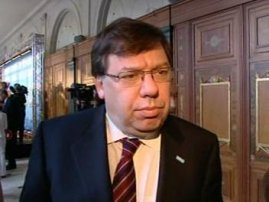
During leaders' questions Brian Cowen (above left) said that the government was "looking at a range of measures to remedy the liquidity problem", but he was "constrained in revealing what they are at this time". This was another fine example of procrastination in true Offaly style.

Under the bank guarantee scheme, Cowen stated, all covered banks were drawing up business plans, and this process was now "at an advanced stage". He also announced that the Financial Regulator had received a draft report on the banks from the consultants Price Waterhouse Cooper.

Today the government expects to receive the full business plans from the financial institutions.

Brian Cowen said that if these plans did not contain measures to provide adequate lines of credit to businesses, they would be rejected.

Labour Party Leader Eamon Gilmore (right) declared that the government sounded "like helpless bystanders", while Fine Gael Leader Enda Kenny demanded that the banks be recapitalised.
He reminded the Dáil that 10,000 Irish jobs were being lost every month as small businesses got squeezed.

Meanwhile the International Monetary Fund (IMF) has approved a loan of more than $ 2 billion to Iceland, to help it cope with what has been described as "a banking crisis of extraordinary proportions".
The government of Iceland had asked the IMF for help after its banking system collapsed within hours last month. Let's hope that Ireland will be spared such a traumatic experience.

The Emerald Islander

19 November 2008

Citibank reduces Staff by 20%

The large US financial group Citibank has announced plans for about 52,000 new job cuts, on top of 23,000 redundancies already made this year. This makes a total of 75,000 job cuts in the organisation and represents a staff reduction of about 20%. About 300,000 jobs worldwide will remain in the bank "in the near term".
According to a spokesperson, the job cuts will come "from redundancies, the sale of units and natural wastage".

I cannot help but wonder what any bank needs 375,000 or even 300,000 (well paid) employees for, in an era when most of the world's money is electronic and only exists virtually, when stock market trading is computerised and automated - with pre-set cut-off points in case of extreme price drops - and when the number of traditional branch offices is at an all-time low (which is the case with all banks, not just Citibank).
The service staff in those branches also seems to get ever younger, which means two things: less experience and less pay. Personally I think that the overall very young age of bank service and trading staff is partly responsible for the current crisis.

A year ago, Citibank (with its huge and glamorous head office in New York) was the largest bank in the world. But how different things can be within a few months shows today's financial bulletin.
From being a world champion, Citibank dropped to 7th place in the international ranking, where four of the five largest banks in the world are now Chinese.

Citibank was established in 1912 as the City Bank of New York by a number of - mostly Jewish - merchants under the leadership of the former US Postmaster General Samuel Thompson.
After going through changes in ownership, the bank established its presence as the USA's largest bank in 1865, and soon it became the first US bank to set up operations overseas. Mergers and acquisition followed and the bank could only grow larger and larger.

However, the bank's many international engagements created a lot of criticism, and it was also blamed directly for "having played a major role in the Wall Street Crash" of 1929. Four years later, in 1933, Senator Carter Glass said during an investigation into the financial markets that the bank's then president Charles E. Mitchell "more than any 50 men is responsible for this stock crash".

More recently the group has faced one of the toughest economical periods, with the weakening US economy and the collapse of the 'subprime' mortgage market the main reasons for trouble.
In fact, much of the crisis was actually created by Citibank itself (again), as it was one of the main instigators of the 'subprime' mortgage market and one of the largest lenders in it.

Meanwhile Citibank has lost more than $ 20 billion in the past year and the bank's chairman and CEO Charles O. Prince III (left) had little choice but to resign in disgrace and rather hastily a year ago.
(He will, however, enjoy a comfortable retirement, as he left Citibank with a 'golden handshake' of $ 38 million in personal compensation.)

Citibank has reported four straight quarterly losses and some analysts believe the bank will not make a profit again until 2010.

Of the 52,000 newly announced job losses, about half are understood to be accounted for already, with the recently announced sale of Citibank's German retail banking business and the closing of an Indian outsourcing operation.
It is expected that the remaining 25,000 jobs will be gone by the first half of 2009, but Citibank declined to comment on the cuts.

"Underlying business remains strong and revenues have been stable," a spokesman said, adding that its capital position was also "very strong". However, business analysts and share prices tell a different story and I wonder if it is a general requirement for a banker to be a habitual liar, or if it just helps to do the job.

The share value of Citibank has dropped again by 6.2% after the announcement. It is down almost 70% since last year, and the bank's new chief executive Vikram Pandit has come under pressure from critics who have doubted his ability to turn around the company and weather the financial crisis.

However, Citibank is probably quite safe, as it is one of the nine financial institutions benefiting from the US government's bail-out programme.
The US Treasury announced last month that it would be providing cash injections worth $ 125 billion for the troubled financial sector, to be shared between Citibank, JP Morgan Chase, Bank of America, Goldman Sachs, Morgan Stanley, Wells Fargo, Bank of New York Mellon, State Street and Merrill Lynch. (And as soon a the announcement was made, Goldman Sachs paid $ 17 billion in 'bonuses' to its senior managers. One wonders what this was for. Perhaps a bonus for having successfully conned the clueless Bush administration into handing over even more billions of taxpayers' money...)

The Emerald Islander

17 November 2008

Bank of Ireland Shares fell below € 1

Bank of Ireland's share price is back above € 1 this afternoon, regaining some value after losing more than 15% this morning.

It was the first time ever in the 225 year-long history of the bank that its shares fell below € 1.

The bank's shares were the subject of a significant sell-off after it had announced it was suspending paying dividends in a results announcement last week.

Back in February 2007 Bank of Ireland was valued at more than € 18 billion and its shares were trading at well above € 18 a share. Today the bank's value is barely € 1 billion.

In recent times the bank has seen a collapse in confidence, aggravated by acute concern over its exposure to property lending here.

After the announcement of a 32% drop in profits in the six months to the end of September and the suspension of dividend payments last week, its share price began to drift lower to finish last week at € 1.08.

This morning that suspension of dividends has seen the sell-off gain momentum, with the share price falling to 99 Cents, then to 97 and 93 Cents, and eventually reaching the bottom at 90 Cents per share, before regaining 15 Cents to stand at € 1.05 this afternoon.

Investment funds, which hold the shares long-term to earn income from dividends, have had no option but to sell. But they are selling into a market with no appetite for Irish banks, and where 'short selling', which encourages investors to buy shares at low prices, is the subject of a ban from the Financial Regulator.

Analysts think that some people and institutions with plenty of cash - especially from the Middle East and Asia - might be picking up some of the Bank of Ireland shares at these bargain prices, hoping to make major gains when the banking crisis will be over in some years' time.

As a result of the great drop in value, Bank of Ireland was taken out of two of the Dow Jones index lists today.

For Ireland as a country and the Bank of Ireland as one of our main financial institutions today's development is a further sign of how far things have gone and how low confidence in Irish banks - and in particular in Bank of Ireland - is now. And given the bank's unwillingness to put all its cards on the table and declare its complete situation, there is no silver lining on the horizon for Bank of Ireland.

Brian Goggin (right), Bank of Ireland's group chief executive since 2004, must be living on an entirely different planet than the rest of us.
In a statement issued on Friday he declared that his bank was "strong, sound and successful" and did not see the need to raise additional capital at the moment. Nevertheless Goggin was more than happy to sign up to the Irish government's - which means the taxpayers' - guarantee scheme. The sooner he is replaced by a more capable man, the better.

It is more than time for the government to intervene, and it would also help if the bank's remaining share holders would show some more responsibility. How a man, whose business has dropped in value from € 18 billion to € 1 billion in 18 months' time can say he is "strong and successful" is beyond me. Perhaps he should see a psychiatrist, as there must be something wrong with his mind.

Irish banks have been run by a bunch of reckless dreamers and fantasists for years, and that is one main reason for the current problem. Only radical change from the top down can bring sense and normality back into our financial institutions.

The Emerald Islander