Showing posts with label sport. Show all posts

14 September 2009

O'Donoghue defends his Expenses as Minister

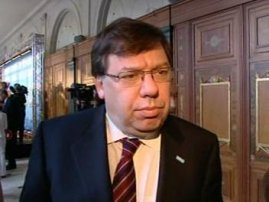
John O'Donoghue (photo), the Ceann Comhairle (Speaker or Chairman of the Dáil, the lower House of Parliament) has made his first public comments on the expenses controversy surrounding his time as government minister.

O'Donoghue defends his record as the Minister for Arts, Sports & Tourism (in the cabinet of Taoiseach Bertie Ahern) and as Ceann Comhairle in a letter to all members of the Dáil, which was sent last Friday.

He says he had "stayed silent so far on the extensive media coverage of expenses" in order "to protect the impartiality" of his current position.
It would "not be proper" for him "to become involved in public debate" concerning his time spent as a minister, despite what he called "the natural desire to cross swords with critics" in his own defence.

This is a pretty lame excuse from a man who has wasted taxpayers' money on a grand scale, running up expenses of more than € 550,000 for a lavish lifestyle that was in no way justified by his position as one of the minor Irish cabinet ministers.

He acknowledged that some of the costs incurred "appeared high", and "sincerely regrets that they occurred".

But he pointed out that arrangements were made by civil servants, and as a minister he would not be informed of the details of such expenditure.

On the basis of this statement, one has to wonder who is actually in charge of our government departments. I am sure that any minister who would want to keep expenses low would easily be able to do so. And if a minister would ask his officials what things cost and how much is spent on his travels and engagements, no one would refuse to tell him.

But old-style Fianna Fáil spongers like John O'Donoghue would never care what Irish taxpayers have to pay for his grand ambitions and lavish lifestyle. As long as he has not to pay for it with his own money, only the best is good enough for him and other political parasites.

Fine Gael leader Enda Kenny said that O'Donoghue's response did not go far enough and that he needed to apologise to the people. Well, that would of course be better than his lame excuses. But what the Ceann Comhairle should really do is to pay back at least some of the money he squandered while living like a king.

Roisin Shortall, the spokesperson on Social & Family Affairs for the Labour Party, said the Ceann Comhairle's statement did not appear to appreciate the extent to which the public has been shocked by the level of expenses incurred.

And she is quite right. John O'Donoghue only appreciates a life in luxury, but not where the money for it comes from. If he had any decency left, he would resign - as Ceann Comhairle and as TD - and free the nation from his unpleasant presence in politics.
But this would be too much to expect from a man like O'Donoghue, whose greed and ignorance are only matched by his selfishness and arrogance.

The Emerald Islander

22 March 2009

Dublin gives Rugby Team a Heroes' Welcome

Nearly 20,000 people streamed into Dublin's inner city today to give Ireland's victorious Rugby team a heroes' welcome after they won their first 'Grand Slam' in the Six Nations Championship in 61 years yesterday in Cardiff (see yesterday's entry below).

Supporters from all across Ireland came to the capital and attended a special homecoming celebration for the team at the Mansion House in Dawson Street (the official residence of the Lord Mayor of Dublin), where the victorious players and their coach - now all wearing smart suits - presented their trophy to the cheering public.

Team Manager Declan Kidney (on the photo front row left, with his left hand on the cup) told the enthusiastic fans it had been "a great journey for the team in recent weeks".
And indeed it has. Ireland defeated France and England at home and won away against Scotland and Italy. And then they also beat Wales yesterday, at the most difficult venue to beat them: their own home ground, the Millennium Stadium in Cardiff.

"It's a special time to be involved in Rugby," Declan Kidney said in his typical modest way. "And I think the boys are enjoying it."

Ireland's captain Brian O'Driscoll (on the photo front row right, with his right hand on the cup) said that it had taken a while for the victory to sink in.
"It's a fantastic feeling waking up this morning: you're not as sore as you would be if you'd lost," he added.

The amazing series of five great wins in a row, and the confident style with which they were achieved, have not only elated the Irish Rugby team (which is an all-Ireland team with players from both the Republic and the North), their coach and their fans. It uplifted the spirit of the whole nation, and even people with little interest in sports (like myself) feel very happy about it.

Now all we need is a government that can copy the spirit of our Rugby players and match their performance...

The Emerald Islander

21 March 2009

Once every sixty Years...

In contrast to our Western (originally Babylonian) system of Astrology, which uses a cycle of 12 Zodiac signs over 12 months, the even older Chinese Astrology uses a cycle of 12 signs over a time span of 60 years.
While we acknowledge four elements (Fire, Water, Air and Earth) in addition to the principal signs, the Chinese have five (Metal, Wood, Water, Fire and Earth). And since in China each sign reigns for a full year - instead of a month in our system - that makes five sub-cycles of 12 years each, which form a full cycle of 60 years. This means that during the lifetime of an average human being each year offers a different condition, and only the very old will experience a repeat of some astrological years.

Even here in the West, where longevity has increased steadily since the end of World War II, six decades is a very long time. Even more so when it is the time someone has to wait for a certain and much desired achievement, while making a fresh attempt at it every year. And when it does happen eventually, the joy and emotions are enormous.

A couple of hours ago the Irish Rugby team (which is an all-Ireland team with players from both jurisdictions on the Emerald Isle) achieved the highest possible honours available to any team in the Northern hemisphere. They not only won the 'Triple Crown' (which means they have beaten all of the other three 'home nations' England, Scotland and Wales), they also finished this year's series with the rarely achieved 'Grand Slam' (which means that they have won every match they played and thus beaten all other teams in the annual Six Nations Championship).

In fact, in the 107 championship series that took place since 1883 (first among the four 'home nations', then as the Five Nations including France and - after Italy was admitted in 2000 - as the Six Nations Championship) a 'Grand Slam' was achieved only 35 times.
And for Ireland today's total success on the Rugby field is only the second 'Grand Slam' ever in the history of the sport.* The first time they did it was 61 years ago, in 1948!

Every year, during the weeks when late Winter turns into early Spring, this contest grips the full attention of Irish people. As regular readers of this weblog will know, I am neither a sports fan of any kind, nor particularly interested in Rugby. But even I could not help myself but listen to the live coverage of the match today, my ears pricked to attention while the commentators on RTÉ Radio 1 were carried away with free-flowing Celtic emotions.

That this - the last match of the 2009 Six Nations Championship - took place at the magnificent Millennium Stadium in the Welsh capital Cardiff gave it a particularly high tension and special sporting importance. Rugby is - and has been for generations - the main sport in Wales and the Welsh are pretty good at it, too. So it was not just any match that both teams played there today, it was a true clash of the giants. Had Wales won, they would have deprived Ireland of both titles. And during the first half it looked as if they would do exactly that. The half-time score of Wales 6 - Ireland 0 was not received well on the Emerald Isle. Hearts of fans and spectators began slowly to sink, giving rise to this terrible thought again that we Irish are "simply not good enough"...
How often have we heard this during the past six months? Or even thought it ourselves? There are times when one wonders if the Irish can do anything right and proper at all.
We not only missed all the signs of the imminent world economic crisis throughout 2007 & 2008, we had to make things a lot worse by creating our own crisis on top of that, a crisis much more serious than anything that Wall Street and the City of London can throw at us.

We began to get rich during the early 1990s, quite suddenly and totally unexpected. But instead of good housekeeping, prudent behaviour and reluctant pride which would have been in order, we went completely over the top. We got drunk on the sudden wealth, just as we get drunk so often in our pubs on beer and whiskey. Then we staggered out into the night and made mischief, plenty of mischief.
For the past six months we are beginning to wake up from it all, not sure where we actually are, how much we have blown and how much - any - we have left in our pockets. Our banks, which are controlled by a bunch of selfish, greedy and immoral crooks, have behaved even worse than the rest of us and expect in a matter of fact way to be rescued by the government and massively recapitalised with taxpayers' - which means our - money. At the same time they turn nasty on their normal customers, the ordinary people and especially small businesses who have done not a thing wrong. To crown this ecstasy of failure and disaster, we also have the most incompetent government in the history of the state.
Meanwhile wages are reduced and taxes rise and rise, while consumer prices remain high. This is the truly bleak background in front of which one has to see today's great and amazing sporting achievement.

Being six points behind after the first half and having not scored a single point yet, Ireland came back onto the pitch for the second half with a lot of extra ambition. Soon the team showed what they are capable of. In a complete change to the way they played in the first half, now the Irish dominated and within a few minutes their captain Brian O'Driscoll (left) scored the first try. This gave the team a huge emotional boost, and a little later Tommy Bowe scored the second try for Ireland (see large photo below).
Wales, although strong and playing with great skills and energy, did not manage to score any tries at all. Their points came from field goals and penalties.

By the time the match went into its final phase, Ireland was leading 14-12 and many people here started already celebrating. Then Wales scored 3 points with another goal, giving them a narrow one-point lead with the score standing now at 15-14. And time was running out.

Was it all going to end in tears for Ireland? Had their fight-back come too late? Or were they just not meant to win this match, to fail once again and fall at the final hurdle of the contest?
These were the thoughts going through the minds of thousands of Irish people, Rugby fans and ordinary folk alike.
But then - with less than three minutes left to play - the Irish were in the lead again. The team's top goal kicker Ronan O'Gara (right) sent the oval ball straight down the line between the Welsh posts, which meant the score changed to Wales 15 - Ireland 17. And at that it remained until the referee blew the final whistle.

Within seconds Ireland was transformed into 'Happyland' and everywhere the celebrations and cheering began.

Nobody expects the Irish economy to be saved by Rugby, and everyone knows that our deep sorrows and serious problems will be there tomorrow morning unchanged, as they were here yesterday. But for a few hours tonight and tomorrow the whole of Ireland will be in a state of great joy, happiness and celebration. It's the way we are, and we so desperately need something to cheer us up during this period of political and economical depression...

The nation has waited 61 years for this day, longer than a complete cycle of Chinese Astrology, and only the most senior of senior citizen will have experienced this before.

For the victorious Irish team, which has played very well now for several years, it is a truly great and historic achievement. And as it happens, today's match was the last for Ireland's steadfast and magnificent team captain Brian O'Driscoll. What a way to say good-bye, what a way to enter the annals of history!

Today's success is of course also an enormous achievement for the team manager Declan Kidney (left), who took charge of the Irish Rugby team less than a year ago. For him 2009 was the first Six Nations Championship and he achieved the absolute maximum possible right away.

But of course Kidney is not a novice. The 48-year-old Corkman was coach of
Munster, the most successful of the Irish provincial teams, for many years and is now bringing all the experience he gathered there to the national side.

I like to take this opportunity to congratulate our team, the Irish Rugby Football Union (IRFU) and the whole nation on this special day that saw even me cheering for a sports team.

The Emerald Islander

* England won 12 'Grand Slams', Wales 10, France 8 and Scotland 3. Ireland - with now 2 - is the second last in that ranking list, as Italy (which only joined the competition in the year 2000 and has clearly the weakest of the six teams) has not won any (yet).

27 October 2008

29th Dublin City Marathon

Mass Marathons have become very popular in recent years, and there is hardly any major city in the world now that does not have one. Thirty years ago the idea was new and somehow odd, but it began to win more and more support throughout the sporting communities around the globe.

In 1980 the idea reached Dublin and the first city marathon was organised by a group of running enthusiasts led by (the late) Noel Carroll.
He persuaded the Business Houses Athletic Association (BHAA) to support the event, and in the first year 2100 runners - most of them Irish - took part. 1420 of them finished. Dick Hooper of the Raheny Shamrocks Athletic Club claimed first place, in a time of 2 hours, 16 minutes and 14 seconds. The first female winner was Carey May, who finished the marathon in 2 hours, 42 minutes and 11 seconds.

Much has changed in the nearly three decades since. We had and lost the economic boom of the 'Celtic Tiger' and many foreigners now live in Ireland and participate in our sporting events. Many foreign athletes even travel to cities to participate in the now popular marathon races, and thus it is no surprise that the number of runners has increased nearly six-fold. But one element of the event has not changed: it still takes place on the last Monday in October, which is always a bank holiday in Ireland (compensating for Samhain, which is unfortunately still not a public holiday).

This morning over 11,700 runners assembled at Fitzwilliam Square, the traditional starting point of the race, for the 29th Dublin City Marathon, run in aid of the National Children's Hospital in Tallaght. It was a crispy cold, but sunny day, as we have quite a few here in October, so mood and conditions were quite good.

There was a major increase in Irish runners this year. Over recent years more than half of the participants had come from overseas, but Irish runners made up 57% of this year's entrants. There were also more women than ever before, making up one-third of the field.

But there is only one Mary Hickey Nolan, the only woman who ran in all the Dublin City Marathons to date, with this being her 29th race.

The event started at 8.50 a.m. with the wheelchair entrants, followed by the elite and then the general field at 9 a.m.
As usual the route went from Fitzwilliam Square through the inner city and the Phoenix Park, to end at Merrion Square.

The first male runner to finish this year was the Ukrainian Andriy Naumov, who ran the 26.2 mile distance in 2 hours, 11 minutes and 6 seconds. As the overall winner he received the Noel Carroll Memorial Trophy and a € 15,000 cash prize.

Thus for the 16th year in a row the winner of the Dublin City Marathon was not Irish, a price we have to pay for opening the event to foreign competitors. The best runner from Ireland was Michael O'Connor, while the Russian Larrisa Zousko was the fastest woman with a time of 2 hours, 29 minutes and 55 seconds.
The special wheelchair race was won by Paul Hannan from Armagh in 2 hours, 22 minutes and 33 seconds.

Even though I run for at least an hour every morning - and on some days longer - I have not yet attempted a marathon myself. I have the greatest respect for anyone who has done it and wish them all the best, together with my sincere congratulations to the winners.

The Emerald Islander

21 September 2008

Tyrone are the new Gaelic Football Champions

Two weeks ago I wrote about the final of the All-Ireland Senior Hurling Championship, which was won in spectacular fashion by Co. Kilkenny, beating Co. Waterford decisively. (see my entry from September 7th)
Today we saw the second of the annual GAA (Gaelic Athletic Association) events that make the hearts of many Irish people beat faster: the final of the All-Ireland Senior Football Championship.


For people outside of Ireland one has to explain that this is Gaelic Football, which has little in common with the sport that is world-wide known as Football. That one is played in Ireland as well, but here we call it Soccer, to avoid confusions.
Gaelic Football is quite different, as it allows the use of hands as well as feet. It is played by two teams of 15 players each, and like in Hurling there are two ways of scoring: Goals (when the ball goes into the box of the goal) and Points, which are scored by putting the ball over the goal box of the opposing team. But they only count if the ball passes between two poles that mark the corners of the goal box.

Confused? Well, many outsiders are when it comes to the uniquely Irish sports, organised by the GAA. But for most Irish people they are all they live for, their joy, excitement and secular religion. It is therefore no surprise that Croke Park in Dublin, the HQ of the GAA, was packed to the last seat again today, as it was two weeks ago for the Hurling final.
As usual President Mary McAleese attended the match, and so did many other dignitaries from politics, sports and all walks of life.

After the obligatory ceremonies and the playing of our national anthem the match got underway, and it was quite a difference to the Hurling final two weeks ago.
Both teams - Co. Kerry in the west of Ireland and Co. Tyrone, which is one of the six counties in the still British-controlled North - are renowned for their skills in playing Gaelic Football.

Kerry, who won the All-Ireland title 35 times since their first success in 1903, were the favourites for many pundits. But others saw Tyrone as the stronger team. Their success in this sport is rather more recent than that of Kerry, but they won the All-Ireland final in 2003 (beating fellow Ulster team Armagh) and in 2005 (beating Kerry). In fact, for the last six years the final was won either by Tyrone or Kerry. The latter were the defending champions and on a possible hat-trick (like Kilkenny two weeks ago in Hurling), having won the title in 2006 (beating Mayo) and 2007 (beating Cork).


But today the luck was with Ulster, and Tyrone are the new All-Ireland champions and this year's holders of the coveted Sam Maguire Cup that comes with the title.

After a fairly balanced first half, which ended with Kerry 0-8 points and Tyrone 0-7 points, Tommy McGuigan (lucky No. 13) scored the first and only goal of the match for Tyrone (photo left), only 22 seconds into the second half.

Kerry managed to catch up, and a few minutes before the final whistle both teams stood on 13 points. But a massive final effort from Tyrone, which seemed to have surprised some of the Kerry players, created the final result of Tyrone 1-15 (= 18 points) and Kerry 0-14 (= 14 points).

So today, as the Sam Maguire Cup is again adorned with ribbons in white and red, my congratulations go up North, to Co. Tyrone, for a well-deserved win of the All-Ireland Senior Football final. There will be celebrations all night, and into tomorrow, when the victorious team will return to their home county.

And a special thought and smile goes to a dear friend of mine, Lady O'Neill de Tyrone, who is also full of joy tonight, even though she is not a very enthusiastic follower of sports. But that does not matter. On days like this the old clan and county loyalties, which have been key elements of the Celtic life on the Emerald Isle for more than 2000 years, are in the hearts and minds of everyone. This is something quite unique to Ireland, and even 750 years of foreign occupation and oppression could not change these strong and vibrant feelings. Every year they are still fresh and present, when the eyes of the nation are on Croke Park and the All-Ireland finals.

The Emerald Islander
09 September 2008

Great Homecoming for Waterford Hurlers

Having reported here on the final of the All Ireland Senior Hurling Championship on Sunday (see my entry from September 7th), it is only proper that I also tell you how the Waterford Hurlers were received when they returned home from Dublin yesterday evening.

Well, as I had already predicted on Sunday, the fact that they lost the match and were beaten with a wide margin by the star team from Co. Kilkenny, did not matter anymore after 24 hours of grief and sorrow had been washed down with a good few pints of beer.
By the time the train from Dublin, on which the team traveled, rolled into Plunkett train station in Waterford City, thousands of loyal fans from the city and all over the county had - despite the bad weather with pouring rain - already gathered along the South Quays to give them a very warm and enthusiastic welcome.

After leaving the train, the team traveled the short distance from the station, across the Edmund Ignatius Rice Bridge, on the top of an open doubledecker bus, decorated in the county colours white and blue. Ignoring the rain and wind, the crowd cheered frantically, and applauded loudly as the bus with the hurlers passed.

At the Quay a special platform had been erected by the City Council, and the local dignitaries had assembled to bid the hurlers a ceremonial civic welcome. Martin Cullen, Minister for the Arts, Tourism and Sport, and - more important last night - one of our local TDs, addressed the roaring crowd and sang the praise of the Waterford team as only an Waterford man could do it. Mayor Jack Walsh also gave a rousing speech and welcomed the team "that had done the best they could" home to their city.

It was a great turnout, showing how much the heart of Waterford people is connected with the sport of Hurling and especially with our county team. One has to wonder how they would have behaved had Waterford actually won the Liam McCarthy Cup...

The Emerald Islander

07 September 2008

A Great Day for Kilkenny

Today has been a great day for County Kilkenny. Perhaps even the greatest day ever since the 17th century, when the town of Kilkenny was briefly - from 1642 to 1649 - the capital of Ireland. Nowadays Kilkenny is of less importance, except that it is the undisputed capital of Hurling, a position confirmed today with another spectacular win against Waterford, my home city and county. (If you live in Ireland, you know all this already, so feel free to skip this entry, which is really written for my many readers outside the Emerald Isle.)

This afternoon at 3.30 p.m. the attention of most Irish people was centred on Croke Park in Dublin, the headquarters of the GAA (Gaelic Athletic Association), which controls Hurling, Camogie (which is Hurling played by women and girls) and Gaelic Football. At that time this year's final of the All-Ireland Senior Hurling Championship - commonly known here as the 'All Ireland Final' - began, attended by President Mary McAleese, Taoiseach Brian Cowen and many other dignitaries from politics, sports and all walks of life. For most Irish people the 'All-Ireland Final' is really the biggest event of the year, and it is broadcast live on both radio and television. (The match has often been compared with the 'Super Bowl' of American Football in the USA or the FA Cup Final in England, but it has a much higher importance in Irish minds and in the Irish culture than those major sporting events have in their countries.)

Even though this annual event always draws large crowds to Croke Park and creates for months huge interest all around the island, this year there was a lot more hype about this very Irish sports contest than in previous years.

The reason was that the two teams in the final were Kilkenny and Waterford. One really has to be Irish or live here for a very long time to understand what that means. So let me explain: It is not only that the two counties are neighbours here in the (usually sunny) South East of the Emerald Isle, they are - and always have been - also the most fierce rivals in sporting contests. Especially when it comes to Hurling, which is - like the whole GAA - a complete amateur sport, played usually on two levels: clubs and counties. The annual contest between the counties (which takes also place for Gaelic Football and Camogie) draws great attention and many Irish people are occupied with it in one way or another, although most of them only as supporters or fans.

Waterford (the oldest city in Ireland) is more than twice as large than Kilkenny (which is only 48 km away, but in the province of Leinster, while Waterford belongs to Munster), but when it comes to Hurling, the County Kilkenny team (pictured above and nicknamed 'Cats' because of their striped jerseys in the county colours black & amber) are the giants and the Waterford team is rather mediocre.
For decades Co. Waterford has tried - and failed - to achieve greatness in Hurling, but in recent years their performance has improved significantly.

The boys in white and blue (our county colours, pictured left) won the Munster championship three times, which has boosted their confidence and created much joy, support and civic pride among the local people.
However, the All-Ireland title - and
the coveted Liam McCarthy Cup that comes with it - seemed to be beyond the reach of our team, no matter how hard they tried and how much the people supported them enthusiastically.
Since the contest began in 1887, Waterford won the All-Ireland Senior Hurling Championship only twice, in 1948 (beating Dublin) and in 1959 (beating Kilkenny). They managed to reach the final in three more years, but lost: in 1938 (against Dublin), 1957 and 1963 (both against the arch rival Kilkenny).

Meanwhile Kilkenny went from success to success, becoming the strongest Hurling county in the whole of Ireland. (The three counties with the strongest Hurling tradition and the most wins of the 'All Ireland' are Kilkenny, Cork and Tipperary.) In the last decade alone Kilkenny won the title six times, and today's success is the second time they achieved a 'hat-trick', three wins in a row. (The first time they did it was almost a century ago, in 1911, 1912 and 1913.)

Despite Kilkenny being the clear favourites, almost the entire population of Waterford city and county (and many others in the 30 other Irish counties - except Kilkenny, of course) was hoping that this year the famous
Liam McCarthy Cup would be won by Waterford. And after 45 years of waiting for another appearance in the final and 49 years after their last win the 'Blaas' (nickname of the team, derived from a popular bread role specific to Waterford) felt confident that they could do it.

For the past two weeks the city and county were in a state of tribalist ecstasy. In all the years I live here, I have never before seen so many flags in the county colurs (white & blue) displayed around the city. Many cars were flying the flag (and often two of them) as well. The atmosphere was electric, with high spirits shown openly. Complete strangers in the street would have a brief conversation about the matter, and people who know each other would speak about Hurling with more depth and enthusiasm. This was a rare experience in a region that is still under-developed, has the highest unemployment rate in Ireland and still no university...

The high spirit was carried on towards Dublin as well, and at Croke Park the presence of white & blue clearly outnumbered the showing of black & amber in the audience of the fully sold-out stadium. Even plenty of the neutrals (people from other counties) felt that, after such a long time of waiting, it was now "Waterford's turn" and wished us well, while many sports reporters and pundits also hoped for a Waterford win, as it would be good for the game as such and keep the competition more interesting.
But - unfortunately - all the enthusiasm and euphoria led to nothing but bitter disappointment. In the match this afternoon Waterford was not only beaten by Kilkenny again, the 'Blaas' were in fact hammered and outclassed by their opponents. The final score of 3-30 for the 'Cats' and only 1-13 for the 'Blaas' speaks for itself. (The first number stands for goals - worth 3 points - and the second for extra points scored. The total of points decides the winner. The same scoring system, which regularly confuses foreigners, is also applied to Camogie and Gaelic Football.)

Commentators and pundits on RTE Radio were audibly disappointed, and some said that they had "never before seen Waterford play so poorly". The disappointment for the thousands of fans who had traveled to Dublin for the match and all the supporters here at home was of course a lot worse. In fact, as I write this Waterford is in shock and a strange silence of sadness hangs over the city.

So what went wrong? Why did 'our boys' not perform as expected? Or was there perhaps simply too much hype and wishful thinking on the side of the Waterford people, not justified by the form and fitness of the team? Hard to say, and nobody really knows. As I am not a Hurling expert and in general not that keen on sports, I would not be qualified to analyse this. So I don't.

All I can report is that the mood in Waterford is terrible now, with the great hopes so many of the local people had invested in a team of 15 players crushed, and crushed in such a spectacular fashion. All who saw the match or listened to the broadcast will know that Kilkenny outplayed and outclassed Waterford right from the opening whistle, scoring massively. It appeared as if the Waterford team was almost stunned by the onslaught and had simply no answer, as they were so sure that it was their turn to win this time.

Well, life goes on and the world has not ended, even though it might seem so for hardcore GAA fans in Waterford. One should be realistic and fair to the team, which after all made it to an All-Ireland final. This in itself is a great achievement, and - as mentioned above - had not happened to Waterford for 45 years. They were beaten by the best, and that is no shame. So I hope that in days and weeks to come the usual begrudgers that always raise their ugly heads when things go wrong, will shut up and mind their own business.
In recent years the Waterford hurlers have improved their playing significantly. They won three Munster championships and several other titles. Last years they missed the All-Ireland final by a whisker, and this year they got there eventually. This should be reason for joy, and it hopefully will be. And, of course, there is always next year...

But today is undoubtedly Kilkenny's day, and it is not more than fair and proper to congratulate the 'Cats' on their great win, while the whole of the Emerald Isle watches with joy and awe their captain James "Cha" Fitzpatrick (above) lifting the Liam McCarthy Cup, once again adorned with black and amber ribbons.

To make it a truly perfect day for Kilkenny, their minor team also won their All-Ireland final (played before the seniors' match), beating Galway 3-6 (15 points) to 0-13 (13 points). In a way the minor match was actually more exciting than the senior one, as Kilkenny had really to fight for their win. Having led by eight points (1-5 to 0-0) at half-time, Kilkenny saw Galway fighting back in the second half and scoring frequently, while Kilkenny almost dried up. Then a substitute (from the lovely little village of Mooncoin) came in, scored a goal and a point, and saved the day for his team. (The young man will be a local hero in Mooncoin for the rest of his life, I can assure you...)
This only underlines the strength of Hurling in County Kilkenny, which is also the home of the national club champions, Ballyhale (which is a tiny village). One of the GAA pundits on RTE said today that "there is nothing else there, so they play Hurling all the time". This might well be the case, but on its own it would not create the great successes. What comes with it is determination, hard work and - most of all - enormous discipline. And this is rather a rare commodity in modern Ireland, where the laissez fair attitude of 'anything goes' is prevalent.

As so often, it probably is a result of proper leadership. For the past ten years the Kilkenny team has the same manager, Brian Cody, who had a great career as a player himself before turning to management.
Cody has a remarkable track record. Since 1999 he guided Kilkenny to six All Ireland titles, nine Leinster titles and four National Hurling League titles. The team's dominance of the Leinster Championship is unparalleled in the modern era, to the extent that under Cody Kilkenny have only lost one provincial game since 1999.
One of the key elements of his success is strict discipline. Brian Cody has the view that no player is bigger than the team. He consistently takes a "my way or the highway" approach when dealing with players and has been accused of having a "ruthless streak" in selecting players. This was evident in 2006, when he dropped his own son from the Kilkenny starting fifteen. However, his system works and has made the 'Cats' the most successful Hurling team in modern times.

Combine this with the fact that Cody is a Kilkenny man himself and has therefore strong local loyalties. Many sports teams nowadays change managers and trainers quite regularly, and often a manager who led one team to success is then hired by their opponents, in the hope that he will do the same for them. GAA sports are no exception to that, even though they are still played by amateurs. But the concept, as much as it might make sense in theory, rarely works in practice. (Waterford manager David Fitzgerald, appointed to his job only in June of this year, comes from Co. Clare, while his predecessor Justin McCarthy, who held the post for seven years, came from Co. Cork.)
Brian Cody is different. He is a Kilkenny man, first and foremost, who only ever played for one county and managed one county: Kilkenny. It is an example of Celtic tribalism at its best. This - in my humble opinion (not being a Hurling expert) - is the 'secret' of Kilkenny's great and lasting success. It might be good for Hurling and for Ireland if we had more people like Brian Cody.

As I write this, both teams are still in Dublin, one celebrating, the other licking their wounds. But tomorrow evening they will both return home to large civic ceremonial welcomes. Obviously the celebration will be larger and more joyful in Kilkenny, but Waterford will also give their team a good turnout for their homecoming. Such is local loyalty. The current Mayor of Waterford City, Jack Walsh (Labour Party) organised the ceremony long before the match was played. (By the way, the division between Waterford and Kilkenny can even go through families. As it happens, both teams will be welcomed home by a member of the same family, as the current Chairman of the Kilkenny County Council is a brother of the current Mayor of Waterford. They have not fallen out over Hurling and both also belong to the same political party.)

The importance of their participation in the All-Ireland final is so great that about 80% of all the companies on Waterford's industrial estate have given their workers Monday off in advance, and many local schools will be closed tomorrow as well. As I said above, one needs to be Irish, or live here for a long time, to understand all this. It might not be relevant to anyone outside this island, but I thought it would be interesting to give you a snapshot of an aspect of Irish life that few who don't live here will ever experience. It says so much about this nation, its culture and mentality.

The Emerald Islander

22 April 2008

Waterford GAA calls Gardaí over missing Money

Well, as I wrote yesterday evening, one scandal comes seldom alone. It's a bit like the buses in Dublin and London: for a while there is none, and then two or three come in a line. And sadly, here is the third scandal in a row from Ireland within two days, this time involving one of the pillars of Irish popular culture, the Gaelic Athletic Association (GAA).

Gardaí in Waterford have been asked to investigate an alleged misappropriation of € 142,000 from the Waterford GAA County Board. The money is believed to be from All Ireland ticket sales last year.

A senior official in the county has resigned his position, following an internal GAA investigation, "which has been going on now for a number of months". At an emergency County Board meeting last night it was confirmed that the money is missing.

Apparently "some efforts" have been made over the past few months "to have the money returned" to the Waterford County Board, but so far without success. But - not unusual in the GAA - everything happens internally, behind closed doors and in closed circles of the initiated. Calling in the Gardaí is now the first step of a public investigation

This morning the Waterford County Board announced that a legal writ has been issued against the now former official (who has resigned), but without naming him. "The Gardaí have also been informed of the situation," a spokesperson said.

It can be expected that the GAA national headquarter in Croke Park, Dublin will also launch its own investigation at some stage. The whole affair has come as a shock to many GAA supporters in Waterford, who have seen their hurlers doing quite well in recent years and have a lot of trust in the organisation.
It is at this stage too early to say if the whole matter is linked exclusively to the one - now resigned - official, or if there are larger internal problems inside the Waterford GAA. Watch this space! I will keep you informed about any further development.

The Emerald Islander
10 February 2008

Not playing Ball

County Cork is in Ireland commonly known as "the rebel county". The popular nickname has historical roots in the long and often bloody struggle of the Irish - and especially the hot-headed and short-tempered people from the south-west - against the British colonial power (until the establishment of the Irish Free State in 1922). Shortly afterwards County Cork became also a hotbed of rebel activity during the Irish Civil War, and ever since a bit of the old rebel spirit can be seen, heard and felt in almost everyone and everything from Cork. It is an invisible badge of honour, worn with pride and together with the county colours red and white.

The rebel spirit has also led to much success in the area of Sport, and especially in the traditional
Gaelic Games (Hurling, Gaelic Football and Camogie). With a total of 113 All-Ireland honours on all levels of Hurling and Gaelic Football, Cork is in fact the most successful of all the 32 Irish counties in the Gaelic Athletic Association (GAA).
Cork is by far the most successful Hurling county and won their 30th
All-Ireland Senior Hurling Championship in 2005. The Rebels also won the All-Ireland Senior Football Championship six times and many other GAA competitions.

It is therefore a shock for most GAA fans to see Cork missing from this year's sporting contests. The reason - well known by now in Ireland and discussed over and over again by numerous pundits - is the
strike of the county's footballers and hurlers, which is two months old today.

The dispute between the players and their County Board (which organises Gaelic Games in the county as well as the county's teams for regional and nation-wide competitions) began with the resignation of Cork football manager Billy Morgan on November 8th over the prospect that he was not allowed to pick his own selectors.
This seemingly minor disagreement became very quickly a major point of contention in Cork and the Gaelic Players Association backed the Cork players in their threat of going on strike over the matter.

The County Board ignored the thunderclouds on the sporting horizon and on November 21st it appointed Teddy Holland as the replacement for Billy Morgan. This led to even more anger among the players, who now gave notice of their strike intentions and indeed stopped playing for Cork on December 10th.

After Christmas the crisis escalated further, when the players refused to participate in the Waterford Chrystal Cup (Jan. 9th) and Teddy Holland declared he would not resign (Jan. 23rd).
On January 30th
more than a hundred club delegates voted unanimously in support of Holland at a meeting of the County Board, but to no avail. The players remained stubborn and on strike.

Last Tuesday even Taoiseach Bertie Ahern got involved and called on both sides to end the dispute and seek a compromise solution. Many hours of talk have by now taken place behind closed doors, but so far to no avail. Many thought that at least by the start of the National Hurling League - which was today - the players would come out and play (because otherwise they could force suspension and relegation). But no, there is neither an end to the strike, nor a solution in sight. Both sides have dug in their heels and the boys from the rebel county are still not playing ball.

Earlier this afternoon around a thousand people attended a march in support of the players through the streets of Cork. The march was also attended by Cork senior footballer Noel O'Leary and senior hurler John Gardiner. And tonight the Cork senior hurlers and footballers are meeting again to discuss the latest developments in their dispute with the Cork County Board.

I am not a sports pundit, and certainly no soothsayer. But it would surprise me if the Cork players would give in soon, after having stood their ground for so long. The County Board - also made up of stubborn men - can form many committees and hold talks as long as they please, but in the end there is no sport without the people playing it. So in the long run the County Board has the much weaker position in the dispute and will eventually have to give in somehow. If the officials can manage to keep their faces (and positions) remains to be seen.

The overall looser is already the spirit of the GAA, together with the good will that goes a long way. And many disappointed fans are losing out, too, of course.
To paraphrase a well-known satirical poem by Bertold Brecht: Perhaps it might be best if the County Board dissolved the sport and looked for another...

The Emerald Islander
(who lived in Cork and has still friends there)