Ireland's Minister for Foreign Affairs Micheál Martin has acknowledged that there is still "a significant challenge for the YES side in the remaining weeks of the Lisbon Treaty referendum campaign".
He reacted to a new opinion poll that shows a drop in support for the treaty.
The TNS-MRBI poll, published in yesterday's edition of The Irish Times, lists the ratio of YES voters at 46% - an eight point fall since the last survey in May.
29% of those asked say that they will vote NO (up one point since May), and there is a big increase in the 'don't knows', whose number went up to 25%.
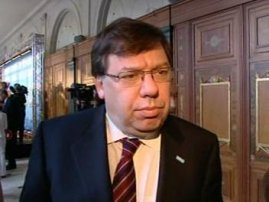
 Micheál Martin (right) said that "a vigorous campaign is needed to get the YES message across".
He has also accused the NO campaign of "a basic mistrust of Europe based on conspiracy theories".
Well, this "vigorous campaign" is already in full flow, and one can expect that it will become even stronger, the closer we come to the referendum day, October 2nd.
On Thursday I was in Dublin, and what I saw there truly astonished me. There is not a single lamp post in the city that is not displaying a Lisbon Treaty campaign poster. More than 80% of them are pro-treaty, and the rest - mostly from the Catholic campaign group COIR - ask for a NO vote. It is an amazing sight to behold and I have never seen anything like it. Not in any Irish election campaign, and not in the run-up to a referendum either.
Among the pro-treaty posters those from the political parties - predominantly Fianna Fáil and Fine Gael - are outnumbered by large-size ads from two groups one has never heard of before. They were only formed very recently, and for the sole purpose of promoting the YES vote on October 2nd. Nobody seems to know who is really behind them and, even more important, where their money comes from.
The massive poster campaign in Dublin alone costs several millions of Euros (and since I have managed general election campaigns, I do know what posters cost). Who is paying for all these posters?
There is a deeply sinister element in the campaign that makes one quite uneasy. When Micheál Martin speaks of "a basic mistrust of Europe based on conspiracy theories" in the NO camp, he is not too far off the truth. Only that there is neither 'mistrust of Europe' nor pre-occupation with 'conspiracy theories'. But people with open eyes and a working brain do notice the very strange structure the YES campaign has developed.
Why is the government relying on non-descript groups of shady people to achieve a YES vote? Why is there hardly any government minister giving major speeches in favour of the treaty? And why is it that no one in Fianna Fáil or the Green Party is seeking an open exchange of arguments over the details of the treaty, as we had it last year in the National Forum on Europe (NFOE)?
Well, the NFOE, which was the best debating forum Ireland has ever seen, was abolished by the government, with the excuse of "cost-cutting during the recession". The real reason is that the NFOE was too fair and too sophisticated for a government of ignorant bullies. It produced deep, open and high-spirited discussions about the real matters, and as a result a majority of 53.4% of the Irish electorate rejected the Lisbon Treaty on June 12th, 2008.
Soon after Micheál Martin commissioned a 'research group' to find out the reasons for the rejection. I am sure that he was told what motivated the Irish people, but he did not publish it. Instead he came up with a smokescreen of lies and half-truths (see my entries of September 8th & November 17th, 2008) that deliberately omitted the main reasons for last year's NO vote: The unwillingness of the Irish people to become voiceless and powerless inside the EU Council, and the extreme unpopularity of the current government, which had not even bothered to read the treaty, but expected the nation to accept it nevertheless.
Now the YES campaign uses no longer political arguments, but relies mainly on scaremongering, baseless attacks on the NO campaign and an avalanche of posters and leaflets, the majority of which are apolitical, vague and entirely manipulative. Not even to mention that they are also conveying lies.
Instead of seasoned politicians, some businessmen, footballers, actors and so-called 'celebrities' are wheeled out to persuade the Irish nation that the Lisbon Treaty is a good thing. What do they know about it? Does anyone think that people like Michael O'Leary, Roy Keane or some shallow game-show hosts have actually read - and understood - the treaty, when neither the Taoiseach nor our EU Commissioner Charlie McCreevy could do it?
The YES campaign has obviously enormous amounts of money at their disposal, and they are using it. What they do not have are valid arguments and trustworthy people to put them forward.
Anyone who has voted NO last year should do so again, because - with one exception - nothing has changed since the last referendum.
This one exception is the retention of our EU Commissioner, which is a direct result of the fact that Ireland rejected the treaty. (Had we voted it through, we would have already lost our right to have a permanent EU Commissioner at all times.) It is rather strange that the government and others in the YES campaign use the retention of the EU Commissioner now as an argument to vote YES this time.
And anyone who voted YES last year should examine very carefully what has happened to Ireland since and how our government has squandered every bit of political and economic credit we had left.
The latest opinion poll, which shows the support for Fianna Fáil at 17% and that for Brian Cowen even lower - at 15% - should give you more than enough direction for October 2nd. Should the devious campaign of deception, which suggests that our EU membership is at risk if we vote NO again, succeed, everyone alive in Ireland today will live to regret it deeply. And our children and even grandchildren will hate us for it, while they still have to pay for the follies of our generation and our current government.
The so-called 'safe-guards' the government has apparently 'secured' in Brussels are worth nothing, not even the paper they are printed on. Not one of them is really relevant for Ireland, and not one of them has been added to the Lisbon Treaty. We were promised that they might become "part of the next EU treaty", perhaps the accession treaty for Croatia. If it were not so serious, one could mistake this for a joke.
It is not even certain yet that Croatia will be admitted into the EU, and no date for it has been set either. All Brian Cowen has 'achieved' in Brussels is a very vague promise of 'perhaps some jam in the future'. But there is no 'jam' today or tomorrow. If the Taoiseach had listened to the people and represented their democratic will strongly in the meetings of the EU Council, he could have achieved a lot more for Ireland and would deserve recognition and praise for it.
But neither he, nor Micheál Martin, have stood up for Ireland in Brussels. They weaselled and crawled in front of the other leaders, especially those from the large member states, and proved as spineless there as they are towards our banks here at home. They have shown more than enough incompetence in every possible way, together with a strong disregard for the people of Ireland and their political will, which was clearly expressed in last year's referendum (and even further in the recent elections of this summer).
Such behaviour can lead any person with common sense only to one decision: To vote NO on October 2nd and reject the Lisbon Treaty a second time - and for good.
 Meanwhile Caoimhghín Ó Caoláin (left), Sinn Féin's leader in the Dáil, responded to Micheál Martin's statement by saying that the government and others had "come back and tried to fool the Irish people that they have a new treaty or a better deal - but they have no such thing".
"We have an agreement which indicates that each of the EU member states will retain a commissioner, but the agreement does not in fact guarantee that the arrangement will continue into perpetuity," he added.
"It is very, very important that people get down to reading the fine print and understand exactly what is involved in the declarations, the protocol and the agreement in relation to the commissioner."
"Make no mistake about it, you have endeavoured to pull the wool over the people's eyes by pretending this is a new treaty, or a better treaty. But it is neither", he told the Minister for Foreign Affairs. "It is the same treaty, and on October the 2nd the Irish people should resolve to vote NO again."
 In a separate statement, the Green Party's leader and Minister for the Environment, Heritage and Local Government John Gormley (right) has acknowledged that "the Lisbon Referendum could be lost unless the YES side runs a positive and energetic campaign".
Gormley said that the Greens were "not in any way complacent", and he had always been of the view that the outcome would be "very close". The YES side had been "put on the back foot in the last campaign", answering the criticisms of the NO campaign. This time, he said, the YES side "must run a positive and energetic campaign". They would run a risk of losing the referendum if that is not done.
I wonder if John Gormley's statement is an ever so slightly camouflaged test balloon for a possible exit of the Green Party from the government coalition, should the treaty be rejected again.
In my opinion Brian Cowen could and would not survive a second defeat as Taoiseach. His own party would look for a new leader, and - with some luck - it might even trigger an early general election. Even though this has nothing to do with the substantial and good reasons to vote NO on October 2nd, it would be an added bonus. As I have stated here already several times, as long as the current government stays in office, there is absolutely no hope for Ireland to find a way out of the current crisis and recession.
The Emerald Islander
He reacted to a new opinion poll that shows a drop in support for the treaty.
The TNS-MRBI poll, published in yesterday's edition of The Irish Times, lists the ratio of YES voters at 46% - an eight point fall since the last survey in May.
29% of those asked say that they will vote NO (up one point since May), and there is a big increase in the 'don't knows', whose number went up to 25%.
 Micheál Martin (right) said that "a vigorous campaign is needed to get the YES message across".
He has also accused the NO campaign of "a basic mistrust of Europe based on conspiracy theories".
Well, this "vigorous campaign" is already in full flow, and one can expect that it will become even stronger, the closer we come to the referendum day, October 2nd.
On Thursday I was in Dublin, and what I saw there truly astonished me. There is not a single lamp post in the city that is not displaying a Lisbon Treaty campaign poster. More than 80% of them are pro-treaty, and the rest - mostly from the Catholic campaign group COIR - ask for a NO vote. It is an amazing sight to behold and I have never seen anything like it. Not in any Irish election campaign, and not in the run-up to a referendum either.
Among the pro-treaty posters those from the political parties - predominantly Fianna Fáil and Fine Gael - are outnumbered by large-size ads from two groups one has never heard of before. They were only formed very recently, and for the sole purpose of promoting the YES vote on October 2nd. Nobody seems to know who is really behind them and, even more important, where their money comes from.
The massive poster campaign in Dublin alone costs several millions of Euros (and since I have managed general election campaigns, I do know what posters cost). Who is paying for all these posters?
There is a deeply sinister element in the campaign that makes one quite uneasy. When Micheál Martin speaks of "a basic mistrust of Europe based on conspiracy theories" in the NO camp, he is not too far off the truth. Only that there is neither 'mistrust of Europe' nor pre-occupation with 'conspiracy theories'. But people with open eyes and a working brain do notice the very strange structure the YES campaign has developed.
Why is the government relying on non-descript groups of shady people to achieve a YES vote? Why is there hardly any government minister giving major speeches in favour of the treaty? And why is it that no one in Fianna Fáil or the Green Party is seeking an open exchange of arguments over the details of the treaty, as we had it last year in the National Forum on Europe (NFOE)?
Well, the NFOE, which was the best debating forum Ireland has ever seen, was abolished by the government, with the excuse of "cost-cutting during the recession". The real reason is that the NFOE was too fair and too sophisticated for a government of ignorant bullies. It produced deep, open and high-spirited discussions about the real matters, and as a result a majority of 53.4% of the Irish electorate rejected the Lisbon Treaty on June 12th, 2008.
Soon after Micheál Martin commissioned a 'research group' to find out the reasons for the rejection. I am sure that he was told what motivated the Irish people, but he did not publish it. Instead he came up with a smokescreen of lies and half-truths (see my entries of September 8th & November 17th, 2008) that deliberately omitted the main reasons for last year's NO vote: The unwillingness of the Irish people to become voiceless and powerless inside the EU Council, and the extreme unpopularity of the current government, which had not even bothered to read the treaty, but expected the nation to accept it nevertheless.
Now the YES campaign uses no longer political arguments, but relies mainly on scaremongering, baseless attacks on the NO campaign and an avalanche of posters and leaflets, the majority of which are apolitical, vague and entirely manipulative. Not even to mention that they are also conveying lies.
Instead of seasoned politicians, some businessmen, footballers, actors and so-called 'celebrities' are wheeled out to persuade the Irish nation that the Lisbon Treaty is a good thing. What do they know about it? Does anyone think that people like Michael O'Leary, Roy Keane or some shallow game-show hosts have actually read - and understood - the treaty, when neither the Taoiseach nor our EU Commissioner Charlie McCreevy could do it?
The YES campaign has obviously enormous amounts of money at their disposal, and they are using it. What they do not have are valid arguments and trustworthy people to put them forward.
Anyone who has voted NO last year should do so again, because - with one exception - nothing has changed since the last referendum.
This one exception is the retention of our EU Commissioner, which is a direct result of the fact that Ireland rejected the treaty. (Had we voted it through, we would have already lost our right to have a permanent EU Commissioner at all times.) It is rather strange that the government and others in the YES campaign use the retention of the EU Commissioner now as an argument to vote YES this time.
And anyone who voted YES last year should examine very carefully what has happened to Ireland since and how our government has squandered every bit of political and economic credit we had left.
The latest opinion poll, which shows the support for Fianna Fáil at 17% and that for Brian Cowen even lower - at 15% - should give you more than enough direction for October 2nd. Should the devious campaign of deception, which suggests that our EU membership is at risk if we vote NO again, succeed, everyone alive in Ireland today will live to regret it deeply. And our children and even grandchildren will hate us for it, while they still have to pay for the follies of our generation and our current government.
The so-called 'safe-guards' the government has apparently 'secured' in Brussels are worth nothing, not even the paper they are printed on. Not one of them is really relevant for Ireland, and not one of them has been added to the Lisbon Treaty. We were promised that they might become "part of the next EU treaty", perhaps the accession treaty for Croatia. If it were not so serious, one could mistake this for a joke.
It is not even certain yet that Croatia will be admitted into the EU, and no date for it has been set either. All Brian Cowen has 'achieved' in Brussels is a very vague promise of 'perhaps some jam in the future'. But there is no 'jam' today or tomorrow. If the Taoiseach had listened to the people and represented their democratic will strongly in the meetings of the EU Council, he could have achieved a lot more for Ireland and would deserve recognition and praise for it.
But neither he, nor Micheál Martin, have stood up for Ireland in Brussels. They weaselled and crawled in front of the other leaders, especially those from the large member states, and proved as spineless there as they are towards our banks here at home. They have shown more than enough incompetence in every possible way, together with a strong disregard for the people of Ireland and their political will, which was clearly expressed in last year's referendum (and even further in the recent elections of this summer).
Such behaviour can lead any person with common sense only to one decision: To vote NO on October 2nd and reject the Lisbon Treaty a second time - and for good.
 Meanwhile Caoimhghín Ó Caoláin (left), Sinn Féin's leader in the Dáil, responded to Micheál Martin's statement by saying that the government and others had "come back and tried to fool the Irish people that they have a new treaty or a better deal - but they have no such thing".
"We have an agreement which indicates that each of the EU member states will retain a commissioner, but the agreement does not in fact guarantee that the arrangement will continue into perpetuity," he added.
"It is very, very important that people get down to reading the fine print and understand exactly what is involved in the declarations, the protocol and the agreement in relation to the commissioner."
"Make no mistake about it, you have endeavoured to pull the wool over the people's eyes by pretending this is a new treaty, or a better treaty. But it is neither", he told the Minister for Foreign Affairs. "It is the same treaty, and on October the 2nd the Irish people should resolve to vote NO again."
 In a separate statement, the Green Party's leader and Minister for the Environment, Heritage and Local Government John Gormley (right) has acknowledged that "the Lisbon Referendum could be lost unless the YES side runs a positive and energetic campaign".
Gormley said that the Greens were "not in any way complacent", and he had always been of the view that the outcome would be "very close". The YES side had been "put on the back foot in the last campaign", answering the criticisms of the NO campaign. This time, he said, the YES side "must run a positive and energetic campaign". They would run a risk of losing the referendum if that is not done.
I wonder if John Gormley's statement is an ever so slightly camouflaged test balloon for a possible exit of the Green Party from the government coalition, should the treaty be rejected again.
In my opinion Brian Cowen could and would not survive a second defeat as Taoiseach. His own party would look for a new leader, and - with some luck - it might even trigger an early general election. Even though this has nothing to do with the substantial and good reasons to vote NO on October 2nd, it would be an added bonus. As I have stated here already several times, as long as the current government stays in office, there is absolutely no hope for Ireland to find a way out of the current crisis and recession.
The Emerald Islander