Showing posts with label Britain. Show all posts

09 September 2009

Less Ferry Traffic between Britain and Ireland, but more Irish People take the Boat to France

Ferry traffic between Britain and Ireland has dropped, but more Irish people are now travelling by ferry to France.

The total number of passengers travelling by ferry from Ireland to Britain was down by 130,000 in the first half of this year, compared to last year.

"Subdued consumer demand" is the main reason given by the Irish Maritime Development Office (IMDO) in its half-yearly passenger traffic report

Dublin Port showed a growth of 14%, which is attributed to the moving of ferry traffic from Dun Laoghaire to Dublin.

However, overall the ferry business to Britain is down, and the Sterling-Euro exchange rate is another reason blamed in the IMDO report.

In contrast, ferry passenger traffic to France, where Irish people find a better Euro value than at home, is up by 4%. This increase is mostly due to the excellent service of Irish Ferries, the operator of the ferries to and from France.
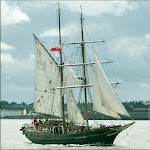
Their main vessel at present is the
Oscar Wilde (above), which sails from Rosslare, Co. Wexford to Cherbourg every second day, with the return journey the next day.

Adding an observation of my own to the IMDO report, there is also a growing number of people who are utterly fed-up with the ever increasing extra charges, invented by so-called 'low fares' airlines to boost their profits. This, combined with ever more hassle at airports, turns sensible people travelling to Europe away from airlines and makes them use the ferry service to France, which is very competitive now.

The Emerald Islander

01 September 2009

A Day of great historic Importance

Of all days in the year, September 1st is one of the most significant, if not the most important in history.
I am of course referring to the outbreak of World War II, which happened on this day exactly 70 years ago.

It is amazing how fast time passes, and how much we know of events we have not even experienced ourselves. I am meanwhile over fifty, but I cannot remember even one year of my life when there were not new books about World War II published, and new films about it produced.
Many of them are quite informative, but there is also a lot of rubbish, especially the sick and brainless attempts to make the war look 'funny'. For some strange reason the British are most eager on that (e.g. Hallo, Hallo or Dad's Army), which seems to appeal especially to the lesser educated elements of their society (and even to some people here in Ireland).

The British were the cause for many laughs of a different kind on the battlefields, where their poorly trained soldiers and their inferior equipment were rarely a match for enemies, especially the Germans and Japanese. (Only when the British used ever more American equipment, their performance improved slightly.) But this was not only the case during World War II. In fact, there was in the last three centuries not one major war Britain fought or won on its own, and it always had the same problems: poorly trained soldiers, with bad weapons and equipment, and not enough of either.

On a day like this, one is likely to reflect: on history, the world and on oneself. Had I been born just one generation earlier, I would most likely have fought in World War II. My father, who was five weeks away from his 13th birthday when the war began, was drafted for military training at the age of 17 and served - as an 18-year-old - for the last year of the war with an anti-aircraft artillery regiment.

My paternal grandfather, who was born in 1889, had fought already in World War I as a cavalry officer, from the first to the last day, and ended that war as a Captain with the highest decoration for bravery and several other medals.
After 1918 he lived a quiet life as a civilian, running the family estate in Bohemia (which had been Austrian for centuries, but was by then part of the first Czechoslovak republic).
When Hitler annexed the Sudetenland in 1938, my grandfather and his family became over night German citizens. It was neither their choice, nor had anyone bothered asking them for their opinion. It just happened, and both Britain and France sanctioned it.
A few months later my grandfather - at the age of 49 - was "re-activated" for military service, because of his "excellent war record from 1914 to 1918".

70 years ago he was one of the oldest Majors - perhaps even the oldest - in the German Army and in charge of a light squadron of (still mounted) cavalry in East Prussia.

His regiment was among the first German troops ordered to cross the border and advance into Poland (photo above left), where they met - and defeated - a regiment of Polish cavalry. This was one of the last battles in history with mounted cavalry on both sides.*

Earlier that day - beginning at 4.45 am - the German Airforce had started bombing raids on Polish towns and military positions (photo right), and shortly after daybreak the old German pre-dreadnought battleship Schleswig-Holstein (photo below left), which had been launched in 1906 and was a veteran of World War I as well, fired the first shots of World War II at the Polish garrison on the Westerplatte, an area at the outskirts of Danzig (Gdansk), an old Hanseatic city on the Baltic Sea which had been German for centuries, but was then a 'free city' under the neutral administration of the League of Nations.

Hitler had only days before signed a secret pact with Stalin, which brought the two worst dictators of the 20th century into an unexpected alliance against Poland, on whose territory both Russia and Germany had historic demands.
Poland had earlier received diplomatic guarantees from both Britain and France, but neither country was in a position to give any real - and especially military - support in case of war. They knew that only too well, but Poland believed that it had allies.
In fact, it was an isolated country, surrounded by potential enemies. The Polish army was quite strong and highly motivated, but on the technical level of World War I and thus no match for the well-equipped modern forces Germany and the Soviet Union sent against it.

Knowing that Britain and France were in no position to assist Poland militarily, Hitler - well known to be a political gambler - took the risk and invaded Poland, against the advice of many of his political aides and senior generals. And being also a life-long Anglophile (a fact that is often ignored by historians and commentators), Hitler did not believe that Britain would declare war on Germany "over a small and unimportant Eastern province like Poland".

He was wrong, of course, as we now know. And hindsight is always easier than making decisions on the day and under pressure.

When the British Prime Minister Neville Chamberlain (right), who had tried long and hard to come to terms with Hitler and accommodate his various demands (the return of the Rhineland and the Saar province to Germany and later the annexations of Austria and the Sudetenland), eventually declared war on the morning of September 3rd, he felt that he had no other choice left.
With hindsight, he was wrong as well. But this is of course only an academic point.

Neither the British Army, nor the Royal Air Force (RAF) were ready for a war. Their numbers were low, and most of their equipment was either old and obsolete, or of inferior quality when compared with the German forces. Only the Royal Navy was of a superior strength and able to go to war at a moment's notice. But even in Britain's 'senior service' there were shortfalls (in particular a lack of modern submarines) that became soon only too visible.

The French army was much stronger than the British, and better equipped. But France had the problem that its - mostly elderly - generals were still thinking in a 19th century way and their strategy was at best of World War I vintage.

None of the French strategists - with one single exception - could see the tank as a modern offensive weapon. They used it mostly as fire support for the infantry.
The one exception was a young and bright Colonel called Charles de Gaulle (left).
He had written a book about modern armoured warfare in the 1920s, but was widely ignored by his superiors. Ironically, this book was read by the German General Heinz Guderian (below right), who agreed with de Gaulle's ideas and made them the core of his own 'Blitzkrieg' (lightning warfare) strategy.

September 1st, 1939 was the first day this strategy was used for real (and not just for exercise), and it worked even better than all optimists in the German General Staff had expected.

By September 17th most of the Polish forces were beaten, destroyed or in retreat, and the Germans controlled much of Poland's territory. On that day, seeing that all went according to their secret plan, Stalin ordered his 'Red Army' to invade Poland from the East and to occupy the areas Hitler had conceded to him previously.

The rest, as the often used phrase tells us, is history. This weblog is not the place (and has not enough space) to list all events of the war, not even those of September 1939. And most of them are well-enough known anyway, perhaps with the exception that the war ended on this day as well, after exactly six years, with the official surrender of Japan on September 1st, 1945.

But I like to mention a number of other historic events that also took place on this day, making it even more significant than it would be if only World War II had begun on this date.
  • Way back in the year 69 (CE) Jerusalem was - after a long siege - finally captured and destroyed by Roman legions.
  • In 1482 a Tatar army from the Crimea captured and plundered Kiev.
  • On September 1st, 1661 the first recorded yacht race took place in English waters. The only two competitors were King Charles and his brother James.
  • Five years later, in 1666, the Great Fire of London began on this day in Pudding Lane. When then flames were put out eventually some days later, 80% of London was in ruins.
  • On September 1st, 1715 King Louis XIV of France died after a reign of 72 years - the longest time any European monarch was ever in power.
  • In 1752 the famous 'Liberty Bell' arrived in the city of Philadelphia.
  • In 1859 the first Pullman (railway) sleeping car was put into service.
  • In the USA a federal tax on tobacco was introduced for the first time on September 1st, 1862.
  • In 1870 - during the Franco-Prussian War - the famous Battle of Sedan took place. It ended with a spectacular defeat of the French main army, and Emperor Napoleon III was captured by Prussian troops. (From 1871 to 1918 the day was subsequently celebrated in Germany as 'Sedan Day', a public holiday in commemoration of the great victory. It is quite possible that Hitler was influenced by the 1870 victory at Sedan when he chose the day for the invasion of Poland in 1939.)
  • In 1918 US troops landed in the Russian city of Vladivostok, on the Pacific coast of Siberia. (They stayed there until 1920.)
  • The modern state of Lebanon was created by France on this day in 1920 as a mandate territory.
  • In 1923 a major earthquake, measuring 7.9 on the Richter Scale, devastated parts of Japan. In Tokyo and Yokohama alone 142,000 people were killed, and many more injured.
  • In 1961 the 'War of Independence' in Eritrea began on this day as well.
  • And in 1969 - 40 years ago - a bloodless coup d'etat, led by Colonel Muammar al-Gaddafi, overthrew and deposed the ageing King Idris of Libya. (The day is a national holiday in Libya ever since, and today a special celebration - including a major military parade - takes place in Tripoli to commemorate the revolution.)
This is only a selection, of course, and there are many more minor events that happened on this day. As they happen almost every day, all year round. But I think the information above will show you that September 1st is indeed special and perhaps the most significant single day in the modern calender of the Western world.

The Emerald Islander


* Later my grandfather was transferred to a regiment of mechanised cavalry, which was equipped with light tanks and armoured cars. With them he took part in the campaigns in France, North Africa (photo), Italy and eventually Russia.
He was wounded several times, but - amazingly - he survived and ended the war as a Colonel, commanding a regimental task force.
Neither he, nor anyone in our family, ever liked or supported Hitler, or joined his party. In fact, since 1942 my grandfather was part of the Anti-Nazi dissident group within the German officers' corps. Only the fact that he was in a frontline position in 1944 - when Hitler's assassination by staff officers failed - prevented him from being discovered and shot by the SS.

But my family has paid a heavy price for Hitler's ambitions and adventures. In 1946 we lost our estate in Bohemia (where the family had lived for 300 years) and everything in it, were expelled from there (then the second Czechoslovak republic) and became penniless refugees.
It was only shortly before I was born that the family had managed to gain a proper house and farm again. But the war with all its terror, and also the day when it began, are engraved forever in the memory of every family member.
And even though I am too young to have lived through World War II, it has shaped - in a distant and indirect way - my own life and will always be there in the background. Without it, I would perhaps not even exist in the way I do. And I would most certainly not live and work in Ireland.

28 April 2009

Nuclear Substances leaked into the Sea again at Britain's Faslane Submarine Base in Scotland

A number of serious breaches of safety regulations, including leaking of radioactive waste, has been reported from the main submarine base of Britain's Royal Navy (RN).

In a confidential report, which had to be released under the British Freedom of Information Act, the UK Ministry of Defence (MoD) described safety failings at HM Naval Base Clyde at Faslane, on the Gare Loch near Glasgow (photo), as "a recurring theme".

The worst breaches include three leaks of radioactive coolant from nuclear submarines into the Firth of Clyde, which happened in 2004, 2007 and 2008 .

A spokesman for the UK MoD said: "The discharges into the Gare Loch had no environmental consequences. The MoD is a responsible nuclear operator, and we have informed the appropriate regulatory authorities. We commissioned an independent study into the facilities and practices at HM Naval Base Clyde. An improvement plan is under way to ensure modern standards and best practice at the base."

How responsible as a nuclear operator the UK MoD really is has come to light last year, when a radioactive waste plant manager at the base had to be replaced, because it emerged that he had no qualifications at all in radioactive waste management!

This is not the only case of total mismanagement under the roof of the UK MoD. For the past three centuries the armed forces of England and Britain have always - and constantly - been hampered by underfunding, wrong or bad equipment, incompetent leadership and permanent mismanagement on all levels. And the nuclear-powered and nuclear-armed Royal Navy of today is still the same barely working conglomerate of excellence and failure it was under Nelson more than two centuries ago.

The documents, which were released to Channel 4 News, show that the Scottish Environmental Protection Agency (SEPA) warned that it would consider closing the Faslane base if it had the power to do so.

Civil radioactive safety regulations do not apply to MoD sites, but the department has previously said it would "volunteer to uphold them at the base".

The documents also suggest that Faslane will be the UK's only nuclear submarine base by 2015. Three RN submarines currently based at Devonport in Plymouth (in the Southwest of England) are earmarked for transfer to Scotland.

From an Irish perspective the ongoing series of accidents at the Faslane base, and in particular the leaking of radioactive substances into the water, are reasons for concern. Sooner or later these substances end up in the Irish Sea, whose coastline is shared by Britain and Ireland.

In the past there have been more than enough cases of accidentally released radioactivity from British sites which then caused pollution and serious problems on the East coast of Ireland. This has to stop!

If the Royal Navy cannot keep their nuclear submarines safe, they should decommission them. In fact, there is quite a strong lobby in Britain to do exactly that.
The currently used 'Trident' system is soon due to be replaced with the next generation of submarine-based intercontinental missiles, and ever since this was first debated in the British House of Commons, there has been a growing opposition to it, with people from all political parties arguing against the replacement of 'Trident'.

18 years after the end of the 'Cold War' the world has changed completely, and Britain's potential enemies of today are not big states with nuclear weapons against whom one would need to have the option of nuclear retaliation.
Today's potential enemies are groups of low-level insurgents and irregular forces in the 'third world', people armed with nothing more than AK-47 Kalashnikov rifles and rocket-propelled grenades. Against them a nuclear deterrent is neither necessary nor in any way useful.

Would the UK end her submarine-based nuclear weapons programme instead of commissioning a replacement system, it could save the British tax payer more than £ 200 billion, a vast amount of money, especially in the current times of global recession.
It is still possible that the British government might see the light and follow the advice to abolish nuclear submarines. But going by past experience, it is rather unlikely. And this means that the accidental leaking of radioactive material into the waters around these island, especially into the Irish Sea, will continue for a long time.

The Irish government, and in particular Taoiseach Brian Cowen and Minister for Foreign Affairs Micheál Martin, should make strong representation about this in London and explain Ireland's position as clear as possible. No Irish civilian should suffer or die because Britain wants to play in the big league, but is incapable of keeping her equipment safe.

The Emerald Islander

14 December 2008

Splendid Isolation

There is an old joke about the English that makes the round now and then, and I just heard it again at a corporate Christmas party (one of the few I could not avoid). You probably know this joke, as it has quite a 'beard'. But, like most jokes, it carries a good bit of truth and reality as well.

The story goes that - back in the good old days before the Channel Tunnel - there was a very bad and thick fog over the Channel and thus the British ferries could not sail to Belgium and France. The headline in a London newspaper was: "Continent isolated".

This is an expression of attitude, often described as 'Splendid Isolation', which was for centuries part of the official political doctrine of England and then Britain.

Well, as it happens, I have seen quite a few real headlines in British newspapers that come close to the fictional one in the old joke. I also remember the year of the great British EU referendum (yes, they did hold one, back in 1975, but it has been the only one in the UK so far). The kind of speeches I heard then, and the kind of imperialistic newspaper headlines I saw, make the one in the joke look rather simple and bland.

I had just turned 18 that Spring and knew already that on July 1st I would join the Navy. (I had taken and passed the test during the mid-term holidays the previous Autumn.) Having a little time to spare, I decided to travel to London and experience British politics live and first-hand before I would go to sea. So I became an impartial but very observant witness to the UK's 1975 EU Referendum.

Harold Wilson (left), then the Prime Minister, led the YES campaign. He was supported by most of his Cabinet ministers and about half of his (Labour) party, with good additional support coming from about two thirds of the opposition Conservative Party, which had just elected its first female leader, a certain Margaret Hilda Thatcher, the MP for Finchley. At that time she was quite pro-European. But after becoming Prime Minister four years later, she turned - oh yes, she was for turning after all - and became a very strong Euro-sceptic.
The Liberal Party, the Social Democratic and Labour Party, the Alliance Party of Northern Ireland and the Vanguard Progressive Unionist Party also campaigned for a YES vote and thus for Britain to remain a member of the EU (which was then still only the EEC).

The NO campaign was a truly motley crew, with the largest contingent being the left wing of the Labour Party, including the Cabinet ministers Tony Benn, Michael Foot, Peter Shore and Barbara Castle, and many Labour backbenchers.
The far right of the Conservative Party and most of the Ulster Unionist Party (UUP) also campaigned for a NO vote.
It is worth remembering that a certain Ian Paisley of the Democratic Unionist Party (DUP) - then a minor Unionist splinter group - publicly supported the NO campaign as well and wanted the UK to leave the EU again, barely two years after joining it. (This was of course long before he enjoyed the perks that come with being an MEP, a pleasure he would never have known had his side succeeded in 1975.)
The NO campaign also attracted support from the extreme right, such as the National Front, and the extreme left such as the Communist Party of Great Britain.
The Scottish National Party (SNP) and the Welsh nationalist party Plaid Cymru joined the NO camp as well.

The referendum was called in April 1975. Since there were strong pro-Europeans and staunch anti-Europeans in Wilson's Cabinet, the Prime Minister decided to suspend the constitutional convention of collective responsibility and allowed his ministers to publicly campaign against each other, which was sometimes really funny and quite hilarious.
In total, seven of the twenty-three members of the Cabinet opposed EEC membership.

On April 9th the House of Commons voted with 396 (70%) to 170 (30%) in favour of retaining the Common Market on the new terms negotiated by Wilson's government. The main deal had actually been done in Dublin, during a meeting of the EU heads of government (what we now call a 'summit').

But the big day was June 5th, just one day before the anniversary of the famous D-Day (when Allied troops began to land in German-occupied France in 1944). If the selection of the date was a pure coincidence or if someone in 10 Downing Street with a sense for history had thought about it is not known (and has stimulated speculations ever since).

On a turnout of 64.5% eventually a solid two-thirds majority of British voters decided to stay in the EEC.
The exact numbers were 17,378,581 votes (or 67.2%) for YES, and 8,470,073 (or 32.8%) for NO (leaving the Common Market).

After such a clear decision one would expect that everyone settled down and life returned to normal. But as we all know, this did not happen. Ever since 1975 various elements of the UK's political structure - including four Prime Ministers from both major parties - have become the most serious anti-Europeans inside the EU. Whole political parties were founded on the sole manifesto promise of getting Britain out of Europe. They still exist and even have MEPs, a couple of MPs and some members in the House of Lords.

I have no problem with people who do not share my opinion. Quite the opposite, in fact. Often they make good partners for a really interesting debate.
But I do wonder how much the principles of Democracy - which are apparently so important for the British system (although not really) - are still alive in modern Britain.

In the world I grew up in it was normal that one played by the rules once one had joined a particular club. This is in fact still widely regarded as very 'English' and part of the 'British fair play' concept. The problem is that the British expect everyone else to play by their rules, while they feel entitled to break any rules at any time if they no longer suit or fulfil its purpose for them.

The British EU membership since 1973 has been overshadowed by the problems the UK has to accept and live by the rules someone else has made. Personally I would not shed a tear should the UK decide to leave one day, and there would certainly be loud cheers all around Brussels. (I stopped counting how many times I have heard the phrase that "General de Gaulle was right when he blocked British EU membership. We should never have let them in...")
On the other hand, I don't mind them staying either. As Churchill said in his unique way: "It is better to have some strange people inside the tent, pissing out, than the other way round..." He had a point.

But no matter how awkward someone is, when in Rome, do like the Romans, and when in a club, play by the rules (which are the same for everyone).

One of the most crucial elements of belonging to the EU is the monetary union. When it was proposed to have a common currency called the Euro (after the working title 'Euro Dollar' was thankfully dropped long before there were actually notes and coins), the UK was immediately against it.
Apparently the British would not be able to function without their Pound Sterling.

There are even people who claim that money would not be money without the Queen's head on it. Well, we have not had any monarch's head on our money for nearly nine decades now, and we are still around. And nobody would stop the Brits from putting H.M. visage onto the coins, where we have our harp (and other countries have their symbols).

Do you remember William Hague? Also known as 'Hague the Vague'... Yes, the youthful Tory leader (elected when John Major resigned to spend more time with Cricket and Edwina Curry in the aftermath of the 1997 election) who always looked like a baby that had grown too large without changing its infant features... yes, exactly him, who wore the silly baseball cap to "appeal to the young". (The real reason was to cover his prematurely balded head.)

This William Hague, as leader of the Conservative Party, went around Britain with a lorry, carrying a huge billboard that said "Save the Pound!"
Whenever they stopped, he came out and shouted the same slogan again and again, if people wanted to hear it or not.
Actually, no-one has ever threatened the Pound Sterling, and no-one forces the UK to adopt the Euro. So the whole campaign, which happened only six years ago (and not far back in the silly seventies), was as pointless as the other election ploys the Tories came up with since Tony Blair won his first landslide victory in 1997.

Both Blair and his Chancellor - and now successor - Gordon Brown (right) were and are strong Poundistas and dislike the idea of a common EU currency. They developed a unique system of "five economic tests" that the Euro would have to pass before it could be accepted as the UK currency. And as they set the questions and parameters, it was no problem to fix the settings in a way that the Euro would never pass the 'five tests'.

Since 1997 these 'tests' have been applied three times officially, and each time the Euro fell short of the expectations in at least two of the five areas.
When the Euro - created 1999 - was eventually introduced as physical notes and coins on January 1st, 2002, twelve of the then 15 EU countries adopted it. Only Denmark, Sweden and the UK kept their independent national currencies.

At first there was a lot of grumbling against the Euro in Ireland. The notes looked apparently too similar, and the coins were too small, complained a lot of people. But they all got used to them and manage well now every day.
While the Danish and Swedish Kronas have been sinking in value to the Euro slowly but steadily over the years, the Pound Sterling had always remained strong, giving the British government ever more arguments for holding on to it.
Personally I advised my clients to buy Euros in the UK and keep them in a British Euro account (which is no problem and done all the time). I told them not to touch this money, until the Euro had risen to a strong position towards the Pound.

Over the years the Euro has indeed done so, first very slowly, but steadily and for good reasons. So once again a long-range prediction I made has been correct. Over the last few months even more so, as the Pound is at present in free-fall, thanks to the chaotic UK economy and its many unregulated or 'self-regulating' sectors.

And today comes the news that the British Pound Sterling is now worth less than the Euro on Britain's high streets. This is the first time ever since the single European currency was launched.
Exchange rates are now as low as € 1.0532 to the Pound, so with commission and a handling fee taken into account, customers changing £ 200 might receive as little as € 197.13.

Welcome to the world of real politics and harsh economics.

I bet that Gordon Brown is now regretting his tough and arrogant stance against the Euro. What would he give tonight to be in a safe financial community of - meanwhile 15 - friendly European states...

Ireland is one of the 15, and even though there is a lot going wrong here right now, especially in the economy and with our banks, at least we have one worry less this time: Our currency cannot be taken to the cleaners by some ruthless international speculators and fiscal vultures. The EU as a bloc and its common currency - the Euro - are too strong for that sort of game.

Vultures only attack what is dead or too weak to defend itself - like poor Iceland a few weeks ago.

Splendid isolation, the old phrase of the British island doctrine, has its points. But in times like these it is a lot better to have enough friends and partners. The Euro gives us that support, which the UK is lacking. It is no longer the Continent that is isolated in the fog, it is Britain and its old and battered Pound Sterling.

Perhaps it is time for Gordon Brown to put the list with his 'five economic tests' on the fire and ring the ECB in Frankfurt...

The Emerald Islander

24 November 2008

Irish Customers are fleeced by the ESB to finance new Power Plants in Britain

The Electricity Supply Board (ESB), the Republic of Ireland's largest producer and supplier of electricity, is "planning to expand its operations in the British energy market significantly, with a € 4 billion investment drive to build new power plants in the UK".

ESBI, the ESB's international arm, has "acquired an interest in a number of British power companies" and plans to build "over 3000 megawatts of gas-fired and renewable energy plants before the year 2020".

ESBI currently has operations and projects in more than 35 countries including the UK, and the ESB says this initiative will rank them "in the top ten energy companies in the British electricity market".

"The investment opportunity comes because of a projected shortfall in generating capacity in Britain over the next few years", an ESB statement says.
"ESB will build and operate a gas-fired power station near Manchester, which will generate electricity for 1 million homes by 2013, while another gas-fired station near Southampton will be operational by this time next year. ESB's plans in Britain also include wind-power projects."

I don't know about you, but I was very surprised - and almost stunned - when I read this. The ESB is an Irish company, originally established in the 1920s by the government to produce and provide the energy needed for this country, its development and industrialisation.

Until recently it has been a state company, concentrated on the needs of Ireland and our population and industry. That is how it should be.
Then - following the general trend in capitalist countries - Fianna Fáil part-privatised the ESB. Since then we have experienced several significant changes in their work and relationship with customers.

1) Prices for electricity in Ireland went up several times, without real need and explanations.

2) ESB closed its nation-wide network of shops, thus cutting off the normal way for a customer to contact the company and interact with it.

3) Most of the former shops' premises were sold to a large UK bank, at the height of the Irish property boom, for a massive profit.

4) So-called 'customer relations' are now reduced to contacts by telephone only. If a customer is lucky and skilled enough to get through the system of automated messages and electronic barriers, designed to minimise the number of calls, he is connected to a 'call centre', where predominantly young and very clueless 'operators' are trying to tell him that everything is in order, even if it is not.

5) Letters of complaint written to the ESB, even those addressed to senior management, are never answered.

6) ESB, now a commercial company and no longer a national service provider, is engaging more and more in other countries, while neglecting the Irish market.

7) Nevertheless it is predominantly the money created in Ireland that finances these foreign operations.

I did not know before that the ESB is now active in 35 foreign countries. And I did not know that all the money extracted from Irish customers at exorbitant rates is now going into the financing of the electricity supply of other countries. Did you?

As things stand, Ireland has one of the highest energy prices in the world, with ESB being at the top of the league table.
Whenever we are hit by another price hike for electricity - a utility which is now needed by everyone, so we have not really any choice - the ESB tells us that it is "because of the rising prices of oil, gas and coal on the international markets".

That is a lie. In fact the most barefaced and outrageous lie we have been given by an Irish company for a long time.
And it is about time to stand up to these liars and scoundrels and tell then what we think of them!

Fleecing the Irish public ever more drastically, in order to spend € 4 billion on new power stations in the UK - for the supply of British customers and the benefit of international share holders - is not acceptable in general, and especially not now, in a time of economic recession and financial crisis.
Not to mention the other 34 foreign countries, which have not been named. (I am trying to obtain a list, and if I get it, I will share the information with you here.)

We should not take this quietly, and begin to voice our protest.

Write letters to the chairman and CEO of the ESB!

Write to your TDs and to newspapers!

Talk with your TDs when you see them, and express your anger and disgust.

And use any other form of communication as well, to make your family, friends and neighbours aware of this scandal. They might not have heard of it yet.

The ESB was created by the Irish government, using taxpayers' money, to work for the Irish nation and provide us with enough electricity at affordable prices. Its purpose does not include to fill the gap in the energy market of our former colonial rulers, whose failure to plan properly for their own needs created a shortage of energy in Britain in the first place.

At a time when every single Euro and cent make a difference, we - the Irish nation - should not be robbed of € 4 billion, which then leave the country to help those who oppressed us for 750 years. No, I say, and once again - NO!!!

If you care for your country and the money in your pocket, then follow my example and make yourself heard. There is still time to stop the ESB from this blunder, but every day counts.

Éirinn go Brágh!

The Emerald Islander

07 July 2008

UK MPs say PSNI looks too much into the Past

A new report has accused the police in the North of spending too much time with investigating unsolved murders from the past, the time commonly known in Ireland as 'the Troubles'.

The Northern Ireland Affairs Committee of the UK Parliament has found that the ability of the Police Service of Northern Ireland (PSNI) to cope with present-day terrorist threats "is being compromised because there is so much focus on cold case murders from the 30-year conflict".

In its "Policing the Past" report the committee noted that the costs of the PSNI's Historical Enquiries Team (HET), set up to examine more than 3200 killings that happened in the Six Counties between 1968 and 1998, could spiral to more than £ 45 million, which is 60% over the original budget.

However, despite the financial and manpower resources being diverted into the project, so far only one case out of more than 1100 opened has been passed to the Public Prosecution Service with a recommendation to bring charges.

The work of the independent Police Ombudsman is also being compromised by the need to re-examine allegations of police misconduct over the 30-year conflict, British MPs said in their report.

Committee chairman Sir Patrick Cormack, MP said the HET, which was established in 2005, should be re-assessed, with priority given to cases with a realistic chance of progression. He added that the police had to be able to maintain their focus on the present day.

"The Police Service of Northern Ireland faces significant demands in terms of its work with all of the different historical investigations, and we are concerned about the impact of this in relation to the police service's primary role in policing the present," he said in London.

The report raises the question how much sense the work of the HET really makes, or if it is just one more instrument of UK state bureaucracy, created to keep an oversized group of British and Northern securocrats happy and occupied, forever and ever raking over the past.

Critics of the policing and security system in the North have long suggested the establishment of a Peace and Reconciliation Commission, based on the South African model, to deal with the terror, murders and political crimes of the past. So far the idea has not found enough support from the current political leaders in the North. Instead the HET was set up. If they continue working at their current speed, they might be completing their task by the end of the century.

The Emerald Islander

23 June 2008

High Speed Ferries go slower to save Fuel

High-speed ferry services between Ireland and Britain are being slowed to save fuel.
Ever more soaring oil prices are blamed for
Stena Line's decision, which increases the usual crossing time between Dún Laoghaire in Co. Dublin and Holyhead in northern Wales by 16 minutes (to an average of now 115 minutes).

Journeys between Larne in Co. Antrim and Stranraer in Scotland are extended by 14 minutes (to an average of now 119 minutes) as well to cut costs.

"In the current circumstances most passengers realise that just as they are making some difficult choices, ourselves who operate in the transport sector have to do that as well," a Stena Line spokesman said.
"Compared to the conventional ferries it is still a lot faster. We provide a quality of service and people come back because of that quality."

Stena Line recently opened a new terminal in Belfast, which will shorten the distance to be covered, although the slower speed means that it will now have little impact on crossing times.

07 April 2008

The Olympic Farce and China's Power

Does anyone else see through the huge public spectacle that China has started to force down the throat of major western countries? Or is it just me?
Yesterday, when I was talking to some local people about the matter, they seemed not to be able to understand what is going on. But then again, they have never been to China, and the only way they know Chinese people is from our local take aways. There is not a lot of cultural, philosophical and sociological knowledge gained from ordering the odd fried duck with fried rice and prawn crackers.

For previous Olympic Games the Olympic Torch - always lit by a ray of Sunlight at Olympia, the Greek home of the ancient games - was carried through the host nation until it arrived on the day of the opening ceremony in the host city.
But this year the Chinese have extended this tour of the torch to a number of foreign countries, in order to highlight the fact that they host the games even more. Not that they were short of cities and towns in their own country to parade the torch through. In fact, if one would move it all around China, it would take about two years to complete the journey.
So why then the foreign legs of the tour? Very simple. It is a deliberate act of superior arrogance and dominance, forcing the western countries, most of which are already completely dependent on China for the manufacturing of most of their consumer goods, to bow before Communist China, the Olympic host. There is a lot of pride in this, as well as deliberate humiliation for the western "paper tigers", as Mao tse-tung used to call them.

What I don't understand is why countries like Britain and France play along with it and threat a little stick with a flame as if it were a head of state!
In total there were yesterday more than 2000 uniformed police officers detached for the torch parade through London. And a similarly sad spectacle is expected to take place later today in Paris. How much all this costs the taxpayer, and how much crime those police officers could have prevented if they had been allowed to do their proper duties, can only be estimated. But it is quite substantial.

A protective ring of ten Chinese "flame attendants" (read: special forces police) in light-blue track suits and white baseball caps plus British police officers in fluorescent jackets surrounded the torchbearers closely at all times, with additional uniformed police joining at potential flash points along the route.

This unprecedented close protection of a small object was so massive that the spectators and even people watching the event on TV could often not see the Olympic torch or make out who was actually carrying it. The whole sad show only exposed two things: That there is no freedom in China, and that the UK government prefers the staging of a sick spectacle to please the Chinese dictators to the highlighting of the human rights abuses China commits every day, and especially in Tibet.

Like Hitler used the Olympic Games of 1936 to make the world bow to National Socialism, China now uses the games to make the world bow even deeper before Communist Mercantilism of Chinese fashion. All those - politicians, sports people and anyone else - who close their eyes to the facts or decide that they could not be bothered with details about China, Tibet and human rights as long as they get a few hundred hours of sport on TV this summer, are not only fools, but dangerous fools who contribute to a lot of political, social and economical damage.

People should realise that there is an unbroken tradition of 6000 years in China, which was already a high civilisation at a time when our ancestors still lived in caves and wattle huts. Reading about China and its history might help to understand Chinese ambitions, aspirations and general attitudes. And we should also remember that there is a word called "no" which we should use more often when encountering developments and behaviour we are not happy with. Letting every bully get away with every prank will only create a world ruled by bullies.

The Emerald Islander

10 March 2008

Severe Weather to continue for two more Days

The severe weather, which is currently being experienced across Ireland and the British Isles, is set to continue.
So far southern and western England, southern Wales and Dorset have been worst hit by the storms. Flights and ferries have been cancelled, roads and rail lines blocked by fallen trees and rivers have flooded as gale-force winds of over 80 mph battered the islands.

The Meteorological Office has severe weather warnings in place for South West England, with predictions that England, Wales, central Scotland and Ireland will see a further swathe of gales on Tuesday and Wednesday.

07 March 2008

British People are denied a Lisbon Referendum

Calls for a British Referendum on the Lisbon Treaty have increased over the past couple of weeks.
Despite the UK government's clear refusal to even entertain the idea, and the defeat of a Conservative motion - calling for a referendum on the new treaty - in the British House of Commons, the voices from outside parliament demanding a direct say in the matter are getting louder.

Even though the governing Labour Party promised voters a referendum on the European Constitution in their last general election manifesto, Prime Minister Gordon Brown (left) and his ministers now argue that the Lisbon Treaty is "an entirely new document" which has apparently nothing to do with the Constitution that was rejected in referenda in France and the Netherlands in 2005 (thus saving the UK from holding their own referendum, as any new EU Treaty needs to be accepted by all member states).

On the opposition benches the views on the Lisbon Treaty are divided. The Conservative Party has been calling and arguing for a referendum since the document was signed by all EU leaders in the Portuguese capital last December. Several nationalist and independent MPs also support the call for a British referendum.

Surprisingly, the Liberal Democrats are split over the issue. While the party leader Nick Clegg (right) asked his 63 MPs not to vote on the Conservative motion and abstain, only 50 followed their young leader. 13 LibDem MPs defied the order and voted with the Conservatives. Three of them - Alistair Carmichael, Tim Farron and David Heath - even resigned as front-bench spokesmen so they could vote in favour of the motion. This is no mean feat, and it only shows how deep the emotions over the Lisbon Treaty go in Britain as well. In a later, separate vote on a referendum, proposed by Labour MP Ian Davidson, 14 LibDems rebelled and in total 15 of their MPs ignored the call to abstain.

Many observers see this as the first test of the leadership qualities of Nick Clegg, who was elected as his party's new leader less than three months ago. He has his own agenda on Europe and wants a wider referendum on whether Britain should remain in the European Union or not.

Despite so many opposition calls for a referendum - also strongly supported by the Euro-skeptic UK Independence Party (UKIP), which has no MPs but 12 MEPs - the people of Britain will not have their say on the matter after all. Despite the support from the rebel Liberal Democrats, the Conservatives' motion for a referendum was defeated by 311 votes to 248. By the time British voters can react to this open defiance of a public demand - the next general election - the matter will be dead and buried and the treaty will be long in effect, unless the people of Ireland vote NO. The Irish are indeed the only force left that could yet stop the EU juggernaut.

In a separate development, a privately organised opinion poll in ten marginal constituencies in the South of England asked voters if they were in favour of a referendum and how they would vote if there were one.
88% of those asked declared that they were in favour of a referendum, but once again the British government decided to ignore them. Perhaps the reason for that is the result to the second questions asked: 72.4% of those asked in the ten selected constituencies said they would reject the Lisbon Treaty.

It is probably not a completely representative poll, but it shows clearly a double tendency in Britain: People want more active and personal participation in major political decisions, and they are growing more Euro-skeptic almost by the day.
Sadly, the British political system only pretends to be democratic, while it is not. So the Irish will indeed be the only people who can make a difference in the matter and show the politicians at home and in Europe that democracy still means "government of the people".

The Emerald Islander