Showing posts with label Co. Kerry. Show all posts

28 June 2009

Leinster House as a political Theme Park

For the second time Leinster House (left), the Dublin seat of the Oireachtas - Ireland's parliament - has been turned into a political theme park this weekend.

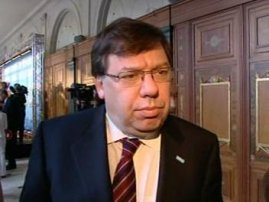
After a trial run last summer, John O'Donoghue (photo below right), the Ceann Comhairle (Speaker of the Dáil), decided to turn the august halls of Irish power once again into a temporary political version of Disneyland for two hot days in late June.

8000 tickets, O'Donoghue stated in a rather pompous manner, "have been made available to members of the public" to visit Leinster House for the "Oireachtas Family Day". And they were apparently "booked up within 24 hours".

Who is the "Oireachtas Family"? Are we talking about the 166 TDs (members of the Dáil), 60 Senators and all their extended families and relatives? Perhaps the quite numerous - and usually unnamed - civil servants and other staff members who make the parliamentary machine work are also included with their families? That would easily make up 8000 people.

But no, John O'Donoghue said the "Family Day" - actually two days on Saturday and Sunday - was meant for "members of the public". In politico speak this means the plebs, the 'ordinary people', also referred to as 'the great unwashed'. In other words, people like you and me, who do not have the privileges and exorbitant incomes of professional politicians.

"Members of the public"!

I really hate this phrase with a vengeance. Better than any other it signifies the deep divide that exists between those in power and the rest of the nation. In the eyes of our politicians we are not more than "the public", the paying audience for their lavish freak show that masquerades as a parliament.

But then again, we are only ourselves to blame for that. After all, our politicians cannot just walk into Leinster House and take their well-upholstered seats. No, we - "the members of the public" - send them there when we vote for them (directly for the TDs, and indirectly through our local councillors for the Senators). So we are responsible for the bunch of wasters, clowns, ignorants and incompetents that populate Leinster House with our five-year-mandate.
If we cared for our country, its political stability and our future, we would elect better people to represent us in the Oireachtas.

But - for some reasons that have been a mystery to me all my life - we don't. We are so lazy and disinterested in politics that we keep electing the same kind of people - and often the very same people - again and again, no matter how badly they treat us and how incompetent they are in governing the country.

So we should not be surprised that they treat us with the contempt we deserve. They do award themselves enormous salaries, with lavish extra fees and 'expenses allowances' on top of their 'normal pay' and exorbitant pensions for their comfortable retirement, and we - the taxpayers - foot the bill. They give themselves extensive holidays - called recesses - which make teachers' holidays look short, and when they are actually sitting, they only work three days a week - from Tuesday to Thursday. The other four days of the week, a regular long weekend from Friday to Monday, are apparently needed "to look after the constituencies".

Ask yourself: When have you last seen a TD going around and 'looking after the constituency'? The only time they do that is during an election campaign, when they want and need our votes to retain their luxurious and easy lifestyle.
From time to time they appear at sports venues or at cultural events - always on free tickets - or they might open some new building, factory or shop. That's about it. The rest is really the longest regular weekend anyone can ever dream of. (Senators do not have constituencies, but enjoy the same three-day week and long weekend as TDs.)

No wonder then that these 226 people see themselves as a privileged elite and the rest of us as nothing more than their "public", the paying crowd that keeps them in luxury and is supposed to applaud their performances.

It is quite interesting that the Oireachtas' first "Family Day" last year coincided with increased anger in "the public" and a fall in the approval ratings of most leading politicians.
The announcement of the first "Family Day" was made just one day before the country voted on the Lisbon Treaty, and the event took place only two weeks after it had been defeated by a clear majority of the Irish electorate.

The organisers, and especially John O'Donoghue, made a big noise about the day (last year it was really only one day - Sunday, June 29th) and praised it already as a success two weeks before it actually happened. He even commissioned a special website to promote the "Family Day", and money was clearly thrown at it in bundles.

Besides all sorts of music, food and "street entertainment" one of the highlights of the day were "Tours of the Oireachtas". They were advertised on the official website with the statement that "for the first time, members of the public can visit both the Dáil and Seanad Chambers". Which, of course, is a blatant lie.

Anyone who has even the slightest bit of knowledge of our parliament knows that the sessions of Dáil and Seanad are held in public. Anyone who wishes to attend can do so and observe the proceedings from the visitors' gallery. Those who do that will have the added benefit that they actually see politicians in action, while all they see on the "Family Day" are the empty chambers of both houses of the Oireachtas. *

So, apart from empty debating chambers, what would be the 'attractions' of Leinster House on a "Family Day"?

Well, there is music - from traditional Irish to weird-looking and even weirder sounding African drummers whose understanding of Democracy matches about that of our TDs - and a number of food stalls. The odd professional juggler and clown is thrown in for good measure, and of course there cannot be any event in Ireland these days without the idiotic practice of face painting.
What is the point in getting acrylic paint smeared over one's face? I find it filthy, disgusting and unhealthy (as it can affect the skin and prevent proper perspiration). And if I had the power, I would make it illegal.

There is one other and indeed 'political' attraction: The re-enactment of famous speeches from the 90-year-long history of the Oireachtas.
Being myself a passionate public speaker (who has won speaking and debating medals in several countries for contributions in three languages and trained many people in the skill), this is the only element of the event I would be interested in. It would be educating - and perhaps even entertaining - to see and hear current politicians repeating the great speeches of the past.

How would the boorish Brian Cowen fare with a solemn oration of Eamon de Valera? Or meek and mild-mannered Enda Kenny with a fiery election rally address of Michael Collins?
Could Eamon Gilmore emulate the speeches of James Connolly, or Michael D. Higgins repeat the powerful words of the great trade union organiser James Larkin? I imagine that Caoimhghín Ó Caoláin might do rather well with the words of Sinn Fein's founder Arthur Griffith, but I could see neither Mary Coughlan nor Mary Hanafin re-enact the hot-tempered speeches of Countess Constance Markiewicz. Perhaps Mary Harney might give it a try...

But, sadly, we will see and hear none of the above. Most of our current TDs are truly abysmal speakers, and they know it. Sitting through several hours of debating in the Dáil can easily make one fall asleep (and TDs have been noticed for that), or lose the will to live. (The rhetoric quality in the Seanad is a bit better, but leaves also much room for improvement.)
So, instead of exposing themselves to "members of the public" as the uninspiring wafflers they are, the politicians hired a troupe of Dublin's trainee actors (fully qualified actors are probably too expensive these days) to perform selected pieces of vintage debates.

For the young thespians this was probably an interesting and valuable exercise (with a welcome extra income on top), but for the listening "public" it was rather disappointing. A great speech is not just a collection of sentences. The delivery is as important as the words are. And here the concept fell down. Even with the best of effort a young woman cannot produce the effect Michael Collins or James Connolly had with their speeches, and a young man is not able to bring across the special personality of Eamon de Valera. So the whole idea of reproducing famous speeches from the past - which is a good one in principle - was rather lost due to the weak performances.

There were some side shows that attracted limited interest from children, but nothing really that would make politics appear as more interesting or bring it closer to the people. A Dublin performer was advertised as "blending sophisticated humour with jaw dropping magic". Maybe Brian Cowen could learn a thing or two from him. But the Taoiseach was nowhere to be seen.

Perhaps he was advised to stay away, in order to avoid unfriendly acts from "members of the public". People in Dublin still remember Wicklow pensioner Gary Keogh and his eggs at the AGM of Allied Irish Bank... (see my entry of May 13th) Who knows how many angry Irishmen are out there with more eggs in their pockets?

For a moment I thought that Brian Cowen had - as he often does - ignored the advice given to him and was appearing in Leinster House after all. However, the man announced as "Ireland's best bilingual juggler" turned out to be not the Taoiseach, but one Johnny Phelan, apparently "the only Irish juggling act that is sponsored by the Arts Council".

Well, all you aspiring authors and struggling little theaters around the country who have been told that there is now no more financial support for you "because of budget cuts at the Arts Council", perhaps you should all become jugglers to be funded with taxpayers' money...

Ceann Comhairle John O'Donoghue, one of Fianna Fáil's most pig-headed old apparatchiks and a kind of political juggler himself, says that "the level of interest in the Family Day makes a clear statement that people do wish to connect with their parliament, their politicians and the political process".

Well, here is a great example of wishful thinking, if you ever need one.

About half of the people attending were political activists from various parties, who were there to show their party colours or to support a particular TD. There were some groups of old-age pensioners, Chinese students and African immigrants who had been brought in especially and on purpose, but they did neither fit in, nor did they know what to do or what the whole thing was about. They were sitting or standing around, quite forlorn and a bit puzzled. The old folks just sat there and stared into an empty distance, while the Chinese - always trying to be polite - smiled all the time and looked like a bunch of dolls from the wax museum. The Africans, with expressionless faces, concentrated on the food and stayed well away from the rest.

The Irish visitors were not excited either. One only had to look into their faces to see that they felt bewildered, and often quite bored. And there were also loads of very bored children, dragged along by their parents and wondering why they had not gone to the seaside instead. They were interested in the ice cream on offer, but not in politics or the parliament. And in fact, there was no parliament on offer anyway. The Houses of the Oireachtas are the people elected to them, not the building and two empty debating chambers.

To be fair, there were quite a few TDs and Senators present, trying to make the best of it. And John O'Donoghue was walking around pompously like a king, shaking graciously the hands of little children. (Could there be any connection with the fact that his home county Kerry is often referred to as "the kingdom"?)
But none of the political heavyweights bothered to attend. They had better things to do than meeting "members of the public" in a tacky little political Disneyland their 'home' had been turned into for the weekend.

I can understand why politicians are interested in polishing their image and getting 'closer to the people'. Turnouts in elections have been falling over years, and many Irish people - especially from the younger generations - have no interest in politics at all. Pop music, consumerism and the 24-hour entertainment culture are more attractive to them.
And the schools are not doing their job either, it appears.
"What county is he playing for, Dad" a little boy aged about ten asked his father when the name Michael Collins was mentioned by a Leinster House tour guide.
If this is the standard of knowledge these days, then I see not much of a future for Ireland.

In principle it is a good idea to bring the people and their parliament closer together. The better one understands the political system and the process of making decisions, the more one will appreciate freedom and Democracy. And one is also more likely to become actively involved in politics oneself.
But closing the gap between politicians and the general population will not be achieved through 'fun' and turning the parliament building into the country's largest fast food outlet for a weekend. Popcorn and ice cream are not political arguments, and no jazz band, magician or juggler** will increase the popularity and approval rates of our elected leaders.

Parliament is a serious place, and it should be taken seriously by everyone, especially those who are part of it.
By pretending for a weekend that Leinster House is just a happy little fun fair on Dublin's Kildare Street "the public" - and in particular the many children who were dragged into the experience - will get a completely wrong and counter-productive impression of it.

If one wants to popularise parliament, then the people need to see it at work and not when it is empty and shut down for the weekend (and only days away from another ludicrous three-month holiday).
People should be encouraged and invited to attend regular sessions and debates, and have the opportunity to meet their local TDs (regardless of party) over a cup of tea afterwards.
And on their free days - like Mondays or Fridays - TDs should visit schools in their constituency and chair organised debates on various subjects, political and non-political.

There should also be a lot more transparency, which could begin with politicians using language everyone understands. Most bills passed into law by the Oireachtas are written in an antiquated and artificially complicated language that no-one ever speaks in daily life. This so-called 'legal English' has only one purpose: To keep the vast majority of people in hock to the members of the legal profession, who charge hefty fees for their services.

And - surprise, surprise - many of our TDs have been trained as lawyers before they entered politics. This self-serving circle neeeds to be broken, and politicians need to have experience of real life before they get elected to parliament. Only then will they have a chance to be closer to the electorate. It can be done, and it would be well worth doing.

The current economic crisis is a heavy burden on most of us, but it also opens opportunities for fundamental changes that no-one would even dare to contemplate during 'good' times. Here lies the chance for the whole nation, and in particular for our politicians. Get things right this time, by making proper changes, and popularity will come along for free.

There is no need - and no demand - for a fun fair in and around Leinster House once a year. The money spent on it could be used much more sensibly, and with much better results. An open and transparent parliament, whose members are realistic and approachable, while sharing the same burden we all have to carry, would do wonders for the popularity of the Oireachtas.

It would also help to maintain the dignity of the Ceann Comhairle. Prancing around like 'King Puck' (of the well-known annual fair in his home county Kerry), while grinning all the time like the proverbial gingerbread horse is not quite the image one would like to have of the man who presides over the sessions of the Dáil. He is supposed to be the primus inter pares (first among equals), and not the biggest bear with little brains amongst 166 Poohs.

The golden rule of common sense should also be applied to the Houses of the Oireachtas: Think before you act; and when it comes to 'entertaining the people', less is often more. (I will send a copy of this entry to John O'Donoghue, and it will be interesting to see if he is able to listen, learn and change.)
To the vast majority of Irish people who have not been at the "Family Day" at Leinster House I can only say: Well done. You were wise to stay away and have certainly not missed anything. It was neither fun, nor interesting or inspiring. It was just another example how our incompetent politicians can make a mess of everything they touch.

The Emerald Islander


** On top of seeing nothing but two empty debating chambers (which one can see on television several times a week) and a few equally empty corridors connecting them, the people who put themselves through this are also herded like cattle by the Leinster House staff and have to queu - some for hours - to qualify for this 'rare privilege'.
And to avoid any misunderstanding, the rules are laid out plainly on the official Oireachtas website:
"Tours of Leinster House will be available on a first come first served basis with access for 1500 people approx. Visitors interested in taking the tour are advised that on arrival they should go directly to the start of tour location at the Leinster House entrance to ensure that they are accommodated."
Well, if this is an "open approach" to make the Oireachtas "more transparent", then my name is Harun al-Rashid!
It looks and sounds a lot more like the Victorian mindset of our former colonial masters, which has somehow survived for 90 years in the hearts and minds of our politicial elite and - even more so - our civil service and legal profession. If it were not so serious, one might mistake it for the hilarious attempt of making a practical joke.

** I still cannot get over the job title "Ireland's best bilingual juggler". Juggling requires a combination of physical and technical skills and has nothing to do with language. So what is the point of making such a distinction? If I would have the skills to juggle, would I be 'Ireland's best trilingual juggler'? Where does it end? It makes no sense.
If he is a good juggler, then that is reputation enough. And if he is not, his ability to speak Irish will be of no help at all.
By the way, how many bilingual jugglers are there in Ireland? Nobody seems to know. So who made the stupid judgement on Mr. Phelan? Maybe he is the only one, which would make it easy to be the best.
The whole way of this promotion shows the insular narrow-mindedness of many Irish people and the idiotic way we - and in particular semi-state bodies and their advertisement agencies - look at ourselves. It is the same mentality that makes us concentrate on sports no-one else in the world plays, and that sent a turkey puppet as our official entry to the Eurovision song contest. Some of us might well find it 'funny', but they will be alone with this. Certain forms of humour simply don't travel well.
It might be helpful if someone would also tell the people in the Arts Council, and in the many other semi-state bodies and organisations, that we have reached the 21st century and that paddy-whacking leprechauns have long passed their sell-by date.

27 May 2009

Quality of East Coast Beaches "disappointing"

The quality of Ireland's east coast bathing water has deteriorated significantly last year, with a doubling of the number of beaches failing to provide 'minimum mandatory standards'.

A new report from the Environmental Protection Agency (EPA) says that even though beaches on Ireland's west coast performed well, the east coast experienced major difficulties, particularly around Dublin.

While the EPA points out that Ireland's bathing waters "remain of a high quality", the sad fact is that more than 20% of them failed to pass two EU quality tests.

Nine bathing areas - out of a total of 131 tested - were found to have failed even the most basic 'minimum mandatory standards'.

Four of the bathing areas were identified in just one local authority area - Fingal County (which is part of the Greater Dublin area).
They are the beaches of Balbriggan, Loughshinny, Malahide and Portrane.

Of the 14 beaches within the Dublin local authority areas, only three were found to have passed both EU mandatory values and the stricter analysis known as 'EU guide values'.
"Poor weather conditions during last summer are partly responsible", explains Dr. Michael Lehane of the EPA. But he describes the test results as "disappointing", and adds that "unless all necessary actions are undertaken", the problems will reoccur.

As things are right now - with our economy in recession, the whole country in turmoil, our incompetent government in chaos, and money being short everywhere - it is rather unlikely that much attention will be paid to the specific conditions of our beaches. Which means that probably even more of them will fail the EU tests next year.

While the east coast, and in particular the Dublin Bay area, are getting the black mark, Ireland's west coast appears to be in good condition.
All of Co. Donegal's 19 official beach areas, as well as the 15 beaches each in Counties Mayo and Kerry, passed both EU tests.

So, if it is a beach holiday you have in mind for this summer, forget the east coast and go bathing in the West.

The Emerald Islander

03 March 2009

The Aer Corps - Fianna Fáil's Air Taxi Service

Yesterday we learned that a large side door had fallen off a new Aer Corps helicopter (above) in mid-flight over Co. Kerry. (see yesterday's entry below)
On its own this would be a rather minor news item, of real interest only to military experts and aircraft enthusiasts. But there is a lot more to this incident than the eye meets at first glance.

Although the official investigation by Aer Corps experts is still under way and I would not want to jump to conclusions from a distance, an incident like this can have in principal three possible reasons:
  1. It could be a construction fault;
  2. It could be caused by wear and tear or metal fatigue;
  3. It could be the result of shoddy maintenance.
The first option could be blamed on the helicopter's Italian manufacturer, Augusta-Westland. It would be the least embarrassing for Ireland, and faults can happen anywhere, even though they should not.
Option two is the least likely. The AW 139 is a new helicopter and regarded as reliable and solid .
The third possibility looks like the most plausible to me. During my own long service in the Navy I had plenty of experience with helicopters, including as a crew member of one for some time. It is very easy to overlook a small maintenance detail, especially during the routine conditions any military organisation developes in peace time.

But the real scandal is not the falling off of a helicopter door, as inconvenient and embarrassing it might be for the Aer Corps. No, the outrage is the use of this helicopter - and others operated by the Irish Aer Corps - for unnecessary ministerial journeys.

It has emerged that the AW 139, a modern medium-sized aircraft that can transport 15 people at one time, was used yesterday as the private air taxi for Martin Cullen (right), Ireland's Minister for the Arts, Sport & Tourism. It collected the Fianna Fáil TD in the morning in Waterford, his home city and constituency, and flew him and one assistant to Killarney, Co. Kerry. There the minister gave a short speech to the about 250 members of the Irish Hotels' Federation, which were holding their annual conference in the Malton Hotel.

There was nothing urgent in the minister's address, and nothing new either. What he said to the hoteliers was just what they expected to hear: Tourist numbers are down significantly (they fell by 3% last year, and the predictions for 2009 are much worse), prices for hotel accomodation - and everything else in Ireland - are way too high, and we all will have to suffer, pull together and do our bit to get out of recession.

What was so important in this speech, and in the minister's visit to the conference in Killarney, that it justified the use of an AW 139 helicopter, at a cost - for Ireland's taxpayers - of € 8130?
Like every Irish minister Martin Cullen has a large Mercedes government car, with a Garda as permanent chauffeur. As his address to the hoteliers began at 2.15 pm, there was plenty of time to drive from Waterford to Killarney. Cullen had no appointments in Waterford on Monday, so if he had left in the morning, he would have arrived in Killarney well in time for lunch. This would have cost a fraction of the helicopter ride.
And while the minister was in the air, his chauffeur drove the empty black Mercedes to Dublin, with orders to meet his boss in the afternoon after the helicopter had brought him to the capital.

After giving his speech, Martin Cullen - apparently in a hurry - left the Malton Hotel in Killarney and boarded the AW 139 waiting for him outside. (During the minister's address the helicopter was spotted by local people flying circles over the nearby National Park. Was that waste of fuel necessary as well?) Once again there were only two passengers - Cullen and his assistant - in the 15-seater aircraft.
Shortly after take-off the left side door suddenly detached itself and crashed into the National Park from a height of 150 metres. (It has meanwhile been located and removed by Aer Corps personnel.) As reported yesterday already, the helicopter then made an emergency landing at the Killarney Golf & Fishing Club.

Martin Cullen emerged "visibly shaken", but determined to be flown to Dublin. He was brought by car to Co. Kerry's regional airport at nearby Farranfore, where another Aer Corps AW 139 picked him up later and flew him and his assistant to the capital.
This second helicopter had been over Co. Cork, as part of a combined exercise involving the Aer Corps and the Naval Service. It was ordered to abandon its operation and became the second air taxi for Martin Cullen in one day, which raised the costs for the minister's travel from Waterford to Dublin via Killarney to a staggering € 16,260!!!

The fact that a third AW 139 was used to fly the Aer Corps' investigation team from Baldonnel to Killarney added a further € 8130 to the expenses, though the minister can of course not be held responsible for that, or the incident itself.
However, his inflated ego and sense of self-importance, which made him travel in an Aer Corps helicopter rather than in his ministerial car, has cost the Irish taxpayers dearly. Three of the Aer Corps' six AW 139 had to be used, which is one third of Ireland's entire military helicopter fleet. The cost of the whole affair, including the aftermath, investigation and recovery of the fallen-off door, will be in the area of € 35,000, not counting the costs for repairing the damaged AW 139. How such a sum could ever be justified for a minor domestic appearance and short speech by one of the lesser cabinet ministers is beyond my capacity of understanding.

But it is not even the worst misuse of Aer Corps aircraft by an Irish government minister. A few years ago (the then Tánaiste) Mary Harney (left) - now the widely hated Minister for Health - used the main government jet to fly from Dublin to Sligo, for the sole purpose of being present at the opening of a personal friend's new off-licence (shop for alcoholic drinks).
Such was the political culture in our 'Celtic Tiger' banana republic...

This afternoon a caller to the Live Line programme (with Joe Duffy) on RTÉ Radio 1 pointed out that Martin Cullen could have easily taken a regular Ryan Air flight from Kerry to Dublin.
But Ireland's most popular tourist airline seemed to be not good enough for the cabinet minister with responsibility for the country's Tourism.

Slice by slice and day by day the true dimensions of our scandalous banana republic become ever more visible, even though - to quote a song popular in the 1930s - "No, we grow no bananas". In a state of unprecedented arrogance and ignorance our incompetent government ministers - and in particular those belonging to Fianna Fáil - behave almost like French aristocrats before 1789 or medieval princes with feudal powers. They have forgotten that they were elected by the Irish people, in order to represent them. Instead they live in a world of their own, on a little golden planet that only exists in their imagination. Unfortunately they make the rest of us, all those who live in the real world, pay for their extravagant lifestyle of luxury and pretence.

In two weeks' time - on St. Patrick's Day - it will even be worse, as almost every Irish minister will use the occasion to fly off - always first class - to faraway places at taxpayers' expense. The Taoiseach will fly to Washington, to present a bowl of shamrock to President Barack Obama, if he likes it or not.
This 'tradition', only invented in the late 20th century, reminds me of medieval vassals, who had once a year to pay tribute to their overlord and humour him with presents.
We must be the only nation in the world where the whole government leaves the country on the National Day!

There is nothing wrong with presenting foreign leaders with a special gift of Irish shamrock on the 17th of March. But such friendly gestures fall into the portfolio of ambassadors. And we have plenty of them abroad. What is the point in having them, if they are not even entrusted with the handing over of a bunch of shamrock...?

I am begining to wonder if yesterday's falling-off of the helicopter's door was a kind of omen, a special sign for the situation we are in. It is somehow telling that by now even Irish aircraft are losing parts in mid-air, after the wheels fell off our banks first, and then off our entire economy.

The fighters of 1916, whose blood was the final price for our eventual independence, must be rotating in their graves when they see Fianna Fáil turning our Aer Corps into the party's private air transport service. On Liveline today one of the many angry callers suggested that we need a real revolution in Ireland, and that some heads need to roll...
It would not surprise me if views like his are gaining more momentum, thanks to self-serving arrogant wasters like Martin Cullen. His ilk has sparked revolutions before...

The Emerald Islander

02 March 2009

Minister "shaken" as Door falls off Helicopter

An Irish Aer Corps helicopter, carrying a cabinet minister, was forced to make an emergency landing in Killarney, Co. Kerry, this afternoon after one of the aircraft's huge doors fell off in mid-air.

Martin Cullen (FF), the Minister for the Arts, Sport & Tourism (left), was in Killarney today to address the annual conference of the Irish Hotels' Federation.
Afterwards an AW 139 helicopter, one of the most modern in the Aer Corps, was ordered to fly him back to Dublin.
It took off from the grounds of the Malton Hotel with a three-man crew and two passengers: Minister Martin Cullen and one of his assistants. They both had boarded through the large door on the right side, which was then closed before the take-off.

But a few minutes later the helicopter's left door, which had not been used, fell suddenly off at a height of 150 metres and crashed into the Killarney National Park near Castlerosse.

The same helicopter had brought Martin Cullen this morning from his home in Waterford to Killarney without any problems.
After the incident it made an emergency landing at the nearest possible spot, the Killarney Golf & Fishing Club, where it still is now (photo above right).

Fortunately no one was injured in the incident, but witnesses say that Minister Cullen was "visibly shaken".

Eventually the minister, a man of slim built and rather small stature, continued his journey by road to Kerry Airport, from where a second AW 139, which was diverted from an Aer Corps training exercise in Cork, picked him up and flew him to Dublin.

In a statement the Irish Defence Forces declared the aircraft as grounded "until a Military Airworthiness Inspection Team and technicians from the Aer Corps HQ examine it". This team will fly to Kerry tomorrow to assess the helicopter and its condition. It will then be moved back to Casement Aerodrome, the Aer Corps' main base at Baldonnel near Dublin.

The Augusta-Westland AW 139, a modern multi-purpose helicopter with 15 seats, can fly with its doors open.
However, the Irish Aer Corps does it "only at certain speeds and when the aircraft works in military and winching roles".
Ireland is one of so far 18 countries that use this helicopter type in various service roles with their armed forces and other government departments. (The other countries are Australia, China, Estonia, India, Italy, Japan, Lebanon, Malaysia, Namibia, the Netherlands, Oman, Pakistan, Qatar, South Korea, Spain, the United Arab Emirates and the USA.) There are no reports that anything like today's incident has ever happened with an AW 139 anywhere else.

The Emerald Islander

10 December 2008

Injured Seaman airlifted from Container Ship

An injured crewman from a German cargo vessel has been successfully lifted from the ship off the coast of Co. Kerry, flown to Shannon Airport and brought to an Irish hospital for medical treatment.

Two US helicopters involved in the operation landed at Shannon at about 10 pm tonight and the injured seaman was taken by ambulance to the Midwest Regional Hospital in Limerick.
The man's injuries are described as "serious", but his condition is said to be stable.

The seaman, reported to be a Burmese national in his forties, sustained his injuries when he fell into the hold of the German container ship Anna Rickmers (photo).
The 28,148 gt Polish-built 'conbulker' vessel is a little over ten years old now and belongs to the famous Rickmers-Linie of Hamburg, one of Germany's largest and most traditional shipping companies, founded in 1834 by Rickmers C. Rickmers.
She is on the way from Canada to the Belgian port of Ghent with a mixed container cargo.

When her captain radioed for help, the ship was about 600 miles off the Irish coast, to the west of Co. Kerry.
Since the distance was too far for the Irish Coast Guard helicopter, British and US aircraft were dispatched from bases in the UK. Two US Pave-Hawk helicopters and a US Hercules C-130, stationed at RAF Lakenheath in England, participated in the rescue, which - because of the long distance - involved mid-air refuelling of the helicopters. The RAF supported the operation with one of their Nimrod maritime reconnaissance aircraft, based in Scotland.

My thanks and congratulations go tonight to the American and British airmen for a difficult rescue mission well executed and accomplished, and my best wishes for a full and speedy recovery go to the injured Burmese seaman in Limerick.

However, this case shows once again how extremely limited the air-sea-rescue capacity of the Republic of Ireland is. Our Coast Guard helicopters are well capable of dealing with incidents and rescue operations in Irish coastal waters, and have done so many times and with great success.
But for a rescue operation further out at sea the helicopters' range is too short. As the Irish Aer Corps has no mid-air refuelling capacity at all, Ireland can offer no help and assistance to vessels passing our island in a greater distance. This is regrettable.

In the current situation of economic recession and financial crisis it is most unlikely that the Irish government will find money to purchase at least one long-range helicopter for our Coast Guard. This could - and should - have been done during the decade of economic boom we enjoyed until the recent decline. But unfortunately only very few of our politicians have any understanding of the sea at all, and none of them have been in government for more than ten years. (To make things worse, last year the then Taoiseach Bertie Ahern even abolished the long-established and traditional Department of the Marine and made it an integrated sub-division of the Department of Transport.)
So all we can do in cases like this is to offer medical care in one of our hospitals, while the Irish Aer Corps and Coast Guard are forced to sit idly on shore when assistance is needed far out at sea.

We often pride ourselves of being a sovereign and neutral nation, but we still depend completely on British and even US forces when a serious rescue operation outside our immediate coastal waters is required.
A truly sovereign country would have the wish, the capacity and the resources to provide a full and proper air-sea-rescue service, no matter how far off its own coast a vessel in need is.

The Emerald Islander

05 October 2008

SIPTU Regional Conference in Tralee

SIPTU, Ireland's largest trade union, has warned that the current global economic crisis could intensify pressure on workers' rights, employment quality and jobs.

Jack O'Connor (photo), the union's General President, also said that it would oppose any future referendum on the Lisbon Treaty if the Irish government did not legislate for the long overdue collective bargaining rights.

He was speaking at SIPTU's regional conference in Tralee, Co. Kerry, where the union discussed among other subjects the rights of workers and the future of pension funds. Speakers urged the government to give priority to protecting workers' pension funds in any bank restructuring.

Addressing the conference, SIPTU's General Secretary Joe O'Flynn said that the current volatile and challenging economic situation had been "brought about by the greed of those in a golden circle, who had little or no regard for the implications of their reckless actions".

He said that workers are witnessing the near collapse of their pension schemes due to reductions in returns from equity and property investments.

The Irish Association of Pension Funds warned yesterday that some private sector defined benefit pension schemes were near collapse.
Joe O'Flynn suggested that the situation was even worse, regarding defined contribution schemes, where all of the risk is carried by the employee.

He said it was "disgraceful the financial sector is protected to the tune of € 400 billion, while ordinary workers are facing the prospect of significantly reduced pensions, particularly at a time of rising unemployment and high interest rates".

Referring to the new national pay agreement, he admitted that he could not describe the proposals as "a great deal", given the strong possibility that the pay increases would barely match inflation.

However, he was satisfied they were the best terms available under the current circumstances and "not a cent was left behind on the negotiating table". He believed that most members would not do any better in a pay free for all.

30 September 2008

Bad Tap Water - It's not just Galway

Last week we heard a lot about the problems with contaminated water supplies in Galway City, and especially about the high lead content in the communal tap water. (see my entries of September 23rd, 24th and 27th)

It now emerges that Galway is not the only place in Ireland with such problems of water quality.

Eleven local authorities from all over the country have now officially contacted the Irish Environmental Protection Agency (EPA) because they have also detected lead levels above the acceptable limit in a total of 23 public water supply systems across the country.

According to the EPA, so far four public health notices have been issued. The affected areas are: Old Mervue in Galway City, Mallow in Co. Cork, Ballintra in Co. Donegal and Bruff in Co. Limerick.

The other local authorities that have contacted the agency revealing higher than acceptable levels of lead in their water supplies are Co. Carlow, Co. Kerry, Co. Leitrim, Co. Longford, Co. Tipperary (North Riding) and Co. Wicklow.

Somehow I have the strange feeling that this represents only the tip of the proverbial iceberg...

The EPA says it is to liaise with the Health Service Executive (HSE) over the coming days to establish the true extent of the problem.
It advises as "best practice" for local authorities that detect levels of lead higher than the safe standard that follow-up tests should be carried out to establish the true extent of the problem.

That's not more than common sense, and it is somehow alarming that the EPA has to point it out to the local authorities.

It is not yet known if secondary tests have been conducted in the 23 identified water supply areas, but the EPA hopes that a more detailed picture will emerge over the coming days.

Meanwhile Cork County Council says that work on replacing a lead-lined water pipe in Mallow should begin before the end of this week.
It comes after it emerged that some residents have been told not to drink their water after more than three times the safe amount of lead was detected in supplies in the town.

The local authority is in the process of arranging for 450 metres of pipeline, and connections to some 60 premises, to be replaced.
Last Friday residents in the Beecher Street area of Mallow were notified that - following routine testing - "elevated levels of lead" were found in the drinking water in one house in the street. Follow-up tests by the HSE identified two other premises.
As a precaution, Cork County Council has advised all people in Beecher Street not to drink, boil or use the water supply in food preparation until further notice. The water is apparently safe for bathing, washing dishes and clothes.
Two temporary safe drinking water supply taps have been put in place at the northern end of the street for residents' use.

One wonders how long the various County Councils have known about the lead contamination in their area, but said nothing. Only after the recent scandal in Galway City made national headlines, they came out of their cosy cocoons and made their problems known to the EPA.

I think there are way too many incompetent and complacent people in responsible positions in local government, and the up-coming local elections next year should be used to make serious changes.

The Emerald Islander

21 September 2008

Tyrone are the new Gaelic Football Champions

Two weeks ago I wrote about the final of the All-Ireland Senior Hurling Championship, which was won in spectacular fashion by Co. Kilkenny, beating Co. Waterford decisively. (see my entry from September 7th)
Today we saw the second of the annual GAA (Gaelic Athletic Association) events that make the hearts of many Irish people beat faster: the final of the All-Ireland Senior Football Championship.


For people outside of Ireland one has to explain that this is Gaelic Football, which has little in common with the sport that is world-wide known as Football. That one is played in Ireland as well, but here we call it Soccer, to avoid confusions.
Gaelic Football is quite different, as it allows the use of hands as well as feet. It is played by two teams of 15 players each, and like in Hurling there are two ways of scoring: Goals (when the ball goes into the box of the goal) and Points, which are scored by putting the ball over the goal box of the opposing team. But they only count if the ball passes between two poles that mark the corners of the goal box.

Confused? Well, many outsiders are when it comes to the uniquely Irish sports, organised by the GAA. But for most Irish people they are all they live for, their joy, excitement and secular religion. It is therefore no surprise that Croke Park in Dublin, the HQ of the GAA, was packed to the last seat again today, as it was two weeks ago for the Hurling final.
As usual President Mary McAleese attended the match, and so did many other dignitaries from politics, sports and all walks of life.

After the obligatory ceremonies and the playing of our national anthem the match got underway, and it was quite a difference to the Hurling final two weeks ago.
Both teams - Co. Kerry in the west of Ireland and Co. Tyrone, which is one of the six counties in the still British-controlled North - are renowned for their skills in playing Gaelic Football.

Kerry, who won the All-Ireland title 35 times since their first success in 1903, were the favourites for many pundits. But others saw Tyrone as the stronger team. Their success in this sport is rather more recent than that of Kerry, but they won the All-Ireland final in 2003 (beating fellow Ulster team Armagh) and in 2005 (beating Kerry). In fact, for the last six years the final was won either by Tyrone or Kerry. The latter were the defending champions and on a possible hat-trick (like Kilkenny two weeks ago in Hurling), having won the title in 2006 (beating Mayo) and 2007 (beating Cork).


But today the luck was with Ulster, and Tyrone are the new All-Ireland champions and this year's holders of the coveted Sam Maguire Cup that comes with the title.

After a fairly balanced first half, which ended with Kerry 0-8 points and Tyrone 0-7 points, Tommy McGuigan (lucky No. 13) scored the first and only goal of the match for Tyrone (photo left), only 22 seconds into the second half.

Kerry managed to catch up, and a few minutes before the final whistle both teams stood on 13 points. But a massive final effort from Tyrone, which seemed to have surprised some of the Kerry players, created the final result of Tyrone 1-15 (= 18 points) and Kerry 0-14 (= 14 points).

So today, as the Sam Maguire Cup is again adorned with ribbons in white and red, my congratulations go up North, to Co. Tyrone, for a well-deserved win of the All-Ireland Senior Football final. There will be celebrations all night, and into tomorrow, when the victorious team will return to their home county.

And a special thought and smile goes to a dear friend of mine, Lady O'Neill de Tyrone, who is also full of joy tonight, even though she is not a very enthusiastic follower of sports. But that does not matter. On days like this the old clan and county loyalties, which have been key elements of the Celtic life on the Emerald Isle for more than 2000 years, are in the hearts and minds of everyone. This is something quite unique to Ireland, and even 750 years of foreign occupation and oppression could not change these strong and vibrant feelings. Every year they are still fresh and present, when the eyes of the nation are on Croke Park and the All-Ireland finals.

The Emerald Islander