Showing posts with label ESRI. Show all posts

16 July 2009

ESRI sees Scope for Public Sector Pay Cuts

The Economic & Social Research Institute (ESRI) in Dublin has stated that there is "scope for further pay cuts in the public sector" in Ireland.

In its latest quarterly study, the ESRI forecasts that the Irish economy will contract by 9% this year, and by a further 2.3% in 2010.

The national rate of unemployment will average 12.5% this year and is expected to soar to over 16% next year.

Unemployment among foreign-national workers has also risen sizeably, particularly compared to Irish workers, but a substantial number are nevertheless choosing to remain in Ireland.

ESRI analysts Alan Barrett, Ide Kearney and Jean Goggin expect that while the economy "may stop contracting in mid-2010", a return to growth will be "anaemic".

However, the grim report is not as bad as earlier forecasts, due to an estimated 40,000 people emigrating and others withdrawing from the labour force, possibly into education.

On pay, the ESRI says there is "scope for further public sector pay cuts", which were preferable to cutting jobs or services. It concludes that the recession will last until the end of next year.

Public sector unions have rejected the findings of the ESRI report.

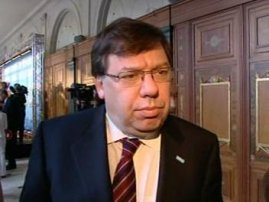
Jack O'Connor (right), the General President of Ireland's largest trade union SIPTU, said "the ESRI has become a mouthpiece for the policies of the establishment".

In a statement, he argued that "pay cuts will solve nothing". "They will actually exacerbate the downward trend by further reinforcing the deflationary spiral," he added.

05 June 2009

Highest Unemployment Rate ever - now 11.8%

The number of people on the Live Register (of the unemployed) has passed the 400,000 mark for the first time last month.

On a seasonally adjusted basis, there are now 402,100 people in the Republic of Ireland seeking unemployment benefit or allowances.

It is the first time the numbers on the dole have ever reached this level and translates into an unemployment rate of 11.8%.

More than 105,000 people were added to the Live Register in the first five months of 2009.

Earlier this year, the Economic & Social Research Institute (ESRI) in Dublin forecast that unemployment could even rise to 17% next year.

The Irish Congress of Trade Unions (ICTU) says that the figures are "an indictment of failed government policies" and has called for "an immediate allocation of one billion Euros to protect and create jobs".

As much as that would help to stimulate the Irish economy, it is most unlikely to see our government spending any extra money at this time, as the Exchequer has just announced a budget deficit of currently € 10.6 billion (see my entry of June 3rd).

27 May 2009

Irish House Prices back at 2004 Levels

The latest index from the Irish Economic & Social Research Institute (ESRI) and permanent tsb bank reveals that house prices in Ireland have fallen by almost 2% last month.
This brings the prices for residential property back to levels not seen here since the summer of 2004.

On national average house prices have fallen by almost 5% in the first four months of this year.

According to this index, the average price paid for a house in April 2009 was € 248,640, compared with € 261,573 in December and € 311,078 at the peak of the property bubble in February 2007.

Prices for the (usually least expensive) houses in the 'first-time buyer category' are falling at the fastest rate and are down 7.9% already this year.

"This is the fastest rate of decline in national prices that we have seen to date since the index started in 1996," says Niall O'Grady of the permanent tsb bank, one of Ireland's major mortgage lenders.
"The particularly dramatic reduction in prices for first-time buyers reflects their reluctance to buy in a market that is still declining and where unsold properties are being reduced further."

Meanwhile several leading economists and independent analysts are predicting that property prices in Ireland will continue to fall "for at least another 12-18 months".

The Emerald Islander

07 May 2009

New ESRI Study reveals Discrimination against People with non-Irish Names

A recent study has found clear evidence of discrimination by Irish employers against people with non-Irish names.

The Economic and Social Research Institute (ESRI) in Dublin conducted this new research into the treatment of Irish and non-Irish job applicants.

As part of the study the researchers sent out 500 CVs in response to job advertisements.
Pairs of CVs with matching details but different names were sent in response to 250 jobs ads.
The two fictitious applicants for each job had identical qualifications, skills and experience. But those with common Irish surnames were more than twice as likely to be called for an interview than people with foreign sounding names.

According to the ESRI's team of researchers, the level of discrimination revealed in Ireland is high, compared to other countries.

Richard Fallon from the Equality Authority said that the findings point to "a needless loss of opportunity" if employers do not look at the skills behind names on job applications.

What the ESRI found out by sending fictitious job applications to Irish employers is no news to me. As my father was from Belgium, I have a surname that looks 'foreign' to most Irish people. And I have experienced discrimination by Irish individuals and institutions over many years.

Employers are only one element of the spectrum. Government offices, TDs, local authorities and their various sub-offices as well as individuals have treated me less favourable than friends and neighbours with typical Irish surnames. And it is still going on.
Almost every day the question I am asked most often by Irish people, after I introduce myself, is: "Where do you come from?"
No-one called Brennan, Hayes, Murphy, O'Neill or Ryan - to mention but five of the typical Irish names - will ever be asked such a question.

But this is only the tip of the proverbial iceberg. In the past I was refused benefits to which I was entitled like anyone else, my name disappeared mysteriously from lists on which it had been put in my presence, and it happens ever so often that some weird people simply abuse me verbally for being 'foreign', without any particular reason.

Among my friends and acquaintances are several individuals with 'foreign' names, and they had and have similar experiences as I do. An interesting example are two couples I know rather well. In both cases one of the partners is Irish and the other foreign, and they live in the same area of the same Irish town.
The Irish wife of my Austrian friend does experience more discrimination than the German wife of an Irish friend. So - just as the ESRI found out in their study - surnames do play a role in this.
I wonder if this only goes for obviously non-Irish surnames, or also for foreign names that came into Ireland in the past with various waves of migration, such as the Normans or the Huguenots.

But there is another element in regard to job applications that annoys me immensely. Every week thousands of people in Ireland answer job ads and send applications to companies, public offices and organisations. And only very few of them ever receive a reply. This, in my opinion, is rude, arrogant and uncivilised.

In several other EU countries there are rules (and even laws) that entitle any job applicant to a reply, and if it is only a three-line letter saying that the application is not successful. Thus people know where they stand and are treated fair and humanely.
In Ireland there are no rules, so most people never hear anything from potential employers they wrote to. They never know if their letters were actually received and read, and if so, why their job applications did not succeed. This should no longer be tolerated.
And if it needs a new law - in case employers' organisations are unwilling to introduce the matter as a common rule to their members - then we should have it.

The Emerald Islander

05 May 2009

EU makes bleak economic Predictions

Today the European Commission has released its latest economic predictions in Brussels.

According to its calculations, the EU economy overall is expected to shrink by 4% over the next year, with unemployment reaching 11.5%.

The Irish economy will, based on EU calculations, shrink by 9% this year. This is clearly (by 1.3 points) higher than the prediction Ireland's Finance Minister Brian Lenihan gave. In his budget speech last month, Lenihan announced a contraction of 7.7% for the domestic economy.
However, the Dublin-based Economic & Social Research Institute (ESRI) has forecast only a week ago (see my entry of April 29th) that Ireland would have economic contraction of 9.2% (1.5 points more than Lenihan's view, and 0.2% more than today's EU prediction).
Whichever figure - if any - is correct, only time can tell. But the general outlook for the EU, and in particular for Ireland, is pretty bleak.

"We are no longer in a free-fall, but even if some positive signals are now appearing, we do not have the critical mass of data to say that we are out of the woods," declared Joaquin Almunia (right), the EU Commissioner for Economic and Monetary Affairs, in a press briefing this morning.

The Commission says that there will be "a modest recovery" in the second-half of 2010, but "unemployment in the EU will rise sharply" with the disappearance of approximately 8.5 million jobs throughout the union.

At the news conference in Brussels Commissioner Almunia commented that Ireland's recent supplementary budget was "a step in the right direction".

Speaking also in Brussels, where he attended a meeting of finance ministers from the Eurozone, Brian Lenihan (left) said that "forecasting is not an exact science" and that the "performance of Ireland's export sector is encouraging".
Such pearls of wisdom from the political art of saying nothing are now the standard of 'information' we get from our government, which is ever more in disarray and under siege ever since it lost the referendum on the Lisbon Treaty eleven months ago.
A little more truth and clarity would be welcome, but then again, one should not expect too much from a Fianna Fáil politician.

The Emerald Islander

29 April 2009

Unemployment Figure now close to 400,000

New figures from Ireland's Central Statistics Office (CSO) show that the numbers on the Live Register (of unemployed people) rose sharply again this month.

The headline figure for April 2009 stands now at 384,448, an increase of just over 13,000 from March, and almost double the figure for the same month last year.

The seasonally adjusted figure rose by 15,900 to 388,600 in April. The increase is made up of 9,300 men and 6,600 women.

But things in Ireland are bound to get a lot worse (before they might - hopefully - get better again).

The latest report from Dublin's Economic and Social Research Institute (ESRI) forecasts the loss of a further 300,000 jobs in Ireland before the end of next year. The ESRI also expects that the rate of unemployment will average 17% in 2010, a rate already reached now in Spain.

In its most downbeat economic assessment ever, the ESRI also expects that by the end of next year living standards in Ireland will be 15% lower than in 2007.

The ESRI report also predicts that our economic output will shrink by 9.2% this year. This contraction in the economy is significantly bigger than the government assumed in the 2009 Budget.
The report forecasts that the government will lose an additional € 1.3 billion in tax receipts this year.

The ESRI says it is fearful that any further increase in income taxes will make it even harder for employers to achieve wage cuts, which it says are vital to restoring the overall competitiveness of our economy.

08 October 2008

ESRI predicts a long and hard Recession

The Economic and Social Research Institute (ESRI) in Dublin had to revise its earlier economic forecast further downwards, predicting now that the recession will extend at least until the end of 2009.

The latest quarterly report from the ESRI predicts that the Gross Domestic Product (GDP) will contract by 1.3% this year and shrink by a further 0.7% in 2009.

The rate of unemployment in Ireland is expected to rise from 6% this year to 8% in 2009, when employment is predicted to fall by 47,000.

The ESRI says that uncertainty surrounds the forecast and warns that "further downward revisions may have to be applied".

The continuing recession is largely the result of the housing downturn and also points to falling consumer spending, the report says.
This is expected to be followed by a downturn in commercial building next year, along with a fall in government spending on goods and services.

The report warns that "weak international conditions leave little scope for external demand" to pick up the slack.

The ESRI says that severe cuts in spending and tax increases are needed to stabilise a deficit which it predicts will reach 5.5% this year. It cautions that the cuts will themselves contribute further to the economic downturn.

24 June 2008

ESRI declares: We are in Recession

The Economic and Social Research Institute (ESRI) in Dublin has declared that Ireland is "in the grip of an economic recession for the first time since 1983".

Economists are warning that government borrowing will exceed EU limits next year if public spending growth is not curtailed to historically low levels. The massive public finance surplus, on which the government has based its election promises in 2007, will be all gone by next year.

In its latest Quarterly Commentary ESRI forecasts that unemployment in Ireland will exceed 7% of the labour force by the end of this year and that public finances will deteriorate sharply.

The authors of the report say that this raises the prospect of a return to net emigration for the first time since the 1980s, with the numbers having to leave the country to find work exceeding those coming here by about 20,000 per year.

The report includes the ESRI's fifth successive downward revision to its outlook for this year. It says the impact of declining consumption, slower exports, the building slump, and the massive international credit crisis have been much worse than feared.

ESRI expects that economic activity will now fall by 0.4% and disposable income by 2.6% this year, the first annual reductions since 1983. The implications are stark.

But speaking on RTÉ Radio's Morning Ireland programme, report co-author Dr. Alan Barrett said that the prospects of getting out of this recession are better than those of the 1980s.

The ESRI argues that the government should break European rules and borrow € 11 billion to run the country next year. It says pay restraint must be imposed in the public sector, and it calls for state agencies to do more to help the unemployed.

14 May 2008

ESRI predicts good Future for the Irish Economy

The Economic and Social Research Institute (ESRI) in Dublin has announced that the Irish economy "remains resilient" and that it will eventually rebound to grow at about 3.75% per year in the medium term. The institute warns that there is a danger that Irish society could "become transfixed by the very real economic difficulties" and miss the opportunity to plan for a better future in the next decade. It insisted that the current downturn in the economy will not inflict any lasting damage to the country's long-term growth potential.

ESRI makes it clear that it remains upbeat about the country's economic prospects despite the current slowdown.
It has conducted its latest two-yearly medium-term review of the economy and taken all issues into account, including the downturn in the housing market, the global financial turmoil, the potential recession in the USA, and the state of Ireland's public finances. It says that it still believes the Irish economy remains fundamentally sound, and is well placed to bounce back when the global situation improves.

Ireland has become very good at selling services abroad, and this is the key reason why it is well placed to recover when the global downturn is over. The institute's findings show that Ireland has developed a comparative advantage in the supply of financial services, computer and IT services and other business services and it expects almost 240,000 additional service sector jobs by 2015, provided competitiveness is maintained.
It says these jobs will more than compensate for about 70,000 expected job losses between agriculture, manufacturing, construction and public utilities.

It also says that demand for housing will remain strong with 48,000 new houses per year still required until 2020. The review warns, however, that although greenhouse gas emissions will be reduced substantially as a result of a new carbon tax, Ireland will still miss its emissions targets by a considerable margin.

The researchers also point out that it is "important for the government to move fairly rapidly to introduce some form of congestion charging" if good value is to be obtained from the huge investment in infrastructure that is now taking place.

30 April 2008

Irish Consumer Confidence at a record Low

The Irish Consumer Sentiment Index (CSI), compiled every month by the IIB Bank and Ireland's Economic and Social Research Institute (ESRI) in Dublin, fell to a record low of 56 in April, down from 63.3 in March. The CSI measures the general mood among Irish consumers.

David Duffy of the ESRI blames the drastic fall on concerns about job losses, rising prices and the gloomy outlook for the property sector.

The Index of current economic conditions also dropped - from 83 to 75.1 - while the forward-looking index, which covers expectations about the coming months, was down from 50 in March to 43.1 in April.

IIB Bank's economist Austin Hughes said the survey details indicated that people were more worried about the general economic climate than about their own personal finances.
"This may suggest that consumers have braced themselves for a difficult period, but are not experiencing acute problems," he added and explained that 88% of those surveyed expected unemployment to rise in the coming year, the highest figure in the survey's history.