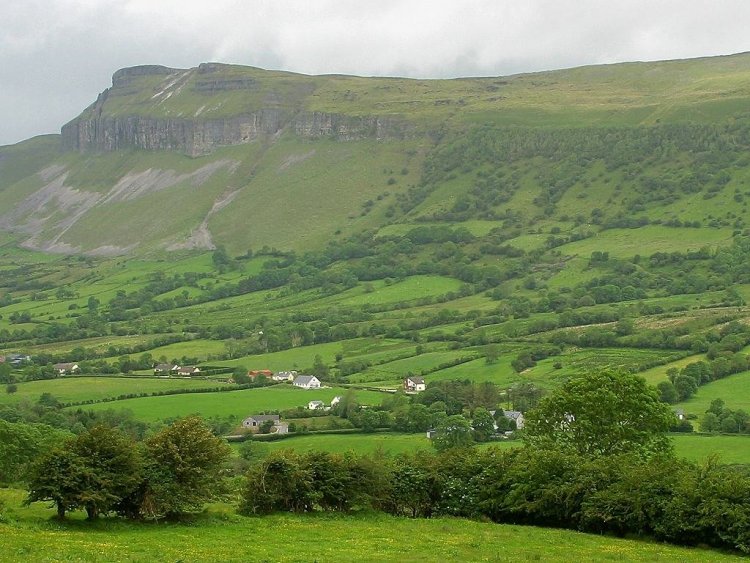
"Sumer is icumen in..." sang a group of traditional Celts this morning when they went out in procession to a hill in the county which has been a place for Celtic celebrations since ancient times. There, in the centre on a prehistoric stone circle, they lit the traditional Bealtaine fire and performed the age-old rituals to welcome the Summer to this island.
At first there were worries about the weather, since we had a few hours of rain early in the morning. (And even weather-hardened traditional Celts find it more enjoyable to celebrate in sunshine than in rainy weather.)
But then, just before the procession was to start, the rain stopped, the clouds disappeared under a fresh morning breeze, and within the hour we were graced with lovely sunshine and a mild and pleasant day. (In the afternoon the temperature rose to 16 C, which is the highest temperature we had here so far this year.)
 Last night the same group of Celts had gathered at another sacred ancient spot in the countryside for the traditional Bealtaine bonfire that is lit before midnight to ward off evil spirits and burns long into the new day, to show the incoming Summer the way to Ireland.
After this morning's celebrations people were going home to hang freshly cut May Boughs on the doors and windows of their houses and to erect the traditional May Bushes in their farmyards. The preferred trees for these decorations are caorthann (rowan or mountain ash) and sceach geal (hawthorn or whitethorn).
In the traditional Celtic calendar Bealtaine, celebrated on the first day of May, marks the official begin of Summer. In ancient times there were many hundreds of bonfires lit on this day - and in the night before - all over Ireland, predominantly on prominent hills and sites of special spiritual importance. The main Bealtaine fire was always lit on the central hill of Uisneach, 'the navel of Ireland', one of the most sacred ritual centres, situated in the Royal Province of Meath (now Co. Westmeath).
But the tradition of celebrating Bealtaine goes back much further than the Celtic settlement of Ireland between 300 and 200 BCE. It marked the beginning of Summer already for the Tuatha Dé Danann and the Milesians, the ancient people of Ireland who populated and ruled this island for thousands of years.
When the Celts arrived, their superior weaponry (in contrast to the ancient people the Celts had the knowledge of iron and used mostly iron swords and spears) made them soon the dominating power and the masters of Ireland. But they accepted and adopted many of the existing rites and cultural elements and blended them into their own rich traditions.
So when we celebrate Bealtaine today, we see it as a Celtic festival, but in fact we are following much more ancient traditions, established by people who arrived in Ireland more than 10,000 years ago. There was a strong bond between those ancient people and Nature, whose immense force and power they respected and worshipped.
Today's celebrants are of course modern people, who live in modern houses, drive cars and have normal jobs. But the deep respect and reverence for Mother Earth and the forces of Nature have survived and are parts of daily life for many Irish people who follow the Old Path.
The well-known round-song "Sumer is icumen in" is probably the oldest piece of music in this part of the world. Its age can only be guessed, but it is clearly of Celtic origin. The oldest surviving manuscript (see above) giving us the text (in medieval English) and music of it dates from 1260. But as all the old lore, stories and songs it was passed on - by word of mouth - from generation to generation for centuries and probably millennia. And when we sing it today - still using the medieval words (although there are translations into modern English) - we feel close to all our long gone ancestors who sang it before us since time immemorial.
Sumer is icumen in,
Lhude sing cuccu!
Groweþ sed and bloweþ med
And springþ þe wde nu,
Sing cuccu!
Awe bleteþ after lomb,
Lhouþ after calue cu.
Bulluc sterteþ, bucke uerteþ,
Murie sing cuccu!
Cuccu, cuccu, wel singes þu cuccu;
Ne swik þu nauer nu.
Sing cuccu nu. Sing cuccu.
Sing cuccu. Sing cuccu nu!
I like to take this opportunity to wish everyone - here in Ireland and anywhere in the world -
Bealtaine Shona,
a happy and warm Summer full of joy, and for whatever you do the best of luck!
The Emerald Islander