Showing posts with label social welfare. Show all posts

29 June 2009

Child Benefit is Lenihan's next Target

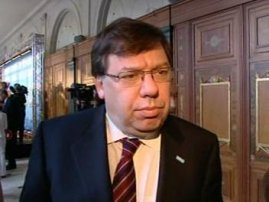
Mary Hanafin (left), the Minister for Social and Family Affairs, has confirmed that the Irish government will soon "reduce the amount it is spending on child benefit payments".

In future the payments are to be either means-tested or taxed, but a decision which of these two options would be more appropriate has not been made yet.

The matter will eventually be decided by the Minister for Finance, Brian Lenihan (right), who is currently more than € 10 billion short of his budget and has to find at least another € 4 billion in savings and spending reductions this year. It is expected that he will wait with his decision until he has received a report from the Commission on Taxation, which is due shortly.

According to Mary Hanafin the universal child benefit is costing the State € 2.5 billion per year. And since child benefit is so far paid to every mother who has a child or children, regardless of income and social status, the scheme is a natural target for Brian Lenihan.

Politicians from different parties and various interest groups have openly criticised the 'free for all' child benefit in the past, making the point that it is also paid to people who are certainly not in need of it (like millionaires and very well-off professionals and civil servants).

Social conservatives have also remarked that the generous payment of child benefit - regardless of circumstances - is one of the main reasons for the high rate of unmarried young mothers and teenage pregnancies in Ireland.

Although I would not regard myself as conservative, I agree with this point. In fact, I would go much further than the government is contemplating. I would abolish universal child benefit completely, and thus save the State at least € 2 billion per annum.

The idea of child benefit payments is a relatively recent addition to the government's social welfare budget, and it is a fact that there was never a shortage of children when there was no child benefit available from the State. Quite the opposite, actually, as birth rates were much higher in the past than they are now.
And somehow most of the children born without the taxpayers' financial assistance were brought up without problems. There were a lot more stable families in the past, and much less unmarried young mothers and teenage pregnancies.

So it could well be argued that child benefit, initially intended to support mothers on the lower end of the social scale who were really struggling to make ends meet, has become an unintended stimulant for less stable families and a lot more single mothers who can live quite comfortably on a combination of social welfare, child benefit, housing benefit and various other benefits available to them.

There are plenty of girls and young women in Ireland who see an early child as their ticket to social and financial security. Most of them come still from the lower end of the social scale, and many are poorly educated. When they leave school, there are few jobs or careers open to them. They might find a low-paid job in a supermarket, but that would pay them less than they can make on state benefits, if they have at least one child.

I know plenty of such cases here, and not far from where I live there is a communal housing estate with about twenty houses, all of which are occupied by single mothers and their children. The rent they are charged by the Council is minimal, and if they play their cards right, they can receive additional benefits in kind, such as a certain amount of free electricity and telephone units each month, a free TV licence (which costs € 162 per annum for other people) and a winter fuel allowance for the cold half of the year. Some have even managed to get free bus passes.

For these women having children out of wedlock has become a very profitable 'business', and usually they have a few children by different fathers before the age of 30. Apart from various visiting boyfriends there is hardly ever a man to be seen in that housing estate, and not one of the women is in a stable relationship.

I am no moralising prude and have no problems with women who have children out of wedlock. But I do resent that I - and all the other Irish taxpayers - are made to pay for it. Every weekend one can see scores of these single mothers flocking to the various bars, discos and night clubs in the city, scantily clad and with plenty of money to spend on their weekly 'big night out'.
Personally I am not interested in that sort of lifestyle, and I don't take alcoholic drinks. But even if I would be attracted by it, as a hard-working single man I could not afford such extravagance on a regular basis.

So I do think that the abolition of universal child benefit would do a lot more good to our nation and society than it would cause hardship to some. Those mothers who are in real need should of course be supported by the State. A means-tested child benefit, integrated into the normal social welfare scheme, could take care of that.
And it would cost the State not more than € 500 million a year. Which means that by making such a clean cut, Brian Lenihan would have already half of the sum he needs to save this year.


There would most likely be an outcry from certain quarters, such as radical feminists, ultra-liberals and various soft-minded do-gooders. But that would not be for long, especially if the State is fair with mothers who really need help, but firm with those who use child benefit payments to finance their fashion clothes, fancy shoes and the weekly 'big night out'.

Due to the recession and the massive increase in unemployment in recent months Ireland's social welfare payments have increased "very significantly", as Mary Hanafin put it. There are now many families, as well as single people, for whom the bare survival depends on the weekly payment of basic social welfare. These payments cannot be reduced, unless the State wants to risk widespread extreme poverty, social unrest and a serious increase in petty crime.

On the other hand it is quite clear that the current social welfare budget of € 21 billion per annum is - as the Minister stated - "just too much" for Ireland in the current economic crisis.

Child benefit is not only the most obvious and logical target for a spending cut, it is also the most fair from an overall perspective. If people want to have children, it should be their responsibility to look after them and pay for their upbringing and education. There is absolutely no reason why people who are childless should pay for the children of other people.

Children are a blessing, and childless people often suffer enough emotionally and mentally from the fact that they are without offspring. It is extremely unfair to burden them financially with children other people produce in a carefree or careless way, expecting the State to pick up the bill for decades to come.

In the housing estate I mentioned above there is a 'family' of women, consisting of meanwhile three generations of unmarried mothers and their children. The head of this 'family', a woman in her late forties, had four daughters out of wedlock, each by a different father. Her eldest daughter, now in her early thirties, has three daughters out of wedlock. And her eldest has just given birth to her first child - another daughter - at the age of 15!
None of them was ever married or in a stable relationship. And none of them has ever worked a single day. All they do is to live a rather comfortable and secure life, have children out of wedlock, and expect the State to pay for it all.

I don't want to give the impression of being too harsh, but in my opinion this all-female 'family' is nothing but a bunch of feckless parasites.

Abolish universal child benefit, and they might well be forced to live forthwith in the real world. They might still carry on with their immoral and selfish lifestyle, especially as they are by now so used to it, but at least Ireland's taxpayers would no longer be forced to finance it.

As regular readers of this weblog know, I am not a friend of the current Irish government. But if Brian Lenihan and Mary Hanafin have the guts to abolish universal child benefit, I would be the first to applaud and congratulate them.

The Emerald Islander

03 December 2008

Unemployment Rate in Ireland reaches 7.8%

The latest unemployment figures from the Central Statistics Office (CSO) show another record number of Irish people signing on to the Live Register in November.

16,900 people signed up for unemployment payments or Social Welfare credits last month. This brings the total to 277,200 - the highest level since September 1996.

In the year to November, the Live Register saw an unadjusted increase of 106,864 - a jump of 66.1%. This compares with an unadjusted increase of 94,502 or 60% in the year to October.

The figures released today show that another 13,600 men signed on the Live Register in November, reflecting the ever slowing construction industry. There was also an increase of 3,300 women.

The CSO says that the standardised unemployment rate in November rose to 7.8% from a rate of 7.4% in October.

15 October 2008

Charity and Poverty begin at Home

I am sure you will be familiar with the old saying that "Charity begins at home". And that is as it should be. Unfortunately during the years of the so-called 'Celtic Tiger', the massive and unexpected economic boom Ireland experienced over the past decade, many Irish people were so enticed with our newly found - and, as it turned out, very short-lived - wealth that they forgot this important principle.

With our natural generosity and enthusiasm we got involved in all sorts of charity projects around the world, and especially in Africa. We send food aid worth many millions of Euros to Ethiopia (and some other countries), and that saved a lot of lives. But it did nothing to change the situation there, and we are asked to donate ever more money, to send more and more food again and again. An old Chinese proverb comes to mind, when I look at Ethiopia and other African countries in turmoil and chaos: Give a man a fish, and he has food for one day. Teach him fishing, and he will never starve again.
Irish charities either don't know this proverb, or have not taken it to heart. Because all we do is giving the Ethiopians a fish a day, every day. Thus they survive, and in fact the population of Ethiopia has more than doubled in the past twenty years. But they are still not able to look after themselves and feed their own people, because we - and other western charities - never bother to 'teach them fishing'.

There is a long tradition of collecting money for Africa here in Ireland. And it was not started by the likes of John O'Shea (of GOAL), Bob Geldof and Bono (of U 2).
Many people of my generation will remember the Catholic nuns and Christian Brothers, who ran the schools here in the past, urging us to part with the few pennies we had as pocket money and donate them for "the poor black babies in the African missions".


Many of us did, believing in our innocence that we did something good and would make a difference. In recent years we learned that only a portion of our donations ever reached Africa, and was mostly spent on short-term help. No-one seemed to have looked at the bigger picture and long-term prospectives. Subsequently nothing much has changed in Africa, and in fact things are a lot worse there now than they were some decades ago.

Meanwhile many of those former "black babies" are now grown-up adults and here in Ireland, attracted by the great wealth the 'Celtic Tiger' promised everyone, native Irish and foreigner alike. Some are true refugees and in need of our help and support. But the vast majority are economic migrants, pretending to be persecuted at home and thus benefiting from our generous asylum programme. I see many of them every day, well fed and well dressed (often much better than the average Irish people), talking almost constantly on mobile phones and driving around in nice cars, many of which were given to them by Ireland's social services. They are enjoying to be here and have, to use an old Irish phrase, "the life of Reilly".

I am not envious and wish them no harm. Quite the opposite. As a member of Amnesty International for more than 30 years I have worked with countless refugees, including many Africans. And I still do. But what I see more and more is that the really deserving people, those who have suffered and often only narrowly escaped terrible regimes at home, are marginalised by the (Irish) State, which seems to favour well-off West-Africans (predominantly Nigerians) who are here to milk the system. Many of them did not even come directly from Africa, but have lived for years - and often all their previous life - in the UK, where they did the same. The 'Celtic Tiger' and the more generous welfare payments the Republic of Ireland offers (compared with the UK) attracted many thousands to the Emerald Isle. They are in receipt of help and benefits that no Irish person, no matter how needy, and no foreigner from any European country has ever received. Enquiries why that is the case are leading nowhere, as the civil servants in the social welfare department refuse to "comment on individual cases". And politicians say nothing as well, in fear they might be called "racist" by some if they utter a critical word in this matter.

So while we still send many millions of Euros to Africa every year, and spend even more millions on over 100,000 Africans now living in Ireland, thousands of Irish people in deep poverty have been forgotten. Many of them are old or elderly, have medical problems, and most of them live alone, in tiny little houses or flats that have not been renovated for decades.

Yesterday our Minister for Finance - Brian Lenihan - dealt these people another devastating blow by announcing in the 2009 Budget that he is to withdraw the right to a medical card (which guarantees free medical treatment) from all people aged 70 and above. (see also yesterday's entry)
Seven years ago the free medical card for the oldest portion of our population was introduced before an election, and it has made a big difference for many of the most needy people.
They are now distraught and have no idea how they will be able to afford medical treatments in future.

But this is only the tip of the iceberg. There are at least 200,000 people in Ireland who live in fact on or even below the poverty line. They are all at least over 50, and many of them are over 65. While the latter receive an old-age pension, the younger ones are usually unemployed and receive only the most basic benefits. Those between 50 and 65 have almost no chance to find a job in a country that is so massively dominated by the young, and many have disabilities and other medical problems that makes it even more unlikely to be employed.

These people are the forgotten poor of Ireland, a whole generation ignored by their own government and nation. For the past decade they have been living in the shadow of the 'Celtic Tiger', who never even touched them once. While our reckless bankers squandered the nation's savings and pocketed millions as 'bonuses' in the process, greedy stock brokers messed up the financial markets with ever more dubious and risky gambling on worthless shares, and ruthless property developers created - with the help of the government - an irrational and unsustainable housing bubble, the poor of Ireland were ignored and forgotten.

Now that we are in recession and global financial meltdown, they will suffer enormous hardship, without the slightest chance of help from the government or anyone else. The Finance Minister - backed by the Taoiseach and the whole Cabinet - is squeezing the ordinary people for extra taxes. He has nothing left in his coffers that he could offer to the poor, even if he wanted to (which is very unlikely anyway).
And our many charities - with the noble exception of the Society of St. Vincent de Paul - are focused on Africa and don't take any notice of the enormous poverty in Ireland either. In fact, I have seen it so many times that 'charity muggers' on the streets are even trying to talk money for Africa out of these poorest of the poor.

To illustrate the situation in which many poor Irish live, let me give you one concrete example. There is a man living not far from me, and through my own involvement in local charity work I happen to know his circumstances very well.
He is in his mid-fifties, single, childless and an unemployed printer. For many years he worked in one of the well-known printing companies in Waterford, until he was made redundant during a general modernisation process that brought in new machines that require less manpower than the ones used previously. For years he has tried to find work - as a printer or in other industries - but no-one here is interested to employ a man over the age of 50.

Since he never married and has no children, he is entirely on his own. And being a single male, he only qualifies for the lowest rate of social welfare. (All the welcome extras are only given to women and especially single mothers.)
He does not smoke or drink alcohol, and does not gamble either. "I don't like that," he tells me, "but even if I would like it, I could not afford it." Every week he receives about € 190 social welfare money, and this is all he has. He has to pay € 100 rent per week, for the little old house he lives in. It is very old in fact, has no proper bathroom (only a tiny shower) and no central heating. After the costs for electricity and waste collection are deducted, he is left with less than € 50 a week to live on. This is scandalous, as it is not enough for a decent living. Most people spend more than that on one visit to the super-market, or on one meal in a restaurant.

No-one has ever offered him a council house, and when he applied for rent allowance, he was turned down without any explanation. He has as good as no social life, barely survives on meagre meals he prepares for himself, and the only place he goes to is the local library. He loves to read books, but could not afford to buy any. He has no television, no telephone and not even a refrigerator. A little radio and the books from the library are his only 'entertainment'.

Let me remind you: This is a man who has worked and paid taxes in Ireland for 30 years. He was for many years a member of the FCA (voluntary army reserve) and goes to mass every Sunday.
But not even the Church looks after him. "The only times I hear from the parish priest is when there is a special collection and an envelope is pushed through the door," he explains. In nearly four decades no priest has ever knocked on his door. But this is quite normal now, as parish ministry in Ireland is dead. The few remaining priests, most of them now elderly themselves, are no longer able to visit houses of parishioners between saying mass and playing golf.

During the past two years the prices for food, electricity, coal and turf have risen out of all proportion, while the social welfare payment only rose by a few Euros a week.
"I soon won't be able to buy enough coal for the winter," he says, grateful for the voucher from a coal merchant I bring him on behalf of a local charity. "And often it is a choice between heating the house or eating."
I am ashamed when I listen to that and wish I could do more for him. But I am not a rich man myself. So now and them I add a small banknote from my own pocket to the charity vouchers, but that is not more than a drop in the ocean.

There are many people like him. No-one in the social welfare office wants to know about their dire circumstances.
If he were an alcoholic or a drug addict, there would be special programmes he could join, programmes that cost the taxpayers millions each year. If he were mentally ill, there would also be special help. He would even receive some extra money if he were a criminal released from prison.

But he is just a normal and decent ordinary man, a "regular Joe" as they would say in the USA. And for normal people no-one cares. They are supposed to look after themselves, even if they have not a chance in this world or the next.

In the street in which he lives there are now six African families, living in council houses. Before they moved in, the city council spent a lot of money to modernise and refurbish the houses. The Africans pay no rent - as they are seeking asylum - and receive all kinds of social welfare and other payments. They all have a second-hand car, paid for by social welfare, which also covers the costs of insurance, road tax and petrol.
The Irishman I told you about has no car, and would never get one from social welfare. He has not even a bicycle, and as he is under 65, he does not qualify for a free travel pass for public transport. So he is trapped in a little old house that has not been renovated since the 1950s, and completely forgotten by the State, the government and most of the rest of us.

There is nothing wrong with helping the Africans who come here, but it is a scandal that the same help and care offered to them is not also given to the poorest of the poor in our own native population.
Let me remind you just once more: Charity begins at home. And so does poverty. If we ignore this fact then we do it at the peril of losing touch with reality. With the recession being upon us and ever more jobs being lost everywhere and every day, anyone of us could be in a similar situation as the man I introduced to you above.

As much as overseas aid and help for the foreigners living here are necessary, we should never forget our own people. Ignoring one's poor neighbour while feeling good about helping the poor in Africa is at best cruel, but often hypocrisy. Don't let it come to that, and keep your eyes open. When you do, you will soon see the people I refer to, and you can do your share of charity, right here at home, where it begins.

The Emerald Islander