23 June 2009

Heavy Rainfalls cause Flash Floods in Donegal

Heavy rainfalls and thundery showers in the Northwest of Ireland have caused some serious flash flooding in parts of western Co. Donegal.

While the day was warm and sunny in most parts of Ireland, an unpleasant micro weather system developed over the Northwest and caused these quite rare conditions.

According to local reports the rainfall was so sudden and heavy that the normal drainage systems could not cope with it and water was soon running down the main roads.

Several rivers in Co. Donegal also were overwhelmed and burst their banks, leading in some parts of the county to sudden flash floods of up to six feet.

According to the Garda and regional emergency services about 20 houses and several commercial buildings were damaged by the floods.

Ireland's Food & Drink Industry in Decline

About 2000 jobs have been lost in Ireland's food and drink industry since the start of this year and thousands more are currently at risk.

According to a new report, the competitive position of some firms has been "damaged by high business costs and a fall in the value of [the British] Pound Sterling against the Euro".

A key problem for the industry are massive energy costs, which are 20% higher in Ireland than the average paid anywhere across the EU. Industrial electricity prices here have increased 70% since 2001, and 36% across the EU.

More than 40% of Irish food exports go to Britain, but as the Pound Sterling has fallen in value by 30%, this reduces both turnover and profit of Ireland's food products sold to our nearest neighbour.

The report argues for new and special financial supports for Irish companies selling into the UK.

It claims that food and drink production and processing is Ireland's most important indigenous sector with 230,000 incomes directly depending on its future health and stability.

The report also points out that the top three grocery chains control more than 70% of the Irish market. Thus the bargaining power of retailers - especially the big ones - is much higher than that of suppliers.

It calls for the appointment of a 'Supermarket Ombudsman' and a code of practice to protect Irish food suppliers from what it terms as "unfair commercial practices".

Reacting to the report, Tánaiste and Minister for Enterprise, Trade & Employment Mary Coughlan (photo) said she had asked the national Competition Authority to investigate the real costs of doing business in Ireland.

That really says it all, plain and simple. She hasn't got a clue!

If she had any idea of her own department and the matter it deals with, she would well know what is going on in Ireland's shops and supermarkets.

I am no genius or minister, but I do not need to ask some faceless and unelected quango. Every time I go shopping I know within a few minutes who is making the money in Ireland and what is going on in the food industry.
Anyone can do the same, including Fianna Fáil ministers. But the problem with Mary Coughlan is that she has neither any personal interest in the matter, nor much intellectual capacity to deal with anything of importance.

Erin go broke, Paul Krugman would say (see guest column of April 23rd). But 'the Cow' Mary Coughlan never gives a damn, as long as she gets paid her high ministerial salary and is driven around the country like a fairy queen.

The rest of us are only here to pick up the bill and suffer...

The Emerald Islander

State paid € 13.7 Million to political Parties

Latest figures from the Standards in Public Office Commission (SPOC), an independent body established in December 2001, show that the State has provided political parties in Ireland with € 13.7 million of special funding last year.

The parties shared € 5.6 million under the Electoral Acts and € 8.1 million in Party Leaders' Allowances.

In addition, each Independent TD received an allowance of € 41,000, while each Independent Senator got € 23,383.

Money from the state funding cannot be used for electoral or referendum purposes. It has to be accounted for by each party in statements to the SPOC. An exception is made for the Independent TDs and Senators, who do not have to provide Statements of Expenditure.

Last year the various Irish parties received the following sums in state funding:
Fianna Fáil - € 5 million
Fine Gael - € 4.3 million
Labour Party - € 3.1 million.
Sinn Féin - € 800,000
Green Party - € 740,000
Progressive Democrats * - € 450,00
* The Progressive Democrats (PD) are now defunct. But since they still existed last year - at least officially (although they were de facto already a dead party) - they did qualify for the annual state funding.

22 June 2009

Reshuffle of DUP Ministers in the North

Today the Democratic Unionist Party (DUP) in the North has revealed the details of its ministerial reshuffle, following some criticism of 'double jobbing' politicians.

The decision to restructure the currently largest Unionist party in the Six Counties had been taken already more than a month ago (see my entry of May 26th), but the actual details were only announced this afternoon. And it appears that there have been some internal changes of mind since the reshuffle was first mooted.

DUP deputy leader Nigel Dodds (left), who was expected to keep his post, is surprisingly stepping-down as the North's Finance Minister and will in the future concentrate on his position as an MP.
His colleague Gregory Campbell is - as expected - losing his job as Minister for Culture, Arts & Leisure as well.

Former UUP star MP Jeffrey Donaldson (right), who defected to the DUP when the UUP began to decline, will leave his job as the junior minister in the North's First Minister's office, a position he only took over 16 months ago (when he replaced Ian Paisley Jr. who had been forced to resign over a scandal).

Sammy Wilson (left), who had been expected to leave the Northern administration as well, will actually be promoted, swapping his currently held Environment brief for the more senior job of Finance Minister.

Nelson McCausland (right), a Belfast MLA, is appointed as the new Minister for Culture, Arts & Leisure, a rather sensitive job that is more difficult in a divided community like the Six Counties than one might assume.

Arlene Foster will keep her post as the North's Minister for Enterprise, and former Environment Minister Edwin Poots (left), who left the Northern cabinet some time ago under a cloud, is re-called to the front bench and re-appointed to his previous portfolio

The East-Belfast MLA Robin Newtown will replace Jeffrey Donaldson as junior minister to the First Minister.

The changes, which will come into effect after the current parliamentary term ends later this month, mean that the DUP has reduced the number of sitting MPs who also hold a minister's job in the Northern Assembly.

"I indicated at the time of my appointment as First Minister that I would make changes to the ministerial team during the summer of 2009," DUP leader Peter Robinson (right) stated during a press briefing in Belfast today.
"As a party we will continue to work in the interests of the people of Northern Ireland and I look forward to all our new ministers setting about the business of delivering for the community they serve."

Robinson and the new Finance Minister Sammy Wilson remain multi-function holders as MPs, Northern ministers and Assembly members. On top of that Wilson is also a member of Belfast City Council.

However, the DUP leader said that he expects his double-jobbing MPs to choose between sitting in Westminster or Stormont.

Today's move was made with some greater urgency than had been originally expected, predominantly as a result of the recent European Parliament election.

The DUP did win one of the three European seats available in the North, with Nigel Dodds' wife Diane Dodds (left) being elected as the party's new MEP. But overall the result was rather disappointing and the DUP vote plummeted from 32% (in 2004) to 18.2%.

Only time will tell if the new ministers will make any difference to the Northern administration. Somehow I doubt it.

The Emerald Islander

NBRU prepares for Strike at Bus Éireann

Ireland's National Bus and Rail Union (NRBU) is expected to serve a strike notice on Bus Éireann over the state company's € 30 million cost cutting plan.

This follows Bus Éireann's announcement that it intends - despite opposition from its own staff and trade unions - to implement the plan which includes cuts in services as well as redundancies, from Monday, June 29th.

The company says that its passenger numbers are "well down by 10%" and that it is now "losing more than € 500,000 a week". Thus it must address its financial situation "urgently".

Maybe it is because we live on an island, or perhaps it is just the ignorance of the management of
Bus Éireann and its parent company CIÉ - as well as their political master - that makes them so short-sighted and pigheaded. There is - to my knowledge - no public transport system in Europe that is not subsidised by the government of its country. This is seen as quite normal, a price well worth paying to provide proper public transport to all of a nation's people.

Even in Britain, where most of the public transport system was privatised under the last Tory government, subsidies are paid. (The only difference there is that the subsidy money from the taxpayers' contributions is now paid to private companies running a confusing system of many different 'franchises', while in the good old days the money went to a state-owned company.)

Only in Ireland politicians are daft enough to demand that state-owned public transport services have to make a profit, or at least not produce a deficit. They show again and again that they are completely out of touch with the rest of the nation, and have absolutely no idea of public service and public transport.
And - this has to be said - Bus Éireann's management is too spineless and self-serving to stand up to the politicians and make them aware of the realities on the ground.

Bus Éireann employs currently 2700 people, of whom around two thirds are bus drivers. It proposes to make 320 staff redundant, of which 220 are drivers.
And from July 5th it will "phase in" reductions or cuts in some services for which they say the demand is low.

Talks over the matter between Bus Éireann management and representatives of the NBRU and SIPTU (Ireland's largest trade union) were supposed to have concluded last Friday. However, on Wednesday the SIPTU delegates refused to attend, and thus the talks were cancelled.

SIPTU leaders accused Bus Éireann of failing to give details of voluntary redundancy terms, and to make permanent around fifty probationary drivers.

The NBRU will decide today what form of industrial action they intend to take, while SIPTU's position is not yet known. What is certain, however, is that we will see another summer with an industrial dispute in the nation's public transport sector.
Apart from the inconvenience this causes to all travellers, it will have a detrimental effect on the attempts to stabilise our dwindeling tourist numbers. Some years ago, when another strike by employees of the Irish railways lasted for most of the summer, it dealt a severe blow to tourism, which needed more than two years to recover from it.

It is bad enough that we are in a deep recession, made worse by the international financial crisis. But we Irish need to make things a lot more chaotic by creating industrial unrest on top of that. I think it was Jonathan Swift who said that if there is one Irishman roasted on a spit, it will surely be another Irishman turning the handle...
Seems that not much has changed since the days of the witty Dean and great satirical writer who gave us Gullivers Travels and the yahoos.

The Emerald Islander

UPDATE

As expected, representatives of the NBRU have this afternoon served a strike notice on Bus Éireann. SIPTU, which also represents bus drivers at the company, has warned management that it will ballot for industrial action as well if the proposed changes are implemented next week.

Milking is all they know...

Today the newly elected European Parliament debates agricultural matters in Strasbourg. And as there are always some of Europe's farmers protesting against something, there is of course a demonstration taking place outside the parliament building.

By now EU politicians are used to that. Europe's farmers have long learned to begin to complain before they begin to suffer. (I should know, as one of my grandfathers was co-organiser of the very first demonstration of farmers that brought hundreds of tractors into the centre of Brussels and parked them in protest outside the EU Commission building - many years ago.)

Currently the problem seems to be that dairy farmers are not getting paid enough money for their milk. Well, as farming is a business, they should simply demand more and refuse to sell below their production price. The supermarkets can well afford to pay a decent price for milk.

But perhaps we are producing too much milk as it is. One of the farmers interviewed for a radio programme today said that "milking cows is all I know". Maybe that is the problem. Inflexibility does not help anyone, and the millions of other Europeans who have lost their jobs recently as a result of the recession are certainly asked to be flexible and to adjust themselves to the needs of the market.

Is it not fair to expect the same from Europe's farmers? Why should they be treated always a bit better than the rest? And why should all of us have to pay good money to subsidise farmers who are no longer competitive (or whose products are no longer economically viable)?
With the abolition of milk quotas, which has already been decided, there is a chance of a totally new and re-structured Agriculture in Europe. The question is if our farmers will step up to the plate and take this chance as a positive challenge, or if they will keep sitting on their tractors and grumble until the cows come home and the EU's cheques are in the post.

Aside from the main business in Strasbourg there was a little incident today that made me smile. (Sorry, farmers, I just couldn't help it...)
About 100 Irish dairy farmers had hired two buses and were on their way to Strasbourg, where they wanted to join the demonstration against further cuts in the agricultural budget. But - as it happens - the Irish farmers never arrived at their destination.

Their buses were stopped on a French motorway. Not by Police or anxious EU officials, keen to keep them away. No, Eire's eager dairy farmers were caught in a trap of their own protest. Their buses were just two of the many hundreds - perhaps thousands - of vehicles French farmers brought to a lengthy standstill when they decided to go to a main motorway and block it, as an act of protest against low farming income.

A brain or two, plus a couple of mobile phones, could have avoided that or solved the problem. But then again, what can one expect from people who state that "milking is all I know"...

The Emerald Islander

Bogmen still ready for Strike Action

Trade unions at Bord na Móna (Ireland's state-owned national peat company) have deferred plans for strike action after a meeting with the management this morning. All workers will now be balloted this Thursday on new proposals from the company.

A picket was placed on some of Bord na Móna's production sites early this morning, but the industrial action has now been lifted until the ballot is held on Thursday in Tullamore, Co. Offaly.

The workers at the Bord na Móna peat bogs in counties Offaly, Westmeath and Longford had already voted in favour of strike action three weeks ago.

The dispute concerns some proposed changes to the payment system for the company's staff who are mainly harvesting the peat that is burned in three ESB power stations in the Midlands.
Without regular supply from the nearby bogs, the Edenderry, Shannonbridge and Lanesborough power stations would run into difficulties and might have to shut down if the strike action lasts for a longer period of time.

21 June 2009

Happy Solstice Celebrations

This year we have really been lucky with our Summer Solstice celebrations. As the Solstice is falling on a weekend, the number of people taking part in ceremonies and celebrations is much larger than it would be when the date is set in mid-week.
And fortunately the weather is currently quite good here in Ireland as well. (While last year most of our 'summer' was drowned out by constant rainfall and rather cold weather, this year both climate and temperature are so far back to 'normal' expectations.)

Many Celts gathered already on Saturday evening at stone circles and other suitable spots in the countryside and celebrated in a traditional way through the night. (All Celtic festivals start on the evening before the actual date, and the moment the new day begins - midnight - is always of special significance.)
Then, with the local time passing the 4 a.m. mark, Druids and Bards got ready and the groups of people assembled in closer proximity to them. Very slowly the sky turned lighter and lighter, announcing the arrival of the Sun on this Summer Solstice, the longest day of the year.

At precisely 4.58 a.m. BST the first ray of golden light came over the horizon, breaking through a slight set of whitish summer clouds and starting the main Solstice celebrations. This is always a special day, and in particular for those who respect and cherish the powers of Nature.

There are groups of Druids and Bards, Wiccans, Pagans and other traditional Celts all around Ireland, Britain and many continental countries out to celebrate and to welcome the Sun on this day of the greatest light.
Some do it on their own (as anyone can have a solitary Celtic celebration), while others join their neighbours, friends and fellow followers of the Olde Path in public gatherings and more organised and elaborate ceremonies.

The largest crowd always assembles at the world-famous circle of Stonehenge, in the county of Wiltshire in England, which has become a great international symbol for the revival of ancient traditions and Celtic culture (even though Stonehenge - like all the stone circles - is not of Celtic origin and was built more than 2000 years before the Celts arrived on these shores).
But in the same way as the ancient Celts accepted and adopted the Olde Path of the Druids, who were the guardians of lore and wisdom for thousands of years, so modern Celts are taking their symbols and gather at their sacred places to celebrate the powers of Nature and the passing stages of the year.

I like to take this opportunity to wish everyone - in Ireland or abroad - a very happy Summer Solstice. May the bright light of this day fill your life and shine for you at all times.

The Emerald Islander

18 June 2009

Are the Unionist Terror Groups in the North now ready to decommission their Weapons?

The Taoiseach has welcomed unconfirmed reports that Unionist terror organisations in the North have begun to decommission their weapons.

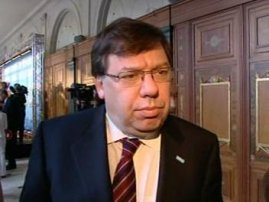
Speaking to RTÉ News, Brian Cowen (above right) stressed the need to wait for an official report from the Independent International Commission on Decommissioning (IICD), which oversees the process of putting terrorist weapons 'beyond use'.

The North's First Minister Peter Robinson (left) said that his party [the DUP] would "certainly welcome any move by the organisations to decommission their weapons and cease from their paramilitary activity".
"The DUP will continue to engage with these organisations in order to impress upon them the need to leave violence and criminality behind and to complete the decommissioning process," he added.

So far unconfirmed reports from the North suggest that the chairman of the IICD, the retired Canadian General John de Chastelain, has "witnessed decommissioning acts by two Unionist terror groups", the 'Ulster Volunteer Force' (UVF) and the 'Ulster Defence Association' (UDA). Those groups were responsible for the killing of about 1000 people - most of them Catholics and Nationalists - during the 'Troubles' in the North since 1969.

Making these pro-British terrorists, who had plenty of unofficial support from the British Army and the Northern security forces in the past, to give up their weapons has been one of the most serious and significant challenges of the still evolving peace process in the North of Ireland.

These groups of thugs and fanatics are not significant political players, and this factor has made persuading them to renounce violence all the more difficult.

However, for the best part of two years considerable efforts have been made behind the scenes to cajole and pressurise the Unionist terror groups to decommission.

General John de Chastelain (right), who oversaw the long decommissioning process of the PIRA (or IRA) weapons between 2002 and 2005, was in Belfast last month.
During that time the two main Unionist terror organisations - the UVF and the UDA - have apparently put weapons "beyond use".

According to the report, they have not yet decommissioned all their weapons, but are expected to continue with the process.

Sir Hugh Orde (left), Chief Constable of the Police Service of Northern Ireland (PSNI), hailed the possibility of Unionist decommissioning as "very good news".
"More guns are off the streets as a result of the decision by both the UDA, as I understand it, and the UVF."

The decision to decommission finally had "not come as a surprise", Orde stated. New legislation that [Britain's] Northern Ireland Secretary Shaun Woodward introduced earlier this year was giving the Unionists until August to decommission their weapons.

"I think the legislation put an additional pressure on these groups, and they have to make a decision," the PSNI Chief added.

Let us hope that the leaked - and as yet unconfirmed - news are true and will soon be verified by the IICD.

The North of Ireland has seen more than enough violence since 1969, and as the PIRA/IRA decommissioned its weapons already years ago, the Unionist terror groups - although officially on 'cease fire' - are the last obstacles on the path to a normal and civilised political system in the Six Counties.

The Emerald Islander

06 June 2009

Thieves used Digger to steal ATM

The combined fall-out from the global financial crisis and the severe recession here in Ireland is leading to ever more bizarre forms of crime. The latest case has been reported yesterday in the north-west of Co. Kildare.

There some ruthless thieves used a mechanical digger to steal a 'hole in the wall' cash dispensing machine (ATM) from a local restaurant.
The unusual raid took place in the early hours of yesterday morning at Mother Hubbard's restaurant in Moyvalley.

As yet unknown thieves stole a yellow digger from a nearby field, where it was parked, and drove it into the restaurant building, causing considerable damage as well as dislodging the ATM.

It is not known how much money was in the machine at the time, and the Garda Síochána (Irish police) is investigating this vandalous act of stealing money.

With no signs to an end of the recession and crime being rampant and out of control in Ireland, one can expect to hear of more cases like this in the future.

The Emerald Islander

05 June 2009

Highest Unemployment Rate ever - now 11.8%

The number of people on the Live Register (of the unemployed) has passed the 400,000 mark for the first time last month.

On a seasonally adjusted basis, there are now 402,100 people in the Republic of Ireland seeking unemployment benefit or allowances.

It is the first time the numbers on the dole have ever reached this level and translates into an unemployment rate of 11.8%.

More than 105,000 people were added to the Live Register in the first five months of 2009.

Earlier this year, the Economic & Social Research Institute (ESRI) in Dublin forecast that unemployment could even rise to 17% next year.

The Irish Congress of Trade Unions (ICTU) says that the figures are "an indictment of failed government policies" and has called for "an immediate allocation of one billion Euros to protect and create jobs".

As much as that would help to stimulate the Irish economy, it is most unlikely to see our government spending any extra money at this time, as the Exchequer has just announced a budget deficit of currently € 10.6 billion (see my entry of June 3rd).

04 June 2009

Dublin Taxi Drivers protest over Licence Fee

Taxi drivers in Dublin withdrew their services this morning in protest at a decision by the Taxi Regulator Kathleen Doyle (left) to increase the licence fee.

The cost to obtain an Irish taxi driver's badge has recently been raised from previously € 3 to € 250 (!!!), at short notice, without consultation and for no good reason.

Despite several public protests last month (see also my entry of May 9th), there has been no reaction and no sign of willingness to negotiate the matter from the utterly useless Commission for Taxi Regulation, which employs 23 people full-time for nothing else but to harass Ireland's taxi drivers and to make their lives more difficult and unpleasant.

So the four main taxi drivers unions told their members in the capital not to work today - the day before the European and local government elections - between 7am and 11am. This is the latest in a long line of strikes and protests Irish taxi drivers have staged in recent months to highlight their desperate situation. (for more information and details see my entries of March 5th, April 1st & 28th and May 9th)

The union leaders will later today hand in a letter at the Department of Transport. It is addressed to Noel Dempsey (right), our (most ignorant and incompetent) Minister for Transport, and will call for the resignation of taxi regulator Kathleen Doyle.

But as things are with Fianna Fáil ministers and their pet minions and cronies, I would think that Kathleen Doyle's job is quite safe.

Noel Dempsey has absolutely no understanding of transport, no interest in public transport, and most certainly no compassion for struggling taxi drivers.
I doubt that he will even read the letter addressed to him by the drivers' unions. For such menial tasks he has other minions, who will then write a meaningless three-line letter in reply.
Such is government in Ireland, and - sadly - in most other countries as well.

The Emerald Islander

03 June 2009

Irish Exchequer Deficit at € 10.6 Billion

Official Exchequer figures for the first five months of this year show that the Irish government is currently running at a deficit of € 10.6 billion.

While tax returns are sharply down on last year's revenue, the returns for May were broadly in line with the government's forecast in the Emergency Budget.

The extent of the slow-down in the Irish economy can be seen clearly in these latest Exchequer figures. Overall, taxes are down by 21% on an annual basis.

Stamp duty and capital gains taxes are down over 63.5% and 68.6% respectively, reflecting the almost total collapse of Ireland's property market.

VAT and excise duty rates are also down sharply, reflecting reduced spending in the economy, although excise duties came in a little better than the government had expected.

On the spending side, most government departments have kept their expenditure broadly in line, but it is nevertheless up by 2.9% on an annual basis.

But whatever happens in the real world, Taoiseach Brian Cowen (left) still lives on a planet of his own and says that he is "optimistic about the country's economic future".

Speaking at the National University of Ireland (NUI) in Maynooth, Co. Kildare, Cowen said his government was "determined to keep people at work and create new jobs in the IT area".

He regarded it as "encouraging" that today's tax returns were "on target".

Addressing IT specialists and academics during a lecture in Maynooth, the Taoiseach stated that "there are hopeful signs nationally that this recession is bottoming out".

In his usual brash and brusque manner, Cowen did however not stop to speak to reporters as he left the function.
This, as well as his strange statement, only underlines how much he is out of touch with the rest of the nation. No-one else here can see any 'hopeful signs' in the economy, and certainly not a 'bottoming out' of our recession.

In two days' time we will most likely see the unemployment figure pass the 400,000 line, and as Friday is also election day, the Irish people will show Cowen, his incompetent government and his rotten party what they think of the economy.

The Emerald Islander

31 May 2009

Galway Maritime Festival attracts large Crowds

About 150,000 people from all over Ireland and from abroad have come to Galway for this long weekend to attend the city's two-week-long maritime festival, which is organised to celebrate the stop-over of the 2008/2009 Volvo Ocean Race (see my entry of May 24th).

According to experts, the Volvo Ocean Race is 'the 6th-biggest sporting event in the world', and the fastest and most expensive sailing boats ever built are taking part in the 37,000 mile round-the-globe challenge.

The Garda Síochána appeals to motorists travelling west to allow themselves "considerable additional time for their journeys", as long tail-backs are expected on the roads to Galway.

Fáilte Ireland, our usually quite useless tourist board, says that it now believes the additional income from the festival will far exceed the € 43 million it had originally predicted.

Attendance figures will set new records for a maritime event in the West of Ireland, but they will not reach the numbers Waterford has seen four years ago, when we hosted the start of the 2005 International Tall Ships' Race. In only four days, during which we had 88 sailing vessels in port - including 28 famous class A ships (which are at least 40 metres long, but many are a lot larger) - Waterford registered more than 450,000 visitors to the city (which has only about 60,000 inhabitants).

In two years' time - in early June of 2011 - we will host the same event again and I am looking forward to it already in great and happy anticipation.

The Emerald Islander

30 May 2009

Ex-Policeman charged with trafficking Women

A former police officer in the North and a woman have been remanded in custody and charged with human trafficking and controlling prostitution.

The accused, who appeared at Belfast Magistrates Court this morning, are the former policeman Simon Dempsey (39) from Newtownards in Co. Down and Chen Rong (32), a Chinese woman with an address at Kidderminster, in the English county of Worcestershire.

Both are alleged to "have facilitated the arrival of people in the UK, knowing a sexual offence would be committed".
Or, in normal English: They are accused of having smuggled Chinese prostitutes into Britain.

Last Thursday police officers raided a number of suspected brothels in Belfast, Derry and Newry and liberated six Chinese women who had been forced by a Chinese criminal gang to work there as prostitutes.

The women are now being cared for by specialist officers from Britain's Serious Organised Crime Agency (SOCA).

Police opposed bail for both accused, because the detective said he feared that they would flee the country, and interfere with identified and as yet unidentified victims.

A solicitor for Chen Rong claimed that the accused had herself been a prostitute before "being used by sinister people", while Simon Dempsey's lawyer claimed that the Chinese woman "had duped him" and that in fact "he knew nothing about the women being used as prostitutes".

Looks and sounds as if the two of them rather deserve each other.

The Magistrate refused bail for both defendants, and they were remanded in custody until June 26th.

Fianna Fáil are likely to lose their Dublin MEP, while Labour Party could win two extra Seats

A new opinion poll, published in today's edition of The Irish Times, suggests that Fianna Fáil is in real danger of losing its European Parliament seat in Dublin.

It shows that public support for the Fianna Fáil MEP Eoin Ryan (left) has slipped by a further two points to now 9%, while his political arch rival, Sinn Féin MEP Mary Lou McDonald (right), is currently down by three points since the last poll and stands on 11%.

However, the Socialist Party's leader and ex-TD Joe Higgins (right) has gained two points and stands now on 9%, level with Eoin Ryan.
With only six days left until election date and public anger growing, Higgins could cause an unexpected upset in the Dublin constituency by winning a seat. (And if he fails, his transfers will certainly help Mary Lou McDonald a lot more than Eoin Ryan.)

The MRBI poll also indicates that the Labour Party might have a realistic chance to gain two extra MEPs.

Senator Alan Kelly (left) in the South and Nessa Childers (right) in the East are believed to benefit from the ever growing national support for Labour. The poll suggests that they are both within reach to win a seat and thus triple the Labour Party's strength in the European Parliament. (At present, Dublin MEP Proinsias de Rossa is the sole representative of his party in Europe.)

A separate TNS-MRBI poll in yesterday's Irish Times showed Labour as the only party to make significant improvements since the last poll a fortnight ago.

I wonder if these latest poll results also indicate that the general mood of the Irish electorate is slowly shifting to the Left, and if this - on the long run - could break the stagnation in Ireland's domestic political system, which has been dominated for far too long by two right-of-centre parties: Fianna Fáil and Fine Gael.

The Emerald Islander

29 May 2009

CSO says: Export and Import Levels are falling

Preliminary figures show that goods to the value of € 7.28 billion were exported from Ireland in March of this year. This is a 6% drop from February.

The Central Statistics Office (CSO) in Dublin states that imports into Ireland were unchanged at a value of € 4.14 billion. The figures are adjusted to take seasonal variations into account.

Detailed figures for the first two months of 2009 show that imports slumped by 25% to the value of € 10.7 billion, as spending power in the Irish economy weakened, with imports of road vehicles plummeting by 74%.

Imports of computer equipment were down 34%, while imports of all types of machinery were "down sharply".

There was a 4% fall in exports in the first two months of 2009, compared with the same period last year, to the value of € 13.9 billion, with electrical machinery down 40% and computer equipment down 29%.

Exports to China were down 24% in the first two months of this year, while exports to Britain fell by 6%. But exports to the USA were 6% higher than in the same period of last year.

Huge Increase in Working Days lost

Official figures also show a sharp increase in the number of days lost to industrial disputes in the first three months of this year.
The CSO says that 11,327 working days were lost in that period, compared with only 1,477 days in the same period of last year.
However, these figures come from only three industrial disputes, and the main factor was a one-day strike by civil servants over the pension levy in February.

First Fall in Irish Mortgages since 1990

Ireland's property market is in stagnation as house prices are falling steadily (see my entry of May 27th) and most people have neither the money nor the will to buy property at this time of economic recession and financial insecurity.

The latest monthly statistics from the Central Bank of Ireland show now the first net fall in mortgage lending since 1990.
The bank's figures for April 2009 confirm that the Irish property market has slowed to a trickle, and in some parts of the country it has dried up completely.

It is the first time that repayments on existing mortgages have been greater than new mortgage lendings since the Central Bank began this monthly statistics series in 1990. Overall, mortgage lending fell by over € 100 million last month.

The amount of money lent out in the rest of the economy also fell, reflecting concerns raised by many business groups about their great difficulties of accessing credit, or even normal business overdraft facilities to maintain proper cash flow.

The Central Bank's statistic also shows a sharp fall-off in credit card spending. The amount of money Irish consumers spent using their credit cards in April was € 180 million lower than in April of last year.

Anglo Irish Bank lost € 4 Billion in six Months

Another day, another scandal. This is now the norm here in the Irish banana republic.

Today's serving of outrage is the news that (the now nationalised) Anglo Irish Bank (right) has lost a total of € 4.1 billion in six months (the fourth quarter of 2008 and the first quarter of 2009).
This is on average a loss of € 683 million each month, or € 22.75 million every single day! And it is also the by far biggest bank loss in the history of the Irish state.

The bank's results also show that deposits from businesses have dropped by almost € 9 billion after nationalisation.

Anglo Irish Bank's new chairman Donal O'Connor says that "lending has been imprudent, and the results are very disappointing".

I put it a bit more bluntly: The bank's behaviour was nothing but criminal. And thus those who were responsible for the blunder should be prosecuted and brought to Justice.

Donal O'Connor also indicates that "the total loan losses are likely to reach € 7.5 billion".

Anglo Irish Bank has now written off the sum of € 308 million in relation to loans to ten 'long-standing clients', who then used these funds to buy shares in the bank.
The ten very wealthy individuals who participated in this scam subsequently became known in public and in the media as the 'Golden Circle'.
A total amount of € 451 million was lent by Anglo Irish Bank to members of the 'Golden Circle' , but as it looks the bank may not get € 308 million of that money back.

Among the losses disclosed today were also € 31 million on loans to former directors of Anglo Irish Bank.

The government now plans to seek the EU's approval to put another € 4 billion of State money - which means in fact Irish taxpayers' money - into Anglo Irish Bank in the coming weeks.

Finance Minister Brian Lenihan (left) has announced that he will recapitalise the rotten bank.
"Winding up Anglo Irish, the third-biggest bank in the country, is not an option," he stated, nailing his colours firmly to the mast of a sunken ship. "The priority is to stabilise the bank," Lenihan emphasised.

Well, I am no banker, but as an old sailor let me say this: One can well stabilise the wreck of a sunken vessel, in order to prevent it from drifting, slipping or from becoming a danger to other shipping. But one can never re-float and sail a ship after it was sailed onto rocks and crashed.

The Emerald Islander

Latest Poll shows Labour Party gaining Support

With just one week to go to the European and local elections, the latest national opinion poll indicates that Fianna Fáil is still on course for disastrous results on June 5th.

The TNS/MRBI poll, published in today's edition of The Irish Times, shows that the Labour Party is the only party with significant improvements since the last poll a fortnight ago.

If Fianna Fáil were hoping for a late surge in support as this election campaign enters its final week, there is no sign of it so far.
The poll shows the party's support at just 20%, down one point since the last poll two weeks ago. (see my entry of May 15th)

Fine Gael are down two points, to now 36% support. But they are still by far the biggest party, and 16 points ahead of their arch rivals.

As mentioned above, Labour are the only point gainers in this poll. They are up three points to 23%, which puts them nationally in second place, after Fine Gael and ahead of Fianna Fáil.

The Green Party, which is now not much more than the outdoors and gardening department of FF, stands unchanged at 3%. This indicates that their core support still exists, but that no-one else will touch them with a barge pole.

Sinn Féin have dropped one point and stand on 8%, while Independents 'and others' (which includes Libertas) are up one point to now 10%.

However, with separate questioning - focused only on the local elections - Independents 'and others' are getting 19%, almost twice their average national support.

This is no surprise, as the amount of independent candidates or smaller parties and groups (such as the Socialist Party, the Workers' Party, the Socialist Workers' Party and 'People before Profit') is very different from one constituency to the next.*
And it is of course in the nature of independent candidates that each one of them has a different personality and thus will appeal to the electorate in a different way.

Overall satisfaction with the Irish government is - surprisingly - up slightly, but by only two points to a still disastrous 12%. The vast majority of the Irish electorate - now 84% - remains dissatisfied with the government's shambolic performance.

Satisfaction with the Taoiseach is also up - by three points - but at 21% he still has the lowest satisfaction rating of all party leaders. (He is even beaten into last place by his coalition partner, as the Greens' leader John Gormley comes in on 25% support.)

Labour Party leader Eamon Gilmore retains the nation's highest satisfaction rating, with now 49%, which is two points lower than his amazing 51% a fortnight ago.

The Emerald Islander


* For example: The Socialist Party and the Workers' Party are both nominally parties with a nation-wide attitude and ambition. And they both have members in different parts of the country.
However, regarding actual strong support and thus any chances for electoral success, the Socialist Party is limited to the northern half of Dublin (city and county), while the last - and currently only - Irish constituency with elected representatives from the Workers' Party (which was founded as a break-away group from the old Sinn Féin) is Waterford City.