23 November 2008

Vatican forgives Lennon and praises The Beatles

The Vatican has finally forgiven John Lennon for declaring that 'The Beatles' were "more famous than Jesus Christ". 42 years after the iconic leader of the world-famous Liverpool music group made the unguarded remark in an interview with a British newspaper, the Vatican and his music-loving ruler Pope Benedict XVI have decided to be no longer officially offended by it.

Yesterday's edition of the Vatican's official newspaper L'Osservatore Romano carried an unusual article. On the feast day of St. Cecilia, the patron saint of music and musicians, a papal journalist was writing about 'The Beatles' and in particular their famous 'White Album', which was released 40 years ago.

In the paper's cultural section a large illustrated article, which covers half a page, deals with the subject in great length and detail.
The author commends 'The Beatles' for "their unique and strange alchemy of sounds and words".

"The talent of John Lennon and the other Beatles gave us some of the best pages in modern pop music," the article states.
Only "snobs" would dismiss the Beatles' songs, which had shown "great musical skill and inspiration".

After heaping more praise on 'The Beatles', in a way never before heard or read from an official source of the Vatican, the article concludes that "the fact remains that now, 38 years after breaking up, the songs of the Lennon-McCartney brand have shown an extraordinary resistance to the passage of time, becoming a source of inspiration for more than one generation of pop musicians."

The now 40-year-old 'White Album' the Vatican author calls "a masterpiece" and remarks that it is "a musical utopia where you will find everything, and the opposite of everything".

He then proceeds even further into new cultural territory and absolves John Lennon of his notorious remark, saying that "after so many years it sounds merely like the boasting of an English working-class lad struggling to cope with unexpected success".

It was back in March 1966 that John Lennon (left) made his famous - for some infamous - statement in an interview with the London Evening Standard.

"Christianity will go," he told a reporter. "It will vanish and shrink. We [The Beatles] are more popular than Jesus now - I don't know which will go first, rock and roll or Christianity. Jesus was alright, but his disciples were thick and ordinary. It's them twisting it that ruins it for me."

The boast provoked widespread outrage, particularly in the United States, where conservative 'Christians' burned piles of 'Beatles' albums in public. The band received death threats and many radio stations, particularly in the Southern states, stopped playing 'Beatles' records altogether.

More than a decade later John Lennon said that he was glad of the furore he had caused.
"My life with 'The Beatles' had become a trap," he wrote in 1978.
"I always remember to thank Jesus for the end of my touring days. If I hadn't said that 'The Beatles' were 'bigger than Jesus' and upset the very Christian Ku Klux Klan, well, Lord, I might still be up there with all the other performing fleas! God bless America. Thank you, Jesus!"

Two years later Lennon was murdered by a fanatic in New York.

For all the years after John Lennon's statement - and after his untimely death - the Vatican had kept silent and ignored the matter completely. So it comes as quite a surprise that the Holy See is now giving him, 'The Beatles' and their still popular music so much space and attention in its official newspaper.

We do of course not know the specific reason for this change of attitude, but it is well known that Pope Benedict XVI is a great music enthusiast, as well as an accomplished musician himself. (The first time I ever met him - then a young theology professor called Joseph Ratzinger who visited my grandfather - he played a few very nice pieces on the piano for us. I was only five years old then, but I still remember it well.)

Although the Pope has a personal preference for Mozart and Beethoven, it is quite possible that he does listen to 'The Beatles' as well from time to time. And despite the still prevalent opinion that he is a very conservative man, many of the decisions he made since his election have been quite progressive and surprised many observers.

About a year ago he appointed the Roman historian, writer and journalist Prof. Giovanni Maria Vian as new editor-in-chief of L'Osservatore Romano, and ever since the Vatican newspaper has become a lot more open and readable for people outside the Catholic hierarchy. Under Prof. Vian's editorship one can - beside the usual and official articles on theology and church matters - now find a lot of secular subjects covered as well, for example popular culture events such as the 'Oscars' and - yesterday - 'The Beatles'.

From time to time Prof. Vian is now also inviting articles from Muslim and Jewish contributors and has certainly widened the scope of his newspaper immensely. However, this would not be possible without the backing of his publisher - the Pope.

It appears that Pope Benedict XVI (right), who began his theological career as a progressive and was actively involved in the discussions of the Second Vatican Council, is returning to his personal and also ideological roots and now shedding gradually the strict conservatism he acquired during his time as theology professor in Regensburg (Ratisbon) and later as the chief ideologist and enforcer of church discipline under the very conservative Pope John Paul II.

In contrast to his predecessor, who came from the strict and rigidly conservative background of the Catholic Church in Poland, Joseph Ratzinger - Pope Benedict XVI - is a product of Upper Bavaria and its rather liberal and uncomplicated tradition of Catholic Baroque.
This becomes ever more obvious the longer his papacy lasts, and now even John Lennon and 'The Beatles' are receiving the benefit of his open mind.

The Emerald Islander

New Red C Poll shows FG still in Lead over FF

A new Irish opinion poll registers a slight recovery in support for the main government party Fianna Fáil, while support for the largest opposition party Fine Gael has also increased.

The Red C poll in today's edition of the Sunday Business Post shows Fianna Fáil now at 30%, which is an increase of four points since last month.

However, Fine Gael is up by two points to 35%, which represents a strong performance for the main opposition party.

The other political parties show a slight fall in support. The Labour Party is down one point to 14%, the Green Party has also dropped one point to 5%, while Sinn Féin lost two points since last month and is now back on 8%, where it stood for some time before.

Support for Independents remains unchanged at 8%.

Last month's Red C poll caused shock waves throughout Ireland's political system with a huge drop in support for Fianna Fáil in the wake of the 2009 Budget.
Fine Gael swept into a seven point lead over its traditional rival and even though the difference is now reduced to 5%, it is the best result for Fine Gael in modern times and coincides with the party's national conference in Wexford.

Last month's findings of the Red C poll were broadly confirmed in an TNS/mrbi poll for The Irish Times, also published last month, and the government's unpopularity continues on an all-time low. Besides the collapse of Fianna Fáil much of the public's anger is directed at the Green Party, which joined the government coalition as a junior partner in June 2007.

The third and smallest coalition partner, the Progressive Democrats, which were still listed in last month's poll, have meanwhile decided to dissolve their party and do no longer exist.
Its representative in the Cabinet - Health Minister Mary Harney - is now regarded as an 'independent'.

The Emerald Islander

22 November 2008

25,000 protest in Cork against Education Cuts

Today about 25,000 Irish people have been marching through the streets of Cork city in protest against the government's cuts in the education budget.

The march was part of a series of protest demonstrations organised by the Irish National Teachers' Organisation (INTO), which says that children should not be made to pay for the current difficulties in our economy.

It was the third time since mid-October that teachers, pupils and their parents have taken to Ireland's streets, protesting against education cutbacks.
INTO's General Secretary John Carr (right) declared that the marches will continue until the cuts are reversed.

Meanwhile the Minister for Education, Fianna Fáil's Batt O'Keeffe (left) who comes from Cork, said that he "simply does not have the funds" to reverse the cuts. This is his mantra ever since the major education debate in the Dáil on October 29th/30th. And unlike other ministers, who have been busy looking for extra money or alternative ways of saving on expenses, O'Keeffe has just remained stubborn, repetitive and inflexible like a stick in the mud.

Many in the education sector, who welcomed the appointment of the former teacher at first, think now that he is not really up to the job of heading the Department of Education.

The Emerald Islander

Energy Prices may remain unchanged after all

Price increases for the supply with gas and electricity, which had been expected in January, are now unlikely to go ahead. This is - after all the bad and gloomy news of this week - at last a positive turn of events.

Following significant falls in fossil fuel prices on the world markets, the Electricity Supply Board (ESB) and Bord Gáis have said that the price increases they both have sought from the Commission for Energy Regulation "may now not be necessary".

Yesterday the price for oil has reached a three-year low of $ 48.25 a barrel. Which means that crude oil is now trading at levels not seen since May 2005, and it costs almost $ 100 a barrel less than in July, when the price peaked at $ 147.27 per barrel. (A 'barrel', the old-fashioned unit of measurement still used by the US-dominated oil industry, equals 159 litres.)

Because of the global recession, the International Energy Agency (IEA) says that world oil demand will rise at its slowest pace for 23 years this year.

The price of natural gas has meanwhile fallen by 60% from the peak it reached earlier this year.

Bord Gáis sought the Energy Regulator's permission to increase its prices by 4.2% only three weeks ago, which would have added about €3 a month to the average household bill. (see my entry of November 4th)
This application for a price rise is still pending with the Regulator, who can accept or reject it. In light of the drastic price reductions on the international energy markets Bord Gáis should now withdraw the application without further delay.

The Emerald Islander

FÁS warns of a serious Employment Crisis while the Taoiseach keeps waffling on as usual

Ireland's self-serving and pompous training and employment authority FÁS is warning that "the number of people employed in Ireland could fall by more than 100,000 next year".

And what is FÁS doing about it? Absolutely nothing!

As long as unemployment rises, their own jobs are by far the safest in the whole country and they can keep enjoying their cosy existence as a well-financed State agency, which spends close to half a million Euros on 'away weekends' for its staff and nearly € 150,000 on office flowers. But then again, with an annual budget of over € 1 billion only the best is good enough for the well-paid, but entirely useless administrators of the nation's unemployed.

The figures suggested by FÁS would be four times more than the annual fall in employment registered in the Quarterly National Household Survey of the Central Statistics Office (CSO). (for details see my earlier entry below)

Commenting on the economic situation, FÁS economist Brian McCormick has said that "the 'credit crunch' is now beginning to hit employment in the financial sector, while the slowdown in consumer spending has adversely affected job prospects in the retail sector". (Now, there is a rare pearl of wisdom! One cannot help but wonder what FÁS needs an economist for in the first place. They are not a bank or financial institution.)
FÁS also says that the rate of unemployment could exceed 8.5% next year. (How fortunate for them. They will be really busy in 2009.)

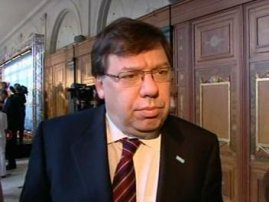
Meanwhile, Taoiseach Brian Cowen (photo) said it was "obvious there is a very difficult economic situation that is affecting our economy the same as others".
But he and the government were "trying to minimise job losses".

One has to congratulate the Taoiseach on his quite exceptional observation and perception skills. He has indeed noticed that we are in "a very difficult economic situation". Well, well... I suppose they do have a newspaper in Co. Offaly after all.

But with the "minimisation of job losses" he seems not to be up to date.

Only yesterday it became known that thanks to his new regulations and Brian Lenihan's budget cuts Donegal County Council alone will have to sack 238 of their workers, and not only the 71 which were already told about it the day before. (see my entries of November 20th & 21st)

I have a very simple solution for the problem, and a suggestion that would indeed minimise job cuts in Ireland. If Brian Cowen and his government would resign (and call a general election), there would only about 45 jobs lost, but the whole country - and with it many thousands of jobs - could be saved.

The Emerald Islander

A Bag full of bad News from the CSO

There was a massive fall of 25,000 in the number of people employed in Ireland in the twelve months to August this year, according to the latest Quarterly National Household Survey from the Central Statistics Office (CSO).

This is the first annual fall in employment recorded by the CSO since 1991. The figures also show that unemployment increased by 60% during the same period.

It is the first time for 25 years that this combination of a sharp fall in employment as well as a sharp rise in unemployment has been recorded in official figures.

Men are doing particularly poorly, with the number of employed males down by 32,000 over the year, while women are faring much better, with a gain of 7,000 in employment during the year.

This shows once again and very clearly that the whole structure of the Irish labour market is changing and shifting from a male to a female dominance. There are three reasons for that:
1) The fact that most women are still earning less than a male equivalent doing the same job. Thus it is cheaper for companies to employ women.
2) The massive increase in low-skilled service jobs, which are predominantly filled with women, while there is a clear decline in manufacturing and other skilled jobs, usually held by men.
3) The ever more aggressive implication of so-called 'equality', which over-proportionally favours women and makes it increasingly more difficult for men to get a fair treatment and a proper job.

The collapse in construction has been one of the biggest drivers of the trend, with the numbers of those engaged in house building down by 40,000 compared with this time last year.
Other areas of construction expanded a little, providing some cushion for builders with a gain of 14,000 jobs on infrastructure and commercial building projects.

Employment in manufacturing is down 9,400, while the contraction in the 'leisure industry' has made another 5,400 people redundant in hotels and restaurants over the 12-month period.

It appears that the job losses are more severe for Irish nationals, as the overall employment of foreign workers is unchanged from last year.
However, the flow of non-Irish nationals into the country has slowed down to just one-sixth of the level of last year. This is not surprising. We were only attractive for migrant workers - most of them from eastern Europe - as long as there were more jobs than we could fill ourselves and more money than anywhere else. In fact, I expect that a good number of Poles will return home for the Christmas and New Year celebrations and not come back, because while Ireland is now in rapid decline, Poland shows the first signs of economic flourish and is tipped to be the next boom country in Europe.

The Emerald Islander

Frank Dunlop charged with Corruption

Dublin lobbyist, ex-journalist and former Fianna Fáil and Government Press Secretary Frank Dunlop (left) was arrested by members of the Criminal Assets Bureau (CAB) yesterday afternoon and has appeared in court in Dublin on corruption charges.

He is accused of bribing eight public representatives, six from Fianna Fáil and two from Fine Gael, and it is alleged that he paid them sums ranging from Ir£ 1000 to Ir£ 3000 to vote in favour of rezoning land at Carrickmines.

Those named in the charge sheets as having been bribed by Frank Dunlop are former Senators Liam Cosgrave of Fine Gael and Don Lydon of Fianna Fáil.
Also named are Fianna Fáil Councillors Tony Fox, Sean Gilibride, Colm McGrath, the late Jack Larkin, the late Cyril Gallagher and Fine Gael's late Councillor Tom Hand.

The money is alleged to have been handed over at the Davenport Hotel and at Buswell's Hotel in Dublin, at Conway's pub, at Mr. Dunlop's own offices, and in the case of the former Senator Don Lydon, at St. John of Gods' in Dublin.

Five of the charges relate to alleged payments he made to Liam Cosgrave and five more relate to Tony Fox (right), who is still representing Fianna Fáil on Dun Laoghaire-Rathdown County Council.

Detective Garda Martin Harrington from the CAB told the court that Frank Dunlop was arrested yesterday. When he was charged with the offences, he replied: "We always knew this day was coming and I will not be contesting the charges."

The court was told the Book of Evidence in the case was ready and Dunlop was handed a copy of it in the courtroom.

Judge Cormac Dunne acceded to a request by counsel for Frank Dunlop and sent the case forward to the next sitting of the Dublin Circuit Criminal Court.
He told him that if he intended to rely on alibi evidence he was to inform the prosecution and he remanded Dunlop on bail of his own bond of € 100.

For those who are not familiar with Frank Dunlop, or are too young to remember his past, it is worth to reflect on the career of the now 61-year-old Dubliner, who was born in Co. Kilkenny.

He first came to the public's attention when he was appointed press secretary of Fianna Fáil in 1974, with an office based at Leinster House. He then became head of the Irish Government's Information Service and Government Press Secretary (under Taoisigh Jack Lynch, Charles J. Haughey and Garret FitzGerald) from 1977 to 1982. The special position had been established on Dunlop's own recommendation.

His role involved developing relationships with the media, especially The Irish Times, the Irish Independent, other newspapers and RTÉ. (There were no other authorised radio stations in Ireland at that time, although there were quite a number of illegal broadcasters.)

Prior to Dunlop's appointment, the Government Information Service was the established unit of the Taoiseach's office for the dissemination of information relating to government activities. Dunlop described its role to the Mahon Tribunal in 2003 as being "a post office - it just delivered copies of statements, speeches, announcements and CSO details to the news desks of the papers; there was no substantive policy discussions with the media prior to that time".

Dunlop's objective was to facilitate 'an understanding in the media of what Fianna Fáil was doing or was about at that time'. This role enabled him to develop significant relationships with political correspondents, news reporters, editorial personnel and politicians.

Following a change in government, Dunlop was established as a civil servant with the rank of Assistant Secretary. He moved to the Department of Education when John Boland was the Minister, and his role was liaison with the media. He also made some inputs on policy matter on education.

Subsequently he moved with Boland to the Department of the Environment and worked there for about two years as Assistant Secretary, with responsibility for media matters. But he had no influence on planning matters then.

In 1986 Frank Dunlop, then aged 39, left the Civil Service and became a public relations consultant with the Dublin firm Murray Consultants. He had a director's role which involved developing a portfolio of clients. Dunlop's prior experience in government and the Civil Service made him uniquely qualified as a lobbyist, and he made extensive use of his contacts.

Where and when he began bribing politicians of various levels will undoubtedly be established during his trial. But one thing is certain: He is only the very small tip of an immense iceberg of corruption that was - and still is - an integral part of Irish politics.

The Emerald Islander

21 November 2008

Trade Union fears that more Council Workers in County Donegal could soon lose their Jobs

The IMPACT trade union has said that as many as 238 contract staff with Donegal County Council may lose their jobs.

71 people, whose contracts are not being renewed by the Council, will lose their jobs between now and the end of the year. (see yesterday's entry on that matter) 49 others are to be let go between January and March of next year.

IMPACT representative Richie Carruthers stated that the situation of the remaining 118 contract workers is currently "under discussion".

Despite the promise of a detailed statement on the matter earlier this week, Donegal County Council has now declared that it will be "making no comment on the situation until after a Council meeting on Monday", when the matter will be discussed further.

Under the new government rules Donegal, like all other local authorities, has to make a saving of 3% on its payroll costs.

Dinny McGinley (left), Fine Gael TD for Donegal South West, described the situation as "a virtual tsunami for the county".
He said that he had been in touch with colleagues in other Irish counties, and it appeared nothing as shocking was happening in these other local authorities.

So one has to wonder why - of all the counties in the Republic - Donegal, home of Tánaiste Mary Coughlan, is making such drastic cuts to its workforce. Could it be that the Fianna Fáil controlled Council has been overspending in previous years and is now running out of money?
Or is the rural county in the far north-west of Ireland just too eager to please the government and in particular Finance Minister Brian Lenihan, who is scraping the bottoms of all barrels in the public sector to find more money for his Budget?

Whatever the reason is, the massive cuts in Council staff will create immense hardship in Co. Donegal, and subsequently also reduce the overall quality of local services, which will affect every person living there.

Fortunately there will be local elections next year, so the people of Co. Donegal - like everyone else in Ireland - will have the chance to make significant changes and send the Fianna Fáil Councillors, who have controlled Donegal County Council for the past 4 1/2 years, where they belong: into private life and the political wilderness.

The Emerald Islander

EU Agriculture Ministers agree on CAP Reform

The European Union's Ministers for Agriculture have finally reached an agreement on major changes to the Common Agricultural Policy (CAP).
It follows all-night negotiations in Brussels to review the system of subsidy payments to farmers.

Padraig Walshe (right), President of the Irish Farmers' Association (IFA), has already spoken out against the new agreement and criticised the decision to cut the single farm payment by 5% over five years.

Meanwhile Brendan Smith (left), Ireland's Minister for Agriculture, Fisheries & Food, said that "despite difficult negotiations, it was a good package for farmers in Ireland".

The ministers at the talks agreed to sweep away various established agriculture support schemes, including diverting subsidies from large farms to countryside preservation schemes.

After concessions given by (the Danish) EU Agriculture Commissioner Mariann Fischer Boel (right), most notably to France, Germany and Italy, ministers struck an early-morning deal that still represents Europe's most significant farm reform in five years.

"It was a qualified majority, not unanimity," said an official, who did not say which country or countries in the 27-nation union had not backed the accord during all-night talks.

Apart from long arguing over how much handouts to divert into countryside funding, the main hurdles were how to liberalise the EU dairy sector before milk production quotas expire in 2015. Public purchasing of key commodities - like wheat and the future of the EU's remaining production-linked farm subsidies - where also on the agenda.

All holdings, subject to a basic threshold of € 5000 in subsidies a year, will shift 5% of their EU farm money into countryside projects by 2012, on top of a compulsory 5% already in force. Commissioner Fischer Boel had originally been seeking 8%.
Much of her vision of applying a tiered system of annual income thresholds to shunt subsidies, in progressively higher amounts, from larger farms into rural spending also got diluted.

Instead of three thresholds for farms receiving subsidies, only one will now apply - € 300,000 and higher - where 4% of subsidies will be moved into rural projects by 2012.

The policy revisions will start in 2009 and run until 2013.

Speculations fly high after Lenihan's Bank Talks

Bank of Ireland has today confirmed that it has been "approached by a number of parties interested in investing in the bank".

This news comes after reports that a major consolidation of Irish banks has emerged as a possible solution to the current crisis.

Last night RTÉ News reported that talks between Minister for Finance Brian Lenihan and bank chiefs had led to the possibility of a radical overhaul of the Irish bank system. (see also yesterday's entry on this subject)
This led to speculations about what shape this would take, and whether foreign or private equity investors would be involved.

Bank of Ireland shares, which had already climbed this morning, were up almost 25% at € 1.26 just after the statement.

Meanwhile the Group Chief Executive of Allied Irish Bank (AIB) has declined to comment at all on the situation.
Arriving at a posh function in Dublin, Eugene Sheehy (right) said that "shareholders read what they read, but we [the bankers] have no comment to make".
It is really mind-boggling how smug and arrogant Sheehy still is, after having lost 95% of his company's value since he took charge of it in 2005 and having to go now to the State and to us - the taxpayers - cap in hand...

Asked if he could see a situation where there would be only two large banks operating in the Irish market, he responded that was speculation.
Which, of course, it is, cooked up by some financial journalists in Dublin who pretend they can read the mind of Brian Lenihan.

Yesterday's talks involved a series of meetings at Farmleigh (the government's official 'guest house' in the Phoenix Park in Dublin) between Lenihan and senior executives from the financial institutions covered under the State guarantee scheme. (see yesterday's entry)

Since the guarantee was given in September, the Minister for Finance has the power to force mergers between financial institutions. This is one of the concessions the troubled banks had to make before the State was willing to cover them.

After the meetings some participants 'believed only Bank of Ireland and AIB would remain after the shake-up', but there has been no comment on the content of the meetings.

Brian Lenihan (left) said that yesterday's meetings were "focused on ensuring there would be adequate credit for Irish businesses".

The suggestion of a major wave of consolidation would also have to be linked with fresh capital for the banks.

There is, however, still no clear picture of how a final deal would be put together, or how long it would take.

I suggest that the nervous crowd of Dublin's financial journalists stop speculating and second-guessing other people, shut their laptops for a couple of days, relax and have a few pints. As the pressure of the world markets weighs heavily on our banks, Brian Lenihan will have to come up with a solution soon. He knows that, the banks know it, and we all know it.

And when he has made his decision - which is his, and his alone by the power of his office - then we can start analysing and commentating. I hope Lenihan will do a better job with the banks than he has done with the 2009 Budget. And personally I also hope that we will in the end have more than just two banks left in this country. I have never trusted the Bank of Ireland, nor the AIB, and never was a customer of theirs. And if these two - as some people suggest - would remain alone in the field of financial services, we all would be forced to do business with them. I would not feel comfortable with that at all.

In fact, mergers and amalgamations that create ever larger banks are in my opinion not the answer to the current financial crisis. The larger a bank is, the more dominant and arrogant it tends to be, and the more it will also be enticed to participate in the massive internatinal gambling that brought all the big western banks into the trouble they - and subsequently we all - are in now.

I would go in the opposite direction and break up the largest banks and create a number of new small regional banks, whose regulations would limit them to traditional banking activities and ban them from participating in the international speculation and gambling operations. They should be staffed by local people and have an actively positive approach towards small and medium-sized businesses, as well as to idividual customers.
This could and would restore the confidence and goodwill the whole Irish banking sector has lost over recent months, and would also stabilise and stimulate our ailing economy.

The Emerald Islander

20 November 2008

Brian Lenihan is meeting Irish Bank Executives to sort out the ever more serious financial Crisis

Today chief executives from the six Irish banks and building societies that are covered by the State guarantee scheme have separate meetings with Finance Minister Brian Lenihan (right).

The series of these one-to-one confessional meetings comes in the wake of the Price Waterhouse Cooper report on the future debts and capital requirements for the six Irish financial institutions covered by the scheme, which was announced by the government in September.

The participants in the talks might be especially cautious, as world markets have once again tumbled, following sharp overnight losses on Wall Street, prompted by a fresh wave of jobs cuts in the USA and another gloomy economic outlook.

But - amazingly - Irish bank shares are among the very few that are rising today. However, one should not forget that on Monday and Tuesday of this week they were hitting rock bottom, with both Bank of Ireland and Anglo Irish Bank shares falling below the € 1 mark for the first time ever. On Tuesday Bank of Ireland shares were even close to 80 cents for a while, and I suppose they could not fall much further without the whole business imploding completely. And - as we have seen in recent weeks only too often - short-term gains on the world's stock markets are often followed by further drops in value.

Today's rises are mainly on expectations that the government is edging closer to a refinancing deal for the nation's main financial institutions.

Earlier this week the Taoiseach had told the Dáil that "the often mentioned recapitalisation of banks alone will not solve the issue of access to credit for small businesses".

During leaders' questions Brian Cowen (above left) said that the government was "looking at a range of measures to remedy the liquidity problem", but he was "constrained in revealing what they are at this time". This was another fine example of procrastination in true Offaly style.

Under the bank guarantee scheme, Cowen stated, all covered banks were drawing up business plans, and this process was now "at an advanced stage". He also announced that the Financial Regulator had received a draft report on the banks from the consultants Price Waterhouse Cooper.

Today the government expects to receive the full business plans from the financial institutions.

Brian Cowen said that if these plans did not contain measures to provide adequate lines of credit to businesses, they would be rejected.

Labour Party Leader Eamon Gilmore (right) declared that the government sounded "like helpless bystanders", while Fine Gael Leader Enda Kenny demanded that the banks be recapitalised.
He reminded the Dáil that 10,000 Irish jobs were being lost every month as small businesses got squeezed.

Meanwhile the International Monetary Fund (IMF) has approved a loan of more than $ 2 billion to Iceland, to help it cope with what has been described as "a banking crisis of extraordinary proportions".
The government of Iceland had asked the IMF for help after its banking system collapsed within hours last month. Let's hope that Ireland will be spared such a traumatic experience.

The Emerald Islander

Cheney indicted for Organised Criminal Activity

A Grand Jury in Texas has indicted US Vice President Richard 'Dick' Cheney (left) and the former US Attorney General Alberto Gonzales (below right) for "organised criminal activity", related to alleged abuse of inmates in private prisons.

The Grand Jury of Willacy County, in the Rio Grande Valley near the US-Mexico border, said that Mr. Cheney is "profiteering from depriving human beings of their liberty".

The indictment cites "a money trail of Mr. Cheney's ownership in prison-related enterprises, including the Vanguard Group", which owns an interest in private prisons in southern Texas.

According to the jury's indictment, Alberto Gonzales has "used his position to stop the investigations as to the wrong doings into assaults in county prisons".

Dick Cheney's office has declined any comment. "We have not received any indictments. I can't comment on something we have not received," Cheney's spokeswoman said.

The indictment, overseen by County District Attorney Juan Guerra, cites the case of one Gregorio De La Rosa, who died on April 26th, 2001 inside a private prison in Willacy County.

The Grand Jury wrote that it made its decision "with great sadness", but said they had "no other choice but to indict Mr. Cheney and Mr. Gonzales, because we love our country".

The indictment has not been seen by a judge yet, who could still dismiss it. But the fact that it was made, and - of all places - in Texas, the heartland of right-wing conservative Republicans, is in itself significant.

It will be interesting to follow developments in this case, which also is one of the first signs for a sea-change in public attitude towards the outgoing Bush administration, after the clear win of Barack Obama on November 4th and an increased majority for the Democrats in both Houses of the US Congress.

Given the many crimes and war crimes the Bush administration has committed, this indictment on a relatively small scale might look insignificant to some, but it could be the first step of a longer and more detailed process, aimed at dealing with the numerous breaches of national and international law that were the hallmark of the Bush administration.
With some luck George W. Bush might in future be indicted himself, as he personally authorised systematic and widespread torture of US prisoners and is responsible for many more criminal acts committed by Americans at home and abroad.

As most people's memories are short, let me just remind you that only last year Cheney's former Chief of Staff and close confidant Irve Lewis 'Scooter' Libby (right) was found guilty of "obstruction and purgery" and then sentenced to "30 months in federal prison, a fine of $ 250,000, two years of supervised release and 400 hours of community service".
Even though George W. Bush pardoned his old pal four weeks later and ordered his release from prison, the fine and community service remained and Libby is therefore still a "convicted felon", as they put it in the USA.

When he was first indicted in 2005, few people believed that the case would lead to a conviction, or even go to court. But it did.

So perhaps the criminals who occupied the White House and ruled the USA for the past eight years will not be getting away scotch-free after all... In the interest of peace and justice, let's hope so.

The Emerald Islander

Bad Times for The Irish Times

It has emerged that The Irish Times is urgently seeking 30 redundancies before Christmas in a bid to reduce the overall costs at the national newspaper, which is one of the three daily broadsheets in Ireland and also a paper of record.

The company's management held briefings with members of staff yesterday morning, to outline a number of cost saving measures, including a pay freeze, a strict ban of bonuses and significant changes to the company's pension arrangements.

Staff who attended this briefing were told that the company is forecasting "possible operating losses of up to € 13 million next year". They were also told that there may be 30 further redundancies in 2009.

More briefings were held yesterday afternoon and staff were told that "revenue from property advertising has fallen by 50% since last year", while "recruitment advertising is down 20%".
However, the staff members were not told which departments would be affected by the 30 redundancies that are being sought immediately.

Management told the briefing that the people involved would be spoken to individually over the next seven to ten days. This kind of secrecy and the attempt to pitch individual staff members against each other and make them fight for being retained is very typical for the stiff and rather old-fashioned culture inside The Irish Times.

An unspecified number of casual staff and freelancers are also to be let go.

It is understood that all aspects of employment terms and conditions will be scrutinised - including the 'nine day fortnight' and the six weeks annual holiday entitlement, as well as the paper's expenses regime.

The management will not be receiving bonuses, and executive terms and conditions will also be examined. This at least seems fair, as management is mainly responsible for the situation of the company.

Staff sources who attended the meetings said that management described current terms and conditions as "relics from another era".
So it appears that after a period of exuberance and uncontrolled splendour these are now also bad times for The Irish Times.

Strangely enough the company had no problems wasting a good deal of money on a new opinion poll regarding a hypothetical second referendum on the Lisbon Treaty, which was published on Monday. (see my entry of November 17th)

If the situation is really as dire as the management suggests, maybe they should start with their staff redundancies right at the top and give editor Geraldine Kennedy the chance to spend more time with her family. She presided over the decline of the paper and did obviously not take provisions for a rainy day when the going was good.
Then the senior management should sack itself instead of pushing hard-working journalists into the dole queue.

With good right we are demanding a change of management from the banks who created our current financial crisis. And what is right for them is equally proper for our big newspapers, who fuelled the boom and spending spree of the past ten years with countless 'lifestyle' articles.

This is the start of a new era, and we should begin the long and slow march to recovery with new people leading the way.

The Emerald Islander

Donegal County Council sacks 71 Workers

71 people who are currently working for Donegal County Council have been told that their contracts will not be renewed.

The people concerned work in a range of areas within the Council, and a shortage of funds is apparently the issue which has led to the decision not to renew their contracts.

Sinn Féin Councillor Pádraig McLochlainn (photo) is blaming severe budget cuts by the government for the situation and says that the news of further job losses is "a devastating blow to the workers, especially in a rural area like Co. Donegal".

Donegal County Council had promised an official statement on this matter, but so far this has not been issued. The Council is controlled by Fianna Fáil, which has 16 of the 29 Councillors.

19 November 2008

Irish Government plans to ban Bedsits

After banning smoking in public and proper light bulbs, the Irish government is now also planning to ban the traditional rented bedsits, as part of a series of new measures, trying to improve standards in the Irish rented accommodation sector.

A new government proposal will see one-room units phased out by new regulations, insisting that rental units should have their own sanitary facilities.

The idea of fading out the many thousands of poor quality bedsits is to be welcomed in general, and the move is actually overdue. It could and should have come years ago, when there was more than enough money available to modernise and improve old apartments.

But now, as economic recession is hitting the whole country and causes great financial distress for many of us, the measure will turn out to be a double-edged sword. Most of these old bedsits, many with facilities of 1950s and 1960s standard, are owned by dodgy landlords who not even declare their earnings from them. The units are predominantly rented by the most vulnerable and poor people in the country, especially unemployed single people, recipients of social welfare and incapacity benefit, and also a good number of elderly people, living on their own.

Since the influx of many foreign workers into Ireland in recent years, a lot of these bedsits are now also occupied by people from eastern Europe, who come here to work and send as much money as possible home to their families. So they go for the cheapest possible option when it comes to accommodation, which is in Ireland the old bedsit with very little comfort and facilities. There are seldom rent books and documents, and the rent is usually paid in cash and collected by the landlord himself every week. Thus many landlords, who are not far removed from the old slum lords of 19th and early 20th century Irish tenements and often lead a shady life, make plenty of money from their bedsits without ever paying a single Cent in taxes.

It is - as I said above - a positive step in the right direction to tackle this problem, close bedsits that are barely fit for habitation and make the landlords to renovate their properties and pay at last their taxes. But the question is how the new law will be enforced? Will we see hundreds of housing inspectors going around the country, checking on rented properties and their occupants and owners? Or will we just have another piece of meaningless legislation, with looks nice on the statute books, but has no real impact on the ground?

Given my experience with Irish politicians, local authorities and landlords, I suspect that it will be the latter. There are already plenty of regulations in place under which a good percentage of old and dingy bedsits should be taken out of the market, as they are shambolic at best and even a health hazard for the occupants at worst. But nothing has happened for years. All is going on as it has been for decades, with the most poor and vulnerable tenants being exploited by landlords who grow rich and fat on them.

So one has to wonder why the government is coming up with this proposal now? The answer is actually quite simple. Rents have been falling, and continue to fall in value, all across the country.
In fact rents have fallen to their lowest levels in more than two years now, according to one of Ireland's biggest property websites.

Analysts say that Irish rents have dropped by an average of 3% across the country in the past three months, due to what it called "the dramatic increase in the number of properties available to rent".

This is of course the result of the uncontrolled and nonsensical building boom during the years of the 'Celtic Tiger', when within just a few years new apartment blocks were built everywhere, and with no regards to real demands.
Here in Waterford alone I know several of these massive blocks which are more than half empty. And if the Department of Health and the Department of Social and Family Affairs would not put large numbers of - mostly African - asylum seekers in there at the taxpayers' expense, they would be 80% empty.

At the start of November, there were over 18,000 properties available to rent nationwide, up 133% on the level of the same time last year.

Economist Ronan Lyons says that "2006 and 2007 saw an unprecedented number of new homes built in Ireland - probably over 170,000 in two years. With no shortage of unsold properties, rents can be expected to continue to fall for perhaps another 12 months".
"Much lower numbers of new homes built from 2009 on - perhaps only 55,000 over the course of 2009 and 2010 - should bring Ireland's property market back into balance," he added.

So, what is really behind the new government proposal? It is not the concern for poor tenants in dingy little bedsits with no proper facilities. And it is not the will to collect taxes from dodgy and unscrupulous landlords, who are well-known to local authorities and politicians, and often even welcome financial supporters of Fianna Fáil or Fine Gael.

No, the real reason for the new proposal - and for its timing - is that the government's friends in the property industry, the many developers who became millionaires on the back of the 'Celtic Tiger' and just kept building and building new apartments like mad - and with borrowed money - are now facing real financial difficulties. So they come running to their friends in high places, asking for help.

The government's answer seems now to force low income tenants out of their bedsits and into a vast array of empty modern apartments they really cannot afford, even at a time of low rents.
Thus the developers will have a new source of income, which might help them to survive the current crisis and economic recession.

And who will pay for all this? You and me, and every taxpayer in the country. Because the poor bedsit tenants cannot afford the rents for modern apartments, they will apply for - and receive - rent allowance from the Department of Health.
At the same time the owners of the old bedsits will apply for - and receive - improvement grants for their buildings, also paid out by the government, which means from our taxes.

None of these measures have been properly budgeted for, and are not even mentioned in the 2009 Budget. So the money will have to be found elsewhere, and most likely be brought into an emergency 'mini budget' next year, which will come anyway as things stand now.

If the government would really care for those who live in bad old bedsits with no proper cooking and sanitary facilities, they would pass a new law that defines the minimum standards for rented accommodation and make the landlords responsible for it, with the explicit provision that they will not be allowed to raise the rent after they have made the required improvements.
Those who make their main income from bedsits are wealthy people, and in the current situation they would not want to lose their tenants. So they would - and would have to - comply with new rules, and still make plenty of money.

Once again we see the government proposing what looks at first glance like a good idea, but after examination of the details it turns out to be just another scam. But then again, what else can one expect from Fianna Fáil?

The Emerald Islander

Citibank reduces Staff by 20%

The large US financial group Citibank has announced plans for about 52,000 new job cuts, on top of 23,000 redundancies already made this year. This makes a total of 75,000 job cuts in the organisation and represents a staff reduction of about 20%. About 300,000 jobs worldwide will remain in the bank "in the near term".
According to a spokesperson, the job cuts will come "from redundancies, the sale of units and natural wastage".

I cannot help but wonder what any bank needs 375,000 or even 300,000 (well paid) employees for, in an era when most of the world's money is electronic and only exists virtually, when stock market trading is computerised and automated - with pre-set cut-off points in case of extreme price drops - and when the number of traditional branch offices is at an all-time low (which is the case with all banks, not just Citibank).
The service staff in those branches also seems to get ever younger, which means two things: less experience and less pay. Personally I think that the overall very young age of bank service and trading staff is partly responsible for the current crisis.

A year ago, Citibank (with its huge and glamorous head office in New York) was the largest bank in the world. But how different things can be within a few months shows today's financial bulletin.
From being a world champion, Citibank dropped to 7th place in the international ranking, where four of the five largest banks in the world are now Chinese.

Citibank was established in 1912 as the City Bank of New York by a number of - mostly Jewish - merchants under the leadership of the former US Postmaster General Samuel Thompson.

After going through changes in ownership, the bank established its presence as the USA's largest bank in 1865, and soon it became the first US bank to set up operations overseas. Mergers and acquisition followed and the bank could only grow larger and larger.

However, the bank's many international engagements created a lot of criticism, and it was also blamed directly for "having played a major role in the Wall Street Crash" of 1929. Four years later, in 1933, Senator Carter Glass said during an investigation into the financial markets that the bank's then president Charles E. Mitchell "more than any 50 men is responsible for this stock crash".

More recently the group has faced one of the toughest economical periods, with the weakening US economy and the collapse of the 'subprime' mortgage market the main reasons for trouble.
In fact, much of the crisis was actually created by Citibank itself (again), as it was one of the main instigators of the 'subprime' mortgage market and one of the largest lenders in it.

Meanwhile Citibank has lost more than $ 20 billion in the past year and the bank's chairman and CEO Charles O. Prince III (left) had little choice but to resign in disgrace and rather hastily a year ago.
(He will, however, enjoy a comfortable retirement, as he left Citibank with a 'golden handshake' of $ 38 million in personal compensation.)

Citibank has reported four straight quarterly losses and some analysts believe the bank will not make a profit again until 2010.

Of the 52,000 newly announced job losses, about half are understood to be accounted for already, with the recently announced sale of Citibank's German retail banking business and the closing of an Indian outsourcing operation.
It is expected that the remaining 25,000 jobs will be gone by the first half of 2009, but Citibank declined to comment on the cuts.

"Underlying business remains strong and revenues have been stable," a spokesman said, adding that its capital position was also "very strong". However, business analysts and share prices tell a different story and I wonder if it is a general requirement for a banker to be a habitual liar, or if it just helps to do the job.

The share value of Citibank has dropped again by 6.2% after the announcement. It is down almost 70% since last year, and the bank's new chief executive Vikram Pandit has come under pressure from critics who have doubted his ability to turn around the company and weather the financial crisis.

However, Citibank is probably quite safe, as it is one of the nine financial institutions benefiting from the US government's bail-out programme.
The US Treasury announced last month that it would be providing cash injections worth $ 125 billion for the troubled financial sector, to be shared between Citibank, JP Morgan Chase, Bank of America, Goldman Sachs, Morgan Stanley, Wells Fargo, Bank of New York Mellon, State Street and Merrill Lynch. (And as soon a the announcement was made, Goldman Sachs paid $ 17 billion in 'bonuses' to its senior managers. One wonders what this was for. Perhaps a bonus for having successfully conned the clueless Bush administration into handing over even more billions of taxpayers' money...)

The Emerald Islander