08 July 2008

Micheál Martin leaves for Middle East Tour

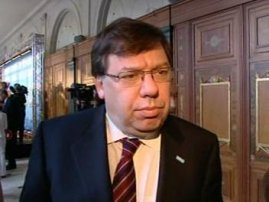
This afternoon the Minister for Foreign Affairs Micheál Martin (photo) has left Dublin for his first diplomatic visits abroad since taking over at the Department of Foreign Affairs.

He is on a three-day tour to the Middle East which will focus on regional and international efforts to restore momentum to the Middle East peace process.

Martin's first destination is Cairo, where he will meet the Secretary General of the Arab League and the Egyptian Minister for Foreign Affairs.
Their discussions are expected to centre on the two-week-old ceasefire between Israel and the Palestinian Hamas movement in Gaza, which was brokered by Egypt. Regional security issues and strengthening economic ties with Ireland will also be on the agenda.

On Thursday the minister will visit a Palestinian refugee camp in the West Bank area and meet UN and local representatives to discuss the humanitarian and security situation there.
He is also expected to meet senior members of the Israeli government and of the Palestinian Authority for talks on the latest developments in the Middle East peace process.

On Friday, before returning to Ireland, Micheál Martin will lay a wreath at the Holocaust Memorial in Jerusalem.

Irish Shares at lowest Level since 2003

Dublin's ISEQ index of Irish shares has closed today at its lowest level since November 2003, losing more than 4% of its total value. Especially Irish bank shares continued to take a severe beating and were the main cause for the massive fall.

By the close of business ISEQ was down 199 points at 4660, wiping a total of € 2.5 billion off the value of Irish shares.
The drastic decline in values was centred on financial stocks and follows concerns that US banks will reveal further significant losses in the near future.

Bank of Ireland shares lost 11% today, falling to € 4.51, after warning shareholders that the current economic slowdown would hurt its profits this year. It also said there was "too much uncertainty" to give a profits forecast at the moment.
The bank's chairman Richard Burrows conceded that "share performance has been abysmal", but insisted that the bank had been run "prudently".

Irish Life & Permanent, owner of the permanent tsb bank and Irish Life insurance, were recently hit by downgrades from credit rating agencies. Today their shares tumbled more than 13% to € 4.65.

Allied Irish Bank (AIB) shares also fell sharply, ending the day down almost 10% at € 8.10.

Thus Bank of Ireland shares have now lost more than 75% of its value since they reached their peak last year, while Irish Life & Permanent has dropped almost 80%.

Even for people with little or no experience in the financial markets it is quite obvious now that our amazing economic boom is over. And not only that. It is over with a heavy crush, a fall from great height.
One cannot but wonder why hardly anyone saw this coming over the past two years, and why it seems that no-one is prepared for it.

The banks, who for the past ten to twelve years were handing out money to almost everyone, as if there were an endless supply of it somewhere, have to carry the main responsibility for our overblown and out-of-control spending spree during the good years, with no provisions made for possible bad years to come.
During the boom not one Irish bank offered any decent interest rates on their savings accounts, so even people who wished to save money - and some actually did - had absolutely no incentive to do so. In fact, saving money was punished by ridiculously low interest rates that did hardly deserve the name.

In most other European countries banks have always encouraged saving, but not so in Ireland. Here the banks - most of them in foreign (and predominantly British) ownership - prefer to have people in debt to them.

It does not make much commercial or economical sense, and I often wonder if there is a deeper political and philosophical reason behind it. We did achieve national independence in 1922, but so far we are still not really independent financially and treated by international banks like serfs.

In times of major growth and economic boom the banks have made huge profits. Now, that they are in trouble - and most of it due to their own doing - they are crying out for help from various governments. Well, you cannot have it both ways! So if there is any government intervention to bail out the banks, the only logical and sensible consequence has to be nationalisation of the bank (or banks) in question.

On days like today it is visible and must be clear to everyone that uncontrolled capitalism of the western kind does not work! What we need is a proper alternative, and there are several models we could adopt. However, our politicians - in hock to big finance and not the sharpest minds even on good days - will not find a solution on their own. Once again it will be down to the people - to the likes of you and me - to come up with new ideas. So start thinking, don't be afraid of having a brainwave, and when you do, talk to your local politicians!

The Emerald Islander

07 July 2008

UK MPs say PSNI looks too much into the Past

A new report has accused the police in the North of spending too much time with investigating unsolved murders from the past, the time commonly known in Ireland as 'the Troubles'.

The Northern Ireland Affairs Committee of the UK Parliament has found that the ability of the Police Service of Northern Ireland (PSNI) to cope with present-day terrorist threats "is being compromised because there is so much focus on cold case murders from the 30-year conflict".

In its "Policing the Past" report the committee noted that the costs of the PSNI's Historical Enquiries Team (HET), set up to examine more than 3200 killings that happened in the Six Counties between 1968 and 1998, could spiral to more than £ 45 million, which is 60% over the original budget.

However, despite the financial and manpower resources being diverted into the project, so far only one case out of more than 1100 opened has been passed to the Public Prosecution Service with a recommendation to bring charges.

The work of the independent Police Ombudsman is also being compromised by the need to re-examine allegations of police misconduct over the 30-year conflict, British MPs said in their report.

Committee chairman Sir Patrick Cormack, MP said the HET, which was established in 2005, should be re-assessed, with priority given to cases with a realistic chance of progression. He added that the police had to be able to maintain their focus on the present day.

"The Police Service of Northern Ireland faces significant demands in terms of its work with all of the different historical investigations, and we are concerned about the impact of this in relation to the police service's primary role in policing the present," he said in London.

The report raises the question how much sense the work of the HET really makes, or if it is just one more instrument of UK state bureaucracy, created to keep an oversized group of British and Northern securocrats happy and occupied, forever and ever raking over the past.

Critics of the policing and security system in the North have long suggested the establishment of a Peace and Reconciliation Commission, based on the South African model, to deal with the terror, murders and political crimes of the past. So far the idea has not found enough support from the current political leaders in the North. Instead the HET was set up. If they continue working at their current speed, they might be completing their task by the end of the century.

The Emerald Islander

Combined Action against Fuel Smuggling

The ever rising price of oil, and the subsequently also rising prices for fuel have an increasing effect on motorist, hauliers and the petroleum industry, as well as on various government bodies and state agencies on both sides of the Irish border.

Fuel smuggling and the illegal 'laundering' of agricultural diesel and special fuels, which are distinguished by an added colour, have always been one of the favourite activities of criminal groups on the island, North and South. But the more the prices for oil and fuel rise on the legal markets and at petrol stations, the more lucrative this activity becomes for criminals.

Rogue Irish hauliers have now been warned by the Revenue Commissioners (who collect our taxes, but are also in charge of the Customs Service) that they are to step up their campaign to detect illegal usage of motor fuel.

The move has been welcomed by the Irish Road Haulage Association, which wants the rogue operators put out of business.

Already this year marked mineral oil, reserved for agricultural use, has been discovered in the fuel tanks of 471 Irish vehicles not entitled to use it.

In the first six months of 2008 there have also been seizures of more than 57,000 litres of 'laundered fuel', 'green diesel' and Northern Ireland kerosene in the Republic.

Meanwhile new measures to combat 'fuel laundering' and fuel smuggling are also planned in the North, where most of the illegal fuel operations have been based so far.

Paul Goggins (right), Security Minister in the Northern government, is due to give details of increased activity and co-operation by a number of agencies from both sides of the border today.

It remains to be seen if the combined forces of the two states will have a real effect on the Irish fuel smugglers. They have been in their illegal business since 1922, and despite various campaigns against them over the decades, they are more active now than ever before.

In my opinion fuel smuggling and 'laundering' will continue as long as oil and fuel prices are high and the profits for smugglers and criminals are lucrative.
The limited forces of the Customs Service, Garda Siochana and the PSNI (Police Service of Northern Ireland) will - despite their best intentions and efforts - not be enough to solve the problem.

The Emerald Islander

06 July 2008

20 Years ago: The Piper Alpha Disaster

Twenty years ago I was still serving in the Navy, at that time as 2ic (second in command, what the Americans call executive officer or XO) of a frigate. On the evening of July 6th, 1988, we were on anti-submarine patrol duty in the North Atlantic. I had the bridge for the First Watch (2000 to midnight) and all seemed to be normal and rather quiet. But then, around 2200 BST, the radio channels were suddenly crammed with unusual traffic. I remember it well, as it is one of those things one never forgets. And I also remember a particular call sign that dominated the unusually active radio traffic: Piper Alpha.

It was the name of an oil production platform (pictured left in operating condition) in the North Sea, acting as the technical hub for the Piper, Claymore and Tartan offshore oil and gas fields, about 120 miles northeast of the Scottish city of Aberdeen.

Owned and operated by Occidental Petroleum (Caledonia) Ltd., it had been constructed and originally used for oil production. Later it was converted to handle gas, which - as an investigation would establish in 1990 - broke its safety concept, with the result that sensitive areas that should stay well apart were brought together.

On July 6th, 1988, just before 10 p.m., a major gas leak - caused by faulty maintenance work and a lack of communication between key personnel - occurred, followed by fires and a series of explosions on the platform.

The heat ruptured connecting gas pipelines from other platforms and production rigs, causing further massive explosions and a fireball that engulfed Piper Alpha and could be seen 100 km away. It all took just 22 minutes and left 165 of the workers on board and two crewmen from a rescue vessel dead.

Amazingly 61 men survived. Most of them had to jump into the sea through darkness, a desperate leap that killed some of their colleagues.

Several rescue crews flying to the Piper Alpha platform were confronted with the sight of massive flames, heavy damage and complete chaos. When constructing the platform, there was only one control room built and no provision was made for an emergency control station. As the control room had to be abandoned only minutes after the first explosion, there was absolutely no way to control and coordinate further action from the platform itself.


Rescue teams from nearby vessels, another platform, Royal Navy and RAF did what they could under the extreme and unprecedented circumstances. Their heroic work is well remembered, twenty years after the event as much as at the time itself.

Our own vessel was too far away to offer assistance, but we followed the radio traffic the tragedy created in stunned and respectful silence. No-one who, in one way or another, witnessed the event will ever forget it.

Later the legendary Texan firefighter Red Adair was flown in to quell the blazing wells on what remained of Piper Alpha (photo above), and Britain's Prime Minister Margaret Thatcher was among those who visited the survivors and members of the rescue services.

Twenty years on, Piper Alpha remains the worst disaster in the history of offshore oil and gas production.
A wreck buoy, marking the remains of Piper Alpha, sits as a permanent reminder approximately 120 metres from the south-east corner of the replacement Piper Bravo platform.

Another lasting effect of the disaster was the establishment of Britain's first "post-Thatcher" trade union, the Offshore Industry Liaison Committee (OILC).

Meanwhile a memorial sculpture (right), created by the artist Sue Jane Taylor and showing three oil workers, was erected in the Rose Garden of Hazlehead Park in Aberdeen.


Only Occidental Petroleum, the company that owned and operated Piper Alpha, seems to have forgotten all about it. There was no corporate commemoration of the date, and their website contains no reference to the Piper Alpha disaster.


The Emerald Islander

Is it all a Bank's Fault?

The unfriendly weather we are encountering now already for weeks gets on the nerves of the Irish people. Even on this island, world-wide known as a rainy place, at least the imperial months of July and August (both named after Roman rulers) are usually warm, friendly and bring us sunshine.

Not so last years and this year. The Irish 'summer' weather consists now of heavy cloud cover, cool temperatures, storms and long and heavy spells of rain, often torrential. Along come flooding and damage to property and installations, canceled ferry sailings and many washed-out summer events like village feasts, agricultural shows and sports matches. Today a popular horse race meeting not far from here had to be canceled, because torrential rain had turned the racecourse into a lake. To make life really miserable on a Sunday, we also had a rather bad thunderstorm today.

Many cannot understand this crazy weather and wonder what might cause it and who or what is in essence responsible for it. Well, we all have meanwhile heard more than enough about the global climate change, even though leading politicians (like George W. Bush) and business leaders still refuse to "believe" it, as it it were some religious doctrine. I have written about it meanwhile several times as well, and I will not repeat my points here.

This is just a short entry, written with a twinkle and a smile. On a popular RTE radio programme today a studio guest, who happens to be a leading Irish banker, made an interesting remark, tongue firmly in cheek. He said that his bank started to sponsor the weather forecast on RTE radio some weeks ago, and ever since it has practically not stopped raining.

Now quite a lot of people - and this is not a joke - write and phone in to the bank and complain. It is of course impossible to prove such a strange theory. So the sponsorship continues and every time one hears a weather forecast on RTE, it is "sponsored by" or "in connection with" this bank.

But I do wonder why anyone would want to sponsor the weather forecast - of all things - and pay good money for the - at least verbal - association with bad weather. There are much easier ways to throw away large sums of money, if one wishes to do that.

Why sponsor a weather forecast at all? Do you think RTE would not have a weather forecast on radio or TV if no-one would sponsor it?

Personally I think there should be no sponsorship or advertisement linked to it. The weather is a very important factor for everyone, so it should be presented in a clear, factual and informative way, with no commercial connections.

There is already more than enough advertisement on radio and TV, interrupting programmes willy-nilly with senseless, stupid and often outright offensive advertisement. Maybe RTE could leave the weather and its forecast alone and un-sponsored in the future, and maybe - one hopes at least - the weather would be back to its old normality.
And of course one could approach the matter also from the other side: If no bank or company is daft enough to sponsor the weather forecast, it will just be a piece of meteorological information. And - as a side effect - people would stop blaming the sponsor for all the bad Irish summers...

The Emerald Islander

Tight Rope Walks for the Economy

The Irish Congress of Trade Unions (ICTU) has predicted that inflation in Ireland could rise to 6.5% by January 2009, because of interest rate increases by the European Central Bank (ECB).

Speaking as the Social Partners resumed their talks on a new National Wage Agreement, ICTU General Secretary David Begg (left) said that the government should have a word with the President of the ECB, Jean Claude Trichet.
He declared that the ECB's increase of interest rates - recently to 4.25% - would "damage the Irish economy, hinder investment and make life impossible for people trying to pay mortgages".

Mr. Begg had already called earlier for a review of Ireland's tax system, including the taxation of capital gains as income.

The employers' group IBEC described his proposals as "unhelpful, unrealistic and a throwback to the dark ages".
Its Director General Turlough O'Sullivan said that enterprise was the only way forward for the economy, and that "Ireland must be an attractive place for industry to come".
He described ICTU's proposals as "counterproductive", adding that they "would neither attract nor retain investors in Ireland".


Former PD junior minister Tom Parlon, now head of the Construction Industry Federation, warned that the sector was "under severe pressure to keep businesses going", with some even facing liquidation.
He called for pay restraint and incentives to encourage the sale of houses and to get confidence back into the market.


It is expected that employer and union representatives will respond to the deteriorating financial position presented to them by the Taoiseach, the Tánaiste, and the Minister for Finance.


The half-year Exchequer returns predict a € 3 billion tax shortfall for this year, and the Irish government is expected to disclose its plans for addressing that deficit next week.


Tánaiste and Minister for Enterprise, Trade & Employment Mary Coughlan (right) stated that "the economy is not in meltdown", nor was Ireland returning to the financial difficulties of the 1980s. She said the Cabinet would address all the issues about public finances at its meeting next week.

Last Wednesday government figures were published, showing that there is a shortfall of almost € 1.5 billion, or 7%, in tax receipts in the first six months of this year.


Ms. Coughlan explained that one of the main priorities for the government was "capital investment", allowing the maintenance of the well-being of the economy.

She said the public finances would be discussed in the Cabinet on Tuesday and that Minister for Finance Brian Lenihan (left) would then outline the issues to the Dáil on Wednesday during a debate on the economy and on Europe that is planned to last nine-and-a-half-hours.

Listening to commentators -
Ms. Coughlan remarked - "one would think that the country just closed down last week". It was important to remember that the government would be spending € 8.5 billion this year.

The Tánaiste said that her message to investors was that Ireland was a good economy, the fundamentals were right, "we are open for business, we are flexible and we have the management capacity to engender confidence in the economy". Nothing was being ruled in or out, but decisions would be based on "the government's priority on a background of competitiveness, sustainability and caring for the vulnerable".

As so often in Irish politics, the points of view depend entirely on the positions various people hold. The government, dominated by Fianna Fail now for more than eleven years, has no time for gloom and doom. Obviously, as it could only blame itself. The only way for Brian Cowen, who as former Minister for Finance is indeed also personally responsible for the country's economy, is onwards and upwards. And to no-one's surprise the employers' organisations are of the same view, as only growth can bring the profits.

But is seems that they - once again - overlook the small people, who did not benefit from the windfall of the "Celtic Tiger". Before our sudden economic boom began, about 20% of the people in Dublin were regarded as "living in poverty". After a dozen years of unprecedented economic growth and boom the ratio is still the same. The situation around the country is similar to the capital.

If they like it or not, the members of our government have to accept the fact that they did not do a particular good job with the extra money Ireland made since the mid-1990s. Now that there is no more money left, Dublin and its surrounding area is still one large and unfinished building site, while infrastructure, transport systems and especially public transport remain at a low standard when compared with other developed countries.

It would indeed be foolish to think that "all is lost" and button down the hatches of the economy. But optimistic talk alone will not solve the real problems we have to face. The
Taoiseach, the Tánaiste and the Minister for Finance have a huge responsibility, and on their decisions depends the economic situation of Ireland in the coming years. In order to make tough - and perhaps unpopular - decisions, one has to see the whole picture, accept the facts, be realistic and have new and innovative ideas.
So far I have not seen much of that from the government.
All it has done is to send out again and again the same cheerful message: "Don't worry!"

That alone won't do, and one can only wait with interest and expectation for the new "action plan" the two Brians - Cowen and Lenihan - are preparing, probably as I am writing this. The country will listen carefully to their words, and watch with even more attention their deeds. But one thing is certain already: Should they hold on to their own fat perks, while trying to make the majority of small people tighten the belt, Ireland could very quickly and easily return to the bad old days of economic struggle, inefficiency, striking workers and instability.
On a tight rope one wrong step can mean a deep fall.

The Emerald Islander

04 July 2008

Joy in the USA - Heavy Rain in Ireland

Today is July 4th, the national day of the USA, commemorating the declaration of independence of the first 13 states, which had until then been English colonies. It is a long-established tradition that the American people celebrate this day with parades, concerts and many other festive and happy events.

Friends in the USA have told me that one of the most traditional and also most common events on the 4th of July is to organise a barbecue, to which one invites friends and neighbours. Even though I am a vegetarian and thus would not much benefit from most of the food served at barbecues, the idea I find quite appealing.

The French celebrate their national day - July 14th - with a large military parade, and here on the Emerald Isle we have our civilian and funny parades on March 17th - St. Patrick's Day - which is the national day of the Irish republic.

Given the strong ties between Ireland and the USA, there are actually more and larger parades on St. Patrick's Day in the USA than here in Ireland. But given the early date in the year, it is unlikely that there will be many barbecues or picnics on March 17th. For that one needs good weather, as it is normal for July.

I do hope that the Sun is shining for the Americans today, and especially for those who organise celebratory barbecues and picnics. Sadly I have to report that here in Ireland we have another washed-out summer with cool weather and heavy rain. Had anyone here wished to have a nice barbecue or picnic today, it would not have been possible. The whole of the Emerald Isle was all day covered by dark rain clouds, and it still is now, that night has fallen. It has been one of the wettest and most unfriendly days for weeks, and anyone who could avoid going out has stayed indoors.

This is already the second year in a row that the Irish summer is a short and early event - about four to six weeks in April and May - and that the traditional summer months are cold and rainy. At the same time an unprecedented heat wave with day temperatures of up to 40 degrees Celsius hits the Swiss mountains, in the same way as it turned the Balkans and the Black Sea area into a heat bowl last year. The climate of the planet is changing, and we - the people in the developed world - have a lot of the responsibility for that. Perhaps it is already too late to save the planet or at least to keep our traditional seasons. But I hope that the people of the USA, who celebrate their independence today, also give a little thought to the rest of the world and to the changing climate of our planet.

Ireland has just introduced new laws that penalise high-polluting cars and reward those who use environmentally friendly vehicles with lower taxes. This is only one small step, but it is made in the right direction. And as Ireland is a small country, it might not make all that much difference. But what really counts is to recognise problems, devise solutions and introduce them. Maybe the small step towards a cleaner environment, made now by Ireland, can inspire others, including the USA, which are still the heaviest polluters in the world.

The independence celebrated today was and is a political independence. But in the global village of the 21st century we do no longer have "independence" to ruin our part of the globe. There is only one planet, which we all share. And if we want to continue to exist, with freedom and the pursuit of happiness, then we all have to do our share to save and protect this planet, our environment and the world's climate.

The Emerald Islander

New Car Tax rewards low CO2 Emissions

Significant changes to Ireland's Vehicle Registration Tax (VRT) came into effect on Tuesday, July 1st. The main difference is that cars producing more CO2 emissions will be taxed higher than more environmentally friendly vehicles. Up to now the amount of VRT was based on the engine size of a car: the smaller the engine, the less VRT was charged.

The new VRT rates range from 14% to 36%, depending on the amount of CO2 per kilometre emitted by a vehicle. It means that more fuel-efficient and lower emission cars will be cheaper to buy, and so-called "gas guzzlers" get more expensive.

The cost of annual road tax for a car will also be based on this model, so less environmentally friendly cars will be charged higher road tax.

A full list of the new rates is available on the website of the Irish Revenue Commissioners at http://www.revenue.ie/index.htm?/leaflets/vrt-new-tax-regime.htm

These new regulations are among the first "green laws" developed and introduced by the Irish government as a result of the participation of the Green Party in the ruling coalition that was formed after the 2007 general election.

In the first half of this year, in the run-up to the change-over date of July 1st, a significant number of Irish people have bought and registered large cars under the old system, including many "gas guzzlers" (among them five Rolls-Royce limousines, 37 Porsches and eight massive Hummer vehicles). The new tax law only applies to new registrations after July 1st and does not effect earlier registrations.

Thus we will have to live with many of the heavily polluting cars for another while, despite the best efforts of the Green Party and its leader John Gormley (above right), who is as Ireland's Minister for the Environment responsible for the new law.

The Emerald Islander

03 July 2008

Young Irishman shot dead by US Policeman

The family of a 20-year-old man from Dublin is trying to establish the brutal circumstances surrounding his death in the USA on Monday.

Andrew Hanlon was shot dead by a local part-time police officer in the small town of Silverton in the northwestern US state of Oregon.

Speaking this morning on RTÉ Radio 1, Mr. Hanlon's sister Melanie Heise, who lives in Silverton, said the circumstances surrounding her brother's death were the subject of much hearsay.

Police told the family on Tuesday that Andrew had been shot dead, but they had not contacted the family again since then.

Ms. Heise said there was a lot of anger about the death in the town, which has not had a shooting for twenty years. She said that local residents had held a protest.
They were appalled and wanted to know why such excessive force was used against her brother.

This afternoon the popular Liveline programme on RTÉ Radio 1 was entirely given to the case. Dorothea Hanlon, Andrews mother, appealed for help and received one of the most emotional outpourings of Irish solidarity ever heard on the airwaves.
She is now preparing to travel to Oregon, to find out what exactly happened there to her son.

Sadly the USA are a violent country, and shootings happen there every day. It also happens in regular intervals that US policemen make more than excessive use of their firearms. Mostly the victims of their irresponsible actions are poor black people. But this time it is a young Irishman, who had only moved to the USA a few months ago.

Personally I would never set foot on US soil again, and I can only suggest to others to follow my example. There is enough violence in Ireland, but at least our police force, the Garda Siochana, does not gun down young men as they please.

The Emerald Islander

The latest economic Views from Dublin

Brian Cowen (right) has urged people to "stop talking as if the economy is facing Armageddon".

The Taoiseach said that "the fundamentals of the Irish economy are far stronger than they were in previous decades".
What is needed now is "calm consideration of what action should be taken".

Cowen added that Minister for Finance Brian Lenihan would be announcing the government's new "plan of action" after next week's cabinet meeting.

Meanwhile Fine Gael has proposed a range of measures, including scrapping pay hikes for ministers and senior civil servants, to deal with the downturn in the economy.

FG Finance spokesman Richard Bruton (left) said "the main danger facing the country now is posed by a government in denial about the economic realities".
His party contends that the sharp downturn in the Irish economy is not due to international factors but to government neglect and mismanagement, particularly in its handling of the construction sector.
The number of junior ministers should be cut by at least three, and € 400 million should be released from what Fine Gael calls "Ireland's failed decentralisation programme".

The party also proposes changes in VAT and stamp duty, but the fundamental thrust of its programme is towards public sector and budgetary reform, which it says "is needed now more than ever".

Oil Price rises to another Record High

The steadily rising price of oil has reached a new all-time record, with London Brent crude rising above $ 146 per barrel for the first time.

Brent rose by $ 2.43 to a top mark of $ 146.69, before falling back later in the day to $ 144.48. A barrel of Brent crude has thus risen by almost $ 4 since the beginning of the week.

US light sweet crude rose by 80 cents to $ 144.37, having reached already $145.85 earlier this week.

Oil prices, on the rise ever since the USA began their illegal war against Iraq in 2003, have jumped significantly again after the US government announced yesterday that its crude oil stockpiles had fallen by more than expected.

The Automobile Association (AA) has called the rate of increases "eye watering".
"The market can absorb a little increase on the forecourts, but nothing like this," their spokesman Paul Watters said.

But we have not seen the end yet, and oil prices are expected to rise even further.

Russia's President Dmitry Medvedev, speaking ahead of next week's G 8 meeting of leading industrialised nations, predicted that prices would climb easily to $ 150 a barrel.
"Unfortunately, rising oil prices create problems for the world's economy," he said.

Many companies across the world are suffering under the strain.

Air New Zealand has become the latest airline to say it "cannot continue to absorb the rising cost of jet fuel", which is now more than $ 170 a barrel. So the prices for domestic flights in New Zealand will rise by 3%, and international fares by 5%.

The Hong-Kong based airline Cathay Pacific issued a profit warning yesterday.

Dr. Chakib Khelil, president of the Organisation of oil-producing Countries (OPEC) blames the weakening of the US Dollar, which makes oil a more attractive investment.

Overnight the US Dollar traded at its lowest level against the Euro for more than two months, falling to $ 1.5891 per Euro.

The Emerald Islander

Poland will ratify Lisbon Treaty if Ireland does

Poland's President Lech Kaczynski (photo) declared that he will only ratify the Lisbon Treaty if Ireland also ratifies it, with the approval of the people in a new referendum.

He said if Ireland would make another decision, but not under pressure, and without changing its Constitution, then Poland will not place a block on the treaty, because the Polish parliament has already approved it. However, in order to become legal and be accepted by Poland, the signature of the President is needed.

On Tuesday Lech Kaczynski, who is considered a Eurosceptic, said that "ratifying the treaty after Ireland's rejection would be pointless".

Last month the President of the Czech Republic, Václav Klaus, also expressed his reservation and said he would not sign the treaty "at this time". (see my entry from June 17th)

The Czech Constitutional Court is currently examining the Lisbon Treaty, checking if it is compatible with the Czech Constitution.

So after all the threats, warnings and pictures of doom that leaders of the Irish YES campaign had rolled out before the referendum, it appears that Ireland is not alone after all and even seen by considerable groups of EU citizens, as well as some leading politicians, as the saviours of the democratic spirit for the EU.

Well done, Ireland! And thank you, President Kaczynski and President Klaus!

The Emerald Islander

02 July 2008

People want Coast Guard Stations to remain

A delegation of residents from Valentia Island (off the west coast of Co. Kerry) visited the Joint Oireachtas Committee on Transport this afternoon and challenged the proposal by the Department of Transport and the management of the Irish Coast Guard to close down the coastal radio station on their island (pictured above).

People from Malin Head in Co. Donegal also attended the hearing, to protest against the planned closure of the coastal maritime station in their county.

The people from Valentia and Malin Head, calling themselves fittingly the 'Save Our Stations' (SOS) group, have accused the Coast Guard management of "protecting their own jobs against being moved out of Dublin" and giving a "misleading and factually inaccurate proposal" to the Minister for Transport Noel Dempsey to close the coastal marine radio stations.

The Coast Guard management has rejected this, claiming that "equipment at both stations is out-dated" and that it would be "more efficient to replace the two old stations with one modern station". This has been proposed for an urban centre in the West, possibly at Shannon.

What puzzles me, as a former naval officer, is that no-one in the Coast Guard management has thought of modernising the long-established stations and giving them up-to-date modern equipment. Too many people in the upper echelons of our Civil Service seem to forget that Ireland is an island and depends in many ways on the sea and on the maritime transport routes.

Since the last general election we have no longer a Department of the Marine, which - in a government re-organisation - has been incorporated into the Department of Transport, whose priorities are landbased and whose current head - Minister Noel Dempsey - has no interest in the sea.

The lighthouses around our coastline have been automated now for nearly twenty years, with no more lighthouse keepers being recruited. Thus the nation's service to the maritime community is ever more depleted of the human element. I think this is a very bad mistake. Even though the principal functions of a lighthouse can now be done easily by automated computerised systems, no machine can do the watch duties the traditional lighthouse keepers performed for centuries.

And now the Coast Guard wants to give up their long-established coastal radio stations as well, obviously ignoring the fact that they have done great service to shipping and also helped to save many lives at sea. The residents of Valentia Island and Malin Head, who know from first-hand experience how valuable these stations are, presented their valid arguments today to politicians from Dail and Seanad. One can only hope that they were not only listening, but will act soon on behalf of the coastal and maritime communities and protect the stations from closure.

The Emerald Islander

P.S. Meanwhile, in a separate development, the managements of the Electricity Supply Board (ESB) and the telecommunications company Eircom have rejected statements made in the Coast Guard's report about the low quality of their service to coastal areas. It remains a fact, however, that electricity supply and modern telecommunications services - in particular the now ever more important broadband service for access to the internet - are not of the same quality and standard in the rural areas along the west coast as one finds them in our cities. This situation needs to change drastically and quickly.

01 July 2008

Sarkozy postpones Visit to Ireland

Nicolas Sarkozy (left) has decided to postpone a planned visit to Ireland to discuss the Lisbon Treaty.

The French President, who has so far refused to be drawn on whether there should be a second Irish vote on the Lisbon Treaty, was scheduled to visit Dublin on July 11th. He will now come on July 21st, which gives him, his administration and the EU bureaucracy ten more days to think and reflect on the new political situation in Europe after the Irish referendum.

The Elysee Palace cited the President's "heavy schedule" as main reason for the postponement. But political observers in Paris and analysts are certain that the French leader, who took over the rotating presidency of the EU today, wants to avoid a rushed decision over the future course of Europe.


Meanwhile the French Ambassador to Ireland has said that the Lisbon Treaty will not be re-written at the EU Summit in October. Yvon Roe d'Albert told the Dail Committee on European Affairs that "once was enough".


He was responding to a question from Labour TD Joe Costello (right), who said it appeared there was going to be a re-run of the treaty rather than a new treaty. Deputy Costello said it seemed there was one law in Europe for large countries and another for smaller ones. When Ireland rejected the Nice Treaty there was a re-run, but there was no question of a re-run when two larger countries, France and the Netherlands, rejected the Constitutional Treaty in 2005.

The French Ambassador replied that there was no division between large and small countries.
Regarding the Lisbon Treaty, he declared that it was not exactly the same situation, as France and the Netherlands rejected the Constitution, which was "more difficult and involved sovereignty".

Holding the EU presidency, France is expected to come up with proposals for a solution to the crisis the Irish rejection of the Lisbon Treaty has caused. But six months are a very short time in European politics and it is more likely that concrete steps towards the re-organisation of the EU will not be made before January 2009, when the Czech Republic takes over the EU presidency.

The Emerald Islander

New Rules on Irish Roads - or not...?

Today - July 1st - sees the official introduction of new rules on Irish roads. The main change is that from now on any driver on a second provisional driving license will have to be accompanied in the car by a holder of a full driving license.

This new law, introduced already last year, was postponed by Minister for Transport Noel Dempsey (right) until the 1st of July because there were too many Irish drivers still on provisional licenses and not enough driving instructors and test centres in the country.
Massive protests from drivers forced Dempsey to extend the deadline and to provide more facilities. He promised to do that, and indeed the number of driving instructors and test centres has increased over the past months. However, there are still more than 92,000 Irish drivers with a second provisional license today, and so far only 92 approved instructors with a national road safety certificate.

It is obvious that at a ratio of 1000 drivers per instructor the problem will not disappear over night, regardless what the law is. Waiting lists for driving tests are still long, even though the overall situation is better than it was a couple of years ago, when some Irish drivers had to wait up to two years for their driving test.

Strictly speaking all remaining drivers with a provisional license will have to find from today on a person with a full license to be their passenger. But that, of course, is impossible and everyone - including Minister Dempsey and the Garda Siochana (Ireland's police) - knows it.

So it will be interesting to see how the new law is applied on our roads and streets. If the Gardai are to be strict, they would have to stop and control every car with L plates (which mark a car whose driver has only a provisional license) with only one person in it.

For many drivers the situation is difficult, as they need their car to get to work or earn a living in various ways, while they still wait for their test.
Quite a few of them are determined to keep on driving and have today removed the L plates from their cars. This is a typical Irish solution to an Irish problem. And it does neither improve road safety nor confidence in our government and law makers.

Far too long has the government dithered with road safety and failed to reform the system once and for all. Ireland was only one of two European countries (the other being the UK) allowing provisional driving licenses. But after a change of the law in Britain some time ago, Ireland now is the last country that uses a two-tier system for driving licenses.

In most European countries drivers have to go through rigorous training and pass a tough test - both written and practical - before they can drive a car. This is in my opinion not more than proper and sensible and leads to much more safety on the roads and streets. But as with so many things, Ireland is very slow in catching up with the EU standards. There are thousands of drivers - most of them now elderly - who drove for decades without ever having passed a test. For them the situation is especially difficult, and they will remain a hard core of problem drivers for some time.

Surprisingly the deadline has seen very little media coverage today, and no statements from the Department of Transport. It seems that for Noel Dempsey and his civil servants silence is truly golden. He can hardly extend the deadline again, having been very harsh and determined the first time he did it. But there are neither enough Gardai to control every car, nor enough test centres and instructors to make the still 92,000 provisional drivers disappear. Realistically this very Irish problem will be with us for at least another couple of years.

In my opinion it is more than time to scrap the provisional license altogether and introduce the same system that is operated in Europe so successfully for almost a century. We might have said NO to the Lisbon Treaty, but we should be happy to embrace European standards of driving and road safety.

The Emerald Islander

New Irish Gold Mine discovered

A massive untapped gold mine has been discovered in County Monaghan. The mine, found by Conroy Diamonds & Gold, is believed to be the biggest gold mine ever found in Ireland or the British Isles.

The company has issued a formal announcement to the London Stock Exchange that an area outside Clontibret in Co. Monaghan has more than one million ounces of gold. Although the grade of the discovered gold is relatively low by world standards, the sheer size of the find and the surging world prices of gold mean it could still be hugely profitable.

Company chairman Professor Richard Conroy said it was a substantial amount of gold by any standards and that he was delighted. He added that a feasibility study is now under way and that at current gold prices, he believes it should make economic sense to mine at Clontibret. Work could begin in less than two years' time.

Costs of building and running the mine are estimated at around two-thirds of the value of the unexploited resources. At present prices, the operation could see a return of about € 190 million.

Although there has been very little mining in Ireland for centuries, the island was known as the main source of gold in northern Europe in ancient times. The main mining area was then in the Wicklow Mountains, close to Dublin.

Orders of Irish Druids organised and oversaw the mining, melting and refining of the gold and established a network of trade routes, from the east coast of Ireland across Britain, France and central Europe as far as Scandinavia and the Baltic countries in the North, and Spain, Italy and Greece in the south.
Druidic gold from Ireland was highly priced and desired in those days and made the Celtic wise men also the first real group of international bankers. The eventual depletion of the Irish mines in the early Middle Ages also led to a decline in the power and influence of the Druids, whose symbol was a golden sickle.

The Emerald Islander

30 June 2008

Sinn Féin damands a native Justice Minister

Sinn Féin is pressing for a local politician from the North rather than a Westminster MP as the new Minister for Justice and Policing in the Northern government.
A party spokesman says that a Northern minister was part of the power-sharing deal with the Democratic Unionist Party (DUP).

This morning the new First Minister Peter Robinson (photo) told a group of international lawyers that he supports the principle, "but with strings attached".
Robinson's problem is that many of his unionists would not support a Sinn Féin justice minister, even though Sinn Féin is now urging support for the police.

He indicated that the DUP might back a justice minister from the modestly nationalist Social Democratic & Labour Party (SDLP) or the liberal cross-community Alliance Party. Such a move may come within the next twelve months.

The Emerald Islander

No Deal involving Pay Cuts

Ireland's trade union leaders, arriving for today's pay talks at Government Buildings in Dublin, have warned that there will be no deal involving pay cuts.

Trade unions, employers and the government are attempting to reach a new National Wage Agreement amid growing concern about the worsening economic situation.

John Douglas (left), General Secretary of the Mandate trade union, said that his members in low-paid sectors could not afford cuts in salaries, as prices for food and fuel continued to rise.

Unions also warned that any cutbacks in services, particularly health and education, would be deal breakers.

Larry Broderick of the Irish Bank Officials Association acknowledged that there were challenges in the economy, but said that workers were being subjected to a pre-emptive strike by employers and the government.

The employers lobby group IBEC said that the economy was under pressure, with 7000 people joining the unemployment register each month.

IBEC's Director General Turlough O'Sullivan said that employers remain committed to social partnership and that any new deal must be good for Ireland and good for jobs.

Taoiseach Brian Cowen (right) warned that painful cutbacks are on the way as Exchequer returns have already experienced a shortfall of € 1.2 billion this year.

The economy is now in decline and apparently the government is powerless to control some of the key international factors involved, including oil and food prices.

Serious cutbacks are on the way in a bid to balance the books, the government announced. All the optimistic promises made by the government parties before the last general elections in May 2007 seem to be forgotten now, and all the extra money promised for major improvements will be spent by the end of this year.

The latest economic returns, out on Wednesday, will set the economic backdrop for negotiations.

For the last week, employers and trade unions have been sniping at each over the airwaves. IBEC wants continued investment in the national plan, but a pay freeze for workers.

Also on the agenda are tricky non-pay issues, including pensions, agency workers and collective bargaining rights. Many analysts believe the talks could drift on into the autumn, if they do not break down completely. The consequences of that could be disastrous for the already weakened Irish economy, prolong the recession and destroy most of the advantages Ireland has gained in the twelve years of the "Celtic Tiger" boom.

The Emerald Islander

29 June 2008

Largest ever Lotto Jackpot goes to Carlow

For nearly two months Ireland has been in an ever growing Lotto fever. There was no winner of the jackpot since May 3rd, and subsequently the twice-weekly roll-over of the top prize went on and on, a total of sixteen times, until it stood last night at the enormous sum of € 18,963,441, making it the largest jackpot ever since the start of Ireland's National Lottery in 1988.

With the growing amount of money in the jackpot the interest of the country's punters in the National Lottery grew massively.
It is estimated that more than 3500 Irish people bought a ticket every minute during peak time in the run up to last night's draw, which was watched live on television by more than half of the nation's population.

A couple of hours later the news emerged that there was a winner, a single ticket, sold in the South-East of the country (where I live myself). I checked my numbers immediately, but sadly is was not me this time.
This morning we learned that the lucky ticket was sold last Wednesday in a supermarket in Carlow (half-way between Dublin and Waterford).

This weekend has been exceptionally lucky for players of our various lotteries. Not only was the largest ever Irish jackpot won last night, on Friday evening an even luckier punter in Spain won the jackpot of the European multi-national Euro-Millions lottery, which - after several roll-overs in previous weeks - stood at the amazing sum of € 58,278,337.

On April 26th, only a week before the Irish jackpot began rolling over again, another massive roll-over jackpot worth € 15.65 million (the third-largest sum ever in Ireland) was won in Dublin. (see my entry from April 27th)

Congratulations to the two extremely lucky people, and to everyone who won anything over this weekend. As I had - as usual - no luck at all, I will continue to be a hard-working consultant and a happy blogger.


The Emerald Islander


UPDATE

It has meanwhile emerged that the largest ever Irish Lotto jackpot - worth € 18,963,441 - was not won by a single person or family. RTE Radio reported that the winner was in fact a syndicate of sixteen workers from a company in Carlow, who spent € 2 each on a combined ticket. Thus the massive win will be divided into sixteen shares of € 1,185,215 each. This is still an awful lot of money for any individual, and in my opinion a lot fairer than one person winning nearly € 19 million out of the blue. Few people would be prepared for such a massive windfall, which might not always lead to joy and happiness.