10 March 2009

Back to the 'Bad Old Days'?

In a month's time the Good Friday Agreement, which was signed in Belfast on April 10th, 1998 (Good Friday), will be eleven years old. It is probably a typically Irish thing that politicians have wasted most of these years with quarrelling over the details of implementation.
Eventually we have seen the power-sharing government at Stormont established - less than two years ago - after the British and Irish governments had brought all political parties from the North to the Scottish university town of St. Andrews, where a second agreement was hammered out under strong pressure from both the Taoiseach and the British Prime Minister.

No-one expected things to be perfect, or to be without plenty of 'teething problems'. But after the strongest exponents from both Northern communities - the former arch enemies DUP and Sinn Féin - managed to bury the hatchet and work together constructively in the Stormont administration, even the most serious sceptics began to think that there could be a peaceful future for the Six Counties.

The dream lasted for 22 months, and with every day the hopes for normality and prosperity grew a little larger.

But then came last weekend, and with it the return of guns - and the nutters who use them - to the North of Ireland.
I can understand that even now - despite all peace declarations, power-sharing and cross-community initiatives - some people are angry with Britain and deeply resent the centuries of oppression, exploitation and cruelties the British Crown, its governments, soldiers and civil servants forced upon this island and its native inhabitants. In fact, I am not a fan of the UK myself.

But this does not mean that I get myself a gun and go out at night shooting British soldiers or policemen. It makes no sense at all to behave in such a way. And anyone who claims that the cruel murders committed by a number of Irishmen on Saturday evening at the gate of the British Army's Massereene Barracks (home base of the 38th Regiment, Royal Engineers) in Co. Antrim (north of Belfast) have anything whatsoever to do with politics or the Irish desire for self-determination and a united Irish nation is both a fool and a liar.

What happened on Saturday night under the shady banner of the so-called 'Real IRA' was a crime. A cruel and terrible crime that made no sense, but no more and no less.

The same goes for the cowardly killing of 48-year-old Constable Stephen Carroll (left) - a man with more than 20 years of service as a policeman - which happened yesterday evening in Craigavon, Co. Armagh and was claimed earlier today by another criminal splinter group, the so-called 'Continuity IRA'.
Constable Carroll is the first policeman killed in the North in more than ten years, and the first member of the PSNI (Police Service of Northern Ireland) who was murdered on duty. More than 300 policemen were killed in the Six Counties during the 30 years of the 'Troubles', when the police was organised differently and known as the Royal Ulster Constabulary (RUC).

According to security experts, both groups that claimed responsibility for the murders of the past three days are "small in numbers, and very limited in their capacity". It appears that they represent the most bitter and fanatical hard-liners who separated from the 'Provisional IRA' (PIRA), which conducted nearly three decades of guerilla warfare against Britain at the end of last century, after the IRA Army Council decided to join the peace process, disband their units and decommission their arms.
Who these people are is unknown. Otherwise they would most likely be in prison. But two things are clear: they are neither Irish patriots, nor representatives of anyone but themselves.

It is also significant - and once again quite typically Irish - that the small group of IRA dissenters did not form one single force of opposition, but at least two. It shows that we can rarely agree on anything, and that we are truly a very tribal people. So it would be wrong to call these people 'republicans' or 'nationalists'. They do neither know nor understand what a nation and a republic is, and would lack the discipline to form either. They are nothing but tribal warriors of the worst kind, without any philosophy, political target or proper command structure.
However, this lack of structure and control makes them quite dangerous.

In fact, there are actually more than two radical splinter groups. There could be as many as a dozen groups of disgruntled ex-IRA people or radical extremists who are determined to carry on regardless. But most of them are so tiny - some maybe not more than four or five people - that they are not able for active operations. Most of them are - thankfully - also lacking weapons and explosives at this time. This limits their anger and action to speeches, poems and articles in small newspapers.
And there is also the possibility that the British intelligence agencies MI-5 and MI-6 still operate a few of their rogue agents provocateur in Ireland. They were amazingly successful during the 'Troubles' and managed to infiltrate almost all of the republican organisations, from Sinn Féin to the IRA Army Council. In some cases those agents rose to astonishingly high positions within the organisations they spied on, perhaps because they were a little more efficient and motivated than the average Irish rebel.

The two groups one has heard of over the years - 'Real IRA' (RIRA) and 'Continuity IRA' (CIRA) - have somehow managed to arm and equip themselves.
It is not clear if they still use former PIRA stocks which they brought under their control before the decommissioning process began or if they have obtained new weapons, perhaps from abroad.

On Saturday evening the so-called 'Real IRA' ambushed four off-duty British soldiers in Antrim. They had come to the gate of their garrison to collect some pizza, which they had ordered to celebrate their departure from Belfast. They were already dressed in khaki-coloured battle fatigues, and hours later they would have been on an aeroplane to Kabul, for a tour of duty in Afghanistan.
The gunmen who had - it appears - followed the pizza delivery man (who is a Polish citizen working here) were shooting indiscriminately, firing more than 60 rounds in about 30 seconds. When they fled the scene, they left behind two soldiers dead, two others wounded, and two civilians also seriously injured.

For the past ten years such horrors were absent from the streets of the Six Counties, and if we heard or read about that kind of thing, it would be news from Iraq or Afghanistan. Now, it seems, the monster of terror has returned to our island.

Why now? And why at all?

This is difficult to answer, and only the perpetrators could really do it. But they remain silent and in the shadows, as one would expect it from the cowards they are.

In Co. Armagh, where the murder of Constable Carroll took place last night, the situation is slightly different than in Co. Antrim. Even during the thirty years of the 'Troubles' Armagh - traditionally the religious capital of all Ireland - and the surrounding county were a special case. There are feuds that run for centuries, and terrorist activities were always concentrated in a few small communities.
The sudden and - for most people - unexpected escalation of violent crime is only the latest act in a long-running series of local rebellion, rural thuggery and organised crime.
Unless the authorities in the North are willing and determined to drain the social swamp that keeps producing generation after generation of thugs and criminals, there will be no end to this problem.

There are, however, two silver linings around the dark clouds that have gathered over the Six Counties since Saturday evening.
In the late afternoon and early evening of today the PSNI arrested two men in Co. Armagh, close to the scene of last night's murder. According to a police spokesman they are "a man aged 37 and a 17-year-old youth, living locally". It is of course too early to draw conclusions, but it appears that the PSNI in Co. Armagh have at least a good idea who their opposition is. (So far no arrests have been made in Co. Antrim.)

The second positive, and probably even more significant, aspect is the rarely seen unity with which politicians of all parties - in the North, in the Republic and in Britain - have condemned the two latest acts of savagery and left no doubt that they will not derail - not even touch - the peace process and the determination for a decent political structure of fairness and co-operation in Ireland, North and South.

It would be easy for the Unionists to cry foul and point fingers, as they have done many times in the past. But nearly two years in government have taught even the most fundamentalist 'black Protestant' followers of Ian Paisley that shouting from the roof tops is no answer to political challenges, and that even in the North of Ireland the world is not just black and white.

And it would be equally easy for Republicans to wash their hands of radical and uncontrollable elements which are, after all, the product of the systematic unfairness, discrimination and 'Irish apartheid' that were the pillars of political philosophy in British-ruled Northern Ireland for 80 years.

But this time there is a strong united front standing against crime and terror. In a joint press conference with PSNI Chief Constable Sir Hugh Orde (centre) in Belfast the North's First Minister (and DUP leader) Peter Robinson (left) and his Deputy, the senior Sinn Féin politician Martin McGuinness (right), made it clear that those who threatened stability and violated the peace are the enemies of them all.

McGuinness, in his youth himself an active member of the Provisional IRA who rose to command the Derry Brigade of that guerilla force, used the strongest words of all the politicians.
"In the past," he said, "there were people fighting for a united Ireland and against British rule. After three decades they decided that peaceful means are the better way to pursue their aims. Now we have a small group of self-appointed avengers who claim to act on behalf of Ireland. These people are traitors to the whole of Ireland. What they do betrays everything Irish nationalists and republicans stand for. They are scum and deserve to be treated as such. They deserve no support from anyone, and I urge the people to co-operate with the police in every possible way and form."

Such a tough statement has rarely been heard from an Irish Republican in the past, and it demonstrates clearly that Sinn Féin - in the past often seen as the 'political wing of the IRA' - is now a normal democratic party like any other in Ireland or Britain.

There is no nation on this planet without crime, and no society without social problems. They vary from one country to the next, and even from town to town things can be different. But the common factor of all crime is that it is directed against the common good, as well as against certain individuals.

In many Irish and British newspapers and on radio stations in both countries journalists and commentators have asked yesterday and today if the North of our beautiful island is "on the way back to the bad old days" of wide-spread violence, terror and the deployment of British troops on the streets of Irish towns and cities.
While some might have contemplated that seriously for a while, I do not expect it to happen. The Irish - and even more so the British - have in the past been slow learners of history and political wisdom. But now a new generation of politicians is in charge, a generation able to look forward and see a future, instead of burying their heads in the quarrels of the past.

There will be no turn-about, no return to guerilla fighting and civil war. As serious and shocking the murders of three uniformed members of the British security forces are, they will not create a new division of the Irish people. One can only hope that the PSNI will deal with the two acts of terror as quickly and professionally as possible, and that those responsible will be brought to Justice in due course.

But we all - Irish people in both jurisdictions - should also be aware of the new threats, as minor as they may be compared with the past, and be vigilant against people whose anti-social attitude would be a danger to any nation, state and society. They include thugs and common criminals, violent gangs and drug dealers as much as those who are trying to hide their brutal murders under a false flag of nationalism and political opposition.
It is high time that tribalism - a typical Irish trait for more than 2000 years - makes way for a new form of positive and true nationalism. Unless the people of Ireland - North and South - realise that our future is linked, and that we can only live peaceful and prosper if everyone co-operates on the basis of common sense and equal standards, we will never get rid of minority violence against the will and aims of the vast majority.

In a welcome change from the past all our politicians - and those in Britain as well - have left bickering and party politics behind. They have united against a common enemy - the enemy of the common people - and shown us the way. It is now for us - every person on this island - to follow their example and move forward into better times. Being people deeply rooted in history, we will never forget the 'bad old days' of violence, but we will never turn back. Even thinking of doing that would be nothing short of collective national suicide.

The Emerald Islander

05 March 2009

Taxi Drivers protest against idiotic Regulation

More than 1500 taxi drivers have protested in Dublin this afternoon over the issue of taxi licences.

The protesting drivers assembled at Merrion Square, after making their way from three separate meeting points at the Liffey Valley Shopping Centre, the Stillorgan Shopping Centre and the Airside Retail Park

This was the fifth public protest by the pressure group Taxi Drivers for Change.

The drivers claim that - since the deregulation of licensing in the year 2000 - the number of taxis in Dublin has risen from originally 2000 to now 25000 (!) and say that too many taxis are currently in operation. As a result it is impossible for drivers to make a decent living.

Taxi Drivers for Change wants the taxi industry to be restructured and the issuing of new licences to be suspended.

The Department of Transport acknowledged that "taxi drivers are facing genuine difficulties". However, a spokesperson said that the Minister for Transport is "waiting for the Commission on Taxi Regulation to report before he makes any further comment".

This is another typical example of the government dragging its feet while a serious problem is appearing on their doorstep. Noel Dempsey (right), the Minister for Transport, has no interest in doing anything, as he has not a clue about the situation on the streets. He also has the reputation of being one of the most messy and least efficient Fianna Fáil ministers.

Neither he nor anyone else in government is willing to acknowledge that the whole idea of 'independent' regulation is a complete failure and responsible for the shambles we can see now every day.

Ireland is a small country with only about 4 million population. But it has a 'Commission on Taxi Regulation' which is "an independent public body, the principal function of which is the development and maintenance of a regulatory framework for the control and operation of small public service vehicles (SPSVs) which comprise taxis, wheelchair accessible taxis, hackneys and limousines". (The author of this definition should be nominated for a hogwash jargon award...)
It is housed in a splendid office building in Dublin and employs 22 people full-time (and some more part-time).
The 22 permanent staff are the Commissioner Kathleen Doyle, and under her two directors, three department heads and a technical advisor. Below management level there are
  • one 'customer services manager',
  • two 'customer services administrators',
  • one 'information officer',
  • one 'enforcement executive',
  • one 'enforcement administrator'
  • and nine 'enforcement officers'.
What all these people with their pompous and meaningless job titles are actually doing all day is anyone's guess. But they are very well paid, for sure.
I asked many taxi drivers about them, and the overwhelming opinion is that they are "a total nuisance", "completely useless", "a waste of space" and "a waste of taxpayers' money".

But that is not enough. The 'Commission on Taxi Regulation' has also a part-time 'Advisory Council' with no less than 17 members! What they do is even more nebulous than the purpose of the commission itself.

In contrast to the Irish situation let's have a brief look at Germany, the largest of the 27 EU countries, with a population of over 82 million (more than twenty times the size of Ireland) and many more taxis than we have.
Germany has neither a commission on taxi regulation, nor any advisory council. The legislation on how to operate a taxi is very clear, and anything that needs to be changed or regulated is done by two civil servants in the German Federal Ministry of Transport. That is it. Two people, for a population of over 82 million, while we have a total of at least 39 people for a population of little more than 4 million.

I think that speaks for itself and needs no further comment.

If the government were really serious with their plans to save money, they would simply abolish the whole bureaucratic apparatus and let the matter of taxis be handled by a civil servant in the Department of Transport. That was good enough until the year 2000, and it worked fine.
But then Bertie Ahern began his mad and irresponsible spending spree, which coincided with a massive programme to create cosy public service jobs for his friends and supporters.

Within a couple of years countless 'regulators' were created out of nothing, and they all got lavish offices with plenty of staff. None of these 'regulators' - from the 'Financial Regulator' over the 'Energy Regulator' and the 'Communications Regulator' to the 'Commission on Taxi Regulation' - has done anything worth doing. In fact, they have made the situation in Ireland a lot worse and cost the taxpayers vast sums of money.

We should scrap the whole lot at once. It would save us hundreds of millions immediately and make life in many areas a lot less complicated.
But going by previous experience, I do not expect this to happen. The cosy cartel of government, TDs, civil servants and corporate bosses is not willing to make the sacrifices the Taoiseach and his Minister for Finance have in mind for the rest of us.

Perhaps some more, and some more direct action is called for to wake them up. I salute the 1500 taxi drivers who made their fifth contribution to this process today, and I was myself among the 120,000 who recently demonstrated in Dublin. We will have to keep this up, and - if necessary - increase the pressure. Otherwise we are settled with this incompetent government for another three years, and by then Ireland would certainly be bankrupt and a failed state.

The Emerald Islander

04 March 2009

Bausch & Lomb seeks 195 Redundancies

Trade union representatives at Bausch & Lomb (photo) in Waterford have been told that the company seeks 195 redundancies, if possible on a voluntary basis.
Negotiations over severance packages will take place in the coming weeks.


The US-owned multinational company, which makes eye care products, employs currently 1400 people at its Waterford factory and is one of the main employers in Ireland's oldest city.

Despite the redundancies, the company has said it is "committed to continuing manufacturing in Waterford".

Most of the staff are currently working three weeks out of every four as part of short-time working arrangements.

The Government is really a travelling Circus

Since Monday's strange incident, when a door fell off an Aer Corps helicopter in mid-flight over Co. Kerry (see my entries of March 2nd & 3rd), the eyes of many Irish people have been opened to the strange and scandalous travel habits of our government ministers.

It appears that Martin Cullen's extravagant helicopter trip from Waterford to Dublin via Killarney, which cost the taxpayers at least € 8130 and created additional costs of around € 35,000, was not at all unusual. Most of our ministers are using the Aer Corps' aircraft regularly for all sorts of trips and don't mind what it costs, because for them it is all free.
In fact, our government has become a real travelling circus, with each minister trying to out-do the others in extravagancy and waste of taxpayers' money.

But since Monday the nation is aware of that and has shown remarkable feats of vigilance and observation.

It has been reported - and meanwhile confirmed by a government spokesperson - that the Tánaiste (Ireland's Deputy Prime Minister) Mary Coughlan (photo), who is also Minister for Enterprise, Trade & Employment, took a flight in one of the government's two main jet aircraft from Dublin to Shannon last Friday.
There she was met by her ministerial Mercedes car, which her Garda chauffeur had brought empty from the capital to Shannon earlier.
Coughlan, who is Ireland's answer to Sarah Palin and nicknamed 'The Cow', was driven over a very short distance from the airport to a nearby industrial estate, where she officially announced the creation of a few new jobs.

Not that this will make any difference to our current recession, as unemployment in Ireland has just risen to a record 10.2%. But the government is now so beleaguered and desperate that every single new job is announced with pomp and circumstances (while job losses are treated rather with a deafening silence).

After a brief stay at the industrial estate, and having performed her PR job as bland as usual, the Tánaiste was driven back to Shannon airport, where she boarded the government jet again and returned to Dublin Airport. There presumably a second state Mercedes was waiting for her, and the one used at Shannon was driven back to the capital, once again empty.

What this bizarre escapade has cost the taxpayers could not be specified at this time, but using the government jet alone for a single flight creates expenses in the range of € 25,000 to 30,000.
At least that was the information received when the same jet was used last year to transport the Taoiseach and three of his ministers - Willie O'Dea (Defence), Batt O'Keeffe (Education) and the ever-present Martin Cullen (Arts, Sport & Tourism) - from Dublin to Shannon. They were then driven in two state cars to Limerick, to watch a Rugby match.

If the government, which keeps telling us now on a daily basis that "we have no money" and that "we all will have to make sacrifices", would be serious, these extravagant journeys would cease. As Ireland is a small country, most places can be reached by car in acceptable times. And when a flight is really necessary, local transport at the airport of arrival could and should be used.

But there is an even better - and much cheaper - way to handle ministerial addresses, speeches and announcements. After all, we live in the 21st century and modern communication technology is available to every government department.
Instead of having ministers rushing around the country like a travelling circus in order to give a string of usually boring speeches to equally boring gatherings of all kinds, these addresses could be given by video link from the minister's office.
This would cost a small fraction of the amount clocked up each year by ministerial journeys. The same message would get across, and the government would also be seen as being serious when it comes to saving money. On top of that it would also show the government as a modern entity that can and does use the latest available technology.

There is no need to provide a separate state car - each with a Garda as full-time chauffeur - for every minister and junior minister. In most of the other EU countries - many much larger than Ireland - there is a government motor pool with a limited amount of cars, which are shared by all ministers. Ireland should follow those examples.

But so far there seems to be no will to reduce the lavish travelling circus. While ordinary people are going to face ever higher taxes and levies, the government continues to behave like a bunch of medieval princes.

Meanwhile another - and even more bizarre - case has been reported. According to information received by Ireland's national broadcaster RTÉ a ministerial car and its driver were used for the purpose of transporting a minister's private dog over a distance of 250 miles. This apparently occured "during the Christmas holidays" and it has not yet been established which minister was responsible. (But given the current political climate and public mood, it might well be revealed soon. If so, I will of course tell you.)

However, the attitude alone speaks for itself. And so does an official statement, issued today by the Department of Justice. It says plainly that "any minister is free to do with the official state car whatever he - or she - likes".
On that basis one has to presume that the government's official fox is in charge of the nation's hen houses...

The Emerald Islander

03 March 2009

The Aer Corps - Fianna Fáil's Air Taxi Service

Yesterday we learned that a large side door had fallen off a new Aer Corps helicopter (above) in mid-flight over Co. Kerry. (see yesterday's entry below)
On its own this would be a rather minor news item, of real interest only to military experts and aircraft enthusiasts. But there is a lot more to this incident than the eye meets at first glance.

Although the official investigation by Aer Corps experts is still under way and I would not want to jump to conclusions from a distance, an incident like this can have in principal three possible reasons:
  1. It could be a construction fault;
  2. It could be caused by wear and tear or metal fatigue;
  3. It could be the result of shoddy maintenance.
The first option could be blamed on the helicopter's Italian manufacturer, Augusta-Westland. It would be the least embarrassing for Ireland, and faults can happen anywhere, even though they should not.
Option two is the least likely. The AW 139 is a new helicopter and regarded as reliable and solid .
The third possibility looks like the most plausible to me. During my own long service in the Navy I had plenty of experience with helicopters, including as a crew member of one for some time. It is very easy to overlook a small maintenance detail, especially during the routine conditions any military organisation developes in peace time.

But the real scandal is not the falling off of a helicopter door, as inconvenient and embarrassing it might be for the Aer Corps. No, the outrage is the use of this helicopter - and others operated by the Irish Aer Corps - for unnecessary ministerial journeys.

It has emerged that the AW 139, a modern medium-sized aircraft that can transport 15 people at one time, was used yesterday as the private air taxi for Martin Cullen (right), Ireland's Minister for the Arts, Sport & Tourism. It collected the Fianna Fáil TD in the morning in Waterford, his home city and constituency, and flew him and one assistant to Killarney, Co. Kerry. There the minister gave a short speech to the about 250 members of the Irish Hotels' Federation, which were holding their annual conference in the Malton Hotel.

There was nothing urgent in the minister's address, and nothing new either. What he said to the hoteliers was just what they expected to hear: Tourist numbers are down significantly (they fell by 3% last year, and the predictions for 2009 are much worse), prices for hotel accomodation - and everything else in Ireland - are way too high, and we all will have to suffer, pull together and do our bit to get out of recession.

What was so important in this speech, and in the minister's visit to the conference in Killarney, that it justified the use of an AW 139 helicopter, at a cost - for Ireland's taxpayers - of € 8130?
Like every Irish minister Martin Cullen has a large Mercedes government car, with a Garda as permanent chauffeur. As his address to the hoteliers began at 2.15 pm, there was plenty of time to drive from Waterford to Killarney. Cullen had no appointments in Waterford on Monday, so if he had left in the morning, he would have arrived in Killarney well in time for lunch. This would have cost a fraction of the helicopter ride.
And while the minister was in the air, his chauffeur drove the empty black Mercedes to Dublin, with orders to meet his boss in the afternoon after the helicopter had brought him to the capital.

After giving his speech, Martin Cullen - apparently in a hurry - left the Malton Hotel in Killarney and boarded the AW 139 waiting for him outside. (During the minister's address the helicopter was spotted by local people flying circles over the nearby National Park. Was that waste of fuel necessary as well?) Once again there were only two passengers - Cullen and his assistant - in the 15-seater aircraft.
Shortly after take-off the left side door suddenly detached itself and crashed into the National Park from a height of 150 metres. (It has meanwhile been located and removed by Aer Corps personnel.) As reported yesterday already, the helicopter then made an emergency landing at the Killarney Golf & Fishing Club.

Martin Cullen emerged "visibly shaken", but determined to be flown to Dublin. He was brought by car to Co. Kerry's regional airport at nearby Farranfore, where another Aer Corps AW 139 picked him up later and flew him and his assistant to the capital.
This second helicopter had been over Co. Cork, as part of a combined exercise involving the Aer Corps and the Naval Service. It was ordered to abandon its operation and became the second air taxi for Martin Cullen in one day, which raised the costs for the minister's travel from Waterford to Dublin via Killarney to a staggering € 16,260!!!

The fact that a third AW 139 was used to fly the Aer Corps' investigation team from Baldonnel to Killarney added a further € 8130 to the expenses, though the minister can of course not be held responsible for that, or the incident itself.
However, his inflated ego and sense of self-importance, which made him travel in an Aer Corps helicopter rather than in his ministerial car, has cost the Irish taxpayers dearly. Three of the Aer Corps' six AW 139 had to be used, which is one third of Ireland's entire military helicopter fleet. The cost of the whole affair, including the aftermath, investigation and recovery of the fallen-off door, will be in the area of € 35,000, not counting the costs for repairing the damaged AW 139. How such a sum could ever be justified for a minor domestic appearance and short speech by one of the lesser cabinet ministers is beyond my capacity of understanding.

But it is not even the worst misuse of Aer Corps aircraft by an Irish government minister. A few years ago (the then Tánaiste) Mary Harney (left) - now the widely hated Minister for Health - used the main government jet to fly from Dublin to Sligo, for the sole purpose of being present at the opening of a personal friend's new off-licence (shop for alcoholic drinks).
Such was the political culture in our 'Celtic Tiger' banana republic...

This afternoon a caller to the Live Line programme (with Joe Duffy) on RTÉ Radio 1 pointed out that Martin Cullen could have easily taken a regular Ryan Air flight from Kerry to Dublin.
But Ireland's most popular tourist airline seemed to be not good enough for the cabinet minister with responsibility for the country's Tourism.

Slice by slice and day by day the true dimensions of our scandalous banana republic become ever more visible, even though - to quote a song popular in the 1930s - "No, we grow no bananas". In a state of unprecedented arrogance and ignorance our incompetent government ministers - and in particular those belonging to Fianna Fáil - behave almost like French aristocrats before 1789 or medieval princes with feudal powers. They have forgotten that they were elected by the Irish people, in order to represent them. Instead they live in a world of their own, on a little golden planet that only exists in their imagination. Unfortunately they make the rest of us, all those who live in the real world, pay for their extravagant lifestyle of luxury and pretence.

In two weeks' time - on St. Patrick's Day - it will even be worse, as almost every Irish minister will use the occasion to fly off - always first class - to faraway places at taxpayers' expense. The Taoiseach will fly to Washington, to present a bowl of shamrock to President Barack Obama, if he likes it or not.
This 'tradition', only invented in the late 20th century, reminds me of medieval vassals, who had once a year to pay tribute to their overlord and humour him with presents.
We must be the only nation in the world where the whole government leaves the country on the National Day!

There is nothing wrong with presenting foreign leaders with a special gift of Irish shamrock on the 17th of March. But such friendly gestures fall into the portfolio of ambassadors. And we have plenty of them abroad. What is the point in having them, if they are not even entrusted with the handing over of a bunch of shamrock...?

I am begining to wonder if yesterday's falling-off of the helicopter's door was a kind of omen, a special sign for the situation we are in. It is somehow telling that by now even Irish aircraft are losing parts in mid-air, after the wheels fell off our banks first, and then off our entire economy.

The fighters of 1916, whose blood was the final price for our eventual independence, must be rotating in their graves when they see Fianna Fáil turning our Aer Corps into the party's private air transport service. On Liveline today one of the many angry callers suggested that we need a real revolution in Ireland, and that some heads need to roll...
It would not surprise me if views like his are gaining more momentum, thanks to self-serving arrogant wasters like Martin Cullen. His ilk has sparked revolutions before...

The Emerald Islander

02 March 2009

Minister "shaken" as Door falls off Helicopter

An Irish Aer Corps helicopter, carrying a cabinet minister, was forced to make an emergency landing in Killarney, Co. Kerry, this afternoon after one of the aircraft's huge doors fell off in mid-air.

Martin Cullen (FF), the Minister for the Arts, Sport & Tourism (left), was in Killarney today to address the annual conference of the Irish Hotels' Federation.
Afterwards an AW 139 helicopter, one of the most modern in the Aer Corps, was ordered to fly him back to Dublin.
It took off from the grounds of the Malton Hotel with a three-man crew and two passengers: Minister Martin Cullen and one of his assistants. They both had boarded through the large door on the right side, which was then closed before the take-off.

But a few minutes later the helicopter's left door, which had not been used, fell suddenly off at a height of 150 metres and crashed into the Killarney National Park near Castlerosse.

The same helicopter had brought Martin Cullen this morning from his home in Waterford to Killarney without any problems.
After the incident it made an emergency landing at the nearest possible spot, the Killarney Golf & Fishing Club, where it still is now (photo above right).

Fortunately no one was injured in the incident, but witnesses say that Minister Cullen was "visibly shaken".

Eventually the minister, a man of slim built and rather small stature, continued his journey by road to Kerry Airport, from where a second AW 139, which was diverted from an Aer Corps training exercise in Cork, picked him up and flew him to Dublin.

In a statement the Irish Defence Forces declared the aircraft as grounded "until a Military Airworthiness Inspection Team and technicians from the Aer Corps HQ examine it". This team will fly to Kerry tomorrow to assess the helicopter and its condition. It will then be moved back to Casement Aerodrome, the Aer Corps' main base at Baldonnel near Dublin.

The Augusta-Westland AW 139, a modern multi-purpose helicopter with 15 seats, can fly with its doors open.
However, the Irish Aer Corps does it "only at certain speeds and when the aircraft works in military and winching roles".
Ireland is one of so far 18 countries that use this helicopter type in various service roles with their armed forces and other government departments. (The other countries are Australia, China, Estonia, India, Italy, Japan, Lebanon, Malaysia, Namibia, the Netherlands, Oman, Pakistan, Qatar, South Korea, Spain, the United Arab Emirates and the USA.) There are no reports that anything like today's incident has ever happened with an AW 139 anywhere else.

The Emerald Islander

01 March 2009

Happy St. David's Day!

To my friends in Wales and to all Welsh people, wherever they may be: With best wishes across the sea
I hope you all have a
Happy St. David's Day!

The Emerald Islander

20 February 2009

AIB has Egg on its Face

The Allied Irish Bank's regional office and main branch in Cork has egg on its face - literally.

Three days ago - on Tuesday, February 17th at about 11.30 am - a "well-dressed man", wearing a suit and tie, approached the AIB's main building on the South Mall in Ireland's second-largest city. He carried a medium-sized cardboard box, and at first it appeared as if he was just another customer, walking towards the bank.

But then he stopped in the street outside the impressive 19th century building (photo below), opened his box and began to throw eggs at the façade and windows. The bombardment lasted only a few minutes, but it brought traffic to a halt on the usually busy South Mall, one of Cork's major inner city streets.
Some of the motorists and various passers-by are reported to have given the unidentified man a spontaneous round of applause.

The AIB building at 97 South Mall, Cork is probably the most beautiful and impressive bank building in Ireland. Built in 1825 and reconstructed 1863-65, it was the first branch office of the Irish Provincial Bank Ltd., which later became part of the Allied Irish Bank Plc (AIB). Thus it is particularly iconic among Irish banks and a clear symbol of traditional banking and old-world capitalism.

After finishing what he had come for and using up all the 'ammunition' he had brought along, the man dropped the by now empty box and walked away from the scene as inconspicously as he had arrived.

The box, which had been filled with three dozen Irish farm eggs, was later identified as an item bought from a poultry merchant at the nearby 'English Market', Cork's very popular traditional grocery market.

However, the identity of the "well-dressed man" and the specific motives for his direct action remain so far unknown.

An AIB spokeswoman confirmed the incident and declared that the bank would not be making a complaint to the Garda (Ireland's police).
"The man did not enter our building," she said, "and we have no idea who he is, or why he has bombarded the bank with eggs."

While the identity of the 'Egg Man of Cork' might well remain a mystery, with regards to his motives one can think of many. The outrageous behaviour of Ireland's major banks, including AIB, whose reckless and irresponsible management has created the most serious economic and financial crisis in the history of the state, is causing widespread anger among Irish people.
Especially the fact that most of the over-paid fat cat bankers are unwilling to admit their mistakes, expect to remain in their posts and receive their salaries of several million Euros per annum as if nothing has happened, creates great resentment among many ordinary people, whose tax money is used by the Irish government to bail out the failed banks.

I suggest that we all pause for a moment and give three cheers to the 'Egg Man of Cork'...

The Emerald Islander

19 February 2009

CPSU Members vote for Industrial Action

More than 13,000 Irish civil servants who belong to the Civil & Public Service Union (CPSU) have voted decisively to take industrial action in protest against the proposed new pensions levy, for which legislation was published yesterday by the government.
83% of the union members balloted voted in favour of strike action, with 17% voting against. The turnout was 86% of the membership.

The CPSU is now set to hold a one-day strike in a week's time - on Thursday next, February 26th - which will affect services across a range of government departments, including social welfare offices.

Yesterday over 4000 civil servants and public sector workers attended a rally outside Leinster House to protest against the levy. There was also a similar - though much smaller - protest by members of the police union GRA (see yesterday's entry below).

It can be expected that this will not be end of the matter, since the government is determined to push through legislation and the affected civil servants and public sector workers are outraged and angry over the new levy. So we better brace ourselves for a season of discontent, disruption and more gloom on the Emerald Isle.

The Emerald Islander

Bus Drivers to go on Strike over Job Cuts

Shop stewards from SIPTU, Ireland's largest trade union, decided that there will be an all-out strike at Dublin Bus from March 1st unless the company's management stops their proposed cost-cutting measures, which include job losses.
This could mean that there will be no buses at all in the capital for quite some time. The union made the decision yesterday, after receiving a clear mandate from its members.


In a statement Dublin Bus said it has "not yet received official notification of any industrial action by the drivers' unions".
It called the action "regrettable" but said it was "open to discussions" to try to resolve the matter before the end of the month.

Also yesterday drivers with Bus Éireann and Dublin Bus said they would mount a one-day strike on Saturday, February 28th in protest against 600 planned redundancies at the two state-owned bus companies.

A further
two-day strike is planned for March 9th & 10th.

So if you are a user of public transport in Ireland, be prepared to go nowhere for quite some time.

1000th British Visitor

The independent automatic tracking system Flagcounter has just registered the 1000th individual visitor from the United Kingdom of Great Britain & Northern Ireland (UK).

Though the number of British tourists visiting Ireland is down now significantly - due to 'credit crunch', economic crisis and the more than 20% drop in value (and spending power) of the Pound Sterling to the value of the Euro - I am pleased to see that our neighbours to the East and North are still visiting this humble weblog as frequently as usual.
And you are of course as welcome as always, regardless of crisis and 'credit crunch'.

Since I began writing this weblog nearly 14 months ago, UK visitors have been constantly the third-largest group of readers, with a current share of 12% of individual visitors*.

The largest amount of individual visitors - currently 41.7% - come from the USA, which has been in the lead from day one, followed by readers from Ireland, which make up currently 19%. Given the fact that the Republic of Ireland has only about 4.2 million inhabitants (compared with over 300 million in the USA), the share of 1/5 shows that our own people take a fair interest in what I have to say.

More surprising I find the fact that positions 4 and 5 in the ranking of individual visitors are held by Malaysia (currently 9.9%) and Singapore (currently 4.6%).
Although I visited these two countries in South-East Asia regularly when I was based in Hong Kong and Thailand, this is a long time ago and I don't usually write about that part of the world on this weblog. The interest of these Asian readers in Ireland and my writing is appreciated even more and they are most welcome. I read Asian weblogs myself and think that knowing more of and about each other can only improve the state of the world and the spreading of new ideas in the interest of global peace and prosperity.

Very recently the system also registered my first ever readers in Uruguay and Venezuela, and I can only hope that my Views from the Emerald Isle will find even more interest everywhere in future. Everyone is welcome here, regardless who they are and where they are based.

At present the various tracking systems I use here have registered visitors from 113 different countries - from Afghanistan to Vietnam - plus 58 computers registered by the EU organisation.
There were also 763 'hits' whose identity and nationality could not be identified by the tracking systems and thus are listed as 'unknown origin'. Maybe some of them come from various intelligence agencies like the American NSA and CIA, or the Russian FSB (the successor of the KGB), who have the technical capacity to hide their IP addresses and surf the web frequently.
Well, who ever they are, they are welcome to this weblog, and I hope they will find it worth their while to come here and read what I have to say.

The Emerald Islander

* Every single computer in the world has an individual IP address (or registration number). This unique IP address is the basis for counting individual visitors. Repeat visits by the same reader, or someone else using the same computer, are not counted. They are however registered in the overall statistic by a separate system that counts the number of 'hits' the weblog receives from any visitors.

18 February 2009

Russia denies Responsibility for Oil Spill at Sea

The Irish Department of Transport & the Marine says that the serious oil spillage in the Celtic Sea (see yesterday's entry) - off the southern coast of Ireland - is now around 30 nautical miles (ca. 55 km) from land.

Coast Guard surveillance established that the slick contains more than 520 tonnes of Russian fuel oil and is at least 6 km long and wide. It is said to be breaking up, reducing naturally and spreading over a larger area.

Yesterday the Coast Guard predicted that the slick could land on the coast of Co. Wexford within about two weeks' time. However, the latest change of conditions make this less certain. There is currently an easterly wind in the area off the Old Head of Kinsale. But winds do of course change all the time.

Irish authorities first learned about the spill last Saturday through surveillance by the European Maritime Safety Agency (EMSA), which is based in the Portuguese capital Lisbon.
Aerial surveillance conducted since then confirmed the spill, surrounding the Russian aircraft carrier Admiral Kuznetsov and its accompanying vessels: one destroyer, two tankers and an ocean-going tug.

As the Admiral Kuznetsov was refuelled at sea and no other ships have been sighted in the same area for some time, it is quite clear and obvious who is the perpetrator of this pollution. However, there are conflicting comments from different Russian military sources.

While the Russian Naval Attaché to Ireland stated that the Admiral Kuznetsov performed a fuel transfer from a supply tanker at sea when the spill took place, General Nikolai Marakov (left), the Chief of Russia's General Staff, only confirmed that a Russian aircraft carrier had refuelled in the area, but denied that there had been "any problems".
And Igor Dygalo, a spokesman for the Russian Navy, says that "there has not been any accident on board of the ships in the Celtic Sea, nor any deliberate dumping of fuel overboard".
He also disputes the size of the oil spill, adding that "it neither has a catastrophic character, nor does it constitute a threat to coastal ecology".

This is another example of the typical Russian manner of arrogantly denying established facts, a habit that has not changed since the days of the old Soviet Union, which thrived on propaganda and barefaced lies, even if there was overwhelming evidence to the contrary.

In contrast to the Russian attempts of denial and shirking responsibility, Molly Walsh of the environmental campaign group Friends of the Earth says that the slick could seriously damage marine life.

The Irish Department of Transport & the Marine expects the oil to reach the southern coast of Ireland in about 14 to 16 days. Some of it will evaporate, and the rest will most likely develop into tar balls, small sticky patches of oil that often wash ashore and cause coastal pollution and serious damage to beaches and wildlife, in particular sea birds.

John Lucey, a senior biologist with Ireland's Environmental Protection Agency (EPA) says it is the biggest oil spill in the waters around Ireland in ten years.
The last happened in 1999, when the oil tanker Sea Empress ran aground off the south-west coast of Wales and dumped 72,000 tonnes of oil. Compared with that disaster the current oil spill is rather small, but it could nevertheless become a serious threat for the Irish south coast.

The Coast Guard took samples of the oil and experts are currently contemplating if a clean-up operation at sea is possible. This could prevent major damage to our coast and would certainly be the best option of dealing with the pollution.
The open question remains who is going to pay for it. Most likely Ireland would have to foot the bill in the first place. But whatever the costs for a clean-up at sea might be, it will be less than a large-scale clean-up of polluted coastline.
So one can only hope that our government will act quickly and decisively, and that eventually common sense will reach Russia, which - as the obvious polluter - should pay for any necessary clean-up work.

The Emerald Islander

Heated Dáil Debate over Banking Scandals

While more than 4000 civil servants and public sector workers - including Gardaí - were protesting outside Leinster House against the proposed new pension levy today (see entry below), a heated debate was going on inside the Dáil chamber.

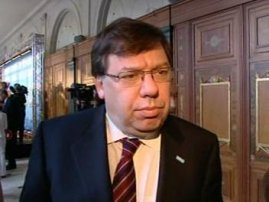
Taoiseach Brian Cowen (left) angrily denied suggestions that he was attempting to protect anyone involved in the Anglo Irish Bank share scandal.
He accused Fine Gael leader Enda Kenny of "impugning his reputation", a charge vehemently rejected by the Mayo TD and most senior deputy in the Dáil .

Cowen told the Dáil that his government was "determined to ensure that due process is followed" and that - if wrong-doing is uncovered - "people will face the legal consequences".

Minister for Justice Dermot Ahern (right) said that he "would prefer that the ten individuals involved [in the fraudulent share-buying scandal] be revealed", but that "due process must be allowed to take its course".

Meanwhile it has come to light that the annual report of the now nationalised Anglo Irish Bank, which is expected to be published on Friday, will reveal that a property owned by a member of (former bank boss) Sean FitzPatrick's family was rented by the bank. It is understood that this property is in London.

The Taoiseach stated that he regarded regulatory reform of banking as "a top priority".
In relation to the so-called 'Golden Circle' of ten fraudulent share buyers, he said the issue arose because of "due diligence by the government". He explained that the debts remained and his government would ensure that these debts would be collected by the bank.

Fine Gael leader Enda Kenny (left) said the government had been "far too timid" about the situation in Ireland's financial institutions, because it was responsible for the failure to regulate the banks properly.
He asked the Taoiseach if he agreed that "a fraud has been perpetrated on the Irish Stock Exchange".

Labour Party leader Eamon Gilmore (right) asked why Brian Cowen, when he was Minister for Finance, ordered the Revenue Commissioners to reverse its decision to impose stamp duty on Contracts for Difference (CFD).
These are high-risk investment 'products' where investors can bet on the future direction of a stock, without having to actually buy shares.
Eamon Gilmore said Brian Cowen had already confirmed that he had been lobbied about the issue, and asked for the identity of those involved.

In reply the Taoiseach said as far as he recalled, the lobbying came from "a professional body", but he promised to check with the Department and provide details.

Meanwhile the Green Party has said that it "could review its support for the government if politicians are implicated in the latest banking scandal".
"We are still committed to remaining in government, but that is not an open-ended commitment," the party's chairman, Senator Dan Boyle (left), told a news agency.
Remaining questions about the scandals should be answered quickly instead of the recent 'drip-drip' of revelations, so the damage to Ireland's reputation could be repaired, Boyle added.

After the debate Fine Gael Enda Kenny stated that the public deserved to know the names of the 'Golden Circle' members.
Speaking on RTÉ's Six-One TV News, he said the Irish people now own Anglo Irish Bank and "are entitled to know what is going on".

I wholeheartedly agree, as anyone with a sound mind would. And to go one step further: I do not understand why the government appears to know nothing about all these scandals, and still - after the matters have emerged into the public domain - makes no active efforts to find out what was - and is - going on.
Is it the high level of pure incompetence in our government we have to blame for that, or is Fianna Fáil fully aware of more skeletons hidden in the government's cupboards...?

The Emerald Islander

4000 Civil Servants protest at Leinster House

More than 4000 Irish civil servants and public sector employees took part in a rally outside Leinster House in Dublin (Ireland's parliament building) today, protesting against the controversial pensions levy the government is about to introduce.

The protest was organised by the Civil & Public Service Union (CPSU), which will announce the result of a ballot for industrial action within the next 24 hours.
If a majority of CPSU members support further action, it is expected that over 13,000 civil servants will hold a one-day strike on February 26th.

Members of the Garda [police] Representative Association (GRA) also joined the protest outside Leinster House (photo left).
Seeing policemen actively participating in such a protest (rather then accompany and police it) is quite a rarity.
But many Gardaí agree that the proposed pensions levy is unfair and that the burden of dealing with the current crisis and with the measures of economic recovery is not been spread equally across the community.

The protesters were met at the gates of Leinster House by Labour Party leader Eamon Gilmore (left) and his deputy Joan Burton, who is also the party's spokesperson on Finance. Both pledged their support for the concerns of the civil servants.

Meanwhile the legislation to impose a public service pension levy was published this morning. It is to be debated in the Dáil tomorrow and next week, and is due to go to the Seanad on Thursday of next week.

The Financial Emergency Measures in the Public Interest Bill 2009 - as it is called in full - includes provisions allowing public bodies to reduce the professional fees paid by them to external service providers.
It also includes changes in the early childcare supplement and the Farm Waste Management Scheme, which were announced at the same time as the levy.

Looking at the bill's name alone one has to wonder if politicians will ever be able to put things straight and in plain English that everyone can understand. Why is it that most of our laws have odd and longwinded titles and are phrased in a way no-one speaks? Not even politicians talk like that...

On top of the whole Civil Service and public sector, the proposed levy will also apply to all TDs - including Ministers, Ministers of State and the Ceann Comhairle (Speaker) and Leas Ceann Comhairle (Deputy Speaker) of the Dáil - as well as to all Senators, the Attorney General and Members of the European Parliament.
However, due to the provisions of the Constitution, the President and the Judiciary cannot be included in the measure.

If passed by both Houses of the Oireachtas (Ireland's parliament), the levy will apply to all earnings of the people affected by it, including allowances and overtime, from March 1st. The legislation specifies that no extra pension benefit is conferred by the deduction.

In light of today's demonstration and the generally unfriendly reactions the proposal has created in a large portion of civil servants and public sector workers, it remains to be seen if the bill will actually become law in the form and way the government wants. It is a fact that no government could function without the Civil Service and the many areas of the public sector.

Maybe the recent talks of the Social Partners were broken off without an agreement a little bit too hastily. As long as Ireland's rich and super-rich, many of which caused the current crisis, do not contribute their fair share to the recovery programme (and are seen by everyone to do so), the Irish are not in the mood for ever more sacrifices from the ordinary people - in the public as well as the private sector - while selfish and arrogant millionaires keep enjoying the wealth they creamed off the nation over the past decade.

The Emerald Islander

17 February 2009

Russian Oil Slick heads towards Irish Coast

A huge oil slick (photo above) in the Celtic Sea is heading towards the Irish coast and could reach the shore in about two weeks' time.

Ireland's Department of Transport and the Marine has confirmed that a spill of up to 1000 tonnes of fuel oil is floating just 43 nautical miles south of the Fastnet lighthouse and drifting towards the Irish mainland.

Aerial surveillance of the scene by the Waterford-based Coast Guard helicopter has established that the oil spill covers currently an area of approximately 4.5 km by 5 km, surrounding the Russian aircraft carrier Admiral Kuznetsov and a refuelling tanker of the Russian Navy (photo below).

Russia's Naval Attaché to Ireland has now confirmed that the Admiral Kuznetsov performed a fuel transfer from a Russian supply tanker at sea when the spill took place.

Meanwhile a spokesman from the Irish Department of Transport and the Marine said: "Several vessels are at the scene in the Celtic Sea at the moment. They include the Russian aircraft carrier, two refuelling tankers, one Russian ocean-going tug, one Russian destroyer, one British destroyer and the Irish Naval vessel L.É. Aisling. It is believed that the Russian Task Group may leave the Celtic Sea tomorrow, having completed their refuelling operations."

The Irish Coast Guard, in co-operation with the British Coastguard, is now carrying out aerial pollution surveillance flights over the area. Samples of the oil have been taken from the scene to be analysed.

As soon as further information is available, I will share it with you here.

The Emerald Islander

11 February 2009

MEP Kathy Sinnott marks European 112 Day

Today - February 11th, 2009 - marks the European 112 Day (11/2), which aims to inform all EU citizens about the European emergency telephone number 112.

More and more EU member states now organise a 112 Day on that same date, such as Finland, Romania, the Netherlands, Poland and Denmark. Here in Ireland, however, we have no time for such sensible things. We are much too occupied with ruining our country and tearing apart the social fabric of the Irish nation.

So while many people in Europe pause for a moment to reflect on better emergency services, the Irish government is dealing with emergency legislation and bailing out our failed banks with € 7 billion of taxpayers' money, but without doing anything about the rotten and deeply corrupt structure of these evil institutions, which are major causes and contributors to our massive and unprecedented economic and financial crisis.

Fortunately there is the independent MEP Kathy Sinnott (photo), who represents Munster in the European Parliament.
She did not forget and hosted a press conference in Brussels this morning, to mark the first EU-wide European 112 Day.

The campaign to establish an EU-wide 112 emergency telephone system has been under way for quite some time.
112
is compatible with all phone systems. The idea is to have a European call centre which can accommodate all the European languages, plus others like Mandarin (Chinese), Filipino Tagalog and Russian.
When someone dials 112 in an emergency from anywhere in Europe, the exchange can identify the location of the nearest emergency response system. If the caller's language is different from that of the working language of the response system, then the 112 call centre can provide translation.

Speaking this morning, Kathy Sinnott said: "I congratulate those who have been working so hard for the past 17 years to promote 112. In Ireland, the emergency number is still 999, like in Britain."
So it appears that in 90 years of Irish independence we did not even manage to drop the old UK emergency number...

"Would an Italian - for example - who is used to dialling 113 for police, fire and ambulance or 118 for medical emergencies know to ring 999 when he is in Ireland?" Kathy Sinnott asked. "The answer is most likely: No. This is where awareness of 112 comes into play."

During the press conference, Ms. Sinnott outlined a number of important details.

"Last year," she explained, "I wrote a report for the European Parliament on protection against injury and promotion of safety. What I learned while researching this report is that people are most in danger of injury during times of leisure, and especially on holidays. For example, a Hungarian tourist breaks his leg while hill walking in West Cork. He can free-phone 112, speak to someone in Hungarian who will put the call through 999 to reach Bandon Garda Station and translate for the Garda on duty. If we were to develop this technology further, translation from 112 could remain available to the tourist even when he reaches hospital."

"Another point I would like to mention is the use of 112 for people who are trafficked to another country against their will. With this very simple number, people deprived of their normal freedom, if they were able to get even a moment alone with a telephone, could dial 112, speak to somebody in their own language and get help."

"This is a real tool which could be very effective, especially in today's multi-cultural society. Sadly, at present only 27% of Irish people are aware of 112. The Irish government have a legal responsibility to promote awareness and use of 112 through the 2002 Directive on universal service and user's rights relating to electronic communications networks and services. I call on our government to put this Directive into practice and start saving lives - now."

One can only hope that someone in Government Buildings was listening to Kathy Sinnott and that after seven years of forgetting the matter one of the many ministers can be found to implement it. I presume they cannot all be busy with bailing out failed banks and organise cosy retirements for corrupt bankers and senior civil servants.

The Emerald Islander