13 September 2008

Asgard II Crew returns home as Inquiries open

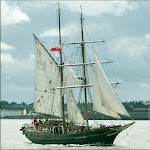
The crew of the Irish brigantine and sail training vessel Asgard II (archive photo above) which was lost at sea off the coast of Brittany on Thursday morning (for details see my entry from September 11th), has returned home to Ireland yesterday evening.
Captain Colm Newport, five regular crew members and twenty trainees who had to abandon ship in pitch-darkness after a sudden ingress of water had turned their vessel into a floating hulk, arrived save and sound at Dublin airport.

After being rescued by the French Coast Guard, they had spent a day on Belle-Île-en-Mer, an island off the southern coast of Brittany, close to the Quiberon peninsula and Quiberon Bay.

Despite the shock and sadness over the loss of the nation's only proper sail training vessel, the good news is that no human life was lost and no-one suffered injuries. Some of the trainees still looked a bit shaken when they landed in Dublin last night, but that will pass. They all behaved in a professional and disciplined way, even under extreme and traumatic circumstances, and that shows that their training has been successful after all.

Meanwhile the Irish Marine Casualty Investigation Board (MCIB) and its French equivalent, the Bureau d'enquêtes sur les événements de mer, have begun their separate inquiries into the circumstances of the sinking of the Asgard II.

As the brigantine is now in waters about 90 metres deep, it is doubtful if an attempt to raise and salvage her can be made or would be sensible. A detailed survey in respect to that and to the vessel's current condition has yet to be conducted and might take a while.

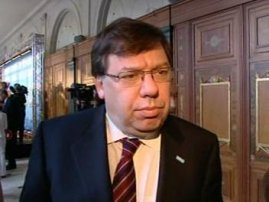
However, the general opinion in Irish maritime and sailing circles is that building a new vessel as replacement for the Asgard II might be the better and more likely option. Unfortunately the loss comes just at the beginning of an economic recession in Ireland, and one has to wonder if Finance Minister Brian Lenihan (who is not the seafaring type) will find enough money in the treasury for such a project.

But all is not lost, even if the Irish government should decide that it has no money for another sail training vessel. We could employ a procedure which has been used with great success in the past, and especially throughout the 19th century (when most people had a lot less money than they have today). I am thinking of Public Subscription, a joint effort of many individuals, putting together as much money as they can afford to give, in order to create a large project. Carlow cathedral, Wellington's obelisk in Phoenix Park in Dublin, and the municipal Clock Tower here on the Quay in Waterford are three examples of works created entirely by using that system.

I am neither a politician, nor rich, so I have neither the power nor the money to start a possible public subscription campaign. But I have pitched the idea already to a cabinet minister and a TD (member of parliament) yesterday, in the hope that it will sink in and influence the government in a positive way.

In less than three years Ireland and Waterford will host the start of the annual International Tall Ships' Race again. It would be very desireable to have a proper national sail training vessel in service again by then.
I still remember how the Asgard II (accompanied by the other two Irish tall ships Dunbrody and Jeannie Johnston) led the Parade of Sails out of our port and down the river Suir in 2005. It was the first and only time that all three Irish tall ships were appearing together.

Speculations that for the time being the Dunbrody and Jeannie Johnston might temporarily be drafted in as sail training vessels might have some substance, but it is doubtful if that would be a good idea and a workable solution. Both barques are replicas of 19th century originals and the main purpose they have is to be a floating museum. The Dunbrody does not even have a full certificate for the high seas, which the Jeannie Johnston was granted after a major struggle with the Irish bureaucracy. Both vessels also operate an extensive programme of corporate entertainment and that provides a significant part of their budget. So it is more than unlikely that they could really function as proper sail training vessels like the Asgard II did.

Having put my idea forward into the political channels, I hope it will be taken up, so that the gap created in the sail training community by the loss of Asgard II will be filled as soon as possible.

The Emerald Islander

12 September 2008

Waterford Man arrested for Shooting at Girl

A 27-year-old man from Waterford - charged in connection with the shooting of a teenage girl in the city on Monday - has been remanded in custody.

Patrick Stokes from Ardmore Park in Ballybeg (an area renowned for troubles and crime) was charged at a sitting of Waterford District Court tonight with "assault causing harm" and a firearms charge. He was granted free legal aid and will appear again before the Court next Thursday.

16-year-old Bridget Delaney was injured during a shooting incident outside her home in Bilberry on Monday night.

"eFlow" is a Shambles

Less than two weeks ago I wrote about the organised highway robbery of Irish toll roads, which is now done completely electronically and without employing any longer people in toll plazas.

As I decided to boycott the system and never use the M 50 motorway around Dublin, I do have of course no personal experience with eFlow, as the rip-off is now called to make it sound snappy.

But I just read two entries - in the blogs of Eoin Brazil and John Browne - that tell in detail how the eFlow online payment system works. Or rather not works, I should say, as both bloggers describe in detail how they struggled in frustration when they tried to hand over their € 3 toll fee.

This confirms my initial worries and suspicions about eFlow (see my entry from August 31st) and in fact things are actually worse than I thought. If you are interested, have a look at the entries of Eoin and John and read it for yourself. The links are:

http://braz.blogspot.com/2008/09/eflowie-broken-and-lacking-any-ia-or.html

and

http://www.johnbrowne.ie/?p=47

If you have any common sense, you follow my example and boycott the M 5o as well. Or if you are a good lawyer, perhaps you might think of making a name for yourself by challenging the eFlow rip-off in court. Good Luck!

The Emerald Islander

P.S. It is interesting and quite telling that the place from which eFlow is operated is not even in Ireland, but in Bristol / England. And there I was, thinking this country is independent from the UK ...

Great Northern Bank Robbery Case in Court

The father of a Northern Bank official accused of having participated in the spectacular £ 26.5 million (€ 32 million) robbery on December 20th, 2004 has dismissed the prosecution case as "ludicrous".

Christopher Ward's father was giving evidence on the second day of the trial. He said the men who held his family hostage for 24 hours at their home in west Belfast and took away his son were "criminals who would stop at nothing".

As to the claims that his son colluded with the robbers, he said Christopher would never have set his family up to be held captive, nor put his mother through such an ordeal. Mr. Ward senior also rejected a suggestion that his family had a "cosy relationship" with their captors.

26-year-old bank clerk Christopher Ward from Poleglass on the outskirts of west Belfast denies a charge of robbing the bank just before Christmas in 2004. The trial continues.

It is interesting to notice that the massive accusations, made by the Police Service of Northern Ireland (PSNI) and northern politicians shortly after the robbery, have disappeared into thin air.
In 2004 and early 2005 leading members of the Unionist parties, as well as senior PSNI officers, were convinced that the crime had been committed by the Provisional IRA and followed that lead in their enquiries. The matter led also to political frictions between Unionist and Nationalist parties in the North and threw the peace process into a crisis.

The Provisional IRA denied any involvement in the crime, and leading Sinn Féin politicians said it was a "stunt to derail the peace process". Despite massive searches only a small fraction of the money has been recovered and the professionally executed crime remains the largest robbery of all times in British history.

A rarely reported fact is that on February 18th, 2005 the PSNI recovered £ 50,000 in unused Northern banknotes (which were identified as part of the stolen money) at Newforge Country Club, a sports and social club in Belfast for off-duty and retired police officers, owned by the PSNI's Athletic Association. And ever since the robbery took place there have been speculations, especially in Nationalist circles, that the crime was committed by British special forces, trying to behave and look like members of the Provisional IRA, in order to stop or derail the ongoing peace process.

Numerous arrests were made on both sides of the border, but so far neither the real culprits nor the bulk of the stolen money have been found and Christopher Ward remains the only person brought to trial. Even though many things have changed in the North, some of the old problems seem still to exist.

The Emerald Islander

Pope urges the EU to promote Human Rights

Pope Benedict XVI has said that Europeans would work actively for the EU when they saw and experienced personally that it promoted Human Rights.

Beginning a four-day visit to France - which currently holds the rotating EU presidency - he also told dignitaries his greatest concern was that young people should be encouraged to respect and help others.

Arriving at Orly Airport in Paris, Benedict XVI was welcomed warmly by the French President Nicolas Sarkozy, his wife Carla and senior members of the French hierarchy. The two heads of state then took the salute of a guard of honour, provided by the infantry component of the Garde Républicaine.

At the Élysée Palace the Pope later met Nicolas Sarkozy privately, before addressing ministers of the French government and other dignitaries. He told them that Europeans would work actively for the EU when they saw and experienced personally that it promoted inalienable human rights to free education, to family life and to work as well as religious rights. This, he explained, would allow them to understand fully the greatness of the EU project.
He said his greatest concern was that young people should be soundly educated and encouraged to respect and help others if they are to develop serenely towards an age of responsibility. He also expressed concern for the surreptitious widening of the gap between rich and poor in the West and the state of the planet.

Later the Pontiff delivered a keynote address to hundreds of intellectuals, researchers and artists, before praying with thousands of people at Notre Dame Cathedral.

Tomorrow Pope Benedict will travel to Lourdes to celebrate the 150th anniversary of the apparitions there.

Gormley called "a Disgrace" at Cork Meeting

Today Cork councillors have been briefed by the Minister for the Environment, Heritage and Local Government, John Gormley (photo left) on the preliminary findings of a report into toxic waste at Haulbowline.

But the session did not progress quite as planned or expected.


Tumultous scenes, emotions and anger erupted in the Town Hall of Cobh during the meeting, whose main subject was a report - compiled by consultants - into the risks posed by waste on the former Irish Ispat site.

Mayor John Mulvihill Jnr had to plead with his father, County Councillor John Mulvihill Snr, to let Gormley speak.
But Mulvihill Snr was having none of it. He accused the minister of being "a disgrace" and told him to resign his position. He also accused Gormley, who is leader of the Green Party, of "not taking the health concerns of people seriously".

Eventually the Mayor, as chairman of the meeting, was forced to intervene again, asking his father to sit down and allow the minister to answer questions from other Councillors as well.

On his way into the meeting John Gormley said that preliminary findings indicate that "the site does not pose a health hazard and people do not have cause for concern".

Last June the minister had promised a full report into the health risks of over 500,000 tonnes of toxic material deposited on the island (photo right) and his plans for a clean-up.
This followed claims by a sub-contractor involved in site clearance work that his company had found Chromium 6, a cancer-causing compound that can be toxic in tiny doses (and is the toxic that sparked a meanwhile famous legal crusade by Erin Brockovich in the USA).

Local councillors were visibly angry that John Gormley had not met with them directly since concerns about the site first came to light.
In the decade before the old steel plant closed in 2001, more than 500,000 tonnes of hazardous waste was dumped on Haulbowline, the same island that also houses Ireland's only naval base (including the HQ of the nation's Naval Service).

The Emerald Islander

No Progress made at National Pay Talks

Talks in Dublin to secure a new national wage agreement have been adjourned with no progress and are set to resume at 2.30 pm tomorrow. When they were restarted at the begin of the week, it had been the expressed aim of all sides to come to an agreement by Friday. But so far the gap between the positions of the Social Partners seems still to be large and unbridgeable.

Employers' negotiators arrived at Government Buildings earlier today for what is expected to be a three-day intensive push to secure an agreement.

David Begg (photo right), general secretary of the Irish Congress of Trade Unions (ICTU) described the next 24 hours as "crucial if there is to be any hope of securing a new agreement".

He said there would have to be movement over the weekend, if the one-week time frame to broker a deal - set by Taoiseach Brian Cowen - is to be met.

All the key issues were still in play and talking over the last four days had been about securing each other's position, he told the media in Dublin earlier today.

"The Government could not put proposals on the table until it knows whether an agreement is possible," he added.

Larry Broderick, general secretary of the Irish Bank Officials Association (IBOA), said he was not confident that a deal could be reached. There had been no sign of movement from employers or the government.

All trade unions have warned that any new agreement must protect vulnerable, low-paid workers who have been worst hit by inflation.

Cowen to assess Prospects of Deal

Meanwhile Brian Cowen said an assessment would have to be made later today on whether progress can be made on the latest round of pay talks.

Speaking in Daingean (in his home county Offaly), the Taoiseach said it had been agreed that another week would be given to try and achieve a deal between both sides, but while the talks continued, it would be necessary to carry out an assessment to see if any progress could be made in extending the process.

11 September 2008

Asgard II lost at Sea

This morning very sad news came across the sea from France, sad for the whole of Ireland, and also for the large community of sailors, seafarers and tall ship fans everywhere.

It has been reported that the Asgard II (photo above), our country's beautiful sail training vessel, was lost at sea at 8.25 am local time (7.25 am Irish time) about twenty nautical miles off the French coast, south of Brittany and southwest of Belle-Île-en-Mer.

The two-masted brigantine had earlier been abandoned after taking on a lot of water, turning her into a floating hulk (see photo right).

The alarm was raised in total darkness shortly before 2.30 am this morning. Shortly after the vessel's Master, Captain Colm Newport, had no choice but to give orders to abandon ship. The five regular crew members and twenty trainees, most of them Irish, transferred to life-rafts (see photo left).

Captain Newport said that the vessel was abandoned in an orderly fashion and with no injuries, and that all 25 people were off the Asgard II in four or five minutes. They stayed alongside the stricken vessel while communicating with the French Coast Guard and sending a distress signal.

Within twenty minutes from the initial alarm, they had to move the life-rafts away from the vessel, which had water up to its deck at that stage.

Crew and trainees were rescued by the French Coast Guard who despatched two lifeboats and two helicopters to the scene.
They were taken to a hotel on the island of Belle-Île-en-Mer.

In an interview with RTE Radio Captain Newport said that he has no idea what caused the ship to sink, adding that it would be foolish to speculate. He explained that there was a "sudden ingress of water", which caused the vessel to lose stability.
All those on board were now in contact with their people at home, were in warm clothes and being looked after well by the people on the French island. However, they had been through a traumatic event. (Being a sailor myself, I can well imagine how traumatic it was, especially for the young and inexperienced trainees...)

The Irish Ambassador to France, Anne Anderson, is traveling from Paris to Belle-Île-en-Mer to meet the crew and trainees.

It is still not clear what caused the loss of the Asgard II, and at this stage it is doubtful if it will be possible to salvage her, even though her last position has been documented. Should a salvage not be possible, it is further doubtful if - in the present recession Ireland experiences - there will be funds to build a replacement. However, the early 1980s were a difficult time for the Irish nation as well, but nevertheless the government still saw fit to build and commission the vessel.

The Asgard II is Ireland's official national sail training vessel. A beautiful traditional brigantine with her hull painted in a deep emerald green, she was designed and built in Arklow, Co. Wicklow by Jack Tyrrell and commissioned in March 1981 by the then Taoiseach Charles J. Haughey. She has a traditional figurehead in the form of a carving of Granuaile.
Her name was taken from the yacht Asgard (now preserved in Kilmainham Jail museum in Dublin), which played a special role in Irish history, in particular as the vessel that brought rifles for the Irish Volunteers from Germany to Ireland in preparation of the 1916 Easter Rising.

Owned by the Republic of Ireland, the Asgard II is a civilian-run training vessel and managed by Coiste an Asgard (chaired by Minister for Defence Willie O'Dea, TD), which is also a founding member of Sail Training International (STI), the organisers of the annual International Tall Ships' Race.

It fills me with great sadness to learn of her loss, as I remember her very well from many happy encounters at sea and here in the port of Waterford.
Three years ago, when Waterford hosted the start of the International Tall Ships' Race, it was the Asgard II (accompanied by the other two Irish tall ships Dunbrody and Jeannie Johnston) who led the Parade of Sails out of the port and down the river Suir to the race's official starting point at Dunmore East. It was a joy for me to see her leading a parade of 88 tall ships and vessels (28 of them large class A ships), as a sailor and as a member of the team that organised and ran the event.

In 2011 Waterford will host the same event again, and should a salvage of the Asgard II not be possible, she will be missed very much by many, including me,

The Emerald Islander.

UPDATE

For an update please see my entry from September 13th

'Big Bang Day'

Yesterday has been designated as 'Big Bang Day' by scientist and media around the world. The reason was the official start of operations at the Large Hadron Collider (LHC) at the European Research Centre CERN in Geneva.

CERN is the abbreviation of Conseil Européen pour la Recherche Nucléaire (European Council for Nuclear Research), which was a provisional council for setting up the laboratory, established by eleven European governments in 1952. The acronym was retained after the provisional council was dissolved and the name changed to the current OERN - Organisation Européenne pour la Recherche Nucléaire (European Organisation for Nuclear Research) in 1954.

For more than fifty years now CERN has been the number one (and the world's largest) research institution for Particle Physics. It's main function is to provide the particle accelerators and other infrastructure needed for high-energy Physics research. Numerous experiments have been conducted there by international collaborations. The main site at Meyrin (photo below), a suburb of Geneva in Switzerland, also has a large computer centre containing very powerful data processing facilities, primarily for experimental data analysis. Because of the need to make them available to researchers elsewhere, CERN has historically been (and continues to be) a major world-wide networking hub and was in the early 1990s the original initiator of the world-wide web or internet (invented by CERN scientist Tim Berners-Lee).

More than 10,000 scientists from many different countries are currently working for CERN on various research projects. It is a truly international institution, which is officially neither under Swiss nor French (some of the facilities are on French soil) jurisdiction. The 20 member states of OERN (Austria, Belgium, Bulgaria, the Czech Republic, Denmark, Finland, France, Germany, Greece, Hungary, Italy, the Netherlands, Norway, Poland, Portugal, Slovakia, Spain, Sweden, Switzerland and the UK) contribute for this year a total of 1 billion Swiss Francs (about € 664 million, US$ 1 billion) to the operational costs of CERN. Six countries from outside Europe (India, Israel, Japan, Russia, Turkey and the USA) as well as the EU Commission and UNESCO have an observer status at CERN.

From 1989 to 2000 the most advanced facility of CERN was the Large Electron-Positron Collider (LEP), which was the world's largest machine of its kind and housed in a 27 km long circular tunnel (right), 100 metres underground, ranging from Geneva's airport to the Jura Mountains. In eight years of hard and highly sophisticated work the LEP was replaced by an even more powerful machine, the Large Hadron Collider.

The LHC (detail photo left), which cost over € 6 billion and took 14 years to develop, is the world's largest and most sophisticated machine ever built, as well as the largest science experiment on the planet. It is designed to smash protons together with cataclysmic force and scientists hope it will shed light on fundamental questions of Physics. Its main aim is to recreate the conditions in the seconds after the 'Big Bang' that created the Universe.

Findings from the research could revamp modern Physics and unlock secrets about the Universe and its origins. The experiments might also lead to the discovery of so far unknown forms of energy, which would not only solve the current world energy crisis and end our dependence on highly polluting fossil fuels, it could also help to develop propulsion systems that would enable us to conduct space exploration to far-away regions of the cosmos, which are not reachable with the conventional technology we have developed so far. If the kind of space flight we see in StarTrek should ever become possible, CERN and especially the LHC could provide the key knowledge for it.

Yesterday morning at precisely 9.38 am CEST (8.38 am BST) the LHC was officially switched on for the first time. Moments later the group of scientists assembled in the control room burst into spontaneous applause and shouts of joy when project leader Lyn Evans told them: "We have a beam on the LHC."
The first - clockwise - beam completed its first circuit of the underground tunnel at just before 9.30 am BST. The second - anti-clockwise - beam successfully circled the ring after 2 pm BST.

The beams have not yet been run continuously. So far, they have been stopped after just a few circuits. This evening engineers hope to inject clockwise and anti-clockwise protons again, but this time they will "close the orbit", letting the beams run continuously for a few seconds each.

CERN has not yet announced when it plans to carry out the first collisions. It is expected that low-energy collisions (like the one pictured right, which was done in the old LEP) could happen in the next few days. This will allow engineers to calibrate instruments, but will not yet produce data of scientific interest. This will come at a later stage. It is impossible to say how long it will take, but there is no doubt among scientists that the LHC will provide answers to the most fundamental question: What is mass?
That alone would bring Physics a huge step forward, and anything beyond that would be a bonus. The scientists at CERN can at this stage not say much more, but they are confident that with the help of the LHC they will be able to reshape the 21st century in yet unimaginable ways. But the first and most important step is to recreate the 'Big Bang', to see how the Universe was formed and to understand how it works.

"We will be able to see deeper into matter than ever before," said Dr. Tara Shears, a particle physicist from the University of Liverpool.
"We will be looking at what the Universe was made of billionths of a second after the 'Big Bang'. That is amazing and really fantastic."

"We know the answer to the question of our existence will be found at the LHC," added Prof. Jim Virdee, a particle physicist from Imperial College London.

The currently favoured model involves a particle called the 'Higgs boson' (named after the British scientist Dr. Peter W. Higgs) or BEH Mechanism, popularly also called the 'God Particle'. It is a hypothetical massive scalar elementary particle, predicted to exist by the Standard Model of Particle Physics, and is the only Standard Model particle not yet observed. According to the theory, particles acquire their mass through interactions with an all-pervading field carried by the 'Higgs boson'.

The latest astronomical observations suggest that ordinary matter - such as the galaxies, gas, stars and planets - makes up just 4% of the Universe. The rest is dark matter (23%) and dark energy (73%). Physicists think the LHC could provide clues about the nature of this mysterious "stuff".

"Nature can surprise us. We have to be ready to detect anything it throws at us," said Prof. Virdee.

The idea of the Large Hadron Collider emerged in the early 1980s. The project was eventually approved in 1996 with an original budget of 2.6 billion Swiss Francs. However, CERN underestimated equipment and engineering costs when it started the project, and subsequently the institution was facing a cash crisis. CERN had to borrow hundreds of millions of Euros from banks to get the LHC completed. The current price is nearly four times of what was originally envisaged.

During winter the LHC will be shut down, allowing the equipment to be fine-tuned for collisions at full energy, which are expected to take place next year.

I am no scientist, but I take an interest in the fundamental questions of this world. And though I do not understand all the details of the experiments conducted by CERN, I find them - as well as the fact that CERN exists at all - fascinating. And I share the hopes of the thousands of scientists involved that with enough effort the secrets of the Universe will eventually be revealed, for the better of all of mankind.

It is also interesting that the LHC has been built and is operated by 20 European countries, and not by the world's apparently one remaining 'super power', the USA. Ever more Americans seem to fall under the spell of fanatic religious fundamentalists who denounce evolution, science and the realities of Nature and believe in 'creationism' (or 'intelligent design'), which pretends that the world was created by 'God' in six days about 6000 years ago (as described in the Old Testament of the Bible). These people have gained a lot of political influence and power in recent years, counting among their believers many prominent Republican politicians, including George W. Bush and Sarah Palin.

In my opinion this will eventually destroy the USA and diminish America's power and influence in the world. It is already evident that the USA are by far not as organised and powerful as they pretend to be. Their health care, education, social security and housing are in disarray, their banks and financial institutions are collapsing one after another, and crime of all sorts rules in all parts of the USA (with more than 2 million people - out of 300 million - in prisons), right from the White House down to the last slum.
Since America does no longer produce enough people with high academic, scientific and technical qualifications, the USA are for the past 20 years already dependent on qualified immigrants from all over the world, even to maintain the status quo of research, science and technology. Sooner or later this brain drain will dry up, and the consequence of that will be stagnation, followed by rapid decline.
The only kind of power the USA still have is the brute force of their military. And that is already shrinking as well, since George W. Bush created two wars they will never be able to win. Thus the strength and morale of the armed forces is undermined and will eventually collapse like the housing market and the financial institutions.

Meanwhile Europe has created the greatest scientific institution in history, and with the LHC the largest scientific experiment ever attempted by mankind. I am very happy to have the privilege of living in Europe, which will in future stand strong beside the coming 'super powers' China and India. If the LHC will indeed provide the answers CERN scientists expect to find, Europe could even - once again - become the dominant force on the planet. This time - hopefully - as leaders in philosophy, science and technology rather than as colonialists.

The Emerald Islander


P.S. I did start this entry already yesterday, but due to work commitments I had no time to finish it. I hope you don't mind that it is posted one day after the event, and hope you will find it still interesting and worth reading.

09 September 2008

Great Homecoming for Waterford Hurlers

Having reported here on the final of the All Ireland Senior Hurling Championship on Sunday (see my entry from September 7th), it is only proper that I also tell you how the Waterford Hurlers were received when they returned home from Dublin yesterday evening.

Well, as I had already predicted on Sunday, the fact that they lost the match and were beaten with a wide margin by the star team from Co. Kilkenny, did not matter anymore after 24 hours of grief and sorrow had been washed down with a good few pints of beer.
By the time the train from Dublin, on which the team traveled, rolled into Plunkett train station in Waterford City, thousands of loyal fans from the city and all over the county had - despite the bad weather with pouring rain - already gathered along the South Quays to give them a very warm and enthusiastic welcome.

After leaving the train, the team traveled the short distance from the station, across the Edmund Ignatius Rice Bridge, on the top of an open doubledecker bus, decorated in the county colours white and blue. Ignoring the rain and wind, the crowd cheered frantically, and applauded loudly as the bus with the hurlers passed.

At the Quay a special platform had been erected by the City Council, and the local dignitaries had assembled to bid the hurlers a ceremonial civic welcome. Martin Cullen, Minister for the Arts, Tourism and Sport, and - more important last night - one of our local TDs, addressed the roaring crowd and sang the praise of the Waterford team as only an Waterford man could do it. Mayor Jack Walsh also gave a rousing speech and welcomed the team "that had done the best they could" home to their city.

It was a great turnout, showing how much the heart of Waterford people is connected with the sport of Hurling and especially with our county team. One has to wonder how they would have behaved had Waterford actually won the Liam McCarthy Cup...

The Emerald Islander

Another Charter Airline in Trouble

There is some good news today for the environment. Another airline has closed down, and if this goes on for another while, the pollution of the atmosphere might actually come down significantly over Ireland.

However, what is good news for environmentalists is rather bad news for the tourist industry.

Seventy employees of Futura Gael, the Irish division of charter airline Futura International Airways, based in Mallorca, have been temporarily laid off after the company decided to seek bankruptcy protection in a Spanish court. A further twenty employees have been put on notice.

The move, which has been blamed on rising oil prices, has thrown the travel plans of thousands of Irish holiday makers into doubt. (This again is good news for the environment.)

The airline, which operated charter flights to the Mediterranean and Eastern Europe, says it has suspended all flight operations, but cannot say for how long.

Futura International Airways was founded in 1989 by Ireland's main airline Aer Lingus, but they sold off their majority stake in 2002 and its last 20% in October of last year.
The Irish-based subsidiary Futura Gael employs 90 people at its Dublin offices and on its aircraft.

The Emerald Islander

More Rain and Floods in Cork and Munster

Met Éireann, Ireland's meteorological office, has warned once again of a risk of flooding, following heavy rain fall last night and today.

Further rain falls of between 25mm and 50mm are predicted, with Connacht and Munster most likely to be affected.

Meanwhile Gardaí in Cork said that traffic is now back to normal, after delays had been caused by heavy surface flooding in the city (photo). A number of road closures were put in place across the city and there were various cases of flooding also in Co. Cork.

Continuing heavy rain has also left thousands of acres of farmland in the West of Ireland flooded.

The Irish Farmers' Association (IFA) says that this year's barley harvest is particularly at risk, but dairy farmers are also running out of pasture land, much of which is now under water.

An IFA spokesman said that farmers in East Galway and in the Shannon basin are among the worst affected, while there is also flooding in the Oranmore and Headford area of the county.

Conditions are described as 'unbelievably bad' and among the worst many farmers have experienced in living memory.

08 September 2008

188 Croke Parks of new Retail Space

A new consultancy study has found that retail floor space in Ireland has almost quadrupled over the past five years.
The report, commissioned by the independent retailers' group RGDATA, also predicts a further growth and expects that shopping centre and retail warehouse space will grow by another 40% in the coming years.

The study, compiled by MacCabe, Durney & Barnes Consulting, shows that retail space in the Republic of Ireland has grown during the past five years from 400,000 sq.m to 1.5 million sq.m.
"This would be enough space to create 188 stadiums the size of Croke Park," a GAA fan among the consultants remarked.

As a major reason for this massive growth in shopping and warehouse space the consultants identified the expansion of the two German supermarket chains Aldi and Lidl into Ireland. They have opened 135 new stores in the country since 2000, providing not only many new jobs, but bringing for the first time in decades real competition - and thus greater choice and lower prices - to the Irish retail market.

In comparison, the British supermarket giant Tesco, which is losing market shares in Ireland in recent years, has opened only 22 new stores here since 1997.

The Emerald Islander

Lisbon Research - A Smoke Screen for Fools

This week the Irish government is due to receive the 'final version' of research (one has to wonder how many versions there have been before, and how much they have been manipulated until they say what the government wants to hear) carried out to assess why people voted NO to the Lisbon Treaty.

But Micheál Martin (left), our Minister for Foreign Affairs, seems to know already what the study has found. Did he see an advanced copy of the 'research' ahead of the rest of the cabinet? Or is he the one who manipulated the results? How else can he have the information?

In a public statement over the weekend Martin said that "it is already clear that the fear of conscription into a European army was a much bigger issue than previously thought".

What a load of nonsense! If it were not so serious, one could take it for a joke. I have been very much involved in the discussion and campaign before the referendum on the Lisbon Treaty, taking part in many of the debates organised by the National Forum on Europe and speaking with a large number of people on the streets in various parts of Ireland. So I know a thing or two about the treaty, the national debate and the concerns people had.

Alright, there were some who expressed worries about a possible European army and the slight possibility that Irish people could be drafted into that. But they were a tiny minority and mostly people with not much knowledge about politics and the institutions of the European Union. When the matter was raised, it was predominantly by women who feared that their sons might be sent to serve in an 'EU army' (which does not even exist) against their will.

Such can and will never happen, as the Irish Constitution has a clause to prevent it. I did wonder during the campaign how well Irish people actually know our own Constitution, and if it is taught in schools at all.

Personally, as a former naval officer who served many years with NATO, including in some of its multi-national commands, I would actually welcome an integrated European army, with peace as its main aim and peacekeeping missions as a possibility. (During the four decades NATO was a peaceful but deterrent organisation, it kept and guaranteed peace in Europe. Now that the USA have turned it into their auxiliary force for the final Americanisation of the world, it has lost most of her original qualities and needs a replacement in Europe.)

I would also be in favour of a national service - including service in the armed forces - for Ireland in the near future. Such a service could solve many of our current problems and create a deeper understanding of the nation and the state among young people at the same time. Especially the young men, naturally full of testosterone, would find a meaningful way of using their surplus of energy in a national service. But in the age of equality I would have girls serve as well (as they do already in the armed forces and the Garda Siochana on a voluntary basis).

Anyone with common sense will see the benefits of such a proposal, and the only reason why we do not have a national service already is our history, in particular the traumatic experience with the British army. But that is a long time ago, and times change. In fact, there are plenty of young Irish men currently serving voluntarily in the British armed forces, because the minute size of the Irish military prevents them from serving their own country. This is a real shame, and in any other country I know it would be seen as scandalous.

This subject needs to be discussed in more detail at another time. But it is interesting and significant that the government chose it as an apparent reason for loosing the referendum. They know very well that it had no real relevance for the referendum, so they use it deliberately as a smoke screen to confuse fools.

Since making one idiotic statement at a time is seldom enough for our government, the minister felt obliged to add another, declaring the government had been "asked by a number of US companies if the vote meant Ireland might leave the EU, and whether they should continue to invest here".

This is even worse than his reference to a non-existent EU army. I doubt that such questions have been asked at all, and I challenge Micheál Martin to provide us with proof for it. (Should any US industrialist or businessman have indeed asked such a stupid question, it would only show how dumb Americans have become, and how little they know of the world as it is.)

But this is not a new tag of the government at all. It only underlines the twisted arguments used by the YES campaign (including the Labour Party and especially Fine Gael) before the Lisbon referendum. Many of the politicians who advocated a YES vote were trying to scare the people with a whole bunch of lies and made-up scenarios - such as Ireland leaving the EU, or foreign investment drying up - all through the campaign. (Fine Gael MEP Gay Mitchell went even as far as using the Second World War as an argument, obviously forgetting that Ireland was not a part of that conflict...) So all Micheál Martin is really doing here is trying to serve us a new brew-up of the same old weak tea. It won't work, since the Irish people are no fools.

Speaking at the fringe of an EU foreign ministers meeting in the French city of Avignon, Micheál Martin said that "there is a need for the government and the people of Ireland to understand where we are coming from (regarding the Lisbon vote) and to communicate that to our colleagues".

Well, the people of Ireland know very well where they are coming from, and with their votes in the referendum they have clearly shown that they also know where they want to go. Obviously such clarity does not exist in our government, and I cannot say I am surprised. And thus there is of course also the problem how to explain to other governments and EU institutions a matter one has not clarified oneself.

Trying to shift the burden of political decision onto the people is quite ridiculous. This is clearly the job of the government between elections. In case the government feels no longer able to do what is expected, they can always call an election...

There is however some hope left, as Micheál Martin also said that "it is timely for us to have a look at our membership of the EU and how we engage with it into the future".

Well done, Minister! You seem to have finally understood what the referendum was all about and why the majority of our people rejected the Lisbon Treaty. Now it would be nice if you would act accordingly. Listen to what they have said. They did it clear enough.
There is no need for any 'research' to understand one's population. Governments who need that are so far removed from reality and from their electorate that they won't last very long.

So, Minister, be so kind and stop trying to fool us with smoke screens. Accept the people's vote and decision, and do what you are paid for: govern the country!

The Emerald Islander

National Pay Talks continue in Dublin

While the country as a whole (and especially the South East) is still recovering from yesterday's All Ireland Hurling finals, life goes on, focusing on more serious matters. In Dublin the crucial talks on a new national pay agreement continue in a gloomy atmosphere, overshadowed by the economic recession the country has fallen into after more than a decade of massive boom and excitement.

The employers' lobby group IBEC has eventually decided to join the talks this afternoon, while representatives of the trade unions and the government resumed negotiation this morning.

Going into the talks, some of the unions rejected out of hand the notion of a pay freeze, which has been mooted especially by IBEC (and supported by some members of the government).

Both employers and trade unions are trying to secure a new national pay agreement by Friday, but the signs are not particularly encouraging.

Betty Tyrrell-Collard of the CPSU - which represents lower paid public service workers - declared that a pay pause for her union's members would be "an absolute non-runner".
She said a pay pause for people who earn more than € 50,000 per year would be acceptable. But she added that clerical staff that are low paid and work hard to secure bonuses for higher paid positions could not suffer.

Jack O'Connor, general president of Ireland's largest trade union SIPTU, said he wanted to "make sure a deal could be done". But the unions would "not agree on an exercise to insulate businesses profits".
He refused to reveal details of what SIPTU would be demanding, but said that all unions needed to decide on a way forward.
"There is a broad consensus on a deal that will take the economic condition into consideration and protect lower paid workers," he stated before entering the talks.

John Douglas of the Mandate trade union (which has many members employed in the retail sector) said that "there will be no deal unless the low paid are protected".
He pointed out that the ball was in the court of the employers, and "something will have to be found to deal with the difficult issues for low paid workers, who have not been dealt with fairly in previous agreements". Now more than ever efforts were needed to deal with the low paid.

Larry Broderick of the Irish Bank Officials Association said he was not optimistic heading into the talks, adding that "the government needs to put something constructive on the table if the talks are to be successful".
He emphasised that his staff would not react well to a pay freeze and said that "a new structure is needed and new legislation on constructive bargaining as well". He also suggested a "flexible arrangement on pay at local level, so different approaches can be taken in different companies".

Peter McLoone, general secretary of IMPACT, said he hopes that at the end of the week a clear package for public sector workers will be on the table. What the government has in mind with regard to a public sector pay freeze "must be clear" and "the purchasing power of low paid people within the public sector must be protected".
"It makes no difference what sector you work in when it comes to buying products and trying to live."

Well, Mr. McLoone - as usual - puts things clear and simple as they are. And he is absolutely right with his statement. Given the massive and constant increases in the costs of living, especially the rocketing prices for food, fuel and electricity, this is the most important element in the pay talks for the vast majority of Irish people.

Taoiseach is "available to assist"

Meanwhile Taoiseach Brian Cowen has stated that "all sides in the talks must take account of the changed economic circumstances".
Speaking in Tullamore (in his home county Offally), Cowen said he would be "available to assist the parties on an ongoing basis, as I was indeed in the last phase, which - unfortunately - did not mean that the fact that I was available brought about a successful conclusion".

Asked if he was more optimistic about a successful outcome this time, Cowen declared that there was "a growing realisation that there are a lot of pressures in the economy". He added that the many job losses this year are "a reflection of the downturn in economic activity".

He said that "we do need to come up with an affordable solution for the medium term, so we can find space to bring about changes for the better" in what he called "a very challenging international environment".

07 September 2008

A Great Day for Kilkenny

Today has been a great day for County Kilkenny. Perhaps even the greatest day ever since the 17th century, when the town of Kilkenny was briefly - from 1642 to 1649 - the capital of Ireland. Nowadays Kilkenny is of less importance, except that it is the undisputed capital of Hurling, a position confirmed today with another spectacular win against Waterford, my home city and county. (If you live in Ireland, you know all this already, so feel free to skip this entry, which is really written for my many readers outside the Emerald Isle.)

This afternoon at 3.30 p.m. the attention of most Irish people was centred on Croke Park in Dublin, the headquarters of the GAA (Gaelic Athletic Association), which controls Hurling, Camogie (which is Hurling played by women and girls) and Gaelic Football. At that time this year's final of the All-Ireland Senior Hurling Championship - commonly known here as the 'All Ireland Final' - began, attended by President Mary McAleese, Taoiseach Brian Cowen and many other dignitaries from politics, sports and all walks of life. For most Irish people the 'All-Ireland Final' is really the biggest event of the year, and it is broadcast live on both radio and television. (The match has often been compared with the 'Super Bowl' of American Football in the USA or the FA Cup Final in England, but it has a much higher importance in Irish minds and in the Irish culture than those major sporting events have in their countries.)

Even though this annual event always draws large crowds to Croke Park and creates for months huge interest all around the island, this year there was a lot more hype about this very Irish sports contest than in previous years.

The reason was that the two teams in the final were Kilkenny and Waterford. One really has to be Irish or live here for a very long time to understand what that means. So let me explain: It is not only that the two counties are neighbours here in the (usually sunny) South East of the Emerald Isle, they are - and always have been - also the most fierce rivals in sporting contests. Especially when it comes to Hurling, which is - like the whole GAA - a complete amateur sport, played usually on two levels: clubs and counties. The annual contest between the counties (which takes also place for Gaelic Football and Camogie) draws great attention and many Irish people are occupied with it in one way or another, although most of them only as supporters or fans.

Waterford (the oldest city in Ireland) is more than twice as large than Kilkenny (which is only 48 km away, but in the province of Leinster, while Waterford belongs to Munster), but when it comes to Hurling, the County Kilkenny team (pictured above and nicknamed 'Cats' because of their striped jerseys in the county colours black & amber) are the giants and the Waterford team is rather mediocre.
For decades Co. Waterford has tried - and failed - to achieve greatness in Hurling, but in recent years their performance has improved significantly.

The boys in white and blue (our county colours, pictured left) won the Munster championship three times, which has boosted their confidence and created much joy, support and civic pride among the local people.
However, the All-Ireland title - and
the coveted Liam McCarthy Cup that comes with it - seemed to be beyond the reach of our team, no matter how hard they tried and how much the people supported them enthusiastically.
Since the contest began in 1887, Waterford won the All-Ireland Senior Hurling Championship only twice, in 1948 (beating Dublin) and in 1959 (beating Kilkenny). They managed to reach the final in three more years, but lost: in 1938 (against Dublin), 1957 and 1963 (both against the arch rival Kilkenny).

Meanwhile Kilkenny went from success to success, becoming the strongest Hurling county in the whole of Ireland. (The three counties with the strongest Hurling tradition and the most wins of the 'All Ireland' are Kilkenny, Cork and Tipperary.) In the last decade alone Kilkenny won the title six times, and today's success is the second time they achieved a 'hat-trick', three wins in a row. (The first time they did it was almost a century ago, in 1911, 1912 and 1913.)

Despite Kilkenny being the clear favourites, almost the entire population of Waterford city and county (and many others in the 30 other Irish counties - except Kilkenny, of course) was hoping that this year the famous
Liam McCarthy Cup would be won by Waterford. And after 45 years of waiting for another appearance in the final and 49 years after their last win the 'Blaas' (nickname of the team, derived from a popular bread role specific to Waterford) felt confident that they could do it.

For the past two weeks the city and county were in a state of tribalist ecstasy. In all the years I live here, I have never before seen so many flags in the county colurs (white & blue) displayed around the city. Many cars were flying the flag (and often two of them) as well. The atmosphere was electric, with high spirits shown openly. Complete strangers in the street would have a brief conversation about the matter, and people who know each other would speak about Hurling with more depth and enthusiasm. This was a rare experience in a region that is still under-developed, has the highest unemployment rate in Ireland and still no university...

The high spirit was carried on towards Dublin as well, and at Croke Park the presence of white & blue clearly outnumbered the showing of black & amber in the audience of the fully sold-out stadium. Even plenty of the neutrals (people from other counties) felt that, after such a long time of waiting, it was now "Waterford's turn" and wished us well, while many sports reporters and pundits also hoped for a Waterford win, as it would be good for the game as such and keep the competition more interesting.
But - unfortunately - all the enthusiasm and euphoria led to nothing but bitter disappointment. In the match this afternoon Waterford was not only beaten by Kilkenny again, the 'Blaas' were in fact hammered and outclassed by their opponents. The final score of 3-30 for the 'Cats' and only 1-13 for the 'Blaas' speaks for itself. (The first number stands for goals - worth 3 points - and the second for extra points scored. The total of points decides the winner. The same scoring system, which regularly confuses foreigners, is also applied to Camogie and Gaelic Football.)

Commentators and pundits on RTE Radio were audibly disappointed, and some said that they had "never before seen Waterford play so poorly". The disappointment for the thousands of fans who had traveled to Dublin for the match and all the supporters here at home was of course a lot worse. In fact, as I write this Waterford is in shock and a strange silence of sadness hangs over the city.

So what went wrong? Why did 'our boys' not perform as expected? Or was there perhaps simply too much hype and wishful thinking on the side of the Waterford people, not justified by the form and fitness of the team? Hard to say, and nobody really knows. As I am not a Hurling expert and in general not that keen on sports, I would not be qualified to analyse this. So I don't.

All I can report is that the mood in Waterford is terrible now, with the great hopes so many of the local people had invested in a team of 15 players crushed, and crushed in such a spectacular fashion. All who saw the match or listened to the broadcast will know that Kilkenny outplayed and outclassed Waterford right from the opening whistle, scoring massively. It appeared as if the Waterford team was almost stunned by the onslaught and had simply no answer, as they were so sure that it was their turn to win this time.

Well, life goes on and the world has not ended, even though it might seem so for hardcore GAA fans in Waterford. One should be realistic and fair to the team, which after all made it to an All-Ireland final. This in itself is a great achievement, and - as mentioned above - had not happened to Waterford for 45 years. They were beaten by the best, and that is no shame. So I hope that in days and weeks to come the usual begrudgers that always raise their ugly heads when things go wrong, will shut up and mind their own business.
In recent years the Waterford hurlers have improved their playing significantly. They won three Munster championships and several other titles. Last years they missed the All-Ireland final by a whisker, and this year they got there eventually. This should be reason for joy, and it hopefully will be. And, of course, there is always next year...

But today is undoubtedly Kilkenny's day, and it is not more than fair and proper to congratulate the 'Cats' on their great win, while the whole of the Emerald Isle watches with joy and awe their captain James "Cha" Fitzpatrick (above) lifting the Liam McCarthy Cup, once again adorned with black and amber ribbons.

To make it a truly perfect day for Kilkenny, their minor team also won their All-Ireland final (played before the seniors' match), beating Galway 3-6 (15 points) to 0-13 (13 points). In a way the minor match was actually more exciting than the senior one, as Kilkenny had really to fight for their win. Having led by eight points (1-5 to 0-0) at half-time, Kilkenny saw Galway fighting back in the second half and scoring frequently, while Kilkenny almost dried up. Then a substitute (from the lovely little village of Mooncoin) came in, scored a goal and a point, and saved the day for his team. (The young man will be a local hero in Mooncoin for the rest of his life, I can assure you...)
This only underlines the strength of Hurling in County Kilkenny, which is also the home of the national club champions, Ballyhale (which is a tiny village). One of the GAA pundits on RTE said today that "there is nothing else there, so they play Hurling all the time". This might well be the case, but on its own it would not create the great successes. What comes with it is determination, hard work and - most of all - enormous discipline. And this is rather a rare commodity in modern Ireland, where the laissez fair attitude of 'anything goes' is prevalent.

As so often, it probably is a result of proper leadership. For the past ten years the Kilkenny team has the same manager, Brian Cody, who had a great career as a player himself before turning to management.
Cody has a remarkable track record. Since 1999 he guided Kilkenny to six All Ireland titles, nine Leinster titles and four National Hurling League titles. The team's dominance of the Leinster Championship is unparalleled in the modern era, to the extent that under Cody Kilkenny have only lost one provincial game since 1999.
One of the key elements of his success is strict discipline. Brian Cody has the view that no player is bigger than the team. He consistently takes a "my way or the highway" approach when dealing with players and has been accused of having a "ruthless streak" in selecting players. This was evident in 2006, when he dropped his own son from the Kilkenny starting fifteen. However, his system works and has made the 'Cats' the most successful Hurling team in modern times.

Combine this with the fact that Cody is a Kilkenny man himself and has therefore strong local loyalties. Many sports teams nowadays change managers and trainers quite regularly, and often a manager who led one team to success is then hired by their opponents, in the hope that he will do the same for them. GAA sports are no exception to that, even though they are still played by amateurs. But the concept, as much as it might make sense in theory, rarely works in practice. (Waterford manager David Fitzgerald, appointed to his job only in June of this year, comes from Co. Clare, while his predecessor Justin McCarthy, who held the post for seven years, came from Co. Cork.)
Brian Cody is different. He is a Kilkenny man, first and foremost, who only ever played for one county and managed one county: Kilkenny. It is an example of Celtic tribalism at its best. This - in my humble opinion (not being a Hurling expert) - is the 'secret' of Kilkenny's great and lasting success. It might be good for Hurling and for Ireland if we had more people like Brian Cody.

As I write this, both teams are still in Dublin, one celebrating, the other licking their wounds. But tomorrow evening they will both return home to large civic ceremonial welcomes. Obviously the celebration will be larger and more joyful in Kilkenny, but Waterford will also give their team a good turnout for their homecoming. Such is local loyalty. The current Mayor of Waterford City, Jack Walsh (Labour Party) organised the ceremony long before the match was played. (By the way, the division between Waterford and Kilkenny can even go through families. As it happens, both teams will be welcomed home by a member of the same family, as the current Chairman of the Kilkenny County Council is a brother of the current Mayor of Waterford. They have not fallen out over Hurling and both also belong to the same political party.)

The importance of their participation in the All-Ireland final is so great that about 80% of all the companies on Waterford's industrial estate have given their workers Monday off in advance, and many local schools will be closed tomorrow as well. As I said above, one needs to be Irish, or live here for a long time, to understand all this. It might not be relevant to anyone outside this island, but I thought it would be interesting to give you a snapshot of an aspect of Irish life that few who don't live here will ever experience. It says so much about this nation, its culture and mentality.

The Emerald Islander

06 September 2008

Sick and tired

As regular readers of this weblog will have noticed, I have not been posting any entries for the past five days. Unfortunately I have not been well and spent most of the week in bed, receiving medical attention. I have just left my bed for the first time in three days, and can report that I am feeling a lot better now. Still somehow a little weak and strange, but the medical problem I had (and which caused me a lot of pain) is solved. So I hope to be able to write normal entries again from tomorrow onwards and catch up with some of the important matters of Ireland and the world.

I did not miss the news during my illness, as the radio beside my bed was on most of the time. So I heard everything about John McCain and Sarah Palin - including their speeches on the BBC World Service - and will write another entry about them tomorrow. As it happens, more details of the so far nebulous background of Mrs. Palin have come to my attention and I think they are worth to be shared here with my readers.

There are also several items from Ireland that I will analyse and comment on, especially the now fully developed recession. Several of our politicians, including the Taoiseach, have made various statements during the past few days, and it seems that they still don't know what to do and how to handle the crisis. I cannot say that I am surprised. Our present government is so full of clear incompetence that any real solution would actually come as a surprise to me.

But more about that tomorrow. Today I am not able to write a large entry. As I mentioned, I did just emerge from my sickbed, and even though it might sound strange, I am feeling quite tired. I presume that is not because of spending much time in bed, but a side effect of the medication. So I will keep this short today, just to let you know that I am still alive.

I don't like gaps in the weblog, but sadly there have been several this year. Well, what can one do? I am only a human being after all, and susceptible to illness and problems as anyone else.

By the way, I should mention that the weather has been absolutely atrocious again, with torrential rain, storm and flooding in many places, including Waterford.


According to a report from the Meteorological Office some parts of the country had in one day as much rain as there is normally in a whole month!

I was in my bed while the rain was hammering onto my roof, but it was at times so massive that I was seriously worried I might have to encounter another damage and leakage to the roof tiles, which have only been repaired recently. Well, fortunately this time I was not a victim of the foul weather. But I heard of many new cases of flooding and damage, and my heart goes out to all the people who are in trouble this time.

Things were especially bad in Dublin, and in another part of the island a bridge over a swollen river collapsed under the onslaught of the water. Many houses were flooded again, and one of the country's most prestigious horse race meeting had to be postponed. (They are hoping to hold it tomorrow...)

So all in all we had a very bad week again, which was even worse for me, being struck down by a painful sickness. Well, I don't want to come across as too troubles. After all, I had medical help and am alright again. Millions of people on this planet are a lot worse off, and that I never forget, regardless how bad I feel myself.

The Emerald Islander