10 April 2008

The "Good Friday Agreement" - Ten Years on

Until ten years ago April 10th was most remembered in this part of the world as the day on which "The Beatles" broke up in 1970. It always puzzled me why so many people seem to be so deeply concerned about any music group, but it appears that certain trivial things are a lot more important to a certain part of the population than the important ones.

Well, for the past ten years now we have something worthwhile to remember on April 10th, something that really stands out over many other events on the Emerald Isle and beyond. Ten years ago - and I remember it well - we were poised to the radio and waited for news from Belfast. It was indeed the Friday before Easter, the day Jesus died on the Cross, and Britain's Prime Minister Tony Blair had vowed not to go home to London before an agreement was reached.

This was a young Tony Blair, still enthusiastic and believing in the power of goodness, and still of the opinion that peace was better than war. It was a world where Bill Clinton was President of the USA (and very supportive of peace in Ireland) and no one here had even heard of George W. Bush.

Tony Blair had won his first general election with a landslide for Labour less than a year before, and the Republic of Ireland also had a new and relatively young leader, Bertie Ahern, who also had won his first general election in 1997.
Both men - Blair and Ahern - were determined to start the political era they both would share with a strong signal on Northern Ireland. There had been various talks and even agreements before, from the first Anglo-Irish agreement between Garreth FitzGerald and Margaret Thatcher to the "Downing Street Declaration" that brought Albert Reynolds and John Major together in front of a Christmas tree.

But all these efforts, made with more or less sincere and honest commitment to real and lasting change, did still leave the door open for sectarian conflict, thug warfare and the sanctimonious hypocrisy of radical preachers, in particular Ian Paisley and his ilk. When Tony Blair was elected on May 1st, 1997, one of his first decisions was to ruffle the feathers of the old established structures in Northern Ireland.

By appointing the independent minded Marjory "Mo" Mowlam (right) to the post of Secretary of State for Northern Ireland, Tony Blair made clear that things were going to change, and to change for good.
Within less than six months the peace process was well underway, and the strong personal involvement of both Tony Blair and Bertie Ahern gave it a momentum that had not been seen before. However, there remained still plenty of obstacles, many of them really of a minor character, but that did not prevent the various battle-hardened factions of Northern Ireland's long and bitter political warfare to drag the negotiations on and on.

Eventually Tony Blair went to Belfast and took personally charge of the final round of negotiations. In those days the main parties were the UUP under the leadership of David Trimble and the SDLP under John Hume and Seamus Mallon. Ian Paisley's DUP was still refusing any positive and constructive participation in Irish politics, and Sinn Fein was simply excluded from any participation, under the excuse of having links to the provisional IRA. I still remember the pictures of Gerry Adam and Martin McGuinness standing outside the closed gates of Stormont Castle, trying to get in but being refused even access to the grounds.

When the Good Friday Agreement was eventually signed by all negotiating parties, it was a first step on a long path, whose end we have not reached yet. It took more than nine years and many days of further negotiations to put all the details agreed on Good Friday 1998 into operation. But eventually even the most difficult looking obstacles were removed. Ian Paisley and his DUP gave up shouting "No" after they became the largest Unionist party, and Sinn Fein was brought in from the cold as well after the provisional IRA decommissioned its weapons. As the legitimate main representatives of both communities DUP and Sinn Fein have even become the two pillars of the new political structure in the North.

Good progress has been made since the Good Friday Agreement was signed in 1998, and many obstacles were removed from Irish politics on both sides of the border. But there is much more left to do in the years and decades to come. Right now, as we remember the agreement, we are going through a period of change in the Republic and in the North. In May both parts of Ireland will have a new political leader, and they will have to find their rapport with each other.
But one thing is certain: Regardless who will be Taoiseach and First Minister, the future of the island of Ireland will be peaceful and co-operative, thanks to the agreement signed after much trouble and pain on this day, ten years ago.

The Emerald Islander

09 April 2008

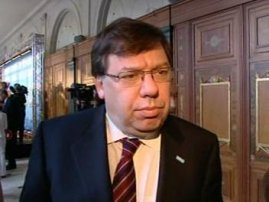
Brian Cowen "excited, but daunted"

It all happened as it was planned, and no one stepped out of line to spoil the parade of the new leader of Fianna Fáil and the country. As expected, the current Tanaiste Brian Cowen was today elected as the successor of Bertie Ahern.

Cowen said he is "excited by the challenge, but daunted by the responsibility" of becoming Taoiseach and leader of Fianna Fáil. At his first press conference since being elected leader-designate of the party, Cowen said his election was the highlight of his political career to date.

Brian Cowen was elected unopposed as the seventh leader of Fianna Fáil at a special meeting of the parliamentary party this morning. This afternoon he said he would devote all his abilities and all his energies to the task before him.

Asked whether he supported the Health Service Executive (HSE) and Minister for Heath Mary Harney, he said he did and claimed opponents of government health policy were attempting to retain the status quo, which he said was not an option. Cowen urged everyone in the country to work together to make the changes "which would deliver to the public the health service they expect and deserve".

The next Fianna Fáil leader reaffirmed his commitment to mutual respect and equality on the island, and stressed the importance of the Lisbon Treaty for the country. He also said that he is deeply committed to continuing the government's involvement in the North.

Brian Cowen said he would bring his own style to the job of Taoiseach. Bertie Ahern, he added, lived the position "day and night" and had a huge work ethic which Cowen said he hopes to match. And he said he would be fully aware of his accountability to the public.

Asked about the potential for Sinn Féin in government, he said this could only be considered in a given set of circumstances.

It took less than twenty minutes to formally elect Brian Cowen this morning as his was the only name in contention at the Fianna Fáil parliamentary party meeting. The leader-designate thanked his colleagues for the honour they had conferred on him before taking part in a photo call outside Leinster House.

Brian Cowen then took his usual place beside the Taoiseach in the Dáil chamber for Leaders' Questions. He will be taking over that particular hot seat in four weeks' time. Until then he will have plenty of time to ponder over the details of his first cabinet. Given his conservative and stable character, it is unlikely that he will make many changes. Besides a replacement for himself as both Tanaiste and Minister for Finance, he might make some minor changes. But since it is less than a year since the cabinet was formed and the junior partners in the coalition will not be touched, observers expect few changes.

The Emerald Islander

08 April 2008

ESB Investment must include Customer Service

It has recently been announced that the ESB (Electricity Supply Board, Ireland's large national electricity company) is planning to spend € 22 billion to reduce its carbon emissions to zero by 2035.
As it undertakes a huge investment, the state-owned company says it will invest the money in renewable energy technologies, such as wind farms, biomass, ocean wave (as pictured below left), clean coal and other green power initiatives.

Part of the investment will go to its overseas division as the ESB has committed to reduce its share of the Irish power generation market to 40%.
Chief executive Padraig McManus said that by 2020 the company will halve its carbon emissions as more clean energy is connected to the electricity grid and older power stations will be closed.

Of the € 22 billion investment, around half will be spent on renewable energy. € 4 billion are earmarked for onshore wind farms and other renewable technology, while around € 6.5 billion will be spent by the ESB connecting the output of other energy suppliers to the national grid.

As the ESB faces up to no longer being the dominant energy company in the Irish market, it also plans to expand overseas, with € 4 billion committed to its international division for projects in Britain and Europe.

To finance the investment the ESB will use its own cash and back it up with borrowings to about € 6 billion. ESB’s finance director Bernard Byrne said the international projects will be with joint venture partners to share the costs.

According to Padraig McManus (right) the ESB will also invest money in so-called "smart meters" that are more efficient than the currently used meters, which are well out of date and obsolete.

Sadly the CEO did not mention at all another area in which the ESB is probably in most need of improvement. That is the area of customer services and customer relations, in particular the matter of customers' access to the ESB in normal and easy ways.

Ever since the ESB sold off all their local shops, which had provided a strong and positive connection between the electricity company and her customers, the only possible way to get in touch with ESB is by telephone. Anyone who has tried that recently will know what a nightmare it is. The whole system works from remote call centres, staffed by badly trained young people on the minimum wage.
But before one even gets connected to them, one has to master a whole labyrinth of various electronic barriers and pre-recorded messages, many of them so generalised that they do not cover every possible reason a customer might have to contact the ESB.

I have spent meanwhile several hours waiting on electronic waiting loops without ever getting through to a real person. And when I did eventually, the person at the other end was not only completely clueless and unhelpful, but also not at all friendly. And when one then takes to writing a letter to the ESB, one never gets a proper reply.
If one gets a reply at all, it is never a personal reply that deals with the matter one has raised, but a photocopied standard print-out that annoys one even more. This cannot be by chance or accidentally and has to be a deliberate attempt of the ESB to cut itself off from their customers.
I have raised this matter already with my local TD, but even he only got a formalised litany of empty statements in reply, which did neither address the problem, nor offered any improvement.

This is not acceptable, and I urge Padraig McManus to invest a small part of his € 22 billion budget in more than overdue improvements of his utterly shambolic and ignorant customer service department.

The Emerald Islander

FF Dinosaur appears before Mahon Tribunal

The Mahon Tribunal at Dublin Castle has continued with its investigation into planning irregularities and corruption.
It heard evidence today from one of
Fianna Fáil's real old dinosaurs of the Haughey era, the 68-year-old former EU Commissioner and cabinet minister Padraig Flynn.
He confirmed that he
had more than £ 71,000 in a non-resident account in London, but said he has no records to back up his evidence that "over half of this was spent on election expenses".

Most of the money in the AIB account in England came from the £ 50,000 the developer Tom Gilmartin gave to Flynn and which, he says, was "a personal political donation".

The long-time senior Fianna Fáil politician and former Minister for Justice, whose
backwards-looking arch-conservative and misogynist attitudes earned him the nickname "Flynn-stone", told the Tribunal that the "external account" in an AIB branch in London was opened by his wife, Dorothy, "using an address in which the couple never lived".

He said that withdrawals totaling £ 37,000 were spent on election expenses, but he has no records. A further £ 35,000 went on "investments in National Irish Bank" handled by his daughter, Beverley Flynn (right). This is the same Beverley Flynn who is still a TD, was re-admitted into FF a day before Bertie Ahern announced his resignation, and immediately stated that she would like to be a minister. Some people really have necks that would look too large on bulls or elephants...

Padraig Flynn denied today that all the investment money for the
National Irish Bank came from withdrawals from this AIB account. He says some of the money came "from cash savings in his safe at home". So it appears that the Taoiseach is not the only Fianna Fáil politician who deals a lot in cash. The whole party seems to have a habit of grabbing and stacking money where ever it becomes available.

In other European countries this would be seen as corruption and inappropriate, but in Ireland - and especially in
Fianna Fáil - it is perceived as "the lads having some fun". And whatever else he did or did not, Padraig Flynn was certainly a very active member of the inner circle of the FF lads...

The Emerald Islander

07 April 2008

Strange April Weather

I think I have mentioned before that the South-East of Ireland lives with the lovely adjective "sunny".
In general that is a correct description, as the weather is usually better here than in other parts of the Emerald Isle and people flock to our sandy beaches earlier in the year than they do in the West, for example.

But recently everything seems to be in turmoil, most likely as a result of the big climate change. It is a lot colder than it usually is at this time of the year, and now we also experience snow.
Yes, you read correctly - snow! I had not seen any of that white substance here in town for at least ten years and never ever before on the far side of January.

Yesterday we had - within the span of an hour - first beautiful spring sunshine, then a little whirling snow and sleet storm for about 40 minutes, and before the hour was over, we were back with spring sunshine. This is weird.
And this morning when I got up, my street and everything on and in it was covered with about two centimetres of freshly fallen snow. It looked rather nice, although quite odd in a way. But it did of course not last long. By 10 a.m. it had all melted away, even though it remains quite cold.

We humans can adjust to that, even though it does puzzle us. But I notice that animals have a lot more problems with sudden weather changes. They are much more set into the rhythm of Nature and unfamiliar with the management advice of "being flexible".

So in these days of strange April weather, please spare a thought for your animals who will feel even more bewildered than you. This goes for domestic pets as well as for the working and farm animals.
Make sure you show them some more of your friendship and kindness, and when it is a cold day, maybe give them a little extra ration. They will appreciate that, and it will keep them in good shape.

The Emerald Islander

The Olympic Farce and China's Power

Does anyone else see through the huge public spectacle that China has started to force down the throat of major western countries? Or is it just me?
Yesterday, when I was talking to some local people about the matter, they seemed not to be able to understand what is going on. But then again, they have never been to China, and the only way they know Chinese people is from our local take aways. There is not a lot of cultural, philosophical and sociological knowledge gained from ordering the odd fried duck with fried rice and prawn crackers.

For previous Olympic Games the Olympic Torch - always lit by a ray of Sunlight at Olympia, the Greek home of the ancient games - was carried through the host nation until it arrived on the day of the opening ceremony in the host city.
But this year the Chinese have extended this tour of the torch to a number of foreign countries, in order to highlight the fact that they host the games even more. Not that they were short of cities and towns in their own country to parade the torch through. In fact, if one would move it all around China, it would take about two years to complete the journey.

So why then the foreign legs of the tour? Very simple. It is a deliberate act of superior arrogance and dominance, forcing the western countries, most of which are already completely dependent on China for the manufacturing of most of their consumer goods, to bow before Communist China, the Olympic host. There is a lot of pride in this, as well as deliberate humiliation for the western "paper tigers", as Mao tse-tung used to call them.

What I don't understand is why countries like Britain and France play along with it and threat a little stick with a flame as if it were a head of state!
In total there were yesterday more than 2000 uniformed police officers detached for the torch parade through London. And a similarly sad spectacle is expected to take place later today in Paris. How much all this costs the taxpayer, and how much crime those police officers could have prevented if they had been allowed to do their proper duties, can only be estimated. But it is quite substantial.

A protective ring of ten Chinese "flame attendants" (read: special forces police) in light-blue track suits and white baseball caps plus British police officers in fluorescent jackets surrounded the torchbearers closely at all times, with additional uniformed police joining at potential flash points along the route.

This unprecedented close protection of a small object was so massive that the spectators and even people watching the event on TV could often not see the Olympic torch or make out who was actually carrying it. The whole sad show only exposed two things: That there is no freedom in China, and that the UK government prefers the staging of a sick spectacle to please the Chinese dictators to the highlighting of the human rights abuses China commits every day, and especially in Tibet.

Like Hitler used the Olympic Games of 1936 to make the world bow to National Socialism, China now uses the games to make the world bow even deeper before Communist Mercantilism of Chinese fashion. All those - politicians, sports people and anyone else - who close their eyes to the facts or decide that they could not be bothered with details about China, Tibet and human rights as long as they get a few hundred hours of sport on TV this summer, are not only fools, but dangerous fools who contribute to a lot of political, social and economical damage.

People should realise that there is an unbroken tradition of 6000 years in China, which was already a high civilisation at a time when our ancestors still lived in caves and wattle huts. Reading about China and its history might help to understand Chinese ambitions, aspirations and general attitudes. And we should also remember that there is a word called "no" which we should use more often when encountering developments and behaviour we are not happy with. Letting every bully get away with every prank will only create a world ruled by bullies.

The Emerald Islander
06 April 2008

New Poll shows FF stronger without Bertie

A new opinion poll shows a 5% increase in support for Fianna Fáil since the Taoiseach has announced his resignation for May.

The Red C poll in today's Sunday Business Post also shows that just 22% of Irish voters think Bertie Ahern should not have announced his resignation.

The unplanned snap poll was carried out on Thursday, just a week since the last Red C poll for The Sunday Business Post.
(For details of that, please see my entry from April 1st)

Only 500 voters were questioned this time, which is half the normal Red C sample. So this gives a higher margin of error. However, the general tendency is clear enough.
It also shows that my own analysis and advice (given on April 1st) was entirely in line with Irish mainstream opinion and spot on. I do not praise myself, but it is a nice feeling to be so much right in such a public way.

Fianna Fáil's support stands now at 40% (up five points since last week), while Fine Gael dropped two points to 28%.

The Labour Party stays unchanged on 11%, while the Green Party moved up one point to 9% and the PDs are stuck on 1%.

Sinn Féin's support in this poll dropped three points to 6%, while the Independents and others dropped two points to now 5%. These two figures I would question as rather incorrect, and they are clearly an effect of the only half-sized focus group.

Only 22% of voters thought Bertie Ahern should not have resigned, while 31% say they did not want him to go, but he had no option after recent revelations.

20% thought it was about time he resigned, and 24% thought he should have gone earlier, as soon as the Mahon Tribunal began investigating his affairs.

It will be interesting to see how long Brian Cowen's political honeymoon will last, and if he can hoodwink the Irish people as successfully as Bertie has done it during the last ten years.

The Emerald Islander

Yes to Yahoo - No to Microsoft Bullying

In January the directors of Microsoft Corp. approached their colleagues of Yahoo and told them that they wanted to take over their business. They were prepared to pay $ 40 billion for it, and that would be that.

Well, in the language of high finance, such behaviour is called a "hostile take-over bit". And hostile it is indeed. Very hostile in my humble opinion.

When I heard about it first, I was also quite worried, since I have been using Yahoo e-mail and other services for many years.
I never had any problems with them, and neither had any other user I know. I contrast there are constant problems with
Microsoft's e-mail service "hotmail" and even more so with the MSN Messenger service. Every time I used the MSN voice-mail option, the software froze my whole computer when I finished. Never ever has anything like it happened with the voice option of Yahoo Messenger.

So far my own technical observations. I am worried that in case of a take-over the superior and much more friendly service of Yahoo will disappear and be replaced by the inferior
Microsoft standard.

To my great joy the directors of Yahoo have rejected the take-over bit. I am very happy with that. But not so the greedy people at
Microsoft. I just learned that they have now given Yahoo "an ultimatum" of three weeks. Unless they give in by then, Microsoft threatens "to go directly to the shareholders".

I am sitting here and cannot believe my ears. An ultimatum? To submit by a specific date? This is the way Hitler operated, and how he annexed first Austria, then the Sudetenland and in the end the rest of Czechoslovakia!
Who the heck do these arrogant greedy bullies in charge of
Microsoft think they are? I am very annoyed and angry. Yahoo has said no. That's it. Stick to your MSN and get your dirty hands off a good and decent company that is serving millions of people all around the world a lot better than you!

As I don't know who the Yahoo shareholders are, I cannot say how susceptible they might be to
Microsoft bullying. But in the remaining three weeks we could all do our small bit to support the people at Yahoo and tell the people at Microsoft that we don't like their attitude.

So I urge everyone who reads this to write at least one letter to the headquarters of both Yahoo and
Microsoft and express their feelings in a few simple words.
Customer satisfaction and positive PR are very important in international business. So we might have a change to get our voices heard. The more take part, the greater is the change to make a mark and be noticed.
Please take a few minutes and write an actual letter, since e-mail is too easy to be ignored by the people in huge companies. But physical letters on the desk get noticed and answered.
The Addresses:

Microsoft Corporation, One Microsoft Way, Redmond, WA 98052-6399, U.S.A.
Address letters to: Mr. Bill Gates (Chairman) or Mr. Steve Ballmer (CEO)
Phone
(800) MICROSOFT (642-7676)
Fax
(425) 93-MSFAX (936-7329)

Yahoo! Inc., 701 First Avenue, Sunnyvale, California 94089, U.S.A.
Address letters to either: Ms. Susan L. Decker (President),
Mr. Jerry Yang (CEO) or Mr. David Filio (Chief of Yahoo!)
Phone (408) 349-3300 / Fax (408) 349-3301

I am only a humble blogger on his own, and alone I will make no difference. But if you help, and spread the word around the web, then there might be a chance to make our point. Tell Bill Gates and Steve Ballmer to leave Yahoo alone.
And tell the people in Yahoo that they have support from people who use their service.
Let's try and make this work. Thank you!

The Emerald Islander

05 April 2008

The Sycophantic Party

In its official publications, printed material and correspondence Fianna Fáil (FF) is - in a second line - always described as "The Republican Party". Even Bertie Ahern mentioned this easily overlooked and rarely used additive in his resignation speech last Wednesday.
But as things have developed in Fianna Fáil over the past few days, this promotional definition will need to be changed soon. First of all, FF has long moved away from republican ideals and is for a considerable time now a party of tribal politics and the protection of tribal and private interests.
So perhaps "The Tribal Party" might be quite appropriate. When I discussed this matter yesterday with a neighbour, he suggested - in light of the next party leader - "The Fat Yob's Party", which would also fit, but might be seen by some as a little rough.

My own suggestion is "The Sycophantic Party", and I will explain to you why.

Shortly after Bertie had announced his more than inevitable date of departure from the helm of the state, ministers of his cabinet queued outside RTÉ to deliver their personal heaps of praise on the man who had more or less made them all and given them their jobs. This did not really surprise me a lot, since FF is a very cliquish and clannish party and Bertie has been the Bass - I mean Boss - of it for more than a decade.

I was however a little astonished that no one mentioned with a word his flaws and shortfalls, or referred to the real reasons for the early departure of the Taoiseach. They all praised him in the highest ways, and the more of that I heard, the more I began to wonder if Patrick Bartholomew Ahern - known as Bertie - is actual a mortal man of flesh and blood.
Listening to his colleagues in government - and they should be the ones who really know him - he looked more like an angel or a demi-god. But then again I remembered who was talking. And when was the last time that one could believe a word
Fianna Fáil was saying in public?

Must have been long before my time, since I do not remember any.

But the real character of FF came to light on Thursday, the day after Bertie's announcement. By then the Taoiseach - even though still in office until May 6th - was already history for his party. No more words about him from the loyal ministers.
Instead they queued up at RTÉ again, this time to renounce any personal interest in succeeding Bertie, and at the same time declaring their support for Tánaiste Brian Cowen (above) as the successor. It is interesting to notice that at that time Cowen had not even declared his interest yet. But this was - as it turned out - not really necessary. In good old Soviet Politburo style the man from County Offaly only declared himself a candidate after every single FF cabinet minister had nominated him in public. Well, down in the pub in Offaly they like things sewn up safely before they go out. They don't like to take risks and prefer to wait for their prey like a snake on a stone.

But of all events of the past week one element really stands out: The unbelievably sycophantic way FF ministers heaped unheard of amounts of praise on Brian Cowen. Only the day before Bertie was the greatest man on Earth for them and they could not find enough superlatives to describe all achievements and the unique and superior personality of the Taoiseach.
But that was Wednesday. By Thursday the party had moved on to prepare for a coronation. The King is dead! Long live the King! No need for even the slightest fig leaf of Democracy. Oh no, in
Fianna Fáil they do things their own way. Anyone who does not like it can always emigrate...

So after the inner clique of the party had decided to make Brian Cowen their next leader, all the superlatives were poured over him. In fact, he received - a month before his appointment to lead the country - way more praise than Bertie had been given the day before, after a decade in office. Well, such is the fickle character of Irish politics, and the sycophantic character of FF politicians.

Almost all cabinet ministers fell over themselves in their effort to portray the Tanaiste as God on Earth, but the most sickening sycophant of them all is Dick Roche (left). He was so anxious to make his feelings for Brian Cowen public that he sent a long press release to RTÉ without having it processed by his office first.
Joe Duffy read passages of it out on Thursday's "Liveline", and I have never heard anything like it before. According to Roche, now Minister of State for Europe (and as such responsible for the Lisbon Treaty), Brian Cowen must be God, Jesus and Superman all rolled into one. Well, this might explain his size...

But in all his haste to win the crown of chief sycophant, Roche exposed himself as a man at war with the English language. According to Joe Duffy the press release was "littered with spelling mistakes". Well, this must be even more embarrassing for Roche than his idiotic performance as the leader of the first St. Patrick's Day Parade in Beijing last month. (For details see my entry from March 18th)
We are not talking about some cleaner or butcher here, who might get away with little literacy. We are talking about a senior FF politician, whose responsibility for Europe means among other things the reading and assessing of new EU documents, many of which will become Irish Law. It is worrying to realise that a man with such limited command of the English language is also the minister for the Lisbon Treaty. Has he actually read it? And if so, did he understand it? It seems rather doubtful.

We should also never forget that Dick Roche is the man primarily responsible for the destruction of the Hill of Tara and the M 3 motorway through the Skryne Valley.
His last act as Minister for the Environment, Heritage and Local Government was in fact the signing of orders for the building contractors, in order to prevent his successor John Gormley from stopping the project. Such devious and ruthless behaviour is even in FF quite rare.

Having been demoted from cabinet to junior status last year, Roche is desperate to get back into a top job. His sycophantic litany of Brian Cowen's virtues, skills and personality would - if set to music - make probably a reasonable ballad. It's really a pity that Eurosong 2008 is over. Otherwise we might be sending a real Dick to Eurovision, instead of a stuffed turkey.

The Emerald Islander
P.S. If I were Brian Cowen, Roche's behaviour would be enough for me to remove him from ministerial responsibility for good.

Unemployment rises to 5.5%

Ireland's unemployment rate has risen from 5.2% to 5.5%, a figure not seen since June 1999.
The information from the Central Statistics Office (CSO) show an increase of 8,507 to 197,992, beating February's record rise of 8,000. This represents a 27% increase on the same month last year, the biggest monthly percentage rise since March 1983.

The seasonally adjusted Live Register figure rose by 12,000 from February to reach 199,900.
This is the biggest rise on record.

More worryingly, the increase in March has been evenly split between men and women, suggesting wider deterioration in the labour market beyond the construction sector. This differs from recent months, when men made up most of the rise.

The figures were higher for all Irish regions, with the biggest percentage increase of 7.2% coming in the South-East.

As the jobless figure is rising, the Central Bank says that the problems in the global banking sector are proving to be more prolonged and far-ranging than had been hoped. So the bank expects Irish GNP to increase by just 2% this year, down from a rise of 4.5% in 2007.

04 April 2008

40 Years ago: Martin Luther King assassinated

40 years ago the most important, effective and charismatic leader of the American civil rights movement died from an assassin's bullet.
Dr. Martin Luther King Jr. (left), who had been awarded the 1964 Nobel Prize for Peace in recognition of his long and peaceful work for civil and equal rights in the USA, did inspire a whole generation of Americans, regardless of their colour, and changed the social structure and politics of the United States for ever. His strong ideas and charismatic personality made him popular all around the world, and he is now regarded as one of the great men of the 20th century.

Born as Michael King, Jr. on January 15th, 1929 in Atlanta, Georgia, he became Martin Luther King, Jr. in 1935, when his father - a Baptist preacher - changed both his and his son's given name. His first encounter with a large crowd was in 1939, when the ten-year-old sang in a choir celebrating the Atlanta première of the famous film "Gone with the Wind".

In 1944 - aged 15 - King entered Morehouse College and after skipping two years he graduated in 1948 with a Bachelor of Arts (B.A.) degree in Sociology. The next three years he spent at Crozer Theological Seminary in Chester, Pennsylvania, from where he graduated with a Bachelor of Divinity (B.D.) degree in 1951.
In September of the same year he began doctoral studies in Systematic Theology at Boston University.
1953 King became pastor of the Dexter Avenue Baptist Church in Montgomery, Alabama, and on June 5th, 1955 he received his Doctorate in Philosophy (Ph.D.) in Boston.

Soon afterwards King became known to a wider audience when he got involved in the Montgomery Bus Boycott. On December 1st, 1955 Rosa Parks, a black woman, was arrested for refusing to comply with US laws that required her to give up her bus seat to a white man. The black people of Montgomery felt that things had gone too far, and assisted by the trade union leader E. D. Nixon, King organised a city-wide bus boycott. It lasted for 385 days, and during that time the situation became so tense that King's house was bombed by white supremacists. King himself was also arrested during the campaign, which only ended when a US District Court ended racial segregation on all Montgomery public buses.

King was instrumental in the founding of the Southern Christian Leadership Conference (SCLC) in 1957, a group created to harness the moral authority and organising power of black churches to conduct non-violent protests in the service of civil rights reform. He continued to dominate the organization for the rest of his life.

King was an adherent of the philosophies of non-violent civil disobedience as described in Henry David Thoreau's essay of the same name, and used successfully in India by Mohandas K. "Mahatma" Gandhi.
King applied this philosophy to the protests organized by the SCLC. In 1958, while signing copies of his book "Strive Toward Freedom" in a Harlem store, he was stabbed in the chest with a letter opener by a deranged black woman and only narrowly escaped death.

Representing the SCLC, Martin Luther King, was among the leaders of the so-called "Big Six" civil rights organizations who were instrumental in the organization of the March on Washington for Jobs and Freedom in 1963.
President John F. Kennedy initially opposed the march, because he was concerned it would negatively impact the drive for passage of civil rights legislation. But King and the other organisers were firm that the march would proceed.

The march made several specific demands: an end to racial segregation in public school; meaningful civil rights legislation, including a law prohibiting racial discrimination in employment; protection of civil rights workers from police brutality; a $ 2 minimum wage for all workers; and self-government for the District of Columbia, then governed by a congressional committee.

Despite tensions, the march was a resounding success. More than 250,000 people of diverse ethnicities attended, sprawling from the steps of the Lincoln Memorial onto the National Mall and around the reflecting pool. At the time, it was the largest gathering of protesters in the history of the US capital. And King's by now world-famous "I Have a Dream" speech electrified the crowd. It is regarded, along with Abraham Lincoln's "Gettysburg Address", one of the finest speeches in American oratory.

Throughout his career, King wrote and spoke frequently, drawing on his experience as a preacher. His "Letter from Birmingham Jail", written in 1963, is a passionate statement of his Crusade for Justice.
On October 14th, 1964 he became the youngest recipient of the Nobel Peace Prize, which was awarded to him for leading non-violent resistance to end racial prejudice in the United States.

In 1965 King began to express serious doubts about the United States' role in Vietnam. On April 4th, 1967 - to the day exactly one year before his death - King delivered his "Beyond Vietnam: A Time to Break Silence" at the New York City Riverside Church. He spoke strongly against American participation in the war, insisting that the US was in Vietnam "to occupy it as an American colony" and calling the US government "the greatest purveyor of violence in the world today." *1

He often claimed that North Vietnam "did not begin to send in any large number of supplies or men until American forces had arrived in the tens of thousands" in South Vietnam. King also praised North Vietnam's land reform. He accused the USA of having killed a million Vietnamese, "mostly children". *2

King had long been hated by many of the radical white southern segregationists, but this speech turned the more mainstream media against him as well.
TIME magazine called the speech "demagogic slander that sounded like a script for Radio Hanoi", and The Washington Post declared that King had "diminished his usefulness to his cause, his country, his people".

On March 30th, 1968, King went to Memphis, Tennessee in support of the black public works employees, who had been on strike since March 12th for higher wages and better treatment. On April 3rd, he returned to Memphis for another rally. And as always when he visited the city, he stayed in the same place, the Lorraine Motel (pictured above right). In fact, King was such a creature of habit that he usually stayed in the very same Room - No. 306. This was no secret and common knowledge all around Memphis.

His last public speech was delivered that day at the Mason Temple, and it was later seen as somehow visionary, as if King had foreseen his own death in a recent dream. He said: "I don't know what will happen now. We've got some difficult days ahead. But it doesn't matter with me now. Because I've been to the mountaintop. Like anybody, I would like to live a long life. Longevity has its place. But I'm not concerned about that now. I just want to do God's will. And He's allowed me to go up to the mountain. I've looked over. And I've seen the promised land. I may not get there with you. But I want you to know that we, as a people, will get to the promised land. I'm not worried about anything. I'm not fearing any man. Mine eyes have seen the glory of the coming of the Lord." *3

The next day, April 4th, King took some fresh air on the balcony of his motel room. According to an official report a single bullet hit him at 6.01 p.m., entering the body through the right cheek, smashing his jaw and then travelling down his spinal cord before lodging in his shoulder. Several close friends of King were present and witnessed the murder, including two well-known black preachers, civil rights campaigners and politicians who later carried on their dead friend's work. They were Ralph Abernathy and Jesse Jackson.
King was rushed to St. Joseph's Hospital, where he was pronounced dead at 7.05 p.m.

When the news of the assassination spread, there were angry demonstrations and spontaneous riots in more than 100 cities all over the USA.
In Illinois - the home state of the first assassinated President Abraham Lincoln - Senator Robert F. Kennedy was due to address a predominantly black crowd during his own campaign for the presidential nomination of the Democratic Party. Minutes before the speech Kennedy had heard the news and then addressed the people in an exemplary way. Speaking six minutes without a script or preparation, he spoke from the heart. The people of Illinois understood him and went home grieving and angry over the murder, but they remained peaceful. *4

Despite the fact that two months after the murder an escaped US convict - James Earl Ray - was arrested at London's Heathrow Airport and rather easily confessed to the murder, days later he retracted his statement and insisted ever since that he was not Martin Luther King's murderer. Nevertheless he was sentenced to 99 years jail and died in prison in 1998.
But there is plenty of evidence that the assassination of Martin Luther King was the result of an elaborate conspiracy, involving government agencies, along the same lines as the assassinations of President John F. Kennedy and his brother, Senator Robert F. Kennedy.

There is not enough space here to outline the whole background, but there are plenty of websites and other sources available to enlighten you further.
The latest sensational revelation came six years ago, when the New York Times reported that a church minister, Ronald Denton Wilson, claimed his father, Henry Clay Wilson - and not James Earl Ray - assassinated Martin Luther King, Jr.
Given the secretive ways of the USA and its extremely right-wing policies, it is doubtful that we will ever have a satisfactory and official explanation of what really happened.

Dr. Martin Luther King Jr. is missed today by the decent people of this world just as much as he was missed and mourned 40 years ago. It appears that for the majority of Americans violence - including murder, war crimes, assassination and torture - is still acceptable and even "normal". As long as this is the case, things will go from bad to worse. Let me close with a word from the New Testament, which Martin Luther King knew so well: "Those who live by the sword shall perish by the sword." This will be the future of the USA, unless some drastic change for good takes place - and takes place soon.

The Emerald Islander

Footnotes:

* 1
Well, nothing has changed since, except the countries the USA occupies as modern colonies. In place of Vietnam and Cambodia they have now Iraq and Afghanistan.
* 2 This is an interesting number, especially during the late 1960s, before the interest of international organisations was drawn closely to monitor Vietnam and Cambodia. But figures from this time are difficult to verify, since the USA never even bother counting local civilian casualties. They still have the same inhumane (but very convenient for the White House) practice today in Iraq and Afghanistan.
* 3 The last sentence is a direct quote from the "Battle Hymn of the Republic", a song popular with the Union troops during the Civil War (1861-65).
* 4 Tragically 63 days later Senator Robert F. Kennedy was assassinated himself in Los Angeles. It appears that even after two centuries as a sovereign nation the USA were still struggling to join the civilised world, where open murder and political assassinations do simply not happen. Sadly, the conditions in the United States today are much worse than they were in 1968, although now most leading politicians are guarded and protected so massively that it is near to impossible for ordinary people to meet them.

03 April 2008

The weak Awareness of Awareness Weeks

Apparently this week is "Organ Donor Awareness Week" in Ireland. At least it says so on a rather badly designed poster outside my local supermarket. To make it more appealing, a photo of RTÉ presenter Ryan Tubridy (left) appears on the poster as well.

These days almost every charity uses a well-known face to promote its cause. Given the subject of the campaign, I would have expected rather Ryan's uncle David Andrews to appear on the poster. After all, the former Minister for Foreign Affairs is now the head of the Irish Red Cross and therefore interested in all things medical.

I am all for organ donations and made personal arrangements many years ago. When I die, all my organs and body parts that are still functioning will be available for transplant. The rest of my body will go to medical research. (Once they are finished with me, the remaining parts will be cremated and the ashes dropped into the sea.)
For me this is the most sensible way to deal with my physical remains, but whenever I mention it to someone, I get a strange look and am told that it was "odd". In fact, I had to go through a good bit of paperwork to make sure that my last wish will be fulfilled one day (but hopefully not too soon).

The problem is a severe shortage of organs. Would more be available, more people could receive one and survive, or live a life free of impediment. As long as people have to opt into the system to become organ donors, there will never be enough. Most people are selfish, silly and occupied with petty trivia, and in Ireland more than elsewhere. Becoming an organ donor is very low on their list of priorities, if it features at all. Add to that superstition and the irrational and anti-social doctrines of religious faith communities, and you know why Ireland has a problem with organ donors.

I am not sure that an "awareness week" is doing much good either. Especially not when it is organised the way I encountered it today. In the entrance to my local supermarket there was the above mentioned poster, and beside it a small table and a chair. On the table stood a large jam bucket (used on this occasion to collect money), and on the chair next to it sat a short, rather odd and rough looking man, sporting one of these utterly ridiculous day-glow vests that seem to creep into every walk of life these days.

It is not known to me who organised this campaign, but I would advice the charity to try and get at least some of the money back they paid for it. When a 100% supporter of the cause is appalled and turned away, what effect will it have on other people?

Overall the quality of most Irish charity campaigns is pretty poor. People think as long as they sit in a shopping centre with a bucket and put little stickers on people's clothes, the bucket will be filled with coins. In most cases donors have absolutely no idea who they gave their money to and what it will be used for. But still it is happening every week. If I would put money into every bucket that is pushed into my face, I would have very little left for myself.

But I am very selective these days and only support very few charities whose structure and work I know myself. Charity has become a multi-million industry, employing large numbers of people in offices and on the streets. And of a Euro you drop into one of their buckets, maybe five cents (if you are lucky) will be spent on the "good cause" the collection is made for.

In my opinion an "awareness week", regardless for what, is pretty useless. It pushes a lot of specific information into people's minds, hastily and with hype, in order to collect fast Euros from the usually uninformed and seldom caring passers-by. And then, for the next 51 weeks, ignorance has again the run of the mill, while other charities are trying to make us aware of their causes.

If we want to make people aware of something, it has to be done in a constant and organised form, over weeks and months, and preferably all year round. It is the only way to achieve real awareness.

With regards to organ donations, I think it is time to change the law and make it an opt-out system instead of opt-in. When someone dies and leaves organs that can be used for another person, then those organs should be used right away, without delay or bureaucratic process.
Anyone who is not happy with that could opt out by putting their name onto a register and by carrying a special plastic card. But I would also make it a condition that a person who opted out of giving their own organs would not qualify to receive any, should the situation arise. This is only fair and logical.

I applaud those who take the initiative to increase the number of Irish organ donors, and am happy to see Ryan Tubridy among them. And RTÉ Radio 1 ran at least one ad for the campaign today. Good.

But since there are meanwhile more campaigning charities than weeks in a year, different campaigns get into each other's way. RTÉ Radio 1, for example, broadcast another ad today, with Football pundit John Giles (right) telling us that this is also "Prostate Cancer Awareness Week".

Maybe there are other ads as well which I haven't heard yet, and further "awareness weeks" not advertised on radio. It is all pretty cluttered and confusing, and really badly organised. With more brains, planning and co-ordination this could all be improved.

If we had a caring government and a proper parliament worth the name (and worth the money TDs receive), there would be legislation as I outlined above. No more need for an "organ donor awareness week" then.
And would we have a decent Health Service, regular prostate cancer screenings for men over the age of 40 would be offered in all hospitals (as it is the case in several other EU countries).

The Emerald Islander

02 April 2008

RTÉ is waffling a good Story to Death

RTÉ is not a bad broadcaster. Quite the opposite. It brings us a lot of quality programmes and comes in this part of the world second only to the BBC, which does the same, but without the constant interruptions for advertisement.

But being Irish and employing Irish presenters, there is also a lot of waffling on the airwaves of the Emerald Isle.
The people here like a good chat, and this is also reflected in the radio programmes of
RTÉ, and even more so in the various private stations. But there is a fine line between exploring a subject to the very last detail, and waffling it to death with simply too much meaningless chatter.

Such happened today on RTÉ Radio 1, which started at 10 a.m. with the coverage of the resignation speech of Bertie Ahern. Given the fact that everyone seemed to be completely taken by surprise - RTÉ journalists and the great and good of our leading newspapers alike - I wonder if our national broadcaster actually employs a political analyst.
The BBC and all national broadcasters I know in other European countries have analysts, whose job it is to see the greater picture and to make sense of trends, developments and events. Even though most analysts are former journalists, their work is quite different from that of a reporter or even commentator.

Our main national newspapers - including the Sunday papers - have large numbers of regular columnists, but I am still waiting to encounter the work of a true political analyst. So it is perhaps not such a mystery how they all could be surprised by today's events in Dublin. For an analyst it was quite clear that Bertie Ahern had only two choices left:
1) Staying on to the very end and risking to be brought down and torn apart by his opponents,
2) Resigning early, and thus saving at least his political legacy and reputation, while at the same time freeing the government from the burden of his muddled private affairs.

When I wrote my piece yesterday, I expected that I would be right in my analysis, but what I did not expect was that Bertie Ahern would follow my advice within less than 12 hours. Alright, I am not that arrogant to assume that I alone made the Taoiseach see sense and step down. He must have seen the writing on the wall himself for some time and drawn his own conclusions. But a person using an Irish government computer was reading yesterday's piece early this morning...

Well, having been "completely surprised" by the Taoiseach's decision,
RTÉ made up for their lack of preparation by talking about almost nothing else the whole day.
The entire "Today" programme (minus its regular presenter Pat Kenny) was dedicated to the resignation speech, and it was actually the only programme I heard today on Radio 1 that had a good bit of background material ready, explaining very well the discrepancies between various statements made by Bertie Ahern and the facts offered in evidence at the Mahon Tribunal which tell a completely different story. This was a really good introduction, and I recommend the editor and producer for such foresight and excellent information.

But from then on it went downhill fast. Having covered Bertie Ahern's actual speech live and in full, numerous politicians and journalists were brought in to give their opinions. This is fine and quite normal, to a certain extent.
However, Radio 1 went into overdrive and actually killed the good story they had in their hands by waffling it to death. The daily 1 o'clock news started already at 12 noon, and for the whole 100 minutes on air presenter Sean O'Rourke had only one single subject: Bertie Ahern's resignation speech (despite the fact that there was plenty of other important news available from around the globe).

Every politician
RTÉ could get hold of was dragged in and asked the same question, which most of them answered in the same fashion. Boring, boring, boring! And in no way contributing any news or proper comment. Of all the people interviewed only two made a real contribution which was worth having and listening to: Sinn Fein President Gerry Adams gave a very good and fair analysis of the Taoiseach's involvement in the North, and Fine Gael leader Enda Kenny made an interesting contribution by calling for new elections. Even though this will not happen in the current situation (and he knows that himself), Kenny has a very good point, as soon none of the three government parties will be led by the people who were their leaders in the last general election in May 2007. This will raise a question of legitimacy, and the next Taoiseach should not ignore the matter. (Britain's Prime Minister Gordon Brown is in a similar situation and has lost a lot of his credibility when he decided not to call an election after he took over from Tony Blair.)

To make things worse, the usually very interesting "Liveline" programme with Joe Duffy had also only one theme today: Bertie Ahern. I liked the quick telephone poll they conducted, with about 12,000 people texting in their opinion on the resignation. But the "ordinary people" who rang in with sycophantic praise of the Taoiseach and plenty of entirely irrelevant petty stories related to him were waffling the story stone-dead, without adding a single valuable news aspect.

Thank God for Derek Mooney, whose 3 o'clock show was free of Bertie-waffle. A sigh of relieve was heard around the house. But our joy did not last long. Mooney was truncated to only half an hour, and then "Drive Time" started early and continued the marathon-waffling over Bertie's resignation.
All sorts of totally irrelevant politicians where wheeled in again or interviewed on the phone, and by then I lost my patience and switched over to BBC Radio 4.

I believe that the Bertie-Saga, which seems more like an obituary for a man still alive, continues tonight on
RTÉ television. But since I don't watch TV, I am safe from another pile of waffle.

It has been said about Ireland that it is a country where never anything important happens. And there is a grain of truth in it. So on the very rare days which have unique events to offer, our media are falling over themselves and drown us with blanket coverage and endless waffling on air. Never mind that they were entirely unprepared for the story by 10 a.m. this morning.

Like in most walks of live, in the media less is usually more.

And especially in those media who have no sense for trends and developments, but then jump frantically onto every band wagon that comes along. It is information and analysis the reader and listener wants, not waffling and hype.


The Emerald Islander

Taoiseach announces Resignation

It appears that Bertie Ahern (or someone close to him) has read yesterday's entry and my advice. * And, for once, the Taoiseach has obviously listened to the impartial advice I have offered him.

Standing down on his own terms and at his own time of choosing, will give him the chance to retain some dignity and also the chance to be remembered for the undoubtedly good things he has done and been responsible for over the years, especially the peace settlement in the North. In many ways Bertie Ahern would be a very positive example for a man from the grassroots who has made it to the top and stayed there for longer than most. This is also the reason for his undiminished popularity with many common people.

But sadly Mr. Ahern, who spent ten years as the political leader of this country and several years previously as the Minister for Finance, was not able to keep his own personal finances in order. This has haunted him for quite some time now, and eventually it has led him to announce his resignation - effective on May 6th - today.

Had we not had Charles J. Haughey stealing money from the country and not paying his taxes while a senior minister and Taoiseach, it might be possible that Bertie Ahern would have got away with his muddled finances. But as much Haughey was Ahern's mentor and helped him up the political ladder, in the same way Haughey's dark shadow hangs over the Taoiseach and it always did.

I think his choice to go early - even before the summer recess as I had suggested yesterday - is a final positive step on a long journey that was often difficult and covered in question marks. The Taoiseach has said that he "never took a corrupt payment", and until someone can provide the evidence for the contrary, we have to take this statement at face value. He also announced that he would defend his position "vigorously" in the Mahon Tribunal, and that is his good right.

But with all possible empathy one could have for him, it has also to be said that if anyone else in Ireland had acted financially as he has for many years, both Revenue Commissioners and Garda Siochana (Ireland's Police) would be after him and he might well be in prison. And in a free and fair democratic country everyone has to be equal before the Law.

It is unacceptable that the Prime Minister and Minister for Finance, who is ad officio in charge of the Revenue Commissioners and would send them after ordinary people with muddled finances, has special rules for himself and his own financial situation. There will be many - especially in Fianna Fail - who will try to portray Bertie Ahern now as a kind of martyr who fell on his own sword in order to save the party. Such is inappropriate and more than foolish. We have to accept the facts and see things as they are: After using every possible way to avoid facing the music, the Taoiseach has run out of steam, arguments and probably also friends. So he is going, with his reputation damaged but still somewhat intact, before he could be dragged down and torn apart by his political opponents. Fine, and good luck to him.

The important thing is now to focus on the next Taoiseach - most likely Tanaiste Brian Cowen - and his general attitude towards politics and the country. His first test will be the forthcoming Referendum on the Lisbon Treaty. But it also will be important to watch if the new leader of the country will be a more fair, decent and trustworthy person than the one who has just announced his resignation on May 6th.

The Emerald Islander

P.S. - It is quite amazing that all leading journalists in this country, including the political editors and parliamentary correspondents of every national newspaper and of RTÉ, were completely surprised by this morning's announcement. Anyone who can read the signs of political change and public opinion should have been aware that a resignation of Bertie Ahern was imminent and inevitable.

*
This is not a joke or empty assumption. I have regular readers of this weblog from computers marked irl.gov (Irish government) and one of them was reading yesterday's entry early this morning.

01 April 2008

Polls say: Bertie, it is Time to go!

Two days ago I was digging my way through Ireland's Sunday papers as usual, while at the same time battling with a bad cold and spending much time in bed, which is very unusual for me. But the extra rest gave me more time for reading, and I went through the various articles and columns, analysing the positions of the political parties according to the latest Red C poll for the Sunday Business Post.

This regular poll, which provides a quite correct snapshot of the political landscape in Ireland, has Fianna Fáil now at 35%, down 2% from last time. Fine Gael stands at 30% (down 1%).
The smaller parties have all gained 1% since last month, giving the Labour Party now 11%, Sinn Féin 9% and the Green Party 8%.

Independents and others have seen their support increase by one point, to now 7%.

Meanwhile the remnants of the PDs have reached rock-bottom at 1% (down 1% from last month) and are close to complete extinction. (Not a moment too soon, in my opinion...)

The poll was conducted on either side of the Easter weekend - after the latest revelations from the Mahon Tribunal about the Taoiseach's personal finances, but before the Progressive Democrats and the Green Party called on Bertie Ahern to clarify the issues involved.
The main issue remains the lodgements in Pounds Sterling, made to Ahern's private account. This matter, together with all the other financial questions he can either not explain or not remember, begins to assume the shape of a Damocles sword which is suspended above the Taoiseach's head and can fall any moment.

Regular readers of this weblog will know that I am not a political friend of Bertie Ahern and have never voted for him or his party. But as a political analyst I always try to be as fair and unbiased as possible.

So if the Taoiseach (or any of his supporters) might read this and is interested in humble impartial advice, I can only say that it is well time to go now for Bertie.
With every new revelation he is sinking a bit deeper into the bog, from which there is no escape. Politics is a cruel game, especially in Fianna Fail.

If Bertie has any common sense left, he should step down as Taoiseach before the summer recess of the Oireachtas and give a new leader - most likely Tanaiste and Minister for Finance Brian Cowen - a fair chance to rebuild confidence in the government (if this is possible) and to prepare for the European and local elections next year.
Regardless what one might think of him and his private finances, a Taoiseach who goes on his own terms and at a time of his own choosing might well retain some respect from the country. But should the investigations of the Mahon Tribunal bring down the Prime Minister in a scandal, this will stick to him for the rest of his days. The times of Mr. Bertie Teflon are over.

Of course I cannot compete with a large organisation like TCH and a sophisticated poll like the one conducted by Red C. But for the past two months I have been running an opinion poll of my own here on the weblog. It might not reflect scientifically selected opinions (as Red C does it), but it shows what the readers of "Views from the Emerald Isle" think of Bertie.

The question asked was:
Your opinion of Bertie Ahern as Taoiseach and there were five options to answer it. The answers and the percentages they reached are listed below.
  • Happy with him - 5.5 %
  • Satisfied with him - 5.5 %
  • Not satisfied with him - 16.5 %
  • Unhappy with him - 72.5 %
  • No opinion - 0.0 %
As I mentioned above, this is not a scientifically selected opinion poll, but it clearly reflects what the readers of this weblog think. It is time to stop bertieing around and treat the nation as fools. It might be April Fool's Day today, but this article is serious. The only fool I can see today is a Taoiseach who ignores the writing on the wall and the sword hanging over him.

It's time to go, Bertie!
You are running out of time and will regret it if you think you can stay put and bumble on. And by the way, when you go, please take Mary Harney with you as well. Her political sell-by date has expired a long time ago.

The Emerald Islander