Showing posts with label trade unions. Show all posts

30 June 2009

More Jobs Cuts in Waterford and Co. Mayo

It has become known this evening that 200 jobs will soon be lost in two different companies, one based in Waterford, and the other in Co. Mayo.

The US-owned multi-national eye care products manufacturer Bausch & Lomb is expected to announce tomorrow morning that 120 people are to be made redundant at its large plant in Waterford (photo), where it is one of the main employers.

This will bring the workforce at the factory to below 1100, nearly 700 people less than were employed there a few years ago.
While I am writing this, talks are continuing tonight at the factory between trade unions and management representatives.

The company has already shed 195 (of its then 1400) jobs - mostly on a 'voluntary' basis - in March of this year. (see my entry of March 4th)

Meanwhile in Co. Mayo, Eurotel Marketing Ltd. has said that 80 workers will lose their jobs with the closure of a major call centre in Belmullet.

04 March 2009

Bausch & Lomb seeks 195 Redundancies

Trade union representatives at Bausch & Lomb (photo) in Waterford have been told that the company seeks 195 redundancies, if possible on a voluntary basis.
Negotiations over severance packages will take place in the coming weeks.


The US-owned multinational company, which makes eye care products, employs currently 1400 people at its Waterford factory and is one of the main employers in Ireland's oldest city.

Despite the redundancies, the company has said it is "committed to continuing manufacturing in Waterford".

Most of the staff are currently working three weeks out of every four as part of short-time working arrangements.

15 November 2008

Most Unions accept new Wage Agreement

Most Irish trade unions have now accepted the draft national wage agreement which was agreed upon by the Social Partners in Dublin on September 17th. (see my entry of that day)

Yesterday SIPTU, Ireland's largest union, voted to accept and earlier members of ten other trade unions also voted in favour of the new agreement as well.
IMPACT and Mandate meanwhile confirmed that their members voted overwhelmingly for the proposed deal, too.

The Irish Nurses' Organisation (INO) announced that its members, who are employed throughout the public health service, have voted in favour, and so has the construction sector trade union UCATT, whose members voted by a margin of five to one to accept the terms of the draft agreement.

To no-one's surprise the Association of Higher Civil & Public Servants, which represents 3300 members, accepted the deal with a majority of 93%.
And the National Union of Journalists (NUJ) followed closely with 90% in favour.

However, the country's second-largest union UNITE (formerly AGTWU), which represents many members across a wide range of sectors including transport and public services, voted with a clear majority to reject the offer.
UNITE is affiliated to the largest UK union of the same name. What consequences their rejection will have is at this time not certain.

07 October 2008

SIPTU reacts to Aer Lingus' Cost Cutting Plan

Members of SIPTU (Ireland largest trade union) in Aer Lingus decided yesterday evening to ballot for all-out industrial action.

SIPTU's National Industrial Secretary Gerry McCormack said: "This is Irish Ferries Mark II. It represents a fire sale of good quality jobs by a management that can see no further than the next quarter's profit and loss sheet."

Aer Lingus has set a deadline of November 1st for the implementation of a € 74 million cost-cutting programme involving up to 1500 job cuts through redundancies and outsourcing. Up to 280 jobs will be lost at Shannon Airport alone as part of this plan.

At a 2 1/2 hour meeting yesterday afternoon management told staff that € 50 million would have to be "eliminated from staff costs".

They also said € 14 million would have to come from a reduction in advertising and distribution costs, airport costs and professional fees, and € 10 million from reducing the airline's long haul fleet from nine to eight aircraft.

There will be a 'voluntary severance' or early retirement package on the same terms as in 2004 for cabin crew and ground staff in airports, catering and cargo divisions. Sick pay entitlements are to be reduced. Contracts based on performance-related pay will be introduced from January.

"Staff who do not take redundancy may transfer to a new service provider, but there will be no opportunity to redeploy within the airline."

Cabin crew bases at Shannon and Heathrow will be closed. Staff may be offered redeployment to Dublin or Cork, or alternatively will face redundancy.

Services from New York, Boston and San Francisco will be staffed with American cabin crew from the summer of next year.

Aer Lingus will also commence a programme to move its head office to smaller and more open-plan facilities.

Earlier it emerged that the airline was to impose a pay freeze until the end of 2009 under the cost cutting package. Staff are also to be given new contracts, which will introduce performance-related pay and abolish traditional increments.

The company has already reported losses of € 22 million for this year, and is forecasting potential losses of over € 100 million next year, depending on the cost of fuel.

Last Friday the Aer Lingus board finally authorised management to proceed with what it described as "a cost reduction programme to deliver substantial savings necessary to ensure the company's long-term viability as an independent airline".
The company also stressed that the cost savings must be delivered as a matter of urgency.

It is also believed that Aer Lingus is not prepared to engage in a lengthy negotiating process, and wants to commence implementation of cost cuts in 2009.

However, the trade unions are likely to highlight that staff have already made significant productivity concessions both in the 'Survival Plan' of 2001 and in the recent cost-cutting programme agreed in the summer.

SIPTU has indicated that it is "totally opposed" to any outsourcing, which would predominantly affect its members.

05 October 2008

Two Unions call for Rejection of Pay Deal

The Civil and Public Services Union (CPSU), which represents 13,000 lower paid civil servants, is to recommend that its members vote to reject the new National Pay Agreement when they ballot on it over the coming weeks.

The executive of the union voted to recommend rejection of the deal narrowly by a margin of nine votes to eight.
General Secretary Blair Horan (photo) had wanted the deal put to members without any recommendation, but the executive overruled his view.

It is understood that the CPSU executive were concerned about the low level of the pay increase of 6% over 21 months, the 11-month pay pause and the linking of general increases to change and modernisation.

Blair Horan acknowledged that the pay deal was "far from ideal", but said he believed it was "the best deal that could be negotiated in the current difficult circumstances".

Ireland's second largest trade union, UNITE, has already recommended that its members should reject the deal.
However, the largest public service union IMPACT has recommended acceptance.

It remains to be seen whether members will vote to accept or reject the deal in light of the ever worsening economic situation.

SIPTU Regional Conference in Tralee

SIPTU, Ireland's largest trade union, has warned that the current global economic crisis could intensify pressure on workers' rights, employment quality and jobs.

Jack O'Connor (photo), the union's General President, also said that it would oppose any future referendum on the Lisbon Treaty if the Irish government did not legislate for the long overdue collective bargaining rights.

He was speaking at SIPTU's regional conference in Tralee, Co. Kerry, where the union discussed among other subjects the rights of workers and the future of pension funds. Speakers urged the government to give priority to protecting workers' pension funds in any bank restructuring.

Addressing the conference, SIPTU's General Secretary Joe O'Flynn said that the current volatile and challenging economic situation had been "brought about by the greed of those in a golden circle, who had little or no regard for the implications of their reckless actions".

He said that workers are witnessing the near collapse of their pension schemes due to reductions in returns from equity and property investments.

The Irish Association of Pension Funds warned yesterday that some private sector defined benefit pension schemes were near collapse.
Joe O'Flynn suggested that the situation was even worse, regarding defined contribution schemes, where all of the risk is carried by the employee.

He said it was "disgraceful the financial sector is protected to the tune of € 400 billion, while ordinary workers are facing the prospect of significantly reduced pensions, particularly at a time of rising unemployment and high interest rates".

Referring to the new national pay agreement, he admitted that he could not describe the proposals as "a great deal", given the strong possibility that the pay increases would barely match inflation.

However, he was satisfied they were the best terms available under the current circumstances and "not a cent was left behind on the negotiating table". He believed that most members would not do any better in a pay free for all.

17 September 2008

Agreement reached in National Pay Talks

This morning - after months of general talks and weeks of intensive negotiations - the Social Partners have eventually reached a new National Wage Agreement for the Republic of Ireland.

The last session with representatives of employers and all Irish trade unions went on for 22 hours and all through the night. Negotiators on both sides realised that they were already into the third day over the deadline set by the Taoiseach, and that might have helped their minds to sharpen and reach an agreement.

The result of the long and tedious talks is a pay increase of 6% for all workers, to be paid over 21 months.
The pay rise will be applied in two phases, with a 0.5% increase at the end of the agreement for workers earning less than € 430.49 per week, or around € 22,463 per annum.

All private sector workers will have a three-month pay pause. They will then receive a 3.5% increase over six months and a further 2.5% for the following year.

Public sector workers will have an 11-month pay pause from the last module of the Towards 2016 programme.
They will then receive 3.5% for the next nine months (commencing September 1st, 2009) and a further 2.5% for the remainder of the agreement.
The agreement also contains commitments on public service modernisation to reflect the latest OECD report.

Brian Cowen explained that the new agreement would include provisions to prevent employers using temporary agency workers to break strikes.
There will also be a statutory prohibition on victimisation of trade union members, and on inducements to encourage trade union members to leave their unions.

"The new National Pay Agreement will give a sense of confidence and stability in the challenging period ahead," the Taoiseach said earlier in Dublin.
"Even though the negotiations were very lengthy and complex, the Social Partners made commendable efforts to enable the terms of a draft Agreement to be identified."

Trade union leaders and the representatives of the employers' organisations are now putting the new draft agreement before their members for approval. There will be internal discussions and a detailed examination of the agreed terms, and a result is expected in about two weeks.

"This has been a long and arduous process, played out against a background of rapidly changing economic reality for workers and the economy as a whole," said Jimmy Kelly, Regional Secretary of Ireland's second-largest trade union UNITE, after the talks had ended and rows of exhausted negotiators emerged from Government Buildings in Dublin.
Turlough O'Sullivan, Director General of the employers' lobbying group IBEC, said there were "many positives in the deal".

The Emerald Islander

08 September 2008

National Pay Talks continue in Dublin

While the country as a whole (and especially the South East) is still recovering from yesterday's All Ireland Hurling finals, life goes on, focusing on more serious matters. In Dublin the crucial talks on a new national pay agreement continue in a gloomy atmosphere, overshadowed by the economic recession the country has fallen into after more than a decade of massive boom and excitement.

The employers' lobby group IBEC has eventually decided to join the talks this afternoon, while representatives of the trade unions and the government resumed negotiation this morning.

Going into the talks, some of the unions rejected out of hand the notion of a pay freeze, which has been mooted especially by IBEC (and supported by some members of the government).

Both employers and trade unions are trying to secure a new national pay agreement by Friday, but the signs are not particularly encouraging.

Betty Tyrrell-Collard of the CPSU - which represents lower paid public service workers - declared that a pay pause for her union's members would be "an absolute non-runner".
She said a pay pause for people who earn more than € 50,000 per year would be acceptable. But she added that clerical staff that are low paid and work hard to secure bonuses for higher paid positions could not suffer.

Jack O'Connor, general president of Ireland's largest trade union SIPTU, said he wanted to "make sure a deal could be done". But the unions would "not agree on an exercise to insulate businesses profits".
He refused to reveal details of what SIPTU would be demanding, but said that all unions needed to decide on a way forward.
"There is a broad consensus on a deal that will take the economic condition into consideration and protect lower paid workers," he stated before entering the talks.

John Douglas of the Mandate trade union (which has many members employed in the retail sector) said that "there will be no deal unless the low paid are protected".
He pointed out that the ball was in the court of the employers, and "something will have to be found to deal with the difficult issues for low paid workers, who have not been dealt with fairly in previous agreements". Now more than ever efforts were needed to deal with the low paid.

Larry Broderick of the Irish Bank Officials Association said he was not optimistic heading into the talks, adding that "the government needs to put something constructive on the table if the talks are to be successful".
He emphasised that his staff would not react well to a pay freeze and said that "a new structure is needed and new legislation on constructive bargaining as well". He also suggested a "flexible arrangement on pay at local level, so different approaches can be taken in different companies".

Peter McLoone, general secretary of IMPACT, said he hopes that at the end of the week a clear package for public sector workers will be on the table. What the government has in mind with regard to a public sector pay freeze "must be clear" and "the purchasing power of low paid people within the public sector must be protected".
"It makes no difference what sector you work in when it comes to buying products and trying to live."

Well, Mr. McLoone - as usual - puts things clear and simple as they are. And he is absolutely right with his statement. Given the massive and constant increases in the costs of living, especially the rocketing prices for food, fuel and electricity, this is the most important element in the pay talks for the vast majority of Irish people.

Taoiseach is "available to assist"

Meanwhile Taoiseach Brian Cowen has stated that "all sides in the talks must take account of the changed economic circumstances".
Speaking in Tullamore (in his home county Offally), Cowen said he would be "available to assist the parties on an ongoing basis, as I was indeed in the last phase, which - unfortunately - did not mean that the fact that I was available brought about a successful conclusion".

Asked if he was more optimistic about a successful outcome this time, Cowen declared that there was "a growing realisation that there are a lot of pressures in the economy". He added that the many job losses this year are "a reflection of the downturn in economic activity".

He said that "we do need to come up with an affordable solution for the medium term, so we can find space to bring about changes for the better" in what he called "a very challenging international environment".

30 June 2008

No Deal involving Pay Cuts

Ireland's trade union leaders, arriving for today's pay talks at Government Buildings in Dublin, have warned that there will be no deal involving pay cuts.

Trade unions, employers and the government are attempting to reach a new National Wage Agreement amid growing concern about the worsening economic situation.

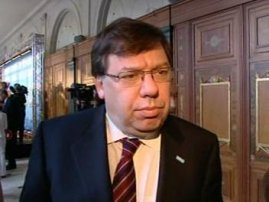
John Douglas (left), General Secretary of the Mandate trade union, said that his members in low-paid sectors could not afford cuts in salaries, as prices for food and fuel continued to rise.

Unions also warned that any cutbacks in services, particularly health and education, would be deal breakers.
Larry Broderick of the Irish Bank Officials Association acknowledged that there were challenges in the economy, but said that workers were being subjected to a pre-emptive strike by employers and the government.

The employers lobby group IBEC said that the economy was under pressure, with 7000 people joining the unemployment register each month.

IBEC's Director General Turlough O'Sullivan said that employers remain committed to social partnership and that any new deal must be good for Ireland and good for jobs.

Taoiseach Brian Cowen (right) warned that painful cutbacks are on the way as Exchequer returns have already experienced a shortfall of € 1.2 billion this year.

The economy is now in decline and apparently the government is powerless to control some of the key international factors involved, including oil and food prices.

Serious cutbacks are on the way in a bid to balance the books, the government announced. All the optimistic promises made by the government parties before the last general elections in May 2007 seem to be forgotten now, and all the extra money promised for major improvements will be spent by the end of this year.

The latest economic returns, out on Wednesday, will set the economic backdrop for negotiations.

For the last week, employers and trade unions have been sniping at each over the airwaves. IBEC wants continued investment in the national plan, but a pay freeze for workers.

Also on the agenda are tricky non-pay issues, including pensions, agency workers and collective bargaining rights. Many analysts believe the talks could drift on into the autumn, if they do not break down completely. The consequences of that could be disastrous for the already weakened Irish economy, prolong the recession and destroy most of the advantages Ireland has gained in the twelve years of the "Celtic Tiger" boom.

The Emerald Islander

15 May 2008

IMPACT sees Benchmarking "dead in the Water"

IMPACT, Ireland's largest public service union, may reject any new national pay agreement unless the 'Benchmarking' pay determination system is radically reformed. Speaking at the IMPACT conference in Kilkenny, the union's General Secretary Peter McLoone (photo) said that as far as his members were concerned, 'Benchmarking' was "dead in the water", after not delivering pay increases to most of them.

McLoone said that voting on the next proposed pay agreement, which is currently negotiated, would be the first opportunity to vent the trade unions' frustration about what they saw as "a flawed mechanism".
But he warned if the outcome of the current pay negotiations included provision for another similar 'Benchmarking' process, he did not think his members would accept it. He also stressed that public servants should not and did not want to lead private sector pay in the labour market. The gap between higher and lower paid workers in the public service should not be getting wider and the same standards of fairness must be used to assess the pay of all, regardless of their place in the hierarchy.


Delegates at the conference endorsed a motion calling for a genuine review of the public service pay determination system to ensure that future pay comparisons are "made with good private sector employers", that genuine reforms of public services are rewarded and that individual pay anomalies can be addressed.


Earlier, Peter McLoone said that a new pay deal could well be achieved, but it must include progress on social objectives and public services. Despite big challenges "a deal is doable if all the social partners have enough ambition".


The Emerald Islander

14 May 2008

IMPACT President criticises Irish Employers

The President of Ireland's largest public sector union, IMPACT, has openly accused Irish employers of "reaching new standards of double standards" by calling for wage restraint for workers, while top people's pay is soaring.

Finbarr O'Driscoll, who took over the leadership of IMPACT from Stephen Lyons earlier this year, called on business leaders "to show some glimmer of understanding of the rage and frustration felt by ordinary people", particularly when top earners award themselves huge pay increases, while telling the little people to tighten their belts.

Speaking at the opening of the union's biennial national delegate conference in Kilkenny, O'Driscoll said that unions needed to see evidence that employers still see partnership as a two-way street where all the parties make gains and sacrifices.

He claimed that in recent months they had witnessed what he called "emboldened employers, determined to row back on the rights, pensions and living standards of working people" and accused employers of "seeking to cut living standards with below-inflation pay rises, even as they awarded themselves big increases in their already huge salaries".

In the current national pay talks the unions needed increases that matched the rate of inflation, simply to maintain living standards.

"Most of the lectures on partnership and performance given to trade unions ahead of the national pay talks come from those who have done exceptionally well out of boardroom pay hikes or the report of the review body on top-level pay in the public sector", O'Driscoll said.

He accused profitable banks of increasing interest rates and leaving hardworking young couples to pay for the mess in the international money markets, which is of the banks' own making. He also slated retailers who hiked up prices for years on the basis of the high cost of the Pound Sterling, but who refused to reduce them when the value of that currency fell, as it currently does.

The powerful speech of the new IMPACT President shows that Ireland's largest public sector union (and second-largest union after SIPTU) is in good and strong hands and will not back down in the national pay negotiations.

The more than 55,000 members of IMPACT work in hundreds of public service occupations, grades and professions in health, local government and education, the civil service, and in many voluntary and community organisations.

The Emerald Islander

06 May 2008

TEEU and CPSU take opposite Views on Lisbon

Two of Ireland's largest trade unions have announced their official positions on the Lisbon Treaty, where they support opposite sides of the argument and advise their member to vote accordingly.
The Technical Engineering and Electrical Union (TEEU) has said it is advising members to vote 'No', while the Civil and Public Service Union (CPSU) has said it will be calling for a 'Yes' vote.

The national executive of the TEEU, which is the country's largest craft union, has joined the 'No' camp and advises its 45,000 members to reject the Lisbon Treaty on June 12th.
It says it favours a social Europe, but points out that recent key judgments by the European Court of Justice show that the pendulum has swung clearly against workers' rights and in favour of big business.

The CPSU, which has about 13,000 members, has said it will be calling for a 'Yes' vote.
This is not such a surprise, as most members of the CPSU are employees of government departments and state agencies, and as such not entirely free and objective in their views on a treaty that is so heavily promoted by the government they serve.

Of course the official advise of the trade unions is not binding for their members, and everyone is free to vote according to their own views and decision.

The UNITE trade union (formerly called ATGWU) has already declared its opposition to the Lisbon Treaty some time ago, predominantly on the same grounds as the TEEU, and joined the 'No' campaign.
And while SIPTU is still weighing the pros and cons of the treaty internally, many SIPTU members - including local organisers and shop stewards - are already actively campaigning against the acceptance of the Lisbon Treaty.

The two recent judgments in the European Court, based on the new positions the Lisbon Treaty has created, are indeed alarming for workers in Ireland and all over Europe, as well as for trade unions.
As a spokesman of the Swedish trade union council put it quite clearly after the first judgment: "A few more decisions like this, and the European trade union movement will be dead and workers' rights will be the playing ball of big industry."

The Emerald Islander

26 March 2008

Demonstration for a decent Health Service

The Irish people have suffered enough (in my opinion more than enough) from the inadequate Health Service our government provides (or often rather not). And even though most of us are too complacent and too slow to complain, the boiling point in public opinion has been reached.

So there will be - at last - a major demonstration for a decent Health Service in Dublin this coming Saturday, March 29th. The march will be organised by the trade unions and by a number of patients' groups. Assembly will be at Parnell Square from 2.30 p.m. on, and the protest march will start at 3 p.m., going to Molesworth Street. There will be speeches on both ends of the demonstration.

This is a significant step forward, and it will be important to have large numbers of people taking part. So if you can manage to participate, please do. I have been informed that SIPTU is organising bus transport from outside Dublin, so if you are not in Dublin and have no transport of your own, it would be advisable to contact your local SIPTU branch.

The Emerald Islander