Showing posts with label national wage agreement. Show all posts

17 November 2008

ICTU accepts new National Wage Agreement

Today a Special Delegate Conference of the Irish Congress of Trade Unions (ICTU) has voted to accept the new National Wage Agreement negotiated in September and signed on September 17th. (see my entry of that day)

The president of the country's largest union, SIPTU, called on the Irish government to withhold state contracts from employers who fail to comply with the new agreement.
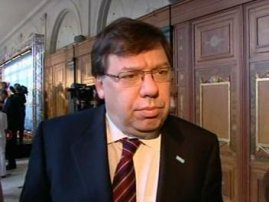
Speaking at the conference, Jack O'Connor (photo) said that employers who reneged on their obligations were "guilty of nothing short of national sabotage".

Last Friday it was clear that the vast majority of Irish trade unions had given the green light to the new National Wage Agreement - albeit reluctantly - and even its strongest advocates acknowledged its shortcomings. (see my entry of November 15th)

The country's second largest trade union, UNITE (formerly AGTWU), which voted against the agreement, blamed inadequate provisions on pay pensions and union negotiating rights.

However, speaker after speaker acknowledged that in the current economic climate there was no prospect of securing anything better outside national partnership negotiations. Unions will now push for full speedy implementation of every promise - particularly on employment rights.

The Irish Business & Employers' Confederation (IBEC) will endorse the deal later today, though the Construction Industry Federation is still not guaranteed to accept it at all.

Meanwhile the Irish Small & Medium Enterprises Association (ISME) has called on the government to suspend the national pay terms, in the interests of the economy.

ISME warned that it was "self-evident that wage increases will exacerbate an already perilous economic situation and, if granted, will drive companies to enforced closure, condemning more people to redundancy".
It is more than unlikely that their arguments will find much support and that the government will follow their advice.

15 November 2008

Most Unions accept new Wage Agreement

Most Irish trade unions have now accepted the draft national wage agreement which was agreed upon by the Social Partners in Dublin on September 17th. (see my entry of that day)

Yesterday SIPTU, Ireland's largest union, voted to accept and earlier members of ten other trade unions also voted in favour of the new agreement as well.
IMPACT and Mandate meanwhile confirmed that their members voted overwhelmingly for the proposed deal, too.

The Irish Nurses' Organisation (INO) announced that its members, who are employed throughout the public health service, have voted in favour, and so has the construction sector trade union UCATT, whose members voted by a margin of five to one to accept the terms of the draft agreement.

To no-one's surprise the Association of Higher Civil & Public Servants, which represents 3300 members, accepted the deal with a majority of 93%.
And the National Union of Journalists (NUJ) followed closely with 90% in favour.

However, the country's second-largest union UNITE (formerly AGTWU), which represents many members across a wide range of sectors including transport and public services, voted with a clear majority to reject the offer.
UNITE is affiliated to the largest UK union of the same name. What consequences their rejection will have is at this time not certain.

17 September 2008

Agreement reached in National Pay Talks

This morning - after months of general talks and weeks of intensive negotiations - the Social Partners have eventually reached a new National Wage Agreement for the Republic of Ireland.

The last session with representatives of employers and all Irish trade unions went on for 22 hours and all through the night. Negotiators on both sides realised that they were already into the third day over the deadline set by the Taoiseach, and that might have helped their minds to sharpen and reach an agreement.

The result of the long and tedious talks is a pay increase of 6% for all workers, to be paid over 21 months.
The pay rise will be applied in two phases, with a 0.5% increase at the end of the agreement for workers earning less than € 430.49 per week, or around € 22,463 per annum.

All private sector workers will have a three-month pay pause. They will then receive a 3.5% increase over six months and a further 2.5% for the following year.

Public sector workers will have an 11-month pay pause from the last module of the Towards 2016 programme.
They will then receive 3.5% for the next nine months (commencing September 1st, 2009) and a further 2.5% for the remainder of the agreement.
The agreement also contains commitments on public service modernisation to reflect the latest OECD report.

Brian Cowen explained that the new agreement would include provisions to prevent employers using temporary agency workers to break strikes.
There will also be a statutory prohibition on victimisation of trade union members, and on inducements to encourage trade union members to leave their unions.

"The new National Pay Agreement will give a sense of confidence and stability in the challenging period ahead," the Taoiseach said earlier in Dublin.
"Even though the negotiations were very lengthy and complex, the Social Partners made commendable efforts to enable the terms of a draft Agreement to be identified."

Trade union leaders and the representatives of the employers' organisations are now putting the new draft agreement before their members for approval. There will be internal discussions and a detailed examination of the agreed terms, and a result is expected in about two weeks.

"This has been a long and arduous process, played out against a background of rapidly changing economic reality for workers and the economy as a whole," said Jimmy Kelly, Regional Secretary of Ireland's second-largest trade union UNITE, after the talks had ended and rows of exhausted negotiators emerged from Government Buildings in Dublin.
Turlough O'Sullivan, Director General of the employers' lobbying group IBEC, said there were "many positives in the deal".

The Emerald Islander

05 August 2008

Views differ after National Pay Talks collapsed

Tánaiste Mary Coughlan (left) is still "very hopeful" that an agreement between Irish trade unions and employers can be reached when pay talks reconvene in Dublin in three weeks time. The negotiations of the Social Partners over a new national wage agreement had collapsed without a result last weekend.

Mary Coughlan said there was "absolutely no acrimony between the sides" and it was "appropriate for Jack O'Connor of SIPTU to reflect that he was taken aback by headlines over the weekend". What happened in the breakdown should not be heightened in any way.

Meanwhile SIPTU president Jack O'Connor (right), head of the country's largest trade union, warned that employers who fail to address pay claims could face industrial action. He said that there had been "no indication that employers would adopt more reasonable approaches" if partnership talks were to resume.

However, Irish employers insist that excessive pay increases would "damage competitiveness" and trigger even more job losses.

The Tánaiste's comments came as bank workers were expected to press ahead with their claim for an increase of 10% in their pay over the next two years. The Irish Bank Officials Association is to meet in two weeks' time to discuss this claim.
The Association's general secretary, Larry Broderick, said that his union lodged its pay claim six months ago and that workers could not afford a pay pause.

The collapse of partnership talks has triggered a new push on pay, with private sector unions set to lodge pay claims this week on an employer-by-employer basis.
Unions say they must protect the interests of their members, whose pay has been eroded by inflation over the last two years.

The nation's employers' lobby group IBEC (Irish Business and Employers Confederation) is advising its member companies not to engage in local bargaining, at least until after the Taoiseach meets the Social Partners to review the situation at the end of the month. They fear excessive pay hikes would damage their competitiveness.

However, the SIPTU president warned that any direction by employers to refuse to engage with unions would contravene most collective agreements and could raise the prospect of industrial unrest. Jack O'Connor said there had been no indication that employers would adopt a more reasonable stance if talks resume - and in those circumstances unions have no alternative but to press ahead with claims against individual employers.

The Emerald Islander