Showing posts with label Richard Bruton. Show all posts

08 September 2009

Many Critical Reactions to the Commission on Taxation's Recommendations

Irish opposition politicians have said they expect the government to use the report of the Commission on Taxation (see yesterday's entry below) "to tackle the shortfall in the public finances".

Fine Gael's deputy leader and Finance spokesman Richard Bruton (left) said that Fianna Fáil was "trying to tax its way back to recovery, and that no country has ever managed to do this".

"The last thing families and taxpayers need at this time of deepening economic crisis is dreaming up even more ways to tax them to pay for Ireland's unreformed, often dysfunctional and high-cost public service," Deputy Bruton said.
"No country has ever taxed its way back to recovery, but that is exactly what Fianna Fáil is trying to do."
"Ireland's tax system may need to be redesigned to support employment and investment, but the government's focus should not be on increasing overall tax levels," he added.

Fine Gael's newest TD (and former RTÉ economics editor) George Lee (right) stated that people would have to wait and see whether the report was a fair one. This would depend on what choices the government made from the menu provided by the commission, he said.

Joan Burton (left), deputy leader and spokesperson for Finance of the Labour Party, said she was "amazed that the commission has not tackled the issue of property based tax relief" and claimed that "the dominance of tax lobbyists in the commission's make up contributed to them side-lining this important issue".

Deputy Burton stated that the report would require "careful study" and called for it to be used "to address glaring anomalies in the tax system".
She added that despite the commission's description of the report as "revenue-neutral", it would be difficult not to see some of the new taxes being proposed being used to plug the gap in the public finances.

Sinn Féin's Finance spokesperson Arthur Morgan (right) said he expected the report to be used to increase taxation of ordinary people.
"This report unfairly targets households, as does the McCarthy Report, to pay for the government's mismanagement of the Irish economy," he said.
"It is not a restructuring of the tax system based on fairness - it is an attempt to squeeze even further ordinary people struggling to make ends meet."

Meanwhile the Irish Farmers' Association (IFA) criticised the report's proposals on carbon tax and changes to the capital allowance system.

IFA President Padraig Walshe (left) said he was "very concerned" that a carbon tax will add another cost to the productive, export-driven sectors of the economy and will also discriminate against farmers and rural dwellers who do not have the option of public transport.

He thinks the recommendation to change the capital allowance system will undermine any future investment in farm buildings in Ireland.

Con Lucey, the IFA Chief Economist, was a member of the Commission on Taxation.

Another farm group, the Irish Creamery Milk Suppliers Association (ICMSA), which has demonstrated against low milk prices outside Government Buildings in Dublin only last Friday (see my entry of September 4th), said that the proposal for a new carbon tax would "fall disproportionately on the agri-food sector and considerably worsen Ireland's competitive position".

The Arts Council has said it will make a "strong case" to the government for the retention of the artists' tax exemption scheme.
Its President Pat Moylan said that if the exemption is abolished, Ireland could lose entirely a considerable number of artists, and that this would not be for the public good.
She added that a study had shown that the Exchequer would lose tax revenue if the exemption is scrapped.

The Emerald Islander

11 December 2008

CSO reports the lowest Inflation Rate in Years, but there is little Evidence in the Shops yet

The annual rate of inflation in Ireland has eased sharply in November, falling to 2.5% from 4% in October. This is the largest reduction since monthly records began.

According to the Central Statistics Office (CSO) in Dublin, the overall cost of living fell by almost 1% during November alone.
Lower mortgage repayments, as well as petrol and diesel price cuts were the main reasons for the reduction. However, there are no signs of food prices coming down. They are still as high as they were last month, and in some cases one can even see further rises, even though not as much as they rose throughout the first half of the year. (see also my entry of February 28th)

2.5% is the lowest inflation rate Ireland had for three years, and many economic indicators suggest that further reductions are likely in the months ahead.

The key factors behind the reduction are global, including a sharp interest rate reduction by the European Central Bank (ECB) in October, as well as rapid cuts in international oil prices due to mounting evidence that the global economy has entered recession.

Today's figures show average mortgage repayments fell by 8.4% in November, as banks began to pass on to borrowers the first of three interest rate reductions. Rents also fell by 6.1% during the month.

There was also a sharp reduction in the cost of home heating oil, which was down by more than 10% in November.
Since I heat my little house with peat and wood, that does not help me. The price for fire wood rose by 20% this year, and peat went up 12.5%. (This came on top of similar rises in 2007.)

Petrol prices were down 7.3% and diesel by almost 10%, as international oil price speculation rapidly unwound. Nevertheless people in Ireland still pay a lot more at petrol stations than anyone else in Europe. Only a few days ago Fine Gael's deputy leader and Finance spokesman Richard Bruton stated that petrol is 24% more expensive in Ireland, while diesel costs 18% more than in the other 26 EU countries. (see my entry of December 3rd)

With further interest rate and oil price cuts still to be passed on to consumers, all the signs suggest that inflation will ease further in the months ahead. There is also likely to be significant downward pressure on inflation coming from the strength of the Euro, which hit another record high of 88.8 pence against the British Pound Sterling today. This would be the equivalent of the old Irish Punt being worth almost £ 1.13, its highest value ever.

At least the currency value proves that adopting the Euro was a good and sensible decision, even though there were plenty of critics and grumblers during the first few years. But that has eased now.

Overall, today's figures are a little bit of good news from the CSO, which has delivered only bad news to us for most of the year.
However, for people like me, who don't have a mortgage and don't drive a car, the fall in inflation is only another number. I watch very closely the prices in the shops, and there have been no reductions at all. The whole of 2008 has seen an ever further rice in prices for even the most basic food and consumer goods. It will be interesting to see if the apparent fall of the inflation rate will reach the shops before Christmas. I somehow doubt it, with the exception that probably pork and products made with pork will be offered at reduced prices as soon as they are back on the shelves.

But that will have nothing to do with inflation. It will be an attempt to make good for the losses shops as well as producers made due to the recent contamination scandal and the subsequent food scare.
Being a vegetarian, this will not do me any good either. So, as much as I welcome the CSO's news of falling inflation, I have not seen or experienced any of its benefits yet.

The Emerald Islander

03 December 2008

The Irish are ripped off at the Petrol Pumps

A new day, and another new Irish scandal - as I have predicted it last week.

According to Ireland's largest opposition party Fine Gael (FG), Irish people are paying significantly more for petrol and diesel than anyone else in the rest of the EU.

The party says that Irish motorists have to spend every month on average € 30 million more that they should, and it is not because of higher taxes.

In recent weeks the costs of petrol and diesel have dropped significantly, due to a drastic fall of the price for crude oil. But Fine Gael says that the prices Irish drivers have to pay at the petrol stations are not going down enough, as oil companies and petrol stations decide not to pass on the full benefit of price reductions and pocket the money themselves instead.

The party has been comparing the prices people in Ireland are paying to everyone else in the EU.

Fine Gael's deputy leader and Finance spokesman Richard Bruton (photo) explains that petrol is 24% more expensive in Ireland, while diesel costs 18% more than in the other 26 EU countries.

Once again we are ripped off in a shameless and criminal way by big businesses - in this case the oil and petrol companies - and no-one seems to be able to do anything about it.

The government does not care, as its members are driven around in their luxurious ministerial cars by Gardai and have not even a clue what Irish people pay on the petrol pumps.
And the National Consumer Agency - a toothless paper tiger established by Bertie Ahern to give his ex-girlfriend Celia Larkin a cosy little job - shows no interest in the matter either.

What - I wonder - will Irish people have to do before the complacent and lazy louts in government begin to take any notice of us, our needs and our misery?

Might some demonstrations do the job? Or will it have to be a revolution after all...?

The Emerald Islander

02 December 2008

Ireland's Tax Deficit will exceed € 8 billion

Ireland's Minister for Finance Brian Lenihan (left) has said that he will take "remedial steps" to reduce government spending after the latest Exchequer figures revealed a very sharp deterioration in the country's public finances.

The new figures show that the shortfall for this year is now set to exceed € 8 billion, which is almost € 2 billion more than the government expected just two months ago.

November is the most important month in the tax collection calendar for the government, since it includes all self-assessed taxes as well as a larger proportion of corporation and capital gains taxes due for the year.

According to the new Exchequer figures there has been a massive shortfall of close to € 7.5 billion in the amount of taxes collected by the government during the first eleven months of the year.
This is a much more than was predicted, and analysts now expect the tax shortfall for 2008 to exceed € 8 billion, which is about twice as much as the amount allowed under EU guidelines.

Richard Bruton (right), the deputy leader and Finance spokesman of the opposition Fine Gael party, accused the government of "rushing the 2009 Budget" and of "making a bad economic situation much worse".

As a neutral observer and analyst I cannot help but agree with Deputy Bruton, who is regarded as one of Ireland's most capable experts on fiscal politics.

But what is even more significant is the fact that for years the Department of Finance - under Brian Cowen and now under Brian Lenihan - got every single forecast of taxation totally wrong. So-called 'experts' of the government and the highly paid senior civil servants in the department alike seem to have no clue about the real economic and fiscal situation in the country.

During the boom times they were each November "surprised" by a sudden surplus of several billions in extra taxes they had not expected to rake in. (But they saw well fit to waste them very quickly on needless projects and - more significantly - on themselves and their luxury lifestyle.) And now they are equally surprised that the shortfall is much larger than it was calculated only a few weeks ago.

One has to wonder what qualifications these people have to hold their senior positions. There are very few economists among them, but plenty of pig-headed apparatchiks whose inflexibility has cost the country already dearly - and it will get a lot worse next year.

No-one in the government, and especially in the Department of Finance, listened to the regular and steady warnings that some well-known and highly qualified Irish economists like David McWilliams, Senator Shane Ross and George Lee (of RTÉ) have issued over years. They predicted with amazing clarity everything that has happened during the past months of rapid economic decline, and I have contributed my own two-pence of analysis and advice as well.

It becomes ever more obvious that our current government, and in particular its majority party Fianna Fáil - which is in charge of the Department of Finance for more than eleven years now - is completely incompetent to govern the country.

Furthermore, the government is directly responsible for many of the elements that caused the current crisis.

But instead of doing the decent thing - resign and call a general election - the clueless and highly overpaid scoundrels muddle on and pretend that they understand what is going on.
Every day they cling on to their power - and the beloved perks it brings them - the situation for our country and economy will get worse. It is now time for the people of Ireland to take matters into their own hands, stand up and be counted.

People power has recently made a huge change in the USA, and people power has also just forced the corrupt government of Thailand to resign. We could learn a lot from those examples, and if we still care for ourselves and our future, we need to act now.

The Emerald Islander

24 November 2008

Would Fine Gael provide a better Government?

Over the past weekend Ireland's largest opposition party Fine Gael (FG) held a national conference in Wexford. It was not, as some people had thought, their annual Ard Fheis (what people outside Ireland would call AGM), which is still to come.

No, this was a special national conference, a confidence-boosting event for party members and the public alike, and set at the time when Fine Gael passed Fianna Fáil in the opinion polls for the second consecutive month.

One can understand that Fine Gael members are excited, as it is the first time in living memory that their national popularity rating is above that of their arch rivals Fianna Fáil. But one has to be realistic and analyse the reasons for this sudden increase in public support.

At the Wexford conference there was no shortage of speakers - TDs, Senators and ordinary delegates - who praised again and again the strength and performance of their party, and in particular the "great and wise leadership" of Enda Kenny.
This is no surprise and can be expected from Fine Gael as well as from any other party. Those inside the pen are always confident and sure that their flock is so much better than all the others 'out there'.

But how much of this self-assuring noise is based on real facts? Let's have a closer look.

Fine Gael's recent jump in popularity is not a result of new political ideas, new people or a fundamental change in public opinion. In fact, since they narrowly lost the 2007 general election, Fine Gael have been rather a tame and timid party, offering only the most basic opposition to the government and being silent on many important issues.

Party leader Enda Kenny (right), now praised by his party delegates like some Messiah, has not been very vociferous or aggressive as head of the main opposition in parliament.
He is undoubtedly a very decent and honest man, which sets him worlds apart from most
Fianna Fáil TDs.
He is also a hard worker and does not dodge difficult subjects. One has to give him that.
But he is not - and never has been - a charismatic leader or particularly inspiring speaker.

In fact, very few members of the Oireachtas are gifted public speakers, so one could say that Kenny is in a company of equals there. So, despite the praise now heaped upon him by happy party members, it cannot be he - or his performance - that led to the rise in popularity for Fine Gael.

What is it then? The answer is not difficult to find for outsiders, even though FG members refuse to accept it in their euphoric mood.

The only reason for the increase in public support for Fine Gael is the dismal performance and utter failure of the present government.
While Fianna Fáil and the - now defunct - PDs got away with a lot of their mismanagement and incompetence during the boom times of the so-called 'Celtic Tiger', it is a different situation now in economic recession. There is no longer a bag with endless supply of money one could throw around to cover up mistakes and failure.
Now the proverbial wolf is at almost every door, including the doors of Government Buildings, every government department and state agency, and money is extremely hard to come by, especially since the ten-year-long mismanagement of our economy has also damaged our banks, probably beyond repair.

Instead of being prudent, humble and constructive, the government decided to remain aloof, arrogant and insensible and produced an appalling budget, which annoyed most of us and outraged significant elements in our society.
Since the budget was presented in the Dáil by Finance Minister Brian Lenihan on October 14th (for detailed budget analysis see my entry of that day), there have been dozens of public protest meetings and demonstrations against the government and its policies, both in Dublin and around the country. Elderly people, students, teachers, parents and farmers have so far been the most active in showing their anger and disappointment, but other interest groups are likely to follow as well.

In such a political climate it is no surprise that the government is becoming unpopular. This is a normal reaction and would happen to any government that behaves in this way, regardless which party or parties are in power.

Had Enda Kenny not run an American-style campaign in 2007 - which was designed and managed for him by US consultants who were unfamiliar with Irish and European politics and only knew the presidential campaign mode they do at home - he would most likely have become Taoiseach in June 2007, with the then Labour Party leader Pat Rabbitte (left) as Tánaiste.
Would they be in office now, they would face the same problems and might have to encounter the same drop in popularity Brian Cowen is experiencing now. Although - to be fair - Enda Kenny and Pat Rabbitte - both from Co. Mayo - are much more kind, pleasant and serious than Cowen and might have handled the crisis more sensibly. Nevertheless the fact of a recession alone will diminish the popularity of whoever is in government at the time.

People in most western countries have little personal interest in politics and think that it is enough to go once every four or five years into a booth and make a cross on a ballot paper. The rest they leave to the people they elect, and expect them to do a good job with the country and the economy.
All the average voter really wants is to live in peace, security, stability and prosperity. People want jobs, enough money and liberties to spend it, a proper house, a car perhaps, and nowadays also a good holiday. As long as they get that, they do not care much who is in government. This is not a shining example of Democracy, but sadly it is the reality.

When the popularity of a government shrinks, it is normal that the opposition party (or parties) will see an increase in public support. One team has failed to deliver what we want, so we no longer like them and hope the other lot will be and do better. One can see this happening all over the world, and it is the same here in Ireland.

The rise in public esteem Fine Gael is now celebrating is not at all based on anything they have done or said.
It is the natural gain they receive from the decline in confidence in the present government. Thus it is a dangerously thin sheet of ice to walk or skate on, and no matter what opinion polls might say, they are only snapshots of public views, taken from a small group of people. The only poll that really matters is the one on election day.

The understandably happy FG members should be a little bit more cautious and not start counting their chicken before they have hatched. Their party is far from perfect and - if roles were reversed - would most likely not perform much better than Fianna Fáil is doing now. (They would be somewhat better, though, as it is virtually impossible to beat the incompetence of Fianna Fáil and the arrogant and otherworldly attitude of the Green Party.)

Nevertheless the predominant opinion in Fine Gael after this weekend is that they are "ready for government" and cannot wait to form one. This is dangerous thinking.

In many constituencies the local grass root organisation of FG is shambolic, and sometimes even non-existent between election campaigns. There are faction fights over some petty issues and personalities, and overall there is a lack of proper organisation and vision.

Fine Gael might be officially Ireland's second-largest party, as well as the largest party in opposition, but it still has not learned how to mobilise the masses and provide new ideas that inspire people.

One should also not forget that only six months ago Fine Gael was very happy to stand shoulder to shoulder with Fianna Fáil and the government in the YES camp during the Lisbon Treaty campaign. In fact, for most of this campaign FG was far more visible, vociferous an pro-treaty than FF (or the Labour Party, who also stood with them and promoted the treaty).

Fine Gael's present spokesperson on Europe, the Mayo-born lawyer and Dublin TD Lucinda Creighton (right), was so arrogant, aggressive and even rude during various debates over the Lisbon Treaty that she and her attitude alone would have been enough reason to vote NO, had there not been a lot more and even better reasons to do so.

And the FG spokesman on Foreign Affairs, Wicklow TD Billy Godfrey Timmins (left), is not only a strong supporter of the Lisbon Treaty, he is also very much in favour of Turkey (a country in Asia) becoming a member of the EU.
That alone I find personally very alarming, and one should be aware of seemingly little details like this, as they can - and often do - become major policies once a party is in government.

However, during the Wexford conference there was not much discussion over the future of Europe and the EU. The dominant theme was - to no one's surprise - the economy and how to overcome the now ever more obvious recession.

Richard Bruton (left), the party's deputy leader and spokesman on Finance, had a field day and was hailed by delegates as much as Enda Kenny.
In fact, since the budget was presented in October, he has been in the frontline of the political battle every day and done most of the arguing on behalf of FG. Knowing how good his deputy is on financial and economic matters, Enda Kenny took deliberately a back seat role in many debates and let Bruton stand up as
Fine Gael's champion. (One has to acknowledge that Richard Bruton is indeed one of Ireland's best and most experienced experts on financial and economic policies.)

Dr. Leo Varadkar (right), a young first-time TD and already Fine Gael's Business & Enterprise spokesman, also received a lot of support from the delegates as he outlined his views on the economy and how to improve it. Although it is early days yet for him, some political analysts see in the 29-year-old a potential future leader of his party.

Another natural contender for the party leadership in years to come is undoubtedly Brian Hayes (left), who - after five years as the FG leader in the Seanad - is now Fine Gael's Education spokesman in the Dáil.
With the scandalous cuts to the education budget, ever rising class sizes and reduced resources for schools and teachers, Education was the second major subject in Wexford.

Fine Gael is committed to undo the current government's cuts in Education, should they form a government of their own (or - more likely - with the help of a coalition partner, which at this stage could only be the Labour Party).

Everything went well for Fine Gael in Wexford, and the special national conference coincided conveniently with another anti-government demonstration in Cork on Saturday (see my entry of November 22nd) and a very favourable new opinion poll published yesterday (see my entry of November 23rd).
So all was really hunky-dory for the opposition and would have remained so, but then FG leader Enda Kenny decided to lob the ball into his own party's goal only minutes before the end of the game.

In his leader's address he demanded that the new National Wage Agreement - signed by the Social Partners on September 17th and accepted by the trade unions only a week ago - should be "suspended for one year" to help the economy. (for details see also my entries of September 17th and November 15th & 17th)

This statement was not only the wrong one at this time, it has also destroyed Enda Kenny's chances to become Taoiseach any time soon. With these few words he offended almost every working class person, and certainly every trade unionist in Ireland.

Jack O'Connor (right), President of the country's largest union SIPTU, did not wait long with his reply to Enda Kenny and the newest Fine Gael position, also defended this morning - once again - by Richard Bruton.

“Apart from the implications for the living standards of ordinary working people, suspending the pay agreement is about the worst possible approach imaginable at this point in time,” O’Connor said.
“It would further depress consumer confidence and exacerbate the recession, when what is needed are means to stimulate demand.”

Quite right, and it is amazing that seasoned politicians like the FG leadership do not agree. But then again, one has to look a bit deeper into the party's structure and tradition.
Fine Gael is still a capitalist right-of-centre party which depends for a lot of its support on big business and very rich people. And ever so often these sponsors and lobbyists demand their proverbial 'pound of flesh'. They have little regards for FG's general policies, appearances and popularity, and only care for what matters most to them: the amount of money in their pockets and bank accounts.

So, ironically, a whole weekend that had gone so well for Fine Gael was blighted in the end by a policy statement from its revered leader. It exposed FG for what they really are: Just another of the old and worn-out parties on the Right of Irish politics, with no new ideas, but ever more appetite for power.

In that regard there is not much difference between FG and FF. Their party manifestos (and I read them both very thoroughly) have the same principles and almost identical lines on most policies. They both are establishment parties with little flexibility and are more than happy with the status quo. Which should not really surprise anyone, as they are the two sides of the same coin.
Both emerged as political 'children' of the original Sinn Féin, but fought each other during the Civil War of 1923. When peace was restored, they stood on opposite sides of the trench and there they still stand today, inflexible, self-centred and incapable to develop new ideas and political concepts.

Reflecting on all this, including the Wexford conference, one has to wonder if Fine Gael would actually provide us with a much better and more capable government, if we gave them the chance.

There is no doubt that anyone would be better than the current government coalition, and could do a better job simply by being less incompetent, corrupt and arrogant.
But after listening to many speeches and statements made in Wexford over the weekend, I am not sure that I would like to see a Fine Gael (or FG-led) government in Leinster House.

I am fully aware that the options are rather limited at the present time. Going by current numbers, there can be no Irish government without either Fianna Fáil or Fine Gael.
The Labour Party, the Green Party and Sinn Féin would be available as junior partners in a coalition. So most analysts expect that - in case the current government loses more of its TDs and is forced to step down - a new coalition of FG and Labour Party, supported by some Independents and - perhaps - even by Sinn Féin, would take over.

But should it come to an early general election, things could turn out quite different. Although the PDs are gone (to everyone's joy) and the Green Party will probably receive the same treatment as the PDs got in 2007, there is a strong possibility that Ireland will see some new political parties emerging.

Declan Ganley (left), the chairman of the Euro-sceptic think tank Libertas, which was very much engaged in the Lisbon Treaty campaign, has meanwhile registered his organisation as a political party. Even though his main interests are the EU and the up-coming elections to the European Parliament, I would not rule out the possibility that he also enters national and local politics in Ireland.

And there are some other people as well, most of them not members of established parties, who are wondering if we need some new faces, ideas, skills and leadership qualities in Irish politics.
It would not surprise me if there were several new parties in the next general election, and perhaps even already in the local elections next year.

Thus the idea of Fine Gael that they have a natural right to take over from Fianna Fáil when they eventually collapse, is a very old one, at a time when new ideas are needed to save the nation and revive our ailing economy.

The Emerald Islander
03 July 2008

The latest economic Views from Dublin

Brian Cowen (right) has urged people to "stop talking as if the economy is facing Armageddon".

The Taoiseach said that "the fundamentals of the Irish economy are far stronger than they were in previous decades".
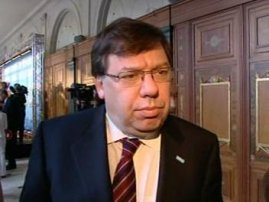
What is needed now is "calm consideration of what action should be taken".

Cowen added that Minister for Finance Brian Lenihan would be announcing the government's new "plan of action" after next week's cabinet meeting.

Meanwhile Fine Gael has proposed a range of measures, including scrapping pay hikes for ministers and senior civil servants, to deal with the downturn in the economy.

FG Finance spokesman Richard Bruton (left) said "the main danger facing the country now is posed by a government in denial about the economic realities".
His party contends that the sharp downturn in the Irish economy is not due to international factors but to government neglect and mismanagement, particularly in its handling of the construction sector.
The number of junior ministers should be cut by at least three, and € 400 million should be released from what Fine Gael calls "Ireland's failed decentralisation programme".

The party also proposes changes in VAT and stamp duty, but the fundamental thrust of its programme is towards public sector and budgetary reform, which it says "is needed now more than ever".