Showing posts with label air travel. Show all posts

10 September 2009

Ryanair increases Baggage Fees again

The Irish 'low fares' airline Ryanair has announced a further increase in its fees for checked-in baggage from next month. According to the airline, it is "part of a change in company policy".

In order to keep people confused at all times, the amount of bags Ryanair passengers can check in will increase, but at a higher cost.

From October 1st passengers will be able to check in two bags, each with a separate 15 kg allowance. This a double the current Ryanair luggage allowance of 15 kg.

But the on-line fee for the first checked-in bag will rise from currently € 10 to € 15, while the fee for the second bag goes up from € 20 to € 35.

If the bags are checked in at the airport, the fee for the first bag climbs from € 20 to € 30, while the charge for the second bag goes up from € 20 to a staggering € 70!!!

The airline says that the higher charges will "recover" the cost of what has apparently been "a 20% fall in average fares" this year. And it adds that the increases are "aimed at encouraging passengers to travel with carry-on luggage only".

I am not so sure about this. To my knowledge, Ryanair fares have not fallen in recent times. In fact, with all the add-on charges for luggage, credit card use (which is obligatory for booking with Ryanair) and other so-called 'extras' that were free until recently and still are with many other airlines, travelling with Ryanair has in fact become ever more expensive.
Adding to this the fact that many Ryanair flights do not go to major European cities - despite the airline's claim that they do - but to obscure small airports* many miles away from these cities, the idea of 'cheap flights to the heart of Europe' becomes even less attractive.

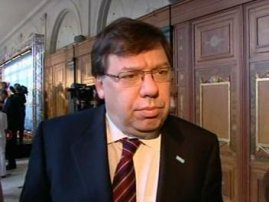
Since Ryanair's boss Micheal O'Leary (right) never does anything without a reason - and without gaining a profit from it - I do wonder if the real reason for the sudden and steep increase in baggage charges might be that Mr. O'Leary is a strong supporter of the Lisbon Treaty. Has become a major donor to the YES campaign in the run-up to the second referendum on October 2nd, and I am sure he is keen to recover this money in some way.

Personally I do no longer fly at all (as regular readers of this weblog will know from previous entries) and I have never used Ryanair. But if I would still fly, Michael O'Leary's aggressive support of the YES campaign for the Lisbon Treaty would be a good reason never to use his airline again.
I hope that readers who still fly with commercial airlines will take notice of this and follow my line of thought.

The Emerald Islander


* Many Ryanair flights pretend to go to major cities, but their aeroplanes actually land on small airports nearby, or in some case quite a distance from the 'official' destination. Passengers are then transported to the actual destination by train or - more often - by bus. When Michael O'Leary developed the Ryanair network, he took advantage of the large number of small local and regional airports in Europe. Some of them had existed for a long time and serviced mainly small private aeroplanes and flying schools, without any airline ever going there. Others had been military airbases during the 40 years of the 'Cold War'. When, after 1990, the strength of NATO military power was reduced all over the European continent, a growing number of these airfields became available for civilian use. A typical example is the former US Airforce base at Hahn, in the German state of Rheinland-Pfalz (Rhineland-Palatinate), which was the home of American fighter bombers for decades. Now it is a civilian regional airport and serves - among others - Ryanair as one of their main destinations in Europe. But only Ryanair sells their flights to Hahn as flights to "Frankfurt-Hahn", even though no such place actually exists. Frankfurt, the metropolis of the neighbouring state of Hessen (Hesse) and the financial capital of Germany, is in fact more than 100 km away.

28 August 2009

Outlook for Aer Lingus is "highly uncertain" as the Company reports increasing Losses

The management of Ireland's national 'flag carrier' Aer Lingus says that "the outlook for the airline is highly uncertain" in light of the latest financial results. Their losses have tripled to now € 93 million in the first half of this year.

After taxes the net loss in the first six months of 2009 more than tripled to now € 73.9 million (compared with a net loss of € 21.6 million for the same period of last year), while revenues were down over 12% on the back of lower passenger fares and cargo fees.

In a company statement Aer Lingus said that it is "not in a position to give guidance for the full year at this time".

The company also announced that it can no longer afford to pay what is described as 'legacy-style' rates to its staff.

Aer Lingus' Chief Financial Officer Sean Coyle stated that the company's board has "a tough job, but believes the airline can be made successful as an independent entity as it undertakes an exhaustive and wide-ranging examination of its operations and commercial focus".

This is nice boardroom lingo, the new language big companies and their representatives use these days to confuse the rest of us, the normal people who speak proper English.

But what does it actually mean?

"Clearly we can't sustain operating losses of these levels, we can't sustain the kind of cash burn we've had in the first half of the year, and we need to rebase our cost structure to live with the lower fares that our passengers are prepared to pay," Sean Coyle explained in a second attempt.

Well, this is a lot clearer, although I still wonder what it means "to rebase our cost structure"...

Perhaps it means just to spend less money, and maybe Aer Lingus should start doing that from the top down. Their directors are still overpaid, and even more so in light of the now revealed disastrous company results.

No bank is prepared to lend money to an airline that is burning about € 400 million of net cash in a 12-month period. Not even the Irish banks that brought us the 'credit crunch', recession and national finance crisis.

"We have to come up with a cost plan to stabilise our position. Nothing is ruled out at this time," Sean Coyle emphasised.

I wonder if he and his fellow directors have thought of reducing the number of their flights and aeroplanes, to match an obviously shrinking market. The idea that anyone can fly to anywhere for next to nothing and for no particular reason is ludicrous. It ruins the rest of the ozon layer that is left by now, and does further damage to our planet.

Education has to do its part to bring the message home, and governments - not only the Irish - have to play their part as well, first of all by imposing normal fuel taxation on aircraft fuel, which is still - and for no good reason - tax-free.

Too many people still fly to too many destinations, for no real reason. Holidays can be spent in one's own country as well as abroad, and if someone really feels the need to go to other countries, we still have very good and reliable ferry services.

The financial crisis of Aer Lingus is only the tip of the proverbial iceberg. It shows that airlines and air travel as most people know them are no longer viable and sustainable. I have seen this a long time ago and not used any airline or commercial flight for more than 20 years.
It is time now for everyone to wake up, see the light and accept reality.

If we allow ourselves - and the airlines - to stay in cloud-cuckoo-land, the crash that will happen in due course will be at least of the same dimension as the recent collapse of the banks.

Good Morning, Ireland! Good Morning, World!

The Emerald Islander

06 May 2009

New Charge for Plastic Bags at Dublin Airport

Passengers taking flights out of Dublin Airport will from now on be charged another unnecessary and unfair fee, for a 'service' equally needless and useless, invented by goons to make the lives of air travellers more difficult, unpleasant and costly.
Resealable plastic bags in which passengers have now to carry all permitted liquids on board their aeroplanes (see photo) will no longer be provided free to the travelling public.

Idiotic and restrictive 'security' measures, apparently "to combat terrorism", were introduced in November 2006 after a massive (and totally unsubstantiated) hype at London's main airport Heathrow.
Since then air travellers are prohibited from carrying liquids and gels on board their aeroplanes in containers greater than 100 ml. Containers which are permitted have to be placed in a clear plastic bag for inspection by 'security' staff.

Until now the Dublin Airport Authority (DAA) provided passengers with these bags free of charge, at an operational cost for the company of € 70,000 per annum.
But as air travel world-wide is becoming ever more weird, irrational and inhumane, airlines and airport operators alike are turning ever more ruthless and greedy, trying to squeeze more and more money out of the gullible air travellers who were lured into flying by an apparently "cheap flight".
After adding all the taxes, fees and levies, plus a dozen extra charges by the airlines for this and that (from having a bag to paying by credit card), the actual prices people have to pay these days for flights are quite high.

The DAA's attitude is obviously that fools who are willing to pay that much for a 'cheap' flight can easily be squeezed even a bit more, especially if there is no choice or alternative. So from now on the compulsory plastic bags will only be available from vending machines, at a cost of € 1 for two bags!
As material value and production costs of the bags are less than 5 cents per item, the DAA will be making a nice and easy 900% profit from this latest extortion idea.

The DAA says that "Dublin is one of the last airports in Europe to introduce such a charge", but this is neither an argument for it, nor an excuse.
It is just the usual way of weaseling around with words and concepts. A bit like the little boy who urinates into the public swimming pool "because all the other boys do it"...

"Passengers can avoid the expense if they plan ahead," a DAA spokeswoman said.

Well, I have an even better idea: You can avoid that expense, plus all the other extortionist charges for air travel and the many extras and add-ons it now has. Just don't fly!

I have not used an aeroplane in more than 20 years, and I am still happy and get around to any place I have to travel to.
Even on an island one has still a choice, and there are very good and reliable ferries, you know... where one is not charged for everything extra, where one is not treated by staff as if one were a cross-breed between cattle and morons, where one does not have to follow dozens of equally silly and sadistic 'security' rules, and where one does not need special plastic bags to carry tooth paste and hair tonic.

I am sure that before long, once the air-travelling masses get used to the idea of paying now for their silly plastic bags as well, the price for each bag (now set at 50 cents) will rise to € 1 and eventually € 2. And those foolish enough to travel by air will pay it, most of them even without a moment of thought or reflection. Despite all the talk of financial hardship, crisis and recession there are still way too many people with more money than brains.

But there are also those who will not be conned, milked, exploited and taken up the garden path by state-licensed street robbers and highwaymen. Among them you'll always find - yours truly -

The Emerald Islander

11 March 2009

Aer Lingus reports a € 120 Million Loss

Aer Lingus has reported a pre-tax loss of almost € 120 million for last year, compared with a profit of € 124.8 million a year earlier.
The profit of Ireland's main commercial airline is particularly affected by a once-off € 140.9 million charge for its controversial cost-cutting and saving programme.

When the restructuring charge is taken out, pre-tax profits fell by almost 84% to € 21.2 million, as fuel costs rose by almost 60%. There was an overall operating loss of € 17.6 million.

Aer Lingus has also lowered its outlook for this year, saying it is "unlikely to make a profit". It states that the weakening economy has reduced its cargo business, while consumer demand has also weakened.

Apparently passengers are increasingly booking later, and lower fares are needed to keep the aeroplanes full. Aer Lingus expects average fares to fall by 10% in 2009.

The 2008 results show that the airline's total revenue grew by 5.6% to € 1.357 billion, while passenger numbers rose by 7.5% to 10 million.

Aer Lingus Chief Executive Dermot Mannion has described last year as "extremely challenging".
"Falling consumer demand in key markets, a weakening of the Dollar and Pound Sterling, and increased competition across the network combined to put sustained and significant pressure on our business throughout the year," he said.

He also stated that while Ireland would "always be a core element of Aer Lingus", diversifying out of the Irish market was key to its success in the long-term.


My personal Comment: It appears that Aer Lingus - like almost all commercial airlines - are still expecting to grow and expand in the future. What they have not yet realised is that the current recession and the rethinking and restructuring of global businesses will actually further reduce air travel. This is also a positive aspect for the environment.

The Emerald Islander

05 December 2008

The Con of the Season

Ireland's Commission for Aviation Regulation has urged a travel company called United Travel to wind down their business and refund the customers.

At least 1175 children and adults are booked with the agency to fly from Dublin to Lapland during the month of December, for the sole purpose of meeting 'Santa Claus' at his apparent home there.

But this is now unlikely to happen, as United Travel does not have a licence to operate. The Aviation Regulator refused to grant the travel agent a licence because he was unhappy with the company's financial situation.

Con Murphy, Managing Director of United Travel, says that he applied for a licence again this week, and that he is "hopeful the passengers intending to travel to Lapland will be able to do so", whether with him or another agent.

I will refrain from playing on the obvious that Mr. Murphy is aptly named. There are many like him who provide illusions, escapism, idiotic stunts and a whole variety of silly things to people with more money than brains.

When I heard of this, I first refused to believe it. But some research established that there is indeed a thriving 'industry' in Ireland that flies stupid and irresponsible parents and their gullible children to northern Finland each December, in order to meet 'Santa'. United Travel is only one of the agencies involved, but apparently the only one without a licence to operate.

The prices for these trips are quite substantial, especially when one takes into account that the people actually pay good money for a flight into the middle of nowhere, to encounter a figment of imagination, portrayed for gullible idiots by an actor who works for the company and is placed in some suitable stage settings.
People phoning into Live Line on RTÉ Radio 1 stated that they had paid as much as € 4000 for the ultimate exercise in self-delusion.

And there I was, under the impression that we are in a recession and money is tight. Obviously not yet tight enough when thousands of Irish people are willing to spend thousands of Euros each on such an unbelievably idiotic trip.

Since there are apparently three classes of idiots, United Travel offers three 'packages': the basic one-day round trip (fly to the middle of nowhere, meet a non-existent person, and fly home again) as well as visits of two and three days length.

On the company's website the one-day trip is described as follows:
"Upon arrival at the official airport of Santa Claus, having cleared passport control and customs, you will be met by your local guides in traditional Lappish costume to assist you to your designated coach and help you in collecting your thermal outfit (overalls, winter shoes, scarves, socks and gloves will be provided) for the duration of your stay in Lapland.
As soon as you get your thermal outfit organised, your elf guide will be waiting to transfer you to Santa's Winter Wonderland, which is reserved exclusively for United Travel guests, located around 30 minutes distance.
At Santa's Winter Wonderland, you will be welcomed by the sound of your favourite Christmas carols, which are played all over this magical playground. Keep yourself and your party warm with warm berry juice and ginger bread served beside the fireplace during the stay."

Similar texts - with more details - also describe the longer trips.
Just a few remarks to the text above:
  • The place people are flown to is actually Rovaniemi, the administrative city of Lappi, the most northern - and by far largest - province of Finland.
  • I wonder what Lappi's governor Hannele Pokka (in office since 1994 and the first woman to hold the post) would say to a dodgy Irish travel agent renaming her regional airport. (What would we say if someone in Finland would declare - for example - Knock Airport "the official airport of the Leprechauns"?)
  • As both Ireland and Finland are members of the EU, there is neither a passport control nor any customs clearing. (After all, one of the main functions of the EU is a customs union.)
  • People who cannot collect a few clothes without being helped by others must be in a serious state of physical and mental deterioration. (But then again, if they were sane and sound, they would never book the trip in the first place...) And anyone flying into the Arctic Circle without proper clothing and outfit is either an enormous fool, or suicidal.
  • The website does not say if those clothes and shoes are given to every passenger to keep, or if they are worn by a different person every day. If the latter is the case, the concept of hygiene seems not to be part of the world United Travel and its passenger live in.
  • It is interesting to learn that "Santa's Winter Wonderland" is "reserved exclusively for United Travel guests". Isn't it rather befitting that the imagined home of a fictional person is "reserved exclusively" for a company without a trading licence, which therefore is legally as non-existent as 'Santa'. (One wonders if there is any 'wonderland' at all, or if the whole thing is a massive con through and through... somehow the old story of the emperor's new clothes comes to mind...)
  • In case there is actually a place with some 'Santa', being bombarded with piped music all day is a form of mental torture (banned by the UN) and can seriously damage one's mind. On second thoughts - those who go there have probably not much to lose in that matter.
Now, I regard myself as quite a tolerant man, and I have an open mind for all sorts of things most people would regard as unusual or weird. But this is way beyond the Pale, and I wonder how daft and brain-dead people must be who find this utter nonsense attractive, book it and pay € 4000 for it up front.

It is certainly the most shameless, tasteless and senseless commercialisation of the already highly secularised and consumerist idea of Christmas. And the fact that the company is selling expensive tickets without having a licence to fly really is the biscuit. It's definitely the con of the season.

But then again, people who are so devoid of brain functions that they willingly go for such a fraud and even tell Joe Duffy of Live Line how "devastated" they would be if they really could not fly to Lapland, probably had it coming and deserve to be taken for the fools they are. And - as an old word of wisdom tells us - a fool and his money are easily parted.

The Aviation Regulator has advised United Travel to wind down their business and refund their customers. But I have a better idea. Instead of giving back the money to fools who seem to have way too much of it, the sums paid for the flights should be seized by the Revenue Commissioners as a special new fools' tax.
As we are in recession and the government is so short of money, they can do with every extra Euro and cent. I would even go further and charge all 'Santa flyers' an annual levy of the same amount for the next three years. Hard times bring hard measures, and those who feel that they can in these times waste good money in the most idiotic way deserve to be punished.

Not even to mention the extra pollution and damage to the environment caused by the idiotic nonsense. Perhaps Finance Minister Brian Lenihan should modify his new air travel tax and raise it for any flights to Lapland to € 100 per passenger and flight.

Parents who drag their little children along to such a preposterous tissue of lies and exploitation should be charged with mental cruelty and child abuse. They should lose custody of the children.

It is bad enough to feed small children all the elaborate lies about Christmas and 'Santa', and worse to go to the so-called 'grottos' greedy shopping centres erect every December.
There mindless and cruel parents pay between 15 and 25 Euros (in some places perhaps even more) per child, in order to have their offspring conned even further by a fat man in a red suit, wearing a fake beard of white cotton wool.

Children are not stupid, and most know from observation how a real beard looks. So what is the point to usher a child for a few minutes into the presence of an obvious fake and pay good money for it?

Most modern people are really not fit to be parents, but in December they behave the worst.
Why are parents lying to children? And furthermore, why do they construct elaborate tissues of lies which are then supported by encounters with someone pretending to be a 'Santa'? (The most confusing thing for small children accompanying their mother or parents into the city is to see in the different shops several versions of 'Santa'. That a very young mind cannot work out properly and it can lead to all sorts of behavioural problems.)

Psychological research has well established that children are not stupid and can spot lies rather easily. Children also have a growing memory and often remember even the smallest details from their early years. When they grow older, they begin to realise that their parents are lying to them, and not just with regards to Christmas and 'Santa'.
This leads to mistrust and alienation, which can end in parents and children living in completely different worlds. Breakdown of family structures, disrespect for the parents, odd and unruly behaviour and petty crime are often the consequences. Some of these children will then progress through further stages into more serious crimes, gang culture and drug abuse.

Of course not every child that is dragged to 'Santa' ends up as a criminal or druggie. But there are many other kinds of illusion and escapism, often happily supported and even fuelled by the media, and especially television.
If we are wondering why our society is becoming ever more dysfunctional, we should look at the way that we - parents, teachers, the media and society as a whole - treat children and young people.

The disrespect we show children from earliest age onwards by feeding them with lies and all sorts of weird and unreal stories is stored, replicated and multiplied over the years, until the natural bonds of trust break. Once this happens, there is really no way back. And all attempts of repairing the damage later is not more than papering over the cracks, pretending - with another lie - that all will be fine. The cracks are still there, we cannot make them disappear. In most cases they will become larger with time, no matter how much we cover them up.

So if you want to live in a better society, stop lying to children and stop exploiting every last bit of culture, lore, tradition and imagination for the sole purpose of making already rich people even richer.

Few people seem to remember that the modern image of 'Santa' in its commercialised form was created during the 1920s in the USA, by no other than the Coca Cola company of Atlanta, Georgia.
They used it first to increase their sales figures during the Winter, when people were naturally less thirsty than in the Summer.
And as the corporate colours of
Coca Cola are red and white, 'Santa' was clad accordingly (and still is).

The traditional roots of 'Santa' go of course much further back into history and mythology. They combine several figures - animistic wood spirits, Pagan gods and a Christian bishop - into one fictional creature, which is depicted and enacted quite differently, depending on the country, its culture, tradition and religion.
But that is really an article in its own right, and I will write it tomorrow, the traditional feast day of Saint Nicholas.

Until then I can only urge you to keep your sanity - and your money - and stay well clear of the Con of the Season.

The Emerald Islander

02 December 2008

Aer Lingus rejects new Ryanair Take-Over Bid

The board of Aer Lingus has rejected a € 748 million offer by Ryanair to buy and take over their airline.
In a statement, the board strongly advised its shareholders to "take no action" in relation to the Ryanair offer.

An earlier take-over bid by Ryanair, issued more than two years ago, was also rejected and later blocked by the European Union as well.

On October 5th, 2006 - only days after Aer Lingus was floated on the stock market - Ryanair announced it had bought a 16% stake in Aer Lingus and was offering € 2.80 for each of the remaining shares.
After Aer Lingus rejected these advances, Ryanair declared a few hours later that it had raised its stake to 19.2%. The low-cost airline also said it had no problem with the Irish government keeping its 28.3% of shares.

It is no secret that Ryanair's CEO Michael O'Leary (right) has a dream. The maverick entrepreneur who changed the structure, character and costs of European air travel in a few years beyond recognition and forced many other airlines to adopt his concept at least in parts, wants to create a single powerful Irish airline, which could carry over 50 million passengers a year.

Ironically this is exactly the opposite of what he wanted - and did - when he established Ryanair, which was to break the monopoly of Aer Lingus. The new large airline he now envisages would in fact restore the monopoly situation Ryanair has broken.

After the rejection of the 2006 take-over bid, which was criticised by the Irish government and eventually banned on June 27th, 2007 by the EU Commission on competition grounds, some analysts believed that this was the end of it and Ryanair would be content with owning a significant portion of their rival's shares.

But they did not take into account the personality of Michael O'Leary. He is a man used to get what he wants. And when he has set his mind on something, he usually keeps at it like a terrier. Whenever there is a chance, he points out the "unique opportunity" to form a large, competitive and profitable Irish airline.

In a move that surprised most analysts and was announced to the Irish Stock Exchange in Dublin yesterday morning, Ryanair declared it was offering now € 1.40 per Aer Lingus share (exactly half of what they offered two years ago).

It already owns now 29.82% of the former state airline, having bought up more Aer Lingus shares steadily and quietly all the time.

Ryanair says it wants to "merge the two airlines into one strong Irish airline group under common ownership, similar to recent mergers in Europe such as Air France-KLM and Lufthansa-Swiss".
It points out that its proposal represents "a premium of about 28%" over the average closing price (€ 1.09) of an Aer Lingus share in November 2008.
In fact, it also represents an premium of about 25% over the closing price of € 1.12 of an Aer Lingus share on Friday.

Ryanair suggests that both airlines should operate as separate companies and keep their separate brands, but share and combine organisation and facilities (such as maintenance, catering etc.).

It says that if the offer is successful, it will double the size of the Aer Lingus short haul fleet from 33 to 66 aeroplanes over the next five years. And it also promises 1000 new jobs.

But still the board of Aer Lingus is having none of it. For them Michael O'Leary is what the Carthaginian General Hannibal was to the Senate of Rome: the arch enemy "ante portas" (at their gates).

Aer Lingus, previously a fully state-owned company, floated on the Dublin stock exchange only in 2006, after the Irish government had decided on a part-privatisation. Within days Ryanair began snapping up shares, before going public with its take-over interest.
Only outsiders and people who never heard of Michael O'Leary could have been surprised by that.

And O'Leary still keeps trying, now with new arguments. "The world has changed", he says, pointing out the various mergers of other airlines and dwelling gloomily on the recession and global financial crisis.

"Over the past two years, the trading environment for all European airlines has deteriorated dramatically as a result of high oil prices and the global recession," O'Leary states plainly. "And more than 30 airlines have failed this year alone."

He says that the airline has requested meetings with the Ministers for Finance and Transport (Brian Lenihan and Noel Dempsey), the board of Aer Lingus and the airline's ESOT trustees to discuss the latest move.

After the announcement Aer Lingus shares jumped over 16% to € 1.30 on the Dublin stock exchange, while Ryanair shares were down marginally.

As much as one might think that with the formal rejection from the Aer Lingus board this second attempt of Ryanair to swallow their rival has ended in failure, just like the first one more than two years ago, this is not necessarily so.
Michael O'Leary is a man with vision and long-term plans, and as long as there is even the slightest chance of success, he will not give up.

Take-over battles can be lengthy and costly, but Ryanair has deep pockets, filled with plenty of cash, which is becoming ever more scarce elsewhere. I am sure that O'Leary will continue to buy up as many Aer Lingus shares as he can get hold of. And the larger his stake in the company grows, the more likely it is that he might one day succeed with his take-over ambition.

With the Irish government finding itself in ever more financial trouble now, I would not rule out a deal in which Ryanair offers Finance Minister Brian Lenihan a nice lump sum for the 25.1% of Aer Lingus shares that are still in state ownership.
Michael O'Leary has long argued that it is "not the job of a goverment to run an airline". With an increase of the financial crisis and a decrease of government liquidity such an argument could suddenly find new supporters where there were none two years ago.

Only time will tell, but I would advise anyone - in government or private business - never to underestimate Michael O'Leary.

The Emerald Islander


P.S. In a separate development it has been reported that British Airways (BA) are in merger talks with Quantas, the main airline of Australia. If successful, this would create the world's third-largest airline.
In a statement BA says that a merger would be through the creation of a dual-listed company, listed in both London and Australia.
This follows indications from the Australian government that it may be prepared to relax the rules on foreign ownership. Under current Australian law, Qantas must be at least 51% Australian-owned and any individual foreign airline can only own up to 25% of it.

07 October 2008

SIPTU reacts to Aer Lingus' Cost Cutting Plan

Members of SIPTU (Ireland largest trade union) in Aer Lingus decided yesterday evening to ballot for all-out industrial action.

SIPTU's National Industrial Secretary Gerry McCormack said: "This is Irish Ferries Mark II. It represents a fire sale of good quality jobs by a management that can see no further than the next quarter's profit and loss sheet."

Aer Lingus has set a deadline of November 1st for the implementation of a € 74 million cost-cutting programme involving up to 1500 job cuts through redundancies and outsourcing. Up to 280 jobs will be lost at Shannon Airport alone as part of this plan.

At a 2 1/2 hour meeting yesterday afternoon management told staff that € 50 million would have to be "eliminated from staff costs".

They also said € 14 million would have to come from a reduction in advertising and distribution costs, airport costs and professional fees, and € 10 million from reducing the airline's long haul fleet from nine to eight aircraft.

There will be a 'voluntary severance' or early retirement package on the same terms as in 2004 for cabin crew and ground staff in airports, catering and cargo divisions. Sick pay entitlements are to be reduced. Contracts based on performance-related pay will be introduced from January.

"Staff who do not take redundancy may transfer to a new service provider, but there will be no opportunity to redeploy within the airline."

Cabin crew bases at Shannon and Heathrow will be closed. Staff may be offered redeployment to Dublin or Cork, or alternatively will face redundancy.

Services from New York, Boston and San Francisco will be staffed with American cabin crew from the summer of next year.

Aer Lingus will also commence a programme to move its head office to smaller and more open-plan facilities.

Earlier it emerged that the airline was to impose a pay freeze until the end of 2009 under the cost cutting package. Staff are also to be given new contracts, which will introduce performance-related pay and abolish traditional increments.

The company has already reported losses of € 22 million for this year, and is forecasting potential losses of over € 100 million next year, depending on the cost of fuel.

Last Friday the Aer Lingus board finally authorised management to proceed with what it described as "a cost reduction programme to deliver substantial savings necessary to ensure the company's long-term viability as an independent airline".
The company also stressed that the cost savings must be delivered as a matter of urgency.

It is also believed that Aer Lingus is not prepared to engage in a lengthy negotiating process, and wants to commence implementation of cost cuts in 2009.

However, the trade unions are likely to highlight that staff have already made significant productivity concessions both in the 'Survival Plan' of 2001 and in the recent cost-cutting programme agreed in the summer.

SIPTU has indicated that it is "totally opposed" to any outsourcing, which would predominantly affect its members.

19 September 2008

Dublin Airport Radar could fail again

According to the Irish Aviation Authority (IAA) a computer failure that caused a huge air traffic chaos at Dublin Airport this summer could happen again.

Thousands of passengers were grounded as airlines had to cancel, divert or delay scores of flights in July when a malfunction occurred at the air transport hub's radar system (photo).
Problems began when codes, which identify incoming aircraft, vanished from the computer screens of Ireland's air traffic controllers.

The capacity at Dublin Airport, which handles about 600 flights on a normal day, was halved for almost three days until engineers declared the system safe again.

In its report into the Air Traffic Management (ATM) system malfunction, the IAA says that it "cannot rule out the possibility of future failures of the system".

Now, that is good news for the environment, as well as a telling insight into the ways our Celtic banana republic function (or not).

"Worldwide, air navigation service providers cannot rule out the possibility of failures of ATM systems, which regularly occur," says the report. But the IAA is "confident that the measures recommended by the system supplier Thales ATM - and now being implemented - will "minimise the effect of a recurrence of like or similar failures of its ATM system in the future," a spokeswoman explained.

The investigation has found that the system in Dublin operated without failure since it was commissioned in 2004. But then, on June 2nd, 2008, identification data for flights entering the system disappeared from the screens.
Similar malfunctions were reported for short periods on June 4th, June 10th, July 2nd and July 9th, when air traffic controllers lost confidence in the system and shut it down.

Engineers later found that the cause of the problem was a "faulty network interface card" - a hardware device attached to the air traffic controller's computer system - and the failure of the local area network recovery mechanism.

One wonders why despite such incidents, malfunctions and the ever more ridiculous rules and restrictions invented to make airline passengers' lives difficult and uncomfortable - not even to mention the multi-fold of hidden extra costs, fees and taxes - there are still so many people in Ireland and everywhere willing to fly. Personally I don't, and since I made that decision, my life and my travels are a lot more enjoyable.

The Emerald Islander

09 September 2008

Another Charter Airline in Trouble

There is some good news today for the environment. Another airline has closed down, and if this goes on for another while, the pollution of the atmosphere might actually come down significantly over Ireland.

However, what is good news for environmentalists is rather bad news for the tourist industry.

Seventy employees of Futura Gael, the Irish division of charter airline Futura International Airways, based in Mallorca, have been temporarily laid off after the company decided to seek bankruptcy protection in a Spanish court. A further twenty employees have been put on notice.

The move, which has been blamed on rising oil prices, has thrown the travel plans of thousands of Irish holiday makers into doubt. (This again is good news for the environment.)

The airline, which operated charter flights to the Mediterranean and Eastern Europe, says it has suspended all flight operations, but cannot say for how long.

Futura International Airways was founded in 1989 by Ireland's main airline Aer Lingus, but they sold off their majority stake in 2002 and its last 20% in October of last year.
The Irish-based subsidiary Futura Gael employs 90 people at its Dublin offices and on its aircraft.

The Emerald Islander

29 April 2008

Ryanair Mishap closes Polish Airport

The airport of Lodz in central Poland was closed today after an aeroplane from Ireland's no-frills airline Ryanair with 170 passengers on board went off the runway while preparing for take-off. A wheel on the Nottingham-bound Boeing 737 got stuck in soft ground after leaving the tarmac while apparently trying to turn around at the end of the runway.

Polish officials closed the airport at around noon, while groups of technicians prepared to pull the trapped aeroplane back on to the runway.
Meanwhile the passengers were bused 130 km eastwards to Warsaw, where they were put on another flight to Nottingham.

Other flights from and to Lodz were being diverted to Warsaw, and a bus service was provided.

Michael O'Leary will not be pleased tonight...

The Emerald Islander

Emergency Landing at Shannon

An Aer Arann flight from Dublin to Galway has been forced to divert and make an emergency landing at Shannon Airport.

The Captain of Flight RE 231 had to shut down one of the two turbo-prop engines of his aircraft because of a technical fault detected shortly after take-off. There were 30 passengers and five crew members on board.

Airport emergency services, backed up by local authority fire and ambulance crews, were on standby when the aeroplane landed safely at Shannon, shortly after 10 a.m. this morning.

The passengers have since been transported to Galway by bus.

26 April 2008

Aer Lingus Ground Staff say "No" to Changes

Aer Lingus ground staff have rejected the airline's new € 10 million costcutting proposals for a second time yesterday. The 1800 staff represented by SIPTU have already voted to take industrial action if the management attempts to implement the reforms without union agreement.

A spokesperson for Aer Lingus said that they would consider their position over the coming days. The airline has spent the last 15 months trying to secure € 20 milliom in staff cost savings, and has already done deals with pilots and cabin crew.

A flexibility and mobility deal for 1800 ground staff represented by SIPTU would have delivered "productivity changes" (what ever that means in proper English), including earlier start times, roster changes and transfers between different kinds of work. There would have been no pay cuts or compulsory redundancies under the plan.

However, staff emphatically rejected those proposals a month ago. Local negotiations and clarifications were followed by a re-ballot, but yesterday afternoon it emerged that staff have again said a clear no to these changes.
Under SIPTU's rules, even if there is an overall majority in favour of acceptance, if any one of the 14 sections - no matter how small - rejects the proposal, it is deemed to be rejected by all.

21 April 2008

Gateway to the Nation or Gateway to Hell?

The Dublin Airport Authority (DAA) has confirmed that it wants to open its second terminal in two years' time. But the group - despite its misleading name now a private company - has said its total debt burden will rise to over € 1.2 billion as a result of the development in the next three years.

The steel frame of the building for the second terminal (of which you can see a model here) is in place and work has commenced on an airport apron space forty times the size of Croke Park. But the cost of the airport's expansion will have to be partly met by the ordinary people using it. In future years passenger charges will rise by € 2.

Ryanair - in all fairness, but not entirely charitable - claims that the facility is "too big and too expensive". Quite right. But the DAA says it is "designed to meet a balance of needs" and is "a vital gateway to the nation". What nation, one has to ask? There is hardly an Irish nation left here, and all we have now is a mixed conglomerate not unlike the one you find in New York, with lots of ethnic groups and tribes who stick together, but no overall feeling of community and nation.

What surprises me is that this enlargement of Dublin airport happens at a time when we hear so much of "carbon footprints" and the ever worsening pollution of the Earth's atmosphere, leading to "global warming", other climate changes and irreperable damage to our planet.
Every aeroplane that flies contributes in a serious way to the problem. But instead of flying less and reducing the number of flights and airports, there is a constant global increase in air traffic, including in Ireland.

What the DAA calls "a vital gateway to the nation" could very well be soon a gateway to Hell.

Are we completely mad? Or bound on collective suicide for the whole human race? Or is this just another of the many Fianna Fáil scams, set up to make some rich builders and developers in the party even richer and more ignorant?

I don't understand it, and I deeply resent the whole development of air travel and the airline industry. So I have stopped using aeroplanes for good and will no longer fly anywhere. If I cannot get to a destination by other means of trabsport, it is probably not worth going there, and I won't.

The Emerald Islander

21 February 2008

Giving up Aer Lingus for Lent?

Ireland is an island, and as such of course very much dependent on sea and air transport, bringing in all the goods we need and taking out our exports, as well as carrying passengers and tourists into and out of the country. But the question has to be asked if a small nation like ours, with just about four million people, needs two major (and several minor) airlines.

Back in the olden days, when a return ticket to the European continent could easily cost 600-700 Irish Punts and was therefore available only to the rich and famous (and of course politicians and civil servants traveling on state business), Aer Lingus was Ireland's only airline. Rigid, stuffy and fully state-owned, it was nevertheless a symbol of national pride. We were a sovereign country now (at least since 1949, after going through the various stages of metamorphosis that turned the British caterpillar into an autonomous pupa, which then gave birth the the republican butterfly) and had a flag-carrying national airline of our own, proudly sporting the shamrock and spelling its name in Irish. Even if we could never afford to use any of their aeroplanes (except when emigrating to the USA, perhaps), we were looking up to them - literally - when they flew in and out of Shannon, Dublin and Cork.

Much has changed since. Aer Lingus is still the "national flag-carrier", but no longer the only and not even the largest Irish airline. This honour is now bestowed on Ryan Air, once a tiny little company, operating their one and only propeller aircraft out of Waterford regional airport.
But ever since Michael O'Leary - once a small shop keeper in Dublin - took charge of it, Ryan Air grew and grew, making it now the world's largest airline by number of passengers carried. And it is still growing.
The "secret" to such success is no secret at all. It is money. Michael O'Leary, undoubtedly one of the most clever, cunning and successful businessmen this island has produced in recent times, introduced the "low fare" concept - originally invented by the US airline Southwest - to Ireland and Europe. Suddenly air travel was affordable for everyone, and a vast number of people took advantage of it. On certain days Ryan Air would fly you from Ireland to Britain or the European continent - and back - for less than you would pay Bus Eireann for a day-return ticket from Waterford to Cork.

O'Leary's marketing strategy made not only his airline strong, large and profitable, it forced Aer Lingus to change and adapt as well. In order to survive besides Ryan Air and other "low cost" airlines, the once state-owned, arrogant and expensive "national flag carrier" had to become a "low fare" airline itself, adding - slightly embarrassed - the suffix ".com" to its proud Irish name. When this was only partially successful, the Irish government decided to get rid of the "albatross around its neck" and privatise Aer Lingus. (Not surprisingly, Michael O'Leary tried to take it over, but was blocked under anti-monopoly laws.)

Ever since nothing is the same again at Aer Lingus. Mentally still the airborne wing of the Civil Service with a slightly arrogant and patronising attitude amongst the staff (especially the senior people), the company is now run on extreme capitalist lines, with maximising of profits for the shareholders and directors the number one target, and cost-cutting applied everywhere else. It led to a breakdown of proper communication between top managers and normal staff, and every time I have encountered people working for Aer Lingus in recent times, I had the clear impression that they were not happy. And their service is getting worse and more expensive at the same time. Now the passengers have to pay an extra fee for checking in their luggage on Aer Lingus flights, a gimmick also applied by Ryan Air, while long-faced ground staff hostesses in the rheseda-green uniforms of the airline stand around idly, occasionally talking down on the great unwashed that use their services and therefore pay their wages.

In all fairness, Ryan Air is not much better and Michael O'Leary seems to find constantly new things he can charge his passengers for - like a "wheelchair fee" or "luggage surcharge" - in order to make a profit, while his "nominal ticket price" remains low (or at least appears to be so). But Ryan Air is not the national carrier and people have no expectations from them. They accept low standard air transport as long as they can get it for a low price.

Meanwhile at Aer Lingus an internal war is fought daily between staff and management, which leads - inevitably - to industrial dispute and possible strike action. SIPTU has balloted members working for Aer Lingus and are preparing for industrial action over a new cost-cutting plan from the airline's management. This 23-page-long "Flexibility and Mobility Agenda" contains the details on implementation of €10 million worth of cost savings sought from SIPTU members. It is still not clear how this dispute will play out, but one thing is sure already: whatever will happen, Aer Lingus passengers will have to pay for it. Shareholders and directors will still rake in their profits, and thanks to their union the staff will not suffer either. So we, the ordinary folks using the airline, will foot the bill, regardless. Unless we come to our senses and do a little bit of the good old Irish boycotting ourselves. I am ready for it and willing to refrain from any further use of Aer Lingus. So perhaps you can join me in giving up Aer Lingus for Lent.

The Emerald Islander
(with both feet firmly on the ground)