Ever since Colm McCarthy's 'Special Group on Public Service Numbers and Expenditure Programmes' - commonly referred to as 'An Bord Snip (Nua)' - suggested to cut the Defence Budget by € 53 million and to reduce the strength of the Irish Defence Forces (IDF) by 520 (see my entry of July 16th), a debate about the structure and duties of our military is going on.
The Naval Service, which has a total strength of 1144 and currently operates eight corvettes of various sizes and ages, is getting a relatively easy time of it. Everyone realises that - as an island nation - we really need it. In fact, we could well do with some additional vessels, but during a recession this is obviously not going to happen.
In contrast, the Aer Corps, with 939 serving members the smallest part of the IDF, is getting a lot of flak. The main criticism is that there is no longer any airborne defence system in operation and the Aer Corps is now "reduced to be the air taxi service for the government".
There is little one can offer in argument against that. Indeed, the Irish Aer Corps has not a single fighter, fighter-bomber or bomber aircraft in service. There is a handful of helicopters, a couple of fixed-wing aircraft, and the two government jets (which are operated by military pilots).
One has indeed to ask if this organisation, which once operated a complete squadron of fighters, is still fit for purpose.
Perhaps not, and one should seriously contemplate a merger of Naval Service and Aer Corps into an efficient Coast Guard.
There is also a significant question mark hanging over the Army, with about 8,500 personnel the largest of the three IDF branches. People usually know that several units of the Irish Army are serving with UN peacekeeping forces in various parts of the world. They have been doing this since 1960, when a large Irish contingent (from the 32nd Battalion, commanded by Lt.Col. Murt Buckley) was sent to the newly established African state (and former Belgian colony) of Congo (Leopoldville)*.
Over the decades Irish troops, serving with the UN and wearing its blue helmets and berets, have become very popular and respected in the areas they policed. This goes especially for Cyprus and South Lebanon, where IDF contingents served under UN command for many years.
More recently Irish peacekeepers were sent to the newly independent East Timor (1999-2000) and to Liberia (2003-2006). In both deployments the Army Ranger Wing - Ireland's 50-strong special forces unit - played a significant role in operations.
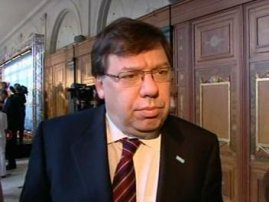
 And for the past two years up to 500 Irish soldiers - 17% of the entire army - have been the core unit of EUFOR Chad/CAR, the EU peacekeeping and peace-enforcing command based in Chad, which is controlled directly by the European Union and in support of multi-national humanitarian operations in both Chad and Darfur (a large province of Sudan). Until his recent retirement, Lt.Gen. Pat Nash (above) - formerly GOC of the 1 Southern Brigade in Cork - was the overall commander of this force.
But as much as Irish troops have established a good name for themselves and for Ireland in far-away places, one has to ask if the only duty of our Army is to provide soldiers for the UN? Or is there a further and deeper purpose for the Army, much closer to home?
Well, as far as the general public knows, the only visible duty our Army performs inside the country is armed escort for private money transports (aka 'cash in transit'). One can see the olive-green range-rovers packed with armed men in battledress almost everywhere in Ireland when a bank receives a delivery of money.
Apart from that the Army is pretty invisible and absent from most people's minds. Unless one lives in a garrison town and close to the barracks, one has hardly ever any contact with the military.
Like most countries without a national service, Ireland has a small professional defence force, entirely staffed by volunteers, for whom this is a job like any other. Well, perhaps not like any other, but the attitude here is that it is a job, and not a national duty.
The only people who know what is going on inside the IDF are those who belong to the service, plus their families and relatives, who usually get at least some idea. For the rest of the country, the vast majority of the Irish nation, the IDF, its structure, mission and duties are a complete enigma.
There are even people who wonder if Ireland needs an army at all. Well, the questions makes some sense, since we are an island nation with - at present - no hostile neighbours and no main threat against us from anywhere. We are simply much too nice a people to become targets for wars or invasions now.
This was of course not always so. During the 9th and 10th centuries the Vikings raided the island regularly, before deciding that it is actually a great place to settle. In the late 12th century the Normans invaded us and took over the country. Their control led to the rule of the English, and thus to 750 years of foreign occupation and oppression.
And it is only 40 years that 'the Troubles' in the North began, leading to massive deployments of British troops and to more than 3000 people killed on both sides of the conflict.
Nowadays we don't think of that much longer. Now we have the 'peace process' and a power-sharing administration in Belfast.
Well, I often wondered what a 'peace process' actually is, apart from a nice sounding word. It is a bit of a contradiction, because either there is peace, or not. In the latter case we are at war. But a 'peace process'? That's neither fish nor flesh, not here nor there, and as impossible as being 'a little bit pregnant'.
Personally I think and believe that there is little chance for a return of widespread violence to the Six Counties. The period of ceasefires and power-sharing has lasted too long now, and too many people from both communities are too much involved. They, and many more, would have to pay a price much too high to contemplate if they would return to civil war and street fighting.
So, what is the Army of the Republic for? We have no longer any enemies, and no-one is planning to invade us. Maybe the pacifists are right, and we could as well abolish our Army under these circumstances?
Well, if the current government and its advisors keep going along the road they have been travelling on for nearly two decades, the Irish Army will eventually disappear quietly.
20 years ago its strength was roundabout 16,500. Then a 'defence review' reduced it to first 14,000 and eventually 12,500.
Not long after that the then Minister for Defence Michael Smith (Fianna Fáil) had the idea of employing a company of civilian consultants to 're-structure and reform' the Army. The result was a White Paper which insulted every serving Irish soldier, and which cut the Army's strength even further, to 9,500 (and thus for the first time below the crucial 10,000-mark).
Meanwhile we stand at a grand total of 8,500. In practical terms this means that at any given time less than 5,000 soldiers would be available to defend the country or deal with a major emergency, if it occurred. (The rest of the Army is either serving abroad, in transit, in training for a foreign mission, on special courses, on holidays or on sick leave.)
If the government follows the recommendations of 'An Bord Snip (Nua)', then we will soon be below 8,000 active Army personnel, which means that just a little over 4,000 soldiers would be on stand-by in Ireland, in case they are needed. This is slightly more than one brigade. (The current Army structure has three brigades.)
Most people may think that this is still more than enough in a country with no threat or enemy, but in fact it is not. Armies have a peculiar structure, which means that their efficiency depends on a 'critical mass' of soldiers in a state of permanent readiness. The larger the overall force is, the easier this 'critical mass' can be achieved. But when the strength of an army falls below the 'natural defence level', which is a quarter of one percent of the population, it is very difficult and almost impossible to achieve efficient defence readiness.
With Ireland's population - not counting foreigners for this purpose - at about 4 million, the 'natural defence level' of our Army is 10,000. For more than a decade we are already 15% below this level, and now it is supposed to be cut even further.
Which means that the Irish Army is now only useful for UN operations abroad, for which the relevant units undergo a special training. But at home we have an Army only by name, but not a force that could act and react with efficiency and expectation of success.
For the past twenty years successive Fianna Fáil governments have reduced the Irish Army more and more, to the point that it is becoming useless. Perhaps not quite as useless as the government, but coming close.
Since our soldiers and officers are better paid than their comrades in many other countries, and our Chief of Staff gets more money than his counterpart in the UK, the Army would indeed be a great cost-cutting chance in a recession. If the government indeed does not want an army - and all the indications point in this direction - then it would be only fair to say so openly.
Costa Rica and Iceland, two other neutral countries with small populations, have not had an army for decades and are doing fine. They have not been attacked, invaded or drawn into a war.
We could save a large amount of money if we would abolish the Army - and the Department of Defence with it - and be as peaceful and neutral as we always pretend to be. Naval Service and Aer Corps could be amalgamated into a new and strengthened Coast Guard, which could also have some land-based units. It should be governed by a restored Dept. of the Marine, which should also get responsibility for Fishing and Natural Resources.
I bet a good sum of money that - if we would go ahead and abolished the Army - hardly anyone in Ireland would miss it. The places where it would be missed are the UN HQ in New York and the deserts and refugee camps of Chad and Sudan.
The Emerald Islander
* After being renamed Zaire (by President Mobuto) for some time, the country has changed its name again and is now known as the 'Democratic Republic of Congo' (DRC).
After nearly 50 years of nominal independence, it is still one of the most unstable and war-torn countries on Earth, and still has a large UN force stationed there. However, at present Ireland is not contributing to this force.