Showing posts with label Dept. of Finance. Show all posts

29 June 2009

Child Benefit is Lenihan's next Target

Mary Hanafin (left), the Minister for Social and Family Affairs, has confirmed that the Irish government will soon "reduce the amount it is spending on child benefit payments".

In future the payments are to be either means-tested or taxed, but a decision which of these two options would be more appropriate has not been made yet.

The matter will eventually be decided by the Minister for Finance, Brian Lenihan (right), who is currently more than € 10 billion short of his budget and has to find at least another € 4 billion in savings and spending reductions this year. It is expected that he will wait with his decision until he has received a report from the Commission on Taxation, which is due shortly.

According to Mary Hanafin the universal child benefit is costing the State € 2.5 billion per year. And since child benefit is so far paid to every mother who has a child or children, regardless of income and social status, the scheme is a natural target for Brian Lenihan.

Politicians from different parties and various interest groups have openly criticised the 'free for all' child benefit in the past, making the point that it is also paid to people who are certainly not in need of it (like millionaires and very well-off professionals and civil servants).

Social conservatives have also remarked that the generous payment of child benefit - regardless of circumstances - is one of the main reasons for the high rate of unmarried young mothers and teenage pregnancies in Ireland.

Although I would not regard myself as conservative, I agree with this point. In fact, I would go much further than the government is contemplating. I would abolish universal child benefit completely, and thus save the State at least € 2 billion per annum.

The idea of child benefit payments is a relatively recent addition to the government's social welfare budget, and it is a fact that there was never a shortage of children when there was no child benefit available from the State. Quite the opposite, actually, as birth rates were much higher in the past than they are now.
And somehow most of the children born without the taxpayers' financial assistance were brought up without problems. There were a lot more stable families in the past, and much less unmarried young mothers and teenage pregnancies.

So it could well be argued that child benefit, initially intended to support mothers on the lower end of the social scale who were really struggling to make ends meet, has become an unintended stimulant for less stable families and a lot more single mothers who can live quite comfortably on a combination of social welfare, child benefit, housing benefit and various other benefits available to them.

There are plenty of girls and young women in Ireland who see an early child as their ticket to social and financial security. Most of them come still from the lower end of the social scale, and many are poorly educated. When they leave school, there are few jobs or careers open to them. They might find a low-paid job in a supermarket, but that would pay them less than they can make on state benefits, if they have at least one child.

I know plenty of such cases here, and not far from where I live there is a communal housing estate with about twenty houses, all of which are occupied by single mothers and their children. The rent they are charged by the Council is minimal, and if they play their cards right, they can receive additional benefits in kind, such as a certain amount of free electricity and telephone units each month, a free TV licence (which costs € 162 per annum for other people) and a winter fuel allowance for the cold half of the year. Some have even managed to get free bus passes.

For these women having children out of wedlock has become a very profitable 'business', and usually they have a few children by different fathers before the age of 30. Apart from various visiting boyfriends there is hardly ever a man to be seen in that housing estate, and not one of the women is in a stable relationship.

I am no moralising prude and have no problems with women who have children out of wedlock. But I do resent that I - and all the other Irish taxpayers - are made to pay for it. Every weekend one can see scores of these single mothers flocking to the various bars, discos and night clubs in the city, scantily clad and with plenty of money to spend on their weekly 'big night out'.
Personally I am not interested in that sort of lifestyle, and I don't take alcoholic drinks. But even if I would be attracted by it, as a hard-working single man I could not afford such extravagance on a regular basis.

So I do think that the abolition of universal child benefit would do a lot more good to our nation and society than it would cause hardship to some. Those mothers who are in real need should of course be supported by the State. A means-tested child benefit, integrated into the normal social welfare scheme, could take care of that.
And it would cost the State not more than € 500 million a year. Which means that by making such a clean cut, Brian Lenihan would have already half of the sum he needs to save this year.


There would most likely be an outcry from certain quarters, such as radical feminists, ultra-liberals and various soft-minded do-gooders. But that would not be for long, especially if the State is fair with mothers who really need help, but firm with those who use child benefit payments to finance their fashion clothes, fancy shoes and the weekly 'big night out'.

Due to the recession and the massive increase in unemployment in recent months Ireland's social welfare payments have increased "very significantly", as Mary Hanafin put it. There are now many families, as well as single people, for whom the bare survival depends on the weekly payment of basic social welfare. These payments cannot be reduced, unless the State wants to risk widespread extreme poverty, social unrest and a serious increase in petty crime.

On the other hand it is quite clear that the current social welfare budget of € 21 billion per annum is - as the Minister stated - "just too much" for Ireland in the current economic crisis.

Child benefit is not only the most obvious and logical target for a spending cut, it is also the most fair from an overall perspective. If people want to have children, it should be their responsibility to look after them and pay for their upbringing and education. There is absolutely no reason why people who are childless should pay for the children of other people.

Children are a blessing, and childless people often suffer enough emotionally and mentally from the fact that they are without offspring. It is extremely unfair to burden them financially with children other people produce in a carefree or careless way, expecting the State to pick up the bill for decades to come.

In the housing estate I mentioned above there is a 'family' of women, consisting of meanwhile three generations of unmarried mothers and their children. The head of this 'family', a woman in her late forties, had four daughters out of wedlock, each by a different father. Her eldest daughter, now in her early thirties, has three daughters out of wedlock. And her eldest has just given birth to her first child - another daughter - at the age of 15!
None of them was ever married or in a stable relationship. And none of them has ever worked a single day. All they do is to live a rather comfortable and secure life, have children out of wedlock, and expect the State to pay for it all.

I don't want to give the impression of being too harsh, but in my opinion this all-female 'family' is nothing but a bunch of feckless parasites.

Abolish universal child benefit, and they might well be forced to live forthwith in the real world. They might still carry on with their immoral and selfish lifestyle, especially as they are by now so used to it, but at least Ireland's taxpayers would no longer be forced to finance it.

As regular readers of this weblog know, I am not a friend of the current Irish government. But if Brian Lenihan and Mary Hanafin have the guts to abolish universal child benefit, I would be the first to applaud and congratulate them.

The Emerald Islander

03 June 2009

Irish Exchequer Deficit at € 10.6 Billion

Official Exchequer figures for the first five months of this year show that the Irish government is currently running at a deficit of € 10.6 billion.

While tax returns are sharply down on last year's revenue, the returns for May were broadly in line with the government's forecast in the Emergency Budget.

The extent of the slow-down in the Irish economy can be seen clearly in these latest Exchequer figures. Overall, taxes are down by 21% on an annual basis.

Stamp duty and capital gains taxes are down over 63.5% and 68.6% respectively, reflecting the almost total collapse of Ireland's property market.

VAT and excise duty rates are also down sharply, reflecting reduced spending in the economy, although excise duties came in a little better than the government had expected.

On the spending side, most government departments have kept their expenditure broadly in line, but it is nevertheless up by 2.9% on an annual basis.

But whatever happens in the real world, Taoiseach Brian Cowen (left) still lives on a planet of his own and says that he is "optimistic about the country's economic future".

Speaking at the National University of Ireland (NUI) in Maynooth, Co. Kildare, Cowen said his government was "determined to keep people at work and create new jobs in the IT area".

He regarded it as "encouraging" that today's tax returns were "on target".

Addressing IT specialists and academics during a lecture in Maynooth, the Taoiseach stated that "there are hopeful signs nationally that this recession is bottoming out".

In his usual brash and brusque manner, Cowen did however not stop to speak to reporters as he left the function.
This, as well as his strange statement, only underlines how much he is out of touch with the rest of the nation. No-one else here can see any 'hopeful signs' in the economy, and certainly not a 'bottoming out' of our recession.

In two days' time we will most likely see the unemployment figure pass the 400,000 line, and as Friday is also election day, the Irish people will show Cowen, his incompetent government and his rotten party what they think of the economy.

The Emerald Islander

15 December 2008

€ 10 Billion Rescue Programme for Irish Banks

The Irish government has announced its support for a massive recapitalisation programme of up to € 10 billion for some of the most battered credit institutions in the country.

A statement from the Department of Finance says that its objective is "to ensure the long-term sustainability of the banking sector in Ireland".
The government will support the programme "alongside existing shareholders and private investors", and it will "underpin its contribution through the availability of credit to individuals and businesses in the real economy".

That sounds rather positive and gives some hope for the Irish economy, which is not only in recession, but also mismanaged by an bunch of third-rate people whos - meanwhile only too obvious - incompetence is only matched and even outshon by their self-serving arrogance and greed.

After long meetings with bank executives the Minister for Finance Brian Lenihan (left) confirmed that money from the National Pensions Reserve Fund will be used for the new recapitalisation programme.
State investment will take the form of preference and/or ordinary shares in the institutions receiving funds, which means in fact a part-nationalisation of our major banks.

Lenihan said that State investment would be "assessed on a case-by-case basis" and all the institutions in question were being asked to submit their proposals by early next month.

A spokesperson for the Allied Irish Bank (AIB) said that the bank's board would "discuss the government announcement" when it meets later this week.

There has also been a special Cabinet meeting today, in addition to the regular meeting on Tuesday.

The Irish Business & Employers' Confederation (IBEC) has welcomed the announcement on recapitalisation.
The group's Director General Turlough O'Sullivan (right) said that "the banking sector is vital to the effective functioning of business and the economy generally".

And he is right, of course. But there remains the so far unmentioned large elephant in the room, whom neither the government not IBEC seems willing to tackle.
I am talking about the people who are fully responsible for the crisis, the chief executives and board members of the banks and building societies, who created the huge financial bubble and then let it burst without any concern for their own institutions or the nation as a whole.

If these people remain in their well remunarated - in my opion highly overpaid - positions, we can as well take the € 10 billion to the cliffs of Moher and throw them into the sea. Everyone can see the dimensions of the crisis now, and everyone agrees that only drastic measures will make a difference, save the banks and restart the economy. But it will only mean throwing in a lot of good money after plenty of bad debts if the creators of the problem are allowed to stay in charge.

The Minister for Finance must insist on the resignation of the entire boards and the chief executives of the failing banks. And should they refuse to do so, he must use his authority and remove them by force.
Only with such a clean sweep of the boards the way will be free for new and inspired leadership that can do things differently and give us hope to come out of the crisis in a reasonable time frame.

We need also to remember that the € 10 billion now offered by Brian Lenihan come from the National Pensions Reserve Fund, which is limited in seize and supposed to guarantee our future pensions. This is not money we can freely and easily use for speculations and gambling.
Only two weeks ago it emerged that there could be a deficit of between € 20 and € 30 billion in our pension system (see my entry of November 30th), which is not yet fully investigated. If we now give € 10 billion of pensions money to the banks as recapitalisation fund, we need to be sure that this money will come back - and hopefully with interest and some profit - and not be lost like the many billions the banks and their incompetent executives squandered in recent years.

Only a radical change in management and policy can secure that. No matter how much of our money the government will pump into the financial institutions, it will only do them some good if the lost confidence in the banks is restored.
With all the old duffers who were either too greedy, too ruthless or too incompetent (and in some cases all three combined) staying in their cosy jobs, there cannot be any confidence-building.

One of the main elements of the crisis is that banks are now refusing to give loans to each other.
Have you ever wondered why? Well, the answer is simple enough: Because they don't trust each other. The people who run our financial system make a relatively small group, and they all know each other only too well. And since they don't trust each other any longer - and for very good reason - it is clear that they have to go. How can the government and the general public have confidence into bankers who are no longer trusted by their peers?

Money is only one element of banking. The second - and way more important - is trust. And that is worth a lot more than € 10 billion, it is in fact priceless. I urge Brian Lenihan not to forget this and to make sure that our money is only injected into the banks after they have cleaned up their management structure.

The Emerald Islander

02 December 2008

Ireland's Tax Deficit will exceed € 8 billion

Ireland's Minister for Finance Brian Lenihan (left) has said that he will take "remedial steps" to reduce government spending after the latest Exchequer figures revealed a very sharp deterioration in the country's public finances.

The new figures show that the shortfall for this year is now set to exceed € 8 billion, which is almost € 2 billion more than the government expected just two months ago.

November is the most important month in the tax collection calendar for the government, since it includes all self-assessed taxes as well as a larger proportion of corporation and capital gains taxes due for the year.

According to the new Exchequer figures there has been a massive shortfall of close to € 7.5 billion in the amount of taxes collected by the government during the first eleven months of the year.
This is a much more than was predicted, and analysts now expect the tax shortfall for 2008 to exceed € 8 billion, which is about twice as much as the amount allowed under EU guidelines.

Richard Bruton (right), the deputy leader and Finance spokesman of the opposition Fine Gael party, accused the government of "rushing the 2009 Budget" and of "making a bad economic situation much worse".

As a neutral observer and analyst I cannot help but agree with Deputy Bruton, who is regarded as one of Ireland's most capable experts on fiscal politics.

But what is even more significant is the fact that for years the Department of Finance - under Brian Cowen and now under Brian Lenihan - got every single forecast of taxation totally wrong. So-called 'experts' of the government and the highly paid senior civil servants in the department alike seem to have no clue about the real economic and fiscal situation in the country.

During the boom times they were each November "surprised" by a sudden surplus of several billions in extra taxes they had not expected to rake in. (But they saw well fit to waste them very quickly on needless projects and - more significantly - on themselves and their luxury lifestyle.) And now they are equally surprised that the shortfall is much larger than it was calculated only a few weeks ago.

One has to wonder what qualifications these people have to hold their senior positions. There are very few economists among them, but plenty of pig-headed apparatchiks whose inflexibility has cost the country already dearly - and it will get a lot worse next year.

No-one in the government, and especially in the Department of Finance, listened to the regular and steady warnings that some well-known and highly qualified Irish economists like David McWilliams, Senator Shane Ross and George Lee (of RTÉ) have issued over years. They predicted with amazing clarity everything that has happened during the past months of rapid economic decline, and I have contributed my own two-pence of analysis and advice as well.

It becomes ever more obvious that our current government, and in particular its majority party Fianna Fáil - which is in charge of the Department of Finance for more than eleven years now - is completely incompetent to govern the country.

Furthermore, the government is directly responsible for many of the elements that caused the current crisis.

But instead of doing the decent thing - resign and call a general election - the clueless and highly overpaid scoundrels muddle on and pretend that they understand what is going on.
Every day they cling on to their power - and the beloved perks it brings them - the situation for our country and economy will get worse. It is now time for the people of Ireland to take matters into their own hands, stand up and be counted.

People power has recently made a huge change in the USA, and people power has also just forced the corrupt government of Thailand to resign. We could learn a lot from those examples, and if we still care for ourselves and our future, we need to act now.

The Emerald Islander

31 October 2008

Shock and Awe - Part 2: An Taoiseach

Taoiseach Brian Cowen has made a rather strange statement yesterday. He said that "we are battling the most severe global economic and financial conditions for 100 years".

How does he know that? Did he commission a study into this matter? Perhaps like the one he commissioned into the reasons for the rejection of the Lisbon Treaty by Ireland's voters?

I think not. And no-one else has heard of it either. So how can Brian Cowen have such amazing insight and defining knowledge about economic history? He is no historian, and no economist. Just a humble country solicitor from Offaly with very little practical experience, as he entered professional party politics aged 24 and has not done any normal work since.

So, I ask again: How can the Taoiseach make such a fundamental statement - one for which usually a hundred historians and economists would have to meet over several conferences to agree on research and findings - just by himself and almost off the cuff?

The answer is actually quite simple: Because he is making things up as he goes along.
He does not have a clue about economic history, or economics in general, but he has the bucolic shrewdness often found in people with a rural background. It is the kind of skill one needs when dealing in cattle or horses, or when trying to buy seeds at a bargain price. (There are quite a few of our TDs - across the party lines - who have this trait. After all, Ireland is still predominantly a rural country, and even most of our city dwellers are only one generation removed from farming the land.)

This shrewdness tells Brian Cowen that the Irish people have been successfully hoodwinked into voting for Fianna Fáil for many years, and especially in the last three general elections. So he thinks that he can carry on with more of the same now, except that this time it is not the prep talk of the "great Irish success" and the "we never had it so good".
This time it is pure scaremongering in order to frighten the living daylight out of us. (Maybe someone has told him that it is Halloween...)

And what is all this patronising lesson in homespun economic history in aid of? Only one thing: to promote a very bad Budget and tell us "that government cutbacks cannot be avoided".

This is the second stage of the 'Shock and Awe' concept, originally invented by the Pentagon for the US invasion of Iraq, but now applied by the Irish government to force a half-baked and counter-productive Budget on the nation. (for a detailed analysis - item by item - see my entry 'Shock and Awe - The 2009 Budget' of October 14th)

Cowen lectures us that "we have to change the economic paradigm and policies, but this cannot be done if people oppose every cut that is proposed".

Interesting. Unless he mutated over night into his evil alter ego, I presume this is the same Brian Cowen who told us only a few months ago that all was fine with Ireland. The same Brian Cowen who boasted about the strength of the Irish economy and our "secure finances" before last year's general election. And perhaps even the same Brian Cowen who is now a Fianna Fáil TD for two dozen years, a member of the Cabinet for 16 and Taoiseach for nearly six months.
The very same Brian Cowen who was - as Minister for Finance - responsible for the last four Budgets, and thus responsible for imprudent overspending and generous tax breaks for property developers. This financial policy of Fianna Fáil, supported by the PDs, created the crisis we find ourselves in now.

The very man who created the virus and helped spreading the disease is now presenting himself as the wise and concerned doctor, while he tries to sell us useless medicine at inflated prices.

No, Mr. Cowen, this will not wash! Your deliberate scaremongering does not impress Irish people who have retained their brain over eleven years of Fianna Fáil rule. You have brought this crisis not only on yourself, but on all of us. It did not just appear out of the blue and fall onto this island like an asteroid from outer space.

True, there is a global crisis. No-one denies that. And it certainly has some affect on Ireland and our economy, as these days much business is interlinked across the globe.
But the crisis we are in now is 90% made in Ireland. The way Fianna Fáil - which controls the Department of Finance since 1997 - has wasted and squandered billions while the money was aplenty, was a major factor in the creation of the current situation. Analysts have warned for years that things are going wrong, that concentration on the construction industry and hyped-up property prices are a recipe for disaster.
No-one listened, and least of all the then Minister for Finance: Brian Cowen.

We might well be living through the most serious financial - but not economic - crisis the world has seen since 1929. But that - in my Maths book - makes 80 years and not 100. And, as I have stated here and in many other articles, Ireland needs not to be affected by that in a big way.

Had we had a prudent Minister for Finance and a competent government, we would now have a nice nest egg in form of a sovereign wealth fund, created by the State and accumulated over the years of plenty. Norway has one, and so has Singapore (to mention only two other countries with a population similar to Ireland).
Many countries - large and small - have established sovereign wealth funds when they took in more money than they needed at the time. This is a sensible and prudent way of government.

Only Ireland - under Taoiseach Bertie Ahern and Finance Minister Brian Cowen - decided that the unexpected extra money could only be spent and spent, as the Irish are supposed to be feckless and don't save money.
And not enough with that, the Irish people were heavily encouraged by their banks and by the government to borrow, and borrow more. This went on until a few months ago, and in some ways it is still going on now.

So if Brian Cowen is looking for a reason we are running out of money, a look into a mirror would give him the desired answer.
If he had any guts, he would call an early general election and give the people a chance to decide their future destination. But Cowen is a bully, and - like all bullies - a coward. He will try to hang on to the sinking ship until the water is reaching his ears. In the process he will take many of us down with him.
And - in all fairness - many deserve nothing else, as they kept voting for Fianna Fáil even when their lies and incompetence were clear and obvious, for everyone to see.

The government we have is only there because we elected it. So some "mea culpa (1997), mea culpa (2002), mea maxima culpa (2007)..." is well in order for those who voted for Fianna Fáil and for the Green Party.

But a Brian Cowen lecture on the world's economic history is not. There are plenty of ways to get out of the crisis with dignity and a maximum of fairness. It is time for the government to abandon bullying and scaremongering and turn to these decent methods. (And if they feel not able to do so on their own, they can drop me a line. I would be happy to offer my services as a political consultant and can be contacted by e-mail...)

The Emerald Islander

05 October 2008

Don't cut the Education Budget, Brian!

Primary school principals are urging the Irish government not to cut funding for education in the up-coming budget.

The Irish Primary Principals' Network (IPPN) says the economic downturn will have a short term impact on the country, but increasing investment in education now will make sure we are ready for the upturn when it comes.

After meeting to discuss the cutbacks necessary in the budget yesterday, government ministers indicated there are difficult decisions to be taken.
But the principals of the country's primary schools are urging the political leadership not to target education when it wields the knife over the budget.

Larry Fleming, President of the IPPN, stresses that cutting back on the primary education budget would have disastrous consequences for the future of Ireland. "It is comparable to a farmer selling his seed in times of hunger," he says.

This statement from the best of our national teachers is a serious and timely reminder that we need to get the priorities right this time. And I hope that Finance Minister Brian Lenihan is listening to the teachers very carefully.
If the Irish government - after a boundless spending spree in the boom - now imposes severe austerity on everything, including education, we can as well go back to Dev's Ireland and forget that we ever were a modern country for a while.

We should not forget that our investment in education during the 1970s was the seed from which eventually the 'Celtic Tiger' grew during the 1990s. Economic cycles take their time, but only the one who is prepared for events will be able to benefit from them.

Given the fast speed of technological changes in our modern world, investment in education must be increased in a recession, and not decreased.
Only then will we have a chance of getting back to the top in good time.

The Emerald Islander

03 October 2008

Big Words, long Meetings, no Money

The deepening recession in Ireland and the collapse of the property market after a long and artificially hyped-up boom has led to a further sharp decline in the government's finances.

Days after the State stepped in to protect the country's banks, Exchequer figures show a serious deficit of € 9.4 billion for the first nine months of this year, to the end of September. This compares to a deficit of 'only' € 3.1 billion at the same point last year.
Total tax revenue of 2008 to the end of September was 11.2% behind expectations at € 29 billion.

The government says that the performances of VAT, Capital Gains Tax and Stamp Duty receipts are "disappointing" and reflect developments in the property market as well as weaker economic activity.
  • VAT receipts are 6.6% lower than they were at the same time last year at € 10.9 billion.
  • Capital Gains Tax receipts are 41.93% lower than they were this time last year at just over € 693 million.
  • Stamp Duty receipts are 45.8% lower than figures for last September at € 1.35 billion.
Tax revenue for the whole year is expected to be € 6.5 billion less than expected, and it is estimated that the government will have to borrow about € 11.5 billion to pay its bills.

The Minister for Finance, Brian Lenihan (right), said the slump in the government finances was "a very serious matter". You can bet it is!

Speaking on RTÉ News, Lenihan said that budget discussions were ongoing, but the State was facing what he called "tough decisions".

Separately the Taoiseach said that this was "a defining moment in our nation's history".

"We are in extraordinary economic circumstances, and if the right choices are not made, it would have catastrophic consequences for our future prospects," he added gloomily.

Brian Cowen (left) stated that "no one should harbour any illusions that living within our means would be easy in the circumstance in which we now find ourselves", but promised that his government would "not be found wanting in making the necessary hard decisions".

Meanwhile the latest report on the economy from the Irish Central Bank predicts that our economy "will shrink this year and next year". The report cites the continuing housing slump and financial market turbulence.

The bank also warns against "measures designed to prop up the property market", saying there are already "considerable tax supports and incentives by international standards".

Meanwhile, a special pre-budget Cabinet meeting, which had been due to be held on Sunday, is to be brought forward to tomorrow (Saturday) instead. There was also a special Cabinet meeting yesterday evening in the wake of the latest Exchequer figures.

The question is if all those hastily scheduled and nervous meetings will eventually produce some results that make a difference to the country and to the Irish people. So far all we hear are big words, we are told of long meetings, and that there is no money...

The Emerald Islander

30 September 2008

Brian is listening and took David's Advice

In the small hours of last Sunday morning David McWilliams, one of the brightest young analysts and commentators in Ireland, posted a new article on his website.

This article made a bold, but very sensible statement: To get out of the current financial crisis the Irish State should go solo - without waiting for models from other countries - and give a full 100% guarantee for all deposits and loans of Irish banks.

"The only option is to guarantee 100 per cent of all depositors/creditors in the Irish banking system. This guarantee does not extend to shareholders who will have to live with the losses they have suffered. However, it applies to everyone else," McWilliams wrote as the essence of his long and learned article. The complete text can be found on David McWilliams' website under 'Articles' at http://www.davidmcwilliams.ie/

I was probably one of the first people who read this article, right after it was posted online. And I happened also to be the first to leave a comment, at 4:04 am on that Sunday morning.

Then I took the liberty to send a copy of the article to Taoiseach Brian Cowen, Minister for Finance Brian Lenihan and a couple of other ministers who - in my opinion - are able to think for themselves.
Knowing that there was a cabinet meeting scheduled for later that Sunday, I hoped that they might read David’s article beforehand and - maybe - be wise enough to take his advice.

Of course I have no way of knowing if my little initiative helped, if they did read the article before the cabinet meeting, and if it influenced them.

However, the government announcement Minister for Finance Brian Lenihan (left) has made today is exactly what McWilliams advised to do and asked for.

So one could well come to the conclusion that one of the Brians (Lenihan & Cowen) - or someone else in the government - is listening to sound advice. Which means there is some hope after all for Ireland and our economy

Following the biggest drop in share prices the Irish market has ever seen - the ISEQ fell by 13% in one day yesterday, and the especially troubled bank shares dropped between 30% and 45% - this morning's announcement has brought some confidence and stability back to the Dublin stock exchange.

It is early days yet, and the massive financial crisis of the western world is far from over. It will probably even get worse, in particular for the USA, which are now caught in the fast downward spiral all collapsing empires in history have encountered after they overreached themselves and overspent on military adventures and senseless luxuries.

But Ireland might this time get away with only one black eye - metaphorically speaking - if nothing else in our country goes badly wrong.

Following David McWilliams' advice, the government has shown a strong position of leadership and the guarantee of our money by the State is good news for all of us, regardless of wealth and position.

In contrast to programmes initiated elsewhere, this is neither a nationalisation (like the British government's take-over of Northern Rock) nor a bail-out (as attempted by the US administration for Wall Street and rejected by the US Congress yesterday).

This is indeed - as David suggested - an Irish solution for an Irish problem.

The government guarantees the money we have in the banks 100%, but only for two years and not for free. The banks will be charged a fee for this high grade of security (the amount of which is not known yet), so the government creates some extra income for itself. That's rather clever.

And the guarantee is not given willy-nilly to just everyone who happens to have a branch office on the Emerald Isle. Only the six Irish-owned banks will receive the full guarantee, and that is not more than fair. They are: Allied Irish Bank, Bank of Ireland, Anglo-Irish Bank, Irish Life & Permanent, which owns permanent tsb, Irish Nationwide Building Society and the EBS (Educational Building Society).

For all details of the new guarantee rules, and how it affects all banks operating in Ireland, have a look here: http://www.itsyourmoney.ie/index.jsp?1nID=93&2nID=100&nID=153&aID=620

Specific subsidiaries that may be approved by the government following consultations with the Central Bank and the Financial Regulator are also covered under the guarantee.
It also includes all money borrowed by Irish banks from other financial institutions and the statement from the Department of Finance says that all deposits, bonds and debts will now be covered by the State.

Pessimists are already crying 'blue murder' from the roof tops and predict the eventual end of the Republic of Ireland in total state bankruptcy and under a cloud of shame and chaos. Well, in a theoretical way this is quite possible, as much as it is possible that an asteroid falls onto Ireland and makes us all perish in a giant puff of smoke. But realistically you have a better chance to win the Lotto jackpot or even the top prize in the Euro-Millions lottery.

Our bankers - and a lot more so those in the USA - might have been reckless and very greedy in recent years, but they are neither complete fools nor suicidal. So they will recognise what a great and rare gift Brian Lenihan - on the advice of David McWilliams and with backing of Brian Cowen - has bestowed on them. By now they have also realised that they made terrible mistakes, and that they will not have a third chance should they blow this one. So I am with David McWilliams on this, and confident that it will work.

With a little bit luck (of the Irish) thrown in, it might even attract extra money from abroad and perhaps lead to another period of growth and prosperity. By this evening the government will have introduced the necessary legislation in Dáil Éireann, and I can say that I will sleep a lot more sound and confident tonight.

A well-known proverb advises that one should stop digging when finding oneself in a hole. This is - translated into financial terms - exactly what David McWilliams advised on Sunday and Brian Lenihan did today. In fact, it is even a bit more than that. The government is not only telling the banks to stop digging, it is declaring the hole to be a building site.

If we all keep a cool head and use common sense, look out for each other and stick together at all times - hard and easy - the future will be bright again for Ireland in years to come. I am not the kind of person who bestows praise easily, and I have very few heroes. But I want to say today that there is always hope and a future as long as we have people like David McWilliams on the Emerald Isle.

The Emerald Islander

29 September 2008

Laughing all the Way to the Bank

The Department of Finance has confirmed that former Taoiseach Bertie Ahern (right) is now receiving approximately € 68,000 in 'severance pay' following his resignation earlier this year.

When Ahern stepped down in May eventually, he lost of course - along with other things - his Taoiseach's allowance, which amounts to around € 185,000 per annum. So now Irish taxpayers are giving him (through the Dept. of Finance) 'severance money' for having resigned - and not a day too soon.

Did you know that members of the government who lose their job or resign are entitled to severance pay? I did not, and I would regard myself as rather well informed about politics.

Apparently this is based on legislation from 1992. I presume it is called the "Take the Money and Run Act", or perhaps the "Last Chance Saloon Payout Act"...

Well, whatever it is called, I think it is a scandal. TDs and ministers are not employees in a private firm who are made redundant at some stage. They are our elected representatives, sent by us to Dáil Éireann. And when we decide to send someone else, so be it. No TD or minister should be entitled to any extra payment, because he (or she) has done a bad job (which is usually the reason for losing a seat).

According to information from the Department of Finance, the former Taoiseach has been receiving these payments since May, and they will amount to around € 68,000 by November. This money comes of course on top of Bertie's normal TD payment of over € 100,000 a year.

For more than a decade he and his ministers have governed this country, during the time of the largest economic boom ever seen in modern times (which was not of their making). They had plenty of money available - billions and billions of surplus taxes - but instead of bringing Ireland forward into the 21st century, giving us a decent infrastructure and making us internationally competitive, they managed to waste and squander the money with not much to show for.
Their strong links with the construction industry created a housing bubble and an irrational property price inflation, both of which are now mill stones around the necks of our banks.

Bertie's private finances are under several clouds, to say the least, and he is still questioned about that element of his life by the Mahon Tribunal.
Having jumped ship in May before someone could push him - and just in time to be not in charge of a lost referendum and the worst economic crisis since 1929 - he is now given more 'severance money' in six months than most of us earn in a year, or many even in two years!
And it's all legal, since TDs have made it law to look after themselves very generously. Just look at Bertie's face and you know: He is laughing all the way to the bank.

In addition to Bertie Ahern, two other sitting Fianna Fáil TDs are paid € 53,218.99 'severance money' each in installments over the next 24 months, after they lost their jobs as junior ministers in May.

The Dept. of Finance has confirmed that it is paying these sums to Wexford TD John Browne (far left) and Cork-East TD Michael Ahern (left). Both were dropped from the government after Brian Cowen took over as the new Taoiseach.
This money comes - like for Bertie Ahern - on top of their normal TD salary "and does not affect their pension entitlements".

However, the third junior minister sacked by Brian Cowen in May - Donegal TD Pat 'The Cope' Gallagher (right), "did not opt for the 'severance pay' scheme".
That is quite interesting. It tells us that these payments are not coming to TDs automatically, but must be applied for. And while Bertie Ahern, John Browne and Michael Ahern obviously decided to get as much as possible out of the state system, Pat 'The Cope' Gallagher did not.
It is a small relief to see that there is still the odd Fianna Fáil TD who is not greedy and selfish. Good on you, Pat! I will remember this, and so should other people.

After the matter became public knowledge today, John Browne and Michael Ahern said that they "are entitled to the payments, are doing nothing wrong and are operating under legislation as laid down by the Oireachtas (both Houses of Parliament)".

Yes, that's quite correct. And it is the even bigger scandal than paying ex-ministers executive bonuses long after they have left office (for whatever reason). Doing so is wrong, but that it is 'legal' after TDs made it a law... well, that really stinks!
And it shows that most of our TDs see parliament still as their private financial self-service supermarket, where they can award themselves as much money as they like, without anyone else being asked for their opinions, and no-one being able to stop them.

By the way, the three cases that came to light today are not unique. More than € 3 million of 'severance money' were paid to former Oireachtas members who failed to get re-elected at the last general election.

While almost everyone in Ireland is now struggling to make ends meet, prices for everything are rising steadily and Finance Minister Brian Lenihan is desperately looking for extra money to plug the ever more and ever larger wholes in his budget, it is a scandal that such an amount of money is wasted on failed politicians!

If Brian Lenihan is really serious with his intention to tighten the government's belt, this is a very good point to start. He could stop these payments, end the practice for good and get plenty of money from it for his coffers. Additionally, it would show that he has guts and give him a good boost in popularity around the country.

The Emerald Islander

08 July 2008

Lenihan's Plan to save € 440 million

The Minister for Finance Brian Lenihan (photo) has outlined his first package of measures which are aimed at saving € 440 million in public spending this year.
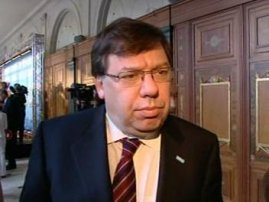
Lenihan says that all government departments - with the exception of Health and Education - will be required to reduce their departmental payroll by 3% by the end of 2009.

The Minister also put on hold further acquisitions of property for the controversial government decentralisation programme, which was one of the favourite ideas of the former Minister for Finance and current Irish EU Commissioner Charlie McCreevy.

Planned pay increases for ministers, senior judges and civil servants will not go ahead, but the matter will be reviewed in September 2010.

The costs of our never-ending tribunals will also be reviewed, so that expenditure is minimised.

Brian Lenihan says that with these steps the government is hoping to save € 440 million in 2008, and a further € 1 billion in 2009.

He also announced that spending on consultancy, advertising and public relations would be cut by at least 50% in 2009, and significantly curtailed for the rest of this year.

State agencies will be reviewed, to see if they can share services, amalgamate or be abolished. The review's outcome is to be considered in the autumn.

Further savings of € 45 million will come from a cut in this year's Overseas Development Aid budget.

The Departments of Finance and Health & Children are to draw up a scheme to reduce surplus staff in the Health Servide Executive (HSE) as soon as possible.

All departments have also been told to stay within their annual budget.

The Cabinet has met today to agree on these measures. On his way into the meeting, Brian Lenihan said that he had "very constructive talks" regarding his cost-cutting measures. More cuts and savings are expected in December, when the new minister will present his first Budget.