Showing posts with label justice. Show all posts

28 May 2009

President backs Abuse Prosecutions

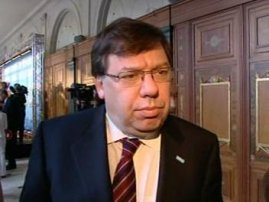
President Mary McAleese (photo) believes that people should face prosecutions as a result of the Ryan Report (see my entry of May 21st) into the systematic torture and child abuse by members of religious orders of the Catholic Church.

The President was speaking in Boston, on the final leg of her official visit to the US state of Massachusetts. There she has been meeting Irish-American communities and promoted Ireland's industry and tourism.

As the presidential good-will tour coincided with the publication of the Ryan Report here, a considerable amount of publicity in US media on the fall-out from the report overshadowed the visit. (With some careful planning, scheduling and co-ordination it would have been possible to avoid that.)

In an interview with RTÉ News the President said today that the report showed "a catalogue of criminal offences", and that "people who committed these awful crimes against innocent children should face prosecution".
Even though prosecution might not bring closure, it would bring Justice, she added.

Mary McAleese is to be saluted on this clear statement and on her straight and honest approach. She stands high above the Irish government, which is now trying to wriggle itself out of the mess it created, while it still tries to protect the Catholic Church from taking full responsibility for her horrible crimes.

The Emerald Islander

28 September 2008

Robinson and McGuinness to talk this Week

Peter Robinson (right), the First Minister of the Northern power-sharing government, and his deputy Martin McGuinness (below left) are to hold face-to-face talks this week.

The move is an attempt to break the deadlock which has prevented the power-sharing Executive from meeting for more than three months. The political impasse centres on Sinn Féin demands for policing and justice powers to be devolved, while the DUP still oppose the move at this time.

DUP leader Peter Robinson said it was vital an executive meeting, planned for Thursday, did go ahead. If it does not, it could result in the cancellation of a North-South ministerial council meeting on Friday.

Meanwhile Martin McGuinness (Sinn Féin) accused the DUP of failing to show true partnership in government and he said they had to live up to their obligations under the St. Andrews Agreement (of 2006).

Relations between the two main parties in the North have become so bad that they could not even agree to issue a joint message of congratulation to the Tyrone senior team on winning the All-Ireland Football Championship and the coveted Sam Maguire Cup. (see my entry from September 21st) Sinn Féin says that the DUP vetoed the sending of a message.

It is no secret that Unionist dislike Gaelic Football and all Gaelic sports administered by the GAA, as they see them as 'nationalist Irish' sports. They themselves are more supporters of Soccer and Rugby.

Let us hope the three months of silence between the Northern government partners will soon be over and constructive policies, guided by common sense, will prevail. Anything else would be extremely foolish and not help anyone. It would not even score political points.

The Emerald Islander

26 September 2008

Paisley clashes with Ahern over Policing Powers

Ian Paisley Sr. (left), the former First Minister in the North and leader of the DUP (Democratic Unionist Party), has clashed with the former Taoiseach Bertie Ahern over the devolution of policing and justice powers to the Northern government at Stormont.

Paisley, who retired from frontline politics in June, spoke out after Bertie Ahern said that Unionists were "stepping outside the terms of the St. Andrews Agreement" of 2006.

The row between Sinn Féin and the DUP over policing and justice threatens the future of their power-sharing government. (see my entry from September 21st) Now Ian Paisley ignores his retirement and criticises the former Taoiseach for effectively blaming Unionists for the deadlock.

The two men had helped to negotiate the St. Andrews Agreement that paved the way for power-sharing, and more recently had become very friendly with each other. This culminated in a joint appearance of both leaders on the site of the historic Battle of the Boyne (see my entry from May 6th), where both treated each other with the utmost courtesy and even signs of friendship.

But now Bertie Ahern (right) has commented on the current Northern stalemate and said that the recent DUP demands for the disbandment of the Provisional IRA's ruling Army Council were not part of the St. Andrews deal.

"I have to restate it again, because it was part of these discussions and talks, the devolution of policing was not predicated on the Army Council doing this, that or the other," Bertie Ahern said.
"It was not on that. It was a solemn agreement that the Irish Government and the British Government were engaged and involved in. It said we would have the devolution of policing, that was the effect of it."

The Provisional IRA has long now decommissioned its weapons and ended its violent campaign, but the DUP is still seeking a formal disbandment of its ruling Army Council. This is nothing new, as the DUP have always been very good at shifting political goal posts, thus changing the sense and meaning of the agreements they signed, at least from their point of view. It appears that after all those years of talks and negotiations they still can't or won't grasp the nettle of true power-sharing. So one has to wonder how serious they can be taken as a political party and how trustworthy they are as a partner in any agreement.

After the Independent Monitoring Commission (IMC) recently ruled the Provisional IRA to be 'redundant' and said that their Army Council was not meeting, the DUP called once again for Republicans to pledge that the IRA was 'gone for good'.
This is just another of the DUP's triumphalist attitudes, as their minds are so deeply occupied with conflict and controversy that a time of real peace and growing prosperity appears strange to them.

It came however as a surprise that Ian Paisley spoke out over the former Taoiseach's suggestion that Unionists were stalling on the transfer of policing powers from Westminster to Stormont.

"We are not time-bound by any commitment," the former First Minister and long-time DUP leader said. "And Mr. Ahern is well aware of that."

"The party (DUP) has correctly judged that the devolution of policing and justice powers can only occur at such a time as when there is sufficient confidence within the community that allows for the unlocking of the triple lock. That is the position that I and my colleagues negotiated at St. Andrews and it remains the DUP position today," he added.

Paisley stated that after the 2006 negotiations he had publicly proclaimed his party's success in achieving a 'triple-lock', giving the DUP effective control over when the policing powers would be devolved.
"The DUP position is totally unchanged from the time of St. Andrews. No commentary from Bertie Ahern after the event will ever alter that," he said.

The St. Andrews Agreement set May of this year as a target date for the devolution of policing powers and the prospect was key to persuading Sinn Féin to accept Northern policing structures.

After the publication of the IMC report, its spokesman, the former Alliance Party leader Lord Alderdice, said the IRA had "left the stage", but he speculated it would not formally announce its final disappearance, for fear of rival Republicans opposed to the peace process taking on its mantle.

The whole dispute is fruitless and will help no-one, including the DUP. As May 2008 was agreed as the time for the transfer of policing powers and control of the Justice Department (which are both in the hands of the UK Northern Ireland Office), the power-sharing executive should have proceeded to do it.
However, May saw a change of leadership in the Republic and in the North, with both Bertie Ahern and Ian Paisley Sr. stepping down as the leaders of government and leaders of their parties. So the matter of transferring policing and justice powers was quietly pushed into the background. Then came the long summer recess of both parliaments, a time that is traditionally void of major political decisions.

So the DUP has managed to postpone this important matter for four months and was hoping it might be forgotten for some more, as the world - including the two parts of Ireland - is shaking under the largest economic crisis since 1929.
However, this is not going to happen, as Sinn Féin, the main partners of the DUP in government, are determined to get those powers transferred to Stormont. For Republicans it is not more than a final step of normalisation and a further reduction of direct British influence on the affairs of the Six Counties.

I am sure that a solution will be found, and that - despite ongoing DUP blocking attempts - the agreement of St. Andrews will eventually be implemented completely. Even though they are the most intolerant and sectarian hard-liners in the North, the DUP must know and understand that the alternative would be the fall of their joint government and the end of the power-sharing agreement. Having grown fond of power and actually running real government departments by now, they will not risk to loose all that over one matter they have agreed on already in principle.

The Emerald Islander

30 June 2008

Sinn Féin damands a native Justice Minister

Sinn Féin is pressing for a local politician from the North rather than a Westminster MP as the new Minister for Justice and Policing in the Northern government.
A party spokesman says that a Northern minister was part of the power-sharing deal with the Democratic Unionist Party (DUP).

This morning the new First Minister Peter Robinson (photo) told a group of international lawyers that he supports the principle, "but with strings attached".
Robinson's problem is that many of his unionists would not support a Sinn Féin justice minister, even though Sinn Féin is now urging support for the police.

He indicated that the DUP might back a justice minister from the modestly nationalist Social Democratic & Labour Party (SDLP) or the liberal cross-community Alliance Party. Such a move may come within the next twelve months.

The Emerald Islander