Showing posts with label Ireland. Show all posts

13 September 2009

New communal Bicycle Scheme for Dublin

A new communal Bicycle Scheme has been launched in Dublin today.
Its aim is to encourage more people - Dubliners as well as visitors - to cycle in Ireland's capital city instead of using their cars or public transport.

The initiative is organised by Dublin City Council in co-operation with a French advertising company which is funding the project in return for advertising space.
This copies similar schemes in Paris, Copenhagen and sixteen other cities. But it falls well short of long-established communal bicycle pools one can find in many Dutch cities.

In Dublin a total of 450 silver-coloured unisex bicycles - complete with a wire basket for small items in front of the handle bar - are now available for use by anyone.
They can be hired at 40 city locations, from the Mater Hospital in the North of the city to Grand Canal Street in the South.

A short journey of up to half an hour is free of charge, but for longer use of the bicycles there is a rental fee. The first six hours are covered by a flat fee of € 4.50, and after that € 2 are charged for every half hour.
The target audience for the scheme is therefore the short-distance or casual cyclist who might not have a bicycle but would like to use one now and then. The project could also be attractive for visitors who wish to discover the city on two wheels at an affordable price.

However, there is an obstacle in the system that might prevent quite a lot of people from using the new communal bicycles. To use one of the velocipedes one has to leave a € 150 deposit at the renting station, "in case the bike is not returned", as one of the organisers explains.

This is so typically Irish. We just don't trust anyone any more these days. It is the same attitude that makes us pay for every drink we order in a pub at the moment we receive it.
No one trusts anyone here these days, and - to be fair - there are indeed plenty of scoundrels in Ireland who like to take advantage of others. This begins with the government and ends among the lowest of lowlife in shabby pubs.

In contrast to Ireland, most countries in continental Europe have a culture of general trust and thus a lot less abuse. There drinks are marked on the beermat as long as one is in a tavern, and before one leaves, one pays for what one has consumed.
And in some continental countries, in particular in the Netherlands and parts of Belgium, free communal bicycle pools are a long-established service in many cities. Occasionally it does happen there too that a bicycle is not returned to the pool, but it is very rare. General honesty is much more common there than in Ireland, and as people enjoy the free service, they do not abuse it.

But in post-Tiger Ireland nothing happens without money. So anyone who wants to use one of the 450 new communal bicycles in Dublin has to make a € 150 deposit, either by credit card "or with a bank draft", as a city official suggests.
As credit cards are quite common these days, it should be easy to use them for this purpose. But what about those who do not have a 'flexible friend' made of plastic?
Most of Ireland's poor people, including many who live on social welfare, never had a credit card and would never get one from the banks. A lot of these people do not even have a bank account. So how could they avail of the new bicycle scheme?

No one seems to have thought that through. Without a credit card, people would need a € 150 bank draft! This is a large amount of money for poorer people (almost 75% of a weekly social welfare payment) and I cannot imagine that many would carry a bank draft over this amount around with them, just to be able to cycle around Dublin. It seems that once again a generally good idea is blighted right from the start by focusing too much on money and by not trusting the people.

As it is, the scheme is obviously aimed at environmentally conscious people from the middle classes, and it leaves those of lower social standing out in the cold.
There is also an unanswered question of data protection, since thousands of credit card details will be collected by a private advertising company. So even though I do have a credit card and care for the environment, I will not use the scheme as long as the deposit demand is in place. Too often we hear of data theft and large amounts of financial data that are abused for commercial purposes or simply go missing.
And there is no way that I will walk around with a € 150 bank draft in my pocket at all times...

The Emerald Islander

FÁS Board Members will resign

The chairman of Ireland's national training and employment agency FÁS has said that all its board members will resign in the wake of a report which showed a massive waste of taxpayer money.

Speaking earlier today on the This Week programme on RTÉ Radio 1, Peter McLoone (left) - who is in his day job the Secretary General of IMPACT, Ireland's largest public service trade union - stated there was "no time frame" from either the Taoiseach or the Tánaiste for the appointment of a new board, but that this was something to be clarified early next week.

He emphasised that the present board was only appointed in 2006 and was therefore "not responsible for earlier follies and misbehaviour" inside the agency. However, the board would not stand in the way of change and co-operate completely with the transition.

McLoone defended the board's actions and said it had "dealt with any issues that came before us". He and the whole board would "take responsibility for anything that happened while we were in office".

The move follows strong criticism of wasteful expenditure, including massive overspending on promotion at the agency, specified in detail in a report by John Buckley, Ireland's Comptroller & Auditor General, who investigated FÁS for almost a year. (see my entry of September 10th)

The investigation was ordered last year by the Tánaiste Mary Coughlan (right), who is in her capacity as Ireland's Minister for Enterprise, Trade & Employment responsible for FÁS.

However, she only acted after the independent Senator Shane Ross (left) had - in a lengthy and painstaking investigation of his own - exposed massive irregularities and waste of taxpayers' money on a colossal scale inside the state agency.

Without courageous and independent people like Shane Ross the truth about FÁS might still be unknown to us and subject to the usual government cover-up and denial.

The Emerald Islander

10 September 2009

Massive Waste of Taxpayers' Money in FÁS

Ireland's national training and employment agency FÁS (Foras Áiseanna Saothair) has wasted vast amounts of taxpayers' money and exceeded its budgets regularly.

A new report by Ireland's Comptroller & Auditor General John Buckley, which is the result of a nearly year-long investigation, highlights "a substantial and prolonged breakdown in budgetary control" at the state agency.

One of the agency's most significant follies is a case especially highlighted in the report: FÁS did spend more than € 600,000 on a television advertisement that was never broadcast.

Mr. Buckley also found that general spending in FÁS exceeded budgets by up to 66%.

Nearly a year ago, when the scandalous money-wasting of FÁS became public knowledge, he was given the task to investigate the agency. (see my entries of September 22nd & 23rd, 2008)

Between 2002 and 2008, FÁS spent over € 48 million alone on advertising and promotional activities. This is the largest advertising spend in the non-commercial state sector, and for most of the period audited Ireland had almost full employment. Which means the agency had hardly anything to do and only very few 'customers'.

The Comptroller & Auditor General also found that budgetary control in FÁS was "poor" and expenditure in this area exceeded budgets by 38%.

As well as the € 600,000 spent on the un-used television advertisement, the agency spent a further € 600,000 with no services at all delivered.

Criticising the wasteful expenditure of FÁS, John Buckley said that "public procurement requirements were not met".

Overall, the report finds that advertising and promotional activities lacked strategic direction and that much of the advertising was ineffective in increasing awareness of FÁS services.

On the basis of what is known by now, there are good reasons to abolish FÁS as an independent agency and to divide its obligations between two government departments: Education (for the training elements) and Enterprise, Trade & Employment (for the work-related and employment duties).

It would also be sensible to prosecute FÁS employees who were responsible for the enormous spending spree and the massive waste of taxpayers' money and try to re-coup as much of it as possible from guilty individuals.
But as things are in Ireland, this is rather unlikely. Those close to the government here get away with everything and are never punished. The ordinary Irish people are instead burdened with the costs of government follies and the many failures and mistakes of its countless agencies.
If one would not know better, one might think Ireland is still a feudal state in the Middle Ages.

The Emerald Islander

For further details about the scandals and wastefulness of FÁS see also my entries of November 22nd, 25th, 26th & 27th, 2008.

Ryanair increases Baggage Fees again

The Irish 'low fares' airline Ryanair has announced a further increase in its fees for checked-in baggage from next month. According to the airline, it is "part of a change in company policy".

In order to keep people confused at all times, the amount of bags Ryanair passengers can check in will increase, but at a higher cost.

From October 1st passengers will be able to check in two bags, each with a separate 15 kg allowance. This a double the current Ryanair luggage allowance of 15 kg.

But the on-line fee for the first checked-in bag will rise from currently € 10 to € 15, while the fee for the second bag goes up from € 20 to € 35.

If the bags are checked in at the airport, the fee for the first bag climbs from € 20 to € 30, while the charge for the second bag goes up from € 20 to a staggering € 70!!!

The airline says that the higher charges will "recover" the cost of what has apparently been "a 20% fall in average fares" this year. And it adds that the increases are "aimed at encouraging passengers to travel with carry-on luggage only".

I am not so sure about this. To my knowledge, Ryanair fares have not fallen in recent times. In fact, with all the add-on charges for luggage, credit card use (which is obligatory for booking with Ryanair) and other so-called 'extras' that were free until recently and still are with many other airlines, travelling with Ryanair has in fact become ever more expensive.
Adding to this the fact that many Ryanair flights do not go to major European cities - despite the airline's claim that they do - but to obscure small airports* many miles away from these cities, the idea of 'cheap flights to the heart of Europe' becomes even less attractive.

Since Ryanair's boss Micheal O'Leary (right) never does anything without a reason - and without gaining a profit from it - I do wonder if the real reason for the sudden and steep increase in baggage charges might be that Mr. O'Leary is a strong supporter of the Lisbon Treaty. Has become a major donor to the YES campaign in the run-up to the second referendum on October 2nd, and I am sure he is keen to recover this money in some way.

Personally I do no longer fly at all (as regular readers of this weblog will know from previous entries) and I have never used Ryanair. But if I would still fly, Michael O'Leary's aggressive support of the YES campaign for the Lisbon Treaty would be a good reason never to use his airline again.
I hope that readers who still fly with commercial airlines will take notice of this and follow my line of thought.

The Emerald Islander


* Many Ryanair flights pretend to go to major cities, but their aeroplanes actually land on small airports nearby, or in some case quite a distance from the 'official' destination. Passengers are then transported to the actual destination by train or - more often - by bus. When Michael O'Leary developed the Ryanair network, he took advantage of the large number of small local and regional airports in Europe. Some of them had existed for a long time and serviced mainly small private aeroplanes and flying schools, without any airline ever going there. Others had been military airbases during the 40 years of the 'Cold War'. When, after 1990, the strength of NATO military power was reduced all over the European continent, a growing number of these airfields became available for civilian use. A typical example is the former US Airforce base at Hahn, in the German state of Rheinland-Pfalz (Rhineland-Palatinate), which was the home of American fighter bombers for decades. Now it is a civilian regional airport and serves - among others - Ryanair as one of their main destinations in Europe. But only Ryanair sells their flights to Hahn as flights to "Frankfurt-Hahn", even though no such place actually exists. Frankfurt, the metropolis of the neighbouring state of Hessen (Hesse) and the financial capital of Germany, is in fact more than 100 km away.

09 September 2009

Micheál Martin's Woolly Waffling

Until this morning I thought that Micheál Martin (photo) is Ireland's Minister for Foreign Affairs.
But since his appearance on the Today programme with Pat Kenny on RTÉ Radio 1 earlier today, I have my doubts.

The 'performance' Martin gave this morning in relation to the Lisbon Treaty makes him more qualified as the Minister for Woolly Waffling, and that is exactly what he does now for quite some time. He tries to pull the wool over the eyes of the Irish people, while he waffles on about "being at the heart of Europe" and how important it is to please everyone else in the EU.

When he took his oath of office as a Minister, he swore to act at all times in the interest of Ireland and the Irish nation.
This he most certainly does not when he performs cheap advertisement stunts for the Lisbon Treaty.
Instead of doing his best to protect the nation in whose government and parliament he serves, Martin signs away ever more of our rights, ignores the democratic will of the Irish people - as expressed very clearly in last year's referendum - and turns himself and the Irish government into weak push-overs for unelected but ambitious EU bureaucrats.

This is more than disappointing. In fact, it comes dangerously close to treason.

And this is the man whom quite a lot of Irish people would still regard as a possible Taoiseach in waiting.
Well, if he does not change his tone and attitudes very soon and very drastically, I cannot see him progressing any further. He will most likely end up on the large dust heap of Irish history, together with the majority of arrogant, useless, clueless and incompetent Fianna Fáil politicians.

The Emerald Islander

Less Ferry Traffic between Britain and Ireland, but more Irish People take the Boat to France

Ferry traffic between Britain and Ireland has dropped, but more Irish people are now travelling by ferry to France.

The total number of passengers travelling by ferry from Ireland to Britain was down by 130,000 in the first half of this year, compared to last year.

"Subdued consumer demand" is the main reason given by the Irish Maritime Development Office (IMDO) in its half-yearly passenger traffic report

Dublin Port showed a growth of 14%, which is attributed to the moving of ferry traffic from Dun Laoghaire to Dublin.

However, overall the ferry business to Britain is down, and the Sterling-Euro exchange rate is another reason blamed in the IMDO report.

In contrast, ferry passenger traffic to France, where Irish people find a better Euro value than at home, is up by 4%. This increase is mostly due to the excellent service of Irish Ferries, the operator of the ferries to and from France.
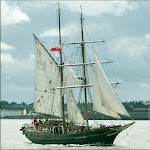
Their main vessel at present is the
Oscar Wilde (above), which sails from Rosslare, Co. Wexford to Cherbourg every second day, with the return journey the next day.

Adding an observation of my own to the IMDO report, there is also a growing number of people who are utterly fed-up with the ever increasing extra charges, invented by so-called 'low fares' airlines to boost their profits. This, combined with ever more hassle at airports, turns sensible people travelling to Europe away from airlines and makes them use the ferry service to France, which is very competitive now.

The Emerald Islander

07 September 2009

Commission on Taxation presents its Proposals

Ireland's Commission on Taxation has proposed an annual tax on all residential property, water charges and the taxing of child benefit.

The report, which has been published in Dublin today, is part of the Irish government's strategy to shore-up the public finances, with the budget deficit likely to exceed € 20 billion this year.

With Ireland facing its worst financial crisis ever, the government is under huge pressure to restore the public finances.
Step one was the McCarthy Report, which recommended extensive spending cuts across the public sector, and step two is the list of recommendations from the Commission on Taxation.

The commission states that its priority is "to broaden the tax base, rather than merely increasing tax rates".

Commission chairman Frank Daly says the recommendations would "not damage economic growth". All recommendations were "designed to spread the burden of taxation more evenly and to give the government more certainty about its tax revenue".

The report urges the government to focus on raising revenue through property taxes, spending taxes and income taxes - in that order.
The commission also identified 245 tax relieving measures in the Irish tax system.

The main proposals are:
  • An annual property tax on all residential property, excluding social and local authority housing.
  • Child benefit should be a taxable income, with a tax credit to offset the increase in tax for low income earners.
  • A new three-rate income tax system should be introduced to replace the current high and low income tax rates.
  • The health levy should be abolished and integrated into the income tax system when fiscal conditions improve.
  • Rules on residency and tax exemption should be strengthened.
  • Stamp duty on ATM, credit and debit cards should be phased out in the interest of promoting a cash-free society.
  • Removal of tax relief for nursing home expenses once the 'Fair Deal' scheme ends.
  • The current 'Cinderella clause' needs to be supplemented with additional tests and criteria.
  • Additional capital gains tax should apply on windfall gains from property rezoning.
  • Domestic water charges should be phased in, with incentives to install meters and with a waiver for low income households.
  • Carbon tax based in tonnes of carbon should be introduced and collected at the earliest point of supply.
  • VRT should be replaced over ten years by a system based on car usage.
  • Tax relief for pension payments should be replaced with a scheme 'along the lines of the former SSIA scheme'.
  • The first € 200,000 of pension lump sums should be tax-free, with the remainder taxed at standard rate.
  • Ireland's low corporate tax rate should remain in place to support economic activity long term.
  • The artists' tax exemption should end.
  • Expenses of Oireachtas members should be treated in the same way as expenses paid to all other employees, with a limit placed on the dual abode allowance and an end to the flat rate of relief for accommodation.
  • End stock relief for farming business, but continue relief on farm land leasing.
  • Income tax relief for trade union subscriptions should be ended.
As these are so far only recommendations, it will be interesting to see which of the proposals the government will adopt, and in which way they will be implemented.

06 September 2009

HSE is facing € 800 Million Budget Cuts

Today the Chief Executive of the Health Service Executive (HSE) has confirmed that the Department of Health has instructed him "to draw up plans to cut next year's budget by at least an additional € 800 million".

Speaking on the Sunday programme This Week on RTÉ Radio 1, Prof. Brendan Drumm (photo) said the HSE would have "to cut at least 6000 jobs in the coming years if substantial savings could not be achieved".

Prof. Drumm also announced that he will not seek a renewal of his contract when his five-year term as head of the HSE comes to an end in 2010.
"Five years are a sensible period of time," he said, "but ten years in the same position might be too long for one man and lead to unexpected problems."

05 September 2009

Outcome of second Lisbon Referendum is still open, while Millions are spent on the Campaign

Ireland's Minister for Foreign Affairs Micheál Martin has acknowledged that there is still "a significant challenge for the YES side in the remaining weeks of the Lisbon Treaty referendum campaign".
He reacted to a new opinion poll that shows a drop in support for the treaty.

The TNS-MRBI poll, published in yesterday's edition of The Irish Times, lists the ratio of YES voters at 46% - an eight point fall since the last survey in May.

29% of those asked say that they will vote NO (up one point since May), and there is a big increase in the 'don't knows', whose number went up to 25%.

Micheál Martin (right) said that "a vigorous campaign is needed to get the YES message across".
He has also accused the NO campaign of "a basic mistrust of Europe based on conspiracy theories".

Well, this "vigorous campaign" is already in full flow, and one can expect that it will become even stronger, the closer we come to the referendum day, October 2nd.

On Thursday I was in Dublin, and what I saw there truly astonished me. There is not a single lamp post in the city that is not displaying a Lisbon Treaty campaign poster. More than 80% of them are pro-treaty, and the rest - mostly from the Catholic campaign group COIR - ask for a NO vote. It is an amazing sight to behold and I have never seen anything like it. Not in any Irish election campaign, and not in the run-up to a referendum either.

Among the pro-treaty posters those from the political parties - predominantly Fianna Fáil and Fine Gael - are outnumbered by large-size ads from two groups one has never heard of before. They were only formed very recently, and for the sole purpose of promoting the YES vote on October 2nd. Nobody seems to know who is really behind them and, even more important, where their money comes from.

The massive poster campaign in Dublin alone costs several millions of Euros (and since I have managed general election campaigns, I do know what posters cost). Who is paying for all these posters?

There is a deeply sinister element in the campaign that makes one quite uneasy. When Micheál Martin speaks of "a basic mistrust of Europe based on conspiracy theories" in the NO camp, he is not too far off the truth. Only that there is neither 'mistrust of Europe' nor pre-occupation with 'conspiracy theories'. But people with open eyes and a working brain do notice the very strange structure the YES campaign has developed.

Why is the government relying on non-descript groups of shady people to achieve a YES vote? Why is there hardly any government minister giving major speeches in favour of the treaty? And why is it that no one in Fianna Fáil or the Green Party is seeking an open exchange of arguments over the details of the treaty, as we had it last year in the National Forum on Europe (NFOE)?

Well, the NFOE, which was the best debating forum Ireland has ever seen, was abolished by the government, with the excuse of "cost-cutting during the recession". The real reason is that the NFOE was too fair and too sophisticated for a government of ignorant bullies. It produced deep, open and high-spirited discussions about the real matters, and as a result a majority of 53.4% of the Irish electorate rejected the Lisbon Treaty on June 12th, 2008.

Soon after Micheál Martin commissioned a 'research group' to find out the reasons for the rejection. I am sure that he was told what motivated the Irish people, but he did not publish it. Instead he came up with a smokescreen of lies and half-truths (see my entries of September 8th & November 17th, 2008) that deliberately omitted the main reasons for last year's NO vote: The unwillingness of the Irish people to become voiceless and powerless inside the EU Council, and the extreme unpopularity of the current government, which had not even bothered to read the treaty, but expected the nation to accept it nevertheless.

Now the YES campaign uses no longer political arguments, but relies mainly on scaremongering, baseless attacks on the NO campaign and an avalanche of posters and leaflets, the majority of which are apolitical, vague and entirely manipulative. Not even to mention that they are also conveying lies.
Instead of seasoned politicians, some businessmen, footballers, actors and so-called 'celebrities' are wheeled out to persuade the Irish nation that the Lisbon Treaty is a good thing. What do they know about it? Does anyone think that people like Michael O'Leary, Roy Keane or some shallow game-show hosts have actually read - and understood - the treaty, when neither the Taoiseach nor our EU Commissioner Charlie McCreevy could do it?

The YES campaign has obviously enormous amounts of money at their disposal, and they are using it. What they do not have are valid arguments and trustworthy people to put them forward.

Anyone who has voted NO last year should do so again, because - with one exception - nothing has changed since the last referendum.
This one exception is the retention of our EU Commissioner, which is a direct result of the fact that Ireland rejected the treaty. (Had we voted it through, we would have already lost our right to have a permanent EU Commissioner at all times.) It is rather strange that the government and others in the YES campaign use the retention of the EU Commissioner now as an argument to vote YES this time.

And anyone who voted YES last year should examine very carefully what has happened to Ireland since and how our government has squandered every bit of political and economic credit we had left.
The latest opinion poll, which shows the support for Fianna Fáil at 17% and that for Brian Cowen even lower - at 15% - should give you more than enough direction for October 2nd. Should the devious campaign of deception, which suggests that our EU membership is at risk if we vote NO again, succeed, everyone alive in Ireland today will live to regret it deeply. And our children and even grandchildren will hate us for it, while they still have to pay for the follies of our generation and our current government.

The so-called 'safe-guards' the government has apparently 'secured' in Brussels are worth nothing, not even the paper they are printed on. Not one of them is really relevant for Ireland, and not one of them has been added to the Lisbon Treaty. We were promised that they might become "part of the next EU treaty", perhaps the accession treaty for Croatia. If it were not so serious, one could mistake this for a joke.

It is not even certain yet that Croatia will be admitted into the EU, and no date for it has been set either. All Brian Cowen has 'achieved' in Brussels is a very vague promise of 'perhaps some jam in the future'. But there is no 'jam' today or tomorrow. If the Taoiseach had listened to the people and represented their democratic will strongly in the meetings of the EU Council, he could have achieved a lot more for Ireland and would deserve recognition and praise for it.

But neither he, nor Micheál Martin, have stood up for Ireland in Brussels. They weaselled and crawled in front of the other leaders, especially those from the large member states, and proved as spineless there as they are towards our banks here at home. They have shown more than enough incompetence in every possible way, together with a strong disregard for the people of Ireland and their political will, which was clearly expressed in last year's referendum (and even further in the recent elections of this summer).
Such behaviour can lead any person with common sense only to one decision: To vote NO on October 2nd and reject the Lisbon Treaty a second time - and for good.

Meanwhile Caoimhghín Ó Caoláin (left), Sinn Féin's leader in the Dáil, responded to Micheál Martin's statement by saying that the government and others had "come back and tried to fool the Irish people that they have a new treaty or a better deal - but they have no such thing".
"We have an agreement which indicates that each of the EU member states will retain a commissioner, but the agreement does not in fact guarantee that the arrangement will continue into perpetuity," he added.
"It is very, very important that people get down to reading the fine print and understand exactly what is involved in the declarations, the protocol and the agreement in relation to the commissioner."

"Make no mistake about it, you have endeavoured to pull the wool over the people's eyes by pretending this is a new treaty, or a better treaty. But it is neither", he told the Minister for Foreign Affairs. "It is the same treaty, and on October the 2nd the Irish people should resolve to vote NO again."

In a separate statement, the Green Party's leader and Minister for the Environment, Heritage and Local Government John Gormley (right) has acknowledged that "the Lisbon Referendum could be lost unless the YES side runs a positive and energetic campaign".

Gormley said that the Greens were "not in any way complacent", and he had always been of the view that the outcome would be "very close". The YES side had been "put on the back foot in the last campaign", answering the criticisms of the NO campaign. This time, he said, the YES side "must run a positive and energetic campaign". They would run a risk of losing the referendum if that is not done.

I wonder if John Gormley's statement is an ever so slightly camouflaged test balloon for a possible exit of the Green Party from the government coalition, should the treaty be rejected again.

In my opinion Brian Cowen could and would not survive a second defeat as Taoiseach. His own party would look for a new leader, and - with some luck - it might even trigger an early general election. Even though this has nothing to do with the substantial and good reasons to vote NO on October 2nd, it would be an added bonus. As I have stated here already several times, as long as the current government stays in office, there is absolutely no hope for Ireland to find a way out of the current crisis and recession.

The Emerald Islander

04 September 2009

Irish Dairy Farmers staged a "Milking Protest" at Government Buildings in Dublin

About 100 members of the Irish Creamery Milk Suppliers Association (ICMSA) have protested outside Government Buildings in Dublin this afternoon over the price they are being paid for their milk.

The dairy farmers used mobile equipment to milk five cows in front of the Taoiseach's office to highlight their difficulties.

ICMSA leader Jackie Cahill said "it is not possible to exaggerate the crisis in the Irish dairy industry" and that there seems to be "a denial of the facts at government level".

Brendan Smith, TD stated that he is "aware of the difficulties". And one would indeed hope so, as he is after all the current Minister for Agriculture.

He said that for many months he has been "demanding special measures at European level, including intervention storage and export refunds", and that he "will be seeking further help next week in Brussels".

But as nice as this might sound, it is just lip-service and no help for the Irish dairy farmers.

What the Irish farmers need is a fair price for their products. And this is not decided by EU officials in Brussels, but by the buyers of the supermarket chains in Ireland. They are the ones who have squeezed the farmers over years and pushed down the prices they pay them for milk At the same time there is no reduction of the prices that Irish consumers have to pay for milk in supermarkets and other shops. The difference is pocketed by the retailers, and if the farmers are seeking a solution for their problem, then they should address it to the right people.

The Emerald Islander

TEVA is cutting 315 jobs in Waterford

Workers at one of the biggest pharmaceutical factories in Waterford have been told today that 315 of the currently 730 jobs at the plant will be cut within the next 12 months.

TEVA (photo), which is now owned by an Israeli financial consortium and was formally known under the name IVAX, is located at the IDA Industrial Estate on the outskirts of Waterford and manufactures inhalers and tablets.

In a surprise meeting, which had been announced only yesterday evening, the workers and their trade union representatives were informed this morning by the company's management that the tablet production at the factory will cease within 12 months. A part of the manufacturing process will be transferred from Waterford to a factory in Hungary, where wages are about a quarter of current Irish payment levels.

The announced redundancies will be a mixture of voluntary and compulsory, but details of packages have not yet been released.

More Jobs in Danger

Speaking about the job losses, Matt Moran of PharmaChemical Ireland, an umbrella body for the pharmaceutical industry in this country, stated that between 500 and 1000 similar jobs could be "vulnerable".

He said that the cost base for manufacturers in Ireland has risen, and that producing generic pharmaceuticals which are off patent is very susceptible to competitive pressure.

The manufacturing of generic pharmaceuticals represents between 5% and 10 % of the sector's production in Ireland.

Elsewhere, the multinational eye-care company Bausch & Lomb has announced that 500 jobs are to go at its facility in Livingston in Scotland, a move which may help safeguard the remaining 1100 Bausch & Lomb jobs in Waterford.

The company said that as part of a restructuring process, approximately 30 new positions will be created in Rochester in the USA during 2010, but there will be no employment increase in Waterford.

Ireland relies too much on foreign Companies

Once again, many Irish jobs that people might have considered as safe not so long ago are to be lost or potentially in danger. And once again they all are in foreign-owned companies.

Readers of this weblog will be well aware that I am no simple-minded nationalist who praises everything Irish and is suspicious of foreigners. In fact, I am quite an internationalist myself. But I am nevertheless of the opinion that we do have too many Irish jobs that depend on foreign money and investment.
For decades the IDA has always been looking for the big money from abroad, predominantly from the USA. Many US multi-national companies have come to Ireland and employed many Irish people. But a lot of them closed again and left Ireland after a few years, usually when their preferential tax regime ran out. Others have just disappeared without trace, and some others (like DELL in Limerick, and now TEVA in Waterford) are moving a large part of their production to low-wage countries.

Had the IDA spent the vast sums of money it threw - and still throws - at US and other foreign companies on the development of an indigenous Irish industry, we all would be a lot better off.
It is well-known that - especially during a recession - the vast majority of companies will rather cut their workforce abroad, while protecting jobs in their country of origin.

We need a new approach and a complete overhaul of the Irish economy, with much more industries owned and controlled by Irish businessmen and investors. Only then will we be able to create a new stability.
As things are at present in Ireland - and have been for many decades - our economy is neither developed nor independent. The large percentage of foreign-owned companies creates actually a situation of limited economic sovereignty, which has a direct negative influence also on our national (political) sovereignty.

And this time we cannot blame the Irish situation on foreign invaders like the Normans or the English. The mess we are in is of our own making, created over decades by a succession of Irish governments and state agencies like the IDA, who care more for foreign investments than for our own nation's status, competitiveness and stability.

Only a complete change of attitude, combined with serious investment of Irish money in Irish industries, can change our economy for the better.

The Emerald Islander

02 September 2009

New Survey shows that Irish People have the third-lowest Confidence in the Economy

A new survey has revealed that the Irish have the third-lowest confidence in the economy within the 27 member states of the European Union.

The latest Eurobarometer survey, which was published today, shows that just 6% of our people think the economic situation in Ireland is 'good'.

Only the Hungarians (at 5%) and the Latvians (with 2%) are more pessimistic than the Irish. The EU average is currently 20%.

The Irish's view of our domestic economy has declined by 83% since the Spring of 2007.

On a positive note, the survey also shows that 69% of Irish people think that membership of the EU has been good for us. This is the fourth-highest rate in the EU.

And despite growing rumbles over the Lisbon Treaty, 57% of the Irish people have still an overall positive image of the EU.

30 August 2009

Key Age Group is undecided on Lisbon Treaty

An opinion poll conducted for the new Pro-Lisbon Treaty campaign group 'We Belong' shows that a large percentage of Irish people under the age of 40 is still undecided on how to vote in the second referendum on the faulty treaty.

Over one third of those surveyed by the Behaviour & Attitudes company said that they were likely to vote Yes, while 23% of the people interviewed are likely to vote No.

The campaign group, which is specifically targeting voters between the ages of 24 and 40 in the weeks leading up to the referendum, says an analysis of the voting patterns that led to last year's rejection of the Lisbon Treaty shows that "the 1.18 million people in this age group will be the key to deciding the final result in the referendum on October 2nd".

Today's poll finds that 36% of them are likely to vote Yes, 23% will vote No, and 37% are still undecided.

The research also shows support for the treaty is holding up among those who voted in favour of the proposals in 2008, while 17% of those who voted against it have now changed their minds.

But since there is still more than a month to go until referendum day, much can happen and the outcome is far from certain.

Railway Safety Commission failed to do its Duty "because it could not employ enough Staff"

Critical safety checks on Ireland's railway system have not been carried out for the past three years, because the official body charged with the inspections did not have enough staff.

According to a report in the Irish Independent newspaper, Iarnród Éireann (Ireland's state-owned railway company) "admitted that its inspection regime - covering more than 1200 bridges - would need to be reviewed after one of the busiest rail lines in the country collapsed into the sea last week". (see my entries of August 22nd, 23rd & 26th)

The Railway Safety Commission (RSC) has revealed that it was "too busy approving new rail projects to carry out planned safety checks on existing lines". It was not employing enough staff and apparently "only able to recruit the full complement of safety inspectors this year".

The RSC is charged with ensuring that Iarnród Éireann and other operators perform to the highest safety standards. But it has emerged that just half of the necessary staff were in place to cope with the huge workload of checking safety systems.

The Irish Independent also reports that:
  • The RSC has warned about a lack of inspectors since it began its operations in 2006.
  • It said this "lack of resources" prevented it from "devoting the time we would wish" to safety checks.
  • It had just four inspectors responsible for almost 2000 km of rail lines and hundreds of bridges until this year.
  • Only in 2009 could it recruit an additional three inspectors, bringing the total employed to seven.
As I have reported here earlier (see my entry of August 22nd), the Broadmeadow viaduct, which crosses open water in North-Dublin, collapsed into the sea despite being passed as "safe" following not one, but - as it has now emerged - two inspections by Iarnród Éireann engineers.

According to the Irish Independent, "the company stands by its inspection regime" and is "defending a decision to pass the structure as safe", despite having been told by members of the Malahide Sea Scouts (referred to originally by an Iarnród Éireann spokesman as "a member of the public") that one of the supporting piers was damaged.

The paper also reports that the collapsed pier that caused the viaduct to fall into the water will not be rebuilt. Instead, rail engineers are planning to "strengthen the line", whatever this means.

Serious questions have been raised over how a supposedly 'safe' bridge could suddenly fall into the sea after two inspections.
As additional details emerge about the incident and the more than lax inspection regime of RSC and Iarnród Éireann, it becomes clear that we are unveiling another major Irish scandal here.

There are further concerns about the general safety on Ireland's rail network, especially as the Railway Safety Programme was extended from five to seven years in an effort to reduce costs in last year's Budget.

Ensuring that bridges, viaducts, railway lines, level crossings and all other pieces of Ireland's rail infrastructure are safe is a key plank of the RSC's brief.
Last year, it also approved 57 infrastructure projects, ranging from construction of new bridges to the approval of new Luas (Dublin's city tram) extensions, which led to the postponement of vital inspections.

"The number of railway projects that required RSC approval meant that we were able to commit less time to performance auditing and monitoring than we would have wished," the inspection body warned in its 2008 report.
"A safety management system is only as effective as its implementation. Assessing the railway undertakings' safety case compliance is an essential part of the RSC's work, but lack of resources has, in the past, prevented us devoting the time we would wish to this task."

Fergus O'Dowd, TD (left), Transport spokesman for the main opposition party Fine Gael, said that the Railway Safety Programme had seen its funding cut, and that there is "a lack of accountability" in relation to the Broadmeadow inquiry.
"They're the regulator of the industry, and the guarantor of safety on the trains. I would be very concerned," he said.

Under the Railway Safety Act 2005, Iarnród Éireann is required to commission an independent audit of its safety management system every four years. The next audit is scheduled for 2010.
It will - among other issues - consider if inspections of the Broadmeadow viaduct were regular enough, and if an underwater survey of the pier should have been conducted.

Iarnród Éireann and the RSC are also expected to appear before the Dáil Transport Committee next month to answer questions about safety.

In my opinion a full and independent inquiry into the incident and into the general safety of the Irish railway network is urgently required. On its own Iarnród Éireann can no longer be trusted.

The Emerald Islander

29 August 2009

Dublin Protests over Hospital Cutbacks

Angry protests over health cutbacks have taken place outside two hospitals in Dublin today.

More than fifty people have demonstrated outside Our Lady's Children's Hospital in Crumlin this afternoon, while a separate protest took place at the Mater Misericordiae University Hospital (commonly better known as the 'Mater Hospital').

The protesters, most of them current and former patients of the hospital and their relatives, demanded the reopening of a closed operating theatre and a ward at Crumlin (right). They also called for the reversal of other cuts at Ireland's best-known children's hospital.

Meanwhile, the Labour Party said that 120 beds in the Mater Hospital are now occupied by patients whose treatment has ended.
During a party protest at the hospital, Dublin Labour TD Joe Costello said that "60 of those beds have been occupied for 100 days or more".

He explained that "a lack of step-down facilities means patients cannot be discharged" and that this is having "a knock-on effect on the hospital's Accident & Emergency department".

Deputy Costello said his information was based on an official reply to a parliamentary question he had asked recently.

Motorways by Name only

Many countries in Europe, as well as on other continents, have an excellent system of roads. But Ireland does not. Many countries also have a network of motorways, and - again - Ireland is not among them. What we have on this island of ours is a patchwork of national, regional and local roads, interspersed with roadlets and paths that have not changed much over the past two or three centuries.

When most of Ireland's roads were designed and built, it was predominantly the (then British) military that was doing it, and for obvious reasons.
Thousands of years ago the ancient Egyptians, the Persians and other great empires had built roads to move their soldiers around faster, and the Romans became the true masters of strategic road building. Every major country in the world has learned from them and given attention to important roads.

However, Ireland is not a major country, and it was never touched by Roman civilisation.

This one can still notice here today. Most of our roads were built between the late 18th and early 20th century, and they were built for the usual traffic of the time: people on horseback, horse-drawn coaches and carriages, carts drawn by horses, oxen or donkeys, and people on foot.
And even though most of Irish roads are meanwhile covered with tarmac, they are still winded, quite narrow (especially when one compares them with roads in other countries) and often in need of maintenance we cannot afford.

Until about 30 years ago Ireland did not have any motorway at all. And it did not need one. Then some of the wider national roads around Dublin were designated as 'motorways', in order to give us a more modern look and impress a number of foreign visitors. We still had no real motorways, but pretence is a great thing for the Irish. And if one does it well here and pretends things long enough, people will actually believe that they exist. (Just think of leprechauns and the faireys...)

During the years of pretended economic boom, the period of the - once worshipped and now cursed - 'Celtic Tiger', a few new motorways have been constructed in Ireland. Most of them are in and around Dublin, and some of them were built with private money and are now operated as toll roads. They have the same traffic jams and congestions as all other roads, but their greedy operators charge motorists an arm and a leg for the privilege to crawl over their piece of tarmac instead of some other, a mile or two away.

But even with the new additions to the system, Ireland still has a very bad road network, and almost no motorways. If you want to see the real thing, you have to travel to Germany, where the motorway was invented in the 1930s. There most of them have six lanes as a rule, with some major sections being even wider and providing eight or even ten lanes.

What we have here in Ireland are mostly modernised national roads, in some sections widened to four lanes. But to make us look a little bigger and more important than we actually are, Noel Dempsey (right), currently Minister for Transport, has now "re-classified" 294.3 km of national roads as "motorways".

They are really motorways by name only, and nothing has changed on these roads, except that the speed limit has been increased from 100 km/h (the standard for national roads) to 120 km/h.
Under general traffic laws the new 'motorways' cannot be used by any learner-drivers, motorcycles and "certain types of agricultural vehicles".

One can understand the ban of agricultural vehicles. It makes sense and is the same in most other countries. As there are no 'learner-drivers' elsewhere - with exception of the UK - the question of them using motorways does not arise in other nations. But why ban motorcycles from our 'motorways'? Motorcyclists can use all roads in other countries, and there seem to be no problems with them, as long as they obey the rules of the road like everyone else.

This whole 're-classification' of roads is another example for the confusion and incomptence of our government in general, and for the specific incompetence of Noel Dempsey in particular. The man is useless and clueless, and has demonstrated this in several government departments he was in charge of. And Transport makes no difference to 'the bouncer' from Co. Meath.

The real joke - unfortunately not a good one - is the list of roads that are now 're-classified' as 'motorways'. If you expect a number of lengthy and well-developed sections of overland roads, you will be disappointed.

But then again, this is Ireland, so what can you really expect?

To begin with, of the 294.3 km of national roads that Noel Dempsey has pompously "re-classified as motorways" yesterday, less than half actually exist at present!
Only 42.6% (125.5 km) exist and are 'open for traffic', while 47.9% (140.8 km) are still 'under construction' and 9.5% (the 28 km section of the N 18 from Oranmore to Gort in Co. Galway) is only 'in planning'.

The longest part of newly re-classified 'motorway' that is actually open for traffic is a 21 km section of the N 11 between Arklow in Co. Wicklow and Gorey in Co. Wexford.
The rest is nothing but a higgledy-piggledy patchwork of small to medium-sized pieces all over the country, with the shortest being a section of the N 3 (from Dublin to Cavan) between Littlepace and Loughsallagh, which is just 2.1 km long.

This means that motorists driving on Ireland's national roads in future will constantly have to watch if they are on a stretch of official 'motorway' with 120 km/h speed limit, or on a normal national road with only 100 km/h limit. It will lead to even more confusion than there is now, and most likely to more speeding tickets for drivers who think that they are still on a 'motorway', while they have in fact passed it already.

The whole thing is nothing but a farce, another sick joke from an utterly clueless minister in an incompetent government that is simply not capable of doing anything right.

The Emerald Islander

28 August 2009

Building in Cork City collapsed

While Ireland's government is crumbling at the edges and the coalition is close to collapse (see my entry of August 25th), the country itself is already collapsing and falling to pieces bit by bit.

No, I am not referring to the banks this time. They are holed below the waterline and sinking slowly, but steadily. And no adult alive today who has a working brain and seen and experienced the absolute crazy, irresponsible and ruthless attitude and behaviour of our banks will ever trust them again. (Any old box or mattress is a much better and safer place for your money than the ugly temples of silly greed and certain doom...)

But as I said, I am not writing about the banks today. When I say that the country is falling to pieces, I mean it literally.

The latest episode in this new series of contemporary Irish 'entertainment' did happen in Cork, Ireland's second-largest city, where a complete multi-story city building has suddenly and unexpectedly collapsed yesterday (photo left).

The incident happened in Castle Street, right in the city, and it is a miracle that no one was killed or seriously injured when the house collapsed into the street without warning.

The only 'casualty' was a small silver-coloured car that was parked right in front of the house, which collapsed on top of it and made it a complete insurance write-off. (see photo right)

The building, which was in a row of houses and connected to two other buildings to the left and right, was undergoing renovation for some time.

Buildings and offices on Castle Street have been evacuated and traffic diversions are in place in the area.

Gardaí in Cork are puzzled by the incident, and a full investigation is expected to take place.

This is the second time within one week that a substantial construction in Ireland has collapsed suddenly and without any apparent reason.
Last Friday evening a 20-metre-long section of the railway viaduct across the Broadmeadow estuary near Malahide station in the North of Dublin also collapsed without warning. (see my entries of August 22nd, 23rd & 26th)

In contrast to many other countries, Ireland does not have a national Department for Buildings and Construction. This leads to the ridiculous situation that there are hundreds of different rules and regulations for different kinds of buildings and structures, often very different from one local authority to the next.
At the same time Ireland's planning law and planning process is among the most complicated and bureaucratic in the world.

If we want to see some progress eventually, this has to stop. We have to streamline planning and building regulations on a national level, with the same rules applying equally to everyone. And when it comes to buildings and other structures, the element of safety and solidity has to come above all other concerns.

Even though I am not much involved with the construction industry or property business, I have seen over the years too many houses and other buildings that I - as a layman - would regard as unsafe or at least critical. They are still in place, and unchanged, and perhaps other collapse cases waiting to happen.

There is no inspection of buildings in Ireland, but such takes place in most continental countries, where buildings do not suddenly collapse. Where and when people take care, things work well, are functioning and satisfactory for all.
But in ridiculous banana republics like Ireland no one seems to care any more, especially not for the common good. Most people are just looking after 'No. 1' (themselves), and an incompetent government, hand-in-glove with a sluggish and self-absorbed bureaucracy, has no interest in the common good either. As long as our ministers, TDs and civil servants receive their exorbitant salaries, 'allowances' and - eventually - pensions, they don't care for anything else.

One of the recommendations of 'An Bord Snip (Nua)' is the complete abolition of the Department of the Gaeltacht, Rural & Community Affairs, whose few responsibilities could easily be taken over by other existing government departments.
This is one of the few recommendations of Colm McCarthy's four-men commission I applaude and fully agree with.
It also means that we could fill a soon empty space in the cabinet with something new and more useful than the Gaeltacht. Why not create a new Department of Construction and Housing and give it responsibility for every house, building and structure in the country?
Many other countries have such a department, and it is more than time for Ireland to follow suit, unless we want to hear of ever more collapsing buildings on a regular basis.

The Emerald Islander