Showing posts with label education. Show all posts

13 July 2009

Green Party wobbles over third-level Fees

Ireland's Green Party has denied that it has done a U-turn on the issue of third-level education fees.

The junior partner in the current government coalition responded to an accusation from the Labour Party's education spokesman (and former Minister for Finance) Ruairi Quinn (above left), following the comments the Minister for Communication, Energy & Natural Resources (and Green Party TD) Eamon Ryan (below right) made on the RTÉ programme 'The Week in Politics'.

After a day with various conflicting statements from the Green Party, an official spokesperson at their head office said tonight that they were "still opposed to the return of fees", but that they would "look at the Minister for Education's proposals as outlined in a document for the Cabinet".

In the RTÉ interview Eamon Ryan had indicated his support for the return of third-level fees that would involve a loan scheme for students.
Under this scheme, graduates would pay back a portion of their college fees once their income is above a set limit.

The Education Minister Batt O'Keeffe (left), a staunch and quite old-fashioned Fianna Fáil politician and uncritical supporter of Taoiseach Brian Cowen, is expected to outline several options for third-level education funding shortly.

But whatever he will propose, it means a big step backwards in the national education system.
And if the Green Party is really going to support the proposal, it also means another breach of their promises to the Irish voters.

It is a long time now that the Green Party was a sensible force for change and promoter of many worthwhile alternative policies. They have sold their soul, principles and beliefs for two seats in the cabinet and a junior minister's job, and in only two years they mutated from Fianna Fáil's harshest critics to Fianna Fáil's tame poodles. What a change... and so typically Irish!

A phrase by the great satirist, Dean Jonathan Swift, comes to mind: "Any Irishman will happily sell his mother for a shilling and throw his sister into the bargain for sixpence..."

The Emerald Islander

14 April 2009

Batt O'Keeffe faced INTO 'Wall of Silence'

Irish primary school teachers are to call on the Irish Congress of Trade Unions (ICTU) to hold a day of action before June, in order to defend public services and jobs.

During their annual conference in Letterkenny, Co. Donegal, delegates of the Irish National Teachers' Organisation (INTO) backed a motion on a 'day of action' and condemned what they call "a campaign of vilification against the pay and conditions of public service employees".
They also support the withdrawal of support for modernisation measures in schools in the event of an extended pay freeze.

Earlier today there was a very frosty reception for Batt O'Keeffe (right) from the teachers at the conference.
The Minister for Education was greeted with a 'wall of silence' as he arrived, and his speech was punctuated by loud moans and derisive laughter at times.

Around thirty of the INTO delegates walked out of the conference room when Batt O'Keeffe began speaking, while many others held up posters highlighting some of the issues that have provoked their anger: the pensions levy, the loss of teaching posts and the abolition of special needs classes (left).

When the Minister ended, there was almost no applause. Only a few of the invited guests, seated in the front row, felt obliged to clap mildly.

Later the delegates gave a long standing ovation to INTO General Secretary John Carr (right) when he spoke of the bitter resentment felt by teachers as their pockets were picked to bail-out bankers, speculators and developers.

To loud and frequent applause, Carr said that Ireland's children were "paying the price for a few capitalist criminals".

Yesterday evening INTO's President Declan Kelleher (left) accused the government of being dictated to by the employers' group IBEC and the right-wing of Fianna Fáil, at the expense of ordinary workers. Declan Kelleher also got a long standing ovation when he warned that "the government would reap its reward". He said that teachers were prepared to pay their fair share, but in the meantime, the rich were getting off scot-free.

The strongly expressed anger of INTO members gathered in Letterkenny reflects the current feelings among Ireland's primary school teachers, as well as the general mood in the public sector as a whole.

No government, regardless of system or political party, can rule or govern a country without the full support of Civil Service and administration.
And usually public service employees - the people with the safest jobs and best pensions in the country - are the slowest to anger when it comes to industrial disputes.

The fact that in the Republic of Ireland it is now exactly this group of people that spearheads the anger and protest against the government and its austerity programme is quite significant.

If - as we expect - the two government parties are hammered in the Local & European Elections in June and the pressure from public sector workers continues (while the number of unemployed in the private sector rises further), it is quite possible that Brian Cowan will have no other choice but call an early General Election for early Autumn.

Our government is by now only a shadow of what it was when formed by Bertie Ahern in the Summer of 2007 with confidence and aspirations. Less than a year after Ahern handed over to Brian Cowan, his own party Fianna Fáil is in tatters, the Greens are completely confused and 'lost in time', while the administration around them is cracking and crumbling at the edges.

The sooner the people of Ireland have a chance to elect a new parliament and government, the better.
Greeting a cabinet minister with a 'wall of silence' is only one step away from taking a wall apart and throwing stones at the government...

The Emerald Islander

18 January 2009

A special Day in German History

Since I was born abroad and grew up in foreign countries, I never got to 'enjoy' the Irish school system. And from what I know of it by now - as an adult who has been a part-time teacher and lecturer both in secondary schools and third-level colleges - I am rather glad that I got my education in countries that take the matter more serious than Ireland.

As a historian I was surprised and quite shocked when I first found out that European History in Irish secondary schools begins only in 1870, with the Franco-Prussian War. This means that Irish children are denied the knowledge of nearly two millennia of mainstream history, which includes many major events, great political, social and intellectual developments, crucial wars and important leaders and thinkers from many nations.

The Roman and Byzantine Empire, the Crusades, the Hanseatic League, the Age of Reformation, the Thirty-Years War, the Enlightenment, the French Revolution and the Napoleonic Wars - to name only the most significant periods - are not introduced to Irish children in secondary school. Thus they have no real notion about people like Caesar, Marcus Aurelius, Charlemagne, Godfrey de Bouillon, Charles the Bold, Emperor Maximilian, Jan Hus, Erasmus, Wallenstein, Louis XIV, Prince Eugene of Savoy, Frederick the Great or even Napoleon - to name but a few.

In my opinion this is a sad and irresponsible shortfall, which has implications on everyone who ever went through the Irish school system. Their view on the world as a whole and on history in particular is very limited.
But I suppose this is the conditioning one needs to be able to be strongly interested in various players of Football, Golf or other pointless sports, which take a lot of time, attention and money from many Irish people, especially men.

However, since European History begins for Irish people in 1870, most of my readers will be familiar with the significance of this day - January 18th - in German history. Having defeated the much larger French army in several decisive battles during the second half of 1870, Prussia - supported by other German states (especially Bavaria, Württemberg and Baden) - emerged as the surprise victor from this war, which marked the end-point of a seven-year period of short wars (the first one in 1864 against Denmark) and ever stronger domination of Prussia inside the German Union (the lose confederation that had replaced the old Holy Roman Empire of German Nation in 1806).

Inspired by the total defeat of France, the various German kingdoms and principalities, which had been brought even closer to Prussia through the war, decided to form a new unified national state called the German Empire (Deutsches Reich). It began its official existence on January 18th, 1871 with the proclamation of Prussia's King William as Emperor William I of Germany.

This proclamation (pictured above) took place in the famous palace of Versailles on the outskirts of Paris, once the home of the French kings. Paris itself surrendered ten days later, but France had lost the war already by September 1870, when after the battle of Sedan the main field force under Marshal MacMahon surrendered to the Germans. Among the 83,000 prisoners of war was Emperor Napoleon III himself.

France, then the second Napoleonic empire, declared war on Prussia alone on July 19th, 1870, in the - as it turned out wrong - assumption that its stronger and superior army could beat the Prussians and re-establish French domination on the continent (as well as restore the fading popularity of the emperor at home). The French army had just finished equipping all its units with the new Chassepot rifle, which had a clear technical superiority over the Dreyse rifle used by Prussia, and also a greater range. On top of that France employed a new invention called the 'mitrailleuse', a multi-barrelled salvo gun which was a fore-runner of the modern machine gun.
The Prussians and the other German armies had no such salvo guns, but instead new Krupp steel cannons, the most advanced artillery in the world at that time. This superior artillery, together with the better training and organisation of Prussian and German troops, crippled the French army within a few weeks. Having started the war with invading Germany and trying to occupy a major German city near the border, the French army was soon forced to retreat to its fortress Metz, where 140,000 troops under the command of Marshal Bazaine were sitting idle until they surrendered as well shortly before the end of hostilities.

The traditional rivalry between the French and the Germans goes back to the year 843 (two dozen years before my own family appeared on the scene) when - after the death of Emperor Charlemagne - his lands were divided between his three sons.
This laid the foundations of modern France and modern Germany as national states. The buffer state between them was Burgundy (home of my ancestors), which established the traditions that are today carried on by Belgium and Luxembourg. Only after World War II, more than eleven centuries later, the two nations of France and Germany developed a new and friendly relationship, which became the core element of the EU.

But for the Germans, and especially Prussians, the 18th of January has an even deeper meaning than being the day when the second German empire was proclaimed, just 18 weeks after the second French empire had collapsed with the capture of Napoleon III. The date of the 1871 proclamation was chosen by Prussia's Prime Minister Otto von Bismarck very carefully and deliberately.
January 18th, 1871 marked the 170th anniversary of the proclamation of the Kingdom of Prussia. By selecting the same day for the foundation of the second empire, Bismarck created an emotional and historical bond of great strength between the two events.

Way back - on January 18th, 1701 - Prince-Elector Frederick III of Brandenburg (pictured left) stood in the great castle of Königsberg in East-Prussia (since 1944 occupied by Russia and called Kaliningrad), which had been the headquarters of the Teutonic Order of Knights since 1457 and seat of the secular Duchy of Prussia since 1525.
Ignoring the local bishop, who had been summoned for a ceremony, the Prince took a newly created crown, put it on his head and thus became King Frederick I of Prussia, remembered for his love of the arts and music.
His son, Frederick-William I, was more interested in the military and thus gained the nick name 'the soldier king'. With great energy and a lot of money he created a large and strong army and enjoyed watching his regiments on the drill ground and on parades. But he would hardly ever send them to war, as he did not like damage done to his 'favourite toy'.

Prussia's third king - Frederick II (pictured right) - combined the passions and interests of his father and grandfather and added to them great courage and high strategic and administrative skills. Under his rule there was little time for the drill and parade grounds, as Prussia fought a number of major wars, including the Seven-Years War, and every last man - the king included - was needed in the field.

Between winning battles, Frederick II loved to play music, especially the flute, and he composed a large number of musical pieces, many of which are still played today. He reformed and modernised the structure of his state, created the modern civil service with a special loyalty ethos, and found the time to oversee the construction of some of the finest buildings in central Europe, including the palace of Sanssouci (photo below), which he modelled on Versailles.

Frederick II was also an active philosopher, who was in regular discussion (by correspondence as well as through personal meetings) with Voltaire, the greatest French philosopher of the 18th century. We still know and remember the man as Frederick the Great.

Due to the low standards of our history teaching, today few people know of these great people and events, and of the double significance of January 18th for Germany, the largest of our EU partners. So I thought I will bring them back to common memory, on a day when nothing much is happening in Ireland, except that it is a rather cold, wet and unpleasant day with high winds up to storm force 10 and 11. In other words, a day to stay at home, keep the fire burning and spend the time with plenty of tea, a pipe, a good book and some history.

The Emerald Islander

29 November 2008

8000 protest in Donegal against Education Cuts

Today over 8000 people took part in a protest march in Donegal town against the government's cuts in the education budget. The protesters included teachers, parents and members of boards of management from schools across the north-west of Ireland and came mainly from counties Sligo, Leitrim and Donegal.

They outnumbered the 2500 inhabitants of Donegal town by more than 3:1, and a good number of local residents also joined the demonstration.

The gathering in Donegal was addressed by John Carr (right), General Secretary of the Irish National Teachers' Organisation (INTO).
Representatives of other teaching unions were also present.


INTO, which has already organised a number of protests around the country (see my entries of October 29th and November 22nd) since the 2009 Budget was introduced by Finance Minister Brian Lenihan on October 14th (see my entry of that day), is planning further demonstrations in the near future.

The largest of them is a national rally, which will be held in Dublin next Saturday.

INTO's courageous President Declan Kelleher (left) said that there is strong political support for the campaign, and from my own observations I can second this statement.

I would also urge anyone who has the time and opportunity to be in Dublin next Saturday to join the protest march. Education is the key to our future, and we should do everything in our power to prevent the damaging cuts the government has proposed for the education budget.

The Emerald Islander

22 November 2008

25,000 protest in Cork against Education Cuts

Today about 25,000 Irish people have been marching through the streets of Cork city in protest against the government's cuts in the education budget.

The march was part of a series of protest demonstrations organised by the Irish National Teachers' Organisation (INTO), which says that children should not be made to pay for the current difficulties in our economy.

It was the third time since mid-October that teachers, pupils and their parents have taken to Ireland's streets, protesting against education cutbacks.
INTO's General Secretary John Carr (right) declared that the marches will continue until the cuts are reversed.

Meanwhile the Minister for Education, Fianna Fáil's Batt O'Keeffe (left) who comes from Cork, said that he "simply does not have the funds" to reverse the cuts. This is his mantra ever since the major education debate in the Dáil on October 29th/30th. And unlike other ministers, who have been busy looking for extra money or alternative ways of saving on expenses, O'Keeffe has just remained stubborn, repetitive and inflexible like a stick in the mud.

Many in the education sector, who welcomed the appointment of the former teacher at first, think now that he is not really up to the job of heading the Department of Education.

The Emerald Islander

15 November 2008

More Protests against Education Budget Cuts

More than 4000 teachers protested against cuts in the education sector in Tullamore, Co. Offaly (home county of Taoiseach Brian Cowen) this afternoon.

According to he Irish National Teachers' Organisation (INTO), which represents primary school teachers in Ireland, many teachers and parents from counties Offaly, Laois, North Tipperary and Kilkenny took part.

One of the organisers said that Fine Gael TD Olwyn Enright (right) was the only national politician who was willing to speak at this demonstration, which marched through Tullamore to O'Connor Square, where the speeches were given.
Parents, principals, and representatives of boards of management were among the speakers addressing the protest meeting.

The education cuts were also raised at the annual conference of the National Parents Council for primary schools in Athlone, Co. Westmeath this weekend.

Minister for Education Batt O'Keeffe (left) was listed in the conference agenda to open proceedings this morning.
But cowardly as the government is these days, he backed out at the last moment and did not address the meeting. This led to strong expressions of anger and disgust from delegates.

Elsewhere, a protest against the suspension of the cervical cancer vaccination programme has taken place in Dublin. That rally was organised by the Feminist Open Forum, and it is expected that more protests will follow.

Meanwhile there is utter silence from the government, and especially from Batt O'Keeffe. When he was appointed by the new Taoiseach Brian Cowen as Minister for Education in the Cabinet reshuffle in May, there were some hopes for improvement in the Department, since O'Keeffe is himself a former teacher. But as it turns out, he is one the most arrogant and ignorant holders of this post in years and a complete poodle to Brian Cowen. And - as he has shown today - he is the same kind of coward as his master.

By law and by right TDs and ministers are accountable to those who elect them - the people of Ireland. But ever since the disastrous introduction of the 2009 Budget on October 14th (see my entry of that day) almost the whole Cabinet has gone into hiding and refuses to face the facts and the people.

How on Earth can they ever again expect our trust and votes...?

The Emerald Islander

30 October 2008

All depends now on the Green Party

The Irish government has today won the vote on the Labour Party's motion condemning the education cuts in the 2009 Budget, which had been adjourned last night after a long and angry debate in the Dáil. (see yesterday's entry)

The result was 80-74, which means that the original coalition majority of ten has now shrunk to just six votes.
Should further Fianna Fáil backbenchers or independent TDs who support the ruling coalition defect, the government could lose its parliamentary majority in due course.

Today's vote made it quite clear that the government is now completely dependent on the votes of the six Green TDs, the second-largest partner in the coalition.
Should they - for whatever reason - withdraw their support or leave the coalition, Brian Cowen's government would fall like a house of cards, which indeed it has been for some time.

A change of government before the end of the full five-year period for which the 30th Dáil was elected in 2007 looks now more than likely. There could either be a different coalition taking over - as it was the case in 1994, after the short-lived coalition between Fianna Fáil and the Labour Party under Taoiseach Albert Reynolds collapsed - or there could be an early general election.

All depends now on the Green Party, which - probably without intention - has become the crucial political force in Ireland. They can either nail their colour to the mast of the damaged ship of Fianna Fáil, or recover the rests of their once strong morals and decency that have survived 15 months in government and appeal to the mercy and forgiveness of the nation.

This morning the Green Party's youngest TD Paul Gogarty (photo right), who commented in an e-mail that his party "might eventually consider withdrawing from the coalition", stated that he was now "fully behind the Minister for Education".

He said that - contrary to media reports - "the Green Party is not pulling out of government, nor are they climbing down on the education issue".

Taoiseach Brian Cowen said he does not believe there is any question mark over the stability of the current coalition government.

Meanwhile the independent Kerry TD and political 'maverick' Jackie Healy-Rae (photo left) declared that he would continue to support the government.
In statement he said that Minister for Education Batt O'Keeffe had "assured him that educational needs on a school by school basis would be reviewed in a better economic climate".

Last night the opposition claimed the Green Party was facing oblivion over its stance on education cuts, and this view is shared by many political observers and analysts, myself included.

The official position of the Green Party has been that they are in government "for the long haul, even if in the short term they are seeking changes in the education cuts".

But remarks in e-mail correspondence from Paul Gogarty go further. The Dublin TD and spokesman on Education for his party, tells a lobbyist against the budget cuts that "the Greens may eventually have to pull out of government on this or combined issues".

However, he now says "it is not going to happen until the party has exhausted all avenues".

One wonders how many avenues there are in Dublin. Last time I looked at a city map of our capital, I did not notice that many.

And in my opinion the Green Party remains in an uncomfortable fix. Being the youngest of the six Green TDs, Paul Gogarty is probably not yet fully infected with the dangerous virus of incompetence and ignorance that Leinster House seems to spread so easily among our elected representatives. He is obviously still able to see clearly the political reality, to which the more senior members of his party - especially the three Green ministers - close their eyes and ears so conveniently.

Looking at the three Green government ministers, one cannot help but be reminded ever more of the three proverbial monkeys, who see nothing, hear nothing and say nothing.
Quite a change from the once vibrant and ambitious speeches and actions the 'old' Green Party we had for 25 years was famous for.

I take no pleasure in writing this, but for me - until last year a long-time supporter of the Irish Green Party and environmental movement - the party as a force for good, for change and political alternatives, is dead. And if the Irish voters are not entirely blind and stupid, they will give the Green traitors the same treatment they applied to the PDs in the last general election.

The Emerald Islander

29 October 2008

Massive Protest against Education Cuts in Dublin

In freezing cold temperature and rain approximately 12,000 teachers and parents turned out this evening to demonstrate against the education cuts announced in the 2009 Budget. (This figure is according to official sources, while the organisers of the protest say that they brought 20,000 people to Dublin.)
The rally outside Leinster House coincided with a Dáil debate on a Labour Party motion calling for the increase in class sizes to be reversed. It was addressed by several union leaders, parent representatives, school managers and politicians.

John Carr (right), General Secretary of the Irish National Teachers' Organisation (INTO), described the budget as "an act of educational sabotage".
He said the people were there to protest in the strongest possible terms about it, adding that they would not allow the educational system to be destroyed by the people inside Leinster House.
He urged the people to "stand and fight, shoulder to shoulder, against the most savage cuts ever taken against children in this country".
The cutbacks represented one broken promise too many, he added.

John White (left), General Secretary of the Association of Secondary Teachers Ireland (ASTI), said the cuts would affect every single school in the country.
He urged those at the rally to go back to their communities and ascertain what the effect of the cuts will be on their local schools, and then tell their local representatives.

Ferdia Kelly (right), the General Secretary of the Joint Managerial Body (JMB), which represents the Boards of Management of more than 400 Secondary Schools in the Republic of Ireland, warned that from January children may have to be sent home from schools, or schools may even be closed for a time, because of the proposed cutbacks on substitute teachers.
For generations, he said, teachers, parents and management had worked hard to keep Ireland near to the top of the international league on education.

Áine Lynch of the National Parents Council Primary (NPCP) said the increase in the capitation grant announced in the Budget will not even cover the rise in fuel prices and other day-to-day running costs of schools. The NPCP now fears that the cost of the deficit of running schools will be passed onto parents.
It also expressed concern about the reintroduction of the ceiling on language support teachers.

Meanwhile in the Dáil chamber this evening, the Taoiseach Brian Cowen (left) warned that "even with the Budget economies and cutbacks, the country will still run a deficit which will have to be tackled in the years ahead".

He was responding to questions from opposition leaders, including Fine Gael leader Enda Kenny.

Labour's education spokesman (and former leader) Ruairi Quinn (right) described the government's Budget as "an act of social vandalism which attacks children".
Introducing the Labour Party's motion seeking the reversal of the education cuts, he said that one effect of the cuts would be "to push young, shy children into classes of over 30 other children".

Education Minister Batt O'Keeffe (left), who is becoming increasingly rude and aggressive, accused the opposition of "hysterical claims and scaremongering" in the debate.
He described the changes as "a measured adjustment" and told TDs it was "not credible to claim that the primary school system will be in crisis next year as a result". It was pretty obvious that he was not comfortable in his role and stumbled through his speech in a very bad way, not to be seen from him often.

Fine Gael's Education spokesman Brian Hayes (right) said it was "stomach churning" to hear the Green Party justifying their support for the government cutbacks.
He predicted the controversy would prove "the Green's Stalingrad", claiming that the Green Party would never recover from the serious damage caused by breaking their pre-election promises.
Deputy Hayes emphasised that Minister Batt O'Keeffe "has no credibility in the education sector", describing him as "Brian Cowen's puppet".

Sinn Fein's Caoimhghín Ó Caoláin (left) called the Budget cuts a "callous attack on Irish children" and - reaching out across the party lines - urged "all members of the Dáil, regardless of allegiance" to join him in the "defence of our young, our schools and our education system".
Deputy Ó Caoláin, himself a teacher by profession, arrived a few minutes late and entered the Dáil chamber while Ruairi Quinn was already speaking.
He came directly from the mass demonstration outside the parliament and introduced himself to the debate as "a messenger of thousands of teachers and parents gathered outside in outrage and anger over the government's onslaught on the education and future of our children".

A nasty incident overshadowed the debate for a while and raised the political tempers even further. Conor Lenihan (right), Minister of State for Integration and brother of Finance Minister Brian Lenihan, shouted across the Dáil chamber during the speech of a Fine Gael TD and called Dr. Leo Varadkar (left) - Fine Gael's spokesman for Enterprise, Trade and Employment - "a fascist".
Lenihan augmented that outrageous statement with
giving the Nazi salute, which caused uproar on the opposition benches and led to the intervention of Leas-Cheann Comhairle Brendan Howlin, who chaired the session in the absence of Cheann Comhairle John O'Donoghue.

The debate, which saw spirited exchanges between speakers from all parties, has now adjourned until tomorrow morning.

The Emerald Islander

IPPN urges Government to rethink Budget Cuts

The Irish Primary Principals' Network (IPPN) has called on the Irish government to reconsider the planned cuts in spending on education.

The network has a membership of 5100 school principals and deputy principals, representing 90% of all Irish primary schools.
It stated that upwards of 1000 teachers would be lost to the system as a result of the budget cuts.

IPPN Director Sean Cottrell said that it is "unthinkable that consideration would be given to cutting back on an educational infrastructure that has served the country so well."

"Recent history shows us clearly that our education system is an essential part of Ireland's infrastructure," he explained. "Just as it is unthinkable that we would dismantle our transport infrastructure in the face of economic pressures, so too is it unthinkable that we would consider cutting back on the educational infrastructure, which has served - and continues to serve - us so well."

Nine days before the 2009 Budget was introduced in the Dáil, IPPN President Larry Fleming had called on the Minister for Finance Brian Lenihan not to cut the education budget in order to give our children the education they need to succeed later in life. (see my entry of October 5th)

It appears that Brian Lenihan has not listened to the IPPN's plea, and meanwhile his party and cabinet colleague, Education Minister Batt O'Keeffe, has nothing better to do than to hurl insults and groundless accusations towards teachers and their organisations.

This is especially outrageous and disappointing as Mr. O'Keeffe was a teacher himself before he became a politician. But instead of supporting his former colleagues in their daily struggle for better education and fairer conditions, O'Keeffe has now become the fiercest enemy of Ireland's children, their teachers and the whole school and education system.

The Emerald Islander

Quinn calls Budget "a Dog's Dinner"

The Irish Labour Party's spokesman on Education (and former party leader) Ruairi Quinn (left) has described the 2009 Budget as "a dog's dinner" and said that its measures are "an attack on children".

Quinn was speaking on RTÉ Radio 1 this morning, where the Minister for Communications, Energy & Natural Resources Eamon Ryan (Green Party) said there was "not a cut in the education budget, but a € 300 million increase".
Ryan said he did not want to see education bearing the brunt of the financial crisis, but at the same time he did not think it would be right to "completely ignore the possibility of achieving savings or getting greater efficiency".

However, Declan Kelleher (photo right), President of the Irish National Teachers' Organisation (INTO) has said that primary school children are "the least funded sector in the Irish education system".
Kelleher was speaking ahead of a demonstration by teachers, parents and students outside Leinster House in Dublin this evening, in protest against the planned cutbacks .
The campaign to stop the cutbacks would be fought from every parish in the State, Kelleher stated defiantly.

Earlier the Minister for Education Batt O'Keeffe (photo left) accused teachers' unions of "scaremongering".
In an interview on RTÉ's Prime Time programme last night, O'Keeffe said that the government would "not change its stance on the issue".

The Dáil resumed this afternoon amidst the continuing controversy over the government's Budget proposals.

Attention will centre this evening on a Labour Party private members' motion, criticising the cuts in education funding which will focus attention on the Green Party's position on this issue.

Fianna Fáil backbenchers faced opposition taunts last week, and this time it will be the turn of the junior partners in government. The Greens must now effectively defend proposals that will see class sizes in Irish schools rise.

Yesterday the Green Party said it was "committed to remaining in government", prompting one of their most prominent members - Clontarf Councillor Bronwen Maher (right), the only Green member of Dublin City Council - to suggest her own party has "no moral or political bottom line".

Last night a party spokesman said the Green Party was "disappointed and a little puzzled by her comments".

Well, as I expressed in my analysis yesterday, the Green Party is now waking up to the realities of Irish politics and has to live with the fact that it joined their main enemy's camp last year. (see yesterday's entry fro details)
There is really only one alternative: Either the Greens betray their moral and political principles of 25 years' standing (as Bronwyn Maher noticed), or they leave the government coalition and thus trigger an early general election.

The Emerald Islander

05 October 2008

Don't cut the Education Budget, Brian!

Primary school principals are urging the Irish government not to cut funding for education in the up-coming budget.

The Irish Primary Principals' Network (IPPN) says the economic downturn will have a short term impact on the country, but increasing investment in education now will make sure we are ready for the upturn when it comes.

After meeting to discuss the cutbacks necessary in the budget yesterday, government ministers indicated there are difficult decisions to be taken.
But the principals of the country's primary schools are urging the political leadership not to target education when it wields the knife over the budget.

Larry Fleming, President of the IPPN, stresses that cutting back on the primary education budget would have disastrous consequences for the future of Ireland. "It is comparable to a farmer selling his seed in times of hunger," he says.

This statement from the best of our national teachers is a serious and timely reminder that we need to get the priorities right this time. And I hope that Finance Minister Brian Lenihan is listening to the teachers very carefully.
If the Irish government - after a boundless spending spree in the boom - now imposes severe austerity on everything, including education, we can as well go back to Dev's Ireland and forget that we ever were a modern country for a while.

We should not forget that our investment in education during the 1970s was the seed from which eventually the 'Celtic Tiger' grew during the 1990s. Economic cycles take their time, but only the one who is prepared for events will be able to benefit from them.

Given the fast speed of technological changes in our modern world, investment in education must be increased in a recession, and not decreased.
Only then will we have a chance of getting back to the top in good time.

The Emerald Islander

02 October 2008

A Day on the T/S Gunilla

Today has been a very positive and uplifting day for me. The weather was fine, with a clear blue sky and sunshine well into the afternoon, which is not that common here in October. But it was a welcome compensation for the long and grey weeks of rain and storm we had during this year's 'summer'.

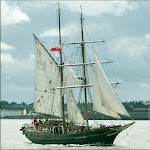
However, the good weather was only the backdrop for this positive day. I have just returned home from Cork, where I spent most of the day on board the Swedish sail training ship Gunilla, which arrived in Cork on Monday and will sail on to Spain on Sunday. Later, after a change of the trainee crew, the beautiful three-masted bark will sail across the Atlantic Ocean, heading for the northern coast of South America.

With 49 metres length the T/S Gunilla is Sweden's largest sail training vessel and a truly fine example of great ship design, initiative and proper seamanship. (for details of the vessel and its history, please see my entry from September 25th)

Like all other sail training ships, T/S Gunilla teaches young people to sail, to work in teams and to take responsibility for each other and for their vessel. But in contrast to other tall ships, this is not all the trainees learn. The Gunilla is home to a unique Swedish education model, which can best be translated as the 'sailing high school'. Besides all the sailing skills and comradeship at sea the students have also normal classes as they would have in any other school on land.

Having seen myself today how it works, and encountered 33 kind and enthusiastic students on board (among them many young women), I am impressed by the concept and convinced that it should be adopted by other training ships and vessels as well.
I also spent good time with the Master, his officers and teachers, and thus gained a good insight into the operation of the seagoing college.
What I found was a combination of professionalism and high quality, combined with a very humane and friendly attitude. All over the barque one meets people with bright eyes, great smiles and a relaxed but nevertheless orderly attitude.

Over the past 33 years I have been in many seagoing vessels, and among them a good number of tall ships. So I think that I have some experience and understanding of the matter and have to say that I rarely experienced such a happy ship - happy in every way - as the T/S Gunilla.

I would like to take this opportunity to thank Captain Frederik Göthberg and Chief Officer Knut Svanholm for their kind invitation and hospitality, and the other officers, crew members and trainees for their great openness, interest and friendly reception. They all have given me a good insight into the great work they do, and it truly made my day.

May the Gunilla and all that sail in her always have a save voyage with good wind, high spirits and educational as well as maritime success. And on a personal note I hope that one day we will be honoured to welcome her also to the port of Waterford.

The Emerald Islander

15 June 2008

Apathy is the main Enemy of Democracy

A well-known proverb states that "every country has the government it deserves". The deeper meaning is that if the people would want to have a different political system or government, they could demand it and see it through. Free nations - like the Irish and the people of most western countries - have in regular intervals the opportunity to vote and thus elect those who will govern them for the next few years. This is, compared with the situation in centuries past, an important development, a great step forward and one for which previous generations fought long and hard. Many of our ancestors paid their desire for freedom and human and political rights with their life.

It is therefore sad and disappointing when I meet people who have "no interest in politics" and who subsequently also not bother to vote in democratic elections and referenda. Many of them are not even aware how much this ignorance and apathy damages them and their future, as well as the future of us all.
Imagine you are playing Football or Cricket, and half of your team never turns up, or just stands idle on the field without taking any part in the game. You would be annoyed, of course, and you would most likely lose every match you attempt to play. Sooner or later you would get rid of the idle idiots and replace them with active people.

Unfortunately we don't have the same option when it comes to a country and its citizens. If only 50% participate in elections and other elements of the political and socio-economic process, we cannot expel the inactive rest from the country. Sometimes I wish we could. But a free society includes also the freedom to be idle, ignorant or lazy. Neither is a crime. If it were, at least a third of every country's population would be permanently in jail.

In some countries - for example Australia and Belgium - voting is compulsory and those who do not cast their vote in an election are fined severely. While the majority of countries do not go that far, there are valid arguments for compulsory voting, seeing it as one of the duties a citizen has to his country and community.

There are political systems where the active participation of individual citizens is not required and even discouraged. One finds this in countries ruled by a dictator or a military junta, but also in monarchies and aristocracies, and most drastically in theocracies.
A democracy, however, requires democrats, people who actively participate in the political and socio-economic process. Without them and their regular involvement a democracy is impossible.
Which means that most of the western countries that regard themselves as "democratic" are in fact no real democracies. The Greek word demos is often translated as "people", but it is in fact more precise and means "the common people".
What we have at present in most "democratic" countries is at best a representative democracy, usually with a parliamentary system or - like in France and the USA - a presidential republic, modeled closely on the example of the ancient Roman Republic.

They are dominated by an elite class of professional politicians, administrators and civil servants who have very little contact and very little in common with the "common people". The latter are asked to vote in regular intervals (usually every four or five years) for representatives of various political parties, but that is where their participation in the political process ends.

In ancient Athens, the cradle of true democracy, this was not the case. There every citizen was actively involved, attended the public meetings and debates, and then voted on the proposals put before the demos, the assembly of all (free male) citizens (which numbered about 10,000 in the ancient city state of Athens).
There are almost no examples of true democracy in existence today. The only modern state that comes close is Switzerland, where every law or major political decision has to be approved by the people in a referendum. The tiny republic of San Marino (entirely surrounded by Italy) is also governed in a truly democratic fashion. Among the representative democracies of the West the Republic of Ireland is the only state with regular referenda on changes to the Constitution and other major political matters. This makes Ireland more democratic than other countries, even though the system of government is parliamentary.

It is quite obvious that over the past century the parliaments of the western nations have been turned into exclusive clubs of the powerful. They have their own special rules and perks, which no-one else in the country enjoys. Subsequently the rift between those who govern and the vast majority of the governed has become wider and wider, to an extent that they speak almost different languages (even when using English), have totally different lives and live in completely different worlds. Members of Parliament (in Ireland called deputies or TDs) have become a new kind of aristocratic (in the original meaning of the word) elite, and most of the western countries are now more aristocratic (ruled by the "best") than democratic.

There is very little education in matters political provided to our children. Most schools stay out of any serious debate and try to please everyone equally without taking a position. Unless a child is lucky and born to politically active parents, there is no real provision for its preparation to become a good and proper citizen. In fact, the present education system is not geared to produce active and responsible citizens at all. It turns children into docile, ignorant and uncritical customers of goods and services, for whom consuming, spending money and "having fun" (whatever that really means) has priority over everything else.
The fact that more Irish people voted in May in the Eurovision song contest than in June in the referendum on the Lisbon Treaty speaks for itself.

Nevertheless, one has to acknowledge that the turnout for the referendum last Thursday was a lot higher that it has been in previous Irish referenda for more than a decade. People were very concerned and felt stronger than ever that "something needs to be done" to stop our politicians from selling out the country's remaining democratic rights (for which the Irish fought over 750 years, with many giving their lives for the cause).

But still almost half of those who have the right to vote decided to abstain. This is a general trend in recent decades, not only in Ireland, but throughout the whole western world. In the short term this might actually suit some politicians and parties, but long-term such a large proportion of non-participating people is a serious danger for our freedom and political system. In history Ireland was several times lost to invading forces, mainly because her leaders did not combine their strength for a proper defence. We see the same happening again in our modern times, with almost half of our population remaining (mostly voluntarily) outside the political process and thus weakening the nation.

Since the referendum result was announced on Friday afternoon, many politicians are wondering why they did not get their message across and why almost half of the Irish electorate registered a double NO by complete abstention.

The answers should not be too difficult to find, since they are clear to me and other analysts. The ever ongoing alienation between politicians and the people, including the massive pay-rise for the Taoiseach and his ministers Bertie Ahern introduced shortly after the last election, is certainly one. The arrogance of politicians who think they know everything better, and the idea that they can bully the population into submission with empty threats is a second.
It does also not help if a politician is completely ignorant. (The fact that Brian Cowen and Charlie McCreevy had to admit in public that they had not read the treaty which they advised people to vote for was certainly a contributing element to their defeat.)

The most important point, however, is the lack of political and social awareness in the general population. This can only be changed with proper education of young people, augmented with a series of independent information campaigns, aimed at the ignorant and apathetic parts of the adult population.
The National Forum on Europe, which has done a great job in the months before the referendum, would be the right body to provide information on and increase awareness of Europe and the EU institutions. On national matters a similar forum, comprising members of all parties as well as relevant groups and organisations, should be formed.

There is a solution for every problem, but the first step on the way to a solution is the recognition and clear identification of the problem. Let us hope that our politicians still have two eyes, two ears, a working brain and enough common sense to lead the country out of its lethargic attitude.

The Emerald Islander