Showing posts with label Catholic Church. Show all posts

28 May 2009

President backs Abuse Prosecutions

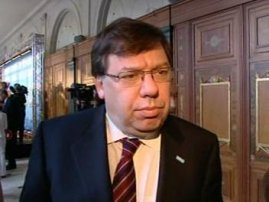
President Mary McAleese (photo) believes that people should face prosecutions as a result of the Ryan Report (see my entry of May 21st) into the systematic torture and child abuse by members of religious orders of the Catholic Church.

The President was speaking in Boston, on the final leg of her official visit to the US state of Massachusetts. There she has been meeting Irish-American communities and promoted Ireland's industry and tourism.

As the presidential good-will tour coincided with the publication of the Ryan Report here, a considerable amount of publicity in US media on the fall-out from the report overshadowed the visit. (With some careful planning, scheduling and co-ordination it would have been possible to avoid that.)

In an interview with RTÉ News the President said today that the report showed "a catalogue of criminal offences", and that "people who committed these awful crimes against innocent children should face prosecution".
Even though prosecution might not bring closure, it would bring Justice, she added.

Mary McAleese is to be saluted on this clear statement and on her straight and honest approach. She stands high above the Irish government, which is now trying to wriggle itself out of the mess it created, while it still tries to protect the Catholic Church from taking full responsibility for her horrible crimes.

The Emerald Islander

22 May 2009

It all began with Eamon de Valera

As the day sets and the weekend approaches, Ireland is still in deep shock over the revelations of the report on long-time organised child abuse in Catholic institutions. This 3000-page document is the result of more than ten years of investigation, was compiled by a State Commission chaired by Judge Seán Ryan and published in Dublin on Wednesday. (for details see yesterday's entry below)

Many people are very angry, others say they "just feel numb" as they never expected that such things could happen, and certainly not in 'Holy Ireland', where priests and religious were put on pedestals for centuries and worshipped almost as much as God and Jesus Christ.

Perhaps this over-reverend, sycophantic and almost slavish attitude towards people in cassocks and habits was one of the contributing factors to the terrible crimes Irish priests and religious committed against Irish children for more than five decades. Anyone who is treated by others like a demi-god may after a while begin to believe that he actually is a demi-god and behave accordingly. (And there are many examples for that in history.)

Or, as the famous Lord Acton wrote in the 19th century: Power corrupts, and absolute power corrupts absolutely.

The first 'industrial schools' for "neglected, orphaned and abandoned children" in Ireland were established by the British colonial administration in the second half of the 19th century under the Industrial Schools Act of 1868. (A similar Act of Parliament was passed already for England in 1857.) The Act was intended to "solve problems of juvenile delinquency, by removing poor and neglected children from their home environment to a boarding school". It allowed magistrates to send "disorderly children" to a residential 'industrial school'.
A further Act of 1876 led to the establishment of non-residential day schools of a similar kind.

It is however worth to point out that the number of children sent to these special schools was not very large in the early years of their existence. Then the size and purpose of Ireland's 'industrial schools' was significantly increased, at the same time that Fianna Fáil - which had until 1927 refused to sit in the Dáil (because they were required to swear an oath of allegiance) or take part in normal parliamentary business - gained power in Ireland for the first time in 1932.

The party's founder and first leader Eamon de Valera (photo) was not only a very pious and old-fashioned Catholic (in the Spanish tradition of his Cuban father) who contemplated at least for some time to become a priest himself, he was also a very strict and authoritarian man who demanded blind and uncritical loyalty from all his followers. (Although the present party leader - Taoiseach Brian Cowen - is the seventh man in charge of Fianna Fáil, the party's demand for blind loyalty, regardless of facts and common sense, is still the same as under de Valera.)

The year that saw Fianna Fáil taking control of the 'Irish Free State' was a time of great upheaval in Spain, where the conflict between different social and political groups would eventually lead to the Spanish Civil War (1936-1939).
De Valera had Spanish as well as Irish roots, and during the first years of the (second) Spanish Republic, which had been established in April 1931, he and many other traditional Catholics all over Europe were very upset by the reports they received from Spain.
Representatives and supporters of the left-wing republican movement turned their anger not only against aristocrats and land owners, but also against Catholic priests and religious, who were seen by many (and with good reason) as backbones of the conservative and reactionary system that had ruled Spain for centuries and ruined her economy. Some Catholic clerics were killed by mobs, others were put on trial in courts and sentenced to death or imprisonment. A number of churches and monasteries were closed or confiscated, and in general life was hard and dangerous for anyone openly supporting the Catholic Church in Spain at that time.

During the 1930s Ireland was still a very young State without a solid base, strong economy or developed infrastructure. And the scars of the Irish Civil War, which ended in 1923, were only too visible everywhere. Old comrades had stood on opposite sides in this short, stupid and totally unnecessary conflict which literally pitched brother against brother and divided families for ever. There was also still a very large and poverty-stricken underclass in Ireland at the time, and who could say if these people might not behave in similar fashion as the poor working classes in Spain, if they got a chance to revolt against the authorities of State and Church.

Parallel to the events in Spain, Benito Mussolini was celebrating ten years of Fascist rule in Italy, and in Germany Adolf Hitler had increased his support so much that it was only a question of time when he would be in power, too. (He got there on January 30th, 1933.)

Unfortunately there has never been any deeper historical research into the personal and political motives of Eamon de Valera and his closest advisers in these early years. I hope that someone will undertake this work and provide us with more insights at some stage.
But for the time being one can only speculate about de Valera's thoughts and feelings during the first few years he was back in charge of the country. (He had been already the head of state and head of government of the unilaterally declared Irish Republic from 1919 to 1922, but resigned over the Anglo-Irish Treaty and stormed out of the Dáil, followed by his supporters. This split led to the Irish Civil War, but even after hostilities had ceased, de Valera and his new political party Fianna Fáil - founded in 1926 - remained refuseniks until 1927, when they decided to join the democratic system of the State.)

It is quite possible and more than likely that between Eamon de Valera and the conservative Irish bishops a strategy was agreed to prevent any left-wing and anti-Catholic revolution in this country.
Every Catholic theologian is familiar with the famous words of Ignatius de Loyola (founder of the Jesuits), who said: "Give me a boy of seven, and I will give you the man."
And even though the Jesuits were never involved in the running of the 'industrial schools', their extensive use under the Fianna Fáil government of Eamon de Valera was most likely inspired by Jesuit thinking and teaching.

The idea of having special schools for the poor (and not just for 'juvenile deliquents'), run and controlled by the Church, would have been very appealing to an authoritarian and conservative Catholic like de Valera. In these schools "the lesser skilled children from the lower classes" could learn a trade that would give them a chance of employment, and they would also receive strict religious instructions and conservative indoctrination to keep them "on the right side of the track".

The same kind of thinking is also evident in the new Irish Constitution, which Eamon de Valera introduced in 1937, and in the new structure of Seanad Éireann, which was re-organised by him according to different social groups in society, and thus along the lines of Catholic social theory of the time. (see my entry of March 23rd)

Neither Eamon de Valera, nor his close friend and spiritual adviser John Charles McQuaid, CSSp (who was later Archbishop of Dublin from 1940 to 1972), were particularly mercantile-minded. So it is unlikely that they saw the huge potential for making massive profits with the 'industrial schools'.
This only dawned on the religious orders after running them for a while on the new enlarged scale, and they then tried to expand the size of their institutions even further and thus maximise their profits as well.

Whatever one might think of Eamon de Valera, he was not a child molester and would certainly never have imagined that the institutions he wanted to use to stabilise the social structure and system of the State would become places of organised child abuse by priests and religious.

But - like anyone else who has held political office in Ireland between the 1930s and the 1980s - Eamon de Valera carries a share of responsibility for the horrible crimes now revealed and documented. Not so much for increasing the use of the 'industrial schools', but more for the ignorance and disinterest he and his ministers displayed when they received complaints from the abuse victims, their parents and relatives, or even from some concerned civil servants of their own administration.
They simply did not care what happened to "brats from the lower classes". They could not even be bothered to have a good look at the institutions, to establish what conditions they - and their inmates - were in.

In the same era that saw Ireland's 'industrial schools' enlarged, the ordinary and 'law-abiding' people of Germany did and said nothing when they saw their Jewish neighbours rounded up by Police and SS. Jews were marched to the local railway station, put on a train and disappeared, never to be heard of again.
Research has established that most Germans did not know in detail what was actually done to them. But they all knew that their former neighbours were not going away on holidays, and not moving house in the normal way (as they were only allowed hand luggage and all their furniture and major possessions were left behind). Some may have guessed, others imagined the truth, as there was of course a massive Nazi propaganda campaign against Jews for many years. But even those who did not think much about Jews knew that they were forced to go, and that they would not come back. This did not bother them in any way, but it made them co-responsible for crimes against humanity.

The same attitude existed in Ireland, where everyone knew at least some of the sinister Catholic institutions, and knew that there was 'something wrong' with them. But no-one cared, bothered to have a closer look, or asked questions.
Which means that as a nation we are collectively guilty as well. People over the age of forty who lived in Ireland during those decades should ask themselves how much they knew, and what they might have been able to do, if they had been more courageous. All those who were in any kind of authority in Ireland participated and collaborated with the system of collective cruelty and neglect. They must now bear their share of responsibility for the horrible crimes Catholic perverts committed against three generations of our children.

Had Fianna Fáil not joined the democratic system in 1927 and not won the general elections of 1932, would we have had such a large network of 'industrial schools' in Ireland, with so many thousands of children in them for half a century? Probably - or most likely - not.

And without the bleak institutions, we might not have had the widespread subculture of violence, sadism and child abuse. But then again, there was more than enough violence against children in normal day schools as well, and the brothers and sisters abused children also in orphanages, homes for the handicapped and all kinds of schools.

In my opinion the roots of the endemic physical and sexual abuse of children grew within the Catholic Church. The unnatural way of life that is forced upon priests and religious pushes many of them over the edge of normal behaviour.
Especially the demand of celibacy (for secular priests) and chastidy (for all religious) is a major problem and causes all kinds of frictions and conflicts of interest. As sexuality is one of the most natural things for any living creature, it makes neither sense to ban people from it, nor does it actually work. (For example, many Catholic priests in Brazil, the Philippines and other parts of the co-called 'Third World' have unofficial wives and children. This is no secret, and they live openly in their parishes as happy family men. The Vatican knows it as well and does officially not approve of it. But since the Church has increasing difficulties finding enough celebate priests, the Catholic hierarchy is closing their eyes on this matter, pretending not to know. It is the same attitude that made them ignore the crimes against Irish children for decades.)

The demand of celebacy has also led to an over-proportional amount of homosexual men being attracted into the Catholic priesthood. And as soon as they find out that their sexual orientation is shared by other priests or brothers, Nature does the rest. There are widespread homosexual networks within the Catholic priesthood, and there were even a number of seminaries in Ireland where the percentage of practising homosexuals - students as well as teachers - was between 80% and 90%. Some were quite discreet, while others made no secret of it and could be seen walking around Irish towns holding hands, or sitting in pubs, drinking and kissing.

Over the past ten years much of this 'camp' behaviour has disappeared from the 'public radar' and gone back underground, where it has existed for centuries.
And although Pope Benedict XVI has meanwhile issued a brave decree, stating that he will no longer tolerate practising homosexuals in the priesthood, I have not heard of any resignations or sackings of priests. At least all of the homosexual Irish clerics I happen to know personally are still here, and still Catholic priests.

If the Catholic Church wants to survive as a world-wide institution, the rule of celebacy will have to go sooner or later. And as it is not one of the divine (or Biblical) laws, but a man-made rule introduced only in the 12th century, it should not cause any theological problem to remove it again. All it needs is the right Pope, and it will disappear over night.

As long as the Catholic Church demands an unnatural lifestyle from her priests and religious, there will be cases of sexual misbehaviour, paedophilia and child abuse among the clergy. And there have been known cases in almost every country in the world where there are Catholics.

What makes the Irish situation so different - and in fact unique - is the dimension. There is no other country - large or small - that has seen such an organised and systematic reign of terror with cruelty and child abuse, perpetrated by Catholic priests and religious, over more than half a century.

The reason is that since the 1930s Ireland's 'industrial schools' provided a unique environment for sadism, exploitation and child abuse on a colossal scale, which did not exist elsewhere. The bleak and deliberately unfriendly conditions of the institutions created plenty of tensions and distress, among the staff as well as among the children sent there.
Who on Earth would be happy living and working in hell holes with no culture and no decency?

Studies into the structure of the US Army have established that soldiers and officers posted for lengthy periods to bleak, inhospitable or boring stations often develop behavioural symptoms they did not show while serving in other commands. These symptoms include the development of strange hobbies, serious alcoholism, increased brutality, sadistic behaviour (towards animals as well as people) and sexual perversions.

It can be concluded that the same conditions applied to Catholic religious did produce the same behavioural symptoms in them as they have done in US military personnel.
So even though sexual misbehaviour is not unusual within the Catholic clergy world-wide, what happened in Ireland was a direct result of the unique environment of 'industrial schools' and other bleak institutions, enlarged to truly industrial dimensions by Eamon de Valera in order to subdue potential revolutionaries from the 'lower classes'.

Over the coming decades historians and psychologists will certainly look more closely at all the available documents, facts and details of this period. They will surely provide more answers than I can give here to the questions that are on almost everyone's mind in Ireland today: Why did this happen? And how could it happen for so long and on such a massive scale?

The Emerald Islander

21 May 2009

Saying "Sorry" is not enough

Yesterday the Irish government published a special report that is unique in the history of the State. It shows and documents - down to every detail - that for most of the 20th century Ireland was a cruel and inhumane country where thousands of innocent people, most of them young children, were victims of lengthy and systematic abuse of various kinds.
They were subjected to mental and physical cruelty on a regular basis, combined with severe beatings, deliberate malnutrition, constant exploitation, deprivation of all human and civic rights, and in many cases (mostly boys) also to sexual abuse.

If one would read this report without knowing beforehand what it is about, one would come to the conclusion that it must be a description of conditions in Soviet Gulag camps of the Stalin era, or of German concentration camps during World War II. But no, this is the long-awaited report of the Commission to Inquire into Child Abuse in Ireland!

After ten long years of painstaking inquiries, investigations, hearings and interviews, presided over first by Judge Mary Laffoy (left), who resigned after five years in protest over the lack of co-operation by the Department of Education, and then by Judge Seán Ryan (above right), the commission has compiled and presented a document of historic dimensions which should become part of the Irish educational curriculum in the same way as the detailed knowledge of Nazi concentration camps is taught in ever school in Germany since 1949.

In its printed form the full report of the Commission to Inquire into Child Abuse covers more than 3000 pages and fills five large bound volumes (photo left). But it is also available on-line. To access it, go to: http://www.childabusecommission.com/rpt/

There will be very few people with enough time to read the report in its entirety, but I would urge anyone who has even the slightest interest in Ireland to have at least a good look at it.

Having read parts of it myself for several hours already, I should however warn you. This is not a text to peruse at ease or leisure. It is serious historic material, comprising the tragic life stories of thousands of unfortunate Irish children who were absorbed systematically into the money-making machine of the Catholic Church and its various religious orders and institutions.
There they were used as slave labour, dressed in shabby and filthy clothes, and fed barely more than scraps, which means they were always hungry and undernourished. This alone is a crime, a scandal and a serious breach of human rights.

But the harsh conditions under which the poor children in Ireland's Catholic orphanages and so-called 'industrial schools' were forced to live and work were - as strange as this might sound - only the background for the really serious abuse that took place there every day.

The children were beaten regularly and severely, and usually without any reason. There was also widespread sexual abuse, predominantly in the institutions for boys, where most of the staff members were sadistic and paedophile homosexual perverts.
The report states that "sexual abuse was endemic in boys' institutions and a chronic problem in some residential institutions". It also points out that the Church authorities, as well as elements in the State administration, were "fully aware" of this, but did absolutely nothing about it.

In fact, it appears that being cruel, sadistic and a paedophile homosexual pervert were almost pre-requisites for becoming an Irish 'Christian Brother', or at least to have a successful career in the congregation. And a large portion of the Irish nuns were not much better, although most of them preferred torture and sadistic physical abuse of the girls in their care to actual sexual acts.

But there was also some sexual abuse by nuns, in particular in Cappoquin, Co. Waterford, where - according to the report - a senior nun "was drinking heavily in front of the children and in the pubs in town, was often drunk, and had a long-time lesbian relationship with her superior".
The same nun is described in the report as "completely incompetent in her job", but when she eventually left the 'Sisters of Mercy', she was given a very positive reference that helped her to get another job - working again with children - outside the order.

The commission received thousands of complaints of emotional, physical and sexual trauma, inflicted on children by Catholic priests, brothers and nuns over decades. And even though these horrific crimes against humanity are now out in the open, it is assumed that still not all of the victims of Catholic cruelty and child abuse have reported to the authorities or made claims to the commission. The reason is that a certain percentage of victims is now deceased, while others are "still too frightened to come forward".

Even those who did lodge complaints and made official statements are still suffering from their traumatic experience. And the way they were treated during the lengthy investigation added more stress, anxiety and mental distress, as representatives of the accused orders and their (usually very expensive) lawyers cross-examined the victims and often suggested that they were lying or making up stories, in the hope to receive financial compensation.

Such allegations have been vehemently denied and condemned by the victims, all of whom say that "this is not about money, this is about Justice".

More than 100 institutions all over Ireand, mostly run by religious orders, including 'industrial schools', institutions for children with disabilities and ordinary day schools, were examined by the commission, which was chaired for the first five years by Judge Mary Laffoy and for the second five years by Judge Seán Ryan.

The report states that physical punishment in the infamous 'industrial school' at Artane in Dublin was "excessive" and "children constantly felt under threat and were fearful".

Cruel physical punishment was also the daily norm in the 'industrial school' at Letterfrack in Co. Galway. According to the report, Letterfrack was "an inhospitable, bleak and isolated institution in which physical punishment was severe, excessive and pervasive". The report states that "for two thirds of the period under investigation there was at least one sexual abuser present in the institution".
Two abusers were present there for 14 years, and the congregation offered no explanation of how they remained there undetected and unreported for so long.

The report also describes how at St. Joseph's 'Industrial School' in Tralee, Co. Kerry, "a brother terrorised children for more than seven years after being moved there from a day school where his violence towards children was causing serious problems with parents".

The report says that the 'Christian Brothers' congregation "was defensive in the way it responded to complaints and claims" and that "the order fails to accept any congregational responsibility for such abuse".

More allegations were made against the 'Christian Brothers' than against all of the other male orders combined, and the report states that "the safety of children was not a priority for the 'Christian Brothers' who ran the institutions".

In a written statement the current leadership of the 'Christian Brothers' says: "We apologise openly and unreservedly to all those who have been hurt either directly or indirectly as a result of the deplorable actions of some Brothers, or by the inaction or inappropriate action of the Congregation as a whole. We are sorry for the hurt caused. We are ashamed and saddened that many who complained of abuse were not listened to. We acknowledge that our responses to physical and sexual abuse failed to consider the long term psychological effects on children."

But that is it. Just words, not backed by any visible deeds of atonement or reparation. In fact, the 'Christian Brothers' have been fighting the many allegations made against them tooth and nail, and with the help of very senior (and thus very expensive) lawyers. Many of their victims (who are by now middle-aged or even elderly) stated on several RTÉ radio programmes that until very recently members of the current leadership of the 'Christian Brothers', in particular Br. Garvey and Br. Mullen, openly and aggressively disputed their allegations, calling them liars and suggesting that they were only after compensation money.
Many of the victims have also said that the verbal apology the 'Christian Brothers' have now issued is "insincere" and consists only of "lukewarm words in the face of hard facts".

As Waterford is the city where the 'Christian Brothers' were originally founded by Edmund Ignatius Rice (right) 200 years ago*, there is a specific interest in this matter here.
I have been down-town for meetings yesterday evening and earlier today, and I have never seen so many people so angry. The outrage over the decades of systematic child abuse in Ireland, organised and perpetrated by the Catholic Church, is even stronger than the widespread anger against our current government.

It appears that those who were in charge of the more than a hundred institutions that were supposed to look after Ireland's most unfortunate children - predominantly 'Christian Brothers' and nuns from several orders, but mostly 'Sisters of Mercy' - had no qualifications at all in childcare and social work.
Instead most of them were masters of sadism, brutality, cruelty and child abuse. They were supposed to have dedicated their lives "to follow Christ" and to humble service in the Catholic Church, but in fact they were nothing more than cruel concentration camp guards, wielding enormous powers over large amounts of vulnerable and defenceless children, for whom - as the report states clearly - no-one in Ireland cared at all. Not the Church, in whose care they were; and not the State, whose officials, courts and institutions put them there, to be exploited, abused and forgotten.

Yes, as much as the main guilt lies firmly with the Catholic Church and her various orders, congregations and institutions, the Irish State, successive governments (lead by both Fianna Fáil and Fine Gael) and a long string of civil servants, local officials, judges, social workers and gardai (Irish policemen) were willing collaborators and must therefore share a portion of the heavy responsibility.

When Ireland won her freedom from Britain - first in a limited form in 1922, and then as a fully sovereign republic in 1949 - the idea was to establish a truly independent state with freedom, fairness and justice. I cannot find any reference to Gulags and concentration camps for children in any of the writings and speeches of Irish politicians of the time. Nor do I find such references in the official teachings and documents of the Catholic Church.
But, as Judge Ryan and his commission have now established beyond any doubt, this is exactly what the Church - with the help, support and collusion of Irish politicians and civil servants - established: Horrific concentration camps for Irish children.

And like the German concentration camps under the Nazi regime, their main purpose was to employ slave labour and create large profits for those who controlled and ran them (in Germany the SS, in Ireland various religious orders). A similar attitude, though less greedy, was also the base idea of the Stalinist Gulags in Soviet Russia.

It is important to point out that the Church did not - and could not - just round up children and put them into their slave camps. For the recruitment of their slaves they needed the help of the State, which was willingly and happily given. In particular the poor Irish underclass was targeted systematically.
Children who had problems (or 'learning difficulties', as we now call them) in regular schools were sent to the 'special' schools, which were also the destination for all orphans and children of single parents. There they were mixed with juvenile delinquents and young petty criminals, mentally and physically handicapped children, and also those who were deemed to be 'unruly' by someone with authority. This could be a teacher, a priest, a garda or even an unfit parent, wanting to get rid of a child.

The Irish Gulag institutions received generous 'head money' from the State for taking them in, and after the system was established and had produced handsome profits for religious orders, they literally cried out for more and more children. In general the Irish State, its government and civil service obliged and sent ever more unfortunate innocents into the hell holes of the Catholic Church.

Only very few ever tried to swim against the tide, and they were not popular for doing so. One particular Judge, who refused to send children en masse to the Catholic 'industrial schools', was black-marked by the then (Fianna Fáil) Minister of Justice, who even tried to get him removed, using a secret internal committee of civil servants for his conspiracy.

It is also worth to remember that this network of organised crime was not entirely in the hands of the Catholic Church. They had helpers in many areas and on many levels, including one that might be least suspected for such crimes.
The Irish Society for the Prevention of Cruelty to Children (ISPCC), formerly known as the NSPCC (National Society for the Prevention of Cruelty to Children), was a very active and keen supplier of fresh victims to the Catholic concentration camps. The society employed self-appointed 'inspectors', commonly known as 'cruelty men', who walked around the poor and deprived districts and housing estates, always on the lookout for 'neglected children'. They snooped around, interfered with existing families and intimidated vulnerable people on a regular basis. And whenever they found another 'neglected child', the poor innocent victim was rounded up by them and delivered to the nearest Catholic Gulag.

The commission report strongly criticises the Department of Education for its handling of complaints about residential institutions, citing that "the Department of Education generally dismissed or ignored complaints of child sexual abuse and dealt inadequately with them".

Batt O'Keeffe (left), the current Minister for Education, has stated yesterday that the government would "carefully study the findings and recommendations in the report". Well, one would hope so, as this is the least the ministers can do.
O'Keeffe also "extended his sympathy" to those who were subjected to abuse while residents in 'industrial schools'.
But once again, all the victims receive are words. What they want to see are deeds and Justice. But there is little hope for that, and certainly not under a deeply corrupt and incompetent Fianna Fáil government that has not only neglected the abuse victims, but meanwhile wrecked the whole country.

Like many of his predecessors, Batt O'Keeffe is closing his eyes and mind, hoping the matter will soon be forgotten. This is the way Fianna Fáil has always ruled Ireland, in tandem with the Catholic Church. They both love ignorant and gullible people, who can be used and abused at their pleasure. And they are both quite happy to do so.

But this matter will not be forgotten. The anger of thousands of Irish people will not disappear because ministers and bishops want it so.

Judge Ryan and his commission recommend that a memorial should be erected, inscribed with the words the former Taoiseach Bertie Ahern used in 1999, when he issued a formal apology to the victims of abuse and established the Commission to Inquire into Child Abuse.

In the past 24 hours, since the report was presented to the media in a Dublin hotel, many voices have been heard all around Ireland. And they all expressed "shock" or "sadness", others voiced "outrage", "anger" and "fury".

Ireland's President Mary McAleese (right) expressed deep sadness at the findings of the Commission to Inquire into Child Abuse.
Welcoming the publication of the report and its comprehensive nature, the President said: "It is shocking and shameful that so many children had to endure such appalling suffering and abuse in institutions whose obligation and vocation it was to provide them with safe and loving care. It was an atrocious betrayal of love, and my heart goes out to the victims of this terrible injustice, an injustice compounded by the fact that they had to suffer in silence for so long."

Cardinal Seán Brady (left), the Archbishop of Armagh (and head of the Catholic Church in Ireland) also gave a public statement.
He welcomed the report and said that "it documents a shameful catalogue of cruelty: neglect, physical, sexual and emotional abuse, perpetrated against children".
"I am profoundly sorry and deeply ashamed that children suffered in such awful ways in these institutions," Brady said. "Children deserved better and especially from those caring for them in the name of Jesus Christ."

Well spoken. And I do acknowledge that Seán Brady is one of the few men in the Catholic hierarchy in Ireland who can be trusted and has no shady past. (During most of the time the horrible crimes against children were committed in Ireland, Brady was in Rome, where his last position was that of Rector of the Irish College.)

But with all respect to the Cardinal, saying "Sorry" is not enough. What the thousands of victims demand, deserve and should receive is fairness and Justice. However - due to the selfish interests of the Catholic Church - there is little chance for that.
In 2002 the Church and her exposed criminal orders and congregations agreed a 'settlement' with the State which let them almost completely off the hook. Under this deal the contribution of the religious orders to the government's official 'Redress Scheme' was capped at € 127 million (equivalent to Ir£ 100 million in old money), but it is estimated that the State will end up paying at least ten times that amount.
And there is a further problem: Of the € 127 million the orders are willing to pay, only € 40 million are in cash (and some of that has yet to be collected). The rest is the value of certain buildings, owned by religious orders, which should be handed over to the State in lieu of money.
However, many of these buildings are already used by the state (mostly for educational and medical purposes), while approximately 20% of the buildings are meanwhile of almost no value at all.

The 'genius' who negotiated this one-sided deal with the religious orders was the senior Fianna Fáil politician Michael Woods (left), who signed the agreement in June 2002, only hours before he left his post as Minister for Education.**

Some may think that this is quite acceptable, since the Irish State, several governments and numerous civil servants have colluded with the Church and are thus as guilty of the crimes as the actual perpetrators. But I disagree, and many people in Ireland do the same.

The Catholic Church as a whole has immense wealth and ranks among the riches organisations in the world. And the religious orders are quite wealthy, too. Thus they could well afford to be more generous, without going broke. But since the majority of Irish politicians, especially those from Fianna Fáil and Fine Gael, are still in hock to the Catholic Church, a change of policy is rather unlikely.

The travesty of Irish investigations and 'Justice' goes even further. Under the strict remit of the commission, the report does not identify any 'respondents' (which is a nice legal word for criminals and perpetrators) and gives pseudonyms to those who were found guilty in a criminal trial. Thus the 'good names' of the Catholic gangsters, rapists, torturers, child abusers and concentration camp guards are protected by the Republic of Ireland and its incompetent, corrupt and immoral government, while thousands of victims are out there, all over the country, traumatised, frightened, upset - and still ignored by those who pretend to care for them.

The victims of the horrific and systemic abuse are not looking for money, and certainly not for any more meaningless words, uttered by people who were not personally involved, but who are now in charge of organisations that were. The demand of the victims is for Justice.

But that is the one thing that seems not to be on offer. Neither the Catholic Church nor the Irish government are interested in Justice, knowing only too well how deeply they are both stuck in the mud of guilt, and how much they were part of the conspiracy and cover-up for decades.
No, there will be no Justice for the victims, only empty words from pompous and incompetent leaders who are incapable to face and accept the facts and make a fresh start when it is needed.

There were plenty of Nazis in Germany before Hitler, and even more after his death. And there were plenty of cruel and sadistic Catholics in Ireland before the first 'industrial school' opened. Plenty of them are still here, many years after the last institution has closed. This seems to be the rule of the world, that evil always triumphs, no matter where it raises its ugly head.

It was the Irishman Edmund Burke (right) - the greatest philosopher this nation has ever produced - who said that "Evil exists because good people do nothing".

And this puts it right to the point.


There were plenty of these sinister Catholic institutions in Ireland, and everyone knew them or knew enough about them. Ordinary people on the outside might well not have known in detail what was really going on inside, and they might not have imagined the beatings and torture, rape and sexual abuse. But everyone knew that there was 'something wrong' with them. Parents mentioned them to scare their own children and bring them to discipline, and enough civil servants and gardai knew the whole truth.
But none of these 'good Catholics' and 'upright Irish citizens' did anything to help the suffering children or said a single word.

Shame on them all! May their souls rot in Hell, where they belong!

Personally I cannot understand how anyone on this island can still be a practising Catholic. You don't have to give up your beliefs, and there is nothing wrong with being a Christian. But every time you go to Mass in a Catholic Church, and every time you make a donation to this Church, you should be aware that you are actively supporting a deeply rotten, immoral and criminal organisation.

If I had the power to do it, I would ban the Catholic Church from Ireland, close down all her institutions and confiscate all her money and property here. (You would be surprised how much that actually is...)
But I am a realist and fully aware that this will never happen, especially since it was done before (by King Henry VIII of England), even though for entirely different reasons.

However, what could and should be done is a serious approach of the responsibility question. Any person found guilty of crimes, especially crimes against defenceless and vulnerable children, should be identified and named in the report. (Using pseudonyms to protect serial child abusers is the most absurd and inappropriate idea I have ever heard of or seen in this regard.) The naming should include both living and deceased perpetrators.

All accused who have not had a trial yet should be brought before an Irish Judge to face Justice in due course, regardless of their age and status.*** This process should not be limited to priests and religious. Anyone who was in one way or another involved in the establishment, running, maintenance or support of the Irish concentration camps for children should be investigated and tried in a court of law.
It is the only way to achieve closure of this very dark and shameful chapter of modern Irish history. If we fail to do that, many generations of Irish people will live with a shadow of guilt and injustice.

Religious orders and congregations that were found responsible for crimes against innocent children should be closed down by the State, banned from working in Ireland, and their entire funds and property should be confiscated and used for compensation payments to abuse victims.
Canada did exactly that a few years ago to great effect. When the authorities discovered what the 'Christian Brothers' - yes, the very same Irish congregation from Waterford that did so much harm to many of our own boys - were doing in the eastern province of Newfoundland, they reacted quickly and decisively. All identified victims of the brothers were fully - and speedily - compensated by the Canadian government, which took good care of its vulnerable citizens. Then the Canadian authorities - in the capital Ottawa as well as in the province of Newfoundland - turned to the 'Christian Brothers' and sued them for every penny of compensation. Eventually the Newfoundland branch of the congregation was forced to declare bankruptcy, the brothers were banned from ever working in Canada again, and all those who were not Canadian citizens were deported (most of them back to Ireland).****

All schools owned or controlled by the religious orders (even though most of them are now run on a day-to-day basis by lay people who are employees of the school) should now be taken over immediately by the State. (There are still more than 100 'Christian Brothers' schools for boys in Ireland - just look for the letters CBS in school lists - despite all that has happened there and in other institutions run by the brothers.)

And furthermore, all religions and beliefs should be removed from the curricula. There should be the same standard of education for every pupil in the country, based on a national curriculum, set and controlled by the Department of Education. No religious, regardless if Catholic or of any other belief system, should be allowed to teach in a state school. (If children or - more likely - their parents want a religious indoctrination to take place, this can happen at other times and outside the schools, in churches, chapels, temples, mosques or even in private houses.)

Freedom of Religion, as guaranteed by our Constitution, means exactly that: Freedom to believe in whatever one wants to believe, freedom to worship in whatever form one might chose, and freedom to attend religious gatherings, ceremonies and services one feels attracted to.
Freedom of Religion does not give anyone - or any religion - the right to dominate, indoctrinate or intimidate Irish people, and in particular not children. So we should keep this in mind and act accordingly.

If we care for the Irish nation, and especially for our children, then we should prevent criminal organisations like the religious orders of the Catholic Church from having any power or influence in future. Letting them plod and meddle on as if nothing has happened in the past would be the same as allowing the Nazis to carry on as a political party in Germany after 1945.

This is a decisive moment in modern Irish history, and we all should make sure that we learn the lessons from the tragedies and inexcusable crimes of the past.
If we fail to do that, we deny the thousands of victims the Justice they deserve. We also allow the horrible crimes of the Catholic Church and her orders and institutions - allowed, assisted and tolerated by the Irish State and several governments - to be pushed under a carpet of artificial silence. And that could easily lead to a repetition of history, sooner or later, as it has happened in other countries that chose to ignore their past and to deny Justice to those who deserved it.

The Irish nation stands at a cross-road today, and whatever path we chose from here, we will have to live with the consequences for a long time.
For me it is clear that saying "Sorry" and moving on is not good enough. I sincerely hope that the majority of my compatriots will see it the same way and not allow politicians, judges, lawyers, bishops, religious and criminals to get away with their attempt of pulling a blanket of silence over the worst crimes ever committed against Irish people.

As we are currently in an election campaign, politicians will appear on our doorsteps, canvassing and asking for our votes and support. I will ask them what they will do about the now officially documented crimes against several generations of our children, and depending on their answers I will vote.
I hope you will all do the same, in the interest of our children, our collective conscience and our national decency. If we fail to do it, being Irish will in future be seen by the rest of the world in the same way as being a Nazi, a Stalinist thug or a Khmer Rouge.

A thousand years ago we were known as the 'island of saints and scholars'. We are now in danger of being seen as the 'island of Catholic Gulags and organised child abuse'.
Only a radical public outcry and a demand for unlimited openness and Justice for the victims can restore our national decency. We can never undo what was done to Irish children over decades, but we can stand up, atone for our collective silence and ignorance, demand Justice for the victims and punish those who committed the crimes. Let us join forces as a nation and do it!

The Emerald Islander


* Rice, a wealthy merchant in Waterford City, became increasingly religious during the last years of the 18th century, after his wife Mary had died in an accident. In 1802 he opened a makeshift (Catholic) school for poor children in a converted barn in the inner city. By doing so, he was breaking the (British) law that forbade all Catholic education in Ireland. But by using his status and influence, Rice got away with it and his school grew fast. In 1808 he and six other men who had supported him over the years as teachers, took religious vows and formed a small new congregation. It was the first ever order of Catholic male religious founded in Ireland.
Originally they called themselves the 'Presentation Brothers' (inspired by the already existing female order of 'Presentation Sisters'). The congregation split during the 1820s into two independent organisations. One kept the original name, while the other, of which Rice was the head, called itself from then on 'Christian Brothers'. (Both congregations still exist as separate - but co-operating - organisations today. But as there have been almost no vocations in Ireland for years, the brothers - as most religious orders - are now depending on new vocations from the so-called 'Third World'.)

** This practice of rushing things through before ministers change office is a hallmark of Fianna Fáil politics on the hoof. Five years later, in June 2007, the same happened again when Fianna Fáil minister Dick Roche signed the final building orders for the very controversial M 3 motorway across Co. Meath - which destroys parts of the historical sites around the ancient Hill of Tara - only an hour before handing over the Department of the Environment, Heritage and Local Government to his successor, the Green Party leader John Gormley (who would most likely not have signed these orders).

*** Only a few days ago John (Ivan) Demjanjuk, an 89-year-old man in a wheelchair, was extradited from the USA to Germany to face trial in one of the last ever Nazi concentration camp cases. Demjanjuk, who is not even German but Ukrainian by birth and now an American cirizen, denies the allegation that in his youth he was 'Ivan the Terrible', a feared and exceptionally cruel guard at the Nazi concentration camp Treblinka.
He is only the latest (and probably the last) in a long line of old and middle-aged men who were investigated, persued and brought to trial over their past involvement with the Nazis, the SS and their concentration camps. Thousands were tried, most of them were found guilty and sent to prison, while others went free on proven innocence or due to lack of evidence. But there was a clear and fair process, and Justice - as difficult as it was to achieve - was done.
The same procedure should be applied to all those accused of sexual abuse and other crimes against children in Ireland. It should not matter if they are priests, brothers, nuns or lay people; if they are old and retired or still active today. Justice has to mean the same for everyone, regardless of age and status.

**** Unfortunately for the Canadian government the 'Christian Brothers' in Newfoundland's capital St. John's were clever bastards and really skilled criminals. Before government departments could bring the full force of the Law into motion against them, they had moved a lot of their money out of Canada and into off-shore bank accounts in the Bahamas and the Cayman Islands.
If Jesus - the one they pretend to follow - would be here today, he would drive them out of the Church with a whip, just as he drove the money lenders and greedy people out of the Temple in Jerusalem. And if Edmund Ignatius Rice would still be around, he would probably close down his own congregation in shame. At least he would throw the rotten apples out of his barrel.
But since he is long dead, he must be rotating in his large sarcophagus, which is on public display in a specially built chapel at Mount Sion in Waterford, where the wealth and spleandour of the 'Christian Brothers' is visible for everyone who visits the place.

23 November 2008

Vatican forgives Lennon and praises The Beatles

The Vatican has finally forgiven John Lennon for declaring that 'The Beatles' were "more famous than Jesus Christ". 42 years after the iconic leader of the world-famous Liverpool music group made the unguarded remark in an interview with a British newspaper, the Vatican and his music-loving ruler Pope Benedict XVI have decided to be no longer officially offended by it.

Yesterday's edition of the Vatican's official newspaper L'Osservatore Romano carried an unusual article. On the feast day of St. Cecilia, the patron saint of music and musicians, a papal journalist was writing about 'The Beatles' and in particular their famous 'White Album', which was released 40 years ago.

In the paper's cultural section a large illustrated article, which covers half a page, deals with the subject in great length and detail.
The author commends 'The Beatles' for "their unique and strange alchemy of sounds and words".

"The talent of John Lennon and the other Beatles gave us some of the best pages in modern pop music," the article states.
Only "snobs" would dismiss the Beatles' songs, which had shown "great musical skill and inspiration".

After heaping more praise on 'The Beatles', in a way never before heard or read from an official source of the Vatican, the article concludes that "the fact remains that now, 38 years after breaking up, the songs of the Lennon-McCartney brand have shown an extraordinary resistance to the passage of time, becoming a source of inspiration for more than one generation of pop musicians."

The now 40-year-old 'White Album' the Vatican author calls "a masterpiece" and remarks that it is "a musical utopia where you will find everything, and the opposite of everything".

He then proceeds even further into new cultural territory and absolves John Lennon of his notorious remark, saying that "after so many years it sounds merely like the boasting of an English working-class lad struggling to cope with unexpected success".

It was back in March 1966 that John Lennon (left) made his famous - for some infamous - statement in an interview with the London Evening Standard.

"Christianity will go," he told a reporter. "It will vanish and shrink. We [The Beatles] are more popular than Jesus now - I don't know which will go first, rock and roll or Christianity. Jesus was alright, but his disciples were thick and ordinary. It's them twisting it that ruins it for me."

The boast provoked widespread outrage, particularly in the United States, where conservative 'Christians' burned piles of 'Beatles' albums in public. The band received death threats and many radio stations, particularly in the Southern states, stopped playing 'Beatles' records altogether.

More than a decade later John Lennon said that he was glad of the furore he had caused.
"My life with 'The Beatles' had become a trap," he wrote in 1978.
"I always remember to thank Jesus for the end of my touring days. If I hadn't said that 'The Beatles' were 'bigger than Jesus' and upset the very Christian Ku Klux Klan, well, Lord, I might still be up there with all the other performing fleas! God bless America. Thank you, Jesus!"

Two years later Lennon was murdered by a fanatic in New York.

For all the years after John Lennon's statement - and after his untimely death - the Vatican had kept silent and ignored the matter completely. So it comes as quite a surprise that the Holy See is now giving him, 'The Beatles' and their still popular music so much space and attention in its official newspaper.

We do of course not know the specific reason for this change of attitude, but it is well known that Pope Benedict XVI is a great music enthusiast, as well as an accomplished musician himself. (The first time I ever met him - then a young theology professor called Joseph Ratzinger who visited my grandfather - he played a few very nice pieces on the piano for us. I was only five years old then, but I still remember it well.)

Although the Pope has a personal preference for Mozart and Beethoven, it is quite possible that he does listen to 'The Beatles' as well from time to time. And despite the still prevalent opinion that he is a very conservative man, many of the decisions he made since his election have been quite progressive and surprised many observers.

About a year ago he appointed the Roman historian, writer and journalist Prof. Giovanni Maria Vian as new editor-in-chief of L'Osservatore Romano, and ever since the Vatican newspaper has become a lot more open and readable for people outside the Catholic hierarchy. Under Prof. Vian's editorship one can - beside the usual and official articles on theology and church matters - now find a lot of secular subjects covered as well, for example popular culture events such as the 'Oscars' and - yesterday - 'The Beatles'.

From time to time Prof. Vian is now also inviting articles from Muslim and Jewish contributors and has certainly widened the scope of his newspaper immensely. However, this would not be possible without the backing of his publisher - the Pope.

It appears that Pope Benedict XVI (right), who began his theological career as a progressive and was actively involved in the discussions of the Second Vatican Council, is returning to his personal and also ideological roots and now shedding gradually the strict conservatism he acquired during his time as theology professor in Regensburg (Ratisbon) and later as the chief ideologist and enforcer of church discipline under the very conservative Pope John Paul II.

In contrast to his predecessor, who came from the strict and rigidly conservative background of the Catholic Church in Poland, Joseph Ratzinger - Pope Benedict XVI - is a product of Upper Bavaria and its rather liberal and uncomplicated tradition of Catholic Baroque.
This becomes ever more obvious the longer his papacy lasts, and now even John Lennon and 'The Beatles' are receiving the benefit of his open mind.

The Emerald Islander

10 October 2008

The last of the aristocratic Popes

50 years ago - on October 9th, 1958 - Pope Pius XII died at the papal summer residence Castel Gandolfo aged 82. With his death an era in the history of the papacy and the Catholic Church ended, and he is rightly seen as the last of the 'traditional' Popes.

Born in Rome on March 2nd, 1876 as Eugenio Maria Giuseppe Giovanni Pacelli, he came from a wealthy aristocratic family with very close ties to the Vatican.
Marcantonio Pacelli, his grandfather, was Under-Secretary in the Ministry of Finances and then the Papal Secretary of the Interior under Pope Pius IX from 1851 to 1870.
He also was the founder of L'Osservatore Romano, the Vatican's newspaper, in 1861.
Eugenio's cousin, Ernesto Pacelli, was a key financial advisor to Pope Leo XIII; his father, Filippo Pacelli, a Franciscan Tertiary, was the dean of the Sacra Rota Romana; and his brother, Francisco Pacelli, became a lay canon lawyer and the legal advisor to Pope Pius XI, in which role he negotiated the Lateran Treaty in 1929, bringing an end to the 'Roman Question'.

At the age of twelve, Eugenio announced his intentions to enter the priesthood instead of becoming a lawyer.

After completing state primary school, he received his secondary classical education at the Visconti Institute, which was dominated by an anti-Catholic atmosphere popular at that time.

In 1894, at the age of eighteen, he entered the Collegio Capranica seminary to begin studying for the priesthood and enrolled at the Pontifical Gregorian University and the Appolinare Institute of the Lateran University. From 1895 to 1896 he studied Philosophy at the University of Rome La Sapienza. In 1899 he received degrees in Theology and in utroque iure (civil and canon law). At the seminary, he received a special dispensation to live at home for health reasons.

Eugenio Pacelli was ordained a priest on Easter Sunday, April 2nd, 1899 by Bishop Francesco di Paola Cassetta - the vice-regent of Rome and a family friend - and received his first assignment as a curate at Chiesa Nuova, where he had served at mass as an altar boy.

In 1901 he entered the Congregation for Extraordinary Ecclesiastical Affairs, a sub-office of the Vatican Secretariat of State, where he became a minutante at the recommendation of Cardinal Vannutelli, another family friend.

In 1904 Pacelli became a papal chamberlain and in 1905 - at the tender age of 29 - a domestic prelate. From 1904 until 1916 he assisted Cardinal Pietro Gasparri in his codification of canon law with the Department of Extraordinary Ecclesiastical Affairs.

In 1908 and 1911 Pacelli turned down professorships in canon law at a Roman university and The Catholic University of America, respectively.
He became the under-secretary in 1911, adjunct-secretary in 1912 (a position he received under Pope Pius X and retained under Pope Benedict XV) and secretary of the Department of Extraordinary Ecclesiastical Affairs in 1914, succeeding Cardinal Gasparri, who was promoted to Cardinal Secretary of State.
As secretary he concluded a concordat with Serbia, just four days before Archduke Franz Ferdinand of Austria was assassinated in Sarajevo.

During World War I Pacelli maintained the Vatican's registry of prisoners of war. In 1915 he travelled to Vienna to assist Monsignor Scapinelli, the apostolic nuncio to Austria-Hungary, in his negotiations with Emperor Franz Joseph regarding Italy.

Pope Benedict XV appointed Pacelli as papal nuncio to Bavaria on April 23rd, 1917, consecrating him as titular Bishop of Sardis and immediately elevating him to archbishop in the Sistine Chapel on May 13th, 1917, the very day Our Lady of Fatima is believed to have first appeared to three shepherd children in Portugal.

As there was no nuncio to Prussia or Germany at the time, Pacelli was, for all practical purposes, the nuncio to all of the German Empire. Once in Munich, he conveyed a papal initiative to end the war to German authorities.
After the war, during the short-lived Bavarian Soviet Republic in 1919, Pacelli was one of the few foreign diplomats to remain in Munich.
In 1920 archbishop Pacelli was appointed nuncio to Germany, and after completion of a concordat with Bavaria the nunciature was moved to Berlin in 1925.

There he was doyen of the Diplomatic Corps and active in diplomatic and many social activities.
He met many interesting and influential people, including Albert Einstein, Gustav Stresemann, Adolf v. Harnack, Clemens August Graf von Galen and Konrad von Preysing. (The latter two he would elevate to cardinals in 1946.)
He also worked closely with the German priest Ludwig Kaas, who was known for his expertise in Church-State relations and was politically active in the predominantly Catholic German Centrum Party.
While in Germany, he enjoyed working as a pastor, travelling to all regions, attending the Katholikentag (national gathering of the faithful) and delivered more than 50 sermons and speeches to the German people.

Nuncio Pacelli worked mainly on clarifying the relations between Church and State. In the absence of a papal nuncio to Moscow, he also worked on diplomatic arrangements between the Vatican and the Soviet Union. He negotiated food shipments for Russia, where the Church was persecuted. He met with Soviet representatives including Foreign Minister Georgi Chicherin, who rejected any kind of religious education, but offered agreements without the points vital to the Vatican. Despite Vatican pessimism and a lack of visible progress, Pacelli continued the secret negotiations until Pope Pius XI ordered them to be discontinued in 1927.

When he returned to Rome in 1929, praise was heaped by Catholics and Protestants alike on Pacelli, who by now had become more popular than any German cardinal or bishop, which he had largely excluded from his negotiations and dealings with the German government.

On December 16th, 1929 Eugenio Pacelli was made a cardinal by Pope Pius XI. Within a few months, on February 7th, 1930, Pius XI appointed him Cardinal Secretary of State and five years later he was also named Camerlengo (administrator of the property and revenues of the Holy See).

Secretary of State Pacelli signed concordats with a number of countries and states, including Baden (1932), Austria and Germany (1933), Yugoslavia (1935) and Portugal (1940). The Lateran treaties with Italy (1929) were concluded before his appointment.
Concordats allow the Church to organise youth groups, make ecclesiastical appointments, run schools, hospitals and charities, or conduct religious services. They also ensured that canon law would be recognised within some spheres (e.g. church decrees of nullity in the area of marriage).

He made many diplomatic visits throughout Europe and the Americas, including an extensive visit to the United States in 1936 where he met with President Franklin D. Roosevelt, who appointed a personal envoy to the Holy See in December 1939, re-establishing a diplomatic tradition that had been broken since 1870, when the Pope lost temporal power.
Cardinal Eugenio Pacelli also presided as Papal Legate over the International Eucharistic Congresses in Buenos Aires in October 1934, and in Budapest in May 1938.

Pope Pius XI died on February 10th, 1939. Several historians interpret the conclave to choose his successor as facing a choice between a diplomat or a spiritual candidate, and they view that Pacelli's diplomatic experience, especially with Germany, as one of the deciding factors for his election on March 2nd, 1939, his 63rd birthday. The conclave lasted only one day, and there were just three ballots.
Eugenio Pacelli was the first Cardinal Secretary of State to be elected Pope since Clement IX in 1667. He was also one of only two men known to have served as Camerlengo immediately prior to being elected as Pope (the other being Pope Leo XIII).

Pacelli took the same papal name as his predecessor, and was quoted saying: "I call myself Pius; my whole life was under Popes with this name, but especially as a sign of gratitude towards Pius XI."
After his election, Pius XII listed three objectives as pontiff:
  1. A new translation of the psalms, daily recited by the religious and priests. (It was completed in 1945)
  2. A definition of the Dogma of the Assumption. This necessitated numerous studies into Church history and consultations with the episcopate worldwide. (The dogma was proclaimed in November 1950)
  3. Increased archaeological excavations under St. Peter's Basilica in Rome, to determine whether St. Peter was actually buried there, or whether the Church subjected itself for more than 1500 years to a pious hoax. (The first results were published in 1950)
Only twice in his pontificate did Pius XII hold a consistory to create new cardinals, in contrast to Pius XI, who had done so seventeen times in seventeen years. Pius XII chose not to name new cardinals during World War II, and the number of cardinals had shrunk to only 38, with Cardinal Denis Dougherty being the last living US cardinal.
The first occasion on February 18th, 1946 - which is known as the 'Grand Consistory' - brought the elevation of a record 32 new cardinals, almost 50% of the Sacred College, and reaching the canonical limit of 70 cardinals.
While maintaining the maximum size, Pius XII named cardinals from China, India and the Middle East, also increasing the number of cardinals from the Americas. Thus he lessened the Italian influence on the Church. The two consistories of 1946 and 1953 brought in fact an end to over 500 years of Italians constituting a clear majority in the College of Cardinals.

Pius XII explained the Catholic faith in 41 encyclicals and almost 1000 messages and speeches during his long pontificate.
Mediator Dei clarified membership and participation in the Church. The encyclical Divino Afflante Spiritu opened the doors for biblical research. But his magisterium was far larger and is difficult to summarise. In numerous speeches Catholic teaching is related to various aspects of life, education, medicine, politics, war and peace, the life of saints, Mary, things eternal and contemporary. Theologically Pius XII specified the nature of the teaching authority of the Church, gave a new freedom to engage in theological investigations and canonized numerous saints, including Pope Pius X and Maria Goretti.

The pontificate of Pius XII began on the eve of World War II. Earlier, in the 1937 encyclical Mit brennender Sorge, drafted by him when he was still Cardinal Eugenio Pacelli, Pope Pius XI warned Catholics that anti-Semitism is incompatible with Christianity. Read from the pulpits of all German Catholic churches, it described Hitler as an insane and arrogant prophet and was the first official denunciation of Nazism made by any major organization.

During the war, the Pope followed a policy of neutrality, mirroring that of Pope Benedict XV during World War I. In 1939 Pius XII turned the Vatican into a centre of aid which he organised from various parts of the world. An information office for prisoners of war and refugees operated in the Vatican under Giovanni Battista Montini (later to become Pope Paul VI), which in the years of its existence from 1939 until 1947 received almost 9,891,497 information requests and produced 11,293,511 answers about missing persons.

However, Pius XII has been accused by several historians of having not spoken out against the Nazis in Germany and the Fascists in Italy strongly enough. They also criticised his lack of support for the persecuted Jews in Europe, even though it is well known that the Vatican did whatever was possible under the circumstances.

After the war the Pope focused on material aid to the devastated countries of Europe, an internal internationalisation of the Catholic Church and the development of its worldwide diplomatic relations. Pius XII demanded recognition of local cultures as fully equal to European culture.

Continuing the line of his predecessors, he supported the establishment of local administration in Church affairs.
In 1950 the hierarchy of Western Africa became independent, in 1951 Southern Africa and in 1953 British Eastern Africa. Finland, Burma and French Africa became independent dioceses in 1955.

The last years of the pontificate began in late 1954 with a long illness, during which Pius XII considered resignation. Afterwards changes in his work habit became noticeable. The Pope avoided long ceremonies, canonisations and consistories and displayed hesitancy in personnel matters.

Pius XII often elevated young priests to bishops, and one of his last appointees in 1958 was a 38-year-old Polish priest named Karol Wojtyla (who would later become Pope John Paul II).

After the death of Pius XII in October 1958 the conclave would have liked to elect Giovanni Battista Montini as his successor. But as he was not a cardinal (yet), that was not possible. So the Sacred College chose a compromise candidate, a gentle 77-year-old Italian cardinal who would not have many years left to reign and to whom the elevation to the papacy came as a huge surprise.
His name was Angelo Giuseppe Roncalli, and he was not expected to do more than hold the Holy See warm for Monsignor Montini (who was made a cardinal by him in December 1958).

However, the Curia was in for a series of surprises. First Roncalli, who had been Patriarch of Venice for the previous five years, did not take as his papal name Pius XIII, but John XXIII, thus signalling a clear break with the line before him.
And then he announced his intention to reform the Church and called the Second Vatican Council. The rest is history and well-known, and no Pope since was able to turn back the tide of change.
Today it would be unthinkable for any Roman pontiff - including the present Pope Benedict XVI, whom many see as conservative - to return to the structures and policies of Pius XII. He was indeed the last of the traditional and aristocratic pontiffs, and with him the old Roman concept of Theology, hierarchy and control died.

Pius XII's cause of canonisation was opened on November 18th, 1965 by Pope Paul VI and on September 2nd, 2000 - during the pontificate of John Paul II - Pius XII was given the title Venerable. There is a strong fraction in the Vatican that wants to see him as a saint, and the signs are not bad at present.
A special conference of scholars on Pius XII was held in Rome from September 15th to 17th by the Paving the Way Foundation. On September 19th Pope Benedict XVI held a reception for the participants and praised Pius XII as a Pope who "made every effort to save Jews during the war".
A second conference, to be held by the Pontifical Academy of Life, is scheduled for November 6th to 8th.

Yesterday, on the 50th anniversary of Pius' death, Pope Benedict XVI celebrated pontifical mass in his memory.
Shortly prior to, and after the mass, dialectics continued between the Jewish hierarchy and the Vatican, as Rabbi Shear Yeshuv Cohen of Haifa addressed the Synod of Bishops and expressed his disappointment towards Pius XII's "silence" during the war. But even though the bishops were listening, I doubt that the Vatican is yet taking serious advice from a Rabbi.

The Emerald Islander