The leader of Ireland's Green Party has declared that the 'Programme for Government' his party signed when going into coalition with Fianna Fáil in 2007 "needs to be renegotiated in the light of the collapse of the Economy".
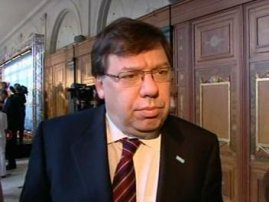
 John Gormley (left), who took over the party leadership from Trevor Sargent after the Greens joined Fianna Fáil, said that "the government has to re-examine its priorities, given the recent economic downturn".
I wonder if this is the same John Gormley who said only a week ago in a long interview with RTÉ Radio 1 that "within the next two years we should see a turnaround in the Economy". (see my entry of May 10th)
Can such strong optimism really disappear so quickly from a seasoned politician and minister? Or is there something - or someone - else that is changing John Gormley's mind?
 It seems there is, and his name is Dan Boyle (right). The Green Party chairman, who was made a Senator and Deputy Leader of the Seanad (by Bertie Ahern) after losing his Dáil seat in Cork in the 2007 elections, has in recent weeks become a voice for change and reflection.
A late convert to reality, perhaps, but Dan Boyle is no fool. Many - in his party and outside - regard him as "the only Green politician who understands money", and over the years he has done a lot behind the scenes to make his party more efficient.
Nevertheless Boyle was also one of the 'realos' who supported the move into government and helped negotiate the coalition agreement. So it is quite significant that Dan Boyle now says: "It is time for the [Green] party to rethink the programme for government agreed with Fianna Fáil."
Looking for an Exit Strategy?
He states that there are "too many unresolved issues, policy errors that are not been admitted, and areas where responsibility has not been taken".
A number of government policies had been "disastrous", including "the light touch regulation of the financial sector and excessive salary arrangements in many areas including political life".
According to Senator Boyle, these policies had "not been Green Party policies", and the mistakes needed to be confronted.
Everything had "changed utterly" since the 'Programme for Government' had been agreed, and it was "a document now in need of review".
In a recent statement Boyle proposed that "the deal should be reviewed in the period after the June elections", adding that "it is now clear that the conduct and performance of the government will be the issues that dominates the local and European elections".
These remarks from the Green Party's chairman represent further distancing from Fianna Fáil as that party's ratings continue to plummet and are bound to be interpreted as a sign that the Greens are beginning to think in terms of an exit strategy.
I presume Senator Boyle has been out canvassing lately, and the reactions he got from local people on their doorsteps might well have opened his eyes and mind.
Even though he has not even a remote chance to win a seat, Corkman Boyle is the Green Party candidate for the European Parliament in the Southern constituency. He put a brave face on when he announced his candidacy a few months ago, but now reality is catching up with him.
The brave face has disappeared, at least from his campaign material. I just saw the first large election poster of him, tied to a lamp post not a hundred yards from my house. And I was quite surprised by what I saw. There is no smile, and not even the slightest bit of friendly expression. Boyle looks very grim, annoyed and grumpy*.
If it were not clear that it is an election poster, one might assume the photo depicts a man who suffers heavily from painful haemorrhoids and has just been told that he is at the bottom of a six-months waiting list for his operation.
"Brian Cowen is a real Pain in the Arse..."
Perhaps the nearly two years the Green Party has been sitting on the government benches now have indeed produced a number of severe political haemorrhoids for its members. At least one of the Green TDs (whose request not to be named here I respect) feels the pain every time he sits down in Leinster House.
"Bertie [Ahern] was quite bearable and always relaxed," he told me some weeks ago. "But Brian Cowen is a real pain in the arse, all the time and for everyone."
The same Green TD did not smile when I showed to him what I had written after the current government coalition was formed.
"It has often been observed that rats and other animals are jumping off sinking ships, seemingly guided by their survival instinct," I wrote in 2007. "But it must be the first time that a group of creatures is desperate to jump onto a sinking ship. This group was until now known as Ireland's Green Party. What it will be after their experience as ship mates of Fianna Fáil is anyone's guess."
Well, for a man who is not in the prophecy business, I seem to be able to see many things well ahead of most people and get quite a lot of them right before they happen.
Defection, Resignations and Disappointment
Ever since the Green Party entered government with Fianna Fáil, there has been a steady flow of support away from the party. Some of the people joined other parties, while the majority of disillusioned former Greens are now Independents, and some have given up politics for good.
Despite frequent denials from the Green Party head office, the ever growing list of resignations and defections must be a concern. It would be for me, if I were in their shoes.
Having neither a realistic chance to win a seat in the European Parliament this year**, nor any hope for success in the two Dublin by-elections for the Dáil, the Green Party must naturally concentrate most of their efforts for June 5th on the local elections.
Five years ago they managed to get 18 of their members elected to various county and city councils, particular in urban areas. But they have not made much of a difference locally. And since June 2007 they were forced to defend Fianna Fáil and the government, a task very few Green activists would ever have expected to see on their to-do list.
Three of the Green councillors (which is 1/6 of the party's local representatives) have resigned and left the party between August 2008 and January 2009. And in the build-up to the local and European elections many veteran candidates and activists decided not to stand or campaign for the Green Party this time. Some just left, while others - like Brendan McCann, the long-time Green Party candidate in Waterford City - remain nominally party members, but are no longer active.
 The first Green representative to bail out after the party had joined Fianna Fáil in government was Nessa Childers (left), the daughter of Ireland's former President Erskine H. Childers. She had been elected (in Blackrock) to Dún Laoghaire-Rathdown County Council in 2004. She resigned last August, apparently for 'personal reasons', but meanwhile re-appeared on the political scene as the Labour Party's candidate for the European Parliament in the Eastern constituency.
 In January two of Ireland's best-known Green politicians below Oireachtas level resigned from the party within a week. First Councillor Chris O'Leary (right), the Greens' only representative on Cork City Council, left the party with heavy criticism of its national leadership.
 A few days later Clontarf Councillor Bronwen Maher (left), the only Green member on Dublin City Council, followed suit. Ms Maher, a party member for 20 years and one of the Greens' most prominent local politicians, had been very critical and outspoken for some time, especially in the wake of the October Budget.
Both Maher and O'Leary are now campaigning as Independents.
Watching the Polls
Although several opinion polls published this year saw the Green Party relatively unscathed (while Fianna Fáil dropped from one historic low point to the next), the latest TNS-MRBI poll - published in the Irish Times on Friday (see my entry of May 15th) - has the Greens on only 3%, compared with up to 7% in earlier polls. This must be ringing alarm bells in the party's head office, and so it is not much of a surprise that prominent Green politicians like Dan Boyle and even party leader John Gormley begin to voice their concerns.
Will this change anything? And will there still be enough time for a 'renegotiation' of government policies and strategies?
Somehow I doubt it. Fianna Fáil is in complete denial of Ireland's political and economic reality, and thus - in my opinion - beyond repair or reform. Only a lengthy period in opposition could perhaps restore some of the old FF spirit and the traditional values that made the party strong.
This will of course not help the Green Party. Having nailed their own colours so firmly to the Fianna Fáil mast, the Greens are now as tarnished as their larger coalition partner and people treat them with the same anger and contempt.
Quite rightly so, I think, as they carried and supported every government policy and decision, no matter how wrong, unfair, incompetent or outright idiotic it was, since June 2007.
So they are as responsible for our national crisis and the economic recession as Fianna Fáil is. And they will be punished for it by the electorate.
A Chance of Survival?
If the Green Party is interested in surviving as a political entity, and wants to rescue at least some of its ideas, identity and policies, then the only way to do this is to jump ship and leave the current coalition government as soon as possible.
In that case the party would then have three more years to prove themselves in a new 'rainbow' coalition with Fine Gael and the Labour Party. And who knows, given that we are facing great global and environmental challenges, they might actually regain some of their old supporters and even find new ones.
But all this is purely hypothetical as long as the Greens stay in government with Fianna Fáil. All talks about thinking again and 'renegotiating' the coalition agreement are futile and will lead only to more anger and aggrevation. It is way too late to patch up the damaged ship of this coalition, as it is taking in massive amounts of water and sinking fast.
There is a time for maintenance and repairs, but that needs a vessel in still seaworthy condition. Once a ship is so seriously damaged that it is not more than a hopeless wreck, abandoning ship is the only sensible action for those who want to survive, or at least want to try to survive.
It will be interesting to observe what the Greens will do, if they are really beginning to wake up to reality, or if they are now as hopelessly damaged and irrational as their coalition partner.
I think that in the second half of June we might well get some answers to these questions.
The Emerald Islander
* On this poster Dan Boyle wears a blue tie, and the spot with the usual message "No. 1" is also coloured blue, on an otherwise brightly green background. Most people who see the poster might not think much of that, but as an image consultant I take notice of such details. In general, green and blue are opposite colours that do not combine well in most designs. So why would a professional graphic designer put them together on the same poster, unless the client wants it that way?
In Irish politics green and blue are of course also the colours of the two largest parties, green representing Fianna Fáil and blue Fine Gael. (That green is also the main colour of Sinn Féin and - obviously - of the Green Party is of less signifiance here.)
I wonder if Dan Boyle's choice of colours for the election poster is a first subtle message that his party might be open to suggestions or offers from Fine Gael. If the Greens would switch allegiance, the current government would fall and Fine Gael's leader Enda Kenny could be Taoiseach. We had such a situation when the Labour Party left its coalition with Fianna Fáil in 1994 and formed a new coalition government with Fine Gael and the small Democratic Left party (which has meanwhile been absorbed into the Labour Party).
As political campaigning is a very sophisticated business these days, it would surprise me if Dan Boyle's choice of tie and the use of blue for a prominent spot on his main election poster were purely accidental.
** The one and only Green MEP Ireland ever had was Patricia McKenna, who held a Dublin seat from 1994 to 2004. She was a strong opponent and critic of the Green's partnership with Fianna Fáil as well and fought against it inside the party for nearly two years.
Having realised that the Green Party is seriously damaged, probably beyond repair, she recently ended her membership and is now standing in Dublin as an independent candidate for the European Parliament. (see my entry of May 11th)