Showing posts with label Padraig Walshe. Show all posts

08 September 2009

Many Critical Reactions to the Commission on Taxation's Recommendations

Irish opposition politicians have said they expect the government to use the report of the Commission on Taxation (see yesterday's entry below) "to tackle the shortfall in the public finances".

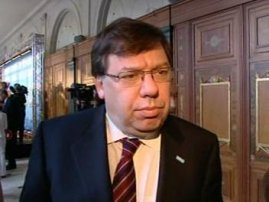
Fine Gael's deputy leader and Finance spokesman Richard Bruton (left) said that Fianna Fáil was "trying to tax its way back to recovery, and that no country has ever managed to do this".

"The last thing families and taxpayers need at this time of deepening economic crisis is dreaming up even more ways to tax them to pay for Ireland's unreformed, often dysfunctional and high-cost public service," Deputy Bruton said.
"No country has ever taxed its way back to recovery, but that is exactly what Fianna Fáil is trying to do."
"Ireland's tax system may need to be redesigned to support employment and investment, but the government's focus should not be on increasing overall tax levels," he added.

Fine Gael's newest TD (and former RTÉ economics editor) George Lee (right) stated that people would have to wait and see whether the report was a fair one. This would depend on what choices the government made from the menu provided by the commission, he said.

Joan Burton (left), deputy leader and spokesperson for Finance of the Labour Party, said she was "amazed that the commission has not tackled the issue of property based tax relief" and claimed that "the dominance of tax lobbyists in the commission's make up contributed to them side-lining this important issue".

Deputy Burton stated that the report would require "careful study" and called for it to be used "to address glaring anomalies in the tax system".
She added that despite the commission's description of the report as "revenue-neutral", it would be difficult not to see some of the new taxes being proposed being used to plug the gap in the public finances.

Sinn Féin's Finance spokesperson Arthur Morgan (right) said he expected the report to be used to increase taxation of ordinary people.
"This report unfairly targets households, as does the McCarthy Report, to pay for the government's mismanagement of the Irish economy," he said.
"It is not a restructuring of the tax system based on fairness - it is an attempt to squeeze even further ordinary people struggling to make ends meet."

Meanwhile the Irish Farmers' Association (IFA) criticised the report's proposals on carbon tax and changes to the capital allowance system.

IFA President Padraig Walshe (left) said he was "very concerned" that a carbon tax will add another cost to the productive, export-driven sectors of the economy and will also discriminate against farmers and rural dwellers who do not have the option of public transport.

He thinks the recommendation to change the capital allowance system will undermine any future investment in farm buildings in Ireland.

Con Lucey, the IFA Chief Economist, was a member of the Commission on Taxation.

Another farm group, the Irish Creamery Milk Suppliers Association (ICMSA), which has demonstrated against low milk prices outside Government Buildings in Dublin only last Friday (see my entry of September 4th), said that the proposal for a new carbon tax would "fall disproportionately on the agri-food sector and considerably worsen Ireland's competitive position".

The Arts Council has said it will make a "strong case" to the government for the retention of the artists' tax exemption scheme.
Its President Pat Moylan said that if the exemption is abolished, Ireland could lose entirely a considerable number of artists, and that this would not be for the public good.
She added that a study had shown that the Exchequer would lose tax revenue if the exemption is scrapped.

The Emerald Islander

01 December 2008

Irish Farmers "won't go away quietly"

Padraig Walshe (left), the President of the Irish Farmers Association (IFA), is warning the Irish government that "farmers won't go away quietly and accept the Budget cuts".

He was speaking yesterday evening in Ennis, Co. Clare, where more than 7000 IFA members from counties Clare, Cork, Galway, Kerry, Limerick, Offaly, Roscommon, Tipperary and Wexford had gathered for a mass demonstration to vent their anger.

Since October more than 20,000 Irish farmers have now expressed their anger over the 2009 Budget cuts at various IFA meetings all over the country. (see also my entries of November 2nd & 16th)

The IFA says that the recent cutbacks will mean a € 20 million loss to farmers in the region every year and is urging the government to think again.
It also accuses the Minister for Agriculture Brendan Smith to be "in denial over the impact of the government cuts on farmers".

Padraig Walshe says that Minister Smith is "disingenuous by referring to 2008 payments, which have nothing to do with the government's farm cuts for 2009".

"The way farmers have been hit is totally unacceptable", Walshe declared in an interview with RTÉ.
"The cuts are a direct attack on the viability of low-income farmers, especially in the West. Many farmers will not be able to make a living from farming under these conditions."

In reply, Brendan Smith (right) said that he did "not accept claims about the impact of the cuts on farm incomes".

This is another example of a Cabinet Minister closing his eyes and ignoring the facts, hoping that the problems will somehow 'go away'.

Smith, who was only appointed to his current position in May of this year when Brian Cowen became Taoiseach , seems to be quite a fast learner when it comes to collective ignorance and - as Padraig Walshe pointed out - denial.

He makes a fine addition to a Cabinet that is meanwhile so far removed from reality and from the Irish people that no argument, no matter how valid, can get through the ring of political cotton wool it surrounds itself with.

There are two ways to deal with this: Either the government removes the cotton wool, or the people have to remove the government. Personally I think the latter is the more desirable and more effective solution to improve our lives, our country and our economy.
As the IFA would be a welcome ally in such an operation, I hope that this time the farmers will indeed "not go away quietly" and remain strong and steadfast in their protest.

The Emerald Islander

21 November 2008

EU Agriculture Ministers agree on CAP Reform

The European Union's Ministers for Agriculture have finally reached an agreement on major changes to the Common Agricultural Policy (CAP).
It follows all-night negotiations in Brussels to review the system of subsidy payments to farmers.

Padraig Walshe (right), President of the Irish Farmers' Association (IFA), has already spoken out against the new agreement and criticised the decision to cut the single farm payment by 5% over five years.

Meanwhile Brendan Smith (left), Ireland's Minister for Agriculture, Fisheries & Food, said that "despite difficult negotiations, it was a good package for farmers in Ireland".

The ministers at the talks agreed to sweep away various established agriculture support schemes, including diverting subsidies from large farms to countryside preservation schemes.

After concessions given by (the Danish) EU Agriculture Commissioner Mariann Fischer Boel (right), most notably to France, Germany and Italy, ministers struck an early-morning deal that still represents Europe's most significant farm reform in five years.

"It was a qualified majority, not unanimity," said an official, who did not say which country or countries in the 27-nation union had not backed the accord during all-night talks.

Apart from long arguing over how much handouts to divert into countryside funding, the main hurdles were how to liberalise the EU dairy sector before milk production quotas expire in 2015. Public purchasing of key commodities - like wheat and the future of the EU's remaining production-linked farm subsidies - where also on the agenda.

All holdings, subject to a basic threshold of € 5000 in subsidies a year, will shift 5% of their EU farm money into countryside projects by 2012, on top of a compulsory 5% already in force. Commissioner Fischer Boel had originally been seeking 8%.
Much of her vision of applying a tiered system of annual income thresholds to shunt subsidies, in progressively higher amounts, from larger farms into rural spending also got diluted.

Instead of three thresholds for farms receiving subsidies, only one will now apply - € 300,000 and higher - where 4% of subsidies will be moved into rural projects by 2012.

The policy revisions will start in 2009 and run until 2013.

16 November 2008

The West awakes and rejects Budget Cuts

It appears that the Irish government has very few friends and supporters left for its outrageous policies and in particular for the shambolic 2009 Budget it presented more than a month ago.

Ireland's farmers, who have in the past always been a strong bulwark for Fianna Fáil and were subsequently awarded with generous - and often even over-generous - grants, subsidies and compensations, are turning now in droves against their former champions as well.

This is quite a change from the last minute change of mind they had earlier this year, when they joined the YES camp for the Lisbon Treaty shortly before the referendum, after having been against the treaty for months before.
But things have changed since June, and we are living under quite different conditions now. The farmers - like almost everyone else - are feeling the pinch of economic recession and financial instability. And - with all respect - Ireland's farmers have always known on which side their bread is buttered. So now they are joining in ever larger numbers the majority and call a spade a spade, or - in this case - the government for what it is: incompetent, arrogant and not up to the job of leading the country.

The growing anger in the farming community is especially strong in the west of Ireland, which is still an agricultural area with very little industry and infrastructure. Having lived in the west myself for some time, I know these farmers. They are very sturdy, conservative people, slow to anger and mainly interested in getting on with their own business.
But once they begin to grumble, pick up placards and go to demonstrations, they really mean it and will not sit down quietly again until their grievances are addressed and their problems are solved.

Today more than 5000 of them gathered in Carrick-on-Shannon, Co. Leitrim, outnumbering the local population of this small county town.
They are concerned and annoyed, feel betrayed and were sending the government a clear and unmistakeable message. "The West rejects 25% cuts" was written on thousands of placards they carried. It was in fact like a sea of messages, but they all said the same and showed a unity seldom seen in that part of the country.

Addressing the gathering, Padraig Walshe (right), the outspoken president of the Irish Farmers' Association (IFA) accused Fianna Fáil of "forgetting their roots and letting down the west of Ireland".

The IFA estimates that the 2009 Budget measures will cost farmers in the west and north-west of Ireland nearly € 40 million.

Since the Budget was announced on October 14th (see my entry of that day), farmers have been holding meetings all over the country to voice their anger over cuts in investment programmes and in retirement and some livestock schemes.

The IFA is accusing the government of taking the easy option by cutting the income of farmers on marginal land, mainly in the west of Ireland.

Padraig Walshe said that "cuts in the suckler welfare and the disadvantaged areas schemes are a direct attack on the viability of low-income farmers".

As things are, we can expect more meetings like this and more demonstrations - by farmers and many other people - in Dublin. One wonders how long it will take for the government to realise that they have really messed up everything and that it is time to go and let better people govern the country.

The Emerald Islander
02 November 2008

Farmers' Protest Gathering in Portlaoise

More than 300 people affected by the recent Budget decision to suspend Installation Aid and the Early Retirement Scheme for farmers attended a protest meeting in Portlaoise, Co. Laois yesterday afternoon.

The meeting, organised by the Irish Farmers' Association (IFA), heard the concerns of individual farmers who plan to retire, and young farmers who want to set up in farming.

IFA President Padraig Walshe (right) said that farmers were angry at the sudden move to block new entrants and pointed out that the industry needed young trained farmers. The axing of the Retirement Scheme has apparently thrown the succession plans of hundreds of Irish farm families into disarray, causing them deep distress and uncertainty.

Upsetting one of their oldest and staunchest support groups - the farming community - could be the last straw to break Fianna Fáil's back. Taoiseach Brian Cowen, himself a man from the rural Midlands (with his home not too far from Portlaoise), must be either insane or desire political suicide. Whatever happens, and whatever has to be done to stem the tide of economic recession, one does not annoy one's most important supporters.
But since he keeps doing it - over and over again - I predict that he will have no great future in Irish politics and will more likely live on in infamy.

The Emerald Islander

20 June 2008

No "quick Fix" for Europe

Taoiseach Brian Cowen (left) has told EU leaders that there is "no quick fix" to resolve the dilemma caused by the rejection of the Lisbon Treaty by Irish voters. Speaking at a press conference after the EU Summit meeting, he made it clear that it is "too early to know how we can move forward at this time".

He said that it has been a busy number of days and that the only potential way forward would need to be acceptable to Ireland and other countries. He added that a number of EU members have indicated that they have no interest in reopening negotiations on the Lisbon Treaty.

When asked about whether a second referendum would be held, the Taoiseach said he could not say whether there would be a further vote on Lisbon. The Irish government could not go beyond where they are at the moment. They are currently analysing the results of the Lisbon Treaty's rejection.

It was also revealed that French President Nicolas Sarkozy will visit Ireland at the beginning of his EU presidency and in the aftermath of Ireland's rejection of the Lisbon Treaty.

Earlier President Sarkozy said he intended to go to Ireland to help finding a solution, but he said he was determined not to re-open the debate on the institutions of the EU.

The French President also declared that the (British) EU's Trade Commissioner Peter Mandelson (right) is partly to blame for Ireland's rejection of the Lisbon Treaty.
Mandelson, a former Northern Secretary, had upset Irish farmers with his strategy at the World Trade Organisation (WTO) talks.

Speaking on the second day of the EU summit in Brussels, President Sarkozy said: "We were going to negotiate, in the case of the WTO, a 20% reduction in European agricultural production. Reducing agricultural production by 20% in a world where there are 800 million people dying of hunger, every 30 seconds a child dies of hunger, is unacceptable."
"Quite honestly," the French President added, "there is one person who is of this opinion, and that is Mr. Mandelson. It is not France's position."

Padraig Walshe, the President of the Irish Farmers' Association (IFA), stated that Mr. Sarkozy was correct in highlighting the damage that Commissioner Mandelson had done to farmers' opinion in the run-up to the Lisbon referendum.

Meanwhile Ireland's Minister for Agriculture, Fisheries and Food rejected comments from Mr. Mandelson that NO campaigners in the Lisbon Treaty campaign were "allowed to spread misinformation".
Speaking at the Farmfest event in Co. Galway, Brendan Smith said the government's focus was now on addressing the issues raised during the campaign, as part of the effort to resolve the difficulties raised by the Irish rejection of the treaty.

The increasing hesitation of the Czech Republic over the Lisbon Treaty was also a point of focus at the EU summit. Ahead of today's session, EU foreign policy chief Javier Solana said he did not think the Czechs would block the treaty. He added that he thought the treaty would be ratified in all the remaining member states.

However, the Belgian Secretary of State for Foreign Affairs Olivier Chastel was sceptical, saying the Czechs were "not willing to listen to reason". This statement coincides with the strong views expressed by the Czech President Václav Klaus three days ago. Klaus had congratulated Ireland on a "victory for democracy against bureaucracy and elitist EU plans". Meanwhile the Lisbon Treaty has been referred to the Czech Constitutional Court for closer examination and a growing number of politicians from the ruling party have expressed their doubts about the value of the Lisbon Treaty for their country and progress in the EU.

Luxembourg has warned that the EU will not be able to enlarge further without the Lisbon Treaty. This is quite a correct analysis, but in my opinion it is actually a good and welcome fact. The EU is already too large and has admitted in recent years new members without proper scrutiny. While - for example - Greece, Portugal and Spain had to wait many years for their EU membership (which was only granted after they had reformed their political systems and laws), Bulgaria and Romania were admitted to the EU after only a few years, without achieving the required and necessary stability and democracy. Bulgaria is virtually run by organised crime gangs, and Romania has still great shortfalls in the fields of economy and political participation.

Slovenia, another new member which currently holds the EU Presidency, said that Ireland's rejection of a new EU treaty should not slow down the process of enlarging the union. This is, however, a minority position.

Separately, the Czech Prime Minister Mirek Topolanek said he expected negotiations with Ireland on what it might do with regards to the rejected Lisbon Treaty would take place in the first half of next year. On January 1st, 2009 the Czech Republic will succeed France (which takes the chair on July 1st) in the rotating six-months EU Presidency.

The Emerald Islander

20 April 2008

Farmers threaten to say NO to Lisbon Treaty

Mary Coughlan (right), the Minister for Agriculture, is taking a recent threat by Irish farmers to vote NO in the forthcoming Lisbon Treaty referendum "seriously". Speaking on RTÉ Radio 1, Ms. Coughlan said she was working to ensure that the outcome of the World Trade negotiations is balanced, with the appropriate protections for Irish farmers and the agri-food sector.
Responding to the minister's statement, Padraig Walshe, President of the Irish Farmers Association (IFA), said he had no disagreement with her stark assessment of the damage to Ireland's farm and food industry posed by WTO negotiations.

Meanwhile Fine Gael MEP Mairéad McGuinness said she is "concerned about the mounting anger among farmers" ahead of the Lisbon Treaty referendum on June 12th. She urged the government to come out very strongly and say it will use its veto on World Trade Talks.

But Education Minister Mary Hanafin said that "the [Irish] government knows that farmers have genuine concerns about what is being proposed at the talks". But she insisted that it was "too early to use the Irish veto". She stated that it was about getting an agreement that is balanced both within agriculture and between trade and agriculture.

Well, she would know, of course... But what she does know - as a former Fianna Fail treasurer and a woman born in Tipperary - is how to hoodwink and pay off the farmers, as FF has done it so successfully in the run-up to previous referenda.

It will be interesting to see if Ireland's farmers are this time wise and forward-looking, and actually mean what they say. In that case they would have to vote NO in the referendum, and that might well defeat it.
Or are Irish farmers still more after the quick buck made now than after a solid income over many years? In two months we will know.

On Thursday more than 10,000 farmers had taken part in a demonstration in Dublin, protesting against current European proposals in negotiations on world trade. Farmers from all parts of the country came to the march, and original turnout expectations were well exceeded.

The farmers gathered at Leinster House and marched to Dublin Castle, where European Commission President Jose Manuel Barosso was addressing the National Forum on Europe.
Farmers are unhappy about the stance EU Trade Commissioner Peter Mandelson is taking in the current negotiations on world trade. They say that the beef and dairy sector could be virtually wiped out.

IFA President
Padraig Walshe said the current proposals to cut import tariffs will have an impact on how farmers vote in the Lisbon Treaty referendum. He warned that farmers would not support a European Commission that sells out their industry.

The European Commission's Director General for Trade, the Irishman David O'Sullivan, defended the proposals, saying that if implemented, the deal would take effect over a number of years.

EU Commission President Jose Manuel Barosso stated that a deal at the Word Trade Organisation talks would be in Ireland's interest, but did not say in which way. He said getting a deal sooner rather than later would guarantee the reform of the Common Agriculture Policy (CAP) agreed four years ago. But he warned that delaying the deal could mean that a review of the CAP starting in the autumn could result in a less favourable outcome for farmers.

Farmers are angry over the stance being taken by EU Trade Commissioner Peter Mandelson in the current round of negotiations to liberalise the rules on world trade. They say Ireland's livestock industry would be decimated, and there would be cuts in the dairy, grain and other sectors. This could result in 50,000 rural jobs being lost and 100,000 cattle farmers being made redundant.

The Emerald Islander