Showing posts with label capitalism. Show all posts

19 January 2009

The most depressing Day in the Year

This morning someone on the radio made the remark that January 19th is - apparently - "the most depressing day in the year". How they come to that conclusion I do not know, and it was not really explained on the programme either. These days many radio presenters have the habit of throwing in comments, remarks and statements that they have neither researched nor cross-checked.
On the other hand, there are countless statistics nowadays, about anything and everything. So it is quite possible that there is such a statistic and that it puts a black mark on this day - January 19th.

Whatever is the case, the stock brokers in Dublin must have been listening to the programme this morning. And they took it very seriously and decided to contribute to the day appropriately. Subsequently the value of Irish bank shares has dropped to another all-time low.
As I write this, shares in Allied Irish Bank (AIB) dropped by almost 52% to 70 cents, after slumping as much as 60% earlier. Bank of Ireland is down now 20% to 60 cents per share, which is already a recovered value from earlier falls of 47%. And Irish Life & Permanent, who own the permanent tsb bank, tumbled 32% to € 1.49.

Today's falls come in the wake of market suggestions that Bank of Ireland and AIB look unlikely to be able to raise extra cash from private investors to top up a proposed state investment in the banks.

It appears that a statement I made on the BBC's "Any Questions?" programme more than seven years ago was quite correct, and every day this becomes more obvious to everyone.
What I said - back in September 2001, shortly after the airborne terror attacks on New York and Washington - was this:
"It becomes quite clear that conventional capitalism as we know it does no longer work. There are people on this planet who - for whatever reason - no longer want to live and work, inspired by the chance to gain wealth and personal comfort, but prefer instead killing themselves, if they can do serious damage to the capitalist system in the process. This means that no business and no organisation that follows the traditional capitalist system alone will be save and successful in future."
There might well be people who heard my statement then and made changes to their lives and to their business, as I did myself. But the vast majority did not. In fact, here in Ireland the small class of really wealthy people took no notice of it at all, as they have never listened to anyone 'on the outside' ever. They just think that their wealth gives them complete immunity from the rest of the world.
For the past ten years they created an artificial bubble of social and financial illusions that puts the well-known story of The Emperor's New Clothes well into the shadows. In the process they have not only done great damage to themselves and their companies, but to the Irish nation as a whole. Now chicken are coming home to roost on an almost daily basis, and there is for now no end in sight.

As this is supposed to be "the most depressing day in the year", I will oblige and make another statement on this matter.
Not only does conventional capitalism as we know it no longer work in the face of fundamentalist terrorism that has no concern for human lives, it does also no longer work in a globalised world that allows banks to create and gamble with artificial money that does not exist, never will exist, and has no relation to any real values.

For thousands of years people used raw materials, produced something other people wanted, and sold it to them for a price higher than the costs of production. That way they made a profit, and this is the core of old-fashioned capitalism.
Nowadays more and more manufacturing - even the production of the most basic goods - is "outsourced" to low-wage economies, mostly in the Far East. Meanwhile here in the West our apparently so bright and clever people find it more suitable to concentrate on 'financial services', which means in plain English gambling with other people's money and getting paid huge bonuses for it, just like in any casino in Las Vegas. What they really are is not bright and clever at all, but greedy and stupid

If we keep this up and do not learn our economic lessons very quickly, capitalism in any form will cease to exist. Private enterprises and public services alike will collapse, and Ireland - together with many other countries, especially in the English-speaking world - will encounter a period of absolute anarchy, violence and destruction. What ever will emerge from that after some time is anyone's guess and unpredictable, even for someone with a good track record of correct predictions.

There is still time to get things right, but not a lot of it is left. Money and time are literally running out for Ireland. The only way to turn things around is a radical change of direction, under a strong leadership.

Well, perhaps that researcher quoted on the radio this morning was right after all and this is the most depressive day of the year...

The Emerald Islander

12 October 2008

In Reply to David McWilliams

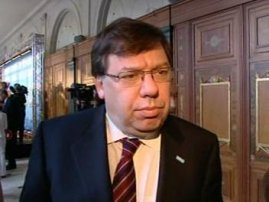
This morning David McWilliams (right) published another very interesting article on his website.
You can read the complete text by going to http://www.davidmcwilliams.ie/2008/10/12/breaking-the-vicious-circle

In this article David suggests the establishment of a new international clearing house for banks under the direct authority of the G 7 (most industrialised) countries, which are the USA, Canada, Japan, the UK, France, Germany and Italy.

Once again I happened to be one of the first people to read the article, and the first to leave a comment at 5:58 a.m. this morning. Having read my comment, which was written impromptu and without preparation, a second time now, I realise that it is not just a comment on David's article, but goes further with its demands and is a separate article itself.

I am taking the liberty of posting it here as well, for the benefit of those who do not read David's articles or visit his website on a regular basis. So, here is the text:

Events in Ireland - and in most other countries - have been overtaken by the international reaction - or perhaps over-reaction - to the US credit crunch.

A new international clearing house under the control of the G 7 would be useful, I agree. But we need a lot more to get the economic fleet sailing again. State pressure on the banks will be necessary, yes, but at this stage one has also to contemplate a complete nationalisation of the whole banking system.

We were very kind and generous to the banks by giving the guarantees, but it seems to have little affect. The problem is that leopards do not change their spots. So they try to carry on, perhaps with reduced speed, but still staying on the same old course. This has to stop.

If we put all our money and state resources up, then I think we should also have control. And that means first of all a change of course and of leadership. Heads need to roll, quite a lot of heads, and from the top downwards. Most of the CEOs and directors have shown their incompetence and recklessness only too clearly, so they have to go - fast and without golden parachutes.

There should be a new rule that no-one in any company - including banks and stock brokers - can earn more than ten times the income of the lowest paid employee. This would lead over night to a massive increase in equality, and also lead to more investment.

Simultaneously Brian Lenihan should raise the income tax for all people earning more than 100,000 per annum significantly, and introduce new taxes on the buying and selling of shares. Betting taxes should be raised as well, and all the loop holes for the super-rich should be closed immediately.

Further the government should - through the budget - impose an immediate freeze of all consumer prices (especially for food, fuel, electricity and all essential commodities) for at least six months. This would be a great relief for everyone, but particularly for people with lower income, and get us well over the winter. The freeze should be reviewed in 6 months, with the option of an extension.

In terms of structure, all the various regulators should be abolished and merged into one single national consumer authority, directly responsible to the Taoiseach, and with real powers and teeth, as they are in existence already in many continental countries. This would reduce state expenditure and strengthen the effects of regulation.

IDA, FÁS and other institutions should focus on supporting existing Irish businesses and helping to start new enterprises - especially small and medium size companies - in Ireland and owned by Irish people. It has been one of the main mistakes to concentrate always on the big international companies - mostly US owned - and give them millions in advance of even coming and creating jobs. They all packed up again when the extra benefits ran out, or when they got better offers elsewhere.

In general Ireland and Europe should reduce their economical and financial ties with the USA as much as possible. The USA have created this crisis, out of greed, stupidity and criminal activity, and now the whole world is suffering as a result. We have to be realistic and look after our own interests first. (As the Prime Minister of Iceland said so rightly last week: Every man for himself.)

Fortunately we are not entirely on our own and have the EU and ECB behind us. If Europe uses her very well developed infrastructure and skill base, the recession will not last as long as is feared now, and it will also be manageable. Let the USA sort out her own mess, which is entirely of her own making!

Europe could come out of this crisis a lot stronger, and become the No. 1 economic power in the world, if we do things right. Otherwise we will always depend on whatever the USA is doing.
Let the Americans sink or swim, whatever they can manage. Their country is meanwhile so run down - in all areas - and riddled with social and political problems that have no relevance for us.

I am no socialist as such, and as we have seen in Eastern Europe, most socialist models have failed as well. But we need to realise that capitalism of the US & UK style, which has so far been our model as well, does not work. It has its failure already built into the system. So if we repair the damage, only to return to the old capitalist model, we can as well leave it and save us the bother and money.

There are very good and workable models of moderate capitalism with a social dimension, especially in the Scandinavian countries, but also in Germany, France and some other nations. These models we need to study closely, and then adopt which ever is the most suitable for us. If we do that, we will have a safe and prosperous future. If not, we will be sucked down into the abyss by the vortex created by the foundering last empire - the USA.

The Emerald Islander

06 October 2008

Another Black Monday

The world's financial markets have been in a deep crisis for weeks, but today they are in panic.

No other word fits the massive turmoil, chaos and running-about like a bunch of headless chicken. There have been heavy falls on stock markets everywhere, with many exchanges hitting record lows and seeing big sell-offs of bank shares.

Analysts are blaming a lack of certainty about US and European rescue initiatives for the financial sector.
That is quite correct, but it only exposes the high rollers in the world's banks and financial institutions as the incompetent and greedy fools they are.
These brainless wreckers of the economies of many countries, who are unqualified for the overpaid jobs they hold, should be rounded up by the police, interned and charged with collective fraud and high treason.
And the governments of their countries should strip them of every personal asset they have accumulated through their criminal machinations which have pushed the world into the biggest crisis for 80 years.

If you think that I am angry about all this, you are quite right. I am very angry.
And if you think that my suggestions would be an over-reaction to what happened - well, this might be. But if we let these white-collar criminals get away with billions of looted money while we all have to suffer as a result of their enormous blunder, the same thing will happen again in some years from now and no-one will have learned any lessons.

Poor people who steal some food from a super-market are sent to prison. Perhaps rightly so.
But the real criminals who wreck whole nations get - so far - away free and can even keep all their ill-gotten gains.
If we let this happen, we deserve every bit of hardship and suffering that is coming to us.

Today will probably enter the history books as another 'Black Monday'. Despite the more than generous (and in my opinion outright foolish) bail-out programmes that many governments - from Ireland over Germany and other EU countries to the USA - have hastily put in place to save the rotten banks, the international money markets seem to know better. Just have a look at today's reports:

DUBLIN:
The ISEQ index closed nearly 10% lower, with shares in the four main financial stocks falling sharply. Irish Life & Permanent and Anglo Irish Bank were more than 20% lower.

NEW YORK:
The Dow Jones index fell below the key psychological level of 10,000 for the first time since October 2004. It lost as much as 800 points, but recovered later, to close down 'only' 3.3% (340.49 points) at 9,984.89.
The high-tech dominated NASDAQ index fell 4.34% (84.43 points) to 1,862.96.
The Standard & Poor's 500 index lost 3.62% (39.78 points) and closed at 1,059.45.

LONDON:
The FTSE index tumbled nearly 8% to stand at 4589 at the close. Banking stocks were hit particularly hard and a total of over £ 93 billion was wiped off the value of British shares.

FRANKFURT:
The DAX index was down 7% to 5387.

PARIS:
The CAC index sank 9% to stand at 3712, its heaviest one-day loss since its creation in 1988.

MOSCOW:
A 15% dive in share value forced yet another halt to Russian trading today.

And these are only the most important ones. There was a downturn in share value everywhere, with not one single example of an economy moving against the trend.

Iceland, a small country with a population of only 250,000, avoided narrowly a complete collapse. Only through a state of emergency and nationalisation of their banks, augmented with the introduction of draconian government powers, did they avoid the risk of becoming a failed state overnight.

The list could go on and on... and I am sure that we will hear more of the same soon.

But do we get any real solutions from our political leaders? Not a word. All they do is throwing a lot of good money after plenty of bad, blowing up the balloon ever more, until it will eventually burst with a bang so loud and large that no-one - not governments and not the banks - will have a leg left to stand on.

Throughout the years of the 'Celtic Tiger' not one bank in Ireland encouraged people to save money. Interest rates for deposits were so low that they actively prevented any real savings. (The only positive exception was the SSIA scheme introduced by Charlie McCreevy, but as it was running for only a limited time, it had only a limited effect.)

But the banks did not only prevent people from saving money, they aggressively encouraged them to spend and borrow ever more, often way beyond prudence and people's real means. Especially young people were heavily targeted by the financial industry, given two or three credit cards and offered 100% mortgages for over-priced houses as well as loans for cars well above their income level and social status.

Above that, the same banks loaned billions to rival property developers, driving them into a hyped-up construction boom that was unsustainable from the very start. The government, and in particular the majority party Fianna Fáil, gave all this its blessing and supported the bubble with very generous tax conditions for the super-rich and the greedy wannabees riding the 'Celtic Tiger'.

Sadly the opposition did not offer any resistance or alternatives either. Even in the 2007 general election campaign Fine Gael pretended that the economy was sound and the country was not facing any financial problems. They could and should have known better, as many analysts warned already of the imminent end of our economic boom.

But Fine Gael leader Enda Kenny (left) and the American consultants who organised his campaign thought that they might lose votes if they mentioned a potential return to harder times. Well, seldom in Irish history was such a crucial strategic mistake made by a party leader.
Had Kenny attacked the government on the grounds of the already shaky economy and the declining financial reserves, he might well be Taoiseach now, with (the then Labour Party leader) Pat Rabbitte as Tánaiste.

And even if they had failed to form a government, they would now at least stand on the moral and political high ground, from which they could attack the incompetent and failing government. However, as things are, the opposition - with the sole exception of Sinn Fein - is caught in the same net of ignorance and complacency that envelopes the government.

One has to wonder if the Green Party is beginning to regret its decision to join the government in 2007. Usually one can see rats leaving a sinking ship, and not jumping onto one. But what is done is done, and so the once proud standard bearers for political and economical alternatives are no more. They have sold their souls and principles for a short-term taste of power, and now they are locked into the rotten system they started out to reform 25 years ago.

Looking around, there is not much hope for changes. Political and economical lifeboats have been burned on the bonfire of our vanities, and now the Irish nation and most of the world - including children, grandchildren and the yet unborn - have to take on a heavy mortgage for the unstable house of capitalism.

There would be ways out of the crisis, and proper solutions, but those who have the power for now are unable and unwilling to even contemplate real alternatives to the capitalist system. Thus we will have no choice but to prepare ourselves for a long and bleak period of collective suffering, while the rich and super-rich who robbed us of a decent future have a good laugh and continue to live in luxury.

The Emerald Islander
29 September 2008

Financial Markets in Freefall and Meltdown

Today the ISEQ share index in Dublin has suffered a record one-day fall, ending down 13% and closing at 3292.

Especially shares in Irish banks plummeted, as a series of US and European bank failures sparked further fears that the massive bailout plan in the USA may not be enough to deal with the problems in the sector.
Shares in Anglo Irish Bank (AIB) were down more than 45% at one stage, while Irish Life & Permanent (who own the permanent tsb bank in Ireland) fell by more than 30%.

Other European shares dropped to a three-and-a-half year closing low. London's FTSE ended down 5.3% - at 4819 - after it was announced that the British government decided to partly nationalise another bank (and former building society), Bradford & Bingley.

Falls in Belgium and the Netherlands were especially steep, following the announcement that their governments, together with Luxembourg, had agreed to nationalise one of Europe's biggest banks - Fortis - in a € 11.2 billion bailout.

Later the US House of Representatives voted against the proposed $ 700 billion rescue package for the financial sector and especially Wall Street, put together by George W. Bush, his Treasury Secretary Henry Paulson and the Chairman of the Federal Reserve Bank, Ben Bernanke. The House rejected the bill with a clear majority of 228 votes to 205, with some conservative Republicans being the most vociferous opponents of a deal.

Subsequently the Dow Jones industrial average in New York plunged more than 600 points as the news reached Wall Street, closing eventually 778 points - 6.9% - lower. This is the biggest one-day drop ever for the Dow Jones.

The massive economic crisis, created by the greed and stupidity of reckless millionaire bankers and stock brokers, is far from over. And two things are becoming ever more evident:
1) Money is not everything, cannot solve every problem, and is actually becoming a big problem itself.
2) Uncontrolled capitalism, praised for decades as the solution for everything and the reason for our wealth and well-being, does not work!

The sooner we find a sensible alternative, the sooner the crisis will ease and a way out of recession will be found. I hope that Brian Cowen and Brian Lenihan have what it takes to lead this nation...

The Emerald Islander