Showing posts with label Taoiseach. Show all posts

03 June 2009

Irish Exchequer Deficit at € 10.6 Billion

Official Exchequer figures for the first five months of this year show that the Irish government is currently running at a deficit of € 10.6 billion.

While tax returns are sharply down on last year's revenue, the returns for May were broadly in line with the government's forecast in the Emergency Budget.

The extent of the slow-down in the Irish economy can be seen clearly in these latest Exchequer figures. Overall, taxes are down by 21% on an annual basis.

Stamp duty and capital gains taxes are down over 63.5% and 68.6% respectively, reflecting the almost total collapse of Ireland's property market.

VAT and excise duty rates are also down sharply, reflecting reduced spending in the economy, although excise duties came in a little better than the government had expected.

On the spending side, most government departments have kept their expenditure broadly in line, but it is nevertheless up by 2.9% on an annual basis.

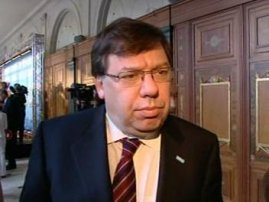
But whatever happens in the real world, Taoiseach Brian Cowen (left) still lives on a planet of his own and says that he is "optimistic about the country's economic future".

Speaking at the National University of Ireland (NUI) in Maynooth, Co. Kildare, Cowen said his government was "determined to keep people at work and create new jobs in the IT area".

He regarded it as "encouraging" that today's tax returns were "on target".

Addressing IT specialists and academics during a lecture in Maynooth, the Taoiseach stated that "there are hopeful signs nationally that this recession is bottoming out".

In his usual brash and brusque manner, Cowen did however not stop to speak to reporters as he left the function.
This, as well as his strange statement, only underlines how much he is out of touch with the rest of the nation. No-one else here can see any 'hopeful signs' in the economy, and certainly not a 'bottoming out' of our recession.

In two days' time we will most likely see the unemployment figure pass the 400,000 line, and as Friday is also election day, the Irish people will show Cowen, his incompetent government and his rotten party what they think of the economy.

The Emerald Islander

26 April 2009

Mill Stones around the Taoiseach's Neck

Today the Taoiseach Brian Cowen (right) addressed his party's usual annual Easter Rising Commemoration at Arbour Hill in Dublin.
As usual it was a sombre occasion, and perhaps even a bit more so this year, with all the dark clouds and bad news hanging over both Fianna Fáil and the government. But, robust as always, Cowen did not show any signs of weakness. Boldly he linked the battle for Dublin in 1916 with the current challenges facing this country in his first Arbour Hill speech as party leader and Taoiseach.

"The present battle for Ireland's economic stability and security will be won," Cowen told the gathering.
"I firmly believe that history will show that we were among the first countries to recognise the scale of the crisis and to put in place a comprehensive framework for recovery."

Well roared, for a wounded lion. And quite optimistic as well. But what about the reality?

Only hours before the event the Sunday Business Post published the latest Red C poll which shows Fianna Fáil at an all-time low point of 23% of public support and approval (see my earlier entry below).

And there is still the matter of John McGuinness (left), who lost his position as the Minister of State at the Department of Enterprise, Trade & Employment in this weeks reshuffle that reduced the number of junior ministers from 20 to 15.
All twenty office holders collectively resigned, and then it was up to the
Taoiseach whom he would re-appoint or perhaps shift to another position. Seven of the 20 lost their ministerial jobs, 13 were re-appointed, and two new junior ministers were brought into government from the Fianna Fáil backbenches.

One of the seven losers was John McGuinness. The TD for Carlow & Kilkenny is undoubtedly the biggest surprise on the list of Brian Cowen's demotions.
Agile, bright and still quite popular (a rarety for a Fianna Fáil politician these days), McGuinness is one of the few people in his party with an understanding of business and the economy. Thus he was well-placed in the Department of Enterprise, Trade & Employment, and in the two years he was there he actually came up with new ideas and new approaches. He also listened to critics and experts from outside the party, including the economist and columnist David McWilliams, who had warned the government over its economic follies for more than a decade.

But unfortunately McGuinness had a boss with absolutely no understanding of business and the economy. When Brian Cowen, after being elected Taoiseach less than a year ago, appointed Donegal TD Mary Coughlan (right) not only as his Tánaiste (Deputy Prime Minister), but also moved her from Agriculture to Enterprise, Trade and Employment, many observers and commentators - myself included - raised eyebrows and wrote that it was not a good decision.

Coughlan, who is Ireland's version of Sarah Palin, gained her nickname 'the Cow' more for her personal attitudes and behaviour than for the reason that - during her time as Minister for Agriculture - she was often photographed in the company of cattle. She is now the second-least popular member of the cabinet, beaten to the bottom only by Health Minister Mary Harney (nicknamed 'Miss Piggy').
This has nothing to do with being female, but is a result of Coughlan's (and Harney's) complete imcompetence, combined with enormous arrogance.

It appears that John McGuinness made the mistake to speak his mind. He told Mary Coughlan that she was "not up to her job" and "better suited to her previous position in Agriculture".

'The Cow', who has no sense of humour, did not like this and urged the Taoiseach to sack her competent but inconvenient internal critic. If McGuinness remained in the department, she is reported to have said, she herself would "consider her position".
Brian Cowen obliged and returned John McGuinness to the backbenches, while stating that he has "full confidence" in his Tánaiste and Minister for Enterprise, Trade and Employment.

This was quite typical for Cowen and shows once more that he is still putting the interests of the Fianna Fáil top brass way ahead of the interests of the country and nation.

The Irish (Gaelic) word Taoiseach means 'chieftain' or 'leader'. With his decision to keep Coughlan happy and sack McGuinness, Brian Cowen has demonstrated that he is - at best - a tribal chieftain (of the Fianna Fáil tribe), but not a true national leader. (A clever leader would have jumped at the chance to get rid of Mary Coughlan so easily and - instead of sacking John McGuinness - would have promoted him into her place, while giving the Tánaiste position to his hard-working Finance Minister Brian Lenihan.)

After losing his ministerial position, John McGuinness had some very effective appearances on various radio programmes and eventually - last Friday - on the popular Late Late Show on RTÉ television. This made him within a few days the unofficial spokesman of the so far ignored internal Fianna Fáil opposition, which is growing slowly but steadily.

In a statement to the media Brian Cowen said that he was "not aware of any discontent in the Fianna Fáil party". This is either a blatant lie, or a further example that he is completely out of touch with the realities in his own party and the country as a whole.

If he cannot see it for himself, someone should tell Brian Cowen that he is currently the most unpopular Taoiseach Ireland ever had. There are five heavy mill stones hanging around his neck, and if he does not get rid of them soon, they will drag him - and his party - down into disaster and eternal damnation.
The five mill stones are the Irish economy, Ireland's banks, Mary Coughlan, Mary Harney and Noel Dempsey (the Minister for Transport). Removing the three most incompetent ministers from his cabinet would not be difficult and could actually give him some desperately needed time to deal with the banks and the economy, the two really big problems. But will Brian Cowen listen, learn and open himself to reality? I somehow doubt it.

The Emerald Islander

20 January 2009

Wrong Day - Wrong Message

Today the Irish parliament met for two separate sessions in two different buildings. In the early afternoon both deputies and senators assembled in their respective chambers in Leinster House to debate the bill to nationalise the failed Anglo Irish Bank, a 38-page document which the government wants to rush through both houses of the Oireachtas in a single day.

But this morning the Dáil assembled also in the Round Room of the Mansion House in Dawson Street (the official residence of the Lord Mayor of Dublin) for a special commemorative session to mark the very first meeting of An Dáil Éireann in January 1919 and the official declaration of the Irish Republic as an independent state (thus ratifying the earlier declaration by the Irish Republican Army on Easter Monday - April 24th - 1916).

This should have been a great event, and in any other country I know it would have been. But not so in Ireland. Here we just ignore important things and let our incompetent political leaders muddle on as they always do.

And a right muddle it was today. First of all the ceremony took place on the wrong day. The first session of Dáil Éireann was on January 21st, 1919 and not on the 20th. So the real anniversary is tomorrow and I will write about it then.

But our government of overpaid fools (GOOF) forgot to reserve the Round Room of the Mansion House - where the First Dáil assembled for its first number of sessions - in advance.
As the room is available to the public and is often booked for civic receptions, conferences, meetings and presentations, this is a very surprising oversight and something that could only happen in Ireland.
When the government eventually contacted the Lord Mayor's office to arrange the special Dáil session, it was told that the room was not available on the 21st. It had long ago been booked by Sinn Féin, Ireland's one and only true Republican party, for a proper commemoration of the First Dáil - on the correct date.

Back in 1919 it was a one-party parliament, and that one party was Sinn Féin. So it is actually quite appropriate to let the party that had the vision as well as the guts to proclaim Ireland an independent state and form the first Irish parliament of modern times hold the commemoration of the event in the correct place and on the right day.

On the other hand, this shows once again how much out of touch with real life our government is. How on Earth can they forget to organise and book the venue for the 90th anniversary of the Dáil? There is no other country on this planet where this sort of thing could or would happen.

But it was not only the wrong day on which the government commemorated the first session of the Dáil, the meeting this morning also sent out the wrong message to the country. Limiting the commemoration of such an important event, which had wide-ranging consequences for the whole nation, to a short session of parliament on a wet Tuesday morning and then carry on as if nothing had happened shows an immense disrespect for the institution (the Dáil) itself and for those who created it under great personal danger at the time.
It also shows disrespect for the whole nation and the people of Ireland, who should celebrate this historic event on a special public holiday. Any other country would have done it that way.

On top of the disrespect there was a second element that was uncalled for, and it too sent out another wrong message from the commemorative session.
In his address to the Dáil the Taoiseach put special emphasis on Europe and our membership of the EU. This was in fact Brian Cowen's unofficial launch of the campaign for a second referendum on the Lisbon Treaty.

These remarks were not called for and completely unsuitable for the event. 1919 was not about Europe, and the EU did not exist for another 38 years.
1919 was about Ireland, Irish independence and the ever more serious struggle of Irish patriots to break free from 750 years of British occupation, dominance and oppression. One would have expected more about that from An Taoiseach, especially since he is a man who claims to be a proud Irish nationalist.

But that is sadly all rhetoric. Today it became once more clear that he and the vast majority of Fianna Fáil are nothing but a bunch of greedy, power-hungry and self-serving parasites who have grown fat and lazy on the body of the Irish Republic. It is high time for a change, time to get rid of the parasites and restore the state our brave ancestors created 90 years ago to health, solidity and proper prosperity.

The Emerald Islander

01 December 2008

Cowen puts his Hope and Trust in Coca Cola

Yesterday was a really bad day in Ireland.

We still have the most incompetent Irish government in living memory, and its performance is getting worse by the day. The country is in the grip of the most serious recession for decades, with unemployment rising faster than ever and its numbers reaching and surpassing those of the last recession we had. As if that were not enough, ever more scandals are uncovered. They appear almost faster and more often than overland buses.
And to make things even worse, it has been freezing cold, with temperatures below zero degrees Celsius for most of the day. (The Meteorological Office meanwhile announced that it was the coldest November day since 1985.)

Ireland's Sunday newspapers are usually a good indication of what is going on in the country and what is on people's minds.

There were of course numerous articles about the outrageous FÁS scandal. Its revelation - slice by slice - began a week ago with a large Sunday Independent article by the independent Senator Shane Ross (who happens to be also the paper's business editor).

The outrageous price hike for health insurance, which hit us on Friday and exposes the now uncontrolled greed of the insurance companies VHI and Quinn, also received much attention.

And then there was the latest bomb shell, revealed by the Sunday Tribune, that many of our pension schemes are in danger of collapsing, as Irish pension funds have apparently accumulated massive deficits of between € 20 and € 30 billion.
Since the report was based on a leaked internal memo from Mary Hanafin, the Minister for Social and Family Affairs, one has to take it very serious, even though she and the Taoiseach do not.

With the recession, the crisis and all the scandals and problems at his door, one would expect Brian Cowen to be very concerned and very busy, spending as much time as possible in his office and trying to sort out all the elements that make us ever more poorer and uncompetitive.
One would also expect him to keep a keen eye on the rising tide of violent crime and drug abuse in Ireland, a situation which worsened steadily over the past ten years. These were the years of previously unseen wealth and economic growth in Ireland, the years when Bertie Ahern was Taoiseach and ignored all the nasty sides and elements the boom brought along as well.
He did absolutely nothing about the spreading of ever more violent gangland crime, fuelled by the increasing drug habits of stupid Irish teenagers and even more stupid and irresponsible middle-class professionals who take drugs to spice up their dull lives or to cope with the stress of their jobs.
Brian Cowen was a senior Cabinet Minister for all these years, and now, that he has inherited the mantle of power from Bertie Ahern, he also does nothing about crime and violence on our streets.

No, our new Taoiseach has other priorities.

Instead of sorting out the country's many problems, he went down to Wexford yesterday, for an - as he sees it - very important event.

He took great pride in personally attending the official ground-breaking ceremony to mark the start of building work for a new Coca Cola 'flavouring plant', which will be established on a 41 acre site there, sponsored and supported by the IDA (Industrial Development Agency).
All smiling, as if the 'Celtic Tiger' were still alive, the Taoiseach and his entourage were anxious to point out that the new factory will "create 60 jobs in the area" and even "up to 100 jobs after five years".
Brian Cowen also praised Coca Cola for its "major investment of € 190 million in Ireland".

One really has to wonder on which planet Cowen is living these days! 60 new jobs - and perhaps another 40 in five years' time - are tiny drops in the vast ocean of the Irish labour force, where now 10,000 people are losing their jobs each month, thanks to his and his ministers' arrogant incompetence!
And what are € 190 million compared with € 20 or € 30 billion deficit in the pension funds, or the € 400 billion the government has pledged to save our rotten banks, who brought the trouble they are in on themselves?!
This really goes far beyond a bad joke. This is an insult for the whole Irish nation!

Not even to mention the fact that Coca Cola is producing nothing but fizzy sugary drinks, which are very unhealthy and at least partly responsible for the massive increase in people - and especially children - being overweight or even obese. Sugary drinks, like the ones made by the Coca Cola company, are also blamed by dentists for "serious damage to children's teeth".

This is a company the Taoiseach favours so much that he has to be personally present when the first piece of sod at the new building site is turned by a worker's spade.

It is the same company that had - until recently - a similar factory already in Ireland. That one was in Co. Louth, and it was closed by Coca Cola after the management was unable to come to an agreement with the local workforce. Coca Cola wanted a 'union-free shop', while the workers insisted that as free Irishmen they have the right to join a trade union. Neither side budged, so Coca Cola closed the plant in Louth and is now planning to build a new one in Wexford instead. (I wonder why... Aren't the people from Wexford nick-named the 'yellow bellies'...?)

Well, now that we know Brian Cowen's list of priorities, many things become a lot clearer. How could anyone even think of bothering him with the future of the country, when he has to turn a piece of sod for Coca Cola?

Surely, those 60 new jobs in Wexford will turn the tide for him, end the recession, bring the banks back into shape and make the people vote for the Lisbon Treaty in a second referendum.

It's all the power of Coca Cola, and Cowen obeys when he is called to come with a spade.
"Put your trust in Coca Cola," he says, "and all will be well again."

I just wonder what he might be thinking when he eventually wakes up, sees the country in tatters and the streets full of people, demonstrating against him and his silly little Coca Cola government...

The Emerald Islander

30 November 2008

Now our Pensions are in Trouble as well...

Two days ago I wrote that a new scandal or outrage appears in Ireland now on a daily basis. Sadly, I have not been wrong and even Sundays are no longer free of bad news.

After the FÁS scandal dominated last week (see my entries of November 25th, 26th & 27th) and on Friday a 'double whammy' from the country's two largest health insurance companies hit us with immense and unaffordable increases in health insurance premiums (see my entry of November 28th), we are learning today that our pensions might be in serious trouble as well.

One cannot help wondering if there is actually anything left here in Ireland that is working well, functioning properly and in good order.

Taoiseach Brian Cowen (left) was quick to react this time and declared that the government would be "engaging the pension industry" to "review funding arrangements".

Once again he only gives us a few empty and meaningless words, despite the seriousness of the matter. What does it mean when the government is "engaging the pension industry"?
Should not the government be in regular contact with and in control of the 'pensions industry'?

(By the way, the use of the word 'industry' in this connection turns my stomach. An 'industry' produces things. Pension funds do not produce anything. They only administer money and shift it around in the hope to make profits, obviously not with much success lately.)

What will happen after the government has "reviewed funding arrangements"? And what exactly is a "funding arrangement" when it is at home?

If the Taoiseach thinks that he can bamboozle us with such hollow language, he is in error.

We demand to know what is really happening, when it is happening, and what the consequences are. And while we are at it, we also like to know why nothing has been done about the problem in the past.

Brian Cowen's empty statement today follows the leaking of a confidential report, which warns that a number of pension schemes "could collapse within the next six months, affecting tens of thousands of Irish workers".

The leaked internal report was prepared for the Cabinet by the Minister for Social and Family Affairs Mary Hanafin (right). So at least she seems to know what is going on.

A memo, seen and made public by Ireland's Sunday Tribune newspaper, warns that "defined-benefit schemes in the private sector and defined-contribution schemes could be under threat as the total pension deficit reaches between € 20 and € 30 billion".

The memo says that in defined contribution schemes, which are directly linked to investment returns and where a worker carries the investment risk, there is "anecdotal evidence that best practice is generally not applied", leaving people "exposed to more risk than they might realise".

"These are turbulent and difficult times for money markets, where most pension funds are invested," Mary Hanafin said in a statement today.
"Pension fund managers have yet to report on their funding standards to the Irish Pension Board, but in public comments they have indicated that funds are subject to market fluctuations."

She added that the government is "continuing to closely monitor the situation and is preparing proposals on the long term strategy on pensions, following the submissions made to the Green Paper on Pensions earlier this year".

Following the example of her master, Mary Hanafin is trying to keep us in the dark. How stupid does she think we are? Does she really believe we need to be told that "these are turbulent and difficult times for money markets"?
And what does it mean that "the government is continuing to closely monitor the situation"?

To 'monitor' something means a passive observation from a distance, in modern times usually via an electronic media screen, or monitor. So this is all the government does. Sitting there and watching numbers running over a computer screen.
No wonder that the country and our economy are in such a shambolic state!

Anyone can look at data on a computer. Even my cat is able to do it. And I am almost certain that she understands them better than our government does.

If incompetence and complacency would make people small, our present government would have a very comfortable existence beneath the floor carpets in Leinster House!


The Irish Business & Employers' Confederation (IBEC) has also repeated its recent expression of concern (see my entry of October 7th) that a number of private sector defined-benefit schemes are in danger and said "this situation could put companies themselves in danger".

Brendan McGinty (left), IBEC's Director of Industrial Relations and Human Resource Services, said he is "concerned that three out of every four providers of private sector defined-benefit schemes" would not be in a position "to meet total pension payments if they were required to do so tomorrow".
"This is the scenario which the government and pensions board use to determine a scheme's liquidity," McGinty explained.

Employers are increasingly seeing defined-benefit provision as a "bottomless pit", he added, stating that IBEC is "calling for the liability to the taxpayer from defined benefit pensions in the public sector to be capped" and urging the government and pensions board to take immediate action.

Meanwhile the Irish Congress of Trade Unions (ICTU) has called on the government to introduce a State-run mandatory pension scheme.

ICTU General Secretary David Begg (right) said that - given the current market difficulties - it is "almost inevitable that some of the schemes will be in trouble".
Begg also agrees with a recent IBEC suggestion that "funding standards for pension schemes may need to be relaxed".

Having lived in a number of different countries, I am familiar with different systems of government, economy and also pensions.
And it really puzzles me why Ireland has not established a State-controlled universal pensions system a long time ago. Why are we - after 86 years of independence - still copying everything Britain does, while there are much better options and models elsewhere that we could adopt?

In my entry of October 7th - titled "Irish Pensions System in Need of Reform" - I have written about this matter already. So I will not repeat all my points and arguments here and suggest you go to the archive and call up this entry, which includes a detailed plan Ireland could follow.

The Emerald Islander

29 November 2008

Farmers protest against Fianna Fáil in Co. Offaly

While more than 8000 teachers and parents protested in Donegal town today against cuts to the education budget (see my earlier entry below), the Irish Cattle and Sheep Farmers Association (ICSA) demonstrated outside the Tullamore Court Hotel in Tullamore, Co. Offaly, where Fianna Fáil were holding their National Councillors' Forum Annual Conference.

Around 200 Fianna Fáil county and city councillors from around the country gathered for this meeting and had to pass the gauntlet of the angry farmers, who displayed banners, placards and a small flock of miniature plastic models of cows and sheep in front of the conference hotel.

ICSA's angry protest was directed against recent cuts in the agricultural budget, and especially against a reduction of support schemes for small farms, which affects mostly people farming in the west and north-west of Ireland, where they raise cattle and sheep.

The Taoiseach, the Tánaiste and three other government ministers were addressing the Fianna Fáil meeting, and it has been reported that especially Brian Cowen gave "a rousing speech" to his party members.
This is probably quite necessary, as the current unpopularity of the Irish government worries many Fianna Fáil councillors, particularly in light of the up-coming local elections next year.

The Tánaiste and Minister for Enterprise, Trade & Employment Mary Coughlan, Transport Minister Noel Dempsey, Education Minister Batt O'Keeffe and Agriculture Minister Brendan Smith also addressed the meeting and then faced the councillors in a questions-and-answers session, especially over the details of the controversial 2009 Budget.

However, in their usual arrogant way neither the Taoiseach nor his ministers had any time for the protesting farmers and showed no concern for their problems. I am sure the farmers - and not only those who were present today in Tullamore - will remember this when they cast their votes in future.

The Emerald Islander

27 November 2008

Harney entangled in hairy FÁS 'Florida Gate'

One of the - recently revealed - spurious expenses paid for with a FÁS credit card was for $ 410, spent at a Florida beauty parlour, which was said to relate to a time when Minister Mary Harney (right) was in the Department of Health.

Last night her office said that she "might have been responsible for part of a bill incurred when she led a FÁS delegation to Florida as Enterprise, Trade & Employment Minister".
But her spokesman vigorously denied that what had amounted to "a wash and blow-dry" could have accounted for the entire bill.

It was also being suggested that "some others" on the delegation could have contributed to the controversial bill.

The Taoiseach, supporting spongers as usual, said he accepts the explanation given by Minister Harney about the hair dressing treatments, and that she has his "full confidence".
He also rejected vehemently calls from the opposition, especially from Fine Gael's spokesman on Enterprise, Trade & Employment Dr. Leo Varadkar, for Mary Harney's resignation.

Speaking on RTÉ Radio 1, independent Senator - and Business Editor of the Sunday Independent - Shane Ross (left), who investigated the misuse of FÁS money and published his findings in last Sunday's edition of his newspaper, explained that the invoice relating to a bill for $ 410 in a beauty salon in Florida is dated from 2004.
He said that there was a misprint by a year in the newspaper article on Sunday, which stated that the bill was from 2005.
He went on to say that the amount of $ 410 is correct, but that it was unclear how many people were responsible for the bill.

There is no question about the need for people in official positions to look proper in public, especially when they are representing the country abroad. However, one should remember that Ministers, TDs and Senators receive not only a very generous salary, but also have an equally generous allowance for their expenses.
This should be more than enough to cover any costs for clothes and shoes, as well as for personal hair and beauty treatments. And the same goes for senior civil servants and employees of state agencies.

Anyone working in the private sector has to pay for all these things from private funds and does usually not receive any allowance for it. So why should the taxpayers foot the bill for these private matters when it comes to public representatives and civil servants, whose income is much higher than that of anyone working in private business?!

The whole concept and attitude is wrong, and it is more than time that we end this self-indulgent culture, where those we elect to represent us believe they are entitled to the life of a king, at our expense.

Meanwhile the Board of FÁS has met last night to consider the circumstances that led to Rody Molloy's resignation and how the organisation should best move forward. (see also my entries of November 25th & 26th)
In a statement, the board said it was "gravely concerned about these matters", but that - in deference to the hearing of the Dáil's Public Accounts Committee (PAC) - it would not be making a detailed statement.

Silence is golden at FÁS, it seems, as golden as the lifestyle its senior staff enjoyed for many years at taxpayers' expense, and perhaps also as golden as the good-bye handshake for Rody Molloy will be.

We have really become a fine example of a banana republic, with the twist that we don't even have the climate to grow bananas.

The Emerald Islander

26 November 2008

Cowen praises disgraced former FÁS Boss

Taoiseach Brian Cowen (left) has commended the former FÁS Director General Rody Molloy, who resigned in disgrace late last night (see yesterday's entry), "on his decision to step down".

Cowen said that Molloy, a fellow Offaly man, had "made a valuable contribution to FÁS" and that "his resignation showed that confidence in him was justified because he has proved himself to be accountable".

When I heard these words, I first feared that there was something wrong with my ears.

But no, Cowen did indeed praise Rody Molloy (right), an unrepentant and arrogant sponger and selfish waster of taxpayers' money, who was forced to step down after eight years as Director General of the state's employment and training authority, after the brave independent Senator Shane Ross exposed the corrupt practices in the senior echelons of FÁS and the colossal amounts of money Molloy and some of his fellow directors had spent on themselves and on lavish corporate entertainment and foreign travel.

One has to pause here for a moment, let this sink in and reflect.

Molloy is a man who - as a public servant - wasted huge amounts of our money on things that were neither necessary nor justifiable. A man whose attitude was - and still is - that, as a large pig at the state's through, he was "entitled" to only the best and took uncontrolled advantage of every possible perk he could get.
And then there is the country's Prime Minister (and former Minister for Finance), who not only gave this man his "full support" when the scandal broke, saying that he was "a very good public servant", but who now - after his forced resignation - still praises him in the highest possible way, as if Molloy had just found the cure for cancer.

This is outrageous, and a scandal in itself! And adding his insult to the immense injury Molloy has caused the nation, Cowen describes him as "accountable". Has the Taoiseach now lost his mind completely?!
Accountable? If there is anything specifically Rody Molloy was not, then it is accountable.
He would still sit in his comfortable chair and enjoy the lifestyle of a king, had Senator Shane Ross not exposed the scandal.

Over the now six months as Taoiseach, Brian Cowen has shown no leadership qualities, but instead demonstrated on many occasions his incompetence, arrogance and lack of judgement. He has also again and again exposed his short-sighted and narrow-minded views on major policies, and in all this also been extremely rude, foul-mouthed and ill-mannered. In short, he is by far the worst Taoiseach this country has ever had.

But today's statement has added a new dimension to Brian Cowen. He has now publicly stated that he approves of corruption, spongers and the massive waste of taxpayers' money on a luxury lifestyle for the senior civil servants of this country. And all this at a time when we are in deep recession and face the worst financial crisis in living memory.

Anyone who can tolerate Brian Cowen any longer as the leader of our government and country must be completely blind, deaf and totally without moral fibre. The man is an utter disgrace and should resign as Taoiseach - and as TD - immediately!

However, he is still muddling on and pretends nothing has happened. And even the opposition is not (yet) willing to attack him in the way he deserves.

During Leaders' Questions in the Dáil today Fine Gael leader Enda Kenny (left) only said that "the entire board of FÁS should also consider their positions". Quite right, and well put!
But Kenny should have called for the resignation of Brian Cowen and his Tánaiste Mary Coughlan - who, as Minister for Enterprise, Trade & Employment, is directly responsible for FÁS - as well.

Yesterday Kenny highlighted a € 410 bill from a nail and beauty salon in Florida, which was paid with an official FÁS credit card. He asked if this was what taxpayers' money should be spent on, and again he was spot on.
This one outrageous example is, however, only the tip of the iceberg. Kenny could and should have been a lot more forceful on the matter, and we all would have applauded him.
But one of the problems with Fine Gael is that they are way too soft on the government and let Cowen and his cronies get away with too much incompetence, arrogance and blunder.

Meanwhile FÁS says that it will "announce the appointment of an acting Director General for an interim period, pending the recruitment of a full-time successor to Mr. Molloy".
It does not surprise me that they are very fast in shoring up the damage, as they are still hoping to get away with their scandalous culture of self-serving perks. What happened over years was not only done by Rody Molloy, although he was in charge, set the example and approved of everything. There were and still are many more culprits in the organisation, and they should go as well. How could we ever again trust FÁS if they remained in their positions?

Fine Gael TD Bernard Allen, the chairman of the Dáil's Public Accounts Committee (PAC), said that Rody Molloy had "no choice but to resign".
He told RTÉ that he had hoped to have him before the committee tomorrow, to ask him to explain his € 5.7 million expenditure for 2007. But with his resignation Molloy escaped this planned grilling by TDs.

Rody Molloy's resignation is unlikely to end questions about financial controls at FÁS, especially as the PAC and the Comptroller and Auditor General were already investigating spending at the organisation for quite some time. (see my entries of September 22nd & 23rd)
In a statement FÁS has said it will "continue to co-operate with the investigations", which will now want to know more about financial controls in the organisation, and how closely spending by senior management was supervised by the board and the government.

Well, they don't really have a choice, have they? The cat is out of the bag now, and everyone in the country knows about the scandalous practices at FÁS. People are rightfully outraged, and they want to see this quagmire of corruption and self-serving arrogance drained and sorted out once and for all.
In my opinion the best solution would be to abolish the whole organisation and replace it with a smaller, better and more efficient agency, directly controlled by the Department of Enterprise, Trade & Employment. But in order to get that, we first need a new minister in charge of this department.

The Emerald Islander

22 November 2008

FÁS warns of a serious Employment Crisis while the Taoiseach keeps waffling on as usual

Ireland's self-serving and pompous training and employment authority FÁS is warning that "the number of people employed in Ireland could fall by more than 100,000 next year".

And what is FÁS doing about it? Absolutely nothing!

As long as unemployment rises, their own jobs are by far the safest in the whole country and they can keep enjoying their cosy existence as a well-financed State agency, which spends close to half a million Euros on 'away weekends' for its staff and nearly € 150,000 on office flowers. But then again, with an annual budget of over € 1 billion only the best is good enough for the well-paid, but entirely useless administrators of the nation's unemployed.

The figures suggested by FÁS would be four times more than the annual fall in employment registered in the Quarterly National Household Survey of the Central Statistics Office (CSO). (for details see my earlier entry below)

Commenting on the economic situation, FÁS economist Brian McCormick has said that "the 'credit crunch' is now beginning to hit employment in the financial sector, while the slowdown in consumer spending has adversely affected job prospects in the retail sector". (Now, there is a rare pearl of wisdom! One cannot help but wonder what FÁS needs an economist for in the first place. They are not a bank or financial institution.)
FÁS also says that the rate of unemployment could exceed 8.5% next year. (How fortunate for them. They will be really busy in 2009.)

Meanwhile, Taoiseach Brian Cowen (photo) said it was "obvious there is a very difficult economic situation that is affecting our economy the same as others".
But he and the government were "trying to minimise job losses".

One has to congratulate the Taoiseach on his quite exceptional observation and perception skills. He has indeed noticed that we are in "a very difficult economic situation". Well, well... I suppose they do have a newspaper in Co. Offaly after all.

But with the "minimisation of job losses" he seems not to be up to date.

Only yesterday it became known that thanks to his new regulations and Brian Lenihan's budget cuts Donegal County Council alone will have to sack 238 of their workers, and not only the 71 which were already told about it the day before. (see my entries of November 20th & 21st)

I have a very simple solution for the problem, and a suggestion that would indeed minimise job cuts in Ireland. If Brian Cowen and his government would resign (and call a general election), there would only about 45 jobs lost, but the whole country - and with it many thousands of jobs - could be saved.

The Emerald Islander

20 November 2008

Brian Lenihan is meeting Irish Bank Executives to sort out the ever more serious financial Crisis

Today chief executives from the six Irish banks and building societies that are covered by the State guarantee scheme have separate meetings with Finance Minister Brian Lenihan (right).

The series of these one-to-one confessional meetings comes in the wake of the Price Waterhouse Cooper report on the future debts and capital requirements for the six Irish financial institutions covered by the scheme, which was announced by the government in September.

The participants in the talks might be especially cautious, as world markets have once again tumbled, following sharp overnight losses on Wall Street, prompted by a fresh wave of jobs cuts in the USA and another gloomy economic outlook.

But - amazingly - Irish bank shares are among the very few that are rising today. However, one should not forget that on Monday and Tuesday of this week they were hitting rock bottom, with both Bank of Ireland and Anglo Irish Bank shares falling below the € 1 mark for the first time ever. On Tuesday Bank of Ireland shares were even close to 80 cents for a while, and I suppose they could not fall much further without the whole business imploding completely. And - as we have seen in recent weeks only too often - short-term gains on the world's stock markets are often followed by further drops in value.

Today's rises are mainly on expectations that the government is edging closer to a refinancing deal for the nation's main financial institutions.

Earlier this week the Taoiseach had told the Dáil that "the often mentioned recapitalisation of banks alone will not solve the issue of access to credit for small businesses".

During leaders' questions Brian Cowen (above left) said that the government was "looking at a range of measures to remedy the liquidity problem", but he was "constrained in revealing what they are at this time". This was another fine example of procrastination in true Offaly style.

Under the bank guarantee scheme, Cowen stated, all covered banks were drawing up business plans, and this process was now "at an advanced stage". He also announced that the Financial Regulator had received a draft report on the banks from the consultants Price Waterhouse Cooper.

Today the government expects to receive the full business plans from the financial institutions.

Brian Cowen said that if these plans did not contain measures to provide adequate lines of credit to businesses, they would be rejected.

Labour Party Leader Eamon Gilmore (right) declared that the government sounded "like helpless bystanders", while Fine Gael Leader Enda Kenny demanded that the banks be recapitalised.
He reminded the Dáil that 10,000 Irish jobs were being lost every month as small businesses got squeezed.

Meanwhile the International Monetary Fund (IMF) has approved a loan of more than $ 2 billion to Iceland, to help it cope with what has been described as "a banking crisis of extraordinary proportions".
The government of Iceland had asked the IMF for help after its banking system collapsed within hours last month. Let's hope that Ireland will be spared such a traumatic experience.

The Emerald Islander

31 October 2008

Shock and Awe - Part 2: An Taoiseach

Taoiseach Brian Cowen has made a rather strange statement yesterday. He said that "we are battling the most severe global economic and financial conditions for 100 years".

How does he know that? Did he commission a study into this matter? Perhaps like the one he commissioned into the reasons for the rejection of the Lisbon Treaty by Ireland's voters?

I think not. And no-one else has heard of it either. So how can Brian Cowen have such amazing insight and defining knowledge about economic history? He is no historian, and no economist. Just a humble country solicitor from Offaly with very little practical experience, as he entered professional party politics aged 24 and has not done any normal work since.

So, I ask again: How can the Taoiseach make such a fundamental statement - one for which usually a hundred historians and economists would have to meet over several conferences to agree on research and findings - just by himself and almost off the cuff?

The answer is actually quite simple: Because he is making things up as he goes along.
He does not have a clue about economic history, or economics in general, but he has the bucolic shrewdness often found in people with a rural background. It is the kind of skill one needs when dealing in cattle or horses, or when trying to buy seeds at a bargain price. (There are quite a few of our TDs - across the party lines - who have this trait. After all, Ireland is still predominantly a rural country, and even most of our city dwellers are only one generation removed from farming the land.)

This shrewdness tells Brian Cowen that the Irish people have been successfully hoodwinked into voting for Fianna Fáil for many years, and especially in the last three general elections. So he thinks that he can carry on with more of the same now, except that this time it is not the prep talk of the "great Irish success" and the "we never had it so good".
This time it is pure scaremongering in order to frighten the living daylight out of us. (Maybe someone has told him that it is Halloween...)

And what is all this patronising lesson in homespun economic history in aid of? Only one thing: to promote a very bad Budget and tell us "that government cutbacks cannot be avoided".

This is the second stage of the 'Shock and Awe' concept, originally invented by the Pentagon for the US invasion of Iraq, but now applied by the Irish government to force a half-baked and counter-productive Budget on the nation. (for a detailed analysis - item by item - see my entry 'Shock and Awe - The 2009 Budget' of October 14th)

Cowen lectures us that "we have to change the economic paradigm and policies, but this cannot be done if people oppose every cut that is proposed".

Interesting. Unless he mutated over night into his evil alter ego, I presume this is the same Brian Cowen who told us only a few months ago that all was fine with Ireland. The same Brian Cowen who boasted about the strength of the Irish economy and our "secure finances" before last year's general election. And perhaps even the same Brian Cowen who is now a Fianna Fáil TD for two dozen years, a member of the Cabinet for 16 and Taoiseach for nearly six months.
The very same Brian Cowen who was - as Minister for Finance - responsible for the last four Budgets, and thus responsible for imprudent overspending and generous tax breaks for property developers. This financial policy of Fianna Fáil, supported by the PDs, created the crisis we find ourselves in now.

The very man who created the virus and helped spreading the disease is now presenting himself as the wise and concerned doctor, while he tries to sell us useless medicine at inflated prices.

No, Mr. Cowen, this will not wash! Your deliberate scaremongering does not impress Irish people who have retained their brain over eleven years of Fianna Fáil rule. You have brought this crisis not only on yourself, but on all of us. It did not just appear out of the blue and fall onto this island like an asteroid from outer space.

True, there is a global crisis. No-one denies that. And it certainly has some affect on Ireland and our economy, as these days much business is interlinked across the globe.
But the crisis we are in now is 90% made in Ireland. The way Fianna Fáil - which controls the Department of Finance since 1997 - has wasted and squandered billions while the money was aplenty, was a major factor in the creation of the current situation. Analysts have warned for years that things are going wrong, that concentration on the construction industry and hyped-up property prices are a recipe for disaster.
No-one listened, and least of all the then Minister for Finance: Brian Cowen.

We might well be living through the most serious financial - but not economic - crisis the world has seen since 1929. But that - in my Maths book - makes 80 years and not 100. And, as I have stated here and in many other articles, Ireland needs not to be affected by that in a big way.

Had we had a prudent Minister for Finance and a competent government, we would now have a nice nest egg in form of a sovereign wealth fund, created by the State and accumulated over the years of plenty. Norway has one, and so has Singapore (to mention only two other countries with a population similar to Ireland).
Many countries - large and small - have established sovereign wealth funds when they took in more money than they needed at the time. This is a sensible and prudent way of government.

Only Ireland - under Taoiseach Bertie Ahern and Finance Minister Brian Cowen - decided that the unexpected extra money could only be spent and spent, as the Irish are supposed to be feckless and don't save money.
And not enough with that, the Irish people were heavily encouraged by their banks and by the government to borrow, and borrow more. This went on until a few months ago, and in some ways it is still going on now.

So if Brian Cowen is looking for a reason we are running out of money, a look into a mirror would give him the desired answer.
If he had any guts, he would call an early general election and give the people a chance to decide their future destination. But Cowen is a bully, and - like all bullies - a coward. He will try to hang on to the sinking ship until the water is reaching his ears. In the process he will take many of us down with him.
And - in all fairness - many deserve nothing else, as they kept voting for Fianna Fáil even when their lies and incompetence were clear and obvious, for everyone to see.

The government we have is only there because we elected it. So some "mea culpa (1997), mea culpa (2002), mea maxima culpa (2007)..." is well in order for those who voted for Fianna Fáil and for the Green Party.

But a Brian Cowen lecture on the world's economic history is not. There are plenty of ways to get out of the crisis with dignity and a maximum of fairness. It is time for the government to abandon bullying and scaremongering and turn to these decent methods. (And if they feel not able to do so on their own, they can drop me a line. I would be happy to offer my services as a political consultant and can be contacted by e-mail...)

The Emerald Islander

14 October 2008

Shock and Awe - The 2009 Budget

There have been many speculations over the past few weeks regarding the 2009 Budget and what it - or more precisely Brian Lenihan - might do to us. The fact that the budget date was brought forward to deal with the recession and the major crisis in the financial sector has hyped-up expectations even more.

For days the rumour mills were rattling in Dublin, and along the Liffey many political kites were seen flying about. But no-one knew for sure what to expect in detail, in particular since the new Minister for Finance only took over the department in May, and this is his very first budget. He is also a lawyer - like his predecessor - and thus not necessarily best qualified to deal with finances and the economy.

This afternoon at 3.48 p.m. the waiting was over when Brian Lenihan rose in the Dáil and read out the 2009 Budget. Before I go into details, let me just say one thing about the delivery of the speech as such. We can deduce from the way Lenihan spoke that he is not a natural orator. He sounded tense and uneasy, and one could hear it clearly that he was reading a text someone else had written for him, a conglomerate of information he did not completely understand himself. (To be fair on him, he is a lot better - and more believable - when he speaks freely and without notes, like he usually does on RTÉ Radio.)

Well, the cat is out of the bag now, and we have heard how bad our financial condition is, and that the economy is not only not growing any longer, it is actually shrinking.
I have often wondered - and asked publicly in writing - why Ireland did not create a sovereign wealth fund when we had all those billions in tax surplus lying around. Had we done that - like Norway, for example - we would now have a very nice and welcome nest egg, which could help to restore economic growth and confidence in the banks and financial markets.

But for the past decade our government decided to spend and squander the immense and unexpected wealth that came upon us. It's gone now, and we are left with the begging bowl. (Maybe we should rename it the Bertie bowl..., as he is the main culprit for the dilemma, but now that he has jumped ship - as rats do when a ship is sinking - he is hardly ever mentioned.)

I am no economist or accountant, so I will leave the number-crunching to those who are better qualified for it. They will soon tell you exactly how much worse you will be off next year if your income is this or your situation is that. There will be few people better off, if any at all.

What I want to focus on here are the main political directions of the 2009 Budget. Because as much as a budget is always about money, it also tells a lot about the general political direction the government has in mind for the coming year - and way beyond.

Let's start with the positive elements. I am quite happy with the 1% extra levy on income tax for everyone. Compared with many other European countries we are still paying income tax at very low rates, and that in itself is part of the 'Irish problem'. If you pay peanuts, you get monkeys...
I also warmly welcome the doubling of betting tax from 1% to 2%, which I myself suggested in the discussion with David McWilliams. (see my entry of October 12th) In fact, I think that this is not quite enough. If I had written the budget, betting tax would have gone up to 5%.

Further I applaud Brian Lenihan for introducing another flying tax of € 10 per person and flight, as we are flying way too much and thus ruining the environment in a serious way. So all those who believe that they can destroy the planet in pursuit of their private pleasure should at least pay some compensation for that. Again, I would charge even more, perhaps € 20 or € 25. (The only wrong element in this new tax is that it does not apply to aeroplanes with less than 20 seats, which means that all the rich and super-rich people who own or use private jets will never pay a single cent for their frequent flights.)

The reduction of excise duty on low alcohol beer and cider - "to encourage the safer use of alcohol and to make a contribution over time to reducing death and injury on our roads" - is also a step in the right direction.

Halving stamp duty on ATM cards from € 10 to € 5 is sensible, and so are the proposed increases to mortgage interest relief.

But here end the positive elements of the 2009 Budget.

Unfortunately the negative elements are much more numerous and will have serious impacts on our economy and society. Let us look at those in some detail:
As much as I applaud the 1% income tax levy for all, the levy of only 2% for higher earners with an annual income above € 100,000 is not enough. There should be a system of gradual increase in that levy, with those earning above € 250,000 paying 3%, those above € 400,000 paying 4% and the real fat cats who pocket more than € 500,000 per annum should pay 5% extra. They could well afford this, without feeling any pinches, and the Treasury would receive a lot more money to balance the budget.

The increase of the Standard Rate of VAT by ½% to 21.5% from December 1st is a move in the wrong direction and will only lead to further price rises across the board. Ireland has already the highest and most unfair consumer prices in the EU, and another increase in VAT will make this situation worse. It is clear that shops will not only increase their retail prices by the extra ½%, but will take this golden opportunity to adjust their prices upwards by a lot more, under the excuse of higher VAT.

The additional excise duties of 50 cents on a packet of 20 cigarettes, 50 cents on a standard bottle of wine, and 8 cent on a litre of petrol are certainly bad news and a big mistake.
They also show that the government - and in particular the Department of Finance - have very little imagination. For decades the people of Ireland have paid extremely unfair prices for tobacco products, alcoholic drinks and fuel. It is the ever tighter turned screw that provides the State with money from these three sectors, which is in fact a punishment for all who smoke, drink wine and have to use a car.

It is interesting to notice that only Britain follows the same pattern, while the majority of EU countries manage to balance their budgets without flogging the same long dead horse of the "old reliables", as they are called in Ireland.
I also notice that this year's increases are especially unfair. Brian Lenihan puts 50 cents extra on each bottle of wine, while he leaves beer, cider and spirits untouched. This is a scandalous and very stupid decision, which can only be explained with the strong influence the vintners' and publicans' lobby has over Fianna Fáil. (And the current Taoiseach is the son of a publican.)

Most of the alcohol-related problems we have in Ireland - from health problems over domestic violence and drink-driving to vandalism and serious crimes - originate not from overindulgence in wine, but from drinking too much beer, cider and strong spirits.
So where is the logic in Lenihan's thinking here? He leaves all the really dangerous drinks, which are used for binge drinking in pubs and clubs, untouched and punishes instead ordinary decent citizens who enjoy a glass of wine with their meal.
In fact, one glass of red wine is highly recommended by medical researchers as a means to decrease the chance of heart diseases. (No such benefit is recorded for beer, cider and spirits.)

Another big mistake is the increase of DIRT (a most befitting name for a tax if there ever was one) to 23% on ordinary deposit accounts and 26% on certain other savings products.
This is in fact another slap in the face of the decent and prudent people of Ireland. A tax on normal savings is a very stupid thing in the first place. (There should be taxes on savings above a certain threshold, but not for normal amounts of money ordinary people put away for their old age or for a rainy day.)
Taxing people for saving will reduce saving activity. If one is punished by the State for saving money, especially when the interest rates offered by banks are extremely low, then people will save less, and many will not bother saving at all. It is no surprise that Ireland has the lowest rate of private savings in the whole of Europe!
In many other countries saving is encouraged by the State, with extra tax incentives and tax relief for savers, as well as decent interest rates from the banks. We had this only once and for a limited time in Ireland, when Charlie McCreevy introduced the SSIA scheme. This was the best thing any government has done for the Irish people. It should be re-introduced, and this time as a permanent feature, without a time limit. Similar schemes exist in several European countries for decades and have created huge financial cushions, as well as a reduced need for government spending in certain areas of social welfare.
In the current time of financial crisis and recession the Irish government should reduce or better even abolish DIRT, to stimulate saving and encourage people to be prudent. By increasing DIRT Brian Lenihan does exactly the opposite, and of all the measures announced in the 2009 Budget, this one is in my opinion the most stupid, ignorant and counter-productive of them all.

I also think that the increase of stamp duty for cheques from 30 cents to 50 cents per cheque is a bad and unnecessary move. Lenihan said this was to "pay for the reduction of stamp duty on ATM cards". That argument does not wash. ATM cards are used by almost everyone these days. But cheques are not. Their use has already decreased massively over recent years, and that will continue naturally with ever more payments being made electronically. But there is a certain amount of areas, especially in business, where cheques still play an important role and are used frequently. These are mostly small and medium-size businesses in certain industries, and they are now punished and made to pay extra for what is after all a very normal and very safe transaction (in fact a lot safer than many forms of the new electronic transfers). Once again Brian Lenihan hits a group of people he should be supporting.

Another area where the wrong people are asked to come up with ever more money is Lenihans new tax for rented accommodation and company car parks. € 200 will be charged per annum for every house or flat, as well as for each parking space.
This sort of taxation is Dickensian and makes no sense in the 21st century. Furthermore, the bureaucracy needed to collect these new taxes - and make sure that they are paid by the right people - will be so cumbersome that its costs probably outweigh the extra revenue gained from them. (It is the same daft concept that is also responsible for the idiotic fact that we still have 'TV licence inspectors' in this country.)
So, who will pay the extra € 200 per year and flat? The landlords? You must be joking. They will pass it on straight away and raise the weekly rent by € 5, or perhaps even more, using the tax as a very convenient excuse. Thus the most vulnerable and least well-off are targeted, while the minister makes it look like a tax on the rich. Pull the other one, Brian. It still has a bell or two left on it...
With regards to car parks, the new tax is a punishment for caring employers who provide decent facilities for their staff. Those who don't give a hoot where their employees park their car while they are at work will be laughing their faces off.

In a country that still has not enough public transport and a widely 19th century infrastructure, the use of a car is often the only way to get from home to work, or from point A to point B. It is thus another onslaught on the ordinary people to increase motor taxes by 4% and 5% respectively (depending on the size and classification of the car). Government ministers will of course not be affected by this, as they enjoy the luxury of chauffeur-driven limousines, paid for by you and me, the taxpayers.

Not surprisingly, all the tax relief and supplementary payments for the farmers have remained untouched and are even partly extended. This is Fianna Fáil's pay-back to the Irish Farmers' Union (IFA), which earlier this year - during the debate on the Lisbon Treaty - defected from the NO camp and joined the government in the eleventh hour. The very generous treatment of farmers also reflects the fact that the present Taoiseach comes from a rural constituency. Brian Cowen (above) is only the third Prime Minister (out of 12) in the history of the State who represents a rural area, and that count includes Eamon de Valera, who was really a Dubliner and spent most of his time in the capital, although in the Dáil he represented the constituency of Clare in the west of Ireland. While de Valera's career lasted for many decades, the other countryside man at the top - Albert Reynolds from Longford - was Taoiseach for only two years (1992-94).

The most outrageous measure announced in the budget speech is the decision to revoke the right of all citizens over the age of 70 to a full medical card. This welcome gift for the elderly was introduced by the government - apparently without proper planning and costing - seven years ago, in order to win over the votes of the old-age pensioners. The ploy worked and Fianna Fáil is still in government, but now - in the face of the greatest crisis in living memory - they are turning around and taking the valuable card away again from the people who are most in need of it.
This is not just cruel and shows no signs of care and concern, it is an outright scandal and probably even illegal, as medical cards have an expiry date and most of those given to the elderly are valid until 2010 or even later.

It appears that the government is preparing for an all-out war against the elderly people of Ireland. The withdrawal of the medical cards that Brian Lenihan defended with "savings of about € 100 million a year" is only the latest attack against those of us who are no longer 20 or 30 years old.
Only recently it came to light that the Health Service Executive (HSE) plans to exclude all people aged between 50 and 65 from the national flu vaccination. (see my entry of September 27th "HSE endangers the Lives of 200,000 People")

Some might think I am exaggerating, but for many people who are affected by these cruel measures it seems as if the government wants them to die quickly and quietly, in order to relief the pressure on pension payments, hospitals and care homes.

And for what? € 100 million a year? Any reckless banker or gambling stock broker could win or lose more than that in an hour! It is about time that the government wakes up to the realities. This country might be full of ignorant and complacent people, not least thanks to our education system, but even the most lazy and docile citizens have a pain threshold. Over the past ten years the government has crossed the borderline of tolerance many times, but always got away with it. This time it is a question of survival for all, and I anticipate very angry reactions from all sides, reactions the cosy slobs in Fianna Fáil are not used to.

Overall the 2009 Budget is a great disappointment. Brian Lenihan (left) had the chance to make a difference, to inspire and motivate the people, and to stimulate the shrinking economy. Unfortunately he did none of that and carries on where Brian Cowen left off. Just like every Irish Minister for Finance in living memory he is wielding a big stick and hitting the most vulnerable in the country, while making sure that the rich and powerful are not inconvenienced in their cosy lives of corruption and luxury.

Brian Lenihan and Brian Cowen - who is after all the Taoiseach and was Minister for Finance until May of this year - could have given us a budget of hope and encouragement. Instead they took a leaf out of the book of the Bush administration in the USA and presented us with a budget of 'Shock and Awe'. I expect that the shock part of it will be outweighing the element of awe, and that people will have rather long memories this time. Well, they better have, if they want to survive in this cruel country of ours, governed by a weird bunch of self-serving, arrogant and ignorant gombeenmen (and gombeenwomen).

The Emerald Islander