31 May 2009

Galway Maritime Festival attracts large Crowds

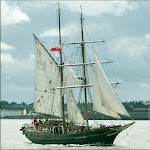
About 150,000 people from all over Ireland and from abroad have come to Galway for this long weekend to attend the city's two-week-long maritime festival, which is organised to celebrate the stop-over of the 2008/2009 Volvo Ocean Race (see my entry of May 24th).

According to experts, the Volvo Ocean Race is 'the 6th-biggest sporting event in the world', and the fastest and most expensive sailing boats ever built are taking part in the 37,000 mile round-the-globe challenge.

The Garda Síochána appeals to motorists travelling west to allow themselves "considerable additional time for their journeys", as long tail-backs are expected on the roads to Galway.

Fáilte Ireland, our usually quite useless tourist board, says that it now believes the additional income from the festival will far exceed the € 43 million it had originally predicted.

Attendance figures will set new records for a maritime event in the West of Ireland, but they will not reach the numbers Waterford has seen four years ago, when we hosted the start of the 2005 International Tall Ships' Race. In only four days, during which we had 88 sailing vessels in port - including 28 famous class A ships (which are at least 40 metres long, but many are a lot larger) - Waterford registered more than 450,000 visitors to the city (which has only about 60,000 inhabitants).

In two years' time - in early June of 2011 - we will host the same event again and I am looking forward to it already in great and happy anticipation.

The Emerald Islander

30 May 2009

Ex-Policeman charged with trafficking Women

A former police officer in the North and a woman have been remanded in custody and charged with human trafficking and controlling prostitution.

The accused, who appeared at Belfast Magistrates Court this morning, are the former policeman Simon Dempsey (39) from Newtownards in Co. Down and Chen Rong (32), a Chinese woman with an address at Kidderminster, in the English county of Worcestershire.

Both are alleged to "have facilitated the arrival of people in the UK, knowing a sexual offence would be committed".
Or, in normal English: They are accused of having smuggled Chinese prostitutes into Britain.

Last Thursday police officers raided a number of suspected brothels in Belfast, Derry and Newry and liberated six Chinese women who had been forced by a Chinese criminal gang to work there as prostitutes.

The women are now being cared for by specialist officers from Britain's Serious Organised Crime Agency (SOCA).

Police opposed bail for both accused, because the detective said he feared that they would flee the country, and interfere with identified and as yet unidentified victims.

A solicitor for Chen Rong claimed that the accused had herself been a prostitute before "being used by sinister people", while Simon Dempsey's lawyer claimed that the Chinese woman "had duped him" and that in fact "he knew nothing about the women being used as prostitutes".

Looks and sounds as if the two of them rather deserve each other.

The Magistrate refused bail for both defendants, and they were remanded in custody until June 26th.

Fianna Fáil are likely to lose their Dublin MEP, while Labour Party could win two extra Seats

A new opinion poll, published in today's edition of The Irish Times, suggests that Fianna Fáil is in real danger of losing its European Parliament seat in Dublin.

It shows that public support for the Fianna Fáil MEP Eoin Ryan (left) has slipped by a further two points to now 9%, while his political arch rival, Sinn Féin MEP Mary Lou McDonald (right), is currently down by three points since the last poll and stands on 11%.

However, the Socialist Party's leader and ex-TD Joe Higgins (right) has gained two points and stands now on 9%, level with Eoin Ryan.
With only six days left until election date and public anger growing, Higgins could cause an unexpected upset in the Dublin constituency by winning a seat. (And if he fails, his transfers will certainly help Mary Lou McDonald a lot more than Eoin Ryan.)

The MRBI poll also indicates that the Labour Party might have a realistic chance to gain two extra MEPs.

Senator Alan Kelly (left) in the South and Nessa Childers (right) in the East are believed to benefit from the ever growing national support for Labour. The poll suggests that they are both within reach to win a seat and thus triple the Labour Party's strength in the European Parliament. (At present, Dublin MEP Proinsias de Rossa is the sole representative of his party in Europe.)

A separate TNS-MRBI poll in yesterday's Irish Times showed Labour as the only party to make significant improvements since the last poll a fortnight ago.

I wonder if these latest poll results also indicate that the general mood of the Irish electorate is slowly shifting to the Left, and if this - on the long run - could break the stagnation in Ireland's domestic political system, which has been dominated for far too long by two right-of-centre parties: Fianna Fáil and Fine Gael.

The Emerald Islander

29 May 2009

CSO says: Export and Import Levels are falling

Preliminary figures show that goods to the value of € 7.28 billion were exported from Ireland in March of this year. This is a 6% drop from February.

The Central Statistics Office (CSO) in Dublin states that imports into Ireland were unchanged at a value of € 4.14 billion. The figures are adjusted to take seasonal variations into account.

Detailed figures for the first two months of 2009 show that imports slumped by 25% to the value of € 10.7 billion, as spending power in the Irish economy weakened, with imports of road vehicles plummeting by 74%.

Imports of computer equipment were down 34%, while imports of all types of machinery were "down sharply".

There was a 4% fall in exports in the first two months of 2009, compared with the same period last year, to the value of € 13.9 billion, with electrical machinery down 40% and computer equipment down 29%.

Exports to China were down 24% in the first two months of this year, while exports to Britain fell by 6%. But exports to the USA were 6% higher than in the same period of last year.

Huge Increase in Working Days lost

Official figures also show a sharp increase in the number of days lost to industrial disputes in the first three months of this year.
The CSO says that 11,327 working days were lost in that period, compared with only 1,477 days in the same period of last year.
However, these figures come from only three industrial disputes, and the main factor was a one-day strike by civil servants over the pension levy in February.

First Fall in Irish Mortgages since 1990

Ireland's property market is in stagnation as house prices are falling steadily (see my entry of May 27th) and most people have neither the money nor the will to buy property at this time of economic recession and financial insecurity.

The latest monthly statistics from the Central Bank of Ireland show now the first net fall in mortgage lending since 1990.
The bank's figures for April 2009 confirm that the Irish property market has slowed to a trickle, and in some parts of the country it has dried up completely.

It is the first time that repayments on existing mortgages have been greater than new mortgage lendings since the Central Bank began this monthly statistics series in 1990. Overall, mortgage lending fell by over € 100 million last month.

The amount of money lent out in the rest of the economy also fell, reflecting concerns raised by many business groups about their great difficulties of accessing credit, or even normal business overdraft facilities to maintain proper cash flow.

The Central Bank's statistic also shows a sharp fall-off in credit card spending. The amount of money Irish consumers spent using their credit cards in April was € 180 million lower than in April of last year.

Anglo Irish Bank lost € 4 Billion in six Months

Another day, another scandal. This is now the norm here in the Irish banana republic.

Today's serving of outrage is the news that (the now nationalised) Anglo Irish Bank (right) has lost a total of € 4.1 billion in six months (the fourth quarter of 2008 and the first quarter of 2009).
This is on average a loss of € 683 million each month, or € 22.75 million every single day! And it is also the by far biggest bank loss in the history of the Irish state.

The bank's results also show that deposits from businesses have dropped by almost € 9 billion after nationalisation.

Anglo Irish Bank's new chairman Donal O'Connor says that "lending has been imprudent, and the results are very disappointing".

I put it a bit more bluntly: The bank's behaviour was nothing but criminal. And thus those who were responsible for the blunder should be prosecuted and brought to Justice.

Donal O'Connor also indicates that "the total loan losses are likely to reach € 7.5 billion".

Anglo Irish Bank has now written off the sum of € 308 million in relation to loans to ten 'long-standing clients', who then used these funds to buy shares in the bank.
The ten very wealthy individuals who participated in this scam subsequently became known in public and in the media as the 'Golden Circle'.
A total amount of € 451 million was lent by Anglo Irish Bank to members of the 'Golden Circle' , but as it looks the bank may not get € 308 million of that money back.

Among the losses disclosed today were also € 31 million on loans to former directors of Anglo Irish Bank.

The government now plans to seek the EU's approval to put another € 4 billion of State money - which means in fact Irish taxpayers' money - into Anglo Irish Bank in the coming weeks.

Finance Minister Brian Lenihan (left) has announced that he will recapitalise the rotten bank.
"Winding up Anglo Irish, the third-biggest bank in the country, is not an option," he stated, nailing his colours firmly to the mast of a sunken ship. "The priority is to stabilise the bank," Lenihan emphasised.

Well, I am no banker, but as an old sailor let me say this: One can well stabilise the wreck of a sunken vessel, in order to prevent it from drifting, slipping or from becoming a danger to other shipping. But one can never re-float and sail a ship after it was sailed onto rocks and crashed.

The Emerald Islander

Latest Poll shows Labour Party gaining Support

With just one week to go to the European and local elections, the latest national opinion poll indicates that Fianna Fáil is still on course for disastrous results on June 5th.

The TNS/MRBI poll, published in today's edition of The Irish Times, shows that the Labour Party is the only party with significant improvements since the last poll a fortnight ago.

If Fianna Fáil were hoping for a late surge in support as this election campaign enters its final week, there is no sign of it so far.
The poll shows the party's support at just 20%, down one point since the last poll two weeks ago. (see my entry of May 15th)

Fine Gael are down two points, to now 36% support. But they are still by far the biggest party, and 16 points ahead of their arch rivals.

As mentioned above, Labour are the only point gainers in this poll. They are up three points to 23%, which puts them nationally in second place, after Fine Gael and ahead of Fianna Fáil.

The Green Party, which is now not much more than the outdoors and gardening department of FF, stands unchanged at 3%. This indicates that their core support still exists, but that no-one else will touch them with a barge pole.

Sinn Féin have dropped one point and stand on 8%, while Independents 'and others' (which includes Libertas) are up one point to now 10%.

However, with separate questioning - focused only on the local elections - Independents 'and others' are getting 19%, almost twice their average national support.

This is no surprise, as the amount of independent candidates or smaller parties and groups (such as the Socialist Party, the Workers' Party, the Socialist Workers' Party and 'People before Profit') is very different from one constituency to the next.*
And it is of course in the nature of independent candidates that each one of them has a different personality and thus will appeal to the electorate in a different way.

Overall satisfaction with the Irish government is - surprisingly - up slightly, but by only two points to a still disastrous 12%. The vast majority of the Irish electorate - now 84% - remains dissatisfied with the government's shambolic performance.

Satisfaction with the Taoiseach is also up - by three points - but at 21% he still has the lowest satisfaction rating of all party leaders. (He is even beaten into last place by his coalition partner, as the Greens' leader John Gormley comes in on 25% support.)

Labour Party leader Eamon Gilmore retains the nation's highest satisfaction rating, with now 49%, which is two points lower than his amazing 51% a fortnight ago.

The Emerald Islander


* For example: The Socialist Party and the Workers' Party are both nominally parties with a nation-wide attitude and ambition. And they both have members in different parts of the country.
However, regarding actual strong support and thus any chances for electoral success, the Socialist Party is limited to the northern half of Dublin (city and county), while the last - and currently only - Irish constituency with elected representatives from the Workers' Party (which was founded as a break-away group from the old Sinn Féin) is Waterford City.

28 May 2009

Largest Irish Wind Farm planned in Co. Clare

Plans have been announced today for the construction of the country's largest community wind farm. It will be developed on Mount Callan in Co. Clare, in the West of Ireland.

The project represents an investment of € 200 million and will be capable to meet the energy needs of all of Co. Clare and half of Co. Limerick.

Thirty local farming families will have the biggest shareholding in the new company - West Clare Renewable Energy - which is developing the project.

They collectively own more than 3000 acres of mostly elevated land on Mount Callan, located between Ennis and Miltown Malbay. There they plan to construct 30 wind turbines with a production capacity of three megawatt.

300 new jobs are expected to be created during the two-and-a-half year construction phase.

Efforts to develop a wind farm in the Mount Callan area have been ongoing for over 15 years, but they had not been successful. Only the combined input of so many local families has made the project now feasible.

Landowner John Talty says that the community wind farm is designed to "create long-term sustainable employment, reverse depopulation in the area, and help struggling farmers secure an alternative form of income".
The project also meets the government's plans to invest in cleaner energy sources.

One can only welcome such a brilliant project with open arms, applaud the entrepreneurial and community spirit of the people in Co. Clare and wish them success and the best of luck.
Hopefully more Irish farmers in different areas - in particular on the west coast - will take note of West Clare Renewable Energy and organise similar projects for their communities.

Only three weeks ago the Spirit of Ireland group has presented their magnificent ideas how Ireland could become energy-independent and even an energy exporter within a few years. (see my entry of May 8th)
There is no shortage of wind and water here, and if we can use them to produce electricity, solve our own energy problems and then become truly wealthy by supplying electricity to continental Europe, let's get on with it and do it.

The Emerald Islander

President backs Abuse Prosecutions

President Mary McAleese (photo) believes that people should face prosecutions as a result of the Ryan Report (see my entry of May 21st) into the systematic torture and child abuse by members of religious orders of the Catholic Church.

The President was speaking in Boston, on the final leg of her official visit to the US state of Massachusetts. There she has been meeting Irish-American communities and promoted Ireland's industry and tourism.

As the presidential good-will tour coincided with the publication of the Ryan Report here, a considerable amount of publicity in US media on the fall-out from the report overshadowed the visit. (With some careful planning, scheduling and co-ordination it would have been possible to avoid that.)

In an interview with RTÉ News the President said today that the report showed "a catalogue of criminal offences", and that "people who committed these awful crimes against innocent children should face prosecution".
Even though prosecution might not bring closure, it would bring Justice, she added.

Mary McAleese is to be saluted on this clear statement and on her straight and honest approach. She stands high above the Irish government, which is now trying to wriggle itself out of the mess it created, while it still tries to protect the Catholic Church from taking full responsibility for her horrible crimes.

The Emerald Islander

27 May 2009

Intel Staff Meetings over Redundancies

Today the management of Intel (Ireland) Ltd. held meetings with staff members who have volunteered to take redundancy.
In February the US company, which is the world's leading manufacturer of computer chips, announced plans to cut "up to 300 jobs" at their Irish main production facility in Leixlip, County Kildare through a voluntary redundancy programme, which is part of a worldwide cost-cutting plan.

The company indicated that the jobs would go before June of this year, but a definite time-scale has not been announced. It is also not known how many of Intel's staff members have applied for voluntary redundancy.

Employees interested in availing of the programme have made applications to the management over the past few months, and today they found out who will stay and who will go.
One-to-one meetings between line managers and staff began early this morning and went on for most of the day.

Implementing their global cost-cutting plan, Intel has shed already thousands of jobs this year and manufacturing plants in China, Malaysia and the Philippines have been closed.

Intel employs currently more than 5000 people in Ireland and is one of the most important high-technology companies in the country.

The Emerald Islander

New Hygiene Guidelines for Irish Hospitals

Public hospitals and other health facilities in Ireland have one year to comply with a new set of mandatory hygiene standards that were published today. And to begin with, they have now six months to "produce an analysis of how they are currently complying or not complying with the standards".

The Health Information & Quality Authority (HIQA) will conduct both announced and unannounced inspections "to ensure that all hospitals meet the twelve new standards".

They cover areas such as hand hygiene, medical device infections, antibiotic resistance, physical environment and disease control.
In other words, they demand behaviour that most people would regard as common sense.

Jon Billings, the HIQA's 'Director of Healthcare Quality' (now there is some title to behold!) says that "most of the standards are straightforward to implement with changes in culture, behaviour, planning, management and leadership".
Or, as I mentioned already above, by using simple common sense.

The first facilities to be "targeted" for inspections are expected to be Ireland's acute hospitals. But the system will also apply to GP and dental surgeries as well as community care facilities.

The HIQA will then "publish the findings on how the inspected institutions are complying with the new rules".

Well, this is just what we need, isn't it? Another quango full of overpaid bureaucrats, producing big reports that no-one will read or act upon. All financed by you and me - the Irish taxpayers.
And at the same time wards are closed because there are not enough doctors and nurses!

The interesting aspect is that private hospitals are exempt from the HIQA inspections. Another proof for the unfair and unacceptable two-tier system in Ireland's healthcare.

According to the government, "it is expected that private facilities will come under the HIQA inspection system when planned legislation, arising from the Commission on Patient Safety & Quality Assurance (another one of Bertie Ahern's useless quangos) comes into force".

And when that will be is anyone's guess. Given the usually slow speed with which Dáil Éireann progresses in normal legislation, it might not even happen in my lifetime.

The Emerald Islander

Irish House Prices back at 2004 Levels

The latest index from the Irish Economic & Social Research Institute (ESRI) and permanent tsb bank reveals that house prices in Ireland have fallen by almost 2% last month.
This brings the prices for residential property back to levels not seen here since the summer of 2004.

On national average house prices have fallen by almost 5% in the first four months of this year.

According to this index, the average price paid for a house in April 2009 was € 248,640, compared with € 261,573 in December and € 311,078 at the peak of the property bubble in February 2007.

Prices for the (usually least expensive) houses in the 'first-time buyer category' are falling at the fastest rate and are down 7.9% already this year.

"This is the fastest rate of decline in national prices that we have seen to date since the index started in 1996," says Niall O'Grady of the permanent tsb bank, one of Ireland's major mortgage lenders.
"The particularly dramatic reduction in prices for first-time buyers reflects their reluctance to buy in a market that is still declining and where unsold properties are being reduced further."

Meanwhile several leading economists and independent analysts are predicting that property prices in Ireland will continue to fall "for at least another 12-18 months".

The Emerald Islander

Quality of East Coast Beaches "disappointing"

The quality of Ireland's east coast bathing water has deteriorated significantly last year, with a doubling of the number of beaches failing to provide 'minimum mandatory standards'.

A new report from the Environmental Protection Agency (EPA) says that even though beaches on Ireland's west coast performed well, the east coast experienced major difficulties, particularly around Dublin.

While the EPA points out that Ireland's bathing waters "remain of a high quality", the sad fact is that more than 20% of them failed to pass two EU quality tests.

Nine bathing areas - out of a total of 131 tested - were found to have failed even the most basic 'minimum mandatory standards'.

Four of the bathing areas were identified in just one local authority area - Fingal County (which is part of the Greater Dublin area).
They are the beaches of Balbriggan, Loughshinny, Malahide and Portrane.

Of the 14 beaches within the Dublin local authority areas, only three were found to have passed both EU mandatory values and the stricter analysis known as 'EU guide values'.

"Poor weather conditions during last summer are partly responsible", explains Dr. Michael Lehane of the EPA. But he describes the test results as "disappointing", and adds that "unless all necessary actions are undertaken", the problems will reoccur.

As things are right now - with our economy in recession, the whole country in turmoil, our incompetent government in chaos, and money being short everywhere - it is rather unlikely that much attention will be paid to the specific conditions of our beaches. Which means that probably even more of them will fail the EU tests next year.

While the east coast, and in particular the Dublin Bay area, are getting the black mark, Ireland's west coast appears to be in good condition.
All of Co. Donegal's 19 official beach areas, as well as the 15 beaches each in Counties Mayo and Kerry, passed both EU tests.

So, if it is a beach holiday you have in mind for this summer, forget the east coast and go bathing in the West.

The Emerald Islander

26 May 2009

Major DUP Reshuffle in the North

The Democratic Unionist Party (DUP) in the North revealed significant changes to it's present parliamentary representation. This will lead to a major reshuffle of some of the most senior Unionist positions in the Northern Assembly and could provide promotion chances for some of the party's younger generation.

DUP leader Peter Robinson (above), who is the First Minister of the Northern Administration, has announced that six of his party's Westminster MPs will give up their positions in Ulster and concentrate full-time on their work in the British House of Commons.

The Northern Environment Minister Sammy Wilson (left) and his party colleague Gregory Campbell (right), who is Minister for Culture, Arts & Leisure in the power-sharing administration of the Six Counties, will relinquish their current posts and concentrate in future on Westminster politics.

Just two of the DUP MPs - Mr. Robinson himself and either Nigel Dodds or Jeffrey Donaldson - will stay in ministerial positions in the power-sharing executive.

Iris Robinson (who is Peter Robinson's wife), David Simpson and Willie McCrea, who all chair committees in the Northern Assembly, will also step down from their positions. This large DUP reshuffle will put the stability of the power-sharing executive to the test.

The changes are made partly in anticipation of a change in British law, which still allows dual mandates. It is expected that a ban of such arrangements will be introduced in the UK in the near future, and Conservative Party leader David Cameron (left) has already stated that he would do exactly that if he wins the next general election (which could take place within the next twelve months). Cameron also said he would favour preventing Sinn Féin MPs from claiming their expenses and allowances at Westminster, unless they take their seats in parliament (which they currently don't, because they refuse to swear the 'Oath of Allegiance' to the Queen, which is demanded from every MP).

Dual mandates for political representatives, which were fairly common in the past, have been already abolished in Ireland and most other EU countries.

At present 16 of the North's Westminster MPs are also members of the Stormont Assembly.

The current media storm over British MPs' expenses claims is causing a massive controversy at Westminster, and in the wake of this frenzy, questions are also being asked about the validity of politicians holding two - and sometimes even three - official jobs and mandates at the same time.

There are currently only two exceptions to the North's double mandate 'rule': the sole Ulster Unionist MP Sylvia Hermon, and the SDLP's Eddie McGrady.
Five Sinn Féin MPs and two SDLP representatives at Westminster are also members of the Northern Assembly.

It is quite possible that the DUP's reshuffle will trigger similar moves in other parties, and this can only be good for the democratic process and politics as a whole.
People who hold public office for too long, or hold too many positions at the same time, tend to make the process of government slow and inefficient. Some new blood ever so often is necessary, for political bodies quite in the same way as it is for families and dynasties.

The Emerald Islander

25 May 2009

New Motorway in Co. Cork

A new stretch of modern motorway (photo) between Fermoy and Mitchelstown in the north-east of Co. Cork opened to traffic for the first time this afternoon.

The new motorway part, whose building cost € 174 million, was completed nine months ahead of schedule.

This is good news for motorists and means that all but a 40-km-long segment of the overland road from Dublin to Cork is now at motorway or dual carriageway standard.

The final remaining section, which is currently under construction, will link the Portlaoise bypass with the M 8 motorway at Cullahill in Co. Laois and is expected to be completed in the second half of 2010.

24 May 2009

Volvo Ocean Race reaches Galway

Regular readers know that I am an old sailor and retired naval officer. And some also know that I am still involved with the sailing community, including STI (Sail Training International). So anything that involves ships, boats and the sea does naturally interest me. However, I am not a great friend and supporter of completely commercialised events that are predominantly large advertisement boards for numerous big companies, with the sailing vessels and their crews degraded to mere 'supporting acts' in the corporate show of vanity.

From today on the spotlight will be on Galway, the largest city in the West of Ireland, which is hosting a two-week-long maritime festival to celebrate their participation in the 2008/2009 international round-the-globe Volvo Ocean Race.

In the early hours of this morning the participating boats entered the port of Galway, finishing the 7th leg (of ten) in this demanding race. They had left the US port of Boston at 1300 h local time (1700 h GMT/1800 h BST) on May 16th for their 2550 nm course to Galway, via St. John's (Newfoundland).
The first boat to arrive in Galway was the Ericsson 4 at 0054 h GMT (0154 h BST), winning leg 7 of the race in a time of 7 days, 10 hours, 33 minutes and 51 seconds. Thus Ericsson 4 gained 8 more points, extending her position as the overall race leader with now 94.0 points on the board.

The Irish-Chinese boat Green Dragon - which obviously attracts the greatest interest and support among the maritime community in Ireland - entered Galway at 0315 h GMT (0415 h BST), finishing leg 7 in third position (behind the Puma, which was the runner-up in the Boston to Galway race).
Overall the Green Dragon is now in 5th position (out of 8) on the board, with a total of 53.0 points.

The international round-the-globe Ocean Race, which is one of the most challenging competitions of its kind, began in 1973 (then under the name of a different sponsor) and was inspired by the achievements of two great British sailors, Sir Francis Chichester and Sir Robin Knox-Johnston.

The 2008/2009 race started last October in the Spanish port of Alicante, with the first leg going all the way across the South Atlantic, down to Cape Town (above) in South Africa.
From there the boats set course for Cochin in India (leg 2), and after some rest they continued east-southeast to Singapore (leg 3). Leaving the 'Pearl of the East' on January 18th, the fleet sailed north on leg 4, to Qingdao (formerly the German colony Tsingtao) in China. From there they set out on leg 5, the longest and toughest part of the competition, with a 12,300 nm course across the Southern Pacific and around Cape Horn (which is the most difficult thing to do for any sailor).
Having left Qingdao on February 14th, only five of the boats - including the Green Dragon - made it through leg 5 and arrived at Rio de Janeiro in late March. It took Ericsson 3 - the winner of this leg - 40 days, 23 hours and 26 minutes of sailing to reach Rio, and the last of the competitors came into port three days later.
After some welcome rest days in sunny Rio de Janeiro, the fleet set sails again on April 11th, embarking on leg 6 of the race to Boston, Massachusetts (below), which they reached on April 26th (and left again for Galway on May 16th).

With seven of the ten legs finished, the overall race positions of the boats are as follows:
  1. Ericsson 4 (94.0 points)
  2. Telefonica Blue (81.0 points)
  3. Puma Ocean Racing (80.0 points)
  4. Ericsson 3 (62.5 points)
  5. Green Dragon (53.0 points)
  6. Telefonica Black (39.0 points)
  7. Delta Lloyd (31.0 points)
  8. Team Russia (10.5 points)
On June 6th leg 8 of the race will be started in Galway, sending the boats on a 1250 nm course to the Swedish port of Gotenburg-Marstrand. From there they will go on a short course (leg 9) to Stockholm, and the final leg will bring them from the Swedish capital to St. Petersburg in Russia, where this year's race ends after more than 37,000 nm.

Until June 6th the city of Galway, despite her still unsolved problems with the local drinking water (see my entries of September 23rd, 24th, 27th & 30th, 2008), is hosting a huge festival, which includes all kinds of the arts, music and performances.
Galway has a long reputation for her artists and cultural diversity, as well a being a 'fun city'. So I presume they will make a good effort to please the many visitors that are expected over the two weeks.
But even more interesting for the City Council and Galway's business people are the € 43 million of extra income for the local economy the two-week-long festival is expected to create.
And, given the fact that we have local government elections on June 5th, the sitting members of Galway City Council should also benefit from the additional 'feel-good factor'.

The Emerald Islander

23 May 2009

Well done, Leinster!

The Leinster 'Blues' have kept the coveted European Rugby Cup - also known (for its sponsors) as the Heineken Cup - in Ireland by beating the English club Leicester 'Tigers' at the Murrayfield stadium in Edinburgh 19-16.
(People who believe in numerology might well see a special significance in this result, as the scores of both teams written in succession give us 1916, the year of the Easter Rising in Dublin, which is the capital of Leinster as well as the capital of Ireland.)

Leinster had reached the final of this prestigious annual European competition for the first time after they beat - for many rather surprisingly - their permanent national rivals Munster (which are usually seen as the stronger team and won the European Rugby Cup in 2006 and last year) in the semi-final at Croke Park in Dublin 25-6.

I am not a follower of Rugby, and certainly no expert on this sport. So, for an opinion I have to rely on the knowledge of a friend who played Union Rugby for many years. From what he tells me, Leinster "had generally the better of the game at Murrayfield, but were forced to stage a strong fightback after falling 16-9 behind early in the second half". Obviously they fought back successfully, scored 10 more points (while Leicester scored none) and won the match 19-16.

From an outside position as a complete Rugby layman - and even though I live in Munster - I like nevertheless to take this opportunity to say "Well done, Leinster!" and wish them good luck for the future.

Leinster's success is the fourth time an Irish team has won this Cup. The first to bring home the silver trophy were Ulster in 1999, followed by Munster in 2006 and 2008.
And if the recent form of Irish Rugby is anything to go by, we might well see more of the same in years to come.

The Emerald Islander

Shopping as it should be

Being a single man, living with a cat as my only companion, I do all the cooking and household chores that many other men have done for them by a woman. But I am not complaining. In fact, I like cooking and see it as one of the creative arts.

I also like to go shopping for groceries, which has of course to come before I can start cooking. And unlike many women I see in the supermarkets each week, filling their trolleys thoughtless and senseless with piles of expensive and unhealthy items of processed food, I am a discerning and selective shopper. I am also very price-conscious, a trait I have inherited from my mother.

So when I go shopping, I always look out for bargains or special offers, and in general I seek good value for my money. This does not mean that I always buy the cheapest items. Good value for money means getting quality for a fair price. As Ireland is quite an expensive country, with most things costing about twice as much as they cost in most other EU countries, it is worth to shop around.

Over the years I have developed personal shopping habits, buying a range of particular items in various shops, depending on quality and price. For my normal weekly grocery shopping I usually frequent three different local supermarkets (two Irish-owned and one foreign) and one small Polish shop that has opened here a few months ago and stocks certain continental delicacies one would not find in Irish shops or supermarkets.

One of the Irish supermarkets I use regularly is SuperValu, a chain of franchised stores under the umbrella of the Cork-based Musgrave Group. It is located in a small shopping centre, only a short walk from my house, and offers a wide range of quality food at fair prices.
The same also applies to the other two supermarkets I frequent, so I always decide carefully what I buy in one or in the others.

What makes SuperValu stand out from their competitors in recent weeks and months is their pro-active response to our current recession.

For the past nine months the Irish economy has not only seen a massive downturn in the wake of the global financial crisis, it has actually crashed and created widespread economic stagnation and the highest rate of unemployment this country has seen for decades.
Our current government, which is chiefly responsible for the terrible mess we are in, has no idea how to lead us out of it again. Facing a huge budget deficit - due to a drastic fall in tax revenue - Finance Minister Brian Lenihan just raises taxes all over the place and imposes extra levies on all those who still have a job. This gives him some extra money on the short-term, but it means of course that most people in Ireland have now less money in their pockets.
Subsequently everyone is tightening the proverbial belt and tries to spend less. And this has of course a direct and significant impact on all Irish shops and businesses.

People still need to eat, to wash their clothes and to clean their houses, but supermarkets and shops feel already the pinch of the nation's reduced spending power.
Some grocery shops just carry on as usual, hoping that people might still buy their products at the normal prices and make their personal spending cuts elsewhere. But the major supermarket chains are beginning to wake up and present their customers with ever more bargains and special offers.

This is a very welcome development and can only be further encouraged.

And though all supermarkets are making efforts now to retain their regular customers and gain new ones as well, the one that stands out from the rest and truly deserves a special mention is SuperValu.

Like most supermarkets, they always have - and had for years - special offers and promotions, usually on a weekly basis. But now SuperValu is going even a step further and offers special deals I have not seen anywhere else.
They actually give away certain food items for free, usually in very lucrative combination offers that are particularly suitable for families.

In recent weeks they offered nice cuts of Irish round roast (beef) at half of the normal price, and for every piece of meat one bought, one got either a small bag of potatoes, a bag of carrots, or a net of onions thrown in free of charge.

This is - in my humble opinion - the right attitude towards loyal customers and a proper and sensible reaction to the current recession and the general shortage of money in people's pockets. Or, to say it with SuperValu's own motto: Shopping as it should be.

When I went there yesterday and saw the week's specials, my heart actually leapt in joy. There were large bags of Irish apples and punnets with clementines, strawberries and blueberries on offer, and all of them for just € 1 each! There were also some other items available for the great price of € 1, including a pound of butter, a large bag of potato crisps (which I don't eat, although they are very popular in Ireland) and a litre block of vanilla ice cream.

I bought plenty of the fruit and went home with a heavy bag, but had actually spent less money than I would normally spend on a Friday. And I think that such commendable action by an Irish retailer deserves to be mentioned to the readers of this weblog.

I also obtained a brochure with special offers for next week, and they are again very attractive, but too many to mention them all here. However, let me tell you that they include sirloin steaks at half of the normal price, with a bag of chips thrown in free of charge for every purchase. So, if you want to treat yourself to a traditional Irish dinner of steak & chips, next week (May 25th - 30th) is the time to go shopping at SuperValu.

The Emerald Islander


P.S. To avoid any misunderstandings, I should mention here that I received no payment or compensation in kind for the article above. I wrote the piece because I think that in hard times, when money is tight and everyone is trying to make ends meet, one should know who cares for the needs of the nation. And when I see good deeds done, I like to share them with my readers, in the same way as I will always expose those who are trying to exploit or overcharge us.

Jacob's end Production in Ireland

Jacob's, Ireland's famous manufacturers of biscuits, crackers and wafers (and one of the oldest and best-known brand names on this island), have baked the last biscuits at their factory in Tallaght, County Dublin yesterday afternoon.

As Tallaght was the company's last manufacturing facility in the Republic of Ireland, this means the end of production of our favourite biscuits in our own country.

The closure of the plant, which had started production in the 1970s, had been already announced in September 2008, and a gradual wind-down process of production took place since then. However, the closure means that another 220 jobs are lost in Dublin, and in the harsh recession we are in, that hurts.
Jacob's sales, marketing and administration departments, which together still employ about 100 people, will remain in Tallaght, at least for the time being.

The 15 popular brand lines of the company (most of which are market leaders) will from now on be manufactured in several plants in Britain and on the European continent, where - according the company's chairman Michael Carey - "the production is more efficient and less costly".

In modern business language this is called 'outsourcing'.

The Jacob's plant at Belgard Road in Tallaght had been working with only 16% of its full capacity for years, and in times of recession this is a situation few companies would or could maintain.

Even though Jacob's have been in Dublin for more than a century, the company was not founded in the capital. Like so many good and important things in Ireland, Jacob's biscuits came originally from the Emerald Isle's oldest city - Waterford.

In 1881 two brothers - William and Richard Jacob - opened a small biscuit bakery here in Bridge Street, close to the river Suir (and leading onto the city's only bridge).

They did very well, and soon their products became popular all over Ireland.
As the business began to grow and expand,
W & R Jacob moved to larger premises on Dublin's Bishop Street (left), a site now occupied by the National Archive of Ireland. The brothers also had another Dublin factory in Peter's Row and later opened an English branch in Liverpool as well.

In 1916 the Bishop Street factory was one of several prominent Dublin buildings occupied by members of the Irish Citizens Army during the Easter Rising.

In the 1920s the company's two branches separated, with the Dublin branch retaining the W & R Jacob name, while the Liverpool branch was renamed Jacob's Bakery Ltd.
In the 1970s W & R Jacob merged with Boland's Biscuits to form Irish Biscuits Ltd. and moved to Tallaght, into the then new manufacturing plant that has produced its last biscuits yesterday.

Since 1990, when the company was bought by the French food giant Groupe Danone, Jacob's is strictly speaking no longer an Irish company. After several changes, the English branch is now part of the multi-national United Biscuits, while the Dublin branch was acquired a few years ago by the Fruitfield Food Group, which then changed its name to Jacob Fruitfield Food Group.

Jacob's biscuits are very popular here, and an almost essential part of every Irish childhood and growing-up process. And even as an adult I still like them very much. In fact, while I am writing this, I have two of Jacob's famous fig rolls sitting beside my mug of tea.

I presume that we will see Jacob's products on the shelves of our shops and supermarkets in the future, as we have seen them for all our lives. But I wonder if we will from now on have the same sentimental feelings that we always had when buying them.
Although we knew perfectly well that they were made in Dublin and Tallaght, for us they were somehow still 'our own' Waterford biscuits from Bridge Street.
Now they are not even made in Ireland any longer, and it is sad to see a great manufacturing tradition end after 128 years.

The Emerald Islander

22 May 2009

It all began with Eamon de Valera

As the day sets and the weekend approaches, Ireland is still in deep shock over the revelations of the report on long-time organised child abuse in Catholic institutions. This 3000-page document is the result of more than ten years of investigation, was compiled by a State Commission chaired by Judge Seán Ryan and published in Dublin on Wednesday. (for details see yesterday's entry below)

Many people are very angry, others say they "just feel numb" as they never expected that such things could happen, and certainly not in 'Holy Ireland', where priests and religious were put on pedestals for centuries and worshipped almost as much as God and Jesus Christ.

Perhaps this over-reverend, sycophantic and almost slavish attitude towards people in cassocks and habits was one of the contributing factors to the terrible crimes Irish priests and religious committed against Irish children for more than five decades. Anyone who is treated by others like a demi-god may after a while begin to believe that he actually is a demi-god and behave accordingly. (And there are many examples for that in history.)

Or, as the famous Lord Acton wrote in the 19th century: Power corrupts, and absolute power corrupts absolutely.

The first 'industrial schools' for "neglected, orphaned and abandoned children" in Ireland were established by the British colonial administration in the second half of the 19th century under the Industrial Schools Act of 1868. (A similar Act of Parliament was passed already for England in 1857.) The Act was intended to "solve problems of juvenile delinquency, by removing poor and neglected children from their home environment to a boarding school". It allowed magistrates to send "disorderly children" to a residential 'industrial school'.
A further Act of 1876 led to the establishment of non-residential day schools of a similar kind.

It is however worth to point out that the number of children sent to these special schools was not very large in the early years of their existence. Then the size and purpose of Ireland's 'industrial schools' was significantly increased, at the same time that Fianna Fáil - which had until 1927 refused to sit in the Dáil (because they were required to swear an oath of allegiance) or take part in normal parliamentary business - gained power in Ireland for the first time in 1932.

The party's founder and first leader Eamon de Valera (photo) was not only a very pious and old-fashioned Catholic (in the Spanish tradition of his Cuban father) who contemplated at least for some time to become a priest himself, he was also a very strict and authoritarian man who demanded blind and uncritical loyalty from all his followers. (Although the present party leader - Taoiseach Brian Cowen - is the seventh man in charge of Fianna Fáil, the party's demand for blind loyalty, regardless of facts and common sense, is still the same as under de Valera.)

The year that saw Fianna Fáil taking control of the 'Irish Free State' was a time of great upheaval in Spain, where the conflict between different social and political groups would eventually lead to the Spanish Civil War (1936-1939).
De Valera had Spanish as well as Irish roots, and during the first years of the (second) Spanish Republic, which had been established in April 1931, he and many other traditional Catholics all over Europe were very upset by the reports they received from Spain.
Representatives and supporters of the left-wing republican movement turned their anger not only against aristocrats and land owners, but also against Catholic priests and religious, who were seen by many (and with good reason) as backbones of the conservative and reactionary system that had ruled Spain for centuries and ruined her economy. Some Catholic clerics were killed by mobs, others were put on trial in courts and sentenced to death or imprisonment. A number of churches and monasteries were closed or confiscated, and in general life was hard and dangerous for anyone openly supporting the Catholic Church in Spain at that time.

During the 1930s Ireland was still a very young State without a solid base, strong economy or developed infrastructure. And the scars of the Irish Civil War, which ended in 1923, were only too visible everywhere. Old comrades had stood on opposite sides in this short, stupid and totally unnecessary conflict which literally pitched brother against brother and divided families for ever. There was also still a very large and poverty-stricken underclass in Ireland at the time, and who could say if these people might not behave in similar fashion as the poor working classes in Spain, if they got a chance to revolt against the authorities of State and Church.

Parallel to the events in Spain, Benito Mussolini was celebrating ten years of Fascist rule in Italy, and in Germany Adolf Hitler had increased his support so much that it was only a question of time when he would be in power, too. (He got there on January 30th, 1933.)

Unfortunately there has never been any deeper historical research into the personal and political motives of Eamon de Valera and his closest advisers in these early years. I hope that someone will undertake this work and provide us with more insights at some stage.
But for the time being one can only speculate about de Valera's thoughts and feelings during the first few years he was back in charge of the country. (He had been already the head of state and head of government of the unilaterally declared Irish Republic from 1919 to 1922, but resigned over the Anglo-Irish Treaty and stormed out of the Dáil, followed by his supporters. This split led to the Irish Civil War, but even after hostilities had ceased, de Valera and his new political party Fianna Fáil - founded in 1926 - remained refuseniks until 1927, when they decided to join the democratic system of the State.)

It is quite possible and more than likely that between Eamon de Valera and the conservative Irish bishops a strategy was agreed to prevent any left-wing and anti-Catholic revolution in this country.
Every Catholic theologian is familiar with the famous words of Ignatius de Loyola (founder of the Jesuits), who said: "Give me a boy of seven, and I will give you the man."
And even though the Jesuits were never involved in the running of the 'industrial schools', their extensive use under the Fianna Fáil government of Eamon de Valera was most likely inspired by Jesuit thinking and teaching.

The idea of having special schools for the poor (and not just for 'juvenile deliquents'), run and controlled by the Church, would have been very appealing to an authoritarian and conservative Catholic like de Valera. In these schools "the lesser skilled children from the lower classes" could learn a trade that would give them a chance of employment, and they would also receive strict religious instructions and conservative indoctrination to keep them "on the right side of the track".

The same kind of thinking is also evident in the new Irish Constitution, which Eamon de Valera introduced in 1937, and in the new structure of Seanad Éireann, which was re-organised by him according to different social groups in society, and thus along the lines of Catholic social theory of the time. (see my entry of March 23rd)

Neither Eamon de Valera, nor his close friend and spiritual adviser John Charles McQuaid, CSSp (who was later Archbishop of Dublin from 1940 to 1972), were particularly mercantile-minded. So it is unlikely that they saw the huge potential for making massive profits with the 'industrial schools'.
This only dawned on the religious orders after running them for a while on the new enlarged scale, and they then tried to expand the size of their institutions even further and thus maximise their profits as well.

Whatever one might think of Eamon de Valera, he was not a child molester and would certainly never have imagined that the institutions he wanted to use to stabilise the social structure and system of the State would become places of organised child abuse by priests and religious.

But - like anyone else who has held political office in Ireland between the 1930s and the 1980s - Eamon de Valera carries a share of responsibility for the horrible crimes now revealed and documented. Not so much for increasing the use of the 'industrial schools', but more for the ignorance and disinterest he and his ministers displayed when they received complaints from the abuse victims, their parents and relatives, or even from some concerned civil servants of their own administration.
They simply did not care what happened to "brats from the lower classes". They could not even be bothered to have a good look at the institutions, to establish what conditions they - and their inmates - were in.

In the same era that saw Ireland's 'industrial schools' enlarged, the ordinary and 'law-abiding' people of Germany did and said nothing when they saw their Jewish neighbours rounded up by Police and SS. Jews were marched to the local railway station, put on a train and disappeared, never to be heard of again.
Research has established that most Germans did not know in detail what was actually done to them. But they all knew that their former neighbours were not going away on holidays, and not moving house in the normal way (as they were only allowed hand luggage and all their furniture and major possessions were left behind). Some may have guessed, others imagined the truth, as there was of course a massive Nazi propaganda campaign against Jews for many years. But even those who did not think much about Jews knew that they were forced to go, and that they would not come back. This did not bother them in any way, but it made them co-responsible for crimes against humanity.

The same attitude existed in Ireland, where everyone knew at least some of the sinister Catholic institutions, and knew that there was 'something wrong' with them. But no-one cared, bothered to have a closer look, or asked questions.
Which means that as a nation we are collectively guilty as well. People over the age of forty who lived in Ireland during those decades should ask themselves how much they knew, and what they might have been able to do, if they had been more courageous. All those who were in any kind of authority in Ireland participated and collaborated with the system of collective cruelty and neglect. They must now bear their share of responsibility for the horrible crimes Catholic perverts committed against three generations of our children.

Had Fianna Fáil not joined the democratic system in 1927 and not won the general elections of 1932, would we have had such a large network of 'industrial schools' in Ireland, with so many thousands of children in them for half a century? Probably - or most likely - not.

And without the bleak institutions, we might not have had the widespread subculture of violence, sadism and child abuse. But then again, there was more than enough violence against children in normal day schools as well, and the brothers and sisters abused children also in orphanages, homes for the handicapped and all kinds of schools.

In my opinion the roots of the endemic physical and sexual abuse of children grew within the Catholic Church. The unnatural way of life that is forced upon priests and religious pushes many of them over the edge of normal behaviour.
Especially the demand of celibacy (for secular priests) and chastidy (for all religious) is a major problem and causes all kinds of frictions and conflicts of interest. As sexuality is one of the most natural things for any living creature, it makes neither sense to ban people from it, nor does it actually work. (For example, many Catholic priests in Brazil, the Philippines and other parts of the co-called 'Third World' have unofficial wives and children. This is no secret, and they live openly in their parishes as happy family men. The Vatican knows it as well and does officially not approve of it. But since the Church has increasing difficulties finding enough celebate priests, the Catholic hierarchy is closing their eyes on this matter, pretending not to know. It is the same attitude that made them ignore the crimes against Irish children for decades.)

The demand of celebacy has also led to an over-proportional amount of homosexual men being attracted into the Catholic priesthood. And as soon as they find out that their sexual orientation is shared by other priests or brothers, Nature does the rest. There are widespread homosexual networks within the Catholic priesthood, and there were even a number of seminaries in Ireland where the percentage of practising homosexuals - students as well as teachers - was between 80% and 90%. Some were quite discreet, while others made no secret of it and could be seen walking around Irish towns holding hands, or sitting in pubs, drinking and kissing.

Over the past ten years much of this 'camp' behaviour has disappeared from the 'public radar' and gone back underground, where it has existed for centuries.
And although Pope Benedict XVI has meanwhile issued a brave decree, stating that he will no longer tolerate practising homosexuals in the priesthood, I have not heard of any resignations or sackings of priests. At least all of the homosexual Irish clerics I happen to know personally are still here, and still Catholic priests.

If the Catholic Church wants to survive as a world-wide institution, the rule of celebacy will have to go sooner or later. And as it is not one of the divine (or Biblical) laws, but a man-made rule introduced only in the 12th century, it should not cause any theological problem to remove it again. All it needs is the right Pope, and it will disappear over night.

As long as the Catholic Church demands an unnatural lifestyle from her priests and religious, there will be cases of sexual misbehaviour, paedophilia and child abuse among the clergy. And there have been known cases in almost every country in the world where there are Catholics.

What makes the Irish situation so different - and in fact unique - is the dimension. There is no other country - large or small - that has seen such an organised and systematic reign of terror with cruelty and child abuse, perpetrated by Catholic priests and religious, over more than half a century.

The reason is that since the 1930s Ireland's 'industrial schools' provided a unique environment for sadism, exploitation and child abuse on a colossal scale, which did not exist elsewhere. The bleak and deliberately unfriendly conditions of the institutions created plenty of tensions and distress, among the staff as well as among the children sent there.
Who on Earth would be happy living and working in hell holes with no culture and no decency?

Studies into the structure of the US Army have established that soldiers and officers posted for lengthy periods to bleak, inhospitable or boring stations often develop behavioural symptoms they did not show while serving in other commands. These symptoms include the development of strange hobbies, serious alcoholism, increased brutality, sadistic behaviour (towards animals as well as people) and sexual perversions.

It can be concluded that the same conditions applied to Catholic religious did produce the same behavioural symptoms in them as they have done in US military personnel.
So even though sexual misbehaviour is not unusual within the Catholic clergy world-wide, what happened in Ireland was a direct result of the unique environment of 'industrial schools' and other bleak institutions, enlarged to truly industrial dimensions by Eamon de Valera in order to subdue potential revolutionaries from the 'lower classes'.

Over the coming decades historians and psychologists will certainly look more closely at all the available documents, facts and details of this period. They will surely provide more answers than I can give here to the questions that are on almost everyone's mind in Ireland today: Why did this happen? And how could it happen for so long and on such a massive scale?

The Emerald Islander

5000 Americans

Today, at precisely 1 pm Irish summer time, the special software installed on this site registered the 5000th individual visitor from the USA.

Ever since I began writing this weblog almost 17 months ago, Americans have provided the largest proportion of visitors and readers. This is probably not so surprising, as the internet began in the USA and a very large number of Americans use it on a daily basis.

But since most of my entries are about Ireland, it is perhaps a little exceptional that they find such interest in the USA. Although there are approximately 45-50 million Americans who have Irish ancestry, I am sure that not all my American readers have a direct personal connection with the Emerald Isle.

Maybe the fact that I look at the world as a whole from time to time, and comment extensively on global political developments - including the USA - is attracting so many American readers.

Especially last year, during the long presidential election campaign, I wrote many pieces about the candidates from both major parties, right from the start of the 'primaries' in January. And I take a little pride in the fact that - using my skills as a political analyst - I was able to predict the final candidates (Barack Obama & John McCain) as well as the correct election result at an early stage of the 'primaries'.

I also managed - after several weeks of intensive research - to establish that Sarah Palin was not a 'surprise candidate', pulled out of John McCain's hat just a few days before the Republican Convention. I documented in detail that she was quietly selected and built-up as a potential vice-presidential candidate by the right-wing neo-cons of the Republican Party even before John McCain declared his own intention to become a candidate for the White House. (see my entry of October 26th, 2008)

This was quite a scoop for me, a single blogger without staff or professional research facilities, and a number of major newspapers that did not find the truth about Sarah Palin by themselves (despite their staff and research facilities) were happy to take this exclusive story from me.

And to round up my coverage of the presidential election, I stayed up all night (from November 4th to November 5th) and live-blogged the development and incoming results, declaring Barack Obama's victory about an hour before the major US television networks did the same.

As I have a great interest in the USA and all American political developments, I will continue to write about them whenever it is appropriate and I find the time.

I like to take this opportunity to thank the 5000 Americans who have taken the time to visit this weblog and read my entries. I hope you find them interesting and informative, and I will do my best to keep up the standard I have established so far.
Please share the information you find here with your family, friends and colleagues, and always feel free to leave comments. They are as much appreciated as your visits to this site.

The Emerald Islander

21 May 2009

Saying "Sorry" is not enough

Yesterday the Irish government published a special report that is unique in the history of the State. It shows and documents - down to every detail - that for most of the 20th century Ireland was a cruel and inhumane country where thousands of innocent people, most of them young children, were victims of lengthy and systematic abuse of various kinds.
They were subjected to mental and physical cruelty on a regular basis, combined with severe beatings, deliberate malnutrition, constant exploitation, deprivation of all human and civic rights, and in many cases (mostly boys) also to sexual abuse.

If one would read this report without knowing beforehand what it is about, one would come to the conclusion that it must be a description of conditions in Soviet Gulag camps of the Stalin era, or of German concentration camps during World War II. But no, this is the long-awaited report of the Commission to Inquire into Child Abuse in Ireland!

After ten long years of painstaking inquiries, investigations, hearings and interviews, presided over first by Judge Mary Laffoy (left), who resigned after five years in protest over the lack of co-operation by the Department of Education, and then by Judge Seán Ryan (above right), the commission has compiled and presented a document of historic dimensions which should become part of the Irish educational curriculum in the same way as the detailed knowledge of Nazi concentration camps is taught in ever school in Germany since 1949.

In its printed form the full report of the Commission to Inquire into Child Abuse covers more than 3000 pages and fills five large bound volumes (photo left). But it is also available on-line. To access it, go to: http://www.childabusecommission.com/rpt/

There will be very few people with enough time to read the report in its entirety, but I would urge anyone who has even the slightest interest in Ireland to have at least a good look at it.

Having read parts of it myself for several hours already, I should however warn you. This is not a text to peruse at ease or leisure. It is serious historic material, comprising the tragic life stories of thousands of unfortunate Irish children who were absorbed systematically into the money-making machine of the Catholic Church and its various religious orders and institutions.
There they were used as slave labour, dressed in shabby and filthy clothes, and fed barely more than scraps, which means they were always hungry and undernourished. This alone is a crime, a scandal and a serious breach of human rights.

But the harsh conditions under which the poor children in Ireland's Catholic orphanages and so-called 'industrial schools' were forced to live and work were - as strange as this might sound - only the background for the really serious abuse that took place there every day.

The children were beaten regularly and severely, and usually without any reason. There was also widespread sexual abuse, predominantly in the institutions for boys, where most of the staff members were sadistic and paedophile homosexual perverts.
The report states that "sexual abuse was endemic in boys' institutions and a chronic problem in some residential institutions". It also points out that the Church authorities, as well as elements in the State administration, were "fully aware" of this, but did absolutely nothing about it.

In fact, it appears that being cruel, sadistic and a paedophile homosexual pervert were almost pre-requisites for becoming an Irish 'Christian Brother', or at least to have a successful career in the congregation. And a large portion of the Irish nuns were not much better, although most of them preferred torture and sadistic physical abuse of the girls in their care to actual sexual acts.

But there was also some sexual abuse by nuns, in particular in Cappoquin, Co. Waterford, where - according to the report - a senior nun "was drinking heavily in front of the children and in the pubs in town, was often drunk, and had a long-time lesbian relationship with her superior".
The same nun is described in the report as "completely incompetent in her job", but when she eventually left the 'Sisters of Mercy', she was given a very positive reference that helped her to get another job - working again with children - outside the order.

The commission received thousands of complaints of emotional, physical and sexual trauma, inflicted on children by Catholic priests, brothers and nuns over decades. And even though these horrific crimes against humanity are now out in the open, it is assumed that still not all of the victims of Catholic cruelty and child abuse have reported to the authorities or made claims to the commission. The reason is that a certain percentage of victims is now deceased, while others are "still too frightened to come forward".

Even those who did lodge complaints and made official statements are still suffering from their traumatic experience. And the way they were treated during the lengthy investigation added more stress, anxiety and mental distress, as representatives of the accused orders and their (usually very expensive) lawyers cross-examined the victims and often suggested that they were lying or making up stories, in the hope to receive financial compensation.

Such allegations have been vehemently denied and condemned by the victims, all of whom say that "this is not about money, this is about Justice".

More than 100 institutions all over Ireand, mostly run by religious orders, including 'industrial schools', institutions for children with disabilities and ordinary day schools, were examined by the commission, which was chaired for the first five years by Judge Mary Laffoy and for the second five years by Judge Seán Ryan.

The report states that physical punishment in the infamous 'industrial school' at Artane in Dublin was "excessive" and "children constantly felt under threat and were fearful".

Cruel physical punishment was also the daily norm in the 'industrial school' at Letterfrack in Co. Galway. According to the report, Letterfrack was "an inhospitable, bleak and isolated institution in which physical punishment was severe, excessive and pervasive". The report states that "for two thirds of the period under investigation there was at least one sexual abuser present in the institution".
Two abusers were present there for 14 years, and the congregation offered no explanation of how they remained there undetected and unreported for so long.

The report also describes how at St. Joseph's 'Industrial School' in Tralee, Co. Kerry, "a brother terrorised children for more than seven years after being moved there from a day school where his violence towards children was causing serious problems with parents".

The report says that the 'Christian Brothers' congregation "was defensive in the way it responded to complaints and claims" and that "the order fails to accept any congregational responsibility for such abuse".

More allegations were made against the 'Christian Brothers' than against all of the other male orders combined, and the report states that "the safety of children was not a priority for the 'Christian Brothers' who ran the institutions".

In a written statement the current leadership of the 'Christian Brothers' says: "We apologise openly and unreservedly to all those who have been hurt either directly or indirectly as a result of the deplorable actions of some Brothers, or by the inaction or inappropriate action of the Congregation as a whole. We are sorry for the hurt caused. We are ashamed and saddened that many who complained of abuse were not listened to. We acknowledge that our responses to physical and sexual abuse failed to consider the long term psychological effects on children."

But that is it. Just words, not backed by any visible deeds of atonement or reparation. In fact, the 'Christian Brothers' have been fighting the many allegations made against them tooth and nail, and with the help of very senior (and thus very expensive) lawyers. Many of their victims (who are by now middle-aged or even elderly) stated on several RTÉ radio programmes that until very recently members of the current leadership of the 'Christian Brothers', in particular Br. Garvey and Br. Mullen, openly and aggressively disputed their allegations, calling them liars and suggesting that they were only after compensation money.
Many of the victims have also said that the verbal apology the 'Christian Brothers' have now issued is "insincere" and consists only of "lukewarm words in the face of hard facts".

As Waterford is the city where the 'Christian Brothers' were originally founded by Edmund Ignatius Rice (right) 200 years ago*, there is a specific interest in this matter here.
I have been down-town for meetings yesterday evening and earlier today, and I have never seen so many people so angry. The outrage over the decades of systematic child abuse in Ireland, organised and perpetrated by the Catholic Church, is even stronger than the widespread anger against our current government.

It appears that those who were in charge of the more than a hundred institutions that were supposed to look after Ireland's most unfortunate children - predominantly 'Christian Brothers' and nuns from several orders, but mostly 'Sisters of Mercy' - had no qualifications at all in childcare and social work.
Instead most of them were masters of sadism, brutality, cruelty and child abuse. They were supposed to have dedicated their lives "to follow Christ" and to humble service in the Catholic Church, but in fact they were nothing more than cruel concentration camp guards, wielding enormous powers over large amounts of vulnerable and defenceless children, for whom - as the report states clearly - no-one in Ireland cared at all. Not the Church, in whose care they were; and not the State, whose officials, courts and institutions put them there, to be exploited, abused and forgotten.

Yes, as much as the main guilt lies firmly with the Catholic Church and her various orders, congregations and institutions, the Irish State, successive governments (lead by both Fianna Fáil and Fine Gael) and a long string of civil servants, local officials, judges, social workers and gardai (Irish policemen) were willing collaborators and must therefore share a portion of the heavy responsibility.

When Ireland won her freedom from Britain - first in a limited form in 1922, and then as a fully sovereign republic in 1949 - the idea was to establish a truly independent state with freedom, fairness and justice. I cannot find any reference to Gulags and concentration camps for children in any of the writings and speeches of Irish politicians of the time. Nor do I find such references in the official teachings and documents of the Catholic Church.
But, as Judge Ryan and his commission have now established beyond any doubt, this is exactly what the Church - with the help, support and collusion of Irish politicians and civil servants - established: Horrific concentration camps for Irish children.

And like the German concentration camps under the Nazi regime, their main purpose was to employ slave labour and create large profits for those who controlled and ran them (in Germany the SS, in Ireland various religious orders). A similar attitude, though less greedy, was also the base idea of the Stalinist Gulags in Soviet Russia.

It is important to point out that the Church did not - and could not - just round up children and put them into their slave camps. For the recruitment of their slaves they needed the help of the State, which was willingly and happily given. In particular the poor Irish underclass was targeted systematically.
Children who had problems (or 'learning difficulties', as we now call them) in regular schools were sent to the 'special' schools, which were also the destination for all orphans and children of single parents. There they were mixed with juvenile delinquents and young petty criminals, mentally and physically handicapped children, and also those who were deemed to be 'unruly' by someone with authority. This could be a teacher, a priest, a garda or even an unfit parent, wanting to get rid of a child.

The Irish Gulag institutions received generous 'head money' from the State for taking them in, and after the system was established and had produced handsome profits for religious orders, they literally cried out for more and more children. In general the Irish State, its government and civil service obliged and sent ever more unfortunate innocents into the hell holes of the Catholic Church.

Only very few ever tried to swim against the tide, and they were not popular for doing so. One particular Judge, who refused to send children en masse to the Catholic 'industrial schools', was black-marked by the then (Fianna Fáil) Minister of Justice, who even tried to get him removed, using a secret internal committee of civil servants for his conspiracy.

It is also worth to remember that this network of organised crime was not entirely in the hands of the Catholic Church. They had helpers in many areas and on many levels, including one that might be least suspected for such crimes.
The Irish Society for the Prevention of Cruelty to Children (ISPCC), formerly known as the NSPCC (National Society for the Prevention of Cruelty to Children), was a very active and keen supplier of fresh victims to the Catholic concentration camps. The society employed self-appointed 'inspectors', commonly known as 'cruelty men', who walked around the poor and deprived districts and housing estates, always on the lookout for 'neglected children'. They snooped around, interfered with existing families and intimidated vulnerable people on a regular basis. And whenever they found another 'neglected child', the poor innocent victim was rounded up by them and delivered to the nearest Catholic Gulag.

The commission report strongly criticises the Department of Education for its handling of complaints about residential institutions, citing that "the Department of Education generally dismissed or ignored complaints of child sexual abuse and dealt inadequately with them".

Batt O'Keeffe (left), the current Minister for Education, has stated yesterday that the government would "carefully study the findings and recommendations in the report". Well, one would hope so, as this is the least the ministers can do.
O'Keeffe also "extended his sympathy" to those who were subjected to abuse while residents in 'industrial schools'.
But once again, all the victims receive are words. What they want to see are deeds and Justice. But there is little hope for that, and certainly not under a deeply corrupt and incompetent Fianna Fáil government that has not only neglected the abuse victims, but meanwhile wrecked the whole country.

Like many of his predecessors, Batt O'Keeffe is closing his eyes and mind, hoping the matter will soon be forgotten. This is the way Fianna Fáil has always ruled Ireland, in tandem with the Catholic Church. They both love ignorant and gullible people, who can be used and abused at their pleasure. And they are both quite happy to do so.

But this matter will not be forgotten. The anger of thousands of Irish people will not disappear because ministers and bishops want it so.

Judge Ryan and his commission recommend that a memorial should be erected, inscribed with the words the former Taoiseach Bertie Ahern used in 1999, when he issued a formal apology to the victims of abuse and established the Commission to Inquire into Child Abuse.

In the past 24 hours, since the report was presented to the media in a Dublin hotel, many voices have been heard all around Ireland. And they all expressed "shock" or "sadness", others voiced "outrage", "anger" and "fury".

Ireland's President Mary McAleese (right) expressed deep sadness at the findings of the Commission to Inquire into Child Abuse.
Welcoming the publication of the report and its comprehensive nature, the President said: "It is shocking and shameful that so many children had to endure such appalling suffering and abuse in institutions whose obligation and vocation it was to provide them with safe and loving care. It was an atrocious betrayal of love, and my heart goes out to the victims of this terrible injustice, an injustice compounded by the fact that they had to suffer in silence for so long."

Cardinal Seán Brady (left), the Archbishop of Armagh (and head of the Catholic Church in Ireland) also gave a public statement.
He welcomed the report and said that "it documents a shameful catalogue of cruelty: neglect, physical, sexual and emotional abuse, perpetrated against children".
"I am profoundly sorry and deeply ashamed that children suffered in such awful ways in these institutions," Brady said. "Children deserved better and especially from those caring for them in the name of Jesus Christ."

Well spoken. And I do acknowledge that Seán Brady is one of the few men in the Catholic hierarchy in Ireland who can be trusted and has no shady past. (During most of the time the horrible crimes against children were committed in Ireland, Brady was in Rome, where his last position was that of Rector of the Irish College.)

But with all respect to the Cardinal, saying "Sorry" is not enough. What the thousands of victims demand, deserve and should receive is fairness and Justice. However - due to the selfish interests of the Catholic Church - there is little chance for that.
In 2002 the Church and her exposed criminal orders and congregations agreed a 'settlement' with the State which let them almost completely off the hook. Under this deal the contribution of the religious orders to the government's official 'Redress Scheme' was capped at € 127 million (equivalent to Ir£ 100 million in old money), but it is estimated that the State will end up paying at least ten times that amount.
And there is a further problem: Of the € 127 million the orders are willing to pay, only € 40 million are in cash (and some of that has yet to be collected). The rest is the value of certain buildings, owned by religious orders, which should be handed over to the State in lieu of money.
However, many of these buildings are already used by the state (mostly for educational and medical purposes), while approximately 20% of the buildings are meanwhile of almost no value at all.

The 'genius' who negotiated this one-sided deal with the religious orders was the senior Fianna Fáil politician Michael Woods (left), who signed the agreement in June 2002, only hours before he left his post as Minister for Education.**

Some may think that this is quite acceptable, since the Irish State, several governments and numerous civil servants have colluded with the Church and are thus as guilty of the crimes as the actual perpetrators. But I disagree, and many people in Ireland do the same.

The Catholic Church as a whole has immense wealth and ranks among the riches organisations in the world. And the religious orders are quite wealthy, too. Thus they could well afford to be more generous, without going broke. But since the majority of Irish politicians, especially those from Fianna Fáil and Fine Gael, are still in hock to the Catholic Church, a change of policy is rather unlikely.

The travesty of Irish investigations and 'Justice' goes even further. Under the strict remit of the commission, the report does not identify any 'respondents' (which is a nice legal word for criminals and perpetrators) and gives pseudonyms to those who were found guilty in a criminal trial. Thus the 'good names' of the Catholic gangsters, rapists, torturers, child abusers and concentration camp guards are protected by the Republic of Ireland and its incompetent, corrupt and immoral government, while thousands of victims are out there, all over the country, traumatised, frightened, upset - and still ignored by those who pretend to care for them.

The victims of the horrific and systemic abuse are not looking for money, and certainly not for any more meaningless words, uttered by people who were not personally involved, but who are now in charge of organisations that were. The demand of the victims is for Justice.

But that is the one thing that seems not to be on offer. Neither the Catholic Church nor the Irish government are interested in Justice, knowing only too well how deeply they are both stuck in the mud of guilt, and how much they were part of the conspiracy and cover-up for decades.
No, there will be no Justice for the victims, only empty words from pompous and incompetent leaders who are incapable to face and accept the facts and make a fresh start when it is needed.

There were plenty of Nazis in Germany before Hitler, and even more after his death. And there were plenty of cruel and sadistic Catholics in Ireland before the first 'industrial school' opened. Plenty of them are still here, many years after the last institution has closed. This seems to be the rule of the world, that evil always triumphs, no matter where it raises its ugly head.

It was the Irishman Edmund Burke (right) - the greatest philosopher this nation has ever produced - who said that "Evil exists because good people do nothing".

And this puts it right to the point.


There were plenty of these sinister Catholic institutions in Ireland, and everyone knew them or knew enough about them. Ordinary people on the outside might well not have known in detail what was really going on inside, and they might not have imagined the beatings and torture, rape and sexual abuse. But everyone knew that there was 'something wrong' with them. Parents mentioned them to scare their own children and bring them to discipline, and enough civil servants and gardai knew the whole truth.
But none of these 'good Catholics' and 'upright Irish citizens' did anything to help the suffering children or said a single word.

Shame on them all! May their souls rot in Hell, where they belong!

Personally I cannot understand how anyone on this island can still be a practising Catholic. You don't have to give up your beliefs, and there is nothing wrong with being a Christian. But every time you go to Mass in a Catholic Church, and every time you make a donation to this Church, you should be aware that you are actively supporting a deeply rotten, immoral and criminal organisation.

If I had the power to do it, I would ban the Catholic Church from Ireland, close down all her institutions and confiscate all her money and property here. (You would be surprised how much that actually is...)
But I am a realist and fully aware that this will never happen, especially since it was done before (by King Henry VIII of England), even though for entirely different reasons.

However, what could and should be done is a serious approach of the responsibility question. Any person found guilty of crimes, especially crimes against defenceless and vulnerable children, should be identified and named in the report. (Using pseudonyms to protect serial child abusers is the most absurd and inappropriate idea I have ever heard of or seen in this regard.) The naming should include both living and deceased perpetrators.

All accused who have not had a trial yet should be brought before an Irish Judge to face Justice in due course, regardless of their age and status.*** This process should not be limited to priests and religious. Anyone who was in one way or another involved in the establishment, running, maintenance or support of the Irish concentration camps for children should be investigated and tried in a court of law.
It is the only way to achieve closure of this very dark and shameful chapter of modern Irish history. If we fail to do that, many generations of Irish people will live with a shadow of guilt and injustice.

Religious orders and congregations that were found responsible for crimes against innocent children should be closed down by the State, banned from working in Ireland, and their entire funds and property should be confiscated and used for compensation payments to abuse victims.
Canada did exactly that a few years ago to great effect. When the authorities discovered what the 'Christian Brothers' - yes, the very same Irish congregation from Waterford that did so much harm to many of our own boys - were doing in the eastern province of Newfoundland, they reacted quickly and decisively. All identified victims of the brothers were fully - and speedily - compensated by the Canadian government, which took good care of its vulnerable citizens. Then the Canadian authorities - in the capital Ottawa as well as in the province of Newfoundland - turned to the 'Christian Brothers' and sued them for every penny of compensation. Eventually the Newfoundland branch of the congregation was forced to declare bankruptcy, the brothers were banned from ever working in Canada again, and all those who were not Canadian citizens were deported (most of them back to Ireland).****

All schools owned or controlled by the religious orders (even though most of them are now run on a day-to-day basis by lay people who are employees of the school) should now be taken over immediately by the State. (There are still more than 100 'Christian Brothers' schools for boys in Ireland - just look for the letters CBS in school lists - despite all that has happened there and in other institutions run by the brothers.)

And furthermore, all religions and beliefs should be removed from the curricula. There should be the same standard of education for every pupil in the country, based on a national curriculum, set and controlled by the Department of Education. No religious, regardless if Catholic or of any other belief system, should be allowed to teach in a state school. (If children or - more likely - their parents want a religious indoctrination to take place, this can happen at other times and outside the schools, in churches, chapels, temples, mosques or even in private houses.)

Freedom of Religion, as guaranteed by our Constitution, means exactly that: Freedom to believe in whatever one wants to believe, freedom to worship in whatever form one might chose, and freedom to attend religious gatherings, ceremonies and services one feels attracted to.
Freedom of Religion does not give anyone - or any religion - the right to dominate, indoctrinate or intimidate Irish people, and in particular not children. So we should keep this in mind and act accordingly.

If we care for the Irish nation, and especially for our children, then we should prevent criminal organisations like the religious orders of the Catholic Church from having any power or influence in future. Letting them plod and meddle on as if nothing has happened in the past would be the same as allowing the Nazis to carry on as a political party in Germany after 1945.

This is a decisive moment in modern Irish history, and we all should make sure that we learn the lessons from the tragedies and inexcusable crimes of the past.
If we fail to do that, we deny the thousands of victims the Justice they deserve. We also allow the horrible crimes of the Catholic Church and her orders and institutions - allowed, assisted and tolerated by the Irish State and several governments - to be pushed under a carpet of artificial silence. And that could easily lead to a repetition of history, sooner or later, as it has happened in other countries that chose to ignore their past and to deny Justice to those who deserved it.

The Irish nation stands at a cross-road today, and whatever path we chose from here, we will have to live with the consequences for a long time.
For me it is clear that saying "Sorry" and moving on is not good enough. I sincerely hope that the majority of my compatriots will see it the same way and not allow politicians, judges, lawyers, bishops, religious and criminals to get away with their attempt of pulling a blanket of silence over the worst crimes ever committed against Irish people.

As we are currently in an election campaign, politicians will appear on our doorsteps, canvassing and asking for our votes and support. I will ask them what they will do about the now officially documented crimes against several generations of our children, and depending on their answers I will vote.
I hope you will all do the same, in the interest of our children, our collective conscience and our national decency. If we fail to do it, being Irish will in future be seen by the rest of the world in the same way as being a Nazi, a Stalinist thug or a Khmer Rouge.

A thousand years ago we were known as the 'island of saints and scholars'. We are now in danger of being seen as the 'island of Catholic Gulags and organised child abuse'.
Only a radical public outcry and a demand for unlimited openness and Justice for the victims can restore our national decency. We can never undo what was done to Irish children over decades, but we can stand up, atone for our collective silence and ignorance, demand Justice for the victims and punish those who committed the crimes. Let us join forces as a nation and do it!

The Emerald Islander


* Rice, a wealthy merchant in Waterford City, became increasingly religious during the last years of the 18th century, after his wife Mary had died in an accident. In 1802 he opened a makeshift (Catholic) school for poor children in a converted barn in the inner city. By doing so, he was breaking the (British) law that forbade all Catholic education in Ireland. But by using his status and influence, Rice got away with it and his school grew fast. In 1808 he and six other men who had supported him over the years as teachers, took religious vows and formed a small new congregation. It was the first ever order of Catholic male religious founded in Ireland.
Originally they called themselves the 'Presentation Brothers' (inspired by the already existing female order of 'Presentation Sisters'). The congregation split during the 1820s into two independent organisations. One kept the original name, while the other, of which Rice was the head, called itself from then on 'Christian Brothers'. (Both congregations still exist as separate - but co-operating - organisations today. But as there have been almost no vocations in Ireland for years, the brothers - as most religious orders - are now depending on new vocations from the so-called 'Third World'.)

** This practice of rushing things through before ministers change office is a hallmark of Fianna Fáil politics on the hoof. Five years later, in June 2007, the same happened again when Fianna Fáil minister Dick Roche signed the final building orders for the very controversial M 3 motorway across Co. Meath - which destroys parts of the historical sites around the ancient Hill of Tara - only an hour before handing over the Department of the Environment, Heritage and Local Government to his successor, the Green Party leader John Gormley (who would most likely not have signed these orders).

*** Only a few days ago John (Ivan) Demjanjuk, an 89-year-old man in a wheelchair, was extradited from the USA to Germany to face trial in one of the last ever Nazi concentration camp cases. Demjanjuk, who is not even German but Ukrainian by birth and now an American cirizen, denies the allegation that in his youth he was 'Ivan the Terrible', a feared and exceptionally cruel guard at the Nazi concentration camp Treblinka.
He is only the latest (and probably the last) in a long line of old and middle-aged men who were investigated, persued and brought to trial over their past involvement with the Nazis, the SS and their concentration camps. Thousands were tried, most of them were found guilty and sent to prison, while others went free on proven innocence or due to lack of evidence. But there was a clear and fair process, and Justice - as difficult as it was to achieve - was done.
The same procedure should be applied to all those accused of sexual abuse and other crimes against children in Ireland. It should not matter if they are priests, brothers, nuns or lay people; if they are old and retired or still active today. Justice has to mean the same for everyone, regardless of age and status.

**** Unfortunately for the Canadian government the 'Christian Brothers' in Newfoundland's capital St. John's were clever bastards and really skilled criminals. Before government departments could bring the full force of the Law into motion against them, they had moved a lot of their money out of Canada and into off-shore bank accounts in the Bahamas and the Cayman Islands.
If Jesus - the one they pretend to follow - would be here today, he would drive them out of the Church with a whip, just as he drove the money lenders and greedy people out of the Temple in Jerusalem. And if Edmund Ignatius Rice would still be around, he would probably close down his own congregation in shame. At least he would throw the rotten apples out of his barrel.
But since he is long dead, he must be rotating in his large sarcophagus, which is on public display in a specially built chapel at Mount Sion in Waterford, where the wealth and spleandour of the 'Christian Brothers' is visible for everyone who visits the place.

17 May 2009

Are the Greens waking up after all?

The leader of Ireland's Green Party has declared that the 'Programme for Government' his party signed when going into coalition with Fianna Fáil in 2007 "needs to be renegotiated in the light of the collapse of the Economy".

John Gormley (left), who took over the party leadership from Trevor Sargent after the Greens joined Fianna Fáil, said that "the government has to re-examine its priorities, given the recent economic downturn".

I wonder if this is the same John Gormley who said only a week ago in a long interview with RTÉ Radio 1 that "within the next two years we should see a turnaround in the Economy". (see my entry of May 10th)
Can such strong optimism really disappear so quickly from a seasoned politician and minister? Or is there something - or someone - else that is changing John Gormley's mind?

It seems there is, and his name is Dan Boyle (right). The Green Party chairman, who was made a Senator and Deputy Leader of the Seanad (by Bertie Ahern) after losing his Dáil seat in Cork in the 2007 elections, has in recent weeks become a voice for change and reflection.
A late convert to reality, perhaps, but Dan Boyle is no fool. Many - in his party and outside - regard him as "the only Green politician who understands money", and over the years he has done a lot behind the scenes to make his party more efficient.
Nevertheless Boyle was also one of the 'realos' who supported the move into government and helped negotiate the coalition agreement. So it is quite significant that Dan Boyle now says: "It is time for the [Green] party to rethink the programme for government agreed with Fianna Fáil."

Looking for an Exit Strategy?

He states that there are "too many unresolved issues, policy errors that are not been admitted, and areas where responsibility has not been taken".
A number of government policies had been "disastrous", including "the light touch regulation of the financial sector and excessive salary arrangements in many areas including political life".
According to Senator Boyle, these policies had "not been Green Party policies", and the mistakes needed to be confronted.
Everything had "changed utterly" since the 'Programme for Government' had been agreed, and it was "a document now in need of review".

In a recent statement Boyle proposed that "the deal should be reviewed in the period after the June elections", adding that "it is now clear that the conduct and performance of the government will be the issues that dominates the local and European elections".

These remarks from the Green Party's chairman represent further distancing from Fianna Fáil as that party's ratings continue to plummet and are bound to be interpreted as a sign that the Greens are beginning to think in terms of an exit strategy.

I presume Senator Boyle has been out canvassing lately, and the reactions he got from local people on their doorsteps might well have opened his eyes and mind.
Even though he has not even a remote chance to win a seat, Corkman Boyle is the Green Party candidate for the European Parliament in the Southern constituency. He put a brave face on when he announced his candidacy a few months ago, but now reality is catching up with him.

The brave face has disappeared, at least from his campaign material. I just saw the first large election poster of him, tied to a lamp post not a hundred yards from my house. And I was quite surprised by what I saw. There is no smile, and not even the slightest bit of friendly expression. Boyle looks very grim, annoyed and grumpy*.
If it were not clear that it is an election poster, one might assume the photo depicts a man who suffers heavily from painful haemorrhoids and has just been told that he is at the bottom of a six-months waiting list for his operation.

"Brian Cowen is a real Pain in the Arse..."

Perhaps the nearly two years the Green Party has been sitting on the government benches now have indeed produced a number of severe political haemorrhoids for its members. At least one of the Green TDs (whose request not to be named here I respect) feels the pain every time he sits down in Leinster House.
"Bertie [Ahern] was quite bearable and always relaxed," he told me some weeks ago. "But Brian Cowen is a real pain in the arse, all the time and for everyone."

The same Green TD did not smile when I showed to him what I had written after the current government coalition was formed.
"It has often been observed that rats and other animals are jumping off sinking ships, seemingly guided by their survival instinct," I wrote in 2007. "But it must be the first time that a group of creatures is desperate to jump onto a sinking ship. This group was until now known as Ireland's Green Party. What it will be after their experience as ship mates of Fianna Fáil is anyone's guess."

Well, for a man who is not in the prophecy business, I seem to be able to see many things well ahead of most people and get quite a lot of them right before they happen.

Defection, Resignations and Disappointment

Ever since the Green Party entered government with Fianna Fáil, there has been a steady flow of support away from the party. Some of the people joined other parties, while the majority of disillusioned former Greens are now Independents, and some have given up politics for good.

Despite frequent denials from the Green Party head office, the ever growing list of resignations and defections must be a concern. It would be for me, if I were in their shoes.

Having neither a realistic chance to win a seat in the European Parliament this year**, nor any hope for success in the two Dublin by-elections for the Dáil, the Green Party must naturally concentrate most of their efforts for June 5th on the local elections.

Five years ago they managed to get 18 of their members elected to various county and city councils, particular in urban areas. But they have not made much of a difference locally. And since June 2007 they were forced to defend Fianna Fáil and the government, a task very few Green activists would ever have expected to see on their to-do list.

Three of the Green councillors (which is 1/6 of the party's local representatives) have resigned and left the party between August 2008 and January 2009. And in the build-up to the local and European elections many veteran candidates and activists decided not to stand or campaign for the Green Party this time. Some just left, while others - like Brendan McCann, the long-time Green Party candidate in Waterford City - remain nominally party members, but are no longer active.

The first Green representative to bail out after the party had joined Fianna Fáil in government was Nessa Childers (left), the daughter of Ireland's former President Erskine H. Childers. She had been elected (in Blackrock) to Dún Laoghaire-Rathdown County Council in 2004. She resigned last August, apparently for 'personal reasons', but meanwhile re-appeared on the political scene as the Labour Party's candidate for the European Parliament in the Eastern constituency.

In January two of Ireland's best-known Green politicians below Oireachtas level resigned from the party within a week. First Councillor Chris O'Leary (right), the Greens' only representative on Cork City Council, left the party with heavy criticism of its national leadership.
A few days later Clontarf Councillor Bronwen Maher (left), the only Green member on Dublin City Council, followed suit. Ms Maher, a party member for 20 years and one of the Greens' most prominent local politicians, had been very critical and outspoken for some time, especially in the wake of the October Budget.
Both Maher and O'Leary are now campaigning as Independents.

Watching the Polls

Although several opinion polls published this year saw the Green Party relatively unscathed (while Fianna Fáil dropped from one historic low point to the next), the latest TNS-MRBI poll - published in the Irish Times on Friday (see my entry of May 15th) - has the Greens on only 3%, compared with up to 7% in earlier polls. This must be ringing alarm bells in the party's head office, and so it is not much of a surprise that prominent Green politicians like Dan Boyle and even party leader John Gormley begin to voice their concerns.

Will this change anything? And will there still be enough time for a 'renegotiation' of government policies and strategies?
Somehow I doubt it. Fianna Fáil is in complete denial of Ireland's political and economic reality, and thus - in my opinion - beyond repair or reform. Only a lengthy period in opposition could perhaps restore some of the old FF spirit and the traditional values that made the party strong.

This will of course not help the Green Party. Having nailed their own colours so firmly to the Fianna Fáil mast, the Greens are now as tarnished as their larger coalition partner and people treat them with the same anger and contempt.
Quite rightly so, I think, as they carried and supported every government policy and decision, no matter how wrong, unfair, incompetent or outright idiotic it was, since June 2007.
So they are as responsible for our national crisis and the economic recession as Fianna Fáil is. And they will be punished for it by the electorate.

A Chance of Survival?

If the Green Party is interested in surviving as a political entity, and wants to rescue at least some of its ideas, identity and policies, then the only way to do this is to jump ship and leave the current coalition government as soon as possible.
In that case the party would then have three more years to prove themselves in a new 'rainbow' coalition with Fine Gael and the Labour Party. And who knows, given that we are facing great global and environmental challenges, they might actually regain some of their old supporters and even find new ones.

But all this is purely hypothetical as long as the Greens stay in government with Fianna Fáil. All talks about thinking again and 'renegotiating' the coalition agreement are futile and will lead only to more anger and aggrevation. It is way too late to patch up the damaged ship of this coalition, as it is taking in massive amounts of water and sinking fast.

There is a time for maintenance and repairs, but that needs a vessel in still seaworthy condition. Once a ship is so seriously damaged that it is not more than a hopeless wreck, abandoning ship is the only sensible action for those who want to survive, or at least want to try to survive.

It will be interesting to observe what the Greens will do, if they are really beginning to wake up to reality, or if they are now as hopelessly damaged and irrational as their coalition partner.
I think that in the second half of June we might well get some answers to these questions.

The Emerald Islander


* On this poster Dan Boyle wears a blue tie, and the spot with the usual message "No. 1" is also coloured blue, on an otherwise brightly green background. Most people who see the poster might not think much of that, but as an image consultant I take notice of such details. In general, green and blue are opposite colours that do not combine well in most designs. So why would a professional graphic designer put them together on the same poster, unless the client wants it that way?
In Irish politics green and blue are of course also the colours of the two largest parties, green representing Fianna Fáil and blue Fine Gael. (That green is also the main colour of Sinn Féin and - obviously - of the Green Party is of less signifiance here.)
I wonder if Dan Boyle's choice of colours for the election poster is a first subtle message that his party might be open to suggestions or offers from Fine Gael. If the Greens would switch allegiance, the current government would fall and Fine Gael's leader Enda Kenny could be Taoiseach. We had such a situation when the Labour Party left its coalition with Fianna Fáil in 1994 and formed a new coalition government with Fine Gael and the small Democratic Left party (which has meanwhile been absorbed into the Labour Party).
As political campaigning is a very sophisticated business these days, it would surprise me if Dan Boyle's choice of tie and the use of blue for a prominent spot on his main election poster were purely accidental.

** The one and only Green MEP Ireland ever had was Patricia McKenna, who held a Dublin seat from 1994 to 2004. She was a strong opponent and critic of the Green's partnership with Fianna Fáil as well and fought against it inside the party for nearly two years.
Having realised that the Green Party is seriously damaged, probably beyond repair, she recently ended her membership and is now standing in Dublin as an independent candidate for the European Parliament. (see my entry of May 11th)

16 May 2009

Fianna Fáil and Fine Gael could lose MEP

Following yesterday's amazing national opinion poll (for details see yesterday's entry below), which gives Fine Gael a commanding lead over Fianna Fáil and lists Eamon Gilmore as the most popular party leader in Ireland, The Irish Times is turning the spotlight on the up-coming European elections.

In today's edition the paper publishes another TNS/MRBI poll, this time for the four European constituencies in Ireland, and the first one in this election campaign.
The big surprise is that - according to this poll - both Fianna Fáil and Fine Gael are apparently "in danger of losing one MEP" on June 5th.

The poll identifies the East constituency as the 'danger zone' for Fine Gael, while Fianna Fáil is in a tight fight with Sinn Féin in Dublin.

In the East, where the veteran MEP Avril Doyle is not standing for re-election, the second outgoing Fine Gael MEP Mairead McGuinness (right) - who was Doyle's surprise running mate five years ago - is rated in the poll on 33% and thus well ahead of her fellow 'blueshirt' John Paul Phelan, who is on 9%.
Unless votes between the two Fine Gael candidates are split in a more equal ratio, the second Fine Gael seat in the East could be lost to the Labour Party's Nessa Childers, daughter of former President Erskine Childers (and until very recently a County Councillor for the Green Party). Fianna Fáil's MEP Liam Aylward is apparently on course to retain his seat.

In Dublin, Fine Gael's veteran MEP Gay Mitchell (left), who is probably the most pro-European politician in Ireland, and Labour's Pronsias de Rossa look at present quite safe. The third seat will be decided between Sinn Féin's Mary Lou McDonald and Eoin Ryan of Fianna Fáil, who are both outgoing MEPs.
As Dublin is losing one of its previously four seats due to the overall down-sizing of the European Parliament, but all four outgoing MEPs are standing for re-election again, one will inevitably lose out.

In the South Fianna Fáil's outgoing MEP Brian Crowley (right), whose personal support clearly outranks that of his party, seems to be certain to return to Brussels and Strasbourg. Fine Gael is likely to win one seat as well, and at present it appears that former GAA President Seán Kelly, parachuted in as a 'celebrity' candidate, has the upper hand over his running mate, the outgoing Fine Gael MEP Colm Burke.
The third seat will be contested by sitting Independent MEP Kathy Sinnot and Toireasa Ferris (daughter of Kerry TD Martin Ferris) of Sinn Féin, with an outsider chance for the Labour Party's Alan Kelly.

The poll also suggests that two of the three seats in the North West would be taken by outgoing MEPs Jim Higgins (left) of Fine Gael and Marian Harkin (Independent), with the third seat going to Pat 'the Cope' Gallagher of Fianna Fáil, who is a former MEP and a sitting TD for Donegal South-West.

If this would indeed be the result on June 5th, it would be a set-back for Declan Ganley (right), the founder and leader of the new Pan-European party Libertas, who also stands as a candidate in the North-West and is confident to be elected.

About 500 people were polled by TNS-MRBI in each of the country's four European constituencies on Monday, Tuesday and Wednesday of this week for what is the first European poll of the campaign.
Although it does show some clear trends already, I think that it is too early in the campaign to make serious predictions. But over the coming weeks there will be more opinion polls, all the way until June 5th, when we will have the one and only poll that really counts: the actual election.

The Emerald Islander

15 May 2009

Tánaiste ambushed by Waterford Protesters

The Tánaiste (Deputy Prime Minister) Mary Coughlan (photo), who is also Minister in charge of Enterprise, Trade and Employment, was visiting Waterford this afternoon to attend a business conference in a city centre hotel.
But when she arrived, she was confronted by a large group of local protesters, most of them former
Waterford Crystal workers.

After some pathetic attempts to ignore the angry crowd, Coughlan agreed eventually - and reluctantly - to meet a delegation of the workers and listen to what they had to say. This meeting took place after she had attended the business conference.

Hours before Coughlan arrived in Waterford, around 70 former employees of Waterford Crystal and their supporters from the UNITE trade union had gathered outside the hotel in the centre of the city to protest against their loss of pensions and the non-payment of redundancy monies for workers of the once world-renowned flagship business.

At first the Tánaiste pretended not to notice the protest. She entered the hotel by the back door and went straight to the conference she had come to attend. But by that time a group of former Waterford Crystal workers had made their way into to hotel's foyer and thus could no longer be ignored or overlooked.

Later, after frantic mobile phone calls had been made and whispers were exchanged between the minister's assistant and hotel staff, Mary Coughlan agreed to meet a delegation of the protesters in a room upstairs.

The former Waterford Crystal employees had by this time brought their protest inside the hotel and refused to leave until their delegation had met with the Tánaiste. So she did not have much of a choice, really.
She listened to the workers, did not promise anything, did not say much, and what she said did not make much sense. But that's just Mary Coughlan, so no-one should be surprised (and no-one in Waterford was).

After the forced meeting with reality a flustered woman looking like Mary Coughlan left the hotel - again via the back door - and rushed back to Dublin in her large chauffeur-driven Mercedes.

The protestors, who were still assembled outside the hotel (and some inside the foyer) were then addressed by trade union representatives and informed about the meeting with the Tánaiste. There were some mutterings, and clear signs of disappointment, but then the group dispersed peacefully. Some went straight home to their anxious families, while a few others were drowning their sorrows in nearby pubs.

As things are, there is little hope for the now empty shell of Waterford Crystal, and even less hope for the hundreds of workers who gave many years of service to the company and are now left with nothing.
It also says quite a lot about the state of a country and its government when the Deputy Prime Minister can no longer enter a prominent hotel through the front entrance and has to sneak in and out by the back door instead.

The Emerald Islander

A new Poll puts Fine Gael in a commanding Lead, and Eamon Gilmore is the most popular Politician

A new TNS/MRBI poll, published in today's edition of the Irish Times, shows the support for Fine Gael at a new all-time high of 38%.
This gives the largest Irish opposition party a 17-point lead over the main government party Fianna Fáil, which dropped by one point to 21%, its worst rating since the party was founded in 1926 by Eamon de Valera.

The poll also shows a further drop in satisfaction with the government as a whole, and in particular with Taoiseach Brian Cowen, whose personal approval rate has sunk to 18%.

In comparison, Fine Gael leader Enda Kenny gets the thumbs-up from a third of the voters (33%), but the darling of the electorate is currently Labour Party leader Eamon Gilmore, with an approval rate of 51%.
I cannot think of any time in the past when the leader of the third-largest party in Ireland had such a high approval rate, in fact outclassing both the Taoiseach and the leader of the majority opposition.

Rather surprisingly the Labour Party has dropped four points in public support since the last poll and now stands on 20%.

With the (European and local) election campaigns now under way, the Green Party begins to feel the pinch and to pay the price for its participation in a government coalition led by Fianna Fáil.
In today's poll the Greens are down one point to 3%, which in a football league would clearly be inside the relegation zone.

Sinn Féin, the only parliamentary party that opposed the Lisbon Treaty, remains unchanged on 9% of public support.
The numerous independents and 'others' (which still includes the new Pan-European party Libertas) are also unchanged at 9%.

Predictably Enda Kenny and members of his front bench welcomed the poll with enthusiasm, while the reaction of the Labour Party was rather mixed.

And Fianna Fáil, to no-one's surprise, is still completely in denial.
Minister for Justice Dermot Ahern (left) tried to put the massive unpopularity of his party down to "the tough decisions we have to make in these difficult times", and to an extent he is certainly right with this assessment.
But what Fianna Fáil is unable - or unwilling - to recognise is the fact that it was no-one but themselves who created this situation. Somehow FF politicians still think that they can and will get away with it (again), without losing votes on a massive scale.

Perhaps on June 6th, which is rather appropriately the 65th anniversary of D-Day, things will be a lot clearer for Ireland and our government. Just as they were for the German government on June 6th, 1944.

The Emerald Islander

14 May 2009

Thank God, it's not Miriam!

Earlier this week Ireland's national broadcaster RTÉ has announced that the 35-year-old Ryan Tubridy (photo above) will be the new host of the station's flagship TV programme, the 'Late Late Show'.
The announcement was apparently "a surprise" for may people in Ireland, and in particular for the Irish bookmakers, who had the 49-year-old TV presenter and mother of eight Miriam O'Callaghan listed as favourite for the job, ever since the show's present host Pat Kenny (photo below) announced his intention to step down at the end of the current series.

Since I dislike television, never watch it on purpose, and not even own a TV set, I am probably not the most qualified person to write about this. But even I know enough about the show and the people involved, and occasionally I have seen bits and pieces while I was in other people's houses. So I will share my views with you, as usual, and invite you to comment or engage with me in debate (below) if you agree or disagree with me.

The really important thing is that the 'Late Late Show' is the longest-running television chat show in the world. Having started in 1962, originally as a short-time filler programme for the summer months, the show is now in its 47th year and - to my amazement - still immensely popular with the nation's TV audience.
In the early years it began at half past eleven on a Friday evening, which was more than late for Irish people in the Sixties and gave the show its name. (There was also already a 'Late Show' on the BBC, which can be received easily in Ireland, and the producers did not want to confuse their viewers, nor get into copyright troubles with their British colleagues.)

Despite its age, the show had so far only three regular hosts. And one of them, Frank Hall, did the job only for a little over a year (1968-69) and is hardly remembered for it.

The man who comes first to most people's mind when the 'Late Late Show' is mentioned is undoubtedly Gabriel Mary 'Gay' Byrne (left), who more or less single-handedly created, shaped and established the programme as a TV mainstay. He hosted the show for 37 years, which must make him one of the most consistent TV presenters in the world (if not the longest-serving).
Gay Byrne, by nature rather a light-hearted man, was always more an entertainer than a dry and factual journalist. He very much enjoyed the light and glossy character of the show, which - at times - also has very serious moments.
In fact, no other modern media element had so much direct influence on the Irish society in recent times. Many movements, ideas and trends of the late 20th century began for Ireland on the 'Late Late Show'. Ever so often the programme was truly controversial and caused upset and outrage in various quarters, from the hierarchy of the Catholic Church to the staunchest Protestant Unionists in the North.

Way back in the early 1960s Gay Byrne was probably not more than a very lucky man among Irish TV journalists. If RTÉ had chosen someone else to host the show, who knows what might have become of young Mr. Byrne. And who knows what might have become of the programme. Perhaps it would have been not more than a short summer filler (as originally intended) and we would not even know or remember its name by now.

But, as always in life, when the right person comes to a cross-road and makes the right choice, big things can wait further down the road. Gay Byrne became not only Ireland's most popular and successful broadcaster, he also made the 'Late Late Show' a household name in Ireland and beyond. And this is meant literally, as Byrne was not only host of the show, but also directed and produced the two-hour-long weekly live programme with great skill and inspiration.

Being well-connected in Dublin's political and society circles, Byrne used his influence and made things possible that without him (and his contacts) would have been hard to imagine. And even now, ten years after his official retirement from the show and from RTÉ, he is still a very active man at the age of 74.
As chairman of the national Road Safety Authority (RSA) the former biker is now a frequent promoter of safety and common sense on Irish roads, and besides that he still finds enough time for special programmes on radio and TV. (For example, his series of erudite studio talks about the four main characters of Jesus' passion - which was broadcast earlier this year, in the week before Easter, on RTÉ Radio 1 - was among the best intellectual radio programmes I have heard in all my life.)

When Gay Byrne decided to retire in 1999, there was for a while great consternation in RTÉ. Who could fill the very big shoes of a man like 'Gaybo'? Was there actually anyone who would even dare to try?
Well, yes, there was. And after contemplating for some time to retire the whole show with Gay Byrne, the RTÉ bosses decided against it. They knew only too well that a programme that big, that popular and so well-established could never be replaced with 'something else'. Not even to mention the nice income from advertisement and sponsorship revenue the 'Late Late Show' generates every week.

So the programme was handed to Pat Kenny, who had made a name for himself already with a number of smaller chat shows and had a considerable track record in traditional journalism and current affairs.
But in contrast to Gay Byrne the new presenter was not a show man. So there were soon critical voices, saying that Kenny's interview style was "too serious", "wooden" and "lacking humour", especially when he was talking to more light-hearted and non-intellectual people like show stars, actresses, models, dancers and some popular singers.
From the few bits and pieces I have ever seen of the show I would agree with those comments, but I would not hold it against Pat Kenny. He is a serious man, with a good journalistic mind, and he demonstrates his interview skills every week from Monday to Friday (10 am to 12 noon) on RTÉ Radio 1.

The light-hearted and glitzy show biz chat on the 'Late Late Show' delighted Gay Byrne, but it bores Pat Kenny, who is interested in real and bigger things.
But I suppose the show was too good a plum to refuse, when RTÉ offered it to Kenny. After all, hosting the station's flagship TV programme made Pat the best-paid person in RTÉ (with more than € 850,000 per annum). I don't think there are many who would say no to such an offer, when it comes their way.

However, after a decade of crafted performances and mixed experience as a would-be showman, Pat Kenny has enough. He probably longs for more reality and serious subjects, and plans to present a new current affairs programme on TV as soon as he ends his ten-year tenure of the 'Late Late Show'. And I have to say that I look forward to that very much. (Even though I won't see the programme, as I don't watch TV, I will hear and know of it, and of the subjects it tackles.)

So now the entertainment gurus at Donnybrook had to find someone new again. As soon as the word was out, some well-known names were mentioned as possible successor for Pat Kenny.

Gerry Ryan (right), one of the biggest beasts in the jungle of RTE's Radio 2 fm (which is aimed at young and less intellectual people), was in the frame right away. He had a little head start, as he stood in for Pat, presenting the 'Late Late Show' on October 24th, 2008, when Kenny took time off after the sudden death of his mother.
But despite his well-known interview skills, Ryan did never have a realistic chance to inherit the programme. Many see him as a lazy slob, and the very public break-up of his marriage did surely not enhance his image either.

Derek Mooney (left), who is now rather a light-weight presenter and works on both radio and TV, was mentioned for the 'Late Late Show', too. He started his career as a RTÉ child performer, but is best known for his excellent and long-running series about animals and wildlife. However, this was before he received big pay cheques from RTÉ. Since he began presenting some of the National Lottery's silly and utterly brainless game shows on RTÉ TV, Mooney comes across quite shallow and artificial. Sad really, but what can one do...?

Ryan Tubridy, who is not unlike Mooney - except that he is not homosexual and has no special interest in wildlife - was in my opinion the 'dark horse' in this race right from the start. Although many regard him as "too flippant and too young" (he is 35, but looks at least ten years younger), I thought that he is the one to watch. Why? Because - like Gay Byrne - Tubridy has the right political and social connections.
What many who watch his TV show and listen to his radio programme seem not to know is that - despite the name Tubridy - Ryan is (through his mother) a member of the prominent Andrews family and thus part of the inner circle of Fianna Fáil's small elite.
Two of his uncles are former TDs, and two of his first cousins are currently members of the Dáil. His grandfather was a close associate and confidant of Eamon de Valera. One of Ryan's uncles - David Andrews - has been the Minister for Foreign Affairs and Minister for the Marine. He now heads the Irish Red Cross. And Ryan's cousin Barry Andrews is Minister of State for Children in the current government.
Even though Ryan is apparently "the non-political one" in his clan and seen by some as "a bit of a clown", he should not be underestimated. During his student years at University College Dublin (UCD) he was a very active member of Ogra Fianna Fáil (the youth wing of the party), and when he speaks about politics or interviews people with a political background, I can hear that his interest is deep and sincere, and based on actual knowledge.

But, for whatever reasons, Ireland's media and bookmakers rated Miriam O'Callaghan (right) as the favourite to succeed Pat Kenny as host of the 'Late Late Show'.
The 49-year-old co-presenter of RTÉ's current affairs magazine 'Prime Time' and mother of eight children was the only female candidate. And as we now live in an age of rampant feminism, most women in RTÉ took it for granted that the job would automatically go to a woman, as it often is these days (while many men are regarded as surplus to requirement).
Fellow RTÉ broadcaster Marian Finucane even said on air that "the job is as good as Miriam's already". Well, you probably know what they say in Rome. The one who goes into a conclave as papabile does usually come out a cardinal.

To make it quite clear, I have nothing personal against Miriam O'Callaghan. But I am awfully glad that she was not chosen to host the 'Late Late Show', and it appears that I am not alone with this opinion. "Thank God, it's not Miriam!" said a friend of mine, who does watch the show every week. "I don't think I could bear her fishwife slang for two hours."

As usual, my friend does not mince his words. And he puts the main point right on the spot. No matter what else Miriam O'Callaghan is or does, she has by far the most unpleasant and vulgar Dublin accent on RTÉ. Sometimes one has even problems to understand her at all. (Many other famous people had similar problems, but they overcame them by taking elocution lessons and speak now perfectly well and understandable. Why Miriam O'Callaghan never took such lessons is puzzling and hard to fathom. Since she is paid more than € 250,000 per annum, a shortage of funds can certainly not be the reason. Perhaps she just does not care and does not mind sounding like a low class washerwoman. But in no other country I know would a person with a comparable accent to the one of Miriam O'Callaghan ever come even near a microphone or TV camera!)

If anyone abroad might wonder how on Earth such a person could get a job as a TV presenter in Ireland in the first place, then I recommend to have a closer look at our country and structure. The political system here is supposed to be Democracy, but in fact it is Nepotism. And it does not limit itself to politics. Everything here is based on who you know, not what you know and can do. Thus we have many unqualified people in prominent positions, and Miriam O'Callaghan is only one of them.
She studied Law and worked briefly as a solicitor in Dublin. But she soon figured out that it is a boring job and looked - as young girls do - for something more glamorous and exciting. Aged 20 she met through her work the journalist and broadcaster Tom McGurk, who is 14 years her senior and worked already for RTÉ. Three years later they married and moved to London. And, despite having no journalistic training and instead one of the world's most awful accents, Miriam soon began working for British TV, but mostly behind the scenes.
Ten years later the couple and their four daughters returned to Ireland. Tom McGurk worked for RTÉ again in various departments, and soon after Miriam was there as well. One would think that having to bring up four daughters would be more than enough work for a mother, but then again, there are different types of mothers...

After 13 years the marriage failed. McGurk and O'Callaghan separated and got divorced later. But both continued to work for RTÉ, and Miriam soon picked up her second media husband, the producer and documentary maker Steve Carson, with whom she has now also four children.

But despite her responsibility for a family of ten, Miriam O'Callaghan seems to increase her screen presence rather than to reduce it. Had she been given the 'Late Late Show', this would have been even more the case.
But she did not get it, and one should be grateful for small mercies.

Although I do not watch television, the idea of having the nation's flagship TV show hosted by a lawyer with no journalistic training who married her way into broadcasting - twice - and cannot even speak clear, proper and understandable English, fills me with strong resentment. It is bad enough that most of our government consists of morons, and we should not do any more damage to Ireland's public image.

So from September on Ryan Tubridy will be the fourth host of the 'Late Late Show'. Hard to say what to expect, and I don't really have much personal interest in it.
But it is significant that at a time when Fianna Fáil - and the government led by the party - are extremely beleaguered and unpopular, the national broadcaster appoints a member of one of the most prominent Fianna Fáil dynasties as the host of the country's most popular entertainment show.

As regular readers of this weblog know, I am not a friend or supporter of Fianna Fáil. And I do not know what - if any - political allegiance Miriam O'Callaghan has.
But when it comes to broadcasting and presenting television programmes, political background or party membership are not the priority. The first element I look at is the qualification for the job, and the ability to do it.
And here the facts and the candidates - literally - speak for themselves: Ryan Tubridy in clear and understandable English, and Miriam O'Callaghan in a slang one might expect from Molly Malone, but not from a woman on RTÉ television.

Some feminist groups are already muttering of "unfair treatment" and "discrimination" (which is as ridiculous as feminism itself), but I think RTÉ has made the right decision.
There are quite a lot of traits Ryan Tubridy and (the then younger) Gay Byrne have in common. I would not be surprised to see the 'spirit of Gaybo' that was clearly absent from the show during the Kenny years return with Ryan Tubridy. And there is another little extra: Should the show be ever short of studio guests, Ryan could just ask a member of his extended family to come in. The Andrews clan could easily fill a whole show with their own movers and shakers alone.

The Emerald Islander

13 May 2009

ISME: Irish Banks not open for Business

More than half of Ireland's small and medium-sized companies have been refused credit by Irish banks in the first three months of this year.
The vast majority of these firms were not looking for large loans or long-term credit, but for the normal over-draft and short-term credit facilities usually available to established businesses.

A nation-wide survey, conducted by the Irish Small & Medium Enterprise Association (ISME), shows that 58% of existing and viable businesses were refused regular credit by their banks between January and March 2009.

This figure is up ten points from the 48% recorded in the last Bank Watch survey, which was published in February. (To put this into perspective: Only a year ago the figure was just below 20%.)

83% of Irish companies said that banks were making it more difficult for small firms to get access to finance. More than half of the companies surveyed have been with their bank for ten years or more.

ISME chief executive Mark Fielding says that the Irish government should "stop pussyfooting around with the banks and force them to free up badly-needed credit".

He points out that the survey's findings are clearly at odds with various public statements issued by Irish banks, saying that they were "open for business".
"Recent initiatives and full-page ads taken out by banks in national newspapers were nothing more than PR stunts," Fielding added. "As far as the Irish small and medium-size companies are concerned, the banks are not open for business."

If this unacceptable behaviour continues, more Irish businesses - most of them sound, viable and well-established - will be forced to cut jobs and, eventually, to close.

Not enough that the banks created our financial crisis in the first place and turned Ireland from boom to bust within a few short months. No, now that the government has guaranteed their existence and bailed them out with billions of taxpayers' money, they become really nasty.

Instead of using the money from the re-capitalisation to stimulate the Economy and provide small and medium-sized businesses with normal credit and cash-flow facilities, Ireland's banks - especially AIB, Bank of Ireland and permanent tsb - are now hoarding money like never before.

If it needed any further proof, this is clear evidence that the banks are no longer part of the normal business environment, and certainly not the "cornerstones of our Economy", as the government and Fianna Fáil keep telling us again and again.
Banking has become an immoral activity, geared only towards the banks' interests and with absolutely no regards for other businesses, for individuals, the Economy or the nation as a whole.
I think we should stop calling them banks, and refer to them in future as 'pigeons'. Because like these parasitic birds the bankers want to be fed when they are on the ground, but when they are up in the air again, all they do is dropping excrements on all of us.

The Emerald Islander

AIB's egg-straordinary General Meeting

This morning the Allied Irish Bank (AIB) held an Extraordinary General Meeting (EGM) of its shareholders, in order to vote on the acceptance of € 3.5 billion re-capitalisation money from the Irish government, which means in effect from the Irish taxpayers.

This EGM preceded the bank's regular AGM (Annual General Meeting), which took place in the afternoon, and was supposed to be "a short, but necessary event". That, at least, was the plan of the AIB's board of directors, who have presided over one of the most spectacular bank busts in economic history. Over the past two years AIB stock lost more than € 20 billion in value. In 2007 a single share was traded at more than € 24, but in recent months the value has been rarely much above € 2 and even fallen below € 1. AIB's share price fell again by 13% yesterday, and by a further 14.63% today, closing in Dublin on a mere 88 cents.

With such a disastrous performance, which sank not only the bank, but contributed significantly to the wrecking of the entire Irish economy, one would expect that the complete board of AIB and its senior management team would be sacked on the spot, and without 'golden parachutes' and fat pension packets.

But this is Ireland, and here big criminals always get away, especially if they are white-collar crooks and government friends (while many poor people are sent to prison for - in comparison - petty offences). And although AIB's Chairman Dermot Gleeson (left) and the unbearably arrogant Group Chief Executive Eugene Sheehy (right) have eventually decided to resign, they will go with millions in their pockets and live their lives as very rich pensioners.

At the EGM this morning, Gleeson made at least a weak attempt of atonement when he verbally apologised "for the mistakes that have been made". He might as well have saved his breath, as the statement was insincere and clearly a rehearsed performance.

The more than 800 shareholders, who attended the meeting in the AIB banking centre* in Dublin, were not impressed and not at all pleased. In fact, they were angry. Very angry.
After Gleeson's formal statement, dozens of individual shareholders rose from the audience and voiced their anger and disappointment. Many attacked the AIB board in no uncertain terms, and most demanded a complete removal of all directors. A large number of the shareholders who spoke were elderly and said they had lost huge amounts of their retirement income.

The atmosphere was heated (see the large photo above), and no matter how much Gleeson and Sheehy tried to weasel themselves out of the situation with meaningless words, the shareholders from the floor were definetely clear winners of the debate.

One of them, who identified himself as Gary Keogh (aged 66) from Blackrock in Dublin, was so outraged that he threw two eggs at the board. One of them narrowly missed Eugene Sheehy, but the other spilled a good bit of its natural substance over Dermot Gleeson's expensive suit when it hit the stage wall.

Gary Keogh (left) was swiftly escorted from the meeting by AIB security staff, but he had done what he had come for and did not intend to stay longer anyway.
Outside the banking centre Mr. Keogh became an instant darling of the Irish media. Surrounded by reporters, he gave more than ten spontaneous interviews for newspapers and radio stations.
And then, at 1.45 pm, Gary Keogh was also the first speaker on the popular phone-in programme Live Line on RTÉ Radio 1, hosted by Joe Duffy.

He said that he had planned his direct action "for about two weeks" and explained that he had lost nearly € 20,000 in the AIB collapse, money he had specifically invested to provide him with a retirement income, "because we were told that bank shares were blue chip stock and as safe and solid as gold".
Now these shares, from whose dividends Mr. Keogh had planned to augment his pension, are almost worthless and payment of dividends has been suspended "for the foreseeable future". It is very unlikely that they will rise to significant heights again in Mr. Keogh's lifetime.

After his courageous and very symbolic action, Gary Keogh is tonight Ireland's hero of the day. There is not one house or pub in the country where people are not talking about him, and many will be drinking to his health.

I don't know if he came up with the idea of using eggs all by himself, or if he was perhaps inspired by the 'Eggman of Cork', who had pelted the façade and windows of the AIB main office in Ireland's second-largest city in February with about three dozen eggs and remains so far unidentified. (for details see my entry of February 20th)

After this morning's egg-straordinary incident, a brief interruption (during which the Chairman tried desperately to clean his suit) and many more angry and emotional statements from the floor, AIB shareholders voted by an overwhelming majority for the re-capitalisation of the bank with € 3.5 billion of taxpayers' money.
In return for the cash injection AIB has allotted the agreed number of preference shares to the Irish government.

When in the afternoon - after lunch (and a change of clothing for Dermot Gleeson) - the regular AGM got underway, the board was subjected to more criticism and emotional statements from angry shareholders.
However, the ownership structure of most large companies and financial institutions makes it impossible for individual shareholders to exercise any of their stutuatory rights, except the right of speaking at AGMs and EGMs.
Institutional shareholders, especially pension funds, control large amounts of shares and are the real forces in charge of banks and major companies. Their one and only interest is a rising share price, and thus they always vote in favour of anything the board proposes. (This has created a corrupt 'golden circle' of large corporate shareholders who vote for each other at various AGMs.)

It is thus no surprise that this evening AIB shareholders voted to return all the bank's current directors to its board. This alone is a scandal, and I hope that more people will do what I have already decided last Autumn: Never do any business with AIB. (And if you are a customer of theirs, then change your bank!)

The Emerald Islander


* It is an interesting footnote to the AIB collapse that the banking centre in Ballsbridge, Dublin (where today's meetings were held) is no longer owned by AIB. At the height of the boom, when the bankers were gambling madly and throwing money around in the most reckless way, the bank's board decided to sell the landmark building to a group of private investors and then rent it on a long-term contract from them. This is pretty stupid and shows how incompetent AIB has been run over many years. But what really takes the biscuit is the fact that AIB was first lending these private businessmen the money with which they were then buying the banking centre. I presume a six-year-old in primary school would have better skills in basic mathematics than the entire AIB board combined. In the olden days people who would have behaved so unbelievably idiotic and reckless would have been taken out and shot. But nowadays we don't even sack them. No, we re-elect them to carry on with their mismanagement, while a couple of scape goats are told to retire - on pension packages worth millions. Perhaps a revulotion might be required after all...

EU Commission imposes biggest ever Anti-Trust Fine on the Computer Chip Maker INTEL

Today the EU Commission in Brussels has imposed a fine of € 1.06 billion on the computer chip manufacturer Intel "for abuse of a dominant position" and ordered it to cease illegal practices.
This sum is by far the biggest anti-trust fine ever imposed on a single company (and makes the € 500 million fine Microsoft received a couple of years ago for similar misbehaviour look rather small).

Intel has already an 80% share of the global processor market, but was trying to increase its share even further, using illegal methods.

The EU Commission says that Intel "broke competition law by offering rebates to computer manufacturers that encouraged them to use its products and not those of rival manufacturer AMD".

Eight years ago AMD complained to the EU about Intel's rebate schemes, and the Commission has been investigating the matter ever since.
Two years ago it started investigating a claim by AMD that Intel was paying large retail chains - like Germany's Media Markt - not to stock devices containing AMD chips.

Intel has said it rejects the allegations and will appeal the ruling. However, the fine must be paid up-front. It will be kept in a special bank account, and should the company's appeal be successful then either the whole sum, or a part of it (depending on the Court's orders) would be returned.

In relation to Ireland, a spokeswoman for Intel said that the company was in the early stages of considering the EU's ruling and would evaluate its impact. She added that "the Irish business continues to be an asset for the company".

11 May 2009

44 Irish Candidates stand in European Elections

More than 500 million people in all 27 countries of the EU are entitled to vote in the European Parliament (EP) elections, which are to take place during the first week of June.
As Europe's nations have traditionally different days of the week for elections, the voting process will be spread over four days, from Thursday, June 4th to Sunday, June 7th.

Britain and the Netherlands hold elections traditionally on a Thursday, and thus they will be the first two countries to go to the European polls on June 4th.

Ireland and the Czech Republic follow on Friday, June 5th (with the Czechs extending their vote to a second day, June 6th).

Saturday, June 6th will be election day in Cyprus, Latvia, Malta and Slovakia, as well as the first of the two days set aside for the polls in Italy.

All the other 18 EU countries - two thirds of the member states with the majority of Europe's population - hold elections traditionally on Sundays. They will vote on June 7th, which is also the second polling day for Italy.

The nine 'early bird' nations - including Ireland - will have to wait until Sunday night before exit polls can be published. Then follows the counting of votes, and the results will be known during the early hours of Monday, June 8th.

Candidate nominations for the European Parliament elections closed at 12 o'clock noon today, and after the deadline had passed, it emerged that a total of 44 individuals will contest the (now) twelve EP seats allocated to the Republic of Ireland.

There are seven political parties contesting the 2009 European elections in the Republic of Ireland: Fianna Fáil, Fine Gael, the Labour Party, the Green Party, Sinn Féin, Libertas and the Socialist Party. Together they are fielding 30 party candidates in the four constituencies, and there are also 14 independent candidates. (For a complete list of all 44 Irish candidates see below, at the end of this article.)


The most remarkable among the Independents are three women: Outgoing North-West MEP Marian Harkin (left), outgoing South MEP Kathy Sinnott (centre), and the political activist and environmentalist Patricia McKenna (right), who has been a Green Party MEP for Dublin from 1994 to 2004. An outspoken campaigner for human rights, the environment and many other issues, McKenna strongly opposed her party's coalition with Fianna Fáil in 2007. For the past two years she was more and more marginalised by the new Green Party leadership and has now left the party to stand in Dublin as an independent candidate for the European Parliament.

In the outgoing European Parliament we had 13 (of the 785) seats, but since the parliamentary reform reduced the overall number of MEPs to 736 for the new five-year session, Ireland lost one seat and retains only twelve, the same amount as Lithuania (and one less than Denmark, Finland and Slovakia). With 99 MEPs Germany has the largest national contingent, and Malta - with only five MEPs - the smallest.

The Irish reduction from 13 to 12 European Parliament seats affects most strongly the Dublin constituency, which is losing one of their currently four MEPs. Like the other three European constituencies in Ireland, Dublin will from now on be a 'three-seater'.
Since the last elections to the European Parliament in 2004 there have also been significant boundary revisions which affect predominantly the North-West constituency. Once covering the province of Connaught and the three Ulster counties in the Republic, this constituency has been enlarged and now also includes counties Clare, Longford, Roscommon and Westmeath. (Thus it is the only of the four constituencies that covers territory in all four Irish provinces.)

Of the 13 outgoing Irish MEPs all but two seek re-election. The retirees are Fine Gael's veteran MEP Avril Doyle (East) and Fianna Fáil's Seán Ó Neachtáin (North-West).
The latter had originally intended to stand again and received the nomination of his party. But then, rather surprisingly, Ó Neachtáin announced only last month that he would not be seeking re-election, apparently on the basis of medical advice he received.

This puts Fianna Fáil in some unexpected extra trouble. After a frantic and secretive consultation process between the party HQ in Dublin and local activists in the constituency, the former Minister of State Pat 'the Cope' Gallagher (left) was hastily appointed as Seán Ó Neachtáin's replacement. Gallagher, currently a Fianna Fáil TD for Donegal South-West, confirmed only this morning - 15 minutes before the deadline for nominations - that he will stand for his party in the North-West, seeking election to the European Parliament.

That the party has chosen him for this task is not a complete surprise, as Gallagher had been an MEP (for the then Connaught-Ulster constituency) from 1994 to 2002 and thus knows the ropes in Brussels. (Between 1981 and 1992 he was a Fianna Fáil TD for Donegal South-West, the same constituency he represents again in Dáil Éireann since 2002.)
From 1987 to 1994 Gallagher was Minister of State for the Marine & the Gaeltacht, and between 2002 and 2004 the No. 2 (junior minister) in the Department of the Environment, Heritage & Local Government.
His last government position was as junior minister in the Department of Health, where he was responsible for 'Health Promotion and Food Safety'. But when Brian Cowen became Taoiseach a year ago, Gallagher was one of the Ministers of State sacked by the new leader.

Speaking on RTÉ's News at One, former Senator (and Fianna Fáil candidate for the European Parliament) Paschal Mooney said that he was "angered by the nomination of Mr. Gallagher", his party comrade, "because both Fianna Fáil candidates are based in the northern part of the constituency".
Mooney explained that when he had been selected at a convention to stand in the north of the constituency, it was to balance the party ticket, with Seán Ó Neachtáin in the south.

Pat 'the Cope' Gallagher said he was standing "for the good of the constituency" and agreed that two weeks ago he had told (the Irish language TV channel) TG4 that if both he and Mr. Mooney were to stand for Fianna Fáil then there would be no balance.

The fact that the - rather popular - Seán Ó Neachtáin is not contesting the elections after all could provide an opening for Declan Ganley, founder and leader of the new Libertas party, who is standing in the North-West.
Based in Galway, Ganley might well be able to fill the political void left by Ó Neachtáin in the southern part of the constituency, while Gallagher and Mooney are chasing the same votes in the northern part. It will therefore be interesting to watch especially the North-West over the coming weeks.

Another hot-spot will be Dublin, where the one-seat-reduction makes this EP election literally a fight for survival for the capital's four outgoing MEPs Mary Lou McDonald (Sinn Féin), Gay Mitchell (Fine Gael), Proinsias de Rossa (Labour Party) and Eoin Ryan (Fianna Fáil).
One of them will be sacrificed on the altar of parliamentary reform, but the quite tricky question is: which one?

I will follow the developments during the campaign and share my analysis and views with you here over the next three weeks. And even though I am based in the South, my consultancy work will lead me all around the country and give me a good overview of trends and tendencies.
Only one year after the Irish rejection of the Lisbon Treaty and with the current Fianna Fáil-led government the most unpopular in the history of the state, this year's European elections promise to be among the most interesting and most unpredictable since 1973, when Ireland joined the EEC.

The Emerald Islander


Complete List of all Irish Candidates for
the European Parliament Election 2009

DUBLIN Constituency
(10 candidates)

Senator Deirdre de Burca - Green Party
Councillor Eibhlin Byrne - Fianna Fáil
Joe Higgins - Socialist Party
Mary Lou McDonald, MEP - Sinn Féin
Patricia McKenna - Independent
Gay Mitchell, MEP - Fine Gael
Proinsias de Rossa, MEP - Labour Party
Eoin Ryan, MEP - Fianna Fáil
Caroline Simmons - Libertas
Emmanuel Sweeney - Independent

* * *

EAST Constituency
(11 candidates)

Liam Aylward, MEP - Fianna Fáil
Thomas Byrne, TD - Fianna Fáil
Nessa Childers - Labour Party
Kathleen Funchion - Sinn Féin
Paddy Garvey - Independent
Micheál E. Grealy - Independent
Mairéad McGuinness, MEP - Fine Gael
Raymond O'Malley - Libertas
Senator John Paul Phelan - Fine Gael
Tomás Sharkey - Sinn Féin
Jim Tallon - Independent

* * *

NORTH-WEST Constituency
(13 candidates)

Pat 'The Cope' Gallagher, TD - Fianna Fáil
Declan Ganley - Libertas
Marian Harkin, MEP - Independent
Jim Higgins, MEP - Fine Gael
John Francis Higgins - Independent
Thomas King - Independent
Councillor Pádraig Mac Lochlainn - Sinn Féin
Noel McCullough - Independent
Michael McNamara - Independent
Paschal Mooney - Fianna Fáil
Susan O'Keefe - Labour Party
Fiachra Ó Luain - Independent
Senator Joe O'Reilly - Fine Gael

* * *

SOUTH Constituency
(10 candidates)

Senator Dan Boyle - Green Party
Colm Burke, MEP - Fine Gael
Brian Crowley, MEP - Fianna Fáil
Councillor Toiréasa Ferris - Sinn Féin
Senator Alan Kelly - Labour Party
Seán Kelly - Fine Gael
Ned O'Keeffe, TD - Fianna Fáil
Maurice Sexton - Independent
Kathy Sinnott, MEP - Independent
Alexander Stafford - Independent

10 May 2009

Gormley is "happy with NAMA"

John Gormley (photo), the leader of Ireland's Green Party and Minister for the Environment, Heritage and Local Government*, today declared that "within the next two years we should see a turnaround in the Economy".
But, according to Gormley, this will only happen "if the vision of the green economy is implemented". In other words, it is most unlikely.

Speaking at lunchtime on the This Week programme on RTÉ Radio 1, Minister Gormley also said he "believes that the fundamentals of the Irish economy are still strong enough", but that "the green vision is the only one to get us through".

Having entered government on a coalition pact with his previously worst political enemy Fianna Fáil (and on a big dream of creating a 'green government') less than two years ago, it appears that Gormley is still dreaming and either unaware of the reality, or closing his eyes deliberately, willing to soldier on until the inevitable bitter end.

John Gormley also stated that he is "happy with the establishment of the National Assets Management Agency (NAMA)".
The creation of this new agency was announced recently by Finance Minister Brian Lenihan. It is supposed to take over all the bad loans and 'toxic' assets Irish banks have accumulated over the past decade of financial madness and recklessness. Nobody knows if this concept will work, and even less what the experiment will cost Irish taxpayers.
Numerous economists have pointed out that a full nationalisation of all Irish banks - and even if it is only for a limited period of time - would be a much better and safer solution, and certainly cost the state a lot less.
But once again the government has made up its mind and is now pressing ahead, regardless if the action makes any sense or not.

It is worth to remember that John Gormley is not an economist. Before entering full-time politics he worked as a language teacher, which is an honourable profession, but does not make one an expert on the Economy.
But since there is not a single economist among Ireland's government ministers, almost everyone of them is lately developing into some kind of self-appointed armchair analyst of the Economy. John Gormley is only the latest among his colleagues to come out with statements on economical matters.

The purpose of all this is to give the Irish people the impression that the government knows what it is doing, and that all is not so bad after all. In 26 days the nation will go to the polling stations and elect 13 Members of the European Parliament and all local Councillors in Ireland's counties and cities. On the same day there are also two by-elections for Dáil Éireann in Dublin, caused by the deaths of the former TDs Seamus Brennan (Fianna Fáil) and Tony Gregory (Independent).
Going by recent opinion polls, the two government parties (Fianna Fáil and Green Party) can expect a hammering on all levels, as there has never been so much dissatisfaction with an Irish government since the foundation of the state.

So John Gormley's attempt to talk up the Economy on national radio, less than a month before election day, has only one purpose: to win votes for his disintegrating party, which has lost two sitting City Councillors (in Dublin and Cork) and several long-established candidates and activists recently.

It won't work, and being an intelligent man, John Gormley must know it. But since he has chosen to be First Mate on a sinking ship, he just keeps going and pretending.
Having supported the Green Party myself for many years, I feel in a personal way sorry for him. However, he made his choice, and he will get the public's reaction for it. Had he even a little bit of green spirit and honesty left, he and his two colleagues would resign from the government and with that trigger an early general election. This is what Ireland really needs urgently, as only a new government would have a chance to lead us out of the current crisis. Every day the present administration stays in office is another black and wasted day for Ireland, and especially for our failing Economy.

The Emerald Islander


* Ireland must be the only country in the world that has - traditionally - no Department (or Ministry) of the Interior. Thus most of the functions of a Department of the Interior are handled here by the Department of the Environment, Heritage & Local Government. However, the responsibility for the Police (in Ireland called the Garda Siochana) is not included and instead part of the Department of Justice.

Seven Anti-Shell Protesters arrested in Glengad

Seven local men, aged from late teens to mid-forties, have been arrested by Gardaí during an organised protest at the heavily fortified Shell compound in Glengad, Co. Mayo yesterday (photo left).

They were taken to the nearby Garda Station at Ballina and kept there overnight. Today it was announced that they all have been charged with a number of "public order offences" and will appear before a Judge at the local District Court on Wednesday.

The campaign group Shell to Sea, which is opposing the Corrib Offshore Pipeline for more than seven years, had planned to dismantle some of the metal fencing (photo right) surrounding the Shell compound, which they claim was erected illegally in recent weeks.

In Erris, Co. Mayo, local activists of the group had in fact declared May 9th, 2009 a "National Day of Action" and sent out a call for supporters to come and join them at 6 pm outside the occupation forces' HQ compound at Glengad. Many came and formed a large protest and support group, while some individuals attempted to work on the metal barrier, which they want to see removed.

Demonstrators criticised the strong Garda (police) presence around Glengad, which was sent there in support of the 'Blue & Limes', hired thugs Shell employs at the compound as private 'security guards'.

Garda Inspector John Ferris declared that the amount of policemen he had been allocated was chosen "on the basis of the threat posed by the demonstrators".

This has been the rolling argument of the government and the Garda Síochána (Ireland's police) ever since the local residents began their protest more than seven years ago.
But the vast majority of the protesters are peaceful and have no intention to escalate the situation. Many of them are elderly and middle-aged people who have lived and worked in the area all their lives.
Occasionally there has been some direct action by activists, but none of it would justify the exceptionally large Garda presence. (At times the government has even despatched two of the eight patrol vessels of the Irish Naval Service to the area, which is not only out of all proportion, but also a colossal waste of money. Our Naval Service is a very small force and over-stretched with its normal duties already.)

Meanwhile Shell EP Ireland said that "all necessary consents have been given for the laying of the Corrib Offshore Pipeline in 2009, including the associated works around Glengad".

But local residents, most of which are active members of the Shell to Sea movement, dispute this vigorously.

Shell to Sea spokesman Terence Conway says that yesterday's demonstration was peaceful and "about sending a message to the government, highlighting the local community's opposition to the dangerous pipeline coming ashore".

As neither Shell nor the Irish government are showing any signs of understanding or willingness to compromise, the protest of the Shell to Sea movement will continue. Local residents have pointed out repeatedly that for them this is - literally - "a matter of life or death" and that they will not back down.

The Emerald Islander

09 May 2009

Dublin Taxi Drivers protest again today

The independent action group Taxi Drivers for Change is staging another protest in Dublin today, which will continue throughout this afternoon. At present more than 100 taxi drivers are taking part, but it is expected that more will join the demonstration later.

The group's organisers are accusing the Minister for Transport, Noel Dempsey (Fianna Fáil), and the completely useless 'Taxi Regulator' Kathleen Doyle (photo below left) of "not listening to their concerns".

Today's protest is also specifically directed against the increase of the taxi license renewal fee.
Last week the statutory renewal fee for a five-year 'Public Service Vehicle License' was suddenly raised by the Commission for Taxi Regulation from € 3 to € 250!
This is a one-step increase of € 247 or - in percentage points - of a staggering 8233% (!!!) and comes at a time when the country is in a deep recession, hundreds of thousands are losing their jobs and money is tight everywhere. It beggars belief how any public body or organisation could be so immensely greedy, cruel and insensible, especially at a time like this.

A spokesperson for Kathleen Doyle said the new fee was "required to cover the processing and renewal of applications".
I suspect the real reason is that the extra money is needed to finance the salary of Doyle's new personal assistant, a position created only recently and now the 23rd employee of the Commission for Taxi Regulation. (In contrast to Ireland, with 4 million people, Germany with a population of 83 million does not have a 'taxi regulator' and anything that needs to be changed in regard to the rules for taxis is handled very efficiently by two civil servants in the Ministry for Transport.)

The taxi drivers say that the massive increase is unsustainable and was imposed on them with no warning or consultation.

Not since the Middle Ages have we seen such arrogance of a public body, which is totally out of touch with the people and in particular with the industry it is supposed to regulate.

Traffic disruptions and delays in some parts of the capital city are expected as a side-effect of the protest. But the people of Dublin are in general very supportive of the taxi drivers' long-running campaign, which has so far organised more than a dozen public protest demonstrations in the capital, as well as a number of smaller protests in other Irish cities, such as Waterford, Galway, Limerick and Cork.

The Emerald Islander


P.S. It is quite an interesting foot note to the ongoing taxi dispute that at a time when jobs are lost and wages are cut almost everywhere in the private sector, the 22 employees of the Commission for Taxi Regulation have received a pay rise. And not enough with that, they even created a new position very recently.
Commissioner Kathleen Doyle, apparently "over-worked and dealing with important issues", now employs a PA (Personal Assistant). The well-paid plum job - surprise, surprise - went to another woman, Sonia McIntyre, an acquaintance of Kathleen.

Nepotism and cosy arrangements are still common practice in Dublin under our government of morons. And those inside the Fianna Fáil lifeboats continue to have safe jobs, very high salaries and a splendid luxurious lifestyle. It is only the rest of us - the vast majority of the Irish people - who are thrown into shark-infested waters, without a wet suit, life belt or swimming lesson...

08 May 2009

The Answer is blowing in the Wind

For centuries Ireland was a poor and backward country, left quite deliberately undeveloped as a purely agrarian nation by its English masters. After we achieved home rule and established the 'Free State', our resources were scarce and development of infrastructure and industry was an extremely slow process. (And this process is still ongoing.)

When Ireland joined the EU (then called EEC) in 1973, we were regarded as the least developed country in the union (of then nine members), and thus we qualified for enormous payments from the European Development Fund (EDF).
Over the years billions were flowing into Ireland, donated by our European partners, to help us with our domestic development. Without these financial donations the Republic of Ireland would most likely still be a country of small farmers and widespread poverty, with bad roads, donkey carts, appalling communication systems and massive emigration of the brightest and best who could not find suitable jobs in their own country. To put it bluntly: Ireland would still be very much like it is portrayed in John Ford's famous film 'The Quiet Man' (starring John Wayne in the title role).

But, as we all know, Ireland has changed a lot since this film was produced in Co. Mayo in 1952. In fact it has changed beyond recognition, even to a point that some people think we have gone too far down the road of modernisation. However, despite all the breath-taking development over more than three decades, there are still many things not right in Ireland.
Much of this has to do with factors we cannot change, such as our location, our geology, our size, and the size of our population (less than 4 million people, not counting recent immigrants from all over the world).

Apart from peat and some natural gas off the West coast (which our feckless, careless and totally incompetent government has given away as a present to Shell, with not a penny in return), we have almost no natural resources, ores or minerals.
We currently import 98% of our energy, and the prices charged for energy in the Republic of Ireland are now the highest in Europe.

The country is still dominated by agriculture, and our economy is totally dependent on exports. More than 80% of what we produce here - predominantly food and other agricultural products, and more recently also computers, software and technology - are exported, while we still import most of the consumer goods for our own needs.
For decades successive Irish governments (of various political parties) have spent vast sums of taxpayers' money to attract foreign investments - mostly from the USA - into the country, and thus we are now completely dependent on the grace and good will of the Americans.

In economical terms we are not an independent country at all (and probably never were), and despite our nominal sovereignty as a republic and our membership of the EU, we are de facto more the 51st state of the USA than anything else.

This is not a healthy condition, and if we have not noticed it that much in the past, we are certainly feeling it now, as Ireland is not only suffering from the fall-out of the big global financial crisis, but also from an even more serious domestic recession, which is a direct result of colossal mismanagement by our government, our banks and parts of our own economy (in particular the construction industry and so-called 'property developers').

If we do not find a solution for this massive crisis, which is by far the most serious challenge to Ireland's existence in economical as well as in political terms since the foundation of the state, we will find ourselves soon as a poor third-world country, controlled by the International Monetary Fund (IMF) and with no more say in our own affairs, domestic or otherwise.
Which ever party (or parties) would be in government then would be of little consequence, as the Taoiseach and his ministers would be reduced to the value of glove puppets. And the members of both Dáil and Seanad would be not more than over-paid and functionless bystanders.

If that is what we desire, then all we have to do is to sit back and watch how Fianna Fáil and the Green Party destroy the little that is left of our national wealth, economy and independence.

But, we don't have to go down that road of collective self-destruction, if we use our brains and skills, and have the courage to take a big step forward into the future.

We are fortunate to have still a large number of bright and well-educated people in Ireland, and also highly intelligent and skilled foreigners who live and work here.
Some of them, from different backgrounds, but all with plenty of ideas and experience, came together about six months ago and formed a private initiative. Quite fittingly they called their group Spirit of Ireland, and the plan they have developed since and presented to the Irish nation yesterday is brilliant, fascinating, breath-taking and - most importantly - absolutely realistic and feasible.

The team includes very experienced engineers, academics, architects, geologists, construction experts and consultants, as well as legal and finance professionals. They have worked intensively - and completely free of charge - on the initial design and costing of hydro-storage reservoirs, wind farms and the power networks necessary to connect them to the National Grid.

According to Spirit of Ireland the solution to our current economic crisis may lie in harnessing Ireland’s huge and constant wind energy potential. Or, to say it with the words of Bob Dylan, who gave one of his amazing live performances in Dublin on Tuesday: The Answer is blowing in the Wind.

The first phase of the suggested project promises energy independence for Ireland within five years, with a € 10 billion boost for our economy.
The second phase would see energy exports from Ireland to Europe, creating additional revenue in the range of € 3-5 billion per annum (in years six, seven and eight) and up to € 50 billion over the following ten years.

If you think this is just theory or science fiction, then wake up, realise that we live in the 21st century, and think again. All the details of this plan have been worked out thoroughly, and they have been tested and costed. This is not some pipe dream. This is reality, ready to happen, if the government and the people of Ireland want it.

The proposal is based on using natural coastal valleys to provide hydro-storage reservoirs. Wind farms would be built and used to pump sea water into these reservoirs, and the stored water can then be passed through turbines, generating massive amounts of electricity.

As well as producing excess energy for export, the project would also create many new jobs in Ireland and cut our carbon dioxide emissions significantly.

A similar model has been adopted successfully in Japan, and senior executives and engineers visiting from Japan confirmed the validity of this approach for Ireland.

To achieve energy independence and save € 15 billion in fossil fuel imports over five years, only two hydro-storage reservoirs (at a cost of € 800 million each) would be required. Wind farms - already existent ones as well as newly created installations - would then be connected to the reservoirs.
Speaking on the Today programme with Pat Kenny on RTÉ Radio 1 yesterday, the group's initiator Graham O’Donnell explained that the project could start "very soon", since "all the conditions are right". He also said that no new technology is needed and materials and machines required to make it happen are "available in Ireland, off the shelf".

And Mr. O’Donnell knows a few things about energy and how to create it. He is an electrical and electronics engineer with more than 20 years experience in the control and communications area of international power networks. During his career he worked on project management of water, gas and energy facilities in Ireland, Europe and Asia, before founding his own company, which specialised in control of power networks and high voltage substations, in 1988. It was responsible for the design of 400kv grid synchronisation equipment for National Grid UK, remote substation grid control for Scottish Power, and other large power utilities in the UK.
Graham O’Donnell also developed power network control systems in Dubai, Abu Dhabi, Qatar, Saudi Arabia and Bahrain.

His principal partner in developing the new idea is Prof. Igor Shvets (left), one of Ireland's most eminent and innovative modern physicists. Originally from the Ukraine, Professor Shvets works at Trinity College in Dublin since 1990, teaching science and engineering students at both undergraduate and postgraduate levels.
He leads the Energy Group within the School of Physics and has also established the Cleaner Energy Laboratory of Trinity College; he regularly publishes papers in the world’s leading journals for Applied Physics, and in addition, Igor Shvets is probably Ireland’s most prolific inventor with over 50 patents and patent applications to his name.

However, the key inspiration for the new energy project came to him not in a laboratory, but in his spare time. Professor Shvets likes to keep fit and does a lot of walking, especially hill walking, around the country.
And while out on his walks, he noticed that many of our hills and valleys - created during the last Ice Age - are "perfectly shaped", as he explained to Pat Kenny. This makes them most suitable for the creation of hydro-storage reservoirs.

Meanwhile Prof. Shvets and his team have identified "about 50 suitable locations in Ireland", mostly in the West, but to make it all work and economically successful only two are needed.
It was mentioned that, at a later stage, more hydro-storage reservoirs could be built to increase the production of energy for export, but that would be far down the lane.

Spirit of Ireland proposes to establish a public company in the form of a national energy co-operative, in which anyone (including very small investors) could buy shares.
This business model would give the people of Ireland real and direct ownership of the project and thus create a true national treasure.

As we all know, there is never a shortage of wind in Ireland, and we are surrounded by plenty of water. Using these natural resources to our benefit would create proper and continuous wealth, and it could be the key to achieve at long last our economic independence, to go hand in glove with our political sovereignty.

Over the past ten to fifteen years we were told of a mythical creature called the 'Celtic Tiger', which would make us all rich beyond imagination. No-one I know ever saw this 'tiger', and only a few people benefited from the hype people created around him.
We now know that it was all an artificial bubble, mostly based on over-inflated and unsustainable property deals, financed with immense sums of borrowed money. And as a result of this we find ourselves close to the edge of the abyss, just a few steps away from long-term poverty, hardship and damnation. On top of that we are also becoming ever more the laughing stock of the 'global village'.
The pot of gold that greedy 'property developers' and criminal bankers apparently found was only fool's gold, and the 'rainbow' they followed was not more than a strip of coloured paper.

We should learn our lessons from this, step away from gangsters and charlatans (and from the stupid and incompetent politicians who supported them and made their deeds possible) and turn to our oldest and closest friend and ally - Nature - to build the new Ireland.

The Spirit of Ireland group is showing us the way and is willing and able to lead us into a future with new hope, new jobs, 'green' and cheap sustainable energy, technological innovation and eventually economic independence. Only a nation of complete fools and clinically insane people would reject such an offer.

Let us therefore embrace the Spirit of Ireland, as our ancestors have done it many times over the centuries. But this time let us make it last, let us produce clean energy and let it flow all over Europe, day and night, as steady as the wind blows over our green and beautiful island.

The Emerald Islander


P.S. - For more information about the group Spirit of Ireland and their proposals you should visit their interesting website at http://www.spiritofireland.org/

Financial Ombudsman is busier than ever

The latest annual report from Ireland's Financial Services Ombudsman shows that the number of complaints made to his office has increased by over a third last year.
In 2008
Ombudsman Joe Meade (photo) received a total of 5947 complaints.

The indications are that this year will be even busier for him, with complaints in the first quarter of 2009 already up by nearly half on the last quarter of 2008.

The report for 2008 reveals that 4887 cases were resolved, and almost two thirds of which saw the complaint upheld.

There was a 150% increase in the number of complaints concerning investment losses, which rose from 400 in 2007 to 1000 last year.

In total, over € 45 million have been refunded to consumers as a result of the Financial Services Ombudsman's findings since its establishment four years ago.

During a media briefing in Dublin Ombudsman Joe Meade said that he received more than 20 complaints in the past two weeks alone, concerning the amounts of money consumers are being charged to switch from a fixed to a variable mortgage. In some cases people were asked to pay between € 20,000 and € 40,000 to make the switch from a fixed five-year mortgage.

The Financial Services Ombudsman is a statutory officer who deals independently with unresolved complaints from consumers about their individual dealings with all financial service providers. It is a free service to the complainant.

So anyone who is not happy with the way banks and other financial institutions are treating him or her should contact the Ombudsman's office in Dublin and lodge a complaint.
The address is: Financial Services Ombudsman
3rd Floor, Lincoln House
Lincoln Place, Dublin 2

The office is open to the public Mondays to Fridays from 9.30 am to 1 pm, and again from 2 pm to 5 pm. You can contact the office by telephone (+353-1-6620899 or Lo Call 1890 882090), by fax (+353-1-6620890) or by sending an initial e-mail to enquiries@financialombudsman.ie .
The website is http://www.financialombudsman.ie/

07 May 2009

New ESRI Study reveals Discrimination against People with non-Irish Names

A recent study has found clear evidence of discrimination by Irish employers against people with non-Irish names.

The Economic and Social Research Institute (ESRI) in Dublin conducted this new research into the treatment of Irish and non-Irish job applicants.

As part of the study the researchers sent out 500 CVs in response to job advertisements.
Pairs of CVs with matching details but different names were sent in response to 250 jobs ads.
The two fictitious applicants for each job had identical qualifications, skills and experience. But those with common Irish surnames were more than twice as likely to be called for an interview than people with foreign sounding names.

According to the ESRI's team of researchers, the level of discrimination revealed in Ireland is high, compared to other countries.

Richard Fallon from the Equality Authority said that the findings point to "a needless loss of opportunity" if employers do not look at the skills behind names on job applications.

What the ESRI found out by sending fictitious job applications to Irish employers is no news to me. As my father was from Belgium, I have a surname that looks 'foreign' to most Irish people. And I have experienced discrimination by Irish individuals and institutions over many years.

Employers are only one element of the spectrum. Government offices, TDs, local authorities and their various sub-offices as well as individuals have treated me less favourable than friends and neighbours with typical Irish surnames. And it is still going on.
Almost every day the question I am asked most often by Irish people, after I introduce myself, is: "Where do you come from?"
No-one called Brennan, Hayes, Murphy, O'Neill or Ryan - to mention but five of the typical Irish names - will ever be asked such a question.

But this is only the tip of the proverbial iceberg. In the past I was refused benefits to which I was entitled like anyone else, my name disappeared mysteriously from lists on which it had been put in my presence, and it happens ever so often that some weird people simply abuse me verbally for being 'foreign', without any particular reason.

Among my friends and acquaintances are several individuals with 'foreign' names, and they had and have similar experiences as I do. An interesting example are two couples I know rather well. In both cases one of the partners is Irish and the other foreign, and they live in the same area of the same Irish town.
The Irish wife of my Austrian friend does experience more discrimination than the German wife of an Irish friend. So - just as the ESRI found out in their study - surnames do play a role in this.
I wonder if this only goes for obviously non-Irish surnames, or also for foreign names that came into Ireland in the past with various waves of migration, such as the Normans or the Huguenots.

But there is another element in regard to job applications that annoys me immensely. Every week thousands of people in Ireland answer job ads and send applications to companies, public offices and organisations. And only very few of them ever receive a reply. This, in my opinion, is rude, arrogant and uncivilised.

In several other EU countries there are rules (and even laws) that entitle any job applicant to a reply, and if it is only a three-line letter saying that the application is not successful. Thus people know where they stand and are treated fair and humanely.
In Ireland there are no rules, so most people never hear anything from potential employers they wrote to. They never know if their letters were actually received and read, and if so, why their job applications did not succeed. This should no longer be tolerated.
And if it needs a new law - in case employers' organisations are unwilling to introduce the matter as a common rule to their members - then we should have it.

The Emerald Islander

06 May 2009

New Charge for Plastic Bags at Dublin Airport

Passengers taking flights out of Dublin Airport will from now on be charged another unnecessary and unfair fee, for a 'service' equally needless and useless, invented by goons to make the lives of air travellers more difficult, unpleasant and costly.
Resealable plastic bags in which passengers have now to carry all permitted liquids on board their aeroplanes (see photo) will no longer be provided free to the travelling public.

Idiotic and restrictive 'security' measures, apparently "to combat terrorism", were introduced in November 2006 after a massive (and totally unsubstantiated) hype at London's main airport Heathrow.
Since then air travellers are prohibited from carrying liquids and gels on board their aeroplanes in containers greater than 100 ml. Containers which are permitted have to be placed in a clear plastic bag for inspection by 'security' staff.

Until now the Dublin Airport Authority (DAA) provided passengers with these bags free of charge, at an operational cost for the company of € 70,000 per annum.
But as air travel world-wide is becoming ever more weird, irrational and inhumane, airlines and airport operators alike are turning ever more ruthless and greedy, trying to squeeze more and more money out of the gullible air travellers who were lured into flying by an apparently "cheap flight".
After adding all the taxes, fees and levies, plus a dozen extra charges by the airlines for this and that (from having a bag to paying by credit card), the actual prices people have to pay these days for flights are quite high.

The DAA's attitude is obviously that fools who are willing to pay that much for a 'cheap' flight can easily be squeezed even a bit more, especially if there is no choice or alternative. So from now on the compulsory plastic bags will only be available from vending machines, at a cost of € 1 for two bags!
As material value and production costs of the bags are less than 5 cents per item, the DAA will be making a nice and easy 900% profit from this latest extortion idea.

The DAA says that "Dublin is one of the last airports in Europe to introduce such a charge", but this is neither an argument for it, nor an excuse.
It is just the usual way of weaseling around with words and concepts. A bit like the little boy who urinates into the public swimming pool "because all the other boys do it"...

"Passengers can avoid the expense if they plan ahead," a DAA spokeswoman said.

Well, I have an even better idea: You can avoid that expense, plus all the other extortionist charges for air travel and the many extras and add-ons it now has. Just don't fly!

I have not used an aeroplane in more than 20 years, and I am still happy and get around to any place I have to travel to.
Even on an island one has still a choice, and there are very good and reliable ferries, you know... where one is not charged for everything extra, where one is not treated by staff as if one were a cross-breed between cattle and morons, where one does not have to follow dozens of equally silly and sadistic 'security' rules, and where one does not need special plastic bags to carry tooth paste and hair tonic.

I am sure that before long, once the air-travelling masses get used to the idea of paying now for their silly plastic bags as well, the price for each bag (now set at 50 cents) will rise to € 1 and eventually € 2. And those foolish enough to travel by air will pay it, most of them even without a moment of thought or reflection. Despite all the talk of financial hardship, crisis and recession there are still way too many people with more money than brains.

But there are also those who will not be conned, milked, exploited and taken up the garden path by state-licensed street robbers and highwaymen. Among them you'll always find - yours truly -

The Emerald Islander

05 May 2009

EU makes bleak economic Predictions

Today the European Commission has released its latest economic predictions in Brussels.

According to its calculations, the EU economy overall is expected to shrink by 4% over the next year, with unemployment reaching 11.5%.

The Irish economy will, based on EU calculations, shrink by 9% this year. This is clearly (by 1.3 points) higher than the prediction Ireland's Finance Minister Brian Lenihan gave. In his budget speech last month, Lenihan announced a contraction of 7.7% for the domestic economy.
However, the Dublin-based Economic & Social Research Institute (ESRI) has forecast only a week ago (see my entry of April 29th) that Ireland would have economic contraction of 9.2% (1.5 points more than Lenihan's view, and 0.2% more than today's EU prediction).
Whichever figure - if any - is correct, only time can tell. But the general outlook for the EU, and in particular for Ireland, is pretty bleak.

"We are no longer in a free-fall, but even if some positive signals are now appearing, we do not have the critical mass of data to say that we are out of the woods," declared Joaquin Almunia (right), the EU Commissioner for Economic and Monetary Affairs, in a press briefing this morning.

The Commission says that there will be "a modest recovery" in the second-half of 2010, but "unemployment in the EU will rise sharply" with the disappearance of approximately 8.5 million jobs throughout the union.

At the news conference in Brussels Commissioner Almunia commented that Ireland's recent supplementary budget was "a step in the right direction".

Speaking also in Brussels, where he attended a meeting of finance ministers from the Eurozone, Brian Lenihan (left) said that "forecasting is not an exact science" and that the "performance of Ireland's export sector is encouraging".
Such pearls of wisdom from the political art of saying nothing are now the standard of 'information' we get from our government, which is ever more in disarray and under siege ever since it lost the referendum on the Lisbon Treaty eleven months ago.
A little more truth and clarity would be welcome, but then again, one should not expect too much from a Fianna Fáil politician.

The Emerald Islander

04 May 2009

Ireland: 2000

A short while ago the software I installed on this weblog to register the nationalities of visitors has counted the 2000th individual reader from the Republic of Ireland.

This is approximately the equivalent of 0.05 % of my country's entire population, and I installed the counting software only last Autumn. So the 2000 Irish people listed there now have visited my humble weblog in the time span of eight months, which I find quite amazing. (The first three places in Ireland where I have lived in the past have together less than 2000 inhabitants...)

I am deeply touched and hope that the interest in my writing, my analysis, views and comments will continue to attract readers from Ireland and the whole world.

So far there are clearly more visitors and readers from outside Ireland than from here. This is not a surprise, since we are a small country. But right from the day I started writing here, the number of Irish readers was the second-largest in the list, behind the USA and ahead of Britain.

I like to take this opportunity to say a heartfelt "thank you" to everyone from Ireland who has been reading this weblog. Please keep looking in, leave comments if you like, and tell your friends about Views from the Emerald Isle. We might be a small country with only 4 million people, but it appears that even a singular voice from Ireland like mine is getting noticed by quite a lot of people.

Thanks again, everyone, and to say it in Irish: Go raibh mile maith agat.

The Emerald Islander

03 May 2009

The Hype over 'Swine Flu'

For several days now the media are brimming with news, reports and scare stories about 'Swine Flu'. There is no newspaper that has not jumped onto this dangerous bandwagon, but predictably the red-top tabloids are making the most of it. Personally I do not even see them as newspapers in the true meaning of the word. They are just outrageous rags that keep the literate among those with lower IQs on their toes and provide them with material for their gossip and pub rants.

But 'Swine Flu' is literally everywhere now, in all papers, magazines and electronic media. Not one news bulletin on the BBC or on RTÉ without at least one item - often the first on the list - about this "dangerous pandemic".

The strange thing is though that 'Swine Flu' is actually not everywhere. Quite the opposite. Yesterday a spokesman of the World Health Organisation (WHO) declared clearly that it has "not been found anywhere outside North America".
This is in the first place Mexico, where the current strain of the virus was first detected, and the neighbouring USA, which has more than 12 million illegal Mexican residents (and many more who are by now legalised). Thus there is a constant interchange of people, and - apart from New York - all places where the virus has been registered in the USA have a border with Mexico.

There have been a number of cases in other countries, from Britain, Germany and Switzerland over Israel right around the globe to China. Even here in Ireland we caught up with the world again and have now our first - so far only 'suspected' - case of 'Swine Flu'.
But all the infected people outside Mexico and the USA are singular cases and have one element in common: They have all spent some time in Mexico recently.

It is too early to speculate why Mexican pigs are apparently more susceptible to influenza than the porcine population in other countries. With enough time scientists will most likely find the answer to that question. But one does not have to be a scientist to know that living conditions in Mexico are not very favourable (for humans and animals alike), except for the super-rich who do have enormous luxury available to them.
Most of the ordinary Mexicans live in appalling places. Their cities are overpopulated (the capital Mexico City alone has now more than 20 million residents), most of the villages have not been improved at all for at least a century, sanitation standards are poor, and the health service is only available to those who can pay for it.

In many places Mexican people and their animals live in close proximity to each other. They share the same spaces, drink the same water and mingle freely, in destitute villages and filthy slums alike. Such conditions are ideal breeding grounds for viruses and diseases of all kinds. Mexicans are affected by them all the time, and plenty of the poorer ones die without any mention of it in our media.

No, our news mongers and professional manipulators of reality only wake up when a virus dares to escape the abject squalor and poverty of an underdeveloped country and begins to threaten the likes of us. But then we get not only the news of actual events, no, we are buried under an avalanche of 'breaking news' and made-up stories that is totally out of proportion and has only two purposes: to sell more newspapers and to stir panic (which again leads to people buying more papers, because "they want to know").

Let us look at the facts with a clear mind and without any hysteria or panic. What is actually happening?

Doctors and vets in Mexico have registered a new strain of the influenza virus. Its official name - by the way - is not at all 'Swine Flu'. It is called A/Veracruz/2009 (H1N1). But as this is too simple and pragmatic for the sensationalist hacks, they have to come up with something more shocking. So instead of seeing A/2009 (H1N1) in headlines and news, we are alarmed by 'Swine Flu'.
Even in the best of times pigs never get a good press and their name is widely used as an insult. Their general image is of stupid and filthy omnivores, creatures we perceive as nothing else but sources of bacon and sausages.

Those of us who read books on Zoology instead of tabloid papers will know that this image is completely wrong. Pigs are in fact among the most advanced and intelligent animals, and share - as scientists have established - not only many genes but also many behavioural habits with us humans. This includes the habit of accepting to live in crowded, filthy and unpleasant places without making too much fuss. And thus pigs share also many of our diseases, including the very common and widespread influenza.

Swine influenza (also called swine flu, pigfluenza, hog flu and pig flu) refers to influenza caused by those strains of influenza virus that usually infect pigs. Swine influenza is quite common in the mid-western states of the USA (and occasionally in other US states), in Mexico, Canada, parts of South America and Europe (including the UK, Sweden and Italy) and in Kenya. It is even more widespread in China, Taiwan, Japan and other parts of eastern Asia, where pigs often live in very close proximity to farm birds and humans.

The first identification of an influenza virus as a cause of disease in pigs occurred in 1930. For the following 60 years swine influenza strains were almost exclusively of the sub-type H1N1. Then, between 1997 and 2002, novel viruses of three different sub-types and five different genotypes emerged as agents of influenza among pigs in North America.
In 1997-1998 the H3N2 strains emerged. They include genes derived by re-assortment from human, swine and avian viruses and have become a major cause of swine influenza in North America. Re-assortment between H1N1 and H3N2 produced H1N2. In 1999 a strain of H4N6 crossed the species barrier from birds to pigs in Canada, but was contained on a single farm.

The H1N1 form of swine influenza is one of the descendants of the so-called 'Spanish Flu' that caused a pandemic in humans in 1918–1919 and killed more than 50 million people (because antibiotics were not available then). As well as persisting in pigs, the descendants of the 1918 virus have also circulated in humans throughout the 20th century, contributing to the normal seasonal epidemics of influenza (usually during the winter months).

Pigs are unusual, as they can be infected with influenza strains that usually infect three different species: pigs, birds and humans. This makes pigs a host where influenza viruses can exchange genes and thus produce new and dangerous strains.
For example, the avian influenza virus H3N2 is endemic in pigs in China and has also been detected in pigs in Vietnam, increasing fears of the emergence of new variant strains. H3N2 evolved from H2N2 by antigenic shift.

In August 2004 researchers in China found the avian influenza virus H5N1 in pigs. These H5N1 infections are now quite common in Asia. In a survey of apparently healthy pigs housed near poultry farms in West Java (Indonesia), where avian flu had broken out, half of the pig samples contained the H5N1 virus. The Indonesian government has since found more similar results in the same region. But additional tests of pigs outside the area showed no viruses.

Of the three genera of influenza viruses that cause human flu, two also cause influenza in pigs, with Influenza Virus A being common in pigs and Influenza Virus C being rather rare. Influenza Virus B has not been reported in pigs. Within influenza virus A and influenza virus C the strains found in pigs and humans are largely distinct, though due to re-assortment there have been transfers of genes among strains crossing swine, avian and human species boundaries.

The current flu outbreak in humans is due to an apparently virulent new strain of influenza A virus - subtype H1N1 - that was produced by re-assortment from one strain of human influenza virus, one strain of avian influenza virus, and two separate strains of swine influenza.
The origin of this new strain is yet unknown, and the World Organisation for Animal Health (OIE) reports that this strain has not been isolated in pigs. It passes with apparent ease from human to human, an ability attributed to an as-yet unidentified mutation.
The new strain causes the normal symptoms of influenza, such as fever, coughing and headache.

Transmission of the swine influenza virus from pigs to humans is not common. And when transmitted, it does not always cause human influenza. Often the only sign of infection is the presence of antibodies, which are only detectable by laboratory tests.
People who work with pigs, especially those with intense exposures, are most at risk of catching swine flu. But only about 50 such transmissions have been recorded since the mid-20th century, when the identification of influenza sub-types became possible.

Eating pork does not pose any risk of infection.

Thus the decision of the Egyptian government to order the complete cull of all 300,000 pigs in their country is not only wrong, nonsensical, completely unhelpful and - in my opinion - frankly idiotic. But Egypt, as a predominantly Islamic country, has its own agenda. As the eating - and even touching - of pork is prohibited for Muslims, the government in Cairo is using the new virus as a welcome excuse to harass the Christian minority in the country. Almost all pig farmers and consumers of pork in Egypt are Christians, and killing all their livestock will cause them severe hardship and economic problems. So the action of Egypt, which has been condemned by the WHO, has nothing to do with 'Swine Flu'. It is a political and even more religious decision, and a further sign of the growing influence of radical Muslim clerics in the Egyptian administration.

As things stand at present, there have so far been only 175 clearly identified cases of Influenza A/Veracruz/2009 (H1N1) in Mexico, of which 15 were fatal. (More people are killed in road accidents in Mexico every day! Not even to mention AIDS, cancer, obesity and various heart conditions, which are the really serious killers of our time.)

And although the WHO has raised the international alarm to Level 5 (out of six), nowhere has there been any sign of an independent outbreak outside Mexico. The total number of people affected by symptoms of the new virus outside Mexico is less than 700, and among them there was only one fatality so far, a 23-months-old Mexican child that was brought over the border to Texas and died there.

So one has to wonder what all the hype is really about.

Apart from selling a lot more newspapers and giving the bored majority of journalists something to get really sensationalist about, there are the vested interests of the pharmaceutical industry and medical supplies companies. Within hours of the first reports of 'Swine Flu' dozens of new websites appeared on the internet, offering gullible people all sorts of apparent remedies, from flu jabs and tablets to disinfectant fluids and face masks. According to medical experts, the latter are useful only to doctors and nurses in direct contact with infected patients.
For ordinary people going about their daily business they have been described as "unhelpful" as they get wet from breathing after a short period of time and then lose their protective capacity. One leading medical expert in Britain said in an interview with the BBC that the use of face masks by the general public "would create a completely false feeling of safety" and could only benefit the manufacturers and sellers of such masks.

Meanwhile there are hundreds of such websites. What they offer ranges from simple medication to the shameless exploitation of public fear. 'Individual packages' are on offer for up to € 50, and 'family packs' for up to € 200. This in itself is a scandal, as there is neither a need for them, nor are they in their majority of any real help or use to most people.

Some years ago we saw a similar media frenzy over the apparently deadly 'Bird Flu' (sub-type H5N1), which emerged first in Asia and especially in China. Hundreds of millions of chicken were killed and incinerated, most of them in China, and all over Asia and Europe (and some parts of Africa) millions of birds of all kinds - farm animals as well as wild birds - were destroyed in a mad panic. This hype also saw the vast promotion and frequent use of face masks.

But what came of it all? Not much. 25 people in China died of this influenza, 17 in Thailand, 55 in Vietnam and 115 (the highest number for any individual country) in Indonesia. And then the media lost interest and the big panic story faded away as many others before. So far there is no world-wide threat from birds, and no pandemic of 'Bird Flu'.

Even though I am no doctor or scientist, I am certain that the current hype over 'Swine Flu' will disappear into oblivion in the same way. As soon as there is another big story that can be hyped up and flogged around the word for the benefit of multi-national media tycoons, 'Swine Flu' will vanish from the headlines as quickly as it has appeared. The living conditions in Mexico will still be appalling, but who cares about that?!
Like the proverbial caravan, the global media circus will move on to the next story they can exploit and shock us with.

In general everyone can do his or her share to keep fit and stay healthy. Proper and nutritious food, especially fruit and vegetables, will provide a solid base for a healthy existence. Combined with an active lifestyle, enough physical exercise and - if necessary - the taking of vitamin and mineral supplements, most of us can live a good life without any fear of infections. And when people do get sick, there are enough doctors and hospitals available to look after them.

As we live in the 'Information Age' and have access to more facts, details and information than any other generation ever before us in the history of mankind, we should use our senses, gather information from serious and trustworthy sources, and then make up our minds. Tabloid papers and media hype provide not information, but only sensations. If we stay away from them and use our own wits and personal judgement, we will be much better off and much safer, in a flu epidemic as well as in any other possible situation.

The Emerald Islander

01 May 2009

Bealtaine Shona!

"Sumer is icumen in..." sang a group of traditional Celts this morning when they went out in procession to a hill in the county which has been a place for Celtic celebrations since ancient times. There, in the centre on a prehistoric stone circle, they lit the traditional Bealtaine fire and performed the age-old rituals to welcome the Summer to this island.

At first there were worries about the weather, since we had a few hours of rain early in the morning. (And even weather-hardened traditional Celts find it more enjoyable to celebrate in sunshine than in rainy weather.)
But then, just before the procession was to start, the rain stopped, the clouds disappeared under a fresh morning breeze, and within the hour we were graced with lovely sunshine and a mild and pleasant day. (In the afternoon the temperature rose to 16 C, which is the highest temperature we had here so far this year.)

Last night the same group of Celts had gathered at another sacred ancient spot in the countryside for the traditional Bealtaine bonfire that is lit before midnight to ward off evil spirits and burns long into the new day, to show the incoming Summer the way to Ireland.

After this morning's celebrations people were going home to hang freshly cut May Boughs on the doors and windows of their houses and to erect the traditional May Bushes in their farmyards. The preferred trees for these decorations are caorthann (rowan or mountain ash) and sceach geal (hawthorn or whitethorn).

In the traditional Celtic calendar Bealtaine, celebrated on the first day of May, marks the official begin of Summer. In ancient times there were many hundreds of bonfires lit on this day - and in the night before - all over Ireland, predominantly on prominent hills and sites of special spiritual importance. The main Bealtaine fire was always lit on the central hill of Uisneach, 'the navel of Ireland', one of the most sacred ritual centres, situated in the Royal Province of Meath (now Co. Westmeath).
But the tradition of celebrating Bealtaine goes back much further than the Celtic settlement of Ireland between 300 and 200 BCE. It marked the beginning of Summer already for the Tuatha Dé Danann and the Milesians, the ancient people of Ireland who populated and ruled this island for thousands of years.
When the Celts arrived, their superior weaponry (in contrast to the ancient people the Celts had the knowledge of iron and used mostly iron swords and spears) made them soon the dominating power and the masters of Ireland. But they accepted and adopted many of the existing rites and cultural elements and blended them into their own rich traditions.

So when we celebrate Bealtaine today, we see it as a Celtic festival, but in fact we are following much more ancient traditions, established by people who arrived in Ireland more than 10,000 years ago. There was a strong bond between those ancient people and Nature, whose immense force and power they respected and worshipped.
Today's celebrants are of course modern people, who live in modern houses, drive cars and have normal jobs. But the deep respect and reverence for Mother Earth and the forces of Nature have survived and are parts of daily life for many Irish people who follow the Old Path.

The well-known round-song "Sumer is icumen in" is probably the oldest piece of music in this part of the world. Its age can only be guessed, but it is clearly of Celtic origin. The oldest surviving manuscript (see above) giving us the text (in medieval English) and music of it dates from 1260. But as all the old lore, stories and songs it was passed on - by word of mouth - from generation to generation for centuries and probably millennia. And when we sing it today - still using the medieval words (although there are translations into modern English) - we feel close to all our long gone ancestors who sang it before us since time immemorial.
Sumer is icumen in,
Lhude sing cuccu!
Groweþ sed and bloweþ med
And springþ þe wde nu,
Sing cuccu!
Awe bleteþ after lomb,
Lhouþ after calue cu.
Bulluc sterteþ, bucke uerteþ,
Murie sing cuccu!
Cuccu, cuccu, wel singes þu cuccu;
Ne swik þu nauer nu.

Sing cuccu nu. Sing cuccu.
Sing cuccu. Sing cuccu nu!
I like to take this opportunity to wish everyone - here in Ireland and anywhere in the world -

Bealtaine Shona,

a happy and warm Summer full of joy, and for whatever you do the best of luck!

The Emerald Islander