29 February 2008

The Man who cannot be responsible

John Gormley, leader of the Green Party and Minister for the Environment, Heritage and Local Government, is once again washing his hands in a large bowl of innocence and ignorance. In a luke-warm interview with Pat Kenny on RTÉ Radio 1 the once fiery critic of the FF government said this morning that he "cannot be responsible" for actions, policies, mistakes [and the many shenanigans] of Fianna Fáil.

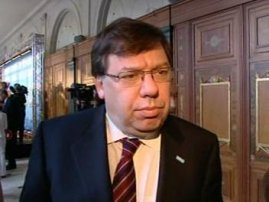
Despite Pat Kenny's best efforts to bring his interview partner to a serious statement on the Taoiseach, Bertie Ahern's unsolved financial irregularities and the revelations at the Mahon Tribunal, John Gormley (photo) weaseled out and produced once again his meanwhile only too well-known excuses. As the "line minister" who is responsible for the Mahon Tribunal in a technical and administrative sense, he pointed out that he could not comment on its procedures. Instead he urged people "to trust in the competence of Mr. Justice Mahon and his excellent team".

No one I know questions the competence and sincerity of Judge Alan Mahon and his tribunal. We all know that it is probably the only way to bring to light the numerous skeletons hidden in the cupboards of Bertie Ahern and Fianna Fáil. But many people here question the sincerity and political judgment of John Gormley and his fellow Green Party TDs.

Of course he is not - and never can be - responsible for Fianna Fáil and their actions. That was a rather cheap excuse from a man whose intelligence is well known and whose opposition speeches I used to read with joy. Nor has he anything to do with Bertie Ahern's financial matters. Of course not! But he and his party are responsible for keeping FF in government and Bertie in charge. No one forced them into the coalition with their once worst political enemy, and no one I know understands why they did it. (I expect that the Irish voters will give them the same kind of message in the next election that they gave the PDs in the last one...)

Like many Irish people I was deeply disappointed by the Greens' abandonment of their long held principles when they crossed the line and joined the government.
But an even deeper disappointment is their silence and self-imposed ignorance on the matters that recently came to light at the Mahon Tribunal. Even the former Tanaiste and PD leader Michael McDowell (whose direct adversary John Gormley was for many years, standing in the same constituency and - by winning his seat - ending McDowell's political career for good) had more critical words for Bertie Ahern when he was his deputy and coalition partner.

It appears that Gormley and his party have adopted a kind of bunker mentality. As long as they don't make any big mistakes themselves, they are save inside the government and getting on with their silent transformation of Ireland into a country that complies with their ideas of green and environmentally friendly.
For that they seem to be willing to close their eyes to everything else and drive their bio-diesel-powered green bulldozer at high speed around the country. One day, however, they might realise that they are driving directly towards the Cliffs of Moher. By then it might well be too late for a U-turn, and 25 years of good policies as a serious and widely respected opposition party will have been wasted, for three men's personal desire of power.

The Emerald Islander

28 February 2008

Irish Food Prices are rising too fast

A survey of Ireland's top supermarkets has revealed little price difference between Dunnes Stores and Tesco. The National Consumer Agency commissioned the survey to measure the impact of the Groceries Act. They found that in a basket of 61 goods purchased at Dunnes Stores and Tesco there was only a 35 cents price difference between both.

However the survey found that Super Valu is providing real competition to Dunnes Stores and Tesco. The survey also indicates that the most competitive pricing in the retail sector exists between discount stores Aldi and Lidl.

What the agency does not mention in the report is the fact that the prices for food and other groceries in Ireland have risen massively during the past year and keep rising still. I am sure you have noticed that yourself if you do the regular shopping for your household.
I don't want to make long lists of prices here, even though I could. But that would be boring. Let me just give you a few examples of the constant and galloping inflation the current government presides over. Last year a normal pound of Irish butter was € 1.42 in most supermarkets. In the Autumn of 2007 this price rose in one step to € 1.76 (an increase of 24%), and a few weeks ago it rose again to now € 1.89 (which is another 7.5% extra). So in less than a year the price for an ordinary pound of butter - something most of use every day - has actually risen by more than a third!

Strangely enough, I have heard no one complaining yet. People moan about the high petrol prices, yes, but they are - unfortunately - set mainly elsewhere (even though the government puts a hefty portion of tax on it as well). Butter is a homemade product. And even though almost everything gets dearer all the time, nothing does justify a price rise of 33% on such a basic consumer product.
And butter is - as I said - only one very prominent example in a long line. Literally everything is getting more and more expensive, without any added value to the goods and products. And the worst sector is indeed food, the one thing we all need to survive.

While the shops and supermarkets are bad enough, it gets worse when one makes the mistake to eat out. An evening meal that used to cost me around € 20 some time ago is now priced at € 35, which is a rise of 75% in less than two years. Last week I met a friend in a local bistro for a chat. We shared a pot of tea for two, had a bowl of the "soup of the day" with a slice of brown bread, and my friend also had a slice of apple tart as dessert. How much do you think this very simple meal is worth? And how much should it cost? Well, I paid € 24.85 for that and really felt ripped-off in a very bad way. Not so long ago you would have paid with a tenner for that, and received some change back. I will certainly not go back to that bistro, but unfortunately these days the prices are very similar in all of the places one can go to.

So why is all this happening to us? It is not a result of a world crisis, nor anything the EU is forcing upon us - God forbid! No, this is an entirely home-made inflation problem, proudly sporting the "Guaranteed Irish" label. It is born out of the marriage between traditional Irish greed and the recent economic boom that befell us, commonly referred to as the "Celtic Tiger".
Having been poor, neglected and ignored backwoods people on the furthest outlet of Europe, we grabbed with both hands every single Euro we could get hold of. Many have made good and are now basking in wealth and sunshine (somewhere further south, where they bought a second home). But the "Celtic Tiger" has by-passed whole areas of the country, and a significant portion of the population has never been touched by luck, nor have they touched the magic pot of gold the tiger brought along.

These are mainly the old and sick, unemployed, disabled and otherwise deprived people. They live almost on a different planet now and would be shocked if they ever set foot into Dublin 4. But they are also the hardest hit by the enormous inflation, and especially the totally unreasonable increase in prices for food and basic commodities, such as electricity, coal, peat brickets and public transport (as only a small percentage of the poor have free travel passes). It might come as a surprise or even a shock to some of you, but there are meanwhile - once again - people in Ireland who can barely afford the basic items of living. In one of the now richest countries on Earth they struggle to survive, especially due to the prices for food, which are clearly out of control in Ireland. (In comparison, almost everywhere in Western Europe food costs are about half of what they are in Ireland, and in Eastern Europe even lower than that.)

The National Consumer Agency's survey results from small independent butchers and from fruit and vegetable retailers indicate significant price differentials, but no such price difference is found in larger supermarket chains (as they watch each other like hawks, if they don't even rig prices at times). The Agency says that consumers can drive competition by shopping around, and I wholeheartedly agree. It is the only way ordinary people can move things. If something is too expensive or not worth the price asked for, just don't buy it. You might find it cheaper elsewhere, and over time prices will and do come down when shops realise that the level charged is too high and turnover is down. It is all very simple, the basic rule of supply and demand, combined with the willingness to pay a certain price or not.

Ireland has already become a rip-off society, which also hampers tourism, which is still an important source ot income on the island. If we - the consumers - don't make a stand every day we go shopping, it will get worse and worse, to the point that we could well fall back into a real economic crisis. I am sure that no one wants this to happen.

The Emerald Islander

EU imposes heavy Fines on Microsoft

The European Commission has imposed a heavy fine on US computer giant Microsoft for defying sanctions imposed on it for anti-competitive behaviour. Microsoft must now pay a record € 899 million ($ 1.4 billion or £ 680.9 million) after it failed to comply with a 2004 ruling that it abused its dominant market position. The ruling said that Microsoft was guilty of not providing key codes to rival software makers. Regulators said that the top IT firm was the first to break an EU anti-trust ruling.

The fine comes on top of earlier fines of € 280 million imposed in July 2006, and of € 497 million in March 2004.

"Microsoft was the first company in 50 years of European competition policy that the Commission has had to fine for failure to comply with an antitrust decision," EU Competition Commissioner Neelie Kroes said in a statement.

An investigation concluded in 2004 that Microsoft was guilty of freezing out rivals in products such as media players, while unfairly linking its Explorer internet browser to its Windows operating system at the expense of rival servers.

The European Court of First Instance upheld this ruling last year, which ordered
Microsoft to pay € 497 million for abusing its dominant market position. Last week, the firm announced that it would open up the technology of some of its leading software, including Windows, to make it easier to operate with rivals' products.

But the firm is still being pursued by Brussels. Last month, the EU Commission launched two new anti-competition investigations against Microsoft into similar issues. The first will look at whether there are still problems regarding Microsoft abusing its dominance of the PC market to grab market share of the internet. The Commission will also investigate the continued interoperability of Microsoft software with rival products.

27 February 2008

Taoiseach thinks that no one cares

The Taoiseach has rejected suggestions that the forthcoming Referendum on the Lisbon Treaty might be influenced by the controversy surrounding him. Speaking after talks with Slovenia's Prime Minister Janez Janša (photo), who is currently the EU president, he told a news conference in the Slovenian capital Ljubljana that Ireland's Referendum would probably be held in June.

Asked whether it might become a vote of confidence in himself given recent events, he said he did not think that was likely.

Here Bertie Ahern might be quite wrong in thinking that no one cares. It is true that many Irish people have so far chosen to ignore his personal and financial irregularities, or to forgive him whatever he does because they see him as "one of the lads". But the longer the matter hangs over him without a satisfactory outcome, the more people in Ireland begin to wonder if he really is the best man to lead the country and the government. Even members of his own party have meanwhile raised doubts, many of them very annoyed over the use of a £ 30,000 loan from a Fianna Fáil fund-raising account by Ahern's former mistress Celia Larkin for private family matters. (for further details see my entries from 22 February)

During the press conference the Taoiseach pointed out that most of the political parties in the Dáil were in favour of a Yes vote, so he was not worried over the outcome of the Referendum.
It is correct that Ireland's largest parties - Fianna Fáil, Fine Gael and Labour (as well as the remnants of the PDs) - are supporting the Lisbon Treaty. But this alone does not guarantee an acceptance of the treaty, since the matter will be decided by the Irish people.

In this regard it is interesting to remember that in 2005 a large majority of parliamentarians in both France and the Netherlands were in favour of the European Constitution (the forerunner of the Lisbon Treaty, whose text is about 90% identical to the Constitution), but nevertheless the people of both countries voted overwhelmingly No in separate referenda.

As Ireland is the only of the 27 EU countries where the people have a direct say on the Lisbon Treaty, the Referendum will have a special momentum and many people will recognise that in this case the people of Ireland have a responsibility for the whole of the Union, including all the nations who were deprived of a direct vote by their national governments. (Only yesterday Britain's House of Commons debated again the possibility of a referendum in the UK, but an opposition motion in favour of it was rejected by the Labour majority.)

Once the Irish voters realise how much Ireland's influence will be reduced by the Lisbon Treaty, not least by losing the right to have a permanent Irish EU Commissioner, the strong confidence displayed by the Taoiseach might well be premature, despite the strong support from most of the mainstream parties.

The Emerald Islander

26 February 2008

Go raibh mile máith agut

To all my friends, colleagues, associates and neighbours, and to everyone who was so kind to wish me well today on my birthday, I like to say a special Thank you.

It has been a very pleasant day for me, with great joy and many lovely surprises. As I am sitting here, by the fire, with a nice fresh cup of tea and eating another piece of my birthday cake, I think of you and wish you were all here with me now. Once again, thank you.

And since the greetings and good wishes came from different places and countries, let me express my thanks also in all your own languages:
  • Go raibh mile máith agut.
  • Thank you very much.
  • Vielen herzlichen Dank.
  • Muchas gracias.
  • Duisend maal dank.
  • Baie Dankie.
  • Dyakuyu.
  • Spasibo balshoye.
  • Xie Xie.
  • Diloch yn fawr.
  • Eskerrik asko.
The Emerald Islander
(happy and most grateful)

Air Traffic Control should be done by the Military

Ireland's air traffic controllers are considering a Labour Court recommendation ahead of a series of meetings today in Dublin, Shannon and Cork. Last night, the Labour Court issued a recommendation that will hopefully resolve the ongoing row over staffing levels, rosters and overtime.

The IMPACT union said there were some positive elements in the recommendation. It will be seeking a meeting with the Irish Aviation Authority (IAA) today to discuss the implications. Earlier yesterday the controllers called off plans for a 24-hour strike and an official overtime ban.
Labour Court Chairman Kevin Duffy says it is not his role to decide appropriate staffing levels in the air traffic control service. But a number of recommendations have been made to settle the dispute.

Personally I do not understand why this problem has arisen in the first place, and why it seems so difficult to sort it out. Modern Ireland is no longer a poor country, and especially since the "Celtic Tiger" boom civil servants are among the top earners in our society. And the air traffic controllers earn even more than most of the other civil servants, since they receive very generous overtime bonuses. They do have a difficult and very responsible job, no doubt, but so have many other people on much lower pay.

So I think it is not appropriate for the air traffic controllers to keep winging and holding the rest of the population - or at least those who use airlines for travel - to ransom. Their recent threats of strike action and their refusal to fill in for sick colleagues (see my entry from 17 February) is not acceptable at a time when we are told by the government to be prepared for less prosperous times. Sitting in a privileged position and knowing that without them no air traffic can happen, this relatively small group of highly paid specialists is blackmailing the whole country.

It is time to look at the wider picture and sort the problem out, once and for all. Unfortunately the current government is hampered by incompetence and widely occupied with the personal problems of Bertie Ahern. I am also not sure if Noel Dempsey, currently Minister for Transport and as such responsible for the matter, is able and willing to act decisively. What we need is a politician who can call the bluff of the air traffic controllers and get things back to normal.

And if that should appear to be impossible, I propose to take the whole air traffic control system into the responsibility of the Department of Defence, to be administered by the Aer Corps (which does not have a lot to do these days anyway). After all, the national airspace is also a matter of security and defence, and in many other countries the whole matter of air traffic - military and civilian - is exclusively in the hands of the national airforce.

I am well aware that Ireland is not a militaristic country, and that such a step would cause some upset, first and foremost from the air traffic controllers and their union. But it would be worth a step to consider, and if only as a potential stick to threaten the stubborn and arrogant air traffic controllers. (And I am writing this as a member of a trade union.)

We are a small country and an island, and as such we depend on air traffic for our industry, export and import, as well as tourism. It is not acceptable that all this, together with the national interest, stability and prosperity is put into jeopardy by a small group of well-paid people whose greed has driven them to irrational demands. For once I hope someone in the government will act in the national interest instead of wondering how to fill their own pockets most easily.

The Emerald Islander

25 February 2008

A well-deserved Oscar for Ireland

After the embarrassing result of Eurosong 2008 on Saturday night, some might have given up on contemporary Irish music already. But despite the Dustin joke that will backfire on us and haunt Ireland for years, there is still hope for the friends of real music on the Emerald Isle.

As I had hoped - and predicted - the beautiful song "Falling Slowly" from the Irish low-budget film once has won the Oscar for Best original Song in Los Angeles last night. Congratulations are due to the singers and musicians Glen Hansard (of the Irish rock band The Frames) and Markéta Irglová, who are also the stars of the musical film. This is a very well-deserved award for two young people who worked hard and made their dream come true.

And once again this success shows that one does not need to have many millions of dollars and a whole string of overpaid Hollywood stars to produce a good - and popular - film. If our film makers in Ireland take a little lesson from once, there might be more sensible films made in this country.
It would certainly help if the Tanaiste, as Minister for Finance, would look kindly on the Irish film industry and give them some more tax breaks, as they are available in many other countries.

The Emerald Islander

Quo vadis, Europa?

Two weeks ago the National Forum on Europe (NFOE), which has promoted and facilitated a national debate on the European Union (EU), on its future and on Ireland's role in it since its establishment by the Taoiseach in October 2001, held a public discussion in Waterford. It was the second in a series of nine regional meetings to introduce to the general public the Treaty of Lisbon and open a public debate on it, in preparation for the Referendum with which the Irish people can accept or reject this latest of the European amendment treaties later this year.

Of the currently 27 member states of the EU, Ireland is the only one to hold a Referendum over the new treaty, as it is specified in our Constitution. Everywhere else the decision will be made by the national parliaments, with no direct involvement of the people. The reasons for this vary, as in several European countries there is no tradition of referenda, while in others the government does not see a need for asking their population or - like in France and the Netherlands - is keen to avoid such an undertaking. In both countries the forerunner of the Lisbon Treaty, which was known as the European Constitution, was rejected by the voters in national referenda in 2005.

Following these rejections, the TCE (Treaty establishing a Constitution for Europe) had to be abandoned and new negotiations among the member states, their governments and the EU Commission produced eventually the Treaty of Lisbon, which was signed by the EU Heads of Government in the Portuguese capital on December 13th, 2007.
The Treaty of Lisbon amending the Treaty on European Union and the Treaty establishing the European Community, as it is called in full, needs to be ratified by all member states before the end of this year, in order to come into effect on January 1st, 2009.

Five of the member states - France, Hungary, Malta, Romania and Slovenia - have already completed the ratification process, and the European Parliament also voted in favour of the new treaty last Wednesday. Given the wide-ranging changes it will impose on the EU structure and the future operation of the Union, the treaty is surprisingly low on the agendas of many member states. But in Ireland, the only country required to hold a referendum, the debate on the treaty and its many elements will be most elaborate, vociferous and emotional.

Two weeks ago in Waterford, and last week in Kilkenny and Tullamore (where further meetings took place), I got a good idea where this debate is now heading. The larger parties - Fianna Fáil, Fine Gael and Labour - are in favour of the Lisbon Treaty and campaign for a yes vote, with many business people and business organisations like IBEC following suit. They form a large bloc which includes government and opposition, and have certainly an advantage in numbers as well as money and general support. The Green Party is split over the issue (for details see my entry from 20 January) and now - bizarrely - campaigns on both sides of the argument. While Green Senator Deirdre de Burca was the main speaker for the treaty at the NFOE meeting in Kilkenny last Monday, the head of the party in Waterford (and repeatedly their local candidate in every election for years) Brendan McCann and former Green MEP Patricia McKenna, for example, are vehemently against it. All Green TDs seem to be in favour, but large parts of the party's lower echelons and grassroot members appear to be - for various reasons - against the treaty.

Not surprisingly, the few remaining members of the PDs are pro treaty, while most of the smaller parties on the left of the political spectrum oppose it. Sinn Fein is the only main party in Ireland that clearly stands and campaigns against the treaty. They are joined by a very mixed bunch of small parties (like the Socialist Party and the Socialist Workers Party), organisations like the Euro-skeptic think thank Libertas, and various groups and individuals, including a number of independent politicians. The most prominent of them is the independent MEP for the constituency of Southern Ireland, Kathy Sinnott (above centre), who was the main anti-treaty speaker at the NFOE Waterford meeting two weeks ago. The veteran European and former Fine Gael MEP John Cushnahan (above right) was the main speaker for the treaty. All the public meetings were presided over by NFOE Chairman, Senator Maurice Hayes (above left), a former senior civil servant from Northern Ireland.

There is not enough space here to outline the whole debate, but I will revisit the issue in future, when the lines of argument become clearer. For now I just like to raise what is for me the key question regarding the Lisbon Treaty, as well as any other development of the EU: Quo vadis, Europa? (Where are you going, Europe?)
Having read the text of the new treaty - as much as it was accessible to me - it appears to me that despite some major changes in the European Union's structure there is no clear direction defined for its future. When the original European Economic Community (EEC) was formed in 1957 by the six founder states (Belgium, France, Germany, Italy, Luxembourg and the Netherlands), it was envisaged as a common market and - as the late President of France, General Charles de Gaulle used to call it frequently - a "Europe of the Fatherlands". Elements of this idea are still present, so is this what we want Europe to be?

Others see the EU basically as a big, but powerless talking shop, some kind of smaller European version of the United Nations, with plenty of papers, committees, civil servants, interpretors and translators. In their opinion everything should be discussed and eventually regulated at European level, but all power would remain with the member states and their national politicians and parliaments.

The most daring view of the EU's future goes much further and wants us to become the "United States of Europe", modeled on the USA, with a completely integrated central power and states relegated to the second level of political power and influence.
In the Lisbon Treaty are elements of this already, such as the new permanent EU President and the new foreign affairs supremo, who is supposed to be responsible for all external affairs of the Union. But there are also elements of the other two models present, so I wonder if those who wrote and negotiated the new treaty actually know themselves where Europe is heading in the future?

I asked this question at the Waterford meeting, and Kathy Sinnott, MEP said that it was the best question she had heard all evening. Thank you very much for the kind comment. I am no politician and have no vested interests or axes to grind. I am just a humble historian with an independent mind who also analyses politics and comments on it. And I see it as one of my little purposes in life to highlight certain elements others tend to overlook.

Ms. Sinnott's answer was very interesting, as well as a little frightening. She said that we would not become a "United States of Europe" following the American model (and she should know that better than anyone, as she was born in Chicago). The old "Europe of the Fatherlands" was still in some way on the books, but no longer in the sense Charles de Gaulle would have understood and liked. But there is apparently a new dimension to the EU, not yet so clear to most of us in the West. MEPs from the new member states, who were not so long ago still part of the Communist East, have told Kathy Sinnott that the more they see and learn of the EU and its structure, the more it reminds them of the old Soviet-dominated Eastern Bloc.

This is a shocking revelation, which calls for further and deeper investigation. I will look into the matter myself and discuss it further with others, before I come back here to write more about it.
For now I can only advice everyone in Ireland to become familiar with the text and details of the Lisbon Treaty, and - if at all possible - attend at least one of the public meetings the NFOE is holding in various parts of the country. The next one takes place tonight at the Linenhall Centre in Castlebar, Co. Mayo. (For more details see the list below)

In a few months we will be asked to vote on the treaty in a Referendum, the outcome of which is of great significance for all of us in Ireland, our country and Europe as a whole. Never before in recent times has so much responsibility been placed in the hands of the Irish people, and I hope we will decide wisely on the matter. Otherwise Dustin will not be the only turkey we are sending to Europe...

The Emerald Islander

Further public meetings of the National Forum on Europe:
  • 25 February, 8 p.m. - Linenhall Centre, Castlebar, Co. Mayo
  • 4 March, 12.30 p.m. - Liberty Hall, Dublin City
  • 10 March, 7 p.m. - Old Ground Hotel, Ennis, Co. Clare
  • 11 March, 7.30 p.m. - Brandon Hotel, Tralee, Co. Kerry
  • 26 March, 8 p.m. - Radisson Hotel, Letterkenny, Co. Donegal

24 February 2008

Irish Cricket News II

Ireland called upon junior batsman Paul Stirling (17) to join the Irish Cricket XI for the up-coming series of one-day internationals in Bangladesh.

Stirling, who was with the Under-19 team in Malaysia and scored a rapid 72, as Ireland endured a heavy 181-run defeat by New Zealand, replaces the experienced opening batsman Jeremy Bray, who will miss the tour because of a shoulder injury.
The left-arm seam bowlers Phil Eaglestone and Reinhardt Strydom have also been named in the 15-man Irish touring team. Andrew White is unavailable, as he is getting married in March.

Trent Johnston remains Ireland's Captain and William Porterfield (who plays now as a professional for the English county Gloucestershire) has been named as the new Vice-Captain, taking over from Kyle McCallan.

Ireland will play a four-day game against the United Arab Emirates in Abu Dhabi from March 6th-9th, before starting their series of three one-day internationals in Bangladesh on March 18th.
They are also expected to play against the English county side Essex, who will be in the region participating in a tournament.

Ireland's touring team for the UAE and Bangladesh are:
T. Johnston [Captain] (Railway Union), A. Botha (North County), A. Cusack (Clontarf), P. Eaglestone (Strabane), T. Fourie (Merrion), G. Kidd (Waringstown), K. McCallan (Waringstown), E. Morgan (Middlesex), K. O'Brien (Railway Union), N. O'Brien (Northants), W. Porterfield [Vice-Capt] (Gloucestershire), B. Rankin (Warwickshire), P. Stirling (Cliftonville), R. Strydom (North County), G. Thompson (Lisburn).

Irish Cricket News I

Ireland missed out on a place at the 2009 ICC Women's Cricket World Cup when they lost to South Africa in the semi-finals of the qualifying competition. Despite Cecelia Joyce's unbeaten 43, the Irish were all out for 107, and the hosts scored their runs in 27.4 overs to win by seven wickets.

South Africa will now meet Pakistan in the final, but both will also play in the tournament proper next year. Pakistan beat the Netherlands by 98 runs in the second semi-final after bowling them out for just 68.

"Everybody is absolutely gutted," said Ireland Women's Captain Heather Whelan (photo). "We trained so hard, and for so long, in order to try to go to the World Cup in Australia, but it's not going to be. But we'll be here again in four years, looking for a place in the World Cup and we expect to make it next time."

Australia, England, India, New Zealand, Sri Lanka and the West Indies automatically qualified for the World Cup, which will be played in New South Wales in March 2009.

Ireland's men took part in their 2007 World Cup in the West Indies and achieved unexpected success, beating Pakistan and drawing against Zimbabwe. This performance has given Cricket in Ireland a great boost, which now also inspires the Irish women's XI.

23 February 2008

Dustin for Taoiseach!

As I have feared - and predicted earlier - Dustin the Turkey (photo) did win Eurosong 2008 and will now be the official representative of the Republic of Ireland in this year's Eurovision Song Contest on May 24th in the Serbian capital Belgrade.

If there would be any need to prove that the Irish are a mad nation, and that voting is not our strong side, this would be it. Unfortunately we have known that already for quite some time, looking at the results of the last three general elections...

For Irish people the vote for Dustin was probably not more than "a laugh", a bit of craic, and maybe a slight two-finger gesture towards the ever so serious movers and shakers in the music industry. It was a typical action for an insular people who know very little of the rest of Europe, and do not give a hoot for it either. Never mind all the Poles and other foreigners working here. As long as they do their jobs for low wages, we don't care.

So, dear compatriots, be not surprised when we will become the laughing stock of Europe (and perhaps even further afield) for sending the stuffed puppet of a turkey to an international and well-televised contest that we once not only took very seriously, but also used to win. No matter how well or poorly Dustin will perform in Belgrade, the turkey image will stick and become an idea other - and way more serious - nations in Europe will associate with Ireland. Dustin will in future be the companion of the "lazy Paddy" when people think of our country.

In light of his great election success tonight, I propose a further career move for the singing and plain speaking turkey. When he returns from his mission to Belgrade in late May, he should take over the reigns of the country and become the next Taoiseach when Bertie Ahern steps down. If he can win a vote like the one tonight, he should be easily elected with overwhelming majority by the Irish people. He could not be doing things much worse than Bertie, and I am sure he would remember it when someone gives him a large sum of money. And, being a turkey, he would most certainly never vote for Christmas, which could only improve the physical and spiritual health of the nation... Dustin for Taoiseach! Dustin for Taoiseach!

The Emerald Islander

Once again we try... (too hard)

Tonight a large number of Irish people will be watching TV and participating in the futile annual spectacle to select our national entry for the Eurovision Song Contest on RTÉ 1. Gone is the old "You're a Star" format that did not produce the desired international success for years, even though it did give loads of Irish singers and musicians a chance to be discovered (or to be gutted). Now the show is called Eurosong 2008 and will start at 7 p.m., with a separate follow-up at 9.45 p.m., when the results of the public vote will be announced.

This year's contest was also open to songwriters from outside of Ireland, and almost 200 entries were received from both home and abroad. In a change from the last two years of the competition, when composers were invited to write a song for an act chosen by RTÉ, this year entrants were asked to submit the complete package of song and performer.
RTÉ has - presumably in painstaking work, done by highly qualified and even higher paid experts - shortlisted six songs that will be played in tonight's final. The rest is now the responsibility of the Irish people, or at least that portion of the population that cares for useless and senseless gimmicks like the Eurovision Song Contest, this year to be staged at - of all places - Belgrade (capital city of Serbia, which still harbours war criminals and is one of the last places to which any person with common sense would want to go).

But common sense and pop music rarely go together, so one should not be surprised that there are at least five people - and one turkey - keen to be sent there as the musical representative of this country. The six final "acts" (yes, they don't even call them songs anymore) for Eurosong 2008 are:
  1. "Double Cross my Heart" performed by Donal Skehan (and composed by Joel Humlén, Oscar Gorres and Charlie Mason)
  2. "Irelande Douze Pointe" performed by Dustin the Turkey (and composed by Darren Smith, Simon Fine and Dustin the Turkey)
  3. "Time to Rise" performed by Maya (and composed by Maja Slatinsek and Ziga Pirnat)
  4. "Not Crazy after all" performed by Leona Daly (and composed by Leona Daly and Steve Booker)
  5. "Sometimes" performed by Liam Geddes (and written by Susan Hewitt)
  6. "Chances" written and performed Marc Roberts
Having heard all six songs earlier this week on the Mooney Show on RTÉ Radio 1, I have to say I am not impressed. Is this really the best we have to offer to Europe, the best we can find in this country that is filled with music (and musical talents) like no other?

Once again we try to have a "strong" entrance that could win the contest, but once again we try too hard. Having won the Eurovision Song Contest a record seven times and achieved many honourable places in the upper ten positions, Ireland seems under renewed pressure each year to produce another great success. What we seem not to realise is that the structure of the whole contest has changed since the days when Ireland could - and did - win it. Nowadays the annual spectacle is dominated by the new countries of Eastern Europe and the Balkans, who have burst onto the Eurovision show stage during the past few years, blasting away anything the Western states of "old" Europe had to offer.

Like most Western European countries, Ireland did very badly in recent years. Despite the fact that our very own sage and IRISH TIMES columnist John Waters wrote last year's Irish song and promised repeatedly that it would win in Helsinki, he instead achieved a surprising first of a different kind: the seven-times winner Ireland came last (and John Waters has not yet recovered from that shock).
The only sensible thing after such a humiliation would have been to call it quits for good and retire gracefully from the contest we once dominated, but which has now moved into another dimension into which we cannot follow. But there are still people in RTÉ who believe in the impossible (like they might also believe in the existence of "Santa" in a grotto at the North Pole).

So they keep going and wasting licence-fee-payers' money on yet another national contest. The result will be watched by large crowds of bored and boring people tonight. And they will vote for their song of choice, wasting more money on SMS text messages, and get excited over the whole affair while getting drunk in the meantime.

I have no favourite for tonight, and no idea who will win. In fact, I couldn't care less. But one thing is already certain: Since we leave the Irish people in charge of selecting a great song for Belgrade, the outcome might well be as disastrous as the last three general elections. One can be sure that Irish people voting will create a real mess of mediocre incompetence, as they have done so expertly in 1997, 2002 and 2007 when electing a new Dáil.

Once again we try - way too hard - and once again we will fail to make a great impression in the Eurovision Song Contest, which is now really the political and cultural hobby horse of the newly freed states of Europe. And once again we completely overlook a possible alternative, a really good song which - with some luck - might actually have a chance in Belgrade.

My repeated use of the word "once" in this text might have given you a hint already. The song I would have chosen as Ireland's entry for this years Eurovision Song Contest is called "Falling Slowly", performed by Glen Hansard and Markéta Irglová, and comes from the soundtrack of the recent Irish film "once", which is already very popular in Ireland and abroad. The song is soft, sensible and original, goes straight to the heart, but also touches the mind. And it has been nominated for an Oscar.
None of the six songs people will hear and vote for tonight has such qualities, so I will not waste any more time talking or writing about them. Just one more point: my neighbour told me today that he is voting for Dustin the Turkey (even though he has not yet heard the song). This is very typical for the Irish mind. Give us a land mine, and we will happily step on it with a laugh...

The Emerald Islander
(going for a long walk tonight)

22 February 2008

Can one believe Bertie Ahern?

Earlier today the Taoiseach said that he thinks the public believes his testimony at the Mahon Tribunal. As he arrived at Dublin Castle for another long day of interrogation, he was asked by reporters if he thought the public believed him.
All Mr. Smile, Bertie Ahern said: "Yes, totally."

It might well be that a certain portion of the population - especially the members and lifelong supporters of Fianna Fáil - would agree with this short statement of confidence. But an increasing number of people are seriously concerned about the Taoiseach and wonder if one can believe what he is saying about his personal finances. (And depending on that, if one can believe anything he says...)

We all have personal experience with earning and handling money, keeping books and accounts, and declaring and paying taxes. There is nothing particularly special about it, as we are all equal before the law and before the revenue commissioners. Or are we not?
Well, it appears that - like on George Orwell's "Animal Farm" - some people in Ireland are more equal than others. And, as seen with the late Charles Haughey, they get away with it if they just pretend long and stubbornly enough to be "innocent" or not to be able to remember certain things and events.

I don't know about you, but if I would receive a cheque over £5000, I would remember that, as well as the person, company or organisation it came from. So when Bertie Ahern tells the Mahon Tribunal that he cannot explain the source of a £5000-cheque cashed at the Irish Permanent building society on the very day his savings account was opened, its sounds strange, to say the least. After all, he is not some aged pensioner suffering from Alzheimer's disease, but our Prime Minister and leader of the largest political party in the country. And at the time in question he was Minister for Finance, responsible for the nation's wealth, the government's budget and the setting and collecting of our taxes. That a man with such high financial responsibilities, who is also a qualified accountant, cannot recall the origin of a £5000-cheque given to him is alarming.

Liar or Fool?
The questions asked by Judge Alan Mahon, his tribunal and the whole country are rather simple, but very important:
Is Bertie Ahern a liar?
Or is he a bumbling fool, unable to recall the source of a significant sum of money donated to him personally?

If he really lies about the cheque, for whatever reason, he could not be trusted with any other matter and should not be Taoiseach or hold any position of political power. And if he is unable to remember important financial transactions, the question needs to be asked if he is actually in command of all his faculties and able to lead the country, as well as if he was ever capable to head the Department of Finance. In both cases he should seriously consider to step down and make room for someone more able (and with much better memory).

One is compelled to agree with Labour Party leader Eamon Gilmore, who said today that the Taoiseach's situation was now "a national embarrassment" and called on the Tánaiste and other ministers "to call time on his leadership".
Once again one would have also hoped to hear a word from the Green Party, whose coalition with Fianna Fáil keeps Bertie Ahern in office and power. But - once again - John Gormley and his people demonstrate that they crossed the line and moved completely into Bertie's camp, leaving behind their once sharp minds, critical remarks and sound judgments of Irish politics.

In English the Irish word Taoiseach means "Leader", just as it means Führer in German and Duce in Italian. But in clear contrast to its German and Italian equivalents, the word Taoiseach is not tainted by history - yet.
Should, however, Bertie Ahern become the second Irish Prime Minister - after Charles Haughey - to be found untrustworthy with money, or even corrupt and lying to a tribunal established by parliament, the word might well become the synonym for a corrupt leader, instead of meaning simply "Leader".

The Emerald Islander

A Pot calling the Kettle black...

Today the Chairman of the Mahon Tribunal asked counsel for the Taoiseach to withdraw what he called "disgraceful and offensive comments". Judge Alan Mahon (left) said suggestions that the tribunal was biased and had an agenda were untrue. He told Conor Maguire SC that comments made by him suggested the Mahon Tribunal was a witch-hunt pursued by a bunch of crooks. He said the suggestion that the tribunal consisted of three judges on an illegal, corrupt and criminal frolic of their own was offensive and should be withdrawn.

The exchange between the two men lasted for more than half an hour, and members of the public clapped and cheered in support of the tribunal during the exchange.
Judge Mahon said Bertie Ahern's senior counsel was in effect accusing the tribunal of being corrupt. This - the judge said - was disgraceful.

The tribunal also formally ruled that the Taoiseach was not prejudiced by the non-circulation of correspondence with a number of stockbroking firms, regarding the Fianna Fáil fundraising activities.
After four hours in the tribunal's witness box yesterday, Bertie Ahern spent a second consecutive day at the Mahon Tribunal today. One begins to wonder if and how these frequent appearances before the investigation reduce the Taoiseach's ability to lead the country and government, and in which way the clouds hanging over him have a lasting effect on his personal and political reputation, which could also reflect back on Ireland as a whole.

In the light of recent revelations about Bertie Ahern's finances and his apparent inability to recall the origins of various large sums of money, one is moved to question his credibility. Anyone I know would remember the receipt of a £5000-cheque, and who he received it from. This should be even more the case for a man who has been dealing with money all his adult life, first as an accountant, then as a politician and especially as the country's Minister for Finance and Taoiseach.

The verbal attacks made by Ahern's senior counsel yesterday on the Mahon Tribunal are in particular unfortunate and uncalled for. It appears that here is a rather dark pot calling the shining and well-polished kettle black...

The Celia Larkin Link
Meanwhile another twist in Bertie's never-ending story emerged. The Taoiseach has denied that a £ 30,000 loan from a Fianna Fáil fundraising account that Celia Larkin (right) - then and for many years his mistress and partner - used to buy a house has any implications for him.
Speaking as he left the Mahon Tribunal this evening, Bertie Ahern said the decision was one for the trust and it was entitled to do it.
It emerged this afternoon that Ms. Larkin is the registered owner of a house bought using a loan of £ 30,000 from the St. Luke's Building Trust account of the Fianna Fáil central Dublin constituency organisation. It was loaned in 1993 to assist with the purchase of the property.

A solicitor for Ms. Larkin and her aunt argued that the matter is not connected to the tribunal and does not fall under its terms of reference.
In the early 1990s, the house in which Celia Larkin's aunts lived with friends was put on the open market. It was proposed that the women remaining could rent the upstairs portion of the house. But concerns about that arrangement were expressed and Ms. Larkin assisted with the purchase. The house cost over £ 40,000 and one of Ms. Larkin's aunts provided part of the price. The property was then bought in Ms. Larkin's name and she undertook the maintenance.

Bertie Ahern told the tribunal this afternoon that there was no legal agreement drawn up for the loan, but "it may have been recorded in minutes or notes". It was agreed if the house was sold, or if the trustees of the Building Trust Account sought repayment, the funds would be returned immediately.
Ahern also confirmed that the loan was only repaid "since [last] Christmas". He said that the funds repaid for the loan with interest will be returned to the Building Trust Account.

The Emerald Islander

21 February 2008

Giving up Aer Lingus for Lent?

Ireland is an island, and as such of course very much dependent on sea and air transport, bringing in all the goods we need and taking out our exports, as well as carrying passengers and tourists into and out of the country. But the question has to be asked if a small nation like ours, with just about four million people, needs two major (and several minor) airlines.

Back in the olden days, when a return ticket to the European continent could easily cost 600-700 Irish Punts and was therefore available only to the rich and famous (and of course politicians and civil servants traveling on state business), Aer Lingus was Ireland's only airline. Rigid, stuffy and fully state-owned, it was nevertheless a symbol of national pride. We were a sovereign country now (at least since 1949, after going through the various stages of metamorphosis that turned the British caterpillar into an autonomous pupa, which then gave birth the the republican butterfly) and had a flag-carrying national airline of our own, proudly sporting the shamrock and spelling its name in Irish. Even if we could never afford to use any of their aeroplanes (except when emigrating to the USA, perhaps), we were looking up to them - literally - when they flew in and out of Shannon, Dublin and Cork.

Much has changed since. Aer Lingus is still the "national flag-carrier", but no longer the only and not even the largest Irish airline. This honour is now bestowed on Ryan Air, once a tiny little company, operating their one and only propeller aircraft out of Waterford regional airport.
But ever since Michael O'Leary - once a small shop keeper in Dublin - took charge of it, Ryan Air grew and grew, making it now the world's largest airline by number of passengers carried. And it is still growing.
The "secret" to such success is no secret at all. It is money. Michael O'Leary, undoubtedly one of the most clever, cunning and successful businessmen this island has produced in recent times, introduced the "low fare" concept - originally invented by the US airline Southwest - to Ireland and Europe. Suddenly air travel was affordable for everyone, and a vast number of people took advantage of it. On certain days Ryan Air would fly you from Ireland to Britain or the European continent - and back - for less than you would pay Bus Eireann for a day-return ticket from Waterford to Cork.

O'Leary's marketing strategy made not only his airline strong, large and profitable, it forced Aer Lingus to change and adapt as well. In order to survive besides Ryan Air and other "low cost" airlines, the once state-owned, arrogant and expensive "national flag carrier" had to become a "low fare" airline itself, adding - slightly embarrassed - the suffix ".com" to its proud Irish name. When this was only partially successful, the Irish government decided to get rid of the "albatross around its neck" and privatise Aer Lingus. (Not surprisingly, Michael O'Leary tried to take it over, but was blocked under anti-monopoly laws.)

Ever since nothing is the same again at Aer Lingus. Mentally still the airborne wing of the Civil Service with a slightly arrogant and patronising attitude amongst the staff (especially the senior people), the company is now run on extreme capitalist lines, with maximising of profits for the shareholders and directors the number one target, and cost-cutting applied everywhere else. It led to a breakdown of proper communication between top managers and normal staff, and every time I have encountered people working for Aer Lingus in recent times, I had the clear impression that they were not happy. And their service is getting worse and more expensive at the same time. Now the passengers have to pay an extra fee for checking in their luggage on Aer Lingus flights, a gimmick also applied by Ryan Air, while long-faced ground staff hostesses in the rheseda-green uniforms of the airline stand around idly, occasionally talking down on the great unwashed that use their services and therefore pay their wages.

In all fairness, Ryan Air is not much better and Michael O'Leary seems to find constantly new things he can charge his passengers for - like a "wheelchair fee" or "luggage surcharge" - in order to make a profit, while his "nominal ticket price" remains low (or at least appears to be so). But Ryan Air is not the national carrier and people have no expectations from them. They accept low standard air transport as long as they can get it for a low price.

Meanwhile at Aer Lingus an internal war is fought daily between staff and management, which leads - inevitably - to industrial dispute and possible strike action. SIPTU has balloted members working for Aer Lingus and are preparing for industrial action over a new cost-cutting plan from the airline's management. This 23-page-long "Flexibility and Mobility Agenda" contains the details on implementation of €10 million worth of cost savings sought from SIPTU members. It is still not clear how this dispute will play out, but one thing is sure already: whatever will happen, Aer Lingus passengers will have to pay for it. Shareholders and directors will still rake in their profits, and thanks to their union the staff will not suffer either. So we, the ordinary folks using the airline, will foot the bill, regardless. Unless we come to our senses and do a little bit of the good old Irish boycotting ourselves. I am ready for it and willing to refrain from any further use of Aer Lingus. So perhaps you can join me in giving up Aer Lingus for Lent.

The Emerald Islander
(with both feet firmly on the ground)

18 February 2008

We might not be alone after all

Rocky planets, possibly with conditions suitable for life, may be more common than previously thought in our galaxy.
So, despite all doubts from skeptics, we might not be alone after all.
New evidence suggests more than half the Sun-like stars in the Milky Way could have similar planetary systems. Astronomers believe there may also be hundreds of undiscovered worlds in outer parts of our Solar System. They say that future studies of such worlds will "radically alter our understanding of how planets are formed".

The new findings about planets were presented at the American Association for the Advancement of Science (AAAS) in Boston.
Michael Meyer, an astronomer from the University of Arizona, said he believes Earth-like planets are "probably very common around Sun-like stars".
"Our observations suggest that between 20% and 60% of Sun-like stars have evidence for the formation of rocky planets not unlike the processes we think led to planet Earth," he explained.

Meyer's team used the US space agency's Spitzer space telescope to look at groups of stars with masses similar to the Sun. They detected discs of cosmic dust around stars in some of the youngest groups surveyed. This dust is believed to be a by-product of rocky debris colliding and merging to form planets. NASA's Kepler mission to search for Earth-sized and smaller planets, due to be launched next year, is expected to reveal more clues about these distant undiscovered worlds.

The Emerald Islander
(looking forward to learn more)

17 February 2008

How to lead a dead Party

It is a very cold morning here today, with roofs and cars covered in lovely white hoar frost. But the Sun is already coming out, and it promises to be a very nice and sunny - though quite cold - day.

It might be even a bit colder for the Progressive Democrats (PDs), the smallest party in our current government (with just two deputies, one of them the Minister for Health, Mary Harney).
Since the PDs were almost wiped out in the last general election (in May 2007), losing six of their previously eight TDs, including their leader Michael McDowell, the party has been languishing in the dolldrums. No one wanted to be the new leader - not even Mary Harney, who is currently and reluctantly functioning as caretaker - and it is pretty obvious that the PDs are more or less a spent force in Irish politics.

But, as it seems, reports of their complete demise might be a little bit premature, because the PDs have now changed their rules for leadership. Previously the party leader was always a TD, but in a three-hour long meeting of the party's general council it has been decided to change that rule. Now any Senator, Councillor or even any ordinary party member with the support of 20 other members can contest the party's leadership. This is certainly a new opening for fresh blood, but if it will be enough to revive the PDs remains doubtful.

For now the party's two remaining Senators, Fiona O'Malley (above) and Ciaran Cannon (right) have put their hats into the ring and declared their interest to become the new leader of the PDs.
Senator O'Malley, daughter of the party's founder and first leader Desmond O'Malley, has certainly a strong personal interest to carry on her father's work and keep the party alive. But if she will have enough support remains to be seen.
Senator Cannon, one of the younger PD politicians, is so far rather an unknown quantity, and even though he might have strong ambitions and ideas, one wonders what difference he could make to an almost dead party, whose grassroot support has melted away like snow under the Sun since the massive defeat in last year's election. It will be interesting for political observers to see what will happen next, but a revival of the PDs to their previous strength is more than unlikely.

The Emerald Islander

Let's close Dublin Airport

There are no air traffic services at Dublin Airport between 11.30 p.m. on Saturday, February 16th and 6.30 a.m. on Sunday, February 17th due to the ongoing dispute between air traffic controllers and the Irish Aviation Authority (IAA). Thanks be to God! This is good news, and if the argument continues, we might reduce the number of flights even further. The Irish environment and the planet would be grateful.

In a statement the IAA said it expects that nine flights in and out of Dublin Airport will be affected by the dispute. However, there could be a knock-on effect to flights early in the morning as the schedule returns to normal. This latest disruption at Dublin Airport is because it cannot get anyone to fill in for an air traffic controller who has called in sick.
One overnight arrival and five early morning departures at Cork Airport were also delayed as a result of the dispute.
The IAA said last night's disruption - the second at the airport in 48 hours - was also because workers refused to cover the shift of a colleague who had called in sick.

If it were not such a sad show by the IAA, one could laugh out loud and see this as a joke. The whole airport of the capital city of an EU country - which also is supposed to be the second-richest country in the world - is coming to a standstill because one man calls in sick. Brilliant!
Someone should nominate the IAA for the Ernst & Young Entrepreneur of the Year Award!

Maybe the IAA should close Dublin Airport, which hardly ever works "normal", even without a strike of the air traffic controllers, altogether and turn it into a huge golf course. This would be very popular with Ireland's many golfers, and it would at the same time drastically reduce emissions and pollution, as well as our carbon footprint. The air traffic controllers could be employed as caddies, and Fáilte Ireland could collect the membership fee. Welcome to Baile Átha Golf!

The Emerald Islander

15 February 2008

Two separate Shows at Dublin Castle

Dublin Castle, originally built under the orders of Prince John as a Norman stronghold and later used for centuries as the HQ of power and oppression on this island, is now popular for various reasons. While tourists from all over the world come to visit it and learn of its history, our own interest in the venue is of a different kind. The Castle has long been - among many other duties - the home for our so dearly cherished tribunals and meeting place for the great and good of the Republic. Today the ancient building was particularly busy.

Taoiseach Bertie Ahern (left) arrived this morning for a meeting of the Social Partners and said that Ireland would have "to maintain and improve competitiveness", or the economy would be in trouble. He warned that "expectations for the pay talks will have to be realistic". This is of course the same Bertie Ahern who only recently - regardless of expected economic trouble - awarded himself a pay rise of € 38,000 per annum, thus becoming the highest paid political leader in the world. He also rewarded his ministers handsomely, with increases of € 25,000 per annum on average.
These increases in payments for leading politicians are more than many Irish people earn in a whole year!

Today's meeting was concerned with launching a mid-term review of the current national agreement, Towards 2016. With the existing agreement on private sector pay due to expire next month, and the public sector in September, pay is a major part of that review.
The Taoiseach said two new pieces of legislation in this area would be published soon, and he hoped this would "reassure people".

IBEC Director General Turlough O'Sullivan insisted that a new pay deal would have to take account of "the difficult economic situation facing many companies".

But there are other issues, too. Many trade unions have expressed serious concerns about worker protection, and in particular the enforcement of the minimum wage.

SIPTU General President Jack O'Connor (right) warned that his union would not even enter the new round of talks unless issues of worker protection and agency workers were addressed. In the fast changing world of the Irish economy in the past-boom era, with hundreds of thousands of foreign workers in the country and age discrimination against job seekers above the age of 45 prevalent, SIPTU will be the hope of many working people in Ireland.

The Conference of Religious in Ireland (yes, there are still some left) criticised the government for "not giving enough attention to social policy, particularly in primary health care, adult literacy and supporting carers". It is a pity that the same religious people were not so concerned about these matters in the past, when they were the dominating force in Ireland's hospitals, schools and other social institutions. But - better late than never.


Meanwhile, in another part of Dublin Castle, broadcaster and sports pundit Eamon Dunphy (left) testified he was told that Taoiseach Bertie Ahern was "taken care of" to support a shopping centre develop- ment in the 1990s.
Dunphy told the Mahon Tribunal he could not say where or exactly when the conversation with developer Owen O'Callaghan took place, but he thinks it was in Dublin, between 1997 and 1998, when the two men were involved in a project to bring Wimbledon FC to Dublin.

He stated that Mr. O'Callaghan referred to his Golden Island Shopping Centre development in Athlone and told him that the then Minister for Finance, Bertie Ahern, "was taken care of to support tax designation for the site", but did not deliver on the deal.

Dunphy said he took this to mean that Mr. Ahern received a bribe. The conversation with Owen O'Callaghan was confidential and he was not wearing his journalist hat at the time.
The former footballer added that he had not questioned the Taoiseach's integrity, specifically during an appearance on the Late Late Show before last year's general election. He said he did not think the allegation was "particularly striking in the overall scheme of things".

In a separate statement, the Taoiseach denied Fine Gael claims that his legal challenge to the Mahon Tribunal will delay its work for up to six months. Mr. Ahern told reporters that the tribunal has been going on now for 11 years and he did not think he had caused it any delay. He said he was ready to give evidence to the tribunal next week, as scheduled. What ever happens then, one thing is certain: More lawyers will make even more money, with a delay or without.

The Emerald Islander

14 February 2008

Valentine's Day

Today is one of the worst days of the year for me - if not the worst - and I even loathe the thought of it when I see it coming up on the calendar. Nothing wrong as such with February 14th as a day. Here in Ireland it is usually a grey and dull day, given that we are still having cool weather (despite the fact that the Celtic Spring is already two weeks old), so nothing special to expect really.
But what gets my goat is the association February 14th has nowadays with "Love", or what some weird people in the advertisement industry understand by "Love". (They would not really know what love is, since it cannot be measured in financial units or airtime performance impact grades.)

Like most evils of modern times, it all started in the USA, where stationery shops began to produce special cards for "Valentine's Day" around 1850. The official claim goes back to 1847 and a woman called Esther Howland (of Worcester, Massachusetts), but since this was the time when more than a million Irish emigrated to the USA (and many of them landed in Massachusetts) as a result of the terrible potato famine, it is quite possible that we have to take a share in the blame for spreading the Valentine nonsense around the world.

Ever since Irish minds have been polluted by organised Christianity, the stories of saints and miracles were mixed with the natural Celtic tendency to "blarney" and produced an entirely fictional world of its own. So we could very well be co-responsible for "St. Valentine's Day" as we are clearly responsible for "Halloween", another moronic American custom created by Irish immigrants and their misunderstood folklore.

After all, relics of one of the eleven men named Valentine (some of them might have been listed twice) who are recognised by the Catholic Church as martyrs are on display at the Carmelite Church in Whitefriar Street, Dublin. They were sent there by Pope Gregory XVI and arrived in 1836, shortly after the Catholic Emancipation Act and only a decade before the begin of the great exodus, related to the potato famine. So the Irish who moved to the USA in the 1840s and 1850s would have been well aware and familiar with St. Valentine, whose feast day was February 14th. [In the great Vatican calendar reform of 1969 Valentine was actually removed (together with many other popular names whose authenticity is in doubt) and is therefore no longer a saint of the universal church. However, the use of his name in calendars of local and regional saints is still permitted by the Vatican.]

But how does an - apparently - early third century Christian priest from Rome, of whom we know nothing but his name (if he did actually exist at all) become the secular patron saint of romantic love (a subject the Church tries to avoid like no other) and the excuse for tasteless greeting cards and piles of tacky gifts for the special occasion?
I don't know, and it seems no one really does. Some blame Chaucer, others Shakespeare (since the day is mentioned by Ophelia in "Hamlet"), but no clear evidence can be produced.

There are two cultural links with ancient traditions, one Jewish and one Roman. In Hebrew culture Tu B'Av, the 15th day of the month of Av (usually corresponding with our late August), is the festival of love. In ancient times girls would wear white dresses and dance in the vineyards, where the boys would be waiting for them. In modern Israel this is still a popular day to pronounce love, propose marriage and give gifts like cards or flowers.

In ancient Rome a three-day feast (of probably pre-Roman origin) known as Lupercalia was always celebrated in mid-February (13th to 15th). The purpose of the festival was to avert evil spirits and purify the city, releasing health and fertility, but without overtones of romance.
As the Catholic Church stole almost all Pagan traditions and feasts and turned them into Christian celebrations, it is quite possible that at some stage the 3rd century Roman priest was linked with the ancient Pagan Lupercalia.

But the real horror of "Valentine's Day" began during the 20th century, and again in the USA. During the times of depression in the 1920s and early 1930s American florists began to promote the giving of flowers as a sign of love on February 14th (probably inspired by the Chicago Valentine's Day Massacre, which created a huge increase of business for the florists, as all seven victims were buried with literally tons of flowers, given as a sign of "respect" which was really fear), while stationery shops and greeting card makers developed a whole range of special cards to accompany the flowers.

Later the chocolate makers jumped onto the band wagon, followed by wine and champaign merchants, hoteliers, travel companies, confectioners, pubs, discos and many other businesses. Meanwhile there is hardly any industry that does not try to make extra money from "Valentine's Day".
Massive advertising campaigns create extra millions for the major brands as well as for the creative agencies, and the collective pressure, applied with increasing ferocity through every medium available in our multi-media culture, drives millions of people to behave completely idiotic and spend large amounts of money "to show their love" to the woman or man of their choice or desire. The moronic custom does not even stop at married couples, and there are meanwhile even women who would feel neglected or insulted if they are not spoiled rotten by their male partner on "Valentine's Day" - all in order to create massive profits for the big multi-national (and mostly US-based) companies who produce all the tacky crap!

Love is about people, and a feeling expressed between people. It does not need a special day - just once a year - because true love is there every day. And it does certainly not need tacky but expensive tokens to proof itself. Lovers feel what they feel for each other all the time, and if they want to give their beloved a present (hopefully a nice and tasteful one), they can do it any time, and with no rules and pressure applied from outside. So if I had the power to change things, the whole charade of "Valentine's Day" is something I would abolish.

The Emerald Islander
(in love, but not a slave of stupid consumerism)

P.S. I just learned that in Saudi Arabia the religious police has this year banned the sale of all goods related to "Valentine's Day", as they are "un-Islamic". I am no fan of this country and have for many years done my best to highlight the massive human rights abuses that happen there. But for once I have to salute the Saudis on doing the right thing.

13 February 2008

A Joker - or a Joke?

For nearly four months the massive and inflexible "mountain" which is the FAI (Football Association of Ireland) has been moved and moved around, again and again, in search of a new Football manager for the Republic of Ireland.
A three-man committee was appointed to find a suitable replacement for the well-qualified and experienced, but luckless Steve Staunton (who was and still remains the Republic's most capped player), who had been sacked by the FAI in a very unceremonious and rather unfair manner on October 23rd, 2007.

The search for a new Ireland manager went on and on, with various names emerging, only to be dropped again faster than a hot potato. Some experienced coaches from abroad, who applied for the job or at least expressed interest, were snubbed by the FAI or simply ignored, while well-known managers from around the British Isles stated openly that they wished "not to be considered" for the position. This led to the clear perception that it is not very popular within the Football world to be manager of the Republic of Ireland.
Other potential candidates, who did show an initial interest - like former England manager (and recently their assistant manager) Terry Venables and the experienced veteran Sam Allardyce, who last managed Newcastle United and before that Bolton Wanderers, Notts County, Blackpool and (in the 1991-92 season) Limerick - were held in suspension for some weeks until they lost interest as well.

Even for outsiders of the intricate world of Soccer the whole process did look more and more like a big muddle, a charade conducted by hapless elderly pundits who might well be good enough to moan and mutter over all aspects of the game - and to analyse every match and criticise every player for hours on television - but who certainly were not able and qualified to find and select a top grade professional as the new manager of the Republic of Ireland team.

To everyone's surprise the "mountain" has stopped moving today - and given birth to a mouse.
This is the only metaphor that comes to my mind, after I heard that the FAI has officially agreed a contract with Giovanni Trapattoni (photo) to become the next manager of Ireland's national Soccer team.
Giovanni who? - you might ask, as I did myself earlier. Well, let me enlighten you a little, since I have just finished my research.

Born on March 17th, 1939 - barely six months before the outbreak of World War II - in Cusano Milanino, a town in the northern Italian province of Milan, Giovanni Trapattoni began playing Football as a boy and - aged 20 - became a professional player with the famous Italian club AC Milan, primarily as a defender and defensive midfielder. However, in his twelve seasons with AC Milan Trapattoni played in only 274 games (an average of 22.8 per season) and scored just 3 goals, as he was prone to injuries and had therefore longs spells of absence from the team. After taking a break from the Italian giants, he thought he could settle with the mid-table team of Varese for one last season instead of playing for one club all his life. Having appeared for Varese in ten matches during the 1971-72 season, he retired from professional Football aged 33.

Two years later Trapattoni returned to AC Milan as a youth coach. After a period as caretaker (in 1974) he managed their first team briefly in 1976, but left the club at the end of the season. He joined Juventus Turin and was their manager from 1976 to 1986. This decade was the most successful in his career, as he lead the club to six wins of Italy's top league Seria A and two wins of the Coppa Italia. There was also international success for Juventus in this period: in 1977 they won the UEFA Cup, in 1984 the Cup Winner's Cup and European Super Cup, and in 1985 they added the European Cup and the Intercontinental Cup to their silverware.
After a decade in Turin, Giovanni returned home to Milan and managed for the next five seasons the city's second top club, Internazionale (better known as Inter Milan). In 1991 he was back at Juventus, but failed to win Seria A in three seasons. The only significant achievement in those three years was another win of the UEFA Cup in 1993 and it looked as if Trapattoni was out of luck or had at least passed his prime.

Meanwhile aged 55, Giovanni was appointed by his friend, the great Franz Beckenbauer, to manage Germany's top club FC Bayern München in 1994, when the "Kaiser" was elevated from manager to club president.
But it was a poor season for Munich and Trapattoni did not meet Beckenbauer's expectations. During this time Bayern players frequently appeared on the gossip pages of the newspapers rather than on the sports pages, resulting in the sarcastic nickname "FC Hollywood". Trapattoni left at the end of the season and took - for just one year - charge of the Sardinian club Cagliari Calcio, then struggling and fighting against relegation in Seria A, while Beckenbauer returned to manage Bayern as coach-president, winning the 1996 UEFA Cup.

But the pressure of holding the two top jobs at his club was taking its toll even on "Kaiser Franz". So his friend Giovanni - having saved Cagliari from relegation - got a second chance with Bayern München. This time he stayed for two seasons (1996-98), but once again it was a difficult time for both the club and its manager. Despite having a strong and highly paid team, Trapattoni did not cover himself in glory. In fact, the only thing he is still remembered for in Munich are his emotional verbal outburst in broken German, which made him a laughing stock with the media.

The next two seasons he was back home in Italy, managing ACF Fiorentina, the leading club of Florence, which had just won the Coppa Italia. But the best Trapattoni could do for his new team was to secure them a place in the UEFA Champions League.
However, being available (and having the right friends) the 61-year-old Giovanni Trapattoni was appointed manager of the Italian national team after Dino Zoff resigned in July 2000. He took the "Azzurri" to the 2002 FIFA World Cup, but once again failed to impress. After winning the first match against Ecuador, Italy's form dropped and they lost against Croatia and almost lost against Mexico (but were eventually saved by an equaliser from substitute Del Piero that secured a draw and Italy's advance into the second round). There Italy were expected to shine, but they were defeated by South Korea, in one of the biggest upsets in the long history of the World Cup.

Surprisingly, Trapattoni kept his job and led Italy to another disappointing performance in the European Championship of 2004, from which the "Azzurri" returned home early after two first-round draws against Denmark and Sweden. This time Trapattoni had to pay the price for failure and was quickly replaced by Marcello Lippi.

Now 65, Giovanni Trapattoni could have retired, as most people do when reaching this age. But instead he returned to international club Football and took charge of Sport Lisboa e Benfica (better known as Benfica Lisbon), a famous old sports club in Portugal, leading them to win the Portuguese league for the first time in eleven years. But this, it seems, was the old lion's last roar. After losing the Portuguese cup final to Vitória de Setúbal he resigned after only one season with Benfica, saying he wanted to be closer to his family (in the north of Italy).

However, at the start of the next season Trapattoni was in Germany, as manager of Bundesliga club VfB Stuttgart, with much hype over his appointment. But once again Giovanni disappointed his employers as well as players and fans. During his 20 games at the helm, the club showed very poor form, with 12 draws, many of them goalless. Eventually two Danish international forwards, playing for Stuttgart, openly criticised their coach, claiming he was "afraid to attack". Trapattoni responded by putting both on the bench, but was fired himself the very next day for "not fulfilling the ambitions of the club".

This should have been the end of his career. Nevertheless, in May 2006 FC Red Bull Salzburg, one of ten clubs in the rather insignificant Austrian federal league, announced it had signed Giovanni Trapattoni as Director of Football, along with the former player Lothar Matthäus as coach. Trapattoni initially cast doubt on this report, claiming he had not agreed to any contract. But three days later, both he and Matthäus signed. After their successful season of 2006/07 the club's directors decided to dismiss Matthäus, leaving Trapattoni in sole charge. Since then FC Red Bull Salzburg were beaten by Ukrainian club Shakhtar Donetsk in the third qualifying round of the UEFA Champions League and then knocked out of the UEFA Cup in the first round by AEK Athens FC.

Now the FAI have chosen the 68-year-old Trapattoni (who will be 69 by the time he takes up his new job) as the next manager for our national team. Do the three men of the selection team know something hidden from the rest of us? Perhaps dear old Giovanni (whose English is by no means better than his German) is meant to be a secret Joker in the house of cards that Irish Football has been for some time. After all, he was born on St. Patrick's Day, and that should give Ireland a real advantage, shouldn't it?
More likely, however, is the possibility that the appointment of a 69-year-old Italian grandfather, who has never played in Ireland, nor managed an English-speaking team, is just another of the many bad jokes the FAI has come up with in recent years.

Undoubtedly, Trapattoni had some great successes, especially with Juventus, when he was in his prime. But those days are long gone. The only time he managed a national side (in 34 years of coaching) was an outright disaster, and several of his club assignments - especially those in Germany - were not much better. Is this really the best man the FAI can come up with, after nearly four months of searching? Or is our reputation within the world of international Football so bad by now that we have to scrap the barrel and can only get a man who should have retired years ago?
I am no longer a Football fan (since it is all money and no longer much of a sport now), even though I played the game myself when I was younger. But my heart is filled with sorrow over the sad state Irish Football is in.
The arrogance, ignorance and mis-management of the FAI have cost us already dearly, with nothing to show for on the field of play. Now even more money will be paid - foolishly, in my opinion - and things will most likely get worse. Maybe I am the only one who thought we were looking for a fresh start. If it is an OAP the FAI is after, they could find many suitable candidates in the old-folkes homes of Ireland...

The Emerald Islander
(still pinching himself to make sure he is not having a bad dream)

12 February 2008

The Taoiseach keeps digging

One of the principle rules from the University of Life is: If you find yourself in a hole, stop digging.
But is seems that such basic rules of common sense do not apply to Irish Prime Ministers. We all still remember - either with fondness or with horror (depending on our political views and affiliations) - the late Charles James Haughey (right), who kept digging until he stood up to his neck in mud and had to be ousted by his own devious mistress.

The current Taoiseach, Bertie Ahern (left), seems now to be following very faithfully in the footsteps of his former mentor and leader, as he comes under ever more pressure over his personal finances. The muddle Bertie got himself into is now so confusing that it looks as if he himself has lost the plot, maybe somewhere on the way from his separation to Manchester, or on the way back from Manchester to the Galway Races.

In a statement to the Dáil he insisted today that he did not mislead parliament in relation to his personal finances. Nevertheless he did go to the High Court, to prevent the Mahon Tribunal (which investigates planning irregularities in Dublin and - connected with that - irregularities of the Taoiseach's finances) from asking him certain questions. This is particularly strange since Bertie Ahern himself was instrumental in setting up the tribunal.

To no one's suprise opposition leaders have been criticising and challenging Bertie Ahern and demanded clarity from the country's leader and former Minister for Finance.

The Taoiseach said he had "clear legal advice" that it would "not be correct for him to answer questions on statements he made to the Dáil" and that the substance of what he said had been repeated outside the house.

However, Labour leader Eamon Gilmore (left) said Mr. Ahern was "either trying to hide something or to buy time". He added that the Taoiseach's court action had nothing to do with parliamentary privilege but was only about protecting himself. He said the Taoiseach's last minute rush to the court was to play for time and to prevent the tribunal from asking questions.

Earlier Fine Gael leader Enda Kenny (right) claimed that there was "a serious gap between the information provided by the Taoiseach to the Mahon Tribunal and statements he made in the Dáil in 2006". Speaking on RTÉ Radio, Mr. Kenny said he did not accept that Bertie Ahern had no alternative but to lodge the High Court challenge. He then suggested the Taoiseach could have rejected the advice of his legal team and added that Ahern's move could well have the consequence of delaying the tribunal and increasing its costs.

Last month government TDs backed a motion in the Dáil affirming confidence in the Mahon Tribunal, and looking forward to receiving its report "expeditiously". But the opposition parties claim the tribunal's work will be delayed by the Taoiseach's High Court challenge to three aspects of its investigation into his personal finances.

Last night the Green Party, in the typical wishy-washy way it has adopted since it joined the government, said that it "noted the legal move" and said it "hoped the legal action would not delay the inquiry's work".

Well, hope is good, but also entirely passive. And this has become the hallmark of the Green Party in government, being Bertie's passive poodle and nodding obediently to every word the Taoiseach utters. Once the standard bearers for a better future, John Gormley's Greens now wave the - also green - flag of Fianna Fail. Meanwhile the Taoiseach, in the tradition of Charles J. Haughey, keeps digging in his hole.

The Emerald Islander

11 February 2008

British Embassy Strike continues

Workers at the British Embassy in Dublin will take to the streets for a second one-day strike next Wednesday, February 20th.
At lunchtime today a general meeting of the more than 40 members of the Unite trade union voted unanimously to take this next step in support of three colleagues who face compulsory redundancy.

Pickets will again be placed outside the Embassy on Merrion Road in Ballsbridge and at the British Ambassador’s residence in Glencairn. “There is a real sense of purpose among the Embassy workers,” said Unite Regional Officer Colm Quinlan after the meeting. “They are determined to support their colleagues and to stand firm with regard to their own future security of employment.”

Over 40 members of Unite, including trade and industry staff, passport section workers, administration officials and household staff from the Ambassador’s residence picketed the British Embassy in a first one-day strike on Thursday, February 7th, after Ambassador David Reddaway refused to attend the Labour Relations Commission for talks. A skeleton staff of British diplomats manned the headquarters in Ballsbridge as their colleagues took to the streets with banners.

Derek Simpson
, General Secretary of the Unite Union which has over 2 million members in Britain and Ireland, has written personally to the British Foreign Secretary David Milliband, MP, asking for his intervention and for "common sense to prevail".

Dublin is the only British embassy worldwide that recognises trade union membership, and there has been a positive and agreed set of procedures dealing with issues and disputes since 2003.

The decision on the compulsory redundancies, which is understood to have originated in London, falls outside those agreed procedures. The individuals affected are locally recruited managers, dealing with UK trade and investment matters in Ireland. Between them they have 20 years of service at the Embassy.

It has also emerged that embassy staff members have lodged a claim for up to € 500,000 in unpaid PAYE allowances, to which they were entitled over the last eight years. The British Embassy - like many others - claims it is not obliged to pay PAYE, because of its diplomatic status. But Unite says other embassies pay money in lieu of the allowance, which the British Embassy stopped doing eight years ago.

Members of the embassy staff are officially registered as "self-employed" and pay and declare their own taxes. Although their employer deducts PRSI, it has never paid PAYE, meaning staff are not eligible for the allowance. Unite has estimated that employees are due a cumulative bill of up to € 10,000 per staff member, amounting to a total bill of between € 250,000 and € 500,000.

Last week the Tanaiste (Deputy Prime Minister) and Minister for Finance, Brian Cowen, TD said that his department had "encouraged" all foreign missions in Ireland to operate the PAYE system for locally hired staff in June 2005.

The Irish Congress of Trade Unions (ICTU) said that the British Embassy should "come to its senses". It accused the embassy of "failing to abide by agreed procedures" by forcing redundancies.
"I find it rather disappointing that the embassy should see fit to ignore the established industrial relations procedures and machinery of this State," said ICTU General Secretary David Begg.

British Embassy staff cannot speak publicly about the dispute, because they are bound by the UK Official Secrets Act. So once again we can see how - after more than 86 years of nominal Irish independence - British laws and rules have still influence on this country and some of its citizens.

The Emerald Islander

10 February 2008

Not playing Ball

County Cork is in Ireland commonly known as "the rebel county". The popular nickname has historical roots in the long and often bloody struggle of the Irish - and especially the hot-headed and short-tempered people from the south-west - against the British colonial power (until the establishment of the Irish Free State in 1922). Shortly afterwards County Cork became also a hotbed of rebel activity during the Irish Civil War, and ever since a bit of the old rebel spirit can be seen, heard and felt in almost everyone and everything from Cork. It is an invisible badge of honour, worn with pride and together with the county colours red and white.

The rebel spirit has also led to much success in the area of Sport, and especially in the traditional
Gaelic Games (Hurling, Gaelic Football and Camogie). With a total of 113 All-Ireland honours on all levels of Hurling and Gaelic Football, Cork is in fact the most successful of all the 32 Irish counties in the Gaelic Athletic Association (GAA).
Cork is by far the most successful Hurling county and won their 30th
All-Ireland Senior Hurling Championship in 2005. The Rebels also won the All-Ireland Senior Football Championship six times and many other GAA competitions.

It is therefore a shock for most GAA fans to see Cork missing from this year's sporting contests. The reason - well known by now in Ireland and discussed over and over again by numerous pundits - is the
strike of the county's footballers and hurlers, which is two months old today.

The dispute between the players and their County Board (which organises Gaelic Games in the county as well as the county's teams for regional and nation-wide competitions) began with the resignation of Cork football manager Billy Morgan on November 8th over the prospect that he was not allowed to pick his own selectors.
This seemingly minor disagreement became very quickly a major point of contention in Cork and the Gaelic Players Association backed the Cork players in their threat of going on strike over the matter.

The County Board ignored the thunderclouds on the sporting horizon and on November 21st it appointed Teddy Holland as the replacement for Billy Morgan. This led to even more anger among the players, who now gave notice of their strike intentions and indeed stopped playing for Cork on December 10th.

After Christmas the crisis escalated further, when the players refused to participate in the Waterford Chrystal Cup (Jan. 9th) and Teddy Holland declared he would not resign (Jan. 23rd).
On January 30th
more than a hundred club delegates voted unanimously in support of Holland at a meeting of the County Board, but to no avail. The players remained stubborn and on strike.

Last Tuesday even Taoiseach Bertie Ahern got involved and called on both sides to end the dispute and seek a compromise solution. Many hours of talk have by now taken place behind closed doors, but so far to no avail. Many thought that at least by the start of the National Hurling League - which was today - the players would come out and play (because otherwise they could force suspension and relegation). But no, there is neither an end to the strike, nor a solution in sight. Both sides have dug in their heels and the boys from the rebel county are still not playing ball.

Earlier this afternoon around a thousand people attended a march in support of the players through the streets of Cork. The march was also attended by Cork senior footballer Noel O'Leary and senior hurler John Gardiner. And tonight the Cork senior hurlers and footballers are meeting again to discuss the latest developments in their dispute with the Cork County Board.

I am not a sports pundit, and certainly no soothsayer. But it would surprise me if the Cork players would give in soon, after having stood their ground for so long. The County Board - also made up of stubborn men - can form many committees and hold talks as long as they please, but in the end there is no sport without the people playing it. So in the long run the County Board has the much weaker position in the dispute and will eventually have to give in somehow. If the officials can manage to keep their faces (and positions) remains to be seen.

The overall looser is already the spirit of the GAA, together with the good will that goes a long way. And many disappointed fans are losing out, too, of course.
To paraphrase a well-known satirical poem by Bertold Brecht: Perhaps it might be best if the County Board dissolved the sport and looked for another...

The Emerald Islander
(who lived in Cork and has still friends there)

09 February 2008

Cassidy's (Driving) Law

Seanad Éireann, the upper house of the Oireachtas (our parliament), does not often make political headlines. Like most upper houses in democratic systems, our 60-seat Senate is a much more quiet place than Dáil Éireann, the 166-seat (lower) House of Representatives, where debates are fought strictly along party lines.
Many of the Senators belong to political parties as well, but there is also a significant contingent of independents and the general tone of debates is more collegiate and often even friendly. And though the Senate is rather active in the production and discussion of legislation, its members seldom make the national headlines.

It came therefore as a surprise when Senator Donie Cassidy (right), the Leader of Seanad Éireann, shook the nation yesterday with a truly revolutionary proposal. The veteran Fianna Fail politician, who lost his Dáil seat in last year's general election and received his current position as a consolation price from Taoiseach Bertie Ahern, obviously decided that he wants to be an active Leader of the Senate instead of being just parked in the upper house until the next election.

Donie Cassidy announced - all by himself - that Ireland's motorists
should give up driving on the left side of the road and join the vast majority of the world's countries whose cars drive on the right side. The main reason for the Senator's suggestion is "to reduce accidents by foreigners accustomed to right-side motoring". Never mind the many Irish drivers who never passed a test and make the island's roads a constant hazard course, and never mind also that a change to right-hand driving would reduce the costs of motor vehicles as well as their insurance. It is once again the foreigners who are to blame for a proposed change to one of our so cherished and equally ridiculous traditions left behind by the former colonial power.

But not enough with a fundamental change of driving habits in this rather conservative country. No, there is more, as the Fianna Fail Senator really has it in for the (bloody) foreigners - most of them from right-driving central and eastern Europe - who meanwhile make up about 15% of our population, due to Ireland's massive economic growth over the past decade.
To punish them for coming here and doing all the jobs the newly rich Irish people are no longer willing to take, Senator Cassidy proposes that people from countries driving on the right should observe a general 80 km per hour speed limit on all Irish roads, compared with speeds up to 120 kilometres permitted for Irish drivers.

This idea is truly xenophobic, discriminating, ridiculous, impractical and probably even illegal and unconstitutional. Even if passed into law, it would never work, as it is totally unenforcable. Most foreigners driving in Ireland have an Irish-registered car. So how shall a Garda patrol know who is driving and if the person behind the wheel learned his or her skills in a country with a right-sided traffic system? The only way would be the display of another symbol on the car: a bright red F (for foreigner) perhaps, or maybe even the letters RM (for right-side motoring). Such a compulsory display would be unique, as no other country has ever sunk to such a low level of culture and common sense. In history such a marking policy would stand right beside the yellow star which Jews in Nazi Germany were forced to wear on their clothes at all times.

Besides our newly acquired European workforce, Cassidy's Law would also hit foreign tourists. Surprisingly, despite our ridiculously high prices and notoriously sloppy service, Ireland is still a popular tourist destination for visitors from Europe and the United States. They, too, should be limited to 80 km per hour when driving on our roads, if Senator Cassidy gets away with his idea.

"We have all of these people coming in from Europe and from America and because of the roads that they are used to driving on in their own countries it is a huge difficulty when they start driving here," Cassidy told our national broadcaster RTE. "I know when I go to America it takes me five or six days to adjust."

Well, I should admit that I am a little bit allergic against individuals who refer to other human beings as "these people". And I could not possibly comment on Senator Donie Cassidy's personal driving skills.
But from my own experience there are no problems for a well-trained and able driver in switching from one system of traffic flow to another. Over the span of my life I have driven all sorts of cars in many different countries: right- driven cars in right-sided and left-sided systems, as well as left-driven cars in left-sided and right-sided systems.
I have crossed deserts and mountain ranges, drove through jungles and across plains, and negotiated successfully the traffic on hundreds of motorways and in many big cities, without a single accident ever.

It is not foreigners who cause Ireland's traffic problems. It is actually a combination of too few roads in often bad conditions, too many untrained drivers and a still unsolved attitude problem with driving under the influence of alcohol and drugs. Another factor is the high proportion of goods transport on our roads, due to a severe lack of railway lines in most parts of the island. No speed limit for non-nationals will ever solve that!

Most traffic accidents are caused by our own people, and it would only be fair if the Leader of Seanad Éireann could acknowledge that. Most foreigners are better drivers than most of the Irish, as in almost all other countries they have much better roads, proper driving tests, and no one is allowed to drive until the test is passed. And regarding the tourists, well, only a small amount of them bring their own car to Ireland. They are mostly EU citizens from countries with vastly superior traffic conditions and have usually more experience. Otherwise it would not be the case that many Irish buses are now driven by Poles, Czechs, Slovaks and other continental Europeans! And 99% of the Americans on holiday in Ireland travel in organised groups, using tour buses. So none of the Senator's arguments wash and he should better forget very quickly his ridiculous proposal, else he might not only be the Leader of the Senate, but also the country's most prominent laughing stock.

However, as daft and impractical as his speed limit for foreigners is, the suggestion to change the driving system in Ireland from left to right makes a lot of sense. With the exception of the UK, several former British colonies, Japan and Thailand most of the world's countries have a right- sided traffic system. Thus cars and insurance are cheaper, and the flow of traffic across national borders is generally unproblematic. Sweden, the last continental European country to switch from left to right (in 1967) experienced no major problems with the change and has since greatly benefited from it.
So as much as I am shocked and appalled by Senator Cassidy's speed limit idea, I wholeheartedly salute him for the suggestion to change the traffic system. If he sticks to that one, and presents it to the country in an unbiased and non-political way, it could (and should) succeed eventually.

The Emerald Islander
(driving on all sides as a true independent)

08 February 2008

Skeletons in the Cardinal's Cupboard

Cardinal Desmond Connell (left) would "rather go to jail than release confidential files" to the government- backed commission that investigates sexual abuse by Catholic priests. According to a report in The Irish Catholic newspaper the now retired former Archbishop of Dublin made this strong statement to some friends, after he had learned that his successor, Archbishop Diarmuid Martin, has agreed to release the confidential documents.

Cardinal Connell has begun proceedings in the High Court, challenging the production of documents from diocesan files to the Dublin Diocesan Commission of Investigation into the handling by the Cardinal and others of complaints of child abuse against Catholic clergy. The Cardinal claims that the documents in question are "legally privileged" and lawyers acting on his behalf secured an interim court injunction restraining the Commission from examining them to decide whether they attract legal privilege and/or a duty of confidentiality.

The proceedings arise from an order, issued by the Diocesan Commission last December, compelling Diarmuid Martin (right) as current Archbishop of Dublin to produce all documents included by him in an "affidavit of discovery". It listed documents dating from 1975 to 2004, relating to claims of child abuse against a representative sample of 46 priests in the Dublin Archdiocese.

Archbishop Martin delivered the documents in disc format on January 15th and the Commission indicated its intention to begin examining them, in order to decide whether they are, as Cardinal Connell claims, "legally privileged or subject to a duty of confidentiality".
The Commission refused a request from Connell's solicitor not to begin that examination process pending the outcome of the Cardinal's legal action. Lawyers then secured leave from Mr. Justice Iarfhlaith O'Neill to bring a judicial review challenge to the Commission's handling of the discovery issue.

These recent developments are disturbing, and one cannot help but wonder what kind of embarrassing skeletons Cardinal Connell has been hiding in all those years when he was in charge of the Dublin Archdiocese. It is already known that he had little time for the victims of sexual abuse and was more concerned with hiding the facts from the public. Numerous priests, accused of wrong-doing, were neither disciplined or removed by the Cardinal, but usually just shifted to another parish where they were previously unknown. Such neglect led often to further cases of abuse.

When the ever longer-growing list of complaints eventually reached Rome, Cardinal Joseph Ratzinger (left), then the powerful Head of the Congregation for the Doctrine of the Faith (and now Pope Benedict XVI), appointed Diarmuid Martin, a Vatican diplomat with an impeccable service record, as the coadjutor Archbishop of Dublin and designated successor of Desmond Connell. One of Martin's main tasks was - and still is - to clear up the mess created by his predecessor. He has not disappointed the Vatican and also regained a lot of the public confidence lost under Cardinal Connell's reign as Archbishop.

Only time will tell if the honest efforts of the current Dublin diocesan administration - fully supported by the Vatican - will succeed, or if the meanwhile 81-year-old Cardinal Connell can - with the help of the Irish judiciary - continue to hide the skeletons in his cupboard.

The Emerald Islander

For the latest up-date see the Comment section below

07 February 2008

The Advantage of the Long-Distance Traveler

This lunchtime I was at Dublin Airport and parted from a friend who was flying to Zürich (a distance of 750 miles), while I was traveling on land to Waterford (a distance of 100 miles). The weather was fine and dry, the temperature 11 degrees Celsius and there appeared to be no problems.

My friend's aeroplane left on time at 12.30 p.m., and shortly afterwards I left the airport and headed South on the Irish motorway system. But I did not get very far. Somewhere - far ahead of me and out of sight - there was apparently an accident, which blocked the flow of traffic and created a massive traffic jam around Dublin.

After about two hours and thirty minutes I received a text message from my friend, telling me of the save arrival in
Zürich, while I was still very close to Dublin Airport. To make a long story short, there were two more accidents on the way South, and after a truly nightmarish journey I did eventually arrive in Waterford shortly before 8.30 p.m. this evening.

For the 100 miles across Ireland I needed eight hours, while my friend crossed a 7.5 times longer
distance to Europe in little more than two hours(!), about a quarter of the time I spent on the road.
We are not a large island, and have a population of only 4.3 million by now. So one would think it should be possible to create an infrastructure that makes traveling in Ireland a normal and reasonably timed experience. Sadly that is much too often not the case, because there is widespread incompetence in our government and on all levels of administration. Everything seems to be more complicated, takes a lot longer, and costs a lot more money than similar things do elsewhere in Europe.

A long-distance traveler coming to or going from Ireland has therefore a clear advantage over the domestic traveler in Ireland, who is left helpless in the huge spider's web of incompetence, bad planning and slow reaction to events. It is really no fun to travel in Ireland, and least so when the journey begins or ends in Dublin.

The Emerald Islander

Obama remains the only Alternative

(6 February 2008) When the political animals (members of the two large political parties) in 24 of the 50 US states are voting all on the same day - even if it is "only" in Primaries - one can see quite clearly if there are trends and where they are going. Yesterday's results from across the USA were interesting and consolidated the bigger picture one is getting from this year's presidential election, but there were no great surprises. We spent all night in Dun Laoghaire with a good crowd of mostly young people - Irish, Americans and various others - and watched on the large TV screens the news coming in on CNN. There was much skillful analysis - on screen as well as in the Lime Club (where politics.ie hosted this birthday party cum "Super Tuesday" watch) - and many a good conversation was heard until the dawn touched us all, reminding us of other duties we have to attend to.

On the Republican side John McCain has gained much support, especially in the larger states (including California), while his two remaining rivals for the nomination - Mitt Romney and Mike Huckabee - performed predictably. It was no surprise that Romney - a Mormon - took Utah (the only predominantly Mormon state in the USA) and that Huckabee - a Southern Baptist preacher and creationist - won his home state Arkansas (where he was governor in the past) and did well in the adjacent Tennessee (now that Fred Thompson is out of the race). Huckabee also won Alabama, Georgia and West Virginia, and it is clear that all his support comes from right-wing fundamentalists and creationists in the so-called "Bible Belt". This will never be enough for a nomination, but being a fighter and convinced of his own "mission", the rather bland and uninspiring former governor will hang on for another while.

So does - surprisingly - Texas congressman Ron Paul. The "lone ranger of libertarianism from the lone star state" might be a maverick and the most unlikely outsider in the run for the Republican nomination, but he is still standing after coming second in Montana (with 25% of the votes) and third in neighbouring North Dakota (where he polled 21%).

Mitt Romney, now the second-favourite Republican after McCain, is gaining his support from a number of different directions. Besides his home state Massachusetts (where he was governor), he also won Maine and the chain of northern states bordering Canada (Minnesota, North Dakota and Montana). They tie in nicely with Utah and Wyoming, bot Romney also gained Colorado and Alaska. Nevertheless, most of these states have a relatively small population and therefore send not many delegates to the nomination conventions.

The great winner in the more populated states (including the important marker California) was - to no one's surprise - John McCain, who won in his home state Arizona, in Oklahoma, Missouri and Illinois, as well as the crucial vote in New York (now that Rudy Guliani is out of the race and has endorsed McCain as his favourite). "Super Tuesday" has been good for the former war hero, and in my opinion his nomination as the Republican candidate for the 44th presidency is as good as certain.

Now the real big question is who will be the nominee for the Democrats. With only two potential candidates left standing and both polling very strongly, there is not much room between Hillary Clinton (who - after winning New York and California - has so far more delegates on her side) and Barack Obama (who won more states, and all of them - except Missouri - with a very clear margin).
Both senators are fighting sophisticated campaigns with highly skilled teams of supporters, but it is becoming quite clear that Hillary Clinton is slowly and steadily losing momentum. She might be an energetic woman with an extremely high grade of recognition, but she has no new ideas. All she can offer the American people is four (or perhaps even eight) more years of the same old policies that have been the hallmark of the USA since the 1950s. This might still find support and create satisfaction with older voters and women (who are more "conservative" in their general views and electoral behaviour than men), but it does not inspire young people.

Surveys are showing that the younger the voters are, the more likely they are to support Barack Obama, who is the only "new kid on the block". If he can win the Democrats' nomination and translate this party support into actual votes in November, the USA and with that the world might see a new beginning with hope for a better world, very much as John F. Kennedy tried to create it in the early 1960s. For me Obama is and remains the only alternative to the "bad old US style" of politics (at home and abroad) in this year's presidential elections. The crucial questions are: Will the Democrats have the guts to nominate him? And will the Americans then have enough wisdom to see what is at stake and vote for him?

The Emerald Islander

P.S. Due to technical problems this entry from February 6th could only be posted on the 7th

05 February 2008

"Super Tuesday"

During the season of US Primary elections traditionally a specific Tuesday in February or March is designated as "Super Tuesday", because a large number of states will vote for the nominees of both major political parties on this very day all over the USA.

As everything this year is a bit early - because of a very early date for Easter - today is "Super Tuesday" for this year's election campaign. In a total of 24 US states millions of Democrats and Republicans will decide who should represent them in the forthcoming presidential election in early November. Many millions more will watch the results from across the whole North-American continent and follow each state and party with great interest. I am one of them, and as I write this, I am getting ready for a special event here tonight.

The fifth birthday of politics.ie, a leading political website here in Ireland, coincides with "Super Tuesday" and many interested people will gather in Dun Laoghaire, a famous suburb of Dublin, to celebrate the anniversary while they also watch the US Primary results coming in - all night long until 7 o'clock tomorrow morning. This will be a long night, but I hope it will be a good one.

All day long some US citizens who are members of the Democratic Party and currently live in Ireland were gathering already in a pub in Dublin's Suffolk Street. There "Democrats abroad", who will send a total of 22 delegates to the nomination convention, were voting in their special Irish Primary. With only Hillary Clinton and Barack Obama left standing, the support was fairly evenly divided and I have not yet heard of a result. But in case I pick that news up tonight in Dun Laoghaire - together with many others - I will report it here tomorrow. Now I better get ready for dinner, as we have booked a table and one should never leave friends waiting.

The Emerald Islander

04 February 2008

The Green Side of Planet Bertie

Twelve months ago John Gormley, TD, then Cathaoirleach (chairman) but not leader of Ireland's Green Party, as well as one of their six TDs (members of Dáil Eireann, the lower house of the Irish parliament), created a new planet.
This amazing feat was accomplished in Galway, where he was rallying the members of his party during a pre-election speech, in anticipation of the general election which was due in May 2007.

Gormley (left) was a passionate orator, and in those heady days - it seems - he also believed in what he said and would deliver what he promised.
In Galway, known as "the city of the tribes", he made his stirring speech about the "strange tribe called Fianna Fail" which "lives in a world of its own (and of its own making) called Planet Bertie". There one could get loans from people that one did not have to pay back, and one could save Ir£ 50,000 without even having a bank account.

But Gormley did not leave it at that. When he noticed how well his speech went down with the audience, he kept going and placed a frontal attack at the doorstep of Michael McDowell, his long nemesis and constituency opponent from Dublin South-East. The then Minister for Justice had only recently become leader of the Progressive Democrats and replaced his predecessor as Tanaiste (Deputy Prime Minister) as well. He was literally basking in joy at the peak of his personal political career. But such joy has a price, and in the case of Michael McDowell this was the "rent" for his patch of land on Planet Bertie, which he inherited from Mary Harney.

John Gormley's eagle eyes saw this weak spot immediately and he said that the new PD leader had become Ireland's version of Tammy Wynnette, "standing desperately by his man Bertie". This hurt, especially since McDowell (right) - in contrast to Mary Harney - had enough doubts about the Taoiseach and his highly unusual (to say the least) personal and financial dealings. Even in the build-up to the 2007 election campaign the then Tanaiste was more than once only a step away from pulling the plug on the coalition with Fianna Fail. I am sure that Michael McDowell - when reflecting on 2007 - has come to regret his loyalty to Planet Bertie. It did not only cost him his seat in Dublin South-East, it destroyed his party and ended his political career forever. (And there are not too many mourning these facts in my neck of the woods...)

Meanwhile the cosmic situation inside the Irish universe has changed dramatically. Before he became fully aware of it, John Gormley, who coined the memorable catch phrases of Planet Bertie and good old Tammy standing by the man, finds himself not only on the very same strange planet he verbally created, but standing by Bertie in exactly the way Michael McDowell did before him (and Tammy Wynnette would have done, too, if she had the luck of being Irish).
And all this in the span of a year... How extraordinary!

Being confronted with his great remarks from the recent past, Gormley was rather taken aback and might have wished to have more powers, including that of turning back the clock. But such power is not available, not even to the Minister for the Environment. So he produced a little sweet-and-sour smile and said that now he lives on "Planet Earth" and is concerned with saving it from climate change. Well put, dear John, but what about all the philosophy, principles and true commitments that were left behind when the Green Party crossed the line of decency to join Fianna Fail?

John Gormley might think he lives on this planet, but I know better. Because I am here on Earth, on the very Emerald Isle he comes from himself, and see each day the problems FF-led coalition governments have caused in more than ten years in power. It seems that the Green Party leadership took off in a dream-like spaceship, when they saw the chance of power looming for them over the horizon. But it was a short and costly flight. The ship crash-landed on Planet Bertie (the only place it was heading for anyway) and John Gormley has - quite ironically, really - become the replacement for Michael McDowell as the nodding little dog in the rear window of the government's big car.

Welcome to the green side of Planet Bertie, where the taxes are higher, pollution is lower, and no one is allowed to change a light bulb, unless it is one that saves energy. The Hill of Tara is still sacrificed to the jaws of big traffic, the concerns of Mayo people over Shell are still ignored, and most of the green principles - built up over more than 25 years in opposition - are burned on the bonfire of vanities. Welcome to the green side on Planet Bertie, indeed!

The Emerald Islander

03 February 2008

No more Saints and Scholars

In the distant past Ireland was known as "the island of Saints and Scholars". This was during the so-called Golden Age of Ireland, when Celtic Christianity dominated the culture, philosophy, daily life and foreign policy of the island and its ruling clans.

During that period the Irish not only educated many students from all over Europe in their famous schools (attached to the many monasteries), they also sent hundreds of monks and missionaries to the continent, in order to spread the Good News, enlighten the barbarians and establish a number of new monasteries under Irish leadership. (Within less than 200 years Irish monks founded about 120 new abbeys in Germany, Austria, Switzerland, parts of France and Northern Italy. Many were given Irish names, and a good few have survived the tests of time and still exist as active places of prayer and contemplation today.)

Then came the Normans and created a two-tier system in Ireland. They also brought with them a much harsher and doctrinal version of Christianity, sanctioned by Rome and deeply suspicious of the more down-to-Earth Celtic Church of the Irish. It took only a few decades for the Golden Age of Ireland to end, being replaced by a harsh system of rules, restrictions and more rules that were not much to the liking of the gregarious Celts.

The Normans were replaced by the even more arrogant English, and when Henry VIII decided to make himself head of a new church, Ireland became the place of strongest resistance, the part of the realm that also suffered most under the new regime. But despite all the hardship, wars and oppression, Ireland still produced the odd saint now and then, and a really amazing amount of scholars.

This went on until fairly recently. But since the "Cetic Tiger" has eaten most of our decency and common sense and left us sitting on a crock of gold (which we have quickly turned into a pile of debts) life in Ireland has changed in many ways. There are still excellent universities and more students than ever study there now. But unfortunately they are no longer renowned for their academic prowess and achievements. These days they are more noticed for binge drinking, the taking of drugs, and subsequently a number of accidents and crimes, often influenced by drink and drugs.

Of course the drinking and drug taking for which Ireland is meanwhile as infamous as it was famous for saints and scholars in the past, is not limited to students.
Far from it. Huge parts of the population are joining in, and subsequently pay the price for it. There is no weekend now without tragedy, and when I switch on the radio on a Sunday morning for the RTE news, there are always reports of killings, brawls, and several fatal traffic accidents.
(I have been wondering if RTE would have any news to report on a Sunday morning if there were not those weekly occurring tragedies...)

This morning was no difference: A stabbing with following murder investigation in Co. Galway, a number of fatal car crashes in the Midlands, a drug confiscation in Co. Cork and, last but not least, some more beatings and assaults in the ongoing gang war that haunts Dublin for years. Not my idea to begin a Sunday, but the blunt reality of the Emerald Isle in the early 21st century.

There are no more saints to be found here, and very few scholars. Their places have long been taken by - to cover only three letters - blaggards and bureaucrats, con men and criminals, drunkards a drug dealers.

The Emerald Islander

02 February 2008

Imbolc Shona

Sometimes people say that in Ireland clocks go differently, or are set after a different time. And even though this is often meant in a derogatory way, it is actually quite true in one particular sense. In ancient times, when the island was populated exclusively by Celtic tribes and ruled by the great clans (like the O'Neills) whose names we still mention with a sense of awe today, time was indeed measured differently and the months had different names and meanings. The old Celtic calendar, which is nowadays once again popular with traditionalists, begins with Samhain on November 1st.

Having the New Year coming in two months earlier than the rest of the world, the Celts in Ireland start every season with the same time advantage. Subsequently today we celebrate Imbolc (or Oimelc, as the Druids used to call it), the feast of the First Whisper of Spring, when the seeds begin to stir and Nature is getting ready for the beauty of springtime. We ourselves begin to open up to the light, and stir from our own hibernation. It is a good time to remind ourselves that we all have a share in the Divine.

I am in Dublin this week, and very early this morning (the traditional Celtic celebrations always start at night and involve either a fire or many candles) we celebrated the arrival of Spring in the old way with a small group of friends. Even the weather outside - which at present is atrocious - could not dampen our spirits, as we joined hands, looked into the light of the candles and listened to the words of the Bard:
The light grows strong once more in the land.
Under the snow, the pulse of life quickens.
Feel the Earth beneath you,
the heartbeat of the waking Mother.
May we share in the great cycle of rebirth
And blossom with new life and creativity.
Let me take this opportunity to wish you all - wherever you are - Imbolc Shona (a very happy Spring), together with a pleasant weekend (weather-wise hopefully more pleasant than the situation in Dublin is right now).

In the afternoon, after the worst of the rain had ended and we had actually a short dry spell, our national Rugby team beat Italy at Croke Park in the opening match of this year's Six Nations' tournament 16:11.
Both sides scored a single try - Girvan Dempsey for Ireland and captain Sergio Parisse for Italy - but it was thanks to Ronan O'Gara's eleven points that the hosts eked out a barely deserved win, with almost the same team that beat Italy convincingly 51-24 in last season's tournament.

Nevertheless celebrations in Dublin went on all afternoon, evening and well into the night. So now, as I am getting ready for bed and some well-deserved rest, un-conducted male voice choirs of joyful Rugby fans - Guinness in hand - are still sending their a capella chants into the dark, wet and cold night. Ireland has won, and that is all that matters to them. Imbolc Shona!

The Emerald Islander

01 February 2008

The Field is narrowing

There are still ten months to go until the US presidential election in November, but the field of potential candidates is narrowing fast.
After the Republican Primary in Florida earlier this week two further candidates of the GOP (the "Grand Old Party", as the Republicans tend to call themselves) decided to quit. They were former New York Mayor Rudy Giuliani and former Tennessee Senator Fred Thompson. Both had been beaten by the Florida voters decisively and decided they would not spend any more money on a contest they cannot win.

This gives now Senator John McCain of Arizona, a former naval officer, war hero and POW in North Vietnam, the chance to secure a nomination even before the national convention. Clearly the front runner now (as I predicted already three weeks ago), McCain has impressed many with his sincerity and independence, as he is one of very few Republicans who had the guts to stand up against the current administration with critical remarks - and get away with it. However, the question is if after eight years of blunder and ignorance from Bush and his cronies the American people want another Republican in the White House.

More likely is that they are yearning for a major change, and looking for the delivery of that to the Democratic party, where the race has now come down to a head- to-head contest between two junior Senators: Hillary Clinton from New York and Barack Obama from Illinois.
After the Democratic Primary in Florida, which will not have any influence on the selection, as their delegates have been banned over a row with the national leadership, former Senator John Edwards, running mate of John Kerry in 2004, dropped out of the race, after New Mexico's governor Bill Richardson, a former Energy Secretary under Bill Clinton, had quit already earlier.
This leaves now only the two front runners Clinton and Obama standing. So if the Democrats - as expected by many - will win the election, they will also make history, with putting either the first woman or the first coloured man into the White House.

On the Republican side the only man who could still hamper McCain's further progress is former Massachusetts governor Mitt Romney, who is still polling quite strongly and came second in both South Carolina and Florida. Since he has accumulated quite a large fighting fund, he might still hang on for a while longer. But the question is: Would American voters be happy to send a Mormon into the White House...? It is not impossible, but quite doubtful.
Most likely "Super Tuesday" - this year held on February 5th - will clear the field even more. In 24 states all over the USA primaries and caucuses of both major parties will bring the decision a good bit closer to a nomination. Should Romney do badly in this massive test, he will fall by the wayside and leave the road open for McCain.

In the Democratic Party the contest will go right to the wire, as neither of the two remaining front runners is likely to quit at any time before the nomination convention. It will not have an easy task, and the selection of the running mate will be as crucial as the name of the main candidate itself. In this regard John Edwards should have a good change to be selected as vice-presidential candidate again. An Obama/Edwards ticket could have a real chance to win the elections and set the USA on a new course of reform, repair and repentance.

The Emerald Islander