31 October 2008

Shock and Awe - Part 2: An Taoiseach

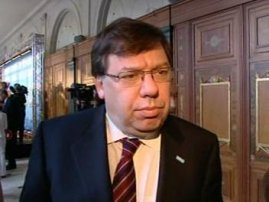
Taoiseach Brian Cowen has made a rather strange statement yesterday. He said that "we are battling the most severe global economic and financial conditions for 100 years".

How does he know that? Did he commission a study into this matter? Perhaps like the one he commissioned into the reasons for the rejection of the Lisbon Treaty by Ireland's voters?

I think not. And no-one else has heard of it either. So how can Brian Cowen have such amazing insight and defining knowledge about economic history? He is no historian, and no economist. Just a humble country solicitor from Offaly with very little practical experience, as he entered professional party politics aged 24 and has not done any normal work since.

So, I ask again: How can the Taoiseach make such a fundamental statement - one for which usually a hundred historians and economists would have to meet over several conferences to agree on research and findings - just by himself and almost off the cuff?

The answer is actually quite simple: Because he is making things up as he goes along.
He does not have a clue about economic history, or economics in general, but he has the bucolic shrewdness often found in people with a rural background. It is the kind of skill one needs when dealing in cattle or horses, or when trying to buy seeds at a bargain price. (There are quite a few of our TDs - across the party lines - who have this trait. After all, Ireland is still predominantly a rural country, and even most of our city dwellers are only one generation removed from farming the land.)

This shrewdness tells Brian Cowen that the Irish people have been successfully hoodwinked into voting for Fianna Fáil for many years, and especially in the last three general elections. So he thinks that he can carry on with more of the same now, except that this time it is not the prep talk of the "great Irish success" and the "we never had it so good".
This time it is pure scaremongering in order to frighten the living daylight out of us. (Maybe someone has told him that it is Halloween...)

And what is all this patronising lesson in homespun economic history in aid of? Only one thing: to promote a very bad Budget and tell us "that government cutbacks cannot be avoided".

This is the second stage of the 'Shock and Awe' concept, originally invented by the Pentagon for the US invasion of Iraq, but now applied by the Irish government to force a half-baked and counter-productive Budget on the nation. (for a detailed analysis - item by item - see my entry 'Shock and Awe - The 2009 Budget' of October 14th)

Cowen lectures us that "we have to change the economic paradigm and policies, but this cannot be done if people oppose every cut that is proposed".

Interesting. Unless he mutated over night into his evil alter ego, I presume this is the same Brian Cowen who told us only a few months ago that all was fine with Ireland. The same Brian Cowen who boasted about the strength of the Irish economy and our "secure finances" before last year's general election. And perhaps even the same Brian Cowen who is now a Fianna Fáil TD for two dozen years, a member of the Cabinet for 16 and Taoiseach for nearly six months.
The very same Brian Cowen who was - as Minister for Finance - responsible for the last four Budgets, and thus responsible for imprudent overspending and generous tax breaks for property developers. This financial policy of Fianna Fáil, supported by the PDs, created the crisis we find ourselves in now.

The very man who created the virus and helped spreading the disease is now presenting himself as the wise and concerned doctor, while he tries to sell us useless medicine at inflated prices.

No, Mr. Cowen, this will not wash! Your deliberate scaremongering does not impress Irish people who have retained their brain over eleven years of Fianna Fáil rule. You have brought this crisis not only on yourself, but on all of us. It did not just appear out of the blue and fall onto this island like an asteroid from outer space.

True, there is a global crisis. No-one denies that. And it certainly has some affect on Ireland and our economy, as these days much business is interlinked across the globe.
But the crisis we are in now is 90% made in Ireland. The way Fianna Fáil - which controls the Department of Finance since 1997 - has wasted and squandered billions while the money was aplenty, was a major factor in the creation of the current situation. Analysts have warned for years that things are going wrong, that concentration on the construction industry and hyped-up property prices are a recipe for disaster.
No-one listened, and least of all the then Minister for Finance: Brian Cowen.

We might well be living through the most serious financial - but not economic - crisis the world has seen since 1929. But that - in my Maths book - makes 80 years and not 100. And, as I have stated here and in many other articles, Ireland needs not to be affected by that in a big way.

Had we had a prudent Minister for Finance and a competent government, we would now have a nice nest egg in form of a sovereign wealth fund, created by the State and accumulated over the years of plenty. Norway has one, and so has Singapore (to mention only two other countries with a population similar to Ireland).
Many countries - large and small - have established sovereign wealth funds when they took in more money than they needed at the time. This is a sensible and prudent way of government.

Only Ireland - under Taoiseach Bertie Ahern and Finance Minister Brian Cowen - decided that the unexpected extra money could only be spent and spent, as the Irish are supposed to be feckless and don't save money.
And not enough with that, the Irish people were heavily encouraged by their banks and by the government to borrow, and borrow more. This went on until a few months ago, and in some ways it is still going on now.

So if Brian Cowen is looking for a reason we are running out of money, a look into a mirror would give him the desired answer.
If he had any guts, he would call an early general election and give the people a chance to decide their future destination. But Cowen is a bully, and - like all bullies - a coward. He will try to hang on to the sinking ship until the water is reaching his ears. In the process he will take many of us down with him.
And - in all fairness - many deserve nothing else, as they kept voting for Fianna Fáil even when their lies and incompetence were clear and obvious, for everyone to see.

The government we have is only there because we elected it. So some "mea culpa (1997), mea culpa (2002), mea maxima culpa (2007)..." is well in order for those who voted for Fianna Fáil and for the Green Party.

But a Brian Cowen lecture on the world's economic history is not. There are plenty of ways to get out of the crisis with dignity and a maximum of fairness. It is time for the government to abandon bullying and scaremongering and turn to these decent methods. (And if they feel not able to do so on their own, they can drop me a line. I would be happy to offer my services as a political consultant and can be contacted by e-mail...)

The Emerald Islander

30 October 2008

All depends now on the Green Party

The Irish government has today won the vote on the Labour Party's motion condemning the education cuts in the 2009 Budget, which had been adjourned last night after a long and angry debate in the Dáil. (see yesterday's entry)

The result was 80-74, which means that the original coalition majority of ten has now shrunk to just six votes.
Should further Fianna Fáil backbenchers or independent TDs who support the ruling coalition defect, the government could lose its parliamentary majority in due course.

Today's vote made it quite clear that the government is now completely dependent on the votes of the six Green TDs, the second-largest partner in the coalition.
Should they - for whatever reason - withdraw their support or leave the coalition, Brian Cowen's government would fall like a house of cards, which indeed it has been for some time.

A change of government before the end of the full five-year period for which the 30th Dáil was elected in 2007 looks now more than likely. There could either be a different coalition taking over - as it was the case in 1994, after the short-lived coalition between Fianna Fáil and the Labour Party under Taoiseach Albert Reynolds collapsed - or there could be an early general election.

All depends now on the Green Party, which - probably without intention - has become the crucial political force in Ireland. They can either nail their colour to the mast of the damaged ship of Fianna Fáil, or recover the rests of their once strong morals and decency that have survived 15 months in government and appeal to the mercy and forgiveness of the nation.

This morning the Green Party's youngest TD Paul Gogarty (photo right), who commented in an e-mail that his party "might eventually consider withdrawing from the coalition", stated that he was now "fully behind the Minister for Education".

He said that - contrary to media reports - "the Green Party is not pulling out of government, nor are they climbing down on the education issue".

Taoiseach Brian Cowen said he does not believe there is any question mark over the stability of the current coalition government.

Meanwhile the independent Kerry TD and political 'maverick' Jackie Healy-Rae (photo left) declared that he would continue to support the government.
In statement he said that Minister for Education Batt O'Keeffe had "assured him that educational needs on a school by school basis would be reviewed in a better economic climate".

Last night the opposition claimed the Green Party was facing oblivion over its stance on education cuts, and this view is shared by many political observers and analysts, myself included.

The official position of the Green Party has been that they are in government "for the long haul, even if in the short term they are seeking changes in the education cuts".

But remarks in e-mail correspondence from Paul Gogarty go further. The Dublin TD and spokesman on Education for his party, tells a lobbyist against the budget cuts that "the Greens may eventually have to pull out of government on this or combined issues".

However, he now says "it is not going to happen until the party has exhausted all avenues".

One wonders how many avenues there are in Dublin. Last time I looked at a city map of our capital, I did not notice that many.

And in my opinion the Green Party remains in an uncomfortable fix. Being the youngest of the six Green TDs, Paul Gogarty is probably not yet fully infected with the dangerous virus of incompetence and ignorance that Leinster House seems to spread so easily among our elected representatives. He is obviously still able to see clearly the political reality, to which the more senior members of his party - especially the three Green ministers - close their eyes and ears so conveniently.

Looking at the three Green government ministers, one cannot help but be reminded ever more of the three proverbial monkeys, who see nothing, hear nothing and say nothing.
Quite a change from the once vibrant and ambitious speeches and actions the 'old' Green Party we had for 25 years was famous for.

I take no pleasure in writing this, but for me - until last year a long-time supporter of the Irish Green Party and environmental movement - the party as a force for good, for change and political alternatives, is dead. And if the Irish voters are not entirely blind and stupid, they will give the Green traitors the same treatment they applied to the PDs in the last general election.

The Emerald Islander

Differences between Austria and Ireland

Vienna - October 28th, 2008
  • A 35-year-old tram driver in the Austrian capital Vienna was bidding farewell to the passengers of his tram with the spoken Nazi-era salute "Sieg Heil!" (meaning: Hail Victory!).
  • The incident was widely ignored, but reported in a Jewish newspaper.
  • When questioned by his bosses, the driver did not deny using the words. But he said "it was just a joke".
  • Vienna's Public Transport Authority took action and sacked the driver with immediate effect and without any severance pay.
  • A spokesman for the public prosecutors' office in Vienna said the driver could face prosecution, as any use of Nazi symbols and phrases is a criminal offence in Austria.
  • If found guilty, the man could face a jail sentence of up to ten years.
Dublin - October 29th, 2008
  • Conor Lenihan, TD, the 45-year-old Minister of State for Integration, called Fine Gael TD Dr. Leo Varadkar in the Dáil "a Fascist" and gave the physical Nazi salute (outstretched arm).
  • The incident was widely reported in all Irish media.
  • When questioned this morning by Pat Kenny on RTÉ Radio 1, he did not deny the incident.
  • After trying to wriggle himself out of the situation verbally by stating that "it was just a joke", he eventually withdrew his remark under pressure from Pat Kenny and Fine Gael TD Simon Coveney.
  • He did not say that he was sorry, nor did he apologise to Dr. Leo Varadkar.
  • Conor Lenihan remains a Fianna Fáil TD and Minister of State for Integration.
  • No further action is taken, and no criminal prosecution will take place.
I do not think that any comment from me is needed on this. The facts speak for themselves.

The Emerald Islander

29 October 2008

Massive Protest against Education Cuts in Dublin

In freezing cold temperature and rain approximately 12,000 teachers and parents turned out this evening to demonstrate against the education cuts announced in the 2009 Budget. (This figure is according to official sources, while the organisers of the protest say that they brought 20,000 people to Dublin.)
The rally outside Leinster House coincided with a Dáil debate on a Labour Party motion calling for the increase in class sizes to be reversed. It was addressed by several union leaders, parent representatives, school managers and politicians.

John Carr (right), General Secretary of the Irish National Teachers' Organisation (INTO), described the budget as "an act of educational sabotage".
He said the people were there to protest in the strongest possible terms about it, adding that they would not allow the educational system to be destroyed by the people inside Leinster House.
He urged the people to "stand and fight, shoulder to shoulder, against the most savage cuts ever taken against children in this country".
The cutbacks represented one broken promise too many, he added.

John White (left), General Secretary of the Association of Secondary Teachers Ireland (ASTI), said the cuts would affect every single school in the country.
He urged those at the rally to go back to their communities and ascertain what the effect of the cuts will be on their local schools, and then tell their local representatives.

Ferdia Kelly (right), the General Secretary of the Joint Managerial Body (JMB), which represents the Boards of Management of more than 400 Secondary Schools in the Republic of Ireland, warned that from January children may have to be sent home from schools, or schools may even be closed for a time, because of the proposed cutbacks on substitute teachers.
For generations, he said, teachers, parents and management had worked hard to keep Ireland near to the top of the international league on education.

Áine Lynch of the National Parents Council Primary (NPCP) said the increase in the capitation grant announced in the Budget will not even cover the rise in fuel prices and other day-to-day running costs of schools. The NPCP now fears that the cost of the deficit of running schools will be passed onto parents.
It also expressed concern about the reintroduction of the ceiling on language support teachers.

Meanwhile in the Dáil chamber this evening, the Taoiseach Brian Cowen (left) warned that "even with the Budget economies and cutbacks, the country will still run a deficit which will have to be tackled in the years ahead".

He was responding to questions from opposition leaders, including Fine Gael leader Enda Kenny.

Labour's education spokesman (and former leader) Ruairi Quinn (right) described the government's Budget as "an act of social vandalism which attacks children".
Introducing the Labour Party's motion seeking the reversal of the education cuts, he said that one effect of the cuts would be "to push young, shy children into classes of over 30 other children".

Education Minister Batt O'Keeffe (left), who is becoming increasingly rude and aggressive, accused the opposition of "hysterical claims and scaremongering" in the debate.
He described the changes as "a measured adjustment" and told TDs it was "not credible to claim that the primary school system will be in crisis next year as a result". It was pretty obvious that he was not comfortable in his role and stumbled through his speech in a very bad way, not to be seen from him often.

Fine Gael's Education spokesman Brian Hayes (right) said it was "stomach churning" to hear the Green Party justifying their support for the government cutbacks.
He predicted the controversy would prove "the Green's Stalingrad", claiming that the Green Party would never recover from the serious damage caused by breaking their pre-election promises.
Deputy Hayes emphasised that Minister Batt O'Keeffe "has no credibility in the education sector", describing him as "Brian Cowen's puppet".

Sinn Fein's Caoimhghín Ó Caoláin (left) called the Budget cuts a "callous attack on Irish children" and - reaching out across the party lines - urged "all members of the Dáil, regardless of allegiance" to join him in the "defence of our young, our schools and our education system".
Deputy Ó Caoláin, himself a teacher by profession, arrived a few minutes late and entered the Dáil chamber while Ruairi Quinn was already speaking.
He came directly from the mass demonstration outside the parliament and introduced himself to the debate as "a messenger of thousands of teachers and parents gathered outside in outrage and anger over the government's onslaught on the education and future of our children".

A nasty incident overshadowed the debate for a while and raised the political tempers even further. Conor Lenihan (right), Minister of State for Integration and brother of Finance Minister Brian Lenihan, shouted across the Dáil chamber during the speech of a Fine Gael TD and called Dr. Leo Varadkar (left) - Fine Gael's spokesman for Enterprise, Trade and Employment - "a fascist".
Lenihan augmented that outrageous statement with
giving the Nazi salute, which caused uproar on the opposition benches and led to the intervention of Leas-Cheann Comhairle Brendan Howlin, who chaired the session in the absence of Cheann Comhairle John O'Donoghue.

The debate, which saw spirited exchanges between speakers from all parties, has now adjourned until tomorrow morning.

The Emerald Islander

IPPN urges Government to rethink Budget Cuts

The Irish Primary Principals' Network (IPPN) has called on the Irish government to reconsider the planned cuts in spending on education.

The network has a membership of 5100 school principals and deputy principals, representing 90% of all Irish primary schools.
It stated that upwards of 1000 teachers would be lost to the system as a result of the budget cuts.

IPPN Director Sean Cottrell said that it is "unthinkable that consideration would be given to cutting back on an educational infrastructure that has served the country so well."

"Recent history shows us clearly that our education system is an essential part of Ireland's infrastructure," he explained. "Just as it is unthinkable that we would dismantle our transport infrastructure in the face of economic pressures, so too is it unthinkable that we would consider cutting back on the educational infrastructure, which has served - and continues to serve - us so well."

Nine days before the 2009 Budget was introduced in the Dáil, IPPN President Larry Fleming had called on the Minister for Finance Brian Lenihan not to cut the education budget in order to give our children the education they need to succeed later in life. (see my entry of October 5th)

It appears that Brian Lenihan has not listened to the IPPN's plea, and meanwhile his party and cabinet colleague, Education Minister Batt O'Keeffe, has nothing better to do than to hurl insults and groundless accusations towards teachers and their organisations.

This is especially outrageous and disappointing as Mr. O'Keeffe was a teacher himself before he became a politician. But instead of supporting his former colleagues in their daily struggle for better education and fairer conditions, O'Keeffe has now become the fiercest enemy of Ireland's children, their teachers and the whole school and education system.

The Emerald Islander

Quinn calls Budget "a Dog's Dinner"

The Irish Labour Party's spokesman on Education (and former party leader) Ruairi Quinn (left) has described the 2009 Budget as "a dog's dinner" and said that its measures are "an attack on children".

Quinn was speaking on RTÉ Radio 1 this morning, where the Minister for Communications, Energy & Natural Resources Eamon Ryan (Green Party) said there was "not a cut in the education budget, but a € 300 million increase".
Ryan said he did not want to see education bearing the brunt of the financial crisis, but at the same time he did not think it would be right to "completely ignore the possibility of achieving savings or getting greater efficiency".

However, Declan Kelleher (photo right), President of the Irish National Teachers' Organisation (INTO) has said that primary school children are "the least funded sector in the Irish education system".
Kelleher was speaking ahead of a demonstration by teachers, parents and students outside Leinster House in Dublin this evening, in protest against the planned cutbacks .
The campaign to stop the cutbacks would be fought from every parish in the State, Kelleher stated defiantly.

Earlier the Minister for Education Batt O'Keeffe (photo left) accused teachers' unions of "scaremongering".
In an interview on RTÉ's Prime Time programme last night, O'Keeffe said that the government would "not change its stance on the issue".

The Dáil resumed this afternoon amidst the continuing controversy over the government's Budget proposals.

Attention will centre this evening on a Labour Party private members' motion, criticising the cuts in education funding which will focus attention on the Green Party's position on this issue.

Fianna Fáil backbenchers faced opposition taunts last week, and this time it will be the turn of the junior partners in government. The Greens must now effectively defend proposals that will see class sizes in Irish schools rise.

Yesterday the Green Party said it was "committed to remaining in government", prompting one of their most prominent members - Clontarf Councillor Bronwen Maher (right), the only Green member of Dublin City Council - to suggest her own party has "no moral or political bottom line".

Last night a party spokesman said the Green Party was "disappointed and a little puzzled by her comments".

Well, as I expressed in my analysis yesterday, the Green Party is now waking up to the realities of Irish politics and has to live with the fact that it joined their main enemy's camp last year. (see yesterday's entry fro details)
There is really only one alternative: Either the Greens betray their moral and political principles of 25 years' standing (as Bronwyn Maher noticed), or they leave the government coalition and thus trigger an early general election.

The Emerald Islander

Ex-Minister supports the Raising of Asgard II

Robert 'Bobby' Molloy (photo left), a former Irish Minister for Defence, is supporting calls for the raising of the Asgard II from the seabed in the Bay of Biscay, where she sank in the early hours of September 11th. (see my entry of that day)

During his time as Minister for Defence, Robert Molloy approved the original funding to build the brigantine specifically as Ireland's national sail training vessel.

In an interview with Ireland's national broadcaster RTÉ, Mr. Molloy said that the Asgard II (archive photo right) had made "a huge contribution to the nation, training thousands of young people and helping to formulate their characters".

He emphasised that it was "essential for safety at sea to know what has happened to the vessel" and that the State should continue to provide sail training for young people in the future.

Two separate investigations by the Irish Marine Casualty Investigation Board (MCIB) and by the French maritime authorities have not been concluded yet, and the current Minister for Defence Willie O'Dea told the Dáil that tenders for lifting the Asgard II from the seabed will close next Friday.

The costs for a salvage operation are expected to be substantial, but since the vessal was insured for € 3.8 million, that amount of money should be well sufficient to raise and restore her.

Willie O'Dea (photo left) said that Coiste an Asgard, the committee which runs the vessel's operations (and which he chairs), has also been looking at a possible replacement to continue national sail training, but has not yet made a decision.

Mr. Molloy, who retired from politics in 2002, said he had met with the present minister and that many people were concerned about the future of the Asgard II. He called on all sailing people to make their voices heard, in order to get the sunken brigantine salvaged and returned to service.

Regular readers of this weblog will know that I have done this already for the past six weeks, and even made further suggestions. (see also my entries of September 13th and October 3rd, 5th, 12th & 18th)
I will continue to do so and welcome the statement and support of Bobby Molloy. Without his clear vision and determination in the early 1980s the Asgard II might not exist at all, and he is a most welcome ally in the campaign to safe her from an eternal grave beneath the waves.

The Emerald Islander

28 October 2008

The Greens are beginning to wake up to the uneasy Reality of Sitting in a political Trap

Ireland's coalition government is stumbling from one crisis into the next, and the three parties involved are drifting from uncertainty to uncertainty now on a daily basis. Crisis has become the normal condition, and worries about the next problem around the corner makes many politicians ever more nervous.

Today TDs and Councillors of Ireland's Green Party - the second largest force in the coalition - have been meeting in Dublin to discuss their (belated) response to the ongoing controversy over the 2009 Budget. (see also my entries of October 14th & 20th)

After a long and deafening silence in the previous week, which saw the Budget introduced by the Minister for Finance Brian Lenihan (FF) and the Irish nation erupt in anger and protest over its new measures - in particular the withdrawal of medical cards from the elderly - the Green politicians are beginning to wake up to the realities of being a junior partner to Fianna Fáil. This - to call a spade a spade - means nothing else but sitting in a political trap, with little legroom and even less leeway. Having burned their 25-year-old ideological ships last year when entering the coalition, they have hardly anywhere left to go, except political oblivion.

Some within the party are now expressing concern about the proposed cutbacks in education, which will be at the centre of a Dáil debate tomorrow and on Thursday.

Ireland's Green Party knows only too well that it stands already fully in the spotlight.
Two independent TDs - Joe Behan and Finian McGrath - withdrew their support from the government over the new budget, rendering the support of John Gormley (above) even more important for Taoiseach Brian Cowan and Fianna Fáil.

Gormley's TDs will have to support the government in Thursday's vote on a Labour Party motion on the education cuts, and that will be difficult and uncomfortable for them.

Dublin TD Paul Gogarty (left), the youngest of the six Green members of the Dáil, has already called for the cutbacks to be reversed and has suggested alternatives to the Minister for Education, Batt O'Keeffe (FF).

Green Party leader John Gormley has said that he is in government for the long haul, but many of his party's Councillors are worried about their prospects in next year's local government elections and may have a different view.
They have already voiced their opposition to the medical card cuts and will be just as unhappy about many other budget provisions.

In order to survive as Taoiseach, Brian Cowen needs the Green Party, and in oder to provide this vital support, John Gormley needs the support of his whole party, not just the six TDs and two Senators he has in Leinster House.

There has been already a split in the Green Party earlier this year, when two thirds decided to support the Lisbon Treaty, while one third voted against it. (for this see also my entry of January 20th)
The latter elements of the party were found in happy and rather easy partnership with the People's Movement in the NO camp before the June referendum, and it is likely that at least some frustrated Greens will give up their party membership sooner or later over the ever more unpopular closeness of their leadership to Fianna Fáil.

Perhaps those members of the Green Party who - against critical advice and against common sense - rushed into the coalition with Fianna Fáil in June 2007, will now feel the eyes of their friends on them, and hear their angry questions ringing in their ears. As things stand right now, anything could happen and no political surprises can be ruled out for the foreseeable future.

The Emerald Islander

27 October 2008

29th Dublin City Marathon

Mass Marathons have become very popular in recent years, and there is hardly any major city in the world now that does not have one. Thirty years ago the idea was new and somehow odd, but it began to win more and more support throughout the sporting communities around the globe.

In 1980 the idea reached Dublin and the first city marathon was organised by a group of running enthusiasts led by (the late) Noel Carroll.
He persuaded the Business Houses Athletic Association (BHAA) to support the event, and in the first year 2100 runners - most of them Irish - took part. 1420 of them finished. Dick Hooper of the Raheny Shamrocks Athletic Club claimed first place, in a time of 2 hours, 16 minutes and 14 seconds. The first female winner was Carey May, who finished the marathon in 2 hours, 42 minutes and 11 seconds.

Much has changed in the nearly three decades since. We had and lost the economic boom of the 'Celtic Tiger' and many foreigners now live in Ireland and participate in our sporting events. Many foreign athletes even travel to cities to participate in the now popular marathon races, and thus it is no surprise that the number of runners has increased nearly six-fold. But one element of the event has not changed: it still takes place on the last Monday in October, which is always a bank holiday in Ireland (compensating for Samhain, which is unfortunately still not a public holiday).

This morning over 11,700 runners assembled at Fitzwilliam Square, the traditional starting point of the race, for the 29th Dublin City Marathon, run in aid of the National Children's Hospital in Tallaght. It was a crispy cold, but sunny day, as we have quite a few here in October, so mood and conditions were quite good.

There was a major increase in Irish runners this year. Over recent years more than half of the participants had come from overseas, but Irish runners made up 57% of this year's entrants. There were also more women than ever before, making up one-third of the field.

But there is only one Mary Hickey Nolan, the only woman who ran in all the Dublin City Marathons to date, with this being her 29th race.

The event started at 8.50 a.m. with the wheelchair entrants, followed by the elite and then the general field at 9 a.m.
As usual the route went from Fitzwilliam Square through the inner city and the Phoenix Park, to end at Merrion Square.

The first male runner to finish this year was the Ukrainian Andriy Naumov, who ran the 26.2 mile distance in 2 hours, 11 minutes and 6 seconds. As the overall winner he received the Noel Carroll Memorial Trophy and a € 15,000 cash prize.

Thus for the 16th year in a row the winner of the Dublin City Marathon was not Irish, a price we have to pay for opening the event to foreign competitors. The best runner from Ireland was Michael O'Connor, while the Russian Larrisa Zousko was the fastest woman with a time of 2 hours, 29 minutes and 55 seconds.
The special wheelchair race was won by Paul Hannan from Armagh in 2 hours, 22 minutes and 33 seconds.

Even though I run for at least an hour every morning - and on some days longer - I have not yet attempted a marathon myself. I have the greatest respect for anyone who has done it and wish them all the best, together with my sincere congratulations to the winners.

The Emerald Islander

26 October 2008

The Making of Sarah Palin

Sarah Palin is not John McCain's 'spontaneous' choice for US Vice President and was not chosen by him.
She is a fundamentalist right-wing creature that was planted on him by party managers.
She was secretly groomed and prepared for her role by right-wing Republican 'spin doctors' for 18 months and originally meant to be the 'running mate' of Rudy Giuliani.

Read the whole story of the Making of Sarah Palin below in this

EXCLUSIVE REPORT


Sarah Palin, the right-wing creationist, 'hockey mom' and governor of Alaska, was sold to the Republican Party, the world's media and the general public as a 'spontaneous' choice of the presidential candidate, Senator John McCain, apparently showing his vigour and love for unconventional decisions.

That presentation was a lie.

I did not buy it right from the start and have been sceptical from the first moment I saw and heard Sarah Palin speak.

This woman, even though clearly inexperienced and a country bumpkin from the wilderness of Alaska, was too much groomed in certain ways, and uttered - almost like a parrot - just the kind of words the right-wing fundamentalists in her party wanted to hear. There was no spontaneity in her 'spontaneous' appearance, and I smelt a rat straight away.

However, between having a hunch and being able to establish that one is right there is a long stretch of thorough research. And not always does one find what one expects to be there.

But this time it is, and today I am happy to share with you the findings of my investigation into the making of Sarah Palin, who was neither a spontaneous choice, nor was she chosen by John McCain.

When Senator McCain presented Sarah Palin as his 'running mate', everyone was completely baffled. Sarah who? - people kept asking one time after the other. And she is the governor of what? (It was quite an interesting observation on the side that many Americans, including even some journalists, seemed not to know that Alaska is one of their 50 states...)

If John McCain had intented to surprise his party, America and the rest of the world and show once again what a great 'maverick' he is, pulling the name of this widely unknown and totally inexperienced backwoods politician out of a hat only two days before the party's convention would indeed qualify as a 'maverick' stunt.

But John McCain is as much a 'maverick' as my neighbour's little hamster. The Arizona Senator and former naval aviator likes the idea of a 'maverick', and he would really love to be one. But that's as far as it goes.
In his long political career - four years in the House of Representatives and 21 years in the US Senate - he has not left many impressions of independent behaviour. And during the nearly eight years of the current administration McCain voted in over 90% of all decisions with George W. Bush and supported his policies.
Not really the behaviour of a 'maverick', is it?

In fact, the artificial image of John McCain as a 'maverick' has only been used by himself and his campaign team since he decided to be a candidate for this year's election and began to run in the 'primaries'. And the sole reason for applying this label to himself is his - later aborted - attempt to switch sides in 2004, when for a short time there was even the possibility of John McCain becoming the 'running mate' of the Democratic candidate John Kerry.

For a few months, during which he was very annoyed and angry with George W. Bush and his administration, he contemplated moving over to the Democrats (inspired and encouraged by his old friend and fellow Senator Joe Lieberman) or even setting up a third party under his own leadership. If he were a real 'maverick', he would have done one of these two things. But after many talks and proposals, nothing came of it and McCain stayed put and quiet as a Republican.

McCain's moves did not remain hidden from George W. Bush and his team, lead by Karl Rove. And after a face-to-face meeting in the White House in the late summer of 2004, the Senator from Arizona was a changed man. Forgotten was all his anger, forgotten were his ideas to make a bold move on his own.
From that time on he voted even more often with the Bush administration and supported it in almost everything.

We don't know exactly what was said during this meeting, of course, and what the two men agreed on, but it is very clear that on this day John McCain sold his soul, and all what was left of his independent mind, to George W. Bush and Karl Rove.
We can assume that Bush promised McCain a 'free run' for the presidency in 2008, when he himself could not stand again. He and Rove might even have promised McCain support from the fundamentalist 'Christian' right, which they both had used as power base for their own success.

It was therefore no great surprise that after John McCain's 2007 announcement to run for the presidency, no strong or serious candidate was nominated from the right wing of his party.
Only Mitt Romney and Mike Huckabee threw their hats into the ring of the 'primary' circus, but neither of them had ever a real chance to become President, or even be nominated as the party's candidate. Romney is a prominent Mormon, and even a right-wing America is not (yet) ready for a Mormon in the White House.
And the fundamentalist 'Christian' and backwoodsman Mike Huckabee, though popular with the right-wing creationists, is a real 'maverick' who would never have mobilised enough voters from 'middle America'.

Thus the only serious opponent for McCain was former New York Mayor Rudy Giuliani (left), who made a real mess of his campaign and fell by the wayside after only one 'primary', the crucial vote in Florida.

It has always baffled me why an experienced and shrewd politician like Rudy Giuliani flatly refused to campaign in the smaller, but nevertheless important, east coast states and put all his hopes and money into Florida.
Could this have been just a diversion, a deliberate failure to leave McCain the open road to the nomination? We will probably never know, but it is quite possible.

After he secured the Republican nomination - long before the convention - many people wanted to know who John McCain's 'running mate' for the vice-presidential office was going to be. But despite repeated and ever more urgent questions, McCain remained silent and only said he would tell the world soon enough. Once again he wanted to play the 'maverick' and had a real surprise in stock for his party. He was going to take his old personal friend Joe Lieberman (above), 'independent Democrat' and Senator from Connecticut, with him to the White House.

When John McCain's chief adviser Steve Schmidt (left), who took complete control of the campaign in July, learned of this plan, he was shocked and outraged.
What the party needed was a staunch Republican as vice-presidential candidate, he argued, especially as McCain himself was still seen as "too soft and too liberal" by the strong right wing of the party.

Joe Lieberman would not be acceptable, Schmidt said, as he was not only a Democrat, but also an orthodox Jew from the east coast. What the party needed was "not Joe Lieberman, but an ordinary Joe" people could relate to. Better even a Josephine, as "a woman always brings extra attraction".

After lengthy arguments McCain gave in eventually and left the selection of the 'running mate' to the 38-year-old Steve Schmidt.
This was not a hard task for the right-wing campaign manager, as he had in fact made his selection already. For quite some time a small group of selected right-wing Republicans, led and organised by George W. Bush's former campaign manager and chief 'spin doctor' Karl Rove (above), had prepared and groomed Sarah Palin for this position. The whole operation was done with the utmost secrecy, and only a few people knew of the plan. John McCain was not among them.

The young female governor of Alaska, hardly known to anyone outside her own state, was just the kind of person Rove and Schmidt needed.
A mother, housewife and politician, who stands on the far right of the party, loves guns and shooting animals, and - most important of all elements - a strict fundamentalist evangelical 'Christian' and creationist, who is vehemently opposed to abortion. She ticks all the crucial right-wing boxes, and it could not have been better.
(That Palin's 17-year-old unmarried daughter would become pregnant at the politically most unsuitable time no-one expected...)

That Sarah Palin is less than two years in her current job as governor and has absolutely no experience with foreign affairs did not bother Schmidt or his mentor Rove. After all, George W. Bush was in the same situation in 2000, and he provided the right-wing war mongers under the leadership of Richard 'Dick' Cheney with two full-sized conflicts after he was briefed in the right way.

However, the 'discovery' of Sarah Palin as a potential vice-presidential candidate was neither made by Steve Schmidt nor by Karl Rove, who taught his associate all the dirty tricks while they both worked in the White House under George W. Bush and Richard 'Dick' Cheney (the latter being advised directly by Schmidt, before he was chosen as the campaign manager of Arnold Schwarzenegger for the gubernatorial election in Calaifornia in 2006).

The rather dubious 'honour' of having found Palin and recognised her potential must go to a young college student in Colorado named Adam Brickley (right), who - at the tender age of 20 - started a private one-man campaign for the selection of Sarah Palin as the Republican candidate for Vice President of the USA.
Brickley, a youth and student activist on the fundamentalist far right of the Republican Party, was looking for new faces among Republican state governors, senators and members of the House of Representatives, with the idea to pick the most appealing for his self-ordained mission to find and promote the next Republican 'celebrity'.
It is not known how many political biographies Adam looked up on Wikipedia or other online sources, but sooner or later he came across Sarah Palin, and he liked what he saw and read.

Being a bit of a computer nerd, he decided to use the internet - and especially blogging - for his promotional purposes. So with his mind made up, Adam Brickley started a new weblog, which had the clear and unmistakeable name Draft Sarah Palin for Vice President.

The first text on this weblog was posted on February 26th, 2007, which was:
  • less than three months after Sarah Palin was inaugurated as the newly elected (first time) governor of Alaska (on December 4th, 2006);
  • two months before Senator John McCain announced (on April 25th, 2007) that he would be seeking the nomination of the Republican Party for the US Presidency;
  • more than 18 months before John McCain presented Sarah Palin as his 'surprise running mate' at the Republican convention on August 29th, 2008 in Saint Paul, Minnesota.
In this first post Adam Brickley explains what he was doing, and why. He writes:
"This blog is the result of about a month worth of research on potential Republican Vice-Presidential candidates for the 2008 election. I had been considerably less than thrilled with all of the early speculation, mostly swirling around second-tier presidential candidates, so I decided to see if there was anyone better suited for the job that I hadn't been hearing about. So, I developed the following profile for the perfect VP candidate (using Rudy Giuliani as my presumptive presidential candidate):
1) A energetic, young, fresh face who will energize the electorate
2) Not connected to the current administration
3) Pro-Life
4) Pro-Gun
5) A woman or minority to counter Hillary or Obama and put to rest the idea that America only elects white males
One of the first names I found that fit these qualifications was that of Sarah Palin, the recently elected Governor of Alaska. I knew that I had stumbled upon a fantastic candidate for national office, but I kept looking in the hope that I could find other potentially viable choices. However, after looking at every GOP [Republican] governor, senator, and congressperson, I found that Palin had only become more appealing."

So, how did the weird idea of a college undergraduate from Colorado make it right into the frontline of the presidential election? It was a long and rather strange journey.

At first the whole 'Palin campaign' was indeed only Adam Brickley and his weblog. And it was not the Arizona Senator John McCain whom young Adam wanted to be the next Republican in the White House.
For the right wing of the party McCain always was - and still is - a suspect 'liberal' and not the man of their choice. (Most of them will still vote for him, now that he is the party's candidate, but there are hard-line fundamentalists who will not.)

Adam Brickley's preferred candidate for the highest office in the USA was Rudolph W. Giuliani, who for most of 2007 was the clear frontrunner in the Republican Party. The only child of an Italo-American Mafioso from New York and until the end of 2001 the Mayor of that city for eight years, Rudy Giuliani - the man who invented 'zero tolerance' - was the hope of most right-wing Republicans, until he totally mismanaged his campaign and had to quit the race after coming third in the Florida 'primary' election, the one he had expected to win with a substantial margin. (How much this was stage-managed by the White House to keep the promise made to John McCain in 2004 can only be guess work.)

So when Adam Brickley sat in front of his computer in Colorado and selected Sarah Palin as potential 'VP' candidate, he chose her as the 'running mate' of Rudy Giuliani, and not for John McCain.
But when events overtook his preference, even a right-wing hick like Adam was flexible enough to adjust his online campaign to the new political realities on the ground.

The blogging campaign for Sarah Palin was not the first time that Adam Brickley - online also known by his internet name 'ElephantMan' - had started a political weblog.
On July 29th, 2005 - a Friday evening with nothing else to do - the then 18-year-old created ConservaGlobe, which - as he described it himself - was a "right wing commentary on world politics from a man on a mission to prove that Conservatism transcends national boundaries".
(By the way, the name 'ElephantMan' has in Adam's case no connection with the famous John Merrick and is instead a verbal link to the mascot animal of the US Republican Party, which is - strangely enough - an elephant.)

For nearly two years 'ElephantMan' ran ConservaGlobe, featuring a large number of political news items and comments from around the world.
For an American living in one of the land-locked states, Adam showed an unusually strong interest in the rest of the world, and although his posts reflect clearly his right-wing political orientation, the ConservaGlobe weblog was maintained well and quite informative.
The last text there - with the rather strange title "Are Terrorists Targeting Gordon Brown?" - was posted on July 1st, 2007, when Adam's newly found obsession with Sarah Palin began to take all his attention.

Because within less than six months of Adam Brickley starting his strange campaign for a woman he had never met or spoken with, the Republican puppet masters had taken him and his idea under their shady wings.

To most outsiders this was not obvious, but behind the scenes the right-wing spin machine began to work for and on Sarah Palin, preparing and grooming her slowly but steadily for a position as 'running mate' for Rudy Giuliani.

The only visible change was the appearance of a second name on Adam Brickley's campaign weblog.
Draft Sarah Palin for Vice President had suddenly another writer, one Stephen R. Maloney, who shaped up the weblog and put more political spin onto it.
Most visitors to the site might not have noticed that and probably did not notice the significance of the new name either. But for political observers and analysts it meant a lot.

Stephen R. Maloney is a right-wing US writer (author of "Talk yourself to the Top") and political consultant, who - after many years in the conservative South - lives and works now in Ambridge, Pennsylvania (a state heavily targeted by the Republicans and one they need to win if they want to win the election).
Besides his work as a political consultant, Maloney has a long track record as a speech writer, working mainly for large US companies who support the Republican Party - and especially the Bush administration - with huge donations. Among them are Phillips Petroleum, Gulf Oil, USX (US Steel), Aetna, Merck, Lilly and many others.

This accomplished 'spin doctor' took now control of Adam Brickley's weblog, and worked closely with the masters of the Republican propaganda machine, Karl Rove and Steve Schmidt.

Maloney is a very prolific blogger and involved with at least 18 different right-wing political weblogs, most of which he controls himself. (This number includes at least five new weblogs which already project and promote Sarah Palin for the next presidential campaign in 2012!)

One of these 18 weblogs, called Campaign 2008 Victory A, was established by Stephen R. Maloney on June 25th, 2007, shortly after he had stepped in as Adam Brickley's political mentor, and more than 14 months before Sarah Palin was presented by John McCain as his 'surprise running mate'.
At that time McCain did not even know she existed, but she was already groomed secretly by right-wing manipulators as his potential vice-presidential partner.

In his first text, posted on this weblog on June 25th, 2007, Stephen R. Maloney wrote:
"I do like Sarah Palin - a lot... Sarah has the character, charisma, and communication skills necessary to appeal to the American people. She doesn’t come with the political history - and the high 'unfavorability ratings' - associated with most national figures. I’m prepared to burn a great deal of time in the effort to get Sarah on the ticket... I’ve invested at least 200 hours so far, and I’m ready to spend at least 2000 more. Why? Because I believe it’s essential to the country that there be a new dynamic - specifically, a dramatically different personality - in American politics. As I’ve said before, if our ticket is the usual one - two aging white males in gray suits, both carrying more baggage than an army of red caps - then we deserve to lose, and we will lose."

To remind you, this was 14 months before Sarah Palin's nomination, and about one year before the increasingly senile John McCain ever heard of her.

But while the Arizona Senator was preparing for his 'primary' campaign across all 50 US states, the right-wing spin doctors manufactured what was in their eyes the 'perfect vice-president' who would not have to run the gauntlet of the 'primaries' and could appear later like a rabbit from a magician's hat - Sarah Palin.

At this early stage none of them even contemplated that John McCain would be their party's nominee, and they were not interested in him at all. Their favourite at that stage was Rudy Giuliani, with actor and former Senator Fred Thompson a possible candidate. These two were the potential candidates Sarah Palin was groomed to assist, in an election they clearly expected to run against the Democratic Senator and former First Lady Hillary Clinton.

As Stephen R. Maloney writes on June 25th, 2007: "Admittedly, I may be wrong, but I don’t think Fred [Thompson] can defeat Rudy [Giuliani] in the Republican primary. And I don’t believe Giuliani alone can defeat Mrs. Clinton in the general election. Recent polls suggest my gloomy assessment is correct. Could Rudy running with Sarah defeat Hillary Clinton? Maybe. Could Fred Thompson running with Sarah defeat Mrs. Clinton? Possibly. I like some of the other Republican presidential candidates, but I see no evidence they could emerge as winners in November 2008."

And he continues: "We’ve never [had] anyone remotely similar in high office. For one thing, Sarah is the mother of four children. [By now she has five.] We’ve never had a high official from Alaska, a state blessedly free of many of our political obsessions in the 'lower-48'. We’ve never [had] a President or a Vice-President whose spouse has actually held what most of American regards as 'real jobs' - in Todd Palin’s case as a commercial fisherman and oil field production foreman."
"The idea of Sarah going to [Washington] D.C. as the nation’s first female vice-president makes me smile. It has a little of the quality of Jimmy Stewart’s old 'Mr. Smith Goes to Washington'. Imagine that: sending a real person - someone with whom a hundred million American[s] can immediately identify."

He goes on: "On critical issues like energy, faith, and family, Sarah might be the best-informed person we’ve ever sent to Washington, DC. She won’t have learned about those matters by reading books; she has lived them first-hand.
Sarah is good at running things. That traces back to her childhood, and especially to her role at a point guard on a state championship basketball team. The point guard brings the ball up the court and decides exactly how the offense will attack the defense.
In both life and politics, Sarah has almost always been a winner. The 'almost' qualification comes from the fact that she lost her race for Lieutenant Governor. She obviously learned a lot from that. She came back to defeat former Senator and then-Republican Governor Frank Murkowski in the primary. Then, she defeated Democrat and former Governor Tony Knowles in the general election."

Concluding the article, Maloney addressed Sarah Palin directly: "So Sarah, you may barely know I exist - at this point. But I’m going to devote every hour I can to making sure you have to relocate sooner rather than later from Wasilla, Alaska to Washington, DC."

And Stephen R. Maloney kept his promise. He and his collaborators ran a subtle campaign - making good use of the internet and blogging - to make Governor Sarah Palin the Republican vice-presidential candidate for - originally - Rudy Giuliani, and then, after he failed and dropped out, for the eventual nominee, John McCain.

He, the former navy pilot, war hero and long-time politician had nothing at all to do with the selection and the 'making' of Sarah Palin.

When the time came to nominate a 'running mate', he was told who it was to be.

His own long-term choice - Senator Joe Lieberman - had never a chance. The party machine, reluctantly accepting McCain - the man they least wanted - as presidential candidate, forced him to do what he was told.
Such is politics, and in particular Republican politics in the era of Karl Rove.

The rest, as people often say, is history.

Most analysts - myself included - expect a Democratic landslide win on November 4th. And one of the main reasons for that is Sarah Palin, the woman who - for a short time - energised the Republican core voters, but has quite the opposite effect on everyone else, including the crucial independent voters who are ever more the deciding factor in US elections.

Given the fanatic devotion some political activists like Stephen R. Maloney and Adam Brickley have for her, they will probably do everything in their power to keep her alive on national level, hoping to run her again in 2012.
But if the current investigations into her abuse of power as governor of Alaska are taking on their own momentum, such efforts - including the already existing five weblogs Maloney has created for a 'Sarah Palin 2012' campaign - might become irrelevant.

The Emerald Islander


This article is copyrighted.
© 2008 by the author & blog owner, and by
Mayfield Communications, Waterford / Ireland


If anyone - newspapers, magazines or fellow bloggers - wishes to copy
or republish this article, then please obtain first permission to do so.
You can do that by e-mailing me at inishtrahoull@yahoo.co.uk

Support for Fianna Fáil plummets to all-time Low

The latest Red C opinion poll in today's Sunday Business Post shows Fianna Fáil down ten points, and thus falling seven points behind Fine Gael for the first time ever.

This massive drop in popular support for Ireland's largest and main government party is a clear and obvious reaction to the 2009 Budget and the extremely foolish and unpopular measures it contains. It comes on top of another loss of four points last month, which means that support for Fianna Fáil has plummeted by 35% over the past 60 days.

Taoiseach Brian Cowen, who will return from China later today, may find some consolation in the thought that the poll was carried out at the worst possible time for his party - last Monday, Tuesday and Wednesday, when the medical card controversy was raging.

But the results are devastating all the same. Fianna Fáil has dropped to just 26% support, the lowest level the party has had since the 1920s.

Fine Gael meanwhile has gained five points to 33%, a full seven points ahead of Fianna Fáil for the first time since opinion polling began.

The Labour Party, second largest political force in the opposition, has gained six points and stands now at 15%, while Sinn Féin gained one point to reach 10%.

Fianna Fáil's two junior coalition partners dropped one point each. The Green Party stands at 6% now, while the remnants of the almost extinct Progressive Democrats have just 2%.

Independents and others remain unchanged at 8%.

Also of concern to the government must be a significant drop in confidence that it can steer the public finances out of current problems.
Just 20% now believe it can, a drop of 19 points, while 59% do not believe it can, and 21% 'Don't Know'.

There was no question in the poll about the survival of the government or a possible election at an early date, but all around the country the idea that the current coalition will last the full five years it set out for is seen now as unlikely.

The Emerald Islander

24 October 2008

Ireland's richest Man is fined Millions by the Financial Regulator over a shady Loan Affair

On a day that saw many of the world's stock exchanges experiencing the worst declines in their history - with drops of around 10% in most indices - a long-running investigation into business irregularities in Ireland has come to an end.

An insurance company owned by Ireland's richest businessman has been fined a record € 3.25 million by the Financial Regulator in Dublin.

Sean Quinn (photo) who comes from Co. Fermanagh in the North, but has now various business interests all over Ireland as well as abroad, was also fined a sum of € 200,000 as a personal punishment.
He has now stepped down as chairman of Quinn Insurance (formerly BUPA Ireland), following the investigation.

The office of the Financial Regulator said it had "reasonable cause to suspect breaches of regulatory requirements". But it pointed out that the insurance company had fully co-operated and the matter was now closed.

In a statement, the Financial Regulator said the suspected breaches related to contraventions by Quinn Insurance of "obligations under the Insurance Acts and Regulations, including failure to notify the Financial Regulator prior to providing loans to related companies". Policyholders with the firm had not been affected.
It appears that assets worth € 288 million were moved internally from the insurance company to another part of the Quinn Group, in order to support Quinn's purchase of 15% of the shares of AIB bank, which at the time stood at a price of € 6 each. (The shares have meanwhile fallen well below € 1 and besides the fines Mr. Quinn is also facing massive losses in the value of his - rather unwise - investment. But as Ireland's richest man and one of the few Irish billionaires, he will not bee too much bother, one can assume.)

In a statement Sean Quinn said the company "had made loans to a related company which amounted to € 288 million in May 2008", when the accounts were finalised.
"These loans breached insurance regulations and as a result of this the Financial Regulator has sanctioned Quinn Insurance and myself. I accept complete responsibility for this breach of regulation. But while I accept that I made mistakes, I feel that the levels of fines do not reflect the fact that there was no risk to policyholders or the taxpayer. However, we will pay the fines and move on."

Sean Quinn said he would continue as chairman of Quinn Group, which last year made profits of € 433 million - an increase of nearly a third on the 2006 results. It also bought the health insurance company BUPA Ireland, which was then re-named Quinn Insurance.

Quinn and his wife and children own the companies outright and are believed to have in 35 years amassed a personal fortune of nearly € 4 billion. The Quinn Group, which began in 1973 as a small gravel pit on the family farm in Derrylin, Co. Fermanagh, employs now more than 5000 people throughout the world and has recently expanded into India and Russia.

The Emerald Islander

20 October 2008

The Silence of the Lambs

While Ireland is trembling with anger over the proposed new taxes and levies introduced by the Minister for Finance Brian Lenihan in Tuesday's 2009 Budget, many of our politicians - from the Taoiseach down to County and City Councillors - are trying to save their political bacon.

The Councillors, who will face their voters in local elections next year, are especially jittery in the wake of the devastating blow Lenihan has landed on all of us, but in particular on the elderly, whose right to a free and full medical card is about to be withdrawn.

To no-one's surprise
Fianna Fáil TDs and Councillors are particularly anxious, as they have to bear the main brunt of the public outcry. Dozens of people were queuing outside party offices and other places where TDs hold their weekly constituency surgeries this weekend to voice their anger and to register their complaints. In Limerick alone more than 60 angry citizens laid siege to the office of the Minister for Defence, unofficial government spokesman and local TD Willie O'Dea. He had not a happy weekend, and most of his colleagues were in the same situation.

Meanwhile several
Fianna Fáil backbenchers are coming out into the media with more or less open criticism of the government and their party leadership, but none of them is yet prepared to go the whole hog and follow Wicklow TD Joe Behan, who resigned last week from Fianna Fáil over the budget.

What is surprising though is the complete silence of the
Green Party. The junior partner in the government coalition has so far not issued a statement on the 2009 Budget and none of their six TDs - including two Cabinet members and a junior minister - and two Senators have uttered a word about it in public.
It appears that the eight green politicians in Leinster House are in some kind of retreat from reality and hope that the whole fuss will blow over before someone out here in the country realises that they are part of the government, too.

John Gormley and Eamon Ryan sat at the Cabinet table just as any other minister when the two Brians - Cowen and Lenihan - presented their plans for robbing the poor, sick and needy, while leaving the rich fat cats unscaved. And they obviously gave their agreement to the plans that became the 2009 Budget. Thus they are as guilty of the fiscal onslaught as all their Fianna Fáil colleagues and the last of the PD Mohicans, Health Minister Mary Harney (who apparently is the one who first suggested the withdrawal of medical cards from the over 70-year-olds).

If the
Green Party thinks that it will not be held co-responsible as willing accomplice of Fianna Fáil and Mary Harney, it is time to wake their sleeping ecologists and show them the real world.
So far they just pretend that all the mess has nothing to do with them.

Only yesterday party leader and Minister for the Environment, Heritage and Local Government
John Gormley (left) stated that "the financial markets might be in trouble, but renewables are much more important and seeing boom times". The man who is obsessed with changing all our light bulbs still believes that by 2020 about 40% of all energy used in Ireland will come from renewable sources.

Where have you been the past six months, Mr. Gormley? Away with the faireys to change their light bulbs as well? The financial markets
might not be in trouble, they are in trouble! In deep trouble in fact, not seen since the world depression of 1929. This alone could sink all your lofty green policies like a stone in a pond. But you still pretend to be green Mr. Innocent, some kind of Irish Winnie the Pooh, playing games with the two Brians, posing as Piglet and Tigger...

Gormley's Cabinet colleague
Eamon Ryan (right) is taking the same route as his leader. He remained completely silent about the budget, but declared over the weekend that "renewable energy will be the cornerstone of our future". He should know, one hopes, as he is the Minister for Energy & Natural Resources. He is also the Minister for Communication, but refuses to communicate with the people about the one big subject on everyone's mind.

Former party leader
Trevor Sargent (left), the man who threw 25 years of green principles over board when he brought the Greens into coalitions with Fianna Fáil, is now junior minister in the Department of Agriculture, Fisheries and Food, with special responsibility for Horticulture. The last time one has heard from him was more than two weeks ago, when he presented the National Organic Award 2008 to Glenisk Irish Organic Butter. Since then he has been as absent from the public eye as a unicorn and as silent as a trappist monk.

The three Green backbenchers and their two friends in the
Seanad are not very visible anyway in recent times and seem to enjoy the quiet but well-paid life in Leinster House.

Currently the most active of them is
Ciarán Cuffe (right), a trained architect, town planner and lecturer, who is a TD for Dún Laoghaire. He is also a fellow blogger, although sometimes with a quite strange sense for priorities. This weekend I had expected to read something about the budget and the treatment of the elderly. But no, those subjects seem indeed taboo in the Green Party now. Ciarán Cuffe is writing about the two things he knows: architecture and Dún Laoghaire.

The young Dublin TD
Paul Gogarty (left) seems to restrict his statements and activities in the public eye to brief spells in intervals of between three and six months. The last time one has heard anything from him was on July 13th, when he reacted to an article in the Irish Independent. This must have been a quite exhausting deed, since he has not been seen or heard of in the media since.

Mary White (right), the party's deputy leader, TD for Carlow-Kilkenny and the only Green woman in the Dáil, even beats Paul Gogarty's silence record by two days. Her last publicly noticed activity was the launch of the first edition of her party's local constituency newsletter on July 11th. And like her Dublin colleague she keeps stumm about the outrageous budget. Is this the same Mary White whom I supported for years in local campaigns, and whom I saw standing up against the big and mighty when it did matter? She still looks like herself by appearance, but the Mary White I knew and supported would not be silent over a budget like this. They must have done something to her since she joined Dáil Éireann.

The two Green Senators are even less visible than their colleagues in the
Dáil. Former TD Dan Boyle (left), who lost his seat in the 2007 general election and was then compensated with a Taoiseach's appointment to the Seanad, has not been heard of in any substantial way since he was made the Deputy Leader of the upper house last year. Maybe he is too busy running the Green's finances in the background, as he is - according to a colleague - apparently "the only Green politician who understands money".

Senator
Déirdre de Búrca (right), a fellow psychologist who worked for over ten years with Rehab, made her last public appearances before the Lisbon Treaty referendum, when she campaigned together with many other government and opposition politicians for a YES vote. She was in fact the most visible Green politician in that campaign, and after the Irish people clearly rejected the treaty in the referendum, she almost disappeared from the political radar. Perhaps she needed a little rest, or maybe she was advising the government in the background on political rehab. And then she had of course to attend - together with Dan Boyle - a gathering of European Greens in France.
However, she is back in Dublin now and in fact
the only one of the eight Greens in the Oireachtas who actually has made a statement on the budget. But it appears that she also - like Mary White - has left her good old self and her common sense at the door when she entered Leinster House. In a speech in the Seanad she said on Wednesday:
"I emphasise the positive aspects of the budget because we are hearing a great deal of critical commentary. Most of those criticising the budget are aware of the difficult circumstances in which the decisions were made. It is important to balance their views by commenting on the positive aspects of the budget decisions. For example, in the Department of the Environment, Heritage and Local Government investment in water services has increased to the highest level ever."
This kind of rhetoric I find especially disappointing. It is not even defending the indefensible, like Willie O'Dea does it for Fianna Fáil. No, this is holding up a stinking old cabbage and telling the world that it is a nice and fragrant rose!

When the Green Party joined the government after the 2007 general election, many observers and analysts were quite surprised, myself included. I remember that I wrote a piece about the dangers of sharing power with Fianna Fáil, reminding the Greens of the price that both Labour and the PDs have paid for their taste of power and warned them not to go into a coalition like the innocent lambs go to the butcher's house.

I think it is a very bad mistake, I wrote, but if you really have to do it, then make sure you do it wisely, independently and as a coalition partner with guts and teeth. Do not make the errors the PDs made, and which led eventually to their demise.

Well, the coalition is only a little more than one year old now, but sadly one has to realise that the Irish Green Party as we knew it for 25 years is no more. For a short-lived share of power their leadership has sold their souls and principles to Fianna Fáil.

And now, in a situation where one is waiting for their voices to be heard, there is - apart from Déirdre de Búrca's meekly bleating in the Seanad - absolutely nothing uttered from the green pastures. Sadly they did enter the coalition as a group of junior sheep, and what we witness now is the silence of these political lambs.

The Emerald Islander

P.S. There is another reason why the Green TDs and Senators have no time for such trivial and unpleasant things as the budget and the worries of the elderly over their medical cards. One can read it on their website, which gives the following enlightening instruction:
"Time to dust down the dancing shoes – the Green Party's inaugural National Ball takes place in the Lord Bagenal Hotel, Leighlinbridge, Co. Carlow on Saturday 1st November.
This will be a black-tie event and tickets are priced at € 80, including a five-course meal (with a vegetarian option of course!) and entertainment by a live band."
And - as the website points out - "tickets are selling fast!"

When you meet one of them the next time, and are uregd to give them your vote, just remember this: While the world is in the deepest financial crisis since 1929, and our own country's economy is in recession, the Greens have nothing to say to us about an outrageous budget, presented by a government of which they are part. They don't give a hoot for the ever more unemployed or for the elderly who are robbed by the government of their medical cards. Instead they are enjoying themselves in style, dancing the time away at a posh ball...
They really do live on a different planet.

19 October 2008

Well done, Marian!

Part of my normal Sunday morning is listening to Marian Finucane's discussion programme on RTÉ Radio 1, which runs from 11 a.m. to shortly before 1 p.m. and is always interesting as a kind of combined social barometer and thermometer.

I have to admit that I don't care much for the last 20 minutes of the programme, which is always filled with unnecessary self-promoting announcements from the RTÉ sports department and then with a string of widely useless film reviews and TV tips.
So if Marian Finucane and her producer Anne Farrell are reading this, then I would urge them to scrap that part in future and let the discussion among the studio guests run the length of the whole programme.
It is often the case that time runs out for the really interesting discussion, and the one is bored with the mediocre reviews of dreadful films, usually American productions not worth seeing anyway.

But from 11 a.m. to 12.30 p.m. on Sunday mornings the Marian Finucane programme is the best one can find on the air waves in this part of the world.

(BBC Radio 4, which is often superior to RTÉ Radio 1, has no chance competing with Marian and fills their Sunday schedule with a whole string of boring and patronising programmes.)

As much as I enjoy the programme every Sunday, I have to state that today's discussion was by miles one of the best I have ever heard. Fuelled by the general anger over the 2009 Budget the emotions flew high, and at times the studio guests were shouting at each other in such rage that one could not really understand anything they were saying.

But I didn't mind. The programme exposed very clearly how serious our crisis is, and how deeply the anger over Fianna Fáil's incompetence to govern the country properly is felt by many people of all social classes.
And when the chattering classes of Dublin 4 begin to shout at each other in anger - live over the airwaves - then something is happening in this usually docile country of ours.

Well done, Marian! And well done, Anne! You have brought out the real emotions of your guests and thus showed us the real picture. Keep up the good work! And we will be listening.

The Emerald Islander

18 October 2008

Irish Shipbuilding Skills are sufficient for the Construction of a new Sail Training Vessel

According to several experts in traditional ship and boat building, a possible replacement for the sail training vessel Asgard II (archive photo left), which sank off the coast of France on September 11th (see my entry of that day), could be built in Ireland with existing Irish skills and craftsmanship.

Michael Kennedy and Bill Crampton, the two shipwrights who led the construction of the replica famine ship Dunbrody - a three-masted barque now moored as a museum vessel in New Ross, Co. Wexford - have told the Irish Times that their entire team is "still alive and well" and "available for such a project", should it become necessary.

A suitable premises for building a new vessel may also be available in the south-east of Ireland - most likely the place in New Ross where the Dunbrody was built - to ensure that it would be ready in time for the next Irish hosting of the International Tall Ships' Race, in 2011 here in Waterford.

Ireland's Minister for Defence Willie O'Dea, who is also chairman of Coiste an Asgard, had expressed concern about the availability of skills in Ireland to build a replacement, if such a decision was taken.
O'Dea was commenting after the sinking of the 27-year-old brigantine in the Bay of Biscay, but before an inspection of the vessel had taken place.

Now Coiste an Asgard is hoping to raise and repair the sunken vessel, which has meanwhile been inspected and found widely intact, sitting upright on the seabed, with only minor visible damage to the hull. (see my entry of October 3rd)
Insurers are assessing the situation, and an investigation into the cause of the sinking is still being conducted by Irish and French maritime authorities.

A spokeswoman for the Department of Defence said that it was "still too early to say whether any attempt would be made to salvage the Asgard II", lying in 80 metres of water, or rather build a replacement.

The beautiful green-painted brigantine, designed and built in 1980-81 by Jack Tyrrell of Arklow, Co. Wicklow, was insured for € 3.8 million. The Dunbrody construction team said this could provide "vital seed capital" to build a new training ship for the Irish State.

Up to 65 people worked on the construction of the Dunbrody in New Ross, Co. Wexford, which was launched by former Taoiseach Bertie Ahern in February 2001. The project was initiated by Seán Reidy of the John F. Kennedy Trust, and based on the design of an emigrant ship built in Quebec/Canada for a New Ross merchant family in 1845.

Over the ten years it took to build the replica Dunbrody (in the foreground below), extensive skill training took place at the wharf, and the national training authority FÁS was heavily involved in it as well. The building of the Dunbrody cost a total of € 6 million, including FÁS labour, whereas the Kerry-built replica famine ship Jeanie Johnston (in the background below) ran well over budget and cost eventually € 15.8 million.


Michael Kennedy said that - in addition to his own team - several craftsmen involved in the construction of the Jeanie Johnston also had sufficient skills to work on a new vessel, and he hoped that the maritime sector would co-operate on such an initiative if it was approved by the Irish government.
"We've had a sail training ship since the foundation of the State, starting with the original Asgard," he explained, "and it would be a terrible pity if we did not have one in future."

Bill Crampton added that proposals to hire the Jeanie Johnston to continue the sail training programme "might meet a short-term need, but it would not be a suitable successor to the Asgard II".

I completely agree with both statements, as I have already expressed in previous articles here. And I would even suggest that building a new (second) sail training vessel for the State should be considered, even if the Asgard II can be salvaged and put back into service.
In the 1980s, when she was constructed, the interest in sail training was very limited in Ireland. The Asgard II was purpose-built as a brigantine to fulfil the Irish need and demand of the time. But now her limited capacity of only 20 trainee places is almost too small for the meanwhile increased interest in sailing and sail training here.

Especially in recent years - due to the great success of the annual Tall Ships' Race and other major sailing regattas and events for tall ships - the idea of sailing and using tall ships for training and team building exercises for young people has become very popular.
Being an island nation with a long and considerable seafaring tradition, Ireland could well afford and sustain two sail training vessels.

The element of costs will of course be a major argument in the current times of recession and global financial crisis. But I would not worry about that. If organised properly, the money for a new vessel could be raised through public subscription. There are many wealthy people in Ireland and around the world, and many of them are sailing enthusiasts.

I would be prepared, willing and more than happy to organise the fund-raising activity for a new Irish sail training vessel and have in fact already made some contacts with other people in the sailing community about it. The reactions I received are all very positive, so now it is up to the government and Coiste an Asgard to make a decision.

The Emerald Islander

17 October 2008

Brian Cowen at the Crossroads

A half-point cut in interest rates by the world's most important central banks has failed to halt the slide on the international stock markets, and the massive infusion of billions into the desolate banks of many western countries seems not to achieve the desired affect either.
It appears that those who control the immense multi-national gambling dens - known as stock exchanges - know something that central banks and governments do not know.

And even though I am no economist, I can imagine what this extra knowledge is: The fact that the whole system of US-led western capitalism is totally over-hyped and under-capitalised. Sooner or later this house of cards will collapse completely and leave all of us with gaping mouths and staring eyes - staring into the abyss.

Unless - that is - we do something drastic about the financial 'markets', and do it fast.

The Irish economist, author and commentator David McWilliams has made a good suggestion on the Questions & Answers programme on RTE 1 television two weeks ago. He suggested to establish an independent investigation unit - something in the style and with the authority of the famous 'Untouchables' under Eliot Ness, which cleaned up Chicago in the 1920s and 1930s - to sort out the mess, mismanagement and corruption in the finance sector.

In my opinion this is an excellent idea, and one can only hope that Taoiseach Brian Cowen and Finance Minister Brian Lenihan are taking David's advice, as they have done with the state guarantee for the bank's deposits and loans.
But time is of the essence, and the usual Irish procrastination could lead us into a huge disaster. The State has instruments already in place - such as the Financial Regulator and the Criminal Assets Bureau (CAB) - and an independent investigation unit could be formed in a relatively short time, if the government has the will to do it.

Brian Cowen, who inherited the prime-ministerial mantle from Bertie Ahern only in May of this year, is approaching his political and personal crossroads. Which direction he chooses will have detrimental and long-lasting affects on him, his reputation, his party, the government and the whole of Ireland.
Depending on his choice of policies, Cowen could become either the most unpopular Taoiseach in Irish history and the greatest failure in political leadership we have ever seen, or - if he rises to the challenge - he could achieve almost heroic stature and great popularity for himself and his party.

So what is it going to be? I don't know, and at this stage really nobody does. But the next few weeks will be crucial and make all the difference.

With the unpopular new measures introduced by Brian Lenihan in the 2009 Budget on Tuesday - especially the scandalous withdrawal of medical cards for the over 70-year-olds - the pressure is mounting on Cowen and his government.
Already one TD - Joe Behan from Wicklow - has resigned from Fianna Fáil over the matter, and the independent Dublin TD Finian McGrath is contemplating to withdraw his support from the government coalition as well.

Now is the time to act, and act decisively, otherwise Brian Cowen could be out of office faster than he got into it.

While only a year ago the new government - formed after the 2007 election - looked safe, stable and settled in for the full five years, almost all of this stability has disappeared in recent weeks. The prospect of an early general election is no longer a far-away figment of wishful thinking.
With the - widely self-inflicted - damage to the government it is now a realistic and ever more looming possibility.


The Emerald Islander

16 October 2008

The Minister for defending the Indefensible

Being an island nation with a small population and no natural enemies, Ireland maintains only a very small Army (of less than 10,000 strength), an even smaller Naval Service for coastal patrol purposes (1200 strong) and a tiny Air Corps (with 930 personnel).

Thus the position of Minister for Defence is actually not the most demanding in the Cabinet, which probably explains why the current office holder, Limerick Fianna Fáil TD Willie O'Dea (right), has been chosen for a new additional role by the Taoiseach and his colleagues in government.

O'Dea is now more and more appearing as inofficial government spokesman on various political topics that are not related to his Defence portfolio. (Unlike many other countries, Ireland does not have a Minister for Information or full-time government spokesman, and usually ministers speak to the media on matters that concern their department.)

Ever since Brian Cowen became Taoiseach in May, Willie O'Dea has appeared several times on RTÉ and in press conferences, presenting and defending various aspects of government policy. So one wonders if under the new leadership of Cowen the Department of Defence is now also charged with defending the government against the increasing criticism from the opposition, the media and the Irish people.

The latest appearance of Willie O'Dea in his new role as defender of the government was today on RTÉ Radio 1, when he tried to explain and justify the highly unpopular measures and new taxes that his Cabinet colleague, Minister for Finance Brian Lenihan, introduced in his 2009 Budget on Tuesday.

Lenihan appeared himself on Pat Kenny's programme yesterday and tried his best to fend off the massive public outrage his new budget has caused within the nation, but now he is hiding behind the walls of his department, where he is apparently "busy working out the necessary details of the finance bill". Very convenient for him, and of course another chance to wheel out the governments new multi-purpose defence weapon - Willie O'Dea.

One cannot say that he is not trying hard in his new role, but nevertheless he has very little impact with his arguments. Defending the indefensible never works, and even a minister whose job is defence cannot succeed in such a task. It does also not help that O'Dea's public perception is that of an involuntary comedian, a reputation he acquired long before he was promoted to ministerial duties.

Perhaps it would be better for Brian Cowen and Brian Lenihan to stand up and admit that they have failed in their task to govern the country properly and prudently. They could still make amends and adjust the new budget. But even better - and certainly more fair and honest - would be to call a new general election and let the people of Ireland decide whom they want to run the country under the new conditions of recession, financial meltdown, high unemployment and global crisis.

The Emerald Islander

15 October 2008

Charity and Poverty begin at Home

I am sure you will be familiar with the old saying that "Charity begins at home". And that is as it should be. Unfortunately during the years of the so-called 'Celtic Tiger', the massive and unexpected economic boom Ireland experienced over the past decade, many Irish people were so enticed with our newly found - and, as it turned out, very short-lived - wealth that they forgot this important principle.

With our natural generosity and enthusiasm we got involved in all sorts of charity projects around the world, and especially in Africa. We send food aid worth many millions of Euros to Ethiopia (and some other countries), and that saved a lot of lives. But it did nothing to change the situation there, and we are asked to donate ever more money, to send more and more food again and again. An old Chinese proverb comes to mind, when I look at Ethiopia and other African countries in turmoil and chaos: Give a man a fish, and he has food for one day. Teach him fishing, and he will never starve again.
Irish charities either don't know this proverb, or have not taken it to heart. Because all we do is giving the Ethiopians a fish a day, every day. Thus they survive, and in fact the population of Ethiopia has more than doubled in the past twenty years. But they are still not able to look after themselves and feed their own people, because we - and other western charities - never bother to 'teach them fishing'.

There is a long tradition of collecting money for Africa here in Ireland. And it was not started by the likes of John O'Shea (of GOAL), Bob Geldof and Bono (of U 2).
Many people of my generation will remember the Catholic nuns and Christian Brothers, who ran the schools here in the past, urging us to part with the few pennies we had as pocket money and donate them for "the poor black babies in the African missions".


Many of us did, believing in our innocence that we did something good and would make a difference. In recent years we learned that only a portion of our donations ever reached Africa, and was mostly spent on short-term help. No-one seemed to have looked at the bigger picture and long-term prospectives. Subsequently nothing much has changed in Africa, and in fact things are a lot worse there now than they were some decades ago.

Meanwhile many of those former "black babies" are now grown-up adults and here in Ireland, attracted by the great wealth the 'Celtic Tiger' promised everyone, native Irish and foreigner alike. Some are true refugees and in need of our help and support. But the vast majority are economic migrants, pretending to be persecuted at home and thus benefiting from our generous asylum programme. I see many of them every day, well fed and well dressed (often much better than the average Irish people), talking almost constantly on mobile phones and driving around in nice cars, many of which were given to them by Ireland's social services. They are enjoying to be here and have, to use an old Irish phrase, "the life of Reilly".

I am not envious and wish them no harm. Quite the opposite. As a member of Amnesty International for more than 30 years I have worked with countless refugees, including many Africans. And I still do. But what I see more and more is that the really deserving people, those who have suffered and often only narrowly escaped terrible regimes at home, are marginalised by the (Irish) State, which seems to favour well-off West-Africans (predominantly Nigerians) who are here to milk the system. Many of them did not even come directly from Africa, but have lived for years - and often all their previous life - in the UK, where they did the same. The 'Celtic Tiger' and the more generous welfare payments the Republic of Ireland offers (compared with the UK) attracted many thousands to the Emerald Isle. They are in receipt of help and benefits that no Irish person, no matter how needy, and no foreigner from any European country has ever received. Enquiries why that is the case are leading nowhere, as the civil servants in the social welfare department refuse to "comment on individual cases". And politicians say nothing as well, in fear they might be called "racist" by some if they utter a critical word in this matter.

So while we still send many millions of Euros to Africa every year, and spend even more millions on over 100,000 Africans now living in Ireland, thousands of Irish people in deep poverty have been forgotten. Many of them are old or elderly, have medical problems, and most of them live alone, in tiny little houses or flats that have not been renovated for decades.

Yesterday our Minister for Finance - Brian Lenihan - dealt these people another devastating blow by announcing in the 2009 Budget that he is to withdraw the right to a medical card (which guarantees free medical treatment) from all people aged 70 and above. (see also yesterday's entry)
Seven years ago the free medical card for the oldest portion of our population was introduced before an election, and it has made a big difference for many of the most needy people.
They are now distraught and have no idea how they will be able to afford medical treatments in future.

But this is only the tip of the iceberg. There are at least 200,000 people in Ireland who live in fact on or even below the poverty line. They are all at least over 50, and many of them are over 65. While the latter receive an old-age pension, the younger ones are usually unemployed and receive only the most basic benefits. Those between 50 and 65 have almost no chance to find a job in a country that is so massively dominated by the young, and many have disabilities and other medical problems that makes it even more unlikely to be employed.

These people are the forgotten poor of Ireland, a whole generation ignored by their own government and nation. For the past decade they have been living in the shadow of the 'Celtic Tiger', who never even touched them once. While our reckless bankers squandered the nation's savings and pocketed millions as 'bonuses' in the process, greedy stock brokers messed up the financial markets with ever more dubious and risky gambling on worthless shares, and ruthless property developers created - with the help of the government - an irrational and unsustainable housing bubble, the poor of Ireland were ignored and forgotten.

Now that we are in recession and global financial meltdown, they will suffer enormous hardship, without the slightest chance of help from the government or anyone else. The Finance Minister - backed by the Taoiseach and the whole Cabinet - is squeezing the ordinary people for extra taxes. He has nothing left in his coffers that he could offer to the poor, even if he wanted to (which is very unlikely anyway).
And our many charities - with the noble exception of the Society of St. Vincent de Paul - are focused on Africa and don't take any notice of the enormous poverty in Ireland either. In fact, I have seen it so many times that 'charity muggers' on the streets are even trying to talk money for Africa out of these poorest of the poor.

To illustrate the situation in which many poor Irish live, let me give you one concrete example. There is a man living not far from me, and through my own involvement in local charity work I happen to know his circumstances very well.
He is in his mid-fifties, single, childless and an unemployed printer. For many years he worked in one of the well-known printing companies in Waterford, until he was made redundant during a general modernisation process that brought in new machines that require less manpower than the ones used previously. For years he has tried to find work - as a printer or in other industries - but no-one here is interested to employ a man over the age of 50.

Since he never married and has no children, he is entirely on his own. And being a single male, he only qualifies for the lowest rate of social welfare. (All the welcome extras are only given to women and especially single mothers.)
He does not smoke or drink alcohol, and does not gamble either. "I don't like that," he tells me, "but even if I would like it, I could not afford it." Every week he receives about € 190 social welfare money, and this is all he has. He has to pay € 100 rent per week, for the little old house he lives in. It is very old in fact, has no proper bathroom (only a tiny shower) and no central heating. After the costs for electricity and waste collection are deducted, he is left with less than € 50 a week to live on. This is scandalous, as it is not enough for a decent living. Most people spend more than that on one visit to the super-market, or on one meal in a restaurant.

No-one has ever offered him a council house, and when he applied for rent allowance, he was turned down without any explanation. He has as good as no social life, barely survives on meagre meals he prepares for himself, and the only place he goes to is the local library. He loves to read books, but could not afford to buy any. He has no television, no telephone and not even a refrigerator. A little radio and the books from the library are his only 'entertainment'.

Let me remind you: This is a man who has worked and paid taxes in Ireland for 30 years. He was for many years a member of the FCA (voluntary army reserve) and goes to mass every Sunday.
But not even the Church looks after him. "The only times I hear from the parish priest is when there is a special collection and an envelope is pushed through the door," he explains. In nearly four decades no priest has ever knocked on his door. But this is quite normal now, as parish ministry in Ireland is dead. The few remaining priests, most of them now elderly themselves, are no longer able to visit houses of parishioners between saying mass and playing golf.

During the past two years the prices for food, electricity, coal and turf have risen out of all proportion, while the social welfare payment only rose by a few Euros a week.
"I soon won't be able to buy enough coal for the winter," he says, grateful for the voucher from a coal merchant I bring him on behalf of a local charity. "And often it is a choice between heating the house or eating."
I am ashamed when I listen to that and wish I could do more for him. But I am not a rich man myself. So now and them I add a small banknote from my own pocket to the charity vouchers, but that is not more than a drop in the ocean.

There are many people like him. No-one in the social welfare office wants to know about their dire circumstances.
If he were an alcoholic or a drug addict, there would be special programmes he could join, programmes that cost the taxpayers millions each year. If he were mentally ill, there would also be special help. He would even receive some extra money if he were a criminal released from prison.

But he is just a normal and decent ordinary man, a "regular Joe" as they would say in the USA. And for normal people no-one cares. They are supposed to look after themselves, even if they have not a chance in this world or the next.

In the street in which he lives there are now six African families, living in council houses. Before they moved in, the city council spent a lot of money to modernise and refurbish the houses. The Africans pay no rent - as they are seeking asylum - and receive all kinds of social welfare and other payments. They all have a second-hand car, paid for by social welfare, which also covers the costs of insurance, road tax and petrol.
The Irishman I told you about has no car, and would never get one from social welfare. He has not even a bicycle, and as he is under 65, he does not qualify for a free travel pass for public transport. So he is trapped in a little old house that has not been renovated since the 1950s, and completely forgotten by the State, the government and most of the rest of us.

There is nothing wrong with helping the Africans who come here, but it is a scandal that the same help and care offered to them is not also given to the poorest of the poor in our own native population.
Let me remind you just once more: Charity begins at home. And so does poverty. If we ignore this fact then we do it at the peril of losing touch with reality. With the recession being upon us and ever more jobs being lost everywhere and every day, anyone of us could be in a similar situation as the man I introduced to you above.

As much as overseas aid and help for the foreigners living here are necessary, we should never forget our own people. Ignoring one's poor neighbour while feeling good about helping the poor in Africa is at best cruel, but often hypocrisy. Don't let it come to that, and keep your eyes open. When you do, you will soon see the people I refer to, and you can do your share of charity, right here at home, where it begins.

The Emerald Islander

14 October 2008

60th International Frankfurt Book Fair

This afternoon at 5 p.m. local time - while Ireland was beginning to digest Brian Lenihan's first budget - the International Frankfurt Book Fair 2008 was officially opened with a ceremony at the central exhibition ground in Frankfurt/Germany.

The annual event, which always takes place in October, is the largest book fair and literary exhibition in the world and runs from tomorrow morning (October 15th) until Sunday (October 19th). While the weekdays are reserved for trade visitors only, on Saturday and Sunday the fair is also open to the general public (and always filled with thousands of eager readers).

This year the Frankfurt Book Fair (Frankfurter Buchmesse) is celebrating it 60th birthday. It started in 1949 - only four years after the end of the Second World War - with 205 publishers exhibiting their books (photo left).

Meanwhile the number has risen to more than 7100 publishing companies from 101 countries, presenting over 400,000 books on 172,000 square metres of exhibition space.

Each year there is also a special cultural focus connected with the fair, and this year the featured country is Turkey (only two years after Orhan Pamuk won the Nobel Prize for Literature).

The organisers expect between 280,000 and 300,000 visitors over the five days of the fair.

For many years I have been a regular attendant of the Book Fair, which is the world's number one meeting place for publishers and book sellers, authors, editors, translators and literary agents, as well as the major cultural journalists from around the globe.
It always is a very special experience, even though it makes huge demands on one's physical stamina. Being on one's feet all day, from early morning to late at night, walking around and talking with many different people about many different books, ideas and new plans, is very exciting. But after the five days one needs always some days of rest to recover.


This year I will not be in Frankfurt myself, as I have other commitments here in Ireland. But some of my work will be there, which means I am present in spirit. And that is what really matters, the presence of one's words and ideas in the world's largest cultural market place.

The Emerald Islander

Shock and Awe - The 2009 Budget

There have been many speculations over the past few weeks regarding the 2009 Budget and what it - or more precisely Brian Lenihan - might do to us. The fact that the budget date was brought forward to deal with the recession and the major crisis in the financial sector has hyped-up expectations even more.

For days the rumour mills were rattling in Dublin, and along the Liffey many political kites were seen flying about. But no-one knew for sure what to expect in detail, in particular since the new Minister for Finance only took over the department in May, and this is his very first budget. He is also a lawyer - like his predecessor - and thus not necessarily best qualified to deal with finances and the economy.

This afternoon at 3.48 p.m. the waiting was over when Brian Lenihan rose in the Dáil and read out the 2009 Budget. Before I go into details, let me just say one thing about the delivery of the speech as such. We can deduce from the way Lenihan spoke that he is not a natural orator. He sounded tense and uneasy, and one could hear it clearly that he was reading a text someone else had written for him, a conglomerate of information he did not completely understand himself. (To be fair on him, he is a lot better - and more believable - when he speaks freely and without notes, like he usually does on RTÉ Radio.)

Well, the cat is out of the bag now, and we have heard how bad our financial condition is, and that the economy is not only not growing any longer, it is actually shrinking.
I have often wondered - and asked publicly in writing - why Ireland did not create a sovereign wealth fund when we had all those billions in tax surplus lying around. Had we done that - like Norway, for example - we would now have a very nice and welcome nest egg, which could help to restore economic growth and confidence in the banks and financial markets.

But for the past decade our government decided to spend and squander the immense and unexpected wealth that came upon us. It's gone now, and we are left with the begging bowl. (Maybe we should rename it the Bertie bowl..., as he is the main culprit for the dilemma, but now that he has jumped ship - as rats do when a ship is sinking - he is hardly ever mentioned.)

I am no economist or accountant, so I will leave the number-crunching to those who are better qualified for it. They will soon tell you exactly how much worse you will be off next year if your income is this or your situation is that. There will be few people better off, if any at all.

What I want to focus on here are the main political directions of the 2009 Budget. Because as much as a budget is always about money, it also tells a lot about the general political direction the government has in mind for the coming year - and way beyond.

Let's start with the positive elements. I am quite happy with the 1% extra levy on income tax for everyone. Compared with many other European countries we are still paying income tax at very low rates, and that in itself is part of the 'Irish problem'. If you pay peanuts, you get monkeys...
I also warmly welcome the doubling of betting tax from 1% to 2%, which I myself suggested in the discussion with David McWilliams. (see my entry of October 12th) In fact, I think that this is not quite enough. If I had written the budget, betting tax would have gone up to 5%.

Further I applaud Brian Lenihan for introducing another flying tax of € 10 per person and flight, as we are flying way too much and thus ruining the environment in a serious way. So all those who believe that they can destroy the planet in pursuit of their private pleasure should at least pay some compensation for that. Again, I would charge even more, perhaps € 20 or € 25. (The only wrong element in this new tax is that it does not apply to aeroplanes with less than 20 seats, which means that all the rich and super-rich people who own or use private jets will never pay a single cent for their frequent flights.)

The reduction of excise duty on low alcohol beer and cider - "to encourage the safer use of alcohol and to make a contribution over time to reducing death and injury on our roads" - is also a step in the right direction.

Halving stamp duty on ATM cards from € 10 to € 5 is sensible, and so are the proposed increases to mortgage interest relief.

But here end the positive elements of the 2009 Budget.

Unfortunately the negative elements are much more numerous and will have serious impacts on our economy and society. Let us look at those in some detail:
As much as I applaud the 1% income tax levy for all, the levy of only 2% for higher earners with an annual income above € 100,000 is not enough. There should be a system of gradual increase in that levy, with those earning above € 250,000 paying 3%, those above € 400,000 paying 4% and the real fat cats who pocket more than € 500,000 per annum should pay 5% extra. They could well afford this, without feeling any pinches, and the Treasury would receive a lot more money to balance the budget.

The increase of the Standard Rate of VAT by ½% to 21.5% from December 1st is a move in the wrong direction and will only lead to further price rises across the board. Ireland has already the highest and most unfair consumer prices in the EU, and another increase in VAT will make this situation worse. It is clear that shops will not only increase their retail prices by the extra ½%, but will take this golden opportunity to adjust their prices upwards by a lot more, under the excuse of higher VAT.

The additional excise duties of 50 cents on a packet of 20 cigarettes, 50 cents on a standard bottle of wine, and 8 cent on a litre of petrol are certainly bad news and a big mistake.
They also show that the government - and in particular the Department of Finance - have very little imagination. For decades the people of Ireland have paid extremely unfair prices for tobacco products, alcoholic drinks and fuel. It is the ever tighter turned screw that provides the State with money from these three sectors, which is in fact a punishment for all who smoke, drink wine and have to use a car.

It is interesting to notice that only Britain follows the same pattern, while the majority of EU countries manage to balance their budgets without flogging the same long dead horse of the "old reliables", as they are called in Ireland.
I also notice that this year's increases are especially unfair. Brian Lenihan puts 50 cents extra on each bottle of wine, while he leaves beer, cider and spirits untouched. This is a scandalous and very stupid decision, which can only be explained with the strong influence the vintners' and publicans' lobby has over Fianna Fáil. (And the current Taoiseach is the son of a publican.)

Most of the alcohol-related problems we have in Ireland - from health problems over domestic violence and drink-driving to vandalism and serious crimes - originate not from overindulgence in wine, but from drinking too much beer, cider and strong spirits.
So where is the logic in Lenihan's thinking here? He leaves all the really dangerous drinks, which are used for binge drinking in pubs and clubs, untouched and punishes instead ordinary decent citizens who enjoy a glass of wine with their meal.
In fact, one glass of red wine is highly recommended by medical researchers as a means to decrease the chance of heart diseases. (No such benefit is recorded for beer, cider and spirits.)

Another big mistake is the increase of DIRT (a most befitting name for a tax if there ever was one) to 23% on ordinary deposit accounts and 26% on certain other savings products.
This is in fact another slap in the face of the decent and prudent people of Ireland. A tax on normal savings is a very stupid thing in the first place. (There should be taxes on savings above a certain threshold, but not for normal amounts of money ordinary people put away for their old age or for a rainy day.)
Taxing people for saving will reduce saving activity. If one is punished by the State for saving money, especially when the interest rates offered by banks are extremely low, then people will save less, and many will not bother saving at all. It is no surprise that Ireland has the lowest rate of private savings in the whole of Europe!
In many other countries saving is encouraged by the State, with extra tax incentives and tax relief for savers, as well as decent interest rates from the banks. We had this only once and for a limited time in Ireland, when Charlie McCreevy introduced the SSIA scheme. This was the best thing any government has done for the Irish people. It should be re-introduced, and this time as a permanent feature, without a time limit. Similar schemes exist in several European countries for decades and have created huge financial cushions, as well as a reduced need for government spending in certain areas of social welfare.
In the current time of financial crisis and recession the Irish government should reduce or better even abolish DIRT, to stimulate saving and encourage people to be prudent. By increasing DIRT Brian Lenihan does exactly the opposite, and of all the measures announced in the 2009 Budget, this one is in my opinion the most stupid, ignorant and counter-productive of them all.

I also think that the increase of stamp duty for cheques from 30 cents to 50 cents per cheque is a bad and unnecessary move. Lenihan said this was to "pay for the reduction of stamp duty on ATM cards". That argument does not wash. ATM cards are used by almost everyone these days. But cheques are not. Their use has already decreased massively over recent years, and that will continue naturally with ever more payments being made electronically. But there is a certain amount of areas, especially in business, where cheques still play an important role and are used frequently. These are mostly small and medium-size businesses in certain industries, and they are now punished and made to pay extra for what is after all a very normal and very safe transaction (in fact a lot safer than many forms of the new electronic transfers). Once again Brian Lenihan hits a group of people he should be supporting.

Another area where the wrong people are asked to come up with ever more money is Lenihans new tax for rented accommodation and company car parks. € 200 will be charged per annum for every house or flat, as well as for each parking space.
This sort of taxation is Dickensian and makes no sense in the 21st century. Furthermore, the bureaucracy needed to collect these new taxes - and make sure that they are paid by the right people - will be so cumbersome that its costs probably outweigh the extra revenue gained from them. (It is the same daft concept that is also responsible for the idiotic fact that we still have 'TV licence inspectors' in this country.)
So, who will pay the extra € 200 per year and flat? The landlords? You must be joking. They will pass it on straight away and raise the weekly rent by € 5, or perhaps even more, using the tax as a very convenient excuse. Thus the most vulnerable and least well-off are targeted, while the minister makes it look like a tax on the rich. Pull the other one, Brian. It still has a bell or two left on it...
With regards to car parks, the new tax is a punishment for caring employers who provide decent facilities for their staff. Those who don't give a hoot where their employees park their car while they are at work will be laughing their faces off.

In a country that still has not enough public transport and a widely 19th century infrastructure, the use of a car is often the only way to get from home to work, or from point A to point B. It is thus another onslaught on the ordinary people to increase motor taxes by 4% and 5% respectively (depending on the size and classification of the car). Government ministers will of course not be affected by this, as they enjoy the luxury of chauffeur-driven limousines, paid for by you and me, the taxpayers.

Not surprisingly, all the tax relief and supplementary payments for the farmers have remained untouched and are even partly extended. This is Fianna Fáil's pay-back to the Irish Farmers' Union (IFA), which earlier this year - during the debate on the Lisbon Treaty - defected from the NO camp and joined the government in the eleventh hour. The very generous treatment of farmers also reflects the fact that the present Taoiseach comes from a rural constituency. Brian Cowen (above) is only the third Prime Minister (out of 12) in the history of the State who represents a rural area, and that count includes Eamon de Valera, who was really a Dubliner and spent most of his time in the capital, although in the Dáil he represented the constituency of Clare in the west of Ireland. While de Valera's career lasted for many decades, the other countryside man at the top - Albert Reynolds from Longford - was Taoiseach for only two years (1992-94).

The most outrageous measure announced in the budget speech is the decision to revoke the right of all citizens over the age of 70 to a full medical card. This welcome gift for the elderly was introduced by the government - apparently without proper planning and costing - seven years ago, in order to win over the votes of the old-age pensioners. The ploy worked and Fianna Fáil is still in government, but now - in the face of the greatest crisis in living memory - they are turning around and taking the valuable card away again from the people who are most in need of it.
This is not just cruel and shows no signs of care and concern, it is an outright scandal and probably even illegal, as medical cards have an expiry date and most of those given to the elderly are valid until 2010 or even later.

It appears that the government is preparing for an all-out war against the elderly people of Ireland. The withdrawal of the medical cards that Brian Lenihan defended with "savings of about € 100 million a year" is only the latest attack against those of us who are no longer 20 or 30 years old.
Only recently it came to light that the Health Service Executive (HSE) plans to exclude all people aged between 50 and 65 from the national flu vaccination. (see my entry of September 27th "HSE endangers the Lives of 200,000 People")

Some might think I am exaggerating, but for many people who are affected by these cruel measures it seems as if the government wants them to die quickly and quietly, in order to relief the pressure on pension payments, hospitals and care homes.

And for what? € 100 million a year? Any reckless banker or gambling stock broker could win or lose more than that in an hour! It is about time that the government wakes up to the realities. This country might be full of ignorant and complacent people, not least thanks to our education system, but even the most lazy and docile citizens have a pain threshold. Over the past ten years the government has crossed the borderline of tolerance many times, but always got away with it. This time it is a question of survival for all, and I anticipate very angry reactions from all sides, reactions the cosy slobs in Fianna Fáil are not used to.

Overall the 2009 Budget is a great disappointment. Brian Lenihan (left) had the chance to make a difference, to inspire and motivate the people, and to stimulate the shrinking economy. Unfortunately he did none of that and carries on where Brian Cowen left off. Just like every Irish Minister for Finance in living memory he is wielding a big stick and hitting the most vulnerable in the country, while making sure that the rich and powerful are not inconvenienced in their cosy lives of corruption and luxury.

Brian Lenihan and Brian Cowen - who is after all the Taoiseach and was Minister for Finance until May of this year - could have given us a budget of hope and encouragement. Instead they took a leaf out of the book of the Bush administration in the USA and presented us with a budget of 'Shock and Awe'. I expect that the shock part of it will be outweighing the element of awe, and that people will have rather long memories this time. Well, they better have, if they want to survive in this cruel country of ours, governed by a weird bunch of self-serving, arrogant and ignorant gombeenmen (and gombeenwomen).

The Emerald Islander

13 October 2008

2008 Nobel Prize for Economics

The 2008 Nobel Prize for Economics (officially called: Sveriges Riksbank Prize in Economic Sciences in Memory of Alfred Nobel) was awarded to the American Paul Krugman for his work on international trade patterns.
The economist, analyst and commemtator is a relentless critic of the current Bush administration, and most recently a strong opponent of the $ 700 billion financial bailout for Wall Street banks.


Paul Krugman, a professor at Princeton University in New Jersey and a columnist with the New York Times, is the best-known US economist to receive the prize of 10 million Swedish Kronor (€ 1,024,427) in decades, and the latest in a long line of Americans to be honoured.
It is only the second time since 2000 that the Nobel Prize for Economics, which is typically shared by two or three researchers, is awarded to a single laureate.

The Nobel committee in Stockholm commended Krugman's work on global trade, beginning in 1979 with a ten-page paper that knit together two fields of study and helped to foster a better understanding of why countries produce similar products, and why people move from the small towns to cities.

Prof. Krugman is best known for his unabashedly liberal column in the New York Times, which he writes since 1999. In it he has said that Republicans are becoming "the party of the stupid" and that the economic meltdown made Republican presidential nominee John McCain "more frightening now than he was a few weeks ago".
But at a news conference Krugman declared that he does not think he was honoured for his political views. "Nobel prizes are given to intellectuals," he said. "A lot of intellectuals are anti-Bush."

However, it is not a secret that the Nobel committee of the Swedish Academy has more than once expressed serious concerns over the way the USA has chosen under Bush, and especially over the insular and ignorant attitude of its politics, culture and literature. (see also my entry from October 5th)

Tore Ellingsen, a member of the committee, acknowledged that Krugman was an "opinion maker", but said he was honoured "solely for his research".
"We disregard everything except for the scientific merits," Ellingsen said in Stockholm.

Following last year's Nobel Prize for Peace, awarded to former Vice President Albert Gore, and the 2002 Nobel Prize for Peace for former President Jimmy Carter, some US commentators on the political right have dismissed the prizes as "politically motivated". By picking one of the best-known voices on the left three weeks before a presidential election, the Royal Swedish Academy is sure to provoke further criticism from that biased quarter.

But many leading economists have stated that Krugman's academic work merits the prize quite easily.
"The prize was rightly given for his early academic work on the theory of international trade, not his more recent work as a political pundit," said one of them, Harvard economist N. Gregory Mankiw, former chairman of George W. Bush's Council of Economic Advisers.

Paul Krugman is the rare academic economist who is also part of pop culture. A YouTube video of his joint appearance with Fox News pundit Bill O'Reilly on "Meet the Press" has been viewed by more than 100,000 people.
Besides co-authoring textbooks, he has written two best-sellers, The Great Unraveling: Losing Our Way in the New Century and The Conscience of a Liberal, which has jumped into the top-25 on Amazon.com and is currently out of stock.

Always outspoken, Krugman has compared the current financial crisis to the Great Depression of 1929-1932, saying today that he hopes a global effort to address the crisis might work.

"I'm slightly less terrified today than I was on Friday," he explained, referring to the weekend talks among European leaders that led to the partial nationalisation of British banks and unlimited access to US dollars for banks worldwide.

That said, he has not found much to praise about the Bush administration's actions during the crisis. In a New York Times column Krugman commended British Prime Minister Gordon Brown and his Chancellor Alistair Darling, saying they "went straight to the heart of the problem ... with stunning speed" by demanding ownership stakes in banks in exchange for financial aid, while the US Treasury Secretary Henry Paulson at first rejected that model

"And whaddya know," Krugman continued, "Mr. Paulson - after arguably wasting several precious weeks - has also reversed course, and now plans to buy equity stakes rather than bad mortgage securities."
Krugman stated that he hopes to continue focusing on his research and writing. "The prize will enhance visibility," he said, "but I hope it does not lead me into going to a lot of purely celebratory events, aside from the Nobel presentation itself."
"I'm a great believer in continuing to do work, and I hope that two weeks from now I'm back to being pretty much the same person I was before."

Krugman's work looked at the question how economies of scale - the idea that as the volume of production increases, the cost of making each unit falls - worked alongside population levels and transportation costs to affect global trade. Krugman's theory was that because consumers want a diversity of products, and because economies of scale make production cheaper, multiple countries can build similar products, such as cars. Sweden builds its own car brands for export and to sell at home, for example, while also importing cars from other countries.

"Trade theory, like much of economics, used to be discussed in the context of perfect competition: thousands of farmers and thousands of customers meeting in a market, with supply and demand governing prices," said Avinash Dixit, a Princeton economist who specialises in trade theory.
The theory changed as economists realised conditions in the market were imperfect, and that only a small number of companies in certain industries, such as automobiles, had economies of scale.

"Krugman was the main person who brought all the theory together, recognised its importance to the real world and produced a large expansion of international trade theory to make it more applicable to the modern world," Dixit explains.

Paul Krugman, a native of Bellmore, New York, graduated from John F. Kennedy High School and then went to Yale University, from where he graduated with a bachelor's degree in 1974. He received a PhD from the Massachusetts Institute of Technology (MIT) in 1977. Besides teaching at Yale and MIT, he also taught at Stanford University.

The last Nobel laureate in Economics who was this well-known outside academia was Milton Friedman, who received the prize in 1976. A professor at the University of Chicago, Friedman also starred in a radio series called "Free to Choose".

The Bush administration would not comment on whether Krugman will be invited to the White House, as it is custom with American Nobel laureates. I am sure the Nobel laureate can easily live without the company of George W. Bush and will certainly be received by his successor.

The Emerald Islander

Arson Attacks on Garda Stations

A Garda station in southern Connemara was extensively damaged in a suspected arson attack. The fire at Carna Garda station (photo left) in Co. Galway broke out at around 10 p.m. last night.
About two weeks ago windows of the same station had been smashed during the night, but no further damage was done at that time. There were also some other acts of vandalism reported in the area in recent weeks.

Only five days ago the Garda station of Blarney (photo right) in Co. Cork was also badly damaged by another fire.
Gardaí
are now attempting to establish a motive for both attacks, but it is not suspected that they are connected.

Arson attacks on Garda stations are fortunately not occurring frequently in Ireland, but there has been a considerable number of such crimes in recent years.

Last year, on March 22nd, 2007, an arson attack was made on the Garda station at Bandon, in the west of Co. Cork. A man walked into the public office of the station at 11 p.m. with a petrol bomb. The spreading fire was quickly extinguished by Gardaí, but there was smoke damage to the floor and walls. A person who had been in the foyer during the attack was treated in hospital as a precaution.

Three years ago the Garda station in Littleton, Co. Tipperary was target of not one but two arson attcks within the short span of 13 weeks. The first took place on July 25th, 2005 and - just as the station had been repaired and refurbished again - a second occurred on November 2nd, 2005.

Six weeks before the first attack at Littleton, in the morning of June 14th, 2005, five petrol bombs were thrown at Blackrock Garda station in Cork city. Two Gardaí, who were in the station at the time, managed to extinguish the fires. There were no injuries and - apart fom burn marks on the outer walls (photo above) - no damage was done to the building.

On
May 3rd, 2004 the Garda station at Carrigbyrne in Co. Wexford was extensively damaged by another serious act of arson.

In the night to Saturday, May 31st, 2003 a 19-year-old woman started at fire at Tallaght Garda station on the outskirts of Dublin.

On February 28th, 2002 a 28-year-old alcoholic from Finglas walked into Ballymun Garda station in Dublin, claiming his brother was missing. He then poured petrol, which he had with him, on the floor of the station's public area and set it alight. The Garda in charge on the night reacted quickly and put the fire out himself, so only € 1000 damage was done in this attack. The man was arrested and on June 19th, 2003 sentenced to three years imprisonment.

The most serious arson attack on Gardaí took place on Wednesday, July 21st, 1999 at Tallaght Garda station. A man entered the station at around a quarter to five in the morning, carrying petrol and some flares. He went into the public office, where the Sergeant and several other Gardaí were on duty, and set it on fire. Then he escaped in a white Ford Sierra car. Extensive damage was done to the station and tragically Sergeant Andrew Callanan, a 36-year-old married man and father of three small children, died from severe burns later in hospital. Several other Gardaí were injured in this outrageous attack.

On April 19th, 1999 another Garda station, this time in Edenderry, Co. Offaly, was set alight in the early hours of the morning. The Sergeant's office was completely gutted and some damage was done to the public office. A Garda patrol car, which was parked at the rear of the station, was burnt-out in the blaze (photo above right), while a second car, owned by a civilian, was also partially damaged.

One wonders why Garda stations around the country are not better protected against such attacks. But then again, many of the stations that suffered arson attacks are in rural areas and not manned around the clock. There is only a Garda present for several hours a day, but never at night. And some smaller rural stations are entirely unattended by now. All they provide for the public is an intercom connection to the next manned station, which is often many miles away.

As a historian I can only reflect on the lessons one can learn about this from history. Whenever the State withdraws its visible presence - which is usually the police - from a local community, it leads to two things: Alienation of people from the State and reduction of their respect for government and authorities; and an increase in crime, vandalism and unsavoury behaviour.

Maybe it is time for the Minister for Justice Dermot Ahern (photo above left) and Garda Commissioner Fachtna Murphy (photo right) to have a closer look at their general strategic policing principles and in particular at the deployment pattern of the Garda Síochána around the country.

The Emerald Islander

12 October 2008

In Reply to David McWilliams

This morning David McWilliams (right) published another very interesting article on his website.
You can read the complete text by going to http://www.davidmcwilliams.ie/2008/10/12/breaking-the-vicious-circle

In this article David suggests the establishment of a new international clearing house for banks under the direct authority of the G 7 (most industrialised) countries, which are the USA, Canada, Japan, the UK, France, Germany and Italy.

Once again I happened to be one of the first people to read the article, and the first to leave a comment at 5:58 a.m. this morning. Having read my comment, which was written impromptu and without preparation, a second time now, I realise that it is not just a comment on David's article, but goes further with its demands and is a separate article itself.

I am taking the liberty of posting it here as well, for the benefit of those who do not read David's articles or visit his website on a regular basis. So, here is the text:

Events in Ireland - and in most other countries - have been overtaken by the international reaction - or perhaps over-reaction - to the US credit crunch.

A new international clearing house under the control of the G 7 would be useful, I agree. But we need a lot more to get the economic fleet sailing again. State pressure on the banks will be necessary, yes, but at this stage one has also to contemplate a complete nationalisation of the whole banking system.

We were very kind and generous to the banks by giving the guarantees, but it seems to have little affect. The problem is that leopards do not change their spots. So they try to carry on, perhaps with reduced speed, but still staying on the same old course. This has to stop.

If we put all our money and state resources up, then I think we should also have control. And that means first of all a change of course and of leadership. Heads need to roll, quite a lot of heads, and from the top downwards. Most of the CEOs and directors have shown their incompetence and recklessness only too clearly, so they have to go - fast and without golden parachutes.

There should be a new rule that no-one in any company - including banks and stock brokers - can earn more than ten times the income of the lowest paid employee. This would lead over night to a massive increase in equality, and also lead to more investment.

Simultaneously Brian Lenihan should raise the income tax for all people earning more than 100,000 per annum significantly, and introduce new taxes on the buying and selling of shares. Betting taxes should be raised as well, and all the loop holes for the super-rich should be closed immediately.

Further the government should - through the budget - impose an immediate freeze of all consumer prices (especially for food, fuel, electricity and all essential commodities) for at least six months. This would be a great relief for everyone, but particularly for people with lower income, and get us well over the winter. The freeze should be reviewed in 6 months, with the option of an extension.

In terms of structure, all the various regulators should be abolished and merged into one single national consumer authority, directly responsible to the Taoiseach, and with real powers and teeth, as they are in existence already in many continental countries. This would reduce state expenditure and strengthen the effects of regulation.

IDA, FÁS and other institutions should focus on supporting existing Irish businesses and helping to start new enterprises - especially small and medium size companies - in Ireland and owned by Irish people. It has been one of the main mistakes to concentrate always on the big international companies - mostly US owned - and give them millions in advance of even coming and creating jobs. They all packed up again when the extra benefits ran out, or when they got better offers elsewhere.

In general Ireland and Europe should reduce their economical and financial ties with the USA as much as possible. The USA have created this crisis, out of greed, stupidity and criminal activity, and now the whole world is suffering as a result. We have to be realistic and look after our own interests first. (As the Prime Minister of Iceland said so rightly last week: Every man for himself.)

Fortunately we are not entirely on our own and have the EU and ECB behind us. If Europe uses her very well developed infrastructure and skill base, the recession will not last as long as is feared now, and it will also be manageable. Let the USA sort out her own mess, which is entirely of her own making!

Europe could come out of this crisis a lot stronger, and become the No. 1 economic power in the world, if we do things right. Otherwise we will always depend on whatever the USA is doing.
Let the Americans sink or swim, whatever they can manage. Their country is meanwhile so run down - in all areas - and riddled with social and political problems that have no relevance for us.

I am no socialist as such, and as we have seen in Eastern Europe, most socialist models have failed as well. But we need to realise that capitalism of the US & UK style, which has so far been our model as well, does not work. It has its failure already built into the system. So if we repair the damage, only to return to the old capitalist model, we can as well leave it and save us the bother and money.

There are very good and workable models of moderate capitalism with a social dimension, especially in the Scandinavian countries, but also in Germany, France and some other nations. These models we need to study closely, and then adopt which ever is the most suitable for us. If we do that, we will have a safe and prosperous future. If not, we will be sucked down into the abyss by the vortex created by the foundering last empire - the USA.

The Emerald Islander

Answers to Questions regarding Asgard II

A week ago I wrote my third article about the loss of the Irish sail training vessel Asgard II (seen here moored at Cork in 2003), which sank off the French coast in the Bay of Biscay on September 11th. (see my entry of that day)

One of my readers - Ronnie - has left a comment with this post and asked 5 questions, which I will answer below to the best of my knowledge and ability.

1) Approx How much would it cost to buy the Prince William?

This is a very good question, but at this point in time I don't have a precise answer for it. I will make further inquiries, and should I be given a specific sum, I will come back to you in a later post.

In general, vessels of this kind and size don't come cheap, especially if they are in good condition, which the Prince William certainly is. There is currently another brig on the market - one that is older than the Prince William and based in Germany - and her owners are looking for € 2.4 million. However, if they can get that amount in the present climate of world-wide economic crisis and recession is somewhat doubtful. Like with everything else, the market forces of supply and demand determine the price for a ship or vessel. If an owner is in desperate need of cash, he might sell at a price below the actual value, and a buyer in urgent need of a vessel might pay more than he would under normal conditions. As things are now, it is more a buyer's market. So negotiating and even a bit of haggling might well be worth one's while.

2) Is there superstitions with sailing on a vessel that have sunk before?

There are many people who have superstitions of all sorts and kinds, and the sailing community is no exception to that. However, the kind of superstitions many sailors had in less enlightened times in the past have almost all disappered from today's modern sailing community. At least I have not encountered any of them in more than thirty years at sea.
One might be thinking of things like the 'Klabautermann' or the ship's 'kobold', or perhaps of the old tale of the sacred Albatros, who would bring doom to a ship if he was killed. Very well-known is also the superstition of the 'Jonah', a crew member or passenger on board who brings the ship bad luck.
And there is the even older superstition that a woman on board will attract bad spirits to a vessel and its crew.
All those were the products of times when sailors were widely uneducated and often illiterate, but to a great extend influenced by religious believes and doctrines, superstitions and old sagas and tales. Today's sailors are modern people, and live in a world of information and technology. Thus these old superstitions are gone for good.
This goes especially for the idea that a woman on board means bad luck. There are many women in all sorts of ships and vessels these days, in passenger ships, ferries and cruise liners, and they serve with equal rights in most of the world's navies. (Norway has even a female officer in charge of one of their submarines now.) And on many modern sail training vessels the number of female trainees often exceeds the number of their male crew mates.

However, the superstition you mention in particular still exists to a certain extend, though I would see it more as a fear or general safety concern than a traditional superstition. There are people who would not buy and drive a second-hand car that was involved in an accident, or buy a house damaged by a fire. The same goes for ships. Some people would not sail in a ship that had a fire or major accident, and this goes especially for vessels put back into service after having sunk and being subsequently salvaged and repaired.

Personally I do not share such fears. Modern technology is very advanced, and any vessel that had the bad luck to founder - usually under heavy weather conditons - and is salvaged and repaired, will be as safe as any other. In fact, one can assume that the owners will make sure that all possible safety measures are put in place, perhaps even more than the ship had before, to avoid a repeat of the traumatic event as much as it possible.
There is never a 100% guarantee, and any ship or vessel can get into trouble if the conditions are bad enough. And of course it is a free world we live in, so no-one is forced to sail in a vessel that has sunk before.

3) Is there problems that can occur later after a vessel has been recovered and repaired?

Well, as I said already above, there is never a 100% guarantee, and any ship or vessel can get into trouble if the conditions are bad enough. If a sunken vessel is deemed fit to be raised and repaired, it means that it is still in good enough condition for further service. Otherwise one would not spend the time, energy and money on it.

When repairs are carried out, they are done professionally and to the best of people's ability. Often a salvaged vessel is modernised and further improved in the process of repair, to make it stronger and better and avoid future calamities.
For the general stability and service ability of a ship it also depends to a certain extent on the conditions under which she sank, which parts were damaged, how badly and by what cause.
For example, ships that were torpedoed or ran onto a mine during a war would have substantial structural damage to the hull. Even after proper and professional repair that can mean a certain structural vulnerability of the vessel. Nevertheless many ships who suffered such a fate have been raised, repaired and put back into service, some in their previous role, others were given less hazardous duties (e.g. as training ships, coastal patrol vessels or storage hulks).

In case of the Asgard II it appears that she is still in pretty good shape and almost undamaged. She sits upright on the bottom of the sea, which means that her masts should be alright, too. Inspection has found light damage to one hull panel, but it is not certain if that damage occurred before and was the reason for her sinking, or if it happened when she hit the seabed.
I am no shipwright or engineer, but from what I know a salvage and repair should be possible and not even too difficult. And after a proper repair I would deem her as safe and stable as any other vessel.

4) Why the sailing community would prefer to see her fixed and not replaced with a larger vessel offering greater training opportunities?

The reasons for that are mainly sentimemtal. There are certainly people who would favour a larger vessel as replacement for Asgard II, as it would indeed offer more places for trainees. When Asgard II was built in 1981, sail training - in Ireland as well as anywhere else - was not as popular as it is now. So the vessel was designed for the needs of a small country like Ireland. At the time no-one would have expected that the tall ships would return from the obscurity of history and become very popular again.
If we would build a sail training vessel for Ireland today - and perhaps we still might have to do that if a salvage of Asgard II is not possible or financially not viable - it would naturally be of a larger size, most likely a brig or even a barque instead of a brigantine.

But one should not underestimate the sentimentalities of sailors. As much as superstitions have now disappeared from the seafaring community, we are still quite a sentimental lot. Each ship and vessel has her own personality, almost like a human being, and emotions are invested in the relationships sailors have with their vessel.
Asgard II has always been a 'happy ship' and was very popular with sailors and the general public alike. And this was not limited to Ireland. Quite the opposite. Even though we are an island and thus surrounded by the sea, the sailing community here is still relatively small.
But through her voyages around the world, visits to many foreign ports and participation in the international Tall Ships' Races the Asgard II has made many friends in many countries. They all were saddened by her sinking and would be very happy to see her salvaged and sail again.

There is also one other aspect that has to be taken into consideration. As the cause of the sinking of Asgard II is yet unknown and the circumstances - as far as we know them - are somewhat unusual, a full and close-up inspection of the vessel is very much desired, in order to establish without doubt what actually happened. This could well be attempted by divers, but it would be a lot more thorough when done by experts on the surface. For that a raising of the sunken vessel is a prerequisite.

5) Why do you think building a new vessel is not the favoured option for Coiste an Asgard?

This answer is easy: Money. As the Asgard II is of course insured, the costs for salvaging and repair would be a matter for the insurance underwriters. Thus the State and Coiste an Asgard would get their vessel back into service at almost no expense.
It also makes no sense to leave a perfectly operable vessel with only slight damage to rot at the bottom of the sea, where she would disintegrate over time and be lost forever.

The only real advantage the building or acquisition of a new - and larger - vessel would give is an increased number of training places. And this alone is not a strong argument with Coiste an Asgard.
In case a replacement for Asgard II would be needed, buying an existing vessel - like the above mentioned Prince William - would be preferred to building an entirely new one in Ireland. Again money is the main factor here, and there is also the element of time. Depending on type and size of the new vessel, and the shipyard chosen to build her, it could easily take years before she would put to sea.
This means a loss of income as well as a loss of skills and experience for Coiste an Asgard. And a new construction would undoubtedly be far more expensive than the purchase of an existing vessel, which would be ready to sail almost immediately after acquisition.
Given the current recession and world crisis, with good negotiations one might even be able to obtain a brig like Prince William second-hand for the money the insurance underwriters would have to pay out in case of a total loss.
Nevertheless, the best and also least expensive option remains a salvage and repair, and I am sure that Coiste an Asgard will do that, unless unforeseen technical problems should stand in the way.

Thank you for your questions, and I hope you will find my answers satisfactory. Keep reading this weblog for any further developments regarding Asgard II and other sailing matters. And feel free to ask any questions you have. They are as welcome as you are.

The Emerald Islander

11 October 2008

A Man from Mogadishu

The first time I heard the name Mogadishu was many years ago, in a geography lesson at school.
At that time Somalia was of some special interest, as it was one of the newly independent states in Africa and no-one really knew what to expect from them. For about a century most of Africa had been ruled by European colonial powers, and some parts of it a lot longer. Now at least the British, French and Belgian colonies were one by one released into official independence, although the word was often not taken so literally by the Europeans and by the USA, who had newly arrived on the continent as the 'great friend from the far West', looking for new markets to buy raw materials and to sell their consumer goods.

The Background

Most of the newly created states were still dependent on much help and assistance from the former colonial masters, which were only too happy to oblige. So even the new states were officially sovereign and became members of the United Nations, their economy, administration and legal system were still widely in the hands of the same people who were there before the declaration of independence. Police and military were still under the command of white officers, and others trained the recruits for the new national armies.

Having been born in Africa myself (by chance), although I did not live there long enough to have many memories, I always had a special interest in the continent. Even though I am a white man of Celtic origin and as European as one can be, this little matter of my place of birth is a bond that still exists between Africa and myself.

Somalia was a little different from the other new states, as it was formed out of more than one colony. The new state on the proverbial 'Horn of Africa' included the once Italian colony, which had been taken by British forces in February 1941, and the much smaller British colony of Somaliland. On July 1st, 1960 they were put together and became the new state of Somalia, with a single white star on it sky-blue flag and Mogadishu as its capital. With 637,661 km² Somalia is slightly larger than Ukraine and a little smaller than the Canadian province of Alberta.

The city of Mogadishu is however much older than Somalia. It was founded around 900 by Muslim traders, who came from the Arabian peninsula. But there were smaller settlements in the area already since the first century.

Given its strategic position in the Benadir coastal region on the Indian Ocean, Mogadishu has been an important regional port for more than a thousand years. Having been visited by various European powers and desired by the Portuguese, who discovered it in the 15th century, the city remained free of Western influence and was never taken by the old colonial powers.

In 1871 Barghash bin Said, the Sultan of Zanzibar, occupied the Mogadishu with troops and in 1892 his successor Ali bin Said leased it to Italy. Thirteen years later, in 1905, Italy purchased the city and port and made Mogadishu the capital of Italian Somaliland, which had been established since 1889.

British troops took Mogadishu in February 1941 and stayed until April 1950, when the United Nations established the Italian Trust Administration of Somalia (AFIS), which existed for a decade and had the task to prepare land and people for independence.

Right from the beginning Somalia's development was hampered by tribal feuds and political rivalries. In 1969, following the assassination of President Shermarke, a military government assumed power in a coup d'état led by General Siad Barre and the Chief of Police, Jama Korshel.
Barre became President and Korshel Vice-President. The revolutionary army established large-scale public works programmes and successfully implemented an urban and rural literacy campaign, which helped dramatically increase the literacy rate from 5% in 1969 to 55% by the mid-1980s.

However, struggles continued during Barre's rule. In July 1976 a real dictatorship of the Somali military commenced with the founding of the Somali Revolutionary Socialist Party. In 1977 and 1978 Somalia fought with its neighbour Ethiopia in the Ogaden War, in which Somalia aimed to liberate and unite Somali lands that had been partitioned by the former colonial powers.

Somalia created the Ogaden National Liberation Front (ONLF, then called the Western Somali Liberation Front, WSLF) and sought to capture Ogaden, a province of neighbouring Ethiopia. Somalia acted unilaterally without consulting the international community, which was generally opposed to redrawing colonial boundaries. The Soviet Union and the Warsaw Pact countries refused to help Somalia and instead backed Communist Ethiopia. For most of the war, Somalia appeared to be winning in most of Ogaden, but with Somali forces at the gates of Addis Ababa, Soviet and Cuban forces and weapons came to the aid of Ethiopia.
The Somali Army was decimated and Somalia sought the help of the United States. Although the Carter Administration originally expressed interest in helping Somalia, they later declined, as did American allies in the Middle East and Asia.

By 1978 the moral authority of the Somali government had collapsed. Many Somalis had become disillusioned with life under military dictatorship and the regime was weakened further in the 1980s as the Cold War drew to a close and Somalia's strategic importance was diminished. The government became increasingly totalitarian, and resistance movements, encouraged by Ethiopia, sprang up across the country, eventually leading to the Somali Civil War, which went on for several years.

1991 saw great changes in Somalia. President Barre was ousted by combined clan based forces from the north and south, all of whom were backed and armed by Ethiopia. Following a meeting of the Somali National Movement with the northern clans' elders, the northern former British portion of the country declared its independence as Somaliland in May 1991. Although de facto independent and relatively stable compared to the tumultuous south, it has not been recognised by any foreign government and remains widely isolated.

In January 1991 Ali Mahdi Muhammad was selected as an interim president for the whole of Somalia until a conference between all stakeholders to be held in Djibouti in February of the same year. However, United Somali Congress (USC) military leader General Mohamed Farrah Aidid, the Somali National Movement (SNM) leader Abdirahman Toor and the Somali Patriotic Movement (SPC) leader Colonel Jess refused to recognize Mahdi as president.
This caused a split between the SNM, USC and SPM and the armed groups Manifesto, Somali Democratic Movement (SDM) and Somali National Alliance (SNA) on the one hand and within the USC forces. This led to an all-out civil war that devastated the country, which has not had any proper government ever since. In 1991 Somalia became the first country to be recognised as a 'failed state' and it still is the worst example of a nation in complete anarchy.

The widely destroyed city of Mogadishu in 2007

It is not surprising that this led to atrocities, mostly against the defenceless civilian population, and so many Somalis fled their country to seek a better life elsewhere. But that is not an easy task.

Some time ago I met one of these Somali refugees in Belgium. His name is Abdi and he comes from Mogadishu, where his father used to work in the harbour master's office. Abdi, now in his early thirties and a tall and slim man with the typically handsome Somali features, had been on the move for nearly four years before he reached eventually the southern coast of Italy.

Having been a medical student in Mogadishu, his prospects of ever becoming a doctor in Somalia were shattered when the armed militia of one of the many warring factions first closed and then later destroyed the university. For a while Abdi survived working as a stevedore in the port of Mogadishu (photo above), but then he decided to leave Somalia and try to get to Europe.

Leaving for good

He was not the only one with such ideas, and soon a group of more than young 200 men had been formed. They found a ship - a small and rickety tramp freighter plying the coastal trade - whose captain was willing to take them to Mombasa in Kenya. But nor for free, of course. The fare was $ 500 for each passenger, payable in cash and in advance. Somehow (he was not willing to elaborate on details) Abdi and most of the others managed to get the money, and on the appointed day they embarked in the freighter.


The conditions were appalling. There were of course no cabins or bunks, so the refugees had to stay and sleep in the hold, constructed for freight and not for passengers. They had to bring their own food and water, sleep on the cold bare steel floor and were not permitted to go on deck during daylight hours. There were no toilets either, and a few buckets had to do for that purpose for nearly 200 men.
"The whole ship stank horribly," Abdi remembers, "was very dirty and full of rats. But they were quite welcome in a way, as we caught and ate many of them. We were willing to take any hardship, if it would bring us freedom and opportunities."

While at sea, the old freighter encountered engine problems more than once and sat motionless for hours while repairs were made. After more than two weeks crawling along the coast the engine failed again, the ship began to drift and struck some submerged rocks.
It began to take in water and listing, and the captain ordered his passengers and crew to abandon ship. They did and managed to swim to a deserted strip of beach nearby, almost sure they were now in Kenya, even though not in Mombasa.

As the area seemed uninhabited, the group of refugees started walking in southern direction, orientating themselves on the position of the Sun. They had little food left, and almost no water, but they kept going, in the hope to reach a Kenyan town soon. After another day they were still on the move through uninhabited desert. In the afternoon a couple of armed pick-up vans approached with high speed and began firing at the group. They then realised that they must still be in Somalia, being attacked by one of the many warring factions.

Many were hit, some fatally, and the group dispersed in panic. The vehicles did not bother with close inspection and drove off again after a while. "Maybe they ran out of ammunition," Abdi speculates, "or perhaps just got bored with shooting at us. Most of those militia men are very young, undisciplined and often drunk or on drugs. You never know what they might do, but mostly it is violent."

After darkness had fallen, the dispersed group gathered again. "But over 20 of us were dead, and 17 were wounded," Abdi tells me. "I was lucky and had not been hit. Allah was protecting me."
Three of the injured were so badly wounded that they could not walk. One died within hours, and the other two asked their comrades to put an end to their suffering.
Someone who had a knife eventually did, and shortly after midnight the remaining group moved on. At some stage during the night they must have crossed the Kenyan border, and shortly after sunrise they were spotted by a patrol of the Kenyan army.

Trapped in Kenya

The Kenyans took them for Somali fighters from the civil war, an assumption underlined by more than a dozen of them having shot wounds. They rounded up the refugees, searched them for weapons and took away most of their possessions, including the little money some of them had left. Then they were marched to a detention camp, only a few miles from the border, where the Kenyans were holding already more than a thousand Somalis under armed guard.

"They thought we were all militia men," Abdi says, "and quite a lot of the other detainees actually were. But there were also many civilian refugees, people like us, who just wanted to get away and have a decent life."

Abdi spent more than two years in various Kenyan detention camps, until he had convinced the army officers who interrogated him many times that he was not a fighter.
By then the United Nations High Commissioner for Refugees had established a liaison office in the area, and the UN staff - most of them Europeans - began to register, feed and process the Somalis.

It took another six months before his case was processed further, and with another 100 refugees from Somalia (some of them actually former fighters who had managed to bypass the UN interviews) Abdi was eventually transported to a UN camp outside Nairobi, the capital of Kenya.

"Conditions there were a lot better," Abdi reflects. "We lived in clean huts, had beds, running water and three meals a day. They also had some books and newspapers there, so I began to read and improve my English. The UN people had told me they were trying to find a place for me, and I hoped it would be in the USA. So having better English, I thought, might be a good idea."

But the USA were not interested in taking any Somalis. Their traumatic experience in Mogadishu in 1993, which is a story in itself (and well documented in the book - and film - Blackhawk down), was still too fresh in the American memory. The general perception in Washington was that all Somalis were terrorists, or at least potential terrorists. So they wanted nothing to do with them, and certainly not give them shelter and education in the USA.

A Chance in Egypt

Time dragged on, and it was nearly three years since Abdi had left Mogadishu when he was offered a placement by the UN staff. Not in the USA though, and not in Europe either. An Islamic charity from Egypt had offered to take twenty young Somali Muslims to Alexandria and give them a university place. It was not what Abdi had desired, but better than sitting in a refugee camp in Kenya. A few weeks later he flew with 19 others from Nairobi to Cairo and was welcomed at the airport by an imam from the charity.

All looked fine at first, and Abdi was enrolled as a medical student at the University of Alexandria (photo left). So he seemed close again to his dream to become a doctor. But then disaster struck.
What Abdi and his Somali comrades had not known was that the charity which looked after them had close links with the Muslim Brotherhood, a radical Islamic organisation actively involved in Egyptian politics and basically the only real opposition to the authoritarian government.
From time to time the regime decides to crack down on their activities and stages police raids on known supporters.

One of these raids happened about half a year after Abdi'a arrival in Alexandria. Dozens of armed policemen surrounded and stormed the charity compound and arrested everyone inside. But Abdi had stayed on for an extra lecture at the university and then missed his regular bus. So he had to walk to the compound, which took him nearly three hours. By the time he arrived, the building was empty and showed clear signs of a police raid.

"Once again Allah has protected me," Abdi says. "He kept me back at the university to save me. Had I returned home at the usual time, I would have been arrested as well." And then, after a short pause, he adds: "Perhaps he has special plans for me. One day I might be called to do some great deed."

A smile appears on the Somalis handsome face, a rare occasion, as he is usually serious and looks not unlike one of the famous African statuettes carved from ebony, with beautiful but stern faces.

Abdi was not the only member of the household who had escaped the police raid by sheer luck. One of the servants, who had been to the market, shopping for food, was also spared and had returned a short while before the medical student.

Flight into Libya

And while Abdi was only an innocent bystander, caught in the internal political conflict of Egypt, the servant was an active member of the Brotherhood. He now used his contacts, and for the next few days he went on the run with Abdi, sleeping in a different house every night.
They went west from Alexandria, and eventually reached the town of Sidi Barrani, near the border with Libya, where the Brotherhood has support bases.

In Sidi Barrani they met a fisherman, who hid them in his boat and brought them eventually to Libya, where they felt safe eventually.
After about two weeks they reached the port city of Benghazi (right) and there they parted company.
The servant was preparing to return to Egypt and work with a different group of the
Brotherhood, but for Abdi that option did not exist. For the Egyptian police he was a fugitive, a potential suspect of foreign origin, even though he had done nothing wrong. But the legal system in Egypt is very arcane, and once in police custody or prison, a man could easily disappear or spent many years of imprisonment, without ever being charged for anything. (Amnesty International has many such cases on their books.)

Abdi was advised to head for Italy and seek his luck in Europe. Having had the desire to live in the West from the time he left Mogadishu, he liked the idea. He was put in contact with Libyan boatmen who organised regular trips across the Mediterranean, carrying migrants and refugees from numerous countries in sub-Saharan Africa. Many of those reach Libya after long and dangerous journeys, often on foot, across jungles, mountains and the great Sahara desert.

Across the Sea to Italy

Compared with them, Abdi was relatively well-off, as he had some money and was in good health. But the money he had was not enough to pay the fare demanded by the boatmen. So he had to spend a few more months in Benghazi, working again as a stevedore in the harbour and doing all sorts of jobs he could find.
When he had earned and saved enough money for the boatmen, he was brought to a battered fishing boat in the port, where about 300 other Africans were already waiting. They came from a number of different countries in West Africa - mostly from Benin, Burkina Faso, Cameroon, Ghana, Ivory Coast, Niger and Nigeria - and had little in common but the wish to reach Europe. They belonged to different tribes and spoke different languages, were suspicious of each other, and some even showed signs of hostility towards their fellow travellers. Abdi was the only Somali in the group, and his East African origin and culture set him immediately apart from the rest and made him the outsider.

"There were times when I feared for my life," he tells me, "as many of the West Africans don't like us and only care for themselves. Especially the Nigerians are very dangerous. They all carry knives, and they like to be in charge and bully other people. And if you don't follow their orders, they might just kill you and throw you overboard."

But once again Abdi had luck - or perhaps Allah - on his side. The captain of the old fishing vessel was a devout Muslim and knew of his connections with the Brotherhood (even though Abdi was never a member). He took him aside and told him to stay with him in the wheelhouse of the boat, thus giving him some protection from the aggressive Nigerians in the hold of the vessel.

"He didn't like them either," Abdi recalls, "and he carried a pistol for his own protection. He only did this kind of work because he needed the money to feed his large family."

Abdi has no grudge against those who charge money for carrying refugees, but it has to be said here that a lot of very shady characters - many ot them outright criminals - make millions from smuggling people across the Mediterranean into Europe. They use their position to exploit the most vulnerable people on the planet, and their earnings far exceed what anyone would need to feed a family, even a large one. It has been established that many criminal organisations, especially the various branches of the Italian Mafia, are involved and take large 'commissions' for their help and co-operation.

After a two-day journey, during which the boat evaded Libyan coast guard vessels and several Italian and US warships, the skipper landed his human cargo in a dark and moonless night on a beach near the town of Avola in the south of Sicily.
As soon as all his passengers had disembarked, the Libyan sailed away and soon disappeared out of sight, having made about $ 300,000 for two days of 'work'. Even though he would have to share this sum with a number of others involved, it would still leave a fat profit for him.

At the beach the group was met by some Italians, most likely members of the Mafia, who ushered the freshly arrived Africans into the loading spaces of three large lorries. What happened next Abdi can only guess, as they were kept in the lorries for two days.

"There was enough water in bottles," he remembers, "but not much food. Just some crates with fruit and a few loaves of bread. The Nigerians put themselves in charge of the food, so I did not get much of it. But at least I survived. After we had left the boat, they were less threatening. Perhaps they were afraid of the Italians who helped us, or maybe of the Italian police."

The Slaves of the Mafia

But there was no police in sight, and the lorries made their way across the Strait of Messina (on a ferry) and ended their journey close to the city of Naples, where the Africans were handed over to another group of Italians.

"They were all armed," Adbi says, "some of them even with automatic weapons. And they were not very friendly to us. We were brought to some kind of camp, given white overalls and told we would be here for some time, as we had to work off our 'transport fee' and the costs for our food."

The 300 Africans who had left their own countries in the hope of a better future in Europe had reached the 'promised land', but did not find it the paradise they had dreamed of.
In fact, they were used as slave labour by the Mafia in a large-scale operation that collected, sorted and disposed of rubbish, vast amounts of rubbish - as Abdi remembers - and some of it highly toxic and dangerous.

"We had no protection against poisonous stuff," he tells me, "no masks or gloves. Only shoes and the white overalls we all had to wear."

After a few days the first of the Africans showed signs of respiratory problems, and soon some got sick and could not work properly. They were taken away by the Italians and never seen again.
"I don't know what happened to them, but I think the Italians just killed them," Abdi says. "We never saw any of them again in the camp, nor heard of them. Some of their friends were very frightened from then on, and we all feared to die there on the rubbish dump. It was so huge that you could not see anything but rubbish. Only in the distance above us we could see a mountain [Vesuvius], and at night the lights of a big city to the north and north-west."

This city was Naples, but at that time Abdi did not know that. He only found out when he and some of the other Africans decided to escape from the Mafia's rubbish dump.

"While we were working there, I had become friendly with some of the others," he recalls. "There was one other Somali man, from Kismayo [in southern Somalia, close to the border to Kenya], who had been there already for some months before I arrived. He knew what was going on and had planned to run away for some time. We also became friendly with three men from Burkina Faso, who also hated the Nigerians and sought we [the two Somalis] could protect them."

Christmas in Naples

Somalis have a reputation as a warrior race and distinguished themselves over centuries in many wars and conflicts. But Abdi was no fighting man, he wanted to be a doctor. However, the man from Kismayo had been in a militia for a while and was very strong, as Adbi remembers. They made a plan and on Christmas Eve, when their Italian masters were celebrating and paying less attention to the camp, the five cut a hole in the wire-mesh fence and slipped away.

They walked for hours, got eventually a lift from a local lorry driver on his way home, and on Christmas morning the five African Muslims found themselves in one of the poorer districts of Naples.

Coming from Mogadishu, Abdi spoke some Italian and was elected leader of the group. They moved about, aimless and just trying to get their bearings, and ended up in a church "that looked like a mosque without a minaret" [Basilica of St. Francis de Paola, photo above], where hundreds of Neapolitan Catholics had gathered for Christmas morning mass.

"We didn't understand much," Abdi says, "but we felt that it was a house of God, and so we felt safe. As Muslims we do things different, but we know of the Christians and have no problems with them."

When mass was over and they remained in the back of the church, one of the priests spotted and approached them. In his limited Italian Abdi explained their situation, and the priest took pity on them. He put them up in a hostel for the homeless, run by the Franciscan Order, where they had a bed and food, could shower and received new clothes.

"On that day," Abdi remembers with a glow in his eyes, "I knew that I was save and that my long and difficult journey was over. I had arrived. I was in Europe, and people were friendly to me. Allah did not forsake me."

More than fours years had passed since he had boarded the ill-fated coastal freighter in his home city and sailed off in search for a better future.
For some weeks the five Africans stayed together in the hostel, but when some of the Franciscans made subtle attempts to convert them to Christianity, they felt that it was time to move on.

From other men at the hostel they had learned a lot about Naples, and how to survive there. And they had also obtained a road map of central Europe and some money. The three men from Burkina Faso, who did not speak Italian, decided to stay and take a basic language course the Franciscans offered them. But Abdi and his Somali friend chose to leave and go north.

A Journey to Belgium

For several months they made their way up the Italian peninsula, tramping or walking, stopping for a few weeks of work where it was offered, and then moving on again. They were treated well by the local people, exploited by those who offered them employment, and always in danger to be picked up by the Italian Police or Carabinieri.
They met other Africans on their way, improved their language skills and learned a lot more, especially the art to survive. Eventually they had reached the city of Mantua in northern Italy, where a chance encounter with a long-distance lorry driver decided their further fate.
He came from Belgium and was now a citizen of that country, but was as black as the Somalis. He had been born in Congo, then a Belgian colony, and was as a child adopted by a family from Liège, where he grew up, went to school and became a true Belgian, only distinguished by the colour of his skin.

He listened to their story and offered them a lift to Belgium. "He said that things were good there, and that there were many Africans, especially from the Congo," Abdi recalls. "We liked the idea to live where Africans are numerous, so we accepted his offer."

As there are no longer border controls between most EU countries on the continent, the journey from northern Italy to eastern Belgium went smoothly and without any trouble.
In Liège (photo right) the lorry driver gave Abdi his address, and several other addresses of administrative offices and useful charities. He told him what to do, and that he would help him and his friend.

Within days the two Somalis had registered with the authorities, claimed political asylum in Belgium (their cases are still pending) and been given a room each in a clean hostel for refugees. They also registered for the government-sponsored language course that is compulsory for receiving any state aid and handouts.

Meanwhile Abdi speaks a very respectable French and can also manage a simple conversation in Flemish. He has applied to study medicine, but was refused a place because of his uncertain status. However, he was able to be accepted as a trainee nurse in a Liège hospital.

"It is another step forward on my long journey," he tells me. "I soon will be a qualified nurse, and so can work in a hospital. And when my status is sorted out, I may get the chance to study medicine as well and become a doctor."

The optimism of this young Somali refugee is quite amazing, and he never seems to give up, no matter what life throws at him. One cannot be sure, of course, and it is a long way to become a fully qualified doctor, but if Abdi keeps going the way he has been for years now, he might well achieve his dream and cure the sick as a GP in the future. I certainly wish him luck and success.

Unfortunately his friend from the rubbish dump in Naples was not so lucky. Having a different temper and no great academic aspirations, he got involved with shady people, soon after they reached Liège.
He frequented seedy bars, and soon worked for the criminal underworld as a body guard and drugs courier. Abdi lost touch with him after a while, and only learned from the newspapers what happened next.
The man from Kismayo was caught in a drugs raid while trying to smuggle heroin from Belgium into Germany, and shot in the process. He survived injured, was eventually tried for drugs offences and illegal possession of firearms, and currently serves a long prison sentence in Germany, at the end of which he will be deported.

"Allah was not looking after him," Abdi says, "and more important, he was not looking after himself."

Some final Thoughts

It is hard to comment on this, and I wonder if one has the right to do so. During my more than 30 years with Amnesty International I have seen thousands of cases, and met many refugees in person. And as much as they have a lot in common, in detail every case and every person is different. They are all human beings, individuals with human rights, which are often enough violated or denied.

It would be an illusion to expect that the rich and powerful countries of the developed world could help all of them, and solve all their problems. And in fairness, many of the problems refugees encounter are at least partly of their own making. They trust ruthless criminals, who only exploit them and see them as means of income, with their lives and pay them large sums of money. That alone spells trouble, and it often leads to great hardship and disappointment.

Most refugees dream of the rich West as a sort of paradise, of which they have no knowledge. Their dreams alone drive them, and those dreams are often shattered. We could and can help them to see the truth and reality, by making the world more transparent and communicate better around the globe. Since the invention of the internet this task has become a lot easier, and every time I see that I have a reader from a so-called 'third world' country I am happy.

Information is crucial for all of us, but especially for those who put their lives at risk in the search for a better future. Knowledge is power, and it is also a great travel companion. So is the ability to speak foreign languages. (I have a few myself and lived in different countries. But I would never even think of living in a country whose language I don't speak.)

We live now in a 'global village' and the old idea of borders and boundaries no longer makes sense. In the developed world we need more people, and there are many willing to come. But uncontrolled and illegal immigration does not help either side; not the western societies in need of new workers, and not the refugees who are pushed around by criminals as cash-producing pawns.

We need a proper concept of immigration, with clear rules and guidelines. And we also need strict policies of enforcing the law against those who engage in people smuggling and exploitation of the vulnerable refugees. Everyone can contribute to a better society and a better future, with fairness and open borders, but also with punishment for ruthless and abusive criminals. Every step forward helps, no matter how small.

Today BLOGGERS UNITE are organising a mass blogging about refugees and thus do their share. I am happy to be a part of this group and hope that my small contribution - the story of Abdi, a man from Mogadishu - will be food for thought to those who take the time and kindness to read it.

The Emerald Islander

2008 Nobel Prize for Peace

The 2008 Nobel Prize for Peace has been awarded to Martti Ahtisaari, former President of Finland, diplomat and international negotiator, "for his important efforts, on several continents and over more than three decades, to resolve international conflicts".

Martti Oiva Kalevi Ahtisaari was born on June 23rd, 1937 in Viipuri / Finland, where his father Oiva was a non-commissioned officer in the service corps.
Oiva Ahtisaari, whose grandfather had emigrated to Finland from southern Norway, took Finnish citizenship in 1929 and changed his surname from Adolfsen to Ahtisaari in 1935.
The war took Martti's father to the front as a military mechanic, while his mother Tyyne moved with her son to Kuopio to escape immediate danger. Kuopio was where Martti spent most of his childhood and first attended school.

In 1952 the family moved to Oulu and Martti Ahtisaari joined the local YMCA. After completing his military service (Ahtisaari still holds the rank of Captain in the Finnish Army Reserve) he began to study through a distance-learning course at the teachers' college in Oulu. Thus he was able to live at home while attending the two-year course, which qualified him as a primary school teacher in 1959. He also was an avid student of foreign languages, and besides his native tongue he also speaks Swedish, French, English and German.

In 1960 Martti Ahtisaari moved to Karachi in Pakistan, to lead the YMCA's physical education training establishment there. During this time he became accustomed to a more international environment. As well as managing the students' home, the job involved also the training of teachers, which in itself suited him well.
He returned to Finland in 1963 and attended the Helsinki Polytechnic Institute. He was also active in organisations responsible for aid to developing countries and joined AIESEC, the world's largest organisation of university students.

In 1965 Martti Ahtisaari joined Finland's Ministry for Foreign Affairs. He first served in the Bureau for International Development Aid, eventually becoming the assistant head of that department. Later Ahtisaari transferred to the diplomatic service and held a number of embassy posts, mostly in Africa. After several promotions he became Finland's Ambassador to Tanzania, Zambia, Somalia and Mozambique.

Following the death of the UN Commissioner for Namibia, Bernt Carlsson, on Pan Am Flight 103 (which exploded due to a bomb on board over the Scottish town of Lockerbie) on December 21th, 1988, Ahtisaari was sent to Namibia in April 1989 as the UN Special Representative to head the United Nations Transition Assistance Group (UNTAG).
After completing this task, he became a member of the council that was seeking a peaceful settlement of the civil war in Bosnia.

He was still in this position, when Finland's Social Democratic Party asked him to become their candidate for the upcoming presidential election. After a change of the Constitution the President of Finland was directly elected by the people for the first time in 1993 (previously an electoral college made that decision) and thus the party was looking for a candidate without political baggage.
Ahtisaari accepted the candidacy and his politically untarnished image was a major factor in the election, as was his vision of Finland as an active participant in international affairs.

He narrowly won the election in the second round, beating his opponent Elisabeth Rehn of the Swedish People's Party, and served as Finland's first directly elected head of state from March 1994 to March 2000.

His term as President began with a schism in the Centre Party government, led by Prime Minister Esko Aho, who did not approve of Ahtisaari's active involvement in foreign policy. There was also some controversy over Ahtisaari's speaking out on domestic issues, such as unemployment.
He travelled extensively in Finland and abroad and was nicknamed 'Matka-Mara' (Travel-Mara).
His monthly travels throughout the country and his meetings with ordinary citizens - the so-called maakuntamatkat (provincial trips) - greatly enhanced his political popularity.

As President Martti Ahtisaari supported Finland's entry into the European Union, and in a referendum in 1994 a majority of 56% of Finnish voters were in favour of membership.

Following his invitation, Boris Yeltsin and Bill Clinton met in Helsinki. He also negotiated alongside Viktor Chernomyrdin with Slobodan Milošević to end the fighting in the Yugoslav province of Kosovo in 1999.

Often encountering resistance from the Finnish parliament, which preferred a more cautious foreign policy, as well as criticism from within his own party, Martti Ahtisaari did not seek re-election in 2000.
He was succeeded by the foreign minister Tarja Halonen, who became the first female President of Finland and is still the incumbent, now in her second term.

Since leaving office, Martti Ahtisaari accepted positions in various international organisations and founded the Crisis Management Initiative (CMI), an independent non-governmental organisation with a goal in developing and sustaining peace in troubled areas.

In 2000 and 2001 he came to the North of Ireland and - together with Cyril Ramaphosa of the ANC - inspected IRA weapons dumps for the Independent International Commission on Decommissioning (under the Canadian General John de Chastelain) as part of the Northern Ireland peace process.

In 2005 Ahtisaari successfully led peace negotiations between the Free Aceh Movement (GAM) and the Indonesian government through his non-governmental organization CMI. The negotiations ended on August 15th, 2005 with a treaty on disarmament of GAM rebels, the dropping of GAM demands for an independent state of Aceh, and withdrawal of non-organic Indonesian forces.

In November 2005 UN Secretary-General Kofi Annan appointed Martti Ahtisaari as Special Envoy for the Kosovo status process, which was to determine whether Kosovo should become independent or remain a province of Serbia. (Kosovo had been administered by the United Nations since the 1999 Kosovo War.)
Ahtisaari opened his UN Office (UNOSEK) in Vienna, from where he conducted the Kosovo status negotiations.
Those opposed to Ahtisaari's settlement proposal, which involved an internationally-monitored independence for Kosovo, sought to discredit him. Allegations made by Balkan media sources of corruption and improper conduct were described by US State Department spokesman Tom Casey as "spurious", adding that Ahtisaari's plan is the "best solution possible" and has "the full endorsement of the United States".


However, in July 2007, when the EU, Russia and the USA agreed to find a new format for the talks, Ahtisaari announced that he regarded his mission as over.
After a period of great uncertainty and mounting tension
Kosovo unilaterally declared its independence from Serbia in February 2008. (see my entry from March 1st)

Ahtisaari strongly defended the actions of US in the crisis that preceded the current war in Iraq. After the war had started, Ahtisaari said: "Since I know that about a million people have been killed by the government of Iraq, I do not need much those weapons of mass destruction". (Iraq's - non-existent -weapons of mass destruction were the primary reason the USA gave to justify the attack.)

Finnish intellectuals and the professor of history Juha Sihvola, who thinks the current war in Iraq is not justified, criticised Ahtisaari's conclusions about the morality of the war, saying that they were "astounding".

And Johan Galtung, the Norwegian founder of peace studies, also criticised heavily Ahtisaari's way of handling peace processes. Galtung claims that "Ahtisaari does not solve conflicts, but drives through short-term solutions that please western countries". He further says that Ahtisaari "lets the EU make use of him". According to Galtung, "Ahtisaari does not hesitate to favour solutions that bypass the United Nations and international law".

On the other hand, the Prime Minister of Finland Matti Vanhanen said that Ahtisaari has been "very determined in his peace negotiations" and that results are only achieved when peace processes are being moved ahead determinedly.

It is not unusual to hear and read such different statements. No-one who stands in the limelight of international politics has only friends or only enemies. People always takes sides, and have their own views, assessments and opinions.

The Nobel Committee in Oslo, which awards the Prize for Peace (while all the other Nobel Prizes are awarded by the Swedish Academy in Stockholm) must have weighed the different arguments and opinions of Martti Ahtisaari before they made their decision. They have found him worthy of the 2008 Nobel Prize for Peace, and he is certainly a worthy recipient.

Furthermore, the prize will help the work of the Crisis Management Initiative (CMI), the organisation Martti Ahtisaari founded and uses for his peace negotiations.
The 71-year-old, who is married and has one son, is in good health and will certainly be strengthened and inspired to further initiatives by receiving this high international honour.

Having met him once briefly in Belfast, when he was here as member of the Decommissioning Board, I remember a man with determination, strength and will power, who is nevertheless very polite, speaks softly and has a certain charisma. And whatever his critics say about his work in Kosovo, for Ireland he has done a lot of good. With our thanks for that we combine our heartfelt congratulations and wish him good health and further success for many years to come.

The Emerald Islander

10 October 2008

The Voice of France that came from Belgium

30 years ago - on October 9th, 1978 - one of the most famous European voices of the 20th century fell silent forever. On that cool and grey day Jacques Brel - singer, songwriter, existentialist and cultural icon for more than one generation - died in Bobigny, a suburb of Paris, aged 49.
The news of his death came as a shock for millions, especially in France, and there are people who are still not able to get over it, three decades later.

Jacques Romain Georges Brel, whose many famous songs were so quintessentially French that they are still used as examples of typical French culture, was not even French himself. He was a Belgian, born on April 8th, 1929 in Schaarbeek, a suburbian district of Brussels.

Although the Brel family spoke French, they were of Flemish descent and came originally from Zandvoorde, near Ieper.

Brel's father was co-owner of a cardboard factory, and Jacques started his working life there, apparently destined to follow in his father's footsteps.
However, he was soon bored with it and showed instead an interest in culture, theatre and music. He joined the Catholic-humanist youth organisation Franche Cordée, where he sang and acted. At Franche Cordée he also met Thérèse Michielsen (known as 'Miche'), whom he married in 1950.

In the early 1950s Jacques Brel achieved minor success in Belgium by singing his own songs. A 78rpm record - La foire/Il y a - was released as a result. But he wanted to achieve more, and from 1954 on he pursued an international singing career.
Eventually he quit his job and moved to Paris, where he stayed at the Hotel Stevens and gave guitar lessons to the artist and dancer Francesco Frediani, to pay for his rent.
Frediani witnessed Brel's first show at the famous Olympia theatre as 'ouverture de rideau' (warm-up) act and encouraged him to continue. In those days Brel had to change behind the bar and was almost a nobody in the big cultural scene of the French capital.

But Bruno Cocquatrix, the Olympia's owner, invited him to come back. Brel carried on writing music and singing in the city's cabarets and music-halls, where on stage he delivered his songs with great energy.
In January 1955 he supported in the Ancienne Belgique in Brussels the performances of the Belgian pop and variety pioneer Bobbejaan Schoepen. After some more success Brel's wife and daughters joined him in Paris.
By 1956 Jacques Brel was touring Europe and recorded the song Quand on n'a que l'amour, which brought him his first major recognition. Soon after he appeared in a show with Maurice Chevalier and Michel Legrand.

By the end of the 1950s Brel's wife Miche and their three daughters returned to Brussels, and from then on they led separate lives. Under the influence of his friend Georges 'Jojo' Pasquier and the pianists Gérard Jouannest and Francois Rauber, Brel's style changed significantly. He was no longer a Catholic-humanist troubadour, but became the existentialist chansonier many people loved and remember. He sang grimmer songs about love, death, and the struggle that is life. The music also became more complex, and his themes more diverse. The songs of this period explored love (Je t'aime, Litanies pour un Retour), society (Les Singes, Les Bourgeois, Jaurès) and spiritual concerns (Le Bon Dieu, Dites, Si c'était Vrai, Fernand).

In contrast to many other singers, Jacques Brel's work is not limited to one style. He was as proficient in funny compositions (Comment tuer l'Amant de sa Femme..., Le Lion) as in more emotional ones (Voir un Ami Pleurer, Fils de..., Jojo).
His acute perception made Brel an innovative and creative 'painter' of daily life with rare poetic ease. His intelligent use of words was striking and often simple, exhibiting a very visual and meaningful vocabulary.
Few of his peers are considered as matching his skill in fitting as much novelty and meaning into a sentence.
He had a keen sense of metaphor, as in Je suis un soir d'été, where the narrator is a summer's evening, telling what he observes as he falls on a city. Being regarded as a master with lyrics, Brel's musical themes were first class as well, and again he was not limited to one style, composing both rhythmic, lively and captivating tunes (L'aventure, Rosa, Au printemps) as well as sad and solemn songs (J'en appelle, Pourquoi faut-il que les hommes s'ennuient?).

Brel's romantic lyricism sometimes revealed darkness and bitter irony. And at moments his tender love songs might show flashes of barely suppressed frustration and resentment. His insightful and compassionate portraits of the so-called dregs of society - the alcoholics, drifters, drug addicts and prostitutes - described in the songs Jef, La chanson de Jacky and the famous Amsterdam evaded easy sentimentality and were not shy about portraying the unsavoury sides of these lifestyles.

Jacques Brel composed and recorded his songs almost exclusively in French, and he is widely recognized in French-speaking countries all around the world as one of the best French-language composers and singers of all times.

But occasionally Brel included parts in Flemish or Dutch - as in Marieke - and he also recorded Flemish versions of some of his most popular songs, such as Le Plat Pays (Mijn vlakke land), Ne me quitte pas (Laat Me niet alleen), Rosa, Les Bourgeois (De Burgerij) and Les paumés du petit matin (De Nuttelozen van de Nacht).
A rather obscure single was uncovered only a few years ago, having Brel singing in Flemish De Apen (Les singes) and Men vergeet niets (On n'oublie rien). These two songs were included in a 16 CD box-set titled Boîte à Bonbons.
Since his own command of Dutch was rather poor, most of his later Flemish interpretations were translated by Ernst van Altena, but De Apen by Eric Franssen and Men vergeet niets by Will Ferdy. Marieke was translated by Brel himself.

Brel's attitude towards the Flemish was marked by a love for Flanders and the Flemish countryside (as evidenced in songs like Le Plat Pays, Marieke, Une Ostendaise and Mon Père Disait), but a dislike of the Flemish nationalists ("les Flamingants") and their political ambitions.
He declared himself Flemish and presented himself to the world as a Belgian singer (saying "moi je suis un Flamand" on French television), but he also mocked rustic Flemish life with the comic song Les Flamandes.

Later in his career he directed his political anger at the Flamingants. From La, la, la (1967) are the words "Vive les Belges, merde pour les flamingants" (Long live Belgians, shit for the flamingants).
In Les F... (1977) Brel portrayed the flamingants, ignoring any sense of nuance, as "Nazis durant les guerres et catholiques entre elles, vous oscillez sans cesse du fusil au missel" (Nazis during the wars and Catholics in between, you constantly swing from rifle to missal). The Flemish were very insulted by this song. After a long debate it was banned by VRT, the Flemish service of the Belgian national radio.

Brel's daughter France says: "He was very Flemish. He believed in discipline, hard work, and was always punctual. Our family is Flemish in character in many ways, Jacques was proud of his Flemish blood."

"If I were king," Brel himself once said, "I would send all the Flemings to Wallonia and all the Walloons to Flanders for six months. Like military service. They would live with a family and that would solve all our ethnic and linguistic problems very fast. Because everybody's tooth aches in the same way, everybody loves their mother, everybody loves or hates spinach. And those are the things that really count."

Although France and especially Paris was Brel's "spiritual home" and he expressed contradictory statements about Belgium, some of his best compositions pay tribute to his native country, like Le Plat Pays or Il neige sur Liège.

He starred in the musical L'Homme de la Mancha (The Man of La Mancha) which he also translated into French and directed. As an actor he gained fame playing opposite Lino Ventura in L'Emmerdeur. In 1969 he took the lead role opposite Claude Jade in Mon oncle Benjamin.
Le Far West, a comedy which he directed, co-wrote and appeared in, competed for the Palme d'Or at the Cannes Film Festival in 1973.

In 1973 Jacques Brel embarked in a yacht, planning to sail around the world. When the vessel reached the Canary Islands, Brel - a heavy smoker - felt unwell and was subsequently diagnosed with lung cancer. He returned to Paris for treatment and later continued his ocean voyage.

In 1975 he reached the Marquesas Islands in French Polynesia and decided to stay there. He remained on the volcanic South Pacific islands until 1977, when he returned to Paris to record his well-received final album.

He had planned to return to the islands, perhaps for good, but renewed pain kept him in Paris, where he died 30 years ago at the young age of 49. He was survived and mourned by his wife Thérèse (called Miche) and three daughters - Chantal, France and Isabelle.

Following his last will and instructions, Jacques Brel's body was shipped back to Polynesia and buried at the Calvary Cemetery in Atuona on Hiva Oa (photo above), only a few yards away from the famous impressionist painter Paul Gauguin, who had spent his later years there as well.

Though he died 30 years ago, Jacques Brel is still present in France today. There is no day without his songs being heard on radio and played in music boxes. About 200,000 of his records are still sold each year. No other artist of the existentialist period, which produced many French singers - male and female - comes even near this great and lasting success.

Brel's body rests on a South Pacific island, his family resides in Belgium, but his music is more than ever alive all over the world, though nowhere more than in France, the country that was his home for more than half of his life and inspired most of his songs.

The Emerald Islander

The last of the aristocratic Popes

50 years ago - on October 9th, 1958 - Pope Pius XII died at the papal summer residence Castel Gandolfo aged 82. With his death an era in the history of the papacy and the Catholic Church ended, and he is rightly seen as the last of the 'traditional' Popes.

Born in Rome on March 2nd, 1876 as Eugenio Maria Giuseppe Giovanni Pacelli, he came from a wealthy aristocratic family with very close ties to the Vatican.
Marcantonio Pacelli, his grandfather, was Under-Secretary in the Ministry of Finances and then the Papal Secretary of the Interior under Pope Pius IX from 1851 to 1870.
He also was the founder of L'Osservatore Romano, the Vatican's newspaper, in 1861.
Eugenio's cousin, Ernesto Pacelli, was a key financial advisor to Pope Leo XIII; his father, Filippo Pacelli, a Franciscan Tertiary, was the dean of the Sacra Rota Romana; and his brother, Francisco Pacelli, became a lay canon lawyer and the legal advisor to Pope Pius XI, in which role he negotiated the Lateran Treaty in 1929, bringing an end to the 'Roman Question'.

At the age of twelve, Eugenio announced his intentions to enter the priesthood instead of becoming a lawyer.

After completing state primary school, he received his secondary classical education at the Visconti Institute, which was dominated by an anti-Catholic atmosphere popular at that time.

In 1894, at the age of eighteen, he entered the Collegio Capranica seminary to begin studying for the priesthood and enrolled at the Pontifical Gregorian University and the Appolinare Institute of the Lateran University. From 1895 to 1896 he studied Philosophy at the University of Rome La Sapienza. In 1899 he received degrees in Theology and in utroque iure (civil and canon law). At the seminary, he received a special dispensation to live at home for health reasons.

Eugenio Pacelli was ordained a priest on Easter Sunday, April 2nd, 1899 by Bishop Francesco di Paola Cassetta - the vice-regent of Rome and a family friend - and received his first assignment as a curate at Chiesa Nuova, where he had served at mass as an altar boy.

In 1901 he entered the Congregation for Extraordinary Ecclesiastical Affairs, a sub-office of the Vatican Secretariat of State, where he became a minutante at the recommendation of Cardinal Vannutelli, another family friend.

In 1904 Pacelli became a papal chamberlain and in 1905 - at the tender age of 29 - a domestic prelate. From 1904 until 1916 he assisted Cardinal Pietro Gasparri in his codification of canon law with the Department of Extraordinary Ecclesiastical Affairs.

In 1908 and 1911 Pacelli turned down professorships in canon law at a Roman university and The Catholic University of America, respectively.
He became the under-secretary in 1911, adjunct-secretary in 1912 (a position he received under Pope Pius X and retained under Pope Benedict XV) and secretary of the Department of Extraordinary Ecclesiastical Affairs in 1914, succeeding Cardinal Gasparri, who was promoted to Cardinal Secretary of State.
As secretary he concluded a concordat with Serbia, just four days before Archduke Franz Ferdinand of Austria was assassinated in Sarajevo.

During World War I Pacelli maintained the Vatican's registry of prisoners of war. In 1915 he travelled to Vienna to assist Monsignor Scapinelli, the apostolic nuncio to Austria-Hungary, in his negotiations with Emperor Franz Joseph regarding Italy.

Pope Benedict XV appointed Pacelli as papal nuncio to Bavaria on April 23rd, 1917, consecrating him as titular Bishop of Sardis and immediately elevating him to archbishop in the Sistine Chapel on May 13th, 1917, the very day Our Lady of Fatima is believed to have first appeared to three shepherd children in Portugal.

As there was no nuncio to Prussia or Germany at the time, Pacelli was, for all practical purposes, the nuncio to all of the German Empire. Once in Munich, he conveyed a papal initiative to end the war to German authorities.
After the war, during the short-lived Bavarian Soviet Republic in 1919, Pacelli was one of the few foreign diplomats to remain in Munich.
In 1920 archbishop Pacelli was appointed nuncio to Germany, and after completion of a concordat with Bavaria the nunciature was moved to Berlin in 1925.

There he was doyen of the Diplomatic Corps and active in diplomatic and many social activities.
He met many interesting and influential people, including Albert Einstein, Gustav Stresemann, Adolf v. Harnack, Clemens August Graf von Galen and Konrad von Preysing. (The latter two he would elevate to cardinals in 1946.)
He also worked closely with the German priest Ludwig Kaas, who was known for his expertise in Church-State relations and was politically active in the predominantly Catholic German Centrum Party.
While in Germany, he enjoyed working as a pastor, travelling to all regions, attending the Katholikentag (national gathering of the faithful) and delivered more than 50 sermons and speeches to the German people.

Nuncio Pacelli worked mainly on clarifying the relations between Church and State. In the absence of a papal nuncio to Moscow, he also worked on diplomatic arrangements between the Vatican and the Soviet Union. He negotiated food shipments for Russia, where the Church was persecuted. He met with Soviet representatives including Foreign Minister Georgi Chicherin, who rejected any kind of religious education, but offered agreements without the points vital to the Vatican. Despite Vatican pessimism and a lack of visible progress, Pacelli continued the secret negotiations until Pope Pius XI ordered them to be discontinued in 1927.

When he returned to Rome in 1929, praise was heaped by Catholics and Protestants alike on Pacelli, who by now had become more popular than any German cardinal or bishop, which he had largely excluded from his negotiations and dealings with the German government.

On December 16th, 1929 Eugenio Pacelli was made a cardinal by Pope Pius XI. Within a few months, on February 7th, 1930, Pius XI appointed him Cardinal Secretary of State and five years later he was also named Camerlengo (administrator of the property and revenues of the Holy See).

Secretary of State Pacelli signed concordats with a number of countries and states, including Baden (1932), Austria and Germany (1933), Yugoslavia (1935) and Portugal (1940). The Lateran treaties with Italy (1929) were concluded before his appointment.
Concordats allow the Church to organise youth groups, make ecclesiastical appointments, run schools, hospitals and charities, or conduct religious services. They also ensured that canon law would be recognised within some spheres (e.g. church decrees of nullity in the area of marriage).

He made many diplomatic visits throughout Europe and the Americas, including an extensive visit to the United States in 1936 where he met with President Franklin D. Roosevelt, who appointed a personal envoy to the Holy See in December 1939, re-establishing a diplomatic tradition that had been broken since 1870, when the Pope lost temporal power.
Cardinal Eugenio Pacelli also presided as Papal Legate over the International Eucharistic Congresses in Buenos Aires in October 1934, and in Budapest in May 1938.

Pope Pius XI died on February 10th, 1939. Several historians interpret the conclave to choose his successor as facing a choice between a diplomat or a spiritual candidate, and they view that Pacelli's diplomatic experience, especially with Germany, as one of the deciding factors for his election on March 2nd, 1939, his 63rd birthday. The conclave lasted only one day, and there were just three ballots.
Eugenio Pacelli was the first Cardinal Secretary of State to be elected Pope since Clement IX in 1667. He was also one of only two men known to have served as Camerlengo immediately prior to being elected as Pope (the other being Pope Leo XIII).

Pacelli took the same papal name as his predecessor, and was quoted saying: "I call myself Pius; my whole life was under Popes with this name, but especially as a sign of gratitude towards Pius XI."
After his election, Pius XII listed three objectives as pontiff:
  1. A new translation of the psalms, daily recited by the religious and priests. (It was completed in 1945)
  2. A definition of the Dogma of the Assumption. This necessitated numerous studies into Church history and consultations with the episcopate worldwide. (The dogma was proclaimed in November 1950)
  3. Increased archaeological excavations under St. Peter's Basilica in Rome, to determine whether St. Peter was actually buried there, or whether the Church subjected itself for more than 1500 years to a pious hoax. (The first results were published in 1950)
Only twice in his pontificate did Pius XII hold a consistory to create new cardinals, in contrast to Pius XI, who had done so seventeen times in seventeen years. Pius XII chose not to name new cardinals during World War II, and the number of cardinals had shrunk to only 38, with Cardinal Denis Dougherty being the last living US cardinal.
The first occasion on February 18th, 1946 - which is known as the 'Grand Consistory' - brought the elevation of a record 32 new cardinals, almost 50% of the Sacred College, and reaching the canonical limit of 70 cardinals.
While maintaining the maximum size, Pius XII named cardinals from China, India and the Middle East, also increasing the number of cardinals from the Americas. Thus he lessened the Italian influence on the Church. The two consistories of 1946 and 1953 brought in fact an end to over 500 years of Italians constituting a clear majority in the College of Cardinals.

Pius XII explained the Catholic faith in 41 encyclicals and almost 1000 messages and speeches during his long pontificate.
Mediator Dei clarified membership and participation in the Church. The encyclical Divino Afflante Spiritu opened the doors for biblical research. But his magisterium was far larger and is difficult to summarise. In numerous speeches Catholic teaching is related to various aspects of life, education, medicine, politics, war and peace, the life of saints, Mary, things eternal and contemporary. Theologically Pius XII specified the nature of the teaching authority of the Church, gave a new freedom to engage in theological investigations and canonized numerous saints, including Pope Pius X and Maria Goretti.

The pontificate of Pius XII began on the eve of World War II. Earlier, in the 1937 encyclical Mit brennender Sorge, drafted by him when he was still Cardinal Eugenio Pacelli, Pope Pius XI warned Catholics that anti-Semitism is incompatible with Christianity. Read from the pulpits of all German Catholic churches, it described Hitler as an insane and arrogant prophet and was the first official denunciation of Nazism made by any major organization.

During the war, the Pope followed a policy of neutrality, mirroring that of Pope Benedict XV during World War I. In 1939 Pius XII turned the Vatican into a centre of aid which he organised from various parts of the world. An information office for prisoners of war and refugees operated in the Vatican under Giovanni Battista Montini (later to become Pope Paul VI), which in the years of its existence from 1939 until 1947 received almost 9,891,497 information requests and produced 11,293,511 answers about missing persons.

However, Pius XII has been accused by several historians of having not spoken out against the Nazis in Germany and the Fascists in Italy strongly enough. They also criticised his lack of support for the persecuted Jews in Europe, even though it is well known that the Vatican did whatever was possible under the circumstances.

After the war the Pope focused on material aid to the devastated countries of Europe, an internal internationalisation of the Catholic Church and the development of its worldwide diplomatic relations. Pius XII demanded recognition of local cultures as fully equal to European culture.

Continuing the line of his predecessors, he supported the establishment of local administration in Church affairs.
In 1950 the hierarchy of Western Africa became independent, in 1951 Southern Africa and in 1953 British Eastern Africa. Finland, Burma and French Africa became independent dioceses in 1955.

The last years of the pontificate began in late 1954 with a long illness, during which Pius XII considered resignation. Afterwards changes in his work habit became noticeable. The Pope avoided long ceremonies, canonisations and consistories and displayed hesitancy in personnel matters.

Pius XII often elevated young priests to bishops, and one of his last appointees in 1958 was a 38-year-old Polish priest named Karol Wojtyla (who would later become Pope John Paul II).

After the death of Pius XII in October 1958 the conclave would have liked to elect Giovanni Battista Montini as his successor. But as he was not a cardinal (yet), that was not possible. So the Sacred College chose a compromise candidate, a gentle 77-year-old Italian cardinal who would not have many years left to reign and to whom the elevation to the papacy came as a huge surprise.
His name was Angelo Giuseppe Roncalli, and he was not expected to do more than hold the Holy See warm for Monsignor Montini (who was made a cardinal by him in December 1958).

However, the Curia was in for a series of surprises. First Roncalli, who had been Patriarch of Venice for the previous five years, did not take as his papal name Pius XIII, but John XXIII, thus signalling a clear break with the line before him.
And then he announced his intention to reform the Church and called the Second Vatican Council. The rest is history and well-known, and no Pope since was able to turn back the tide of change.
Today it would be unthinkable for any Roman pontiff - including the present Pope Benedict XVI, whom many see as conservative - to return to the structures and policies of Pius XII. He was indeed the last of the traditional and aristocratic pontiffs, and with him the old Roman concept of Theology, hierarchy and control died.

Pius XII's cause of canonisation was opened on November 18th, 1965 by Pope Paul VI and on September 2nd, 2000 - during the pontificate of John Paul II - Pius XII was given the title Venerable. There is a strong fraction in the Vatican that wants to see him as a saint, and the signs are not bad at present.
A special conference of scholars on Pius XII was held in Rome from September 15th to 17th by the Paving the Way Foundation. On September 19th Pope Benedict XVI held a reception for the participants and praised Pius XII as a Pope who "made every effort to save Jews during the war".
A second conference, to be held by the Pontifical Academy of Life, is scheduled for November 6th to 8th.

Yesterday, on the 50th anniversary of Pius' death, Pope Benedict XVI celebrated pontifical mass in his memory.
Shortly prior to, and after the mass, dialectics continued between the Jewish hierarchy and the Vatican, as Rabbi Shear Yeshuv Cohen of Haifa addressed the Synod of Bishops and expressed his disappointment towards Pius XII's "silence" during the war. But even though the bishops were listening, I doubt that the Vatican is yet taking serious advice from a Rabbi.

The Emerald Islander

09 October 2008

2008 Nobel Prize for Literature

The 2008 Nobel Prize for Literature has been awarded to the distinguished French writer and novelist J.M.G. Le Clézio.

The now 68-year-old author is honoured with the 10 million Swedish Kronor (€ 1,024,427) award for his life's work, which includes more than 30 books as well many essays, short stories and two major translations.
In its citation, the Swedish Academy describes Le Clézio as "an author of new departures, poetic adventure and sensual ecstasy, ... an explorer of a humanity beyond and below the reigning civilisation."

Jean-Marie Gustave Le Clézio was born on April 13th, 1940 - less than a month before the German tanks began rolling into France - in the city of Nice on the French Riviera, to a family of Breton origin.
His ancestors had left the shores of France in the 18th century and settled on the
île de France (nowadays known as Mauritius). After the island had been taken over by Britain in 1810, French planters were allowed to remain and also keep their lands, houses, culture and language.
Le Clézio is deeply inspired by Mauritius, and several of his books - including the highly praised novel Le Chercheur d'Or (The Prospector) - are set on the island.

For most of his life he has been a traveller, living in various countries, seeing much of the world and writing about it. Even as a child he lived for some time in Africa, where his father - a surgeon - worked for the British Army. During the war the family got separated for a while and the infant Jean-Marie lived with his deaf mute mother in Nice, while his father fought against the Nazis.

Later Le Clézio studied at the Collège littéraire universitaire in Nice, and after his graduation he moved to the United States to work as a teacher.
He began writing at the age of seven (co-incidentally, so did I) and has never stopped. Aged 23 he published his first novel, Le Procès-Verbal (The Deposition), which was shortlisted for the prestigous Prix Goncourt and awarded the Prix Renaudot in 1963.

Literary critics devide his writing career usually into two main periods: the experimental phase and the consolidated phase.

From 1963 to 1975 Le Clézio explored themes like insanity, language and the essence of writing, devoting himself to formal experimentation in the wake of such contemporaries as Georges Perec or Michel Butor. His public image was that of an innovator and a rebel, drawing praise from Michel Foucault and Gilles Deleuze.

But in the late 1970s Le Clézio's writing style suddenly changed. He abandoned experimentation and the mood of his novels became less tormented.
He turned to themes like childhood, adolescence or traveling, thus attracting a broader and more popular audience.
In 1980 Jean-Marie Le Clézio was the first author to receive the newly created Grand Prix Paul-Morand - awarded by the Académie française - for his probably now best-known novel Désert (Desert), which describes in a very beautiful style the life of the Tuareg people.
The Nobel Committee of the Swedish Academy praises this book especially for its "magnificent images of a lost culture in the North African desert".

His most recent works include Révolutions, L'Africain, Ourania and Ballaciner, a work the Swedish Academy describes as "a deeply personal essay about the history of the art of film".
Le Clézio has also written several books for children, among them Lullaby (published in 1980) and Balaabilou (published in 1985).

A survey, conducted in 1994 by the French literary magazine Lire, established that 13% of its readers considered Jean-Marie Le Clézio to be "the greatest living French language writer".
Unfortunately not all of his books have been translated, and thus he is not very well-known in the English-speaking world. But this will hopefully change soon, as major prizes move publishers to action much more than talent and quality.

I like to take this opportunity to congratulate Jean-Marie Le Clézio, whom I have met several times over the years, to this great and well-deserved honour and wish him all the best for his life and work in future.

The Emerald Islander

P.S.
Jean-Marie Le Clézio is the first French writer in more than two decades to be awarded the Nobel Prize. The last French author to win it was Claude Simon in 1985. And though the laureate of 2000 - Gao Xingjian - is also listed under France, he only lives there and is actually Chinese.

Taliban destroys Irish-run School in Pakistan

A group of fighters from the Islamic fundamentalist Taliban movement has attacked and destroyed a girls' school run by Irish Presentation Sisters in the Swat district (on the map coloured yellow) of North-West Frontier Province (tinted grey) in Pakistan.

Fortunately no-one was killed or injured in the onslaught, and it is understood that during the time of the attack none of the Irish sisters were actually present in the compound.
There were both Muslim and Christian students enrolled at the school, which was established by the order of Catholic nuns in 1965 and had in more than 40 years not encountered any hostility.

But this unprecedented aggression against a western and Christian institution highlights the increased tension in Pakistan, whose government is an uneasy ally of the West (and in particular the USA) in the fight against its own radical Muslim groups, most of which have their bases in the semi-autonomous and traditionally unruly North-West Frontier Province.
This area on the border to Afghanistan is populated by various mountain tribes that have - since the days of Alexander the Great - never accepted the full authority of any central government. During the British Raj in India the region was a constant source of rebellion and instability, and this has not changed since the partition of India and the foundation of Pakistan in 1947.

Analysts have observed that significant numbers of Taliban fighters have moved into this area since they are under regular attack by US, British and NATO forces in neighbouring Afghanistan. Some intelligence services even believe that Osama bin Laden might be living in hiding there, though so far no evidence for that assumption has been found.

The Taliban movement of radical Islamic scholars originated in Pakistan during the time of the Soviet occupation of Afghanistan (1979-1989) and received massive funding as well as military training and weapons from the USA (and further support from Pakistan and Saudi Arabia).

In 1990 their fighters moved into Afghanistan and participated in the civil war that erupted after the withdrawal of the Soviet troops. By 1996 the Taliban controlled most of the country and formed a new fundamentalist Islamic government in Kabul. At that time they still received political backing, substantial funds, weapons and military support from Pakistan and the USA.

But in 2001 - after the terror attacks of September 11th - their American allies turned against the force they helped to create and began to call the Taliban fighters "terrorists".
Their regime was defeated by US troops and forces of the 'Northern Alliance' of tribal warlords in late 2001 and has been fighting back ever since.

Ideologically the Taliban are radicalised fundamentalist Muslims. During the time they ruled Afghanistan (1996-2001) they imposed a medieval Islamic regime, which forced all men to have long bushy beards and all women to wear the full-body cover known as the Burka. They closed most libraries and bookshops, forbade the playing of and listening to music, and closed all schools for girls. Employment of women and education of girls became illegal, and breaches of that law were punished by death. This archaeic and violent ideology explains the destruction of the girls' school in Swat, though it does of course not justify it.

Micheál Martin (photo), Ireland's Minister for Foreign Affairs, has described the attack as "an enormous setback for the girls and families of the area around Sengota and in the whole Swat district".

Given the current political instability in Pakistan and the insecurity in the area it is doubtful that the school will be rebuilt any time soon. One has in fact to admire the determination and courage of the Presentation Sisters to establish the school at all in such a dangerous and volatile area.

The Emerald Islander

Interest Rates Cuts did not stop financial Panic

Yesterday's half percent cut of interest rates by the ECB in Frankfurt (left) and the world's other most powerful central banks has failed to halt a slide on the international stock markets, even though the Asian stock exchanges have reacted with some ease this morning.

After a brief rally share prices in most western countries resumed their fall yesterday afternoon, with Dublin's ISEQ index closing down more than 7% at 3054, its lowest value since early 1997.

In London the FTSE index lost more than 5.2% and closed 239 points lower at 4367.

In a joint effort to stem losses coming from the financial markets crisis, coordinated action had been taken by the world's central banks in the morning.

The European Central Bank (ECB), US Federal Reserve and Bank of England cut their key interest rates by half a percentage point. But - obviously - it did not make a difference to the chaos and panic on the financial 'markets'.

The ECB's interest rate now stands at 3.75%, the Bank of England rate is 4.5% and the US Federal Reserve's key rate is already down to 1.5%. One does not have to be a mathematical or financial genius to see that at least the USA have not much leeway left and are approaching the end of the economic line very fast.

The US Federal Reserve said it cut its rate (of previously 2%) "in light of evidence pointing to a weakening of economic activity and a reduction in inflationary pressures." Translated into plain and understandable English this means: The US economy is in it deepest and most serious crisis since the Great Wall Street Crash of 1929.

The People's Bank of China, the Bank of Canada, the Riksbank in Sweden and the Swiss National Bank have also cut their interest rates by 0.5% in a solidarity action. If it will do some good remains to be seen.

John Hurley (right), governor of the Irish Central Bank, said that the move was "aimed at addressing the global lack of confidence in financial markets and institutions".
He explained that, at a time of weakness in the Irish economy, the move should help to cut business costs and ease the repayment burden on mortgage holders. He hopes it would also encourage investment and reduce strains on financial markets.

But this is really more hope and wishful thinking than plain economic reality. Far too long have the western economies followed the insane and criminal machinations designed and devised by Wall Street and other US financial centres. Irresponsible executives and greedy traders believed that they were on a never-ending gravy train that would bring them personal fortunes at the expense of the world's nations.

Well, this gravy train has been derailed, and ironically by its own drivers, who were too blinded by greed to see the obstacles on the track they were racing down. Now both the train and track are wrecked, and there are numerous casualties all around.
Only the nations, whose money and future criminal bankers have stolen, can repair the damage. They should make sure to hold the culprits of the crash responsible and recover as much of the stolen money as possible. Otherwise the Earth will be plunged into at least a decade of extreme poverty, hardship and chaos, which could easily lead also to new wars and political extremism.

The Emerald Islander

08 October 2008

2008 Nobel Prize for Chemistry

Two American scientists and a US-based Japanese researcher have been awarded the 2008 Nobel Prize for Chemistry.
Prof. Osamu Shimomura
, Prof. Martin Chalfie and Prof. Roger Tsien are honoured for their discovery of the brightly glowing protein GFP.

"The remarkable brightly glowing green fluorescent protein GFP was first observed in 1962 in a beautiful jellyfish named Aequorea victoria (right)," the Nobel Committee for Chemistry at the Royal Swedish Academy of Sciences says in their citation.
"Since then, this protein has become one of the most important tools used in contemporary bioscience. With the aid of GFP, researchers have developed ways to watch processes that were previously invisible, such as the development of nerve cells in the brain or how cancer cells spread."

Dr. Osamu Shimomura (left), born in 1928 and now a professor emeritus at the famous Woods Hole Marine Biological Laboratory and Boston University, was the first who isolated GFP from jellyfish drifting off the west coast of North America.
He then discovered that the protein glowed brightly green under ultraviolet light.


Dr. Martin Chalfie (right), born in 1947 and a professor of biology at the Columbia University, picked up on the discovery to demonstrate the value of GFP as a luminous genetic tag for biological phenomena.

And Dr. Roger Tsien (left), born in 1952 and a professor at the University of California in San Diego, extended the colour palette beyond green, which allowed researchers to follow several different biological processes at the same time.

The Nobel laureates receive a gold medal (see above left corner), a diploma and 10 million Swedish Kronor (€ 1,024,427), which can be divided between up to three winners per prize.
This seems to be the common practice now for the Science prizes, as the awards for Physics and Medicine have also been awarded to three laureates each earlier this week. (see my entries from October 6th and 7th)

ESRI predicts a long and hard Recession

The Economic and Social Research Institute (ESRI) in Dublin had to revise its earlier economic forecast further downwards, predicting now that the recession will extend at least until the end of 2009.

The latest quarterly report from the ESRI predicts that the Gross Domestic Product (GDP) will contract by 1.3% this year and shrink by a further 0.7% in 2009.

The rate of unemployment in Ireland is expected to rise from 6% this year to 8% in 2009, when employment is predicted to fall by 47,000.

The ESRI says that uncertainty surrounds the forecast and warns that "further downward revisions may have to be applied".

The continuing recession is largely the result of the housing downturn and also points to falling consumer spending, the report says.
This is expected to be followed by a downturn in commercial building next year, along with a fall in government spending on goods and services.

The report warns that "weak international conditions leave little scope for external demand" to pick up the slack.

The ESRI says that severe cuts in spending and tax increases are needed to stabilise a deficit which it predicts will reach 5.5% this year. It cautions that the cuts will themselves contribute further to the economic downturn.

07 October 2008

Irish Pensions System in Need of Reform

IBEC - the Irish Business & Employers' Confederation - has warned that a number of defined benefit pension funds in Ireland "could collapse, unless urgent action is taken by the government and the pensions board".

The organisation says that "draconian funding rules are placing huge burdens on employers and could threaten jobs".

Such a statement is not really a surprise, as the people represented by IBEC - Irish employers of all kinds, but including the most greedy and ruthless capitalists we have in the country - are always looking for ways to pay their people less and squeeze more profit out of people, the state and the system of social partnership.

In a defined benefit scheme a person's pension is a guaranteed amount and is based on a final salary.

These schemes have become less popular with employers over recent years. Instead employers have implemented defined contribution schemes, which use pension funds and do not have a guaranteed final amount.

Last week the Irish Association of Pension Funds said that a number of private company schemes were in real danger of collapsing over the coming months.

These statements highlight a problem I have been raising in articles and in conversations with various politicians for years. But so far without any success or positive response.

The fact that - apart from the basic state pension - the whole pesions system in Ireland is in private hands is the sole reason for the potential danger of collapses and failures.

When Ireland achieved independence from Britain, we inherited many British institutions and kept them going just as they were, without ever looking into the possibility of replacing them with better alternatives. The way our parliament is run, our legal system, the banks and insurance companies, and even driving cars on the left side of the road are some examples for this. And the private pension funds are another.

If we want to avoid that money reserved to pay pensions is put in danger and used for the greedy speculations and gambling by private fund managers, there is only one way: to put the whole system of pensions under the direct control of the state.

This is done in various other countries with great success. Take for example Germany, where two state-controlled public agencies run the entire pension system. They collect the regular contributions from the people - often that money is automatically deducted from wages, just like taxes - and keep the records for everyone. And when one reaches pensionable age, they pay the pension, based on the amount of contributions one has accumulated over a lifetime.

There is no speculation, or exposure of pensions money to risly international finance schemes and scams. All is safe and sound, with no risks to pensioners. The system is perhaps a bit bureaucratic in its structure, and not unlike the civil service. But that is a condition people are very happy to accept, as they know it guarantees them their pensions, regardless what happens to the economy.

Ireland could adopt the same system, which would do three things at the same time:
1) Make sure that all pensions and pension funds are safe and not used for speculation and gambling.
2) Make sure that everyone who works also contributes to the pension fund, and that all employers do the same (and in the appropriate amount).
3) Create a secure fund worth billions, which is under state control and thus an addition to national stability.

As Brian Lenihan is currently looking into various option to change and reform the financial industry, he would be well advised to look at a long overdue reform of the Irish pensions system as well.

The Emerald Islander

Chicken Processing resumes at Cappoquin

Work has resumed again at the premises of Cappoquin Chickens - recently renamed Cappoquin Poultry - in Cappoquin, Co. Waterford, after many of the employees began accepting new work and pay conditions.

The new (English) management team suggested that employees would have to take a 17% cut in hourly pay, with most of them having to work for the minimum wage of € 8.65. Under the plan 25 people would lose their jobs.
A majority of employees present rejected this and a new offer was put to them which would entail a further ten job losses, but those remaining would be offered € 9 per hour and time and a quarter for overtime.

Most of the 200 employees said they were unhappy with pay terms and conditions first proposed.
They were told that they can either apply for a job with the new company or take redundancy terms set out by the liquidator of Cappoquin Chickens.

Eventually, many of the workers did accept the second offer of the new management, even though they will still earn less than they did before in the old company.
With few jobs available in the rural western part of Co. Waterford and unemployment rising fast all over Ireland, they do not have much of a choice. Especially as most of the people in question have worked in the poultry business for a long time and would not find it easy to change over into other industries.

Under the new regime there are expected to be at least 40 fewer staff required from the 200 which were employed last month. Negotiations are continuing with office and delivery staff.

Cappoquin Chickens, which had been in liquidation for a month, was bought by a consortium led by the British-based company Derby Poultry Processors. (see my entries of September 17th and October 3rd)

It remains to be seen if the business will flourish again under its new ownership, and if market shares lost in the past can be regained.
For the moment it is good news that the business is kept in operation, in particular as Co. Waterford has one of the highest unemployment figures in the country and every person in work is a step forward, out of the current recession.

The Emerald Islander

2008 Nobel Prize for Physics

Two Japanese scientists and a Tokyo-born US citizen are to share the 2008 Nobel Prize for Physics for their work in sub-atomic physics. The announcement was made in Stockholm this morning by Gunnar Oqvist, Secretary of the Royal Swedish Academy of Sciences.

Prof. Yoichiro Nambu (right), now of the Univeristy of Chicago, was chosen for his discovery of the mechanism of 'spontaneous broken symmetry in sub-atomic physics'.
He is one of the leading scientists in the development of modern particle physics and made seminal contributions that introduced the concept of broken symmetry to the field.

He shares the prestigious annual prize of 10 million Swedish Kronor (€ 1,024,427) with Dr. Makoto Kobayashi (sitting on the left) and Dr. Toshihide Maskawa, who were recognised for work that predicted the existence of at least three families of quarks in nature.
Dr. Kobayashi, of the Japanese High Energy Accelerator Research Organisation, and Dr. Maskawa of Tokyo University, laid the theoretical foundations for modern understanding of how the laws of physics differ for matter and anti-matter.

SIPTU reacts to Aer Lingus' Cost Cutting Plan

Members of SIPTU (Ireland largest trade union) in Aer Lingus decided yesterday evening to ballot for all-out industrial action.

SIPTU's National Industrial Secretary Gerry McCormack said: "This is Irish Ferries Mark II. It represents a fire sale of good quality jobs by a management that can see no further than the next quarter's profit and loss sheet."

Aer Lingus has set a deadline of November 1st for the implementation of a € 74 million cost-cutting programme involving up to 1500 job cuts through redundancies and outsourcing. Up to 280 jobs will be lost at Shannon Airport alone as part of this plan.

At a 2 1/2 hour meeting yesterday afternoon management told staff that € 50 million would have to be "eliminated from staff costs".

They also said € 14 million would have to come from a reduction in advertising and distribution costs, airport costs and professional fees, and € 10 million from reducing the airline's long haul fleet from nine to eight aircraft.

There will be a 'voluntary severance' or early retirement package on the same terms as in 2004 for cabin crew and ground staff in airports, catering and cargo divisions. Sick pay entitlements are to be reduced. Contracts based on performance-related pay will be introduced from January.

"Staff who do not take redundancy may transfer to a new service provider, but there will be no opportunity to redeploy within the airline."

Cabin crew bases at Shannon and Heathrow will be closed. Staff may be offered redeployment to Dublin or Cork, or alternatively will face redundancy.

Services from New York, Boston and San Francisco will be staffed with American cabin crew from the summer of next year.

Aer Lingus will also commence a programme to move its head office to smaller and more open-plan facilities.

Earlier it emerged that the airline was to impose a pay freeze until the end of 2009 under the cost cutting package. Staff are also to be given new contracts, which will introduce performance-related pay and abolish traditional increments.

The company has already reported losses of € 22 million for this year, and is forecasting potential losses of over € 100 million next year, depending on the cost of fuel.

Last Friday the Aer Lingus board finally authorised management to proceed with what it described as "a cost reduction programme to deliver substantial savings necessary to ensure the company's long-term viability as an independent airline".
The company also stressed that the cost savings must be delivered as a matter of urgency.

It is also believed that Aer Lingus is not prepared to engage in a lengthy negotiating process, and wants to commence implementation of cost cuts in 2009.

However, the trade unions are likely to highlight that staff have already made significant productivity concessions both in the 'Survival Plan' of 2001 and in the recent cost-cutting programme agreed in the summer.

SIPTU has indicated that it is "totally opposed" to any outsourcing, which would predominantly affect its members.