02 March 2009

Minister "shaken" as Door falls off Helicopter

An Irish Aer Corps helicopter, carrying a cabinet minister, was forced to make an emergency landing in Killarney, Co. Kerry, this afternoon after one of the aircraft's huge doors fell off in mid-air.

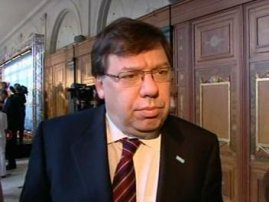
Martin Cullen (FF), the Minister for the Arts, Sport & Tourism (left), was in Killarney today to address the annual conference of the Irish Hotels' Federation.
Afterwards an AW 139 helicopter, one of the most modern in the Aer Corps, was ordered to fly him back to Dublin.
It took off from the grounds of the Malton Hotel with a three-man crew and two passengers: Minister Martin Cullen and one of his assistants. They both had boarded through the large door on the right side, which was then closed before the take-off.

But a few minutes later the helicopter's left door, which had not been used, fell suddenly off at a height of 150 metres and crashed into the Killarney National Park near Castlerosse.

The same helicopter had brought Martin Cullen this morning from his home in Waterford to Killarney without any problems.
After the incident it made an emergency landing at the nearest possible spot, the Killarney Golf & Fishing Club, where it still is now (photo above right).

Fortunately no one was injured in the incident, but witnesses say that Minister Cullen was "visibly shaken".

Eventually the minister, a man of slim built and rather small stature, continued his journey by road to Kerry Airport, from where a second AW 139, which was diverted from an Aer Corps training exercise in Cork, picked him up and flew him to Dublin.

In a statement the Irish Defence Forces declared the aircraft as grounded "until a Military Airworthiness Inspection Team and technicians from the Aer Corps HQ examine it". This team will fly to Kerry tomorrow to assess the helicopter and its condition. It will then be moved back to Casement Aerodrome, the Aer Corps' main base at Baldonnel near Dublin.

The Augusta-Westland AW 139, a modern multi-purpose helicopter with 15 seats, can fly with its doors open.
However, the Irish Aer Corps does it "only at certain speeds and when the aircraft works in military and winching roles".
Ireland is one of so far 18 countries that use this helicopter type in various service roles with their armed forces and other government departments. (The other countries are Australia, China, Estonia, India, Italy, Japan, Lebanon, Malaysia, Namibia, the Netherlands, Oman, Pakistan, Qatar, South Korea, Spain, the United Arab Emirates and the USA.) There are no reports that anything like today's incident has ever happened with an AW 139 anywhere else.

The Emerald Islander

01 March 2009

Happy St. David's Day!

To my friends in Wales and to all Welsh people, wherever they may be: With best wishes across the sea
I hope you all have a
Happy St. David's Day!

The Emerald Islander

20 February 2009

AIB has Egg on its Face

The Allied Irish Bank's regional office and main branch in Cork has egg on its face - literally.

Three days ago - on Tuesday, February 17th at about 11.30 am - a "well-dressed man", wearing a suit and tie, approached the AIB's main building on the South Mall in Ireland's second-largest city. He carried a medium-sized cardboard box, and at first it appeared as if he was just another customer, walking towards the bank.

But then he stopped in the street outside the impressive 19th century building (photo below), opened his box and began to throw eggs at the façade and windows. The bombardment lasted only a few minutes, but it brought traffic to a halt on the usually busy South Mall, one of Cork's major inner city streets.
Some of the motorists and various passers-by are reported to have given the unidentified man a spontaneous round of applause.

The AIB building at 97 South Mall, Cork is probably the most beautiful and impressive bank building in Ireland. Built in 1825 and reconstructed 1863-65, it was the first branch office of the Irish Provincial Bank Ltd., which later became part of the Allied Irish Bank Plc (AIB). Thus it is particularly iconic among Irish banks and a clear symbol of traditional banking and old-world capitalism.

After finishing what he had come for and using up all the 'ammunition' he had brought along, the man dropped the by now empty box and walked away from the scene as inconspicously as he had arrived.

The box, which had been filled with three dozen Irish farm eggs, was later identified as an item bought from a poultry merchant at the nearby 'English Market', Cork's very popular traditional grocery market.

However, the identity of the "well-dressed man" and the specific motives for his direct action remain so far unknown.

An AIB spokeswoman confirmed the incident and declared that the bank would not be making a complaint to the Garda (Ireland's police).
"The man did not enter our building," she said, "and we have no idea who he is, or why he has bombarded the bank with eggs."

While the identity of the 'Egg Man of Cork' might well remain a mystery, with regards to his motives one can think of many. The outrageous behaviour of Ireland's major banks, including AIB, whose reckless and irresponsible management has created the most serious economic and financial crisis in the history of the state, is causing widespread anger among Irish people.
Especially the fact that most of the over-paid fat cat bankers are unwilling to admit their mistakes, expect to remain in their posts and receive their salaries of several million Euros per annum as if nothing has happened, creates great resentment among many ordinary people, whose tax money is used by the Irish government to bail out the failed banks.

I suggest that we all pause for a moment and give three cheers to the 'Egg Man of Cork'...

The Emerald Islander

19 February 2009

CPSU Members vote for Industrial Action

More than 13,000 Irish civil servants who belong to the Civil & Public Service Union (CPSU) have voted decisively to take industrial action in protest against the proposed new pensions levy, for which legislation was published yesterday by the government.
83% of the union members balloted voted in favour of strike action, with 17% voting against. The turnout was 86% of the membership.

The CPSU is now set to hold a one-day strike in a week's time - on Thursday next, February 26th - which will affect services across a range of government departments, including social welfare offices.

Yesterday over 4000 civil servants and public sector workers attended a rally outside Leinster House to protest against the levy. There was also a similar - though much smaller - protest by members of the police union GRA (see yesterday's entry below).

It can be expected that this will not be end of the matter, since the government is determined to push through legislation and the affected civil servants and public sector workers are outraged and angry over the new levy. So we better brace ourselves for a season of discontent, disruption and more gloom on the Emerald Isle.

The Emerald Islander

Bus Drivers to go on Strike over Job Cuts

Shop stewards from SIPTU, Ireland's largest trade union, decided that there will be an all-out strike at Dublin Bus from March 1st unless the company's management stops their proposed cost-cutting measures, which include job losses.
This could mean that there will be no buses at all in the capital for quite some time. The union made the decision yesterday, after receiving a clear mandate from its members.


In a statement Dublin Bus said it has "not yet received official notification of any industrial action by the drivers' unions".
It called the action "regrettable" but said it was "open to discussions" to try to resolve the matter before the end of the month.

Also yesterday drivers with Bus Éireann and Dublin Bus said they would mount a one-day strike on Saturday, February 28th in protest against 600 planned redundancies at the two state-owned bus companies.

A further
two-day strike is planned for March 9th & 10th.

So if you are a user of public transport in Ireland, be prepared to go nowhere for quite some time.

1000th British Visitor

The independent automatic tracking system Flagcounter has just registered the 1000th individual visitor from the United Kingdom of Great Britain & Northern Ireland (UK).

Though the number of British tourists visiting Ireland is down now significantly - due to 'credit crunch', economic crisis and the more than 20% drop in value (and spending power) of the Pound Sterling to the value of the Euro - I am pleased to see that our neighbours to the East and North are still visiting this humble weblog as frequently as usual.
And you are of course as welcome as always, regardless of crisis and 'credit crunch'.

Since I began writing this weblog nearly 14 months ago, UK visitors have been constantly the third-largest group of readers, with a current share of 12% of individual visitors*.

The largest amount of individual visitors - currently 41.7% - come from the USA, which has been in the lead from day one, followed by readers from Ireland, which make up currently 19%. Given the fact that the Republic of Ireland has only about 4.2 million inhabitants (compared with over 300 million in the USA), the share of 1/5 shows that our own people take a fair interest in what I have to say.

More surprising I find the fact that positions 4 and 5 in the ranking of individual visitors are held by Malaysia (currently 9.9%) and Singapore (currently 4.6%).
Although I visited these two countries in South-East Asia regularly when I was based in Hong Kong and Thailand, this is a long time ago and I don't usually write about that part of the world on this weblog. The interest of these Asian readers in Ireland and my writing is appreciated even more and they are most welcome. I read Asian weblogs myself and think that knowing more of and about each other can only improve the state of the world and the spreading of new ideas in the interest of global peace and prosperity.

Very recently the system also registered my first ever readers in Uruguay and Venezuela, and I can only hope that my Views from the Emerald Isle will find even more interest everywhere in future. Everyone is welcome here, regardless who they are and where they are based.

At present the various tracking systems I use here have registered visitors from 113 different countries - from Afghanistan to Vietnam - plus 58 computers registered by the EU organisation.
There were also 763 'hits' whose identity and nationality could not be identified by the tracking systems and thus are listed as 'unknown origin'. Maybe some of them come from various intelligence agencies like the American NSA and CIA, or the Russian FSB (the successor of the KGB), who have the technical capacity to hide their IP addresses and surf the web frequently.
Well, who ever they are, they are welcome to this weblog, and I hope they will find it worth their while to come here and read what I have to say.

The Emerald Islander

* Every single computer in the world has an individual IP address (or registration number). This unique IP address is the basis for counting individual visitors. Repeat visits by the same reader, or someone else using the same computer, are not counted. They are however registered in the overall statistic by a separate system that counts the number of 'hits' the weblog receives from any visitors.

18 February 2009

Russia denies Responsibility for Oil Spill at Sea

The Irish Department of Transport & the Marine says that the serious oil spillage in the Celtic Sea (see yesterday's entry) - off the southern coast of Ireland - is now around 30 nautical miles (ca. 55 km) from land.

Coast Guard surveillance established that the slick contains more than 520 tonnes of Russian fuel oil and is at least 6 km long and wide. It is said to be breaking up, reducing naturally and spreading over a larger area.

Yesterday the Coast Guard predicted that the slick could land on the coast of Co. Wexford within about two weeks' time. However, the latest change of conditions make this less certain. There is currently an easterly wind in the area off the Old Head of Kinsale. But winds do of course change all the time.

Irish authorities first learned about the spill last Saturday through surveillance by the European Maritime Safety Agency (EMSA), which is based in the Portuguese capital Lisbon.
Aerial surveillance conducted since then confirmed the spill, surrounding the Russian aircraft carrier Admiral Kuznetsov and its accompanying vessels: one destroyer, two tankers and an ocean-going tug.

As the Admiral Kuznetsov was refuelled at sea and no other ships have been sighted in the same area for some time, it is quite clear and obvious who is the perpetrator of this pollution. However, there are conflicting comments from different Russian military sources.

While the Russian Naval Attaché to Ireland stated that the Admiral Kuznetsov performed a fuel transfer from a supply tanker at sea when the spill took place, General Nikolai Marakov (left), the Chief of Russia's General Staff, only confirmed that a Russian aircraft carrier had refuelled in the area, but denied that there had been "any problems".
And Igor Dygalo, a spokesman for the Russian Navy, says that "there has not been any accident on board of the ships in the Celtic Sea, nor any deliberate dumping of fuel overboard".
He also disputes the size of the oil spill, adding that "it neither has a catastrophic character, nor does it constitute a threat to coastal ecology".

This is another example of the typical Russian manner of arrogantly denying established facts, a habit that has not changed since the days of the old Soviet Union, which thrived on propaganda and barefaced lies, even if there was overwhelming evidence to the contrary.

In contrast to the Russian attempts of denial and shirking responsibility, Molly Walsh of the environmental campaign group Friends of the Earth says that the slick could seriously damage marine life.

The Irish Department of Transport & the Marine expects the oil to reach the southern coast of Ireland in about 14 to 16 days. Some of it will evaporate, and the rest will most likely develop into tar balls, small sticky patches of oil that often wash ashore and cause coastal pollution and serious damage to beaches and wildlife, in particular sea birds.

John Lucey, a senior biologist with Ireland's Environmental Protection Agency (EPA) says it is the biggest oil spill in the waters around Ireland in ten years.
The last happened in 1999, when the oil tanker Sea Empress ran aground off the south-west coast of Wales and dumped 72,000 tonnes of oil. Compared with that disaster the current oil spill is rather small, but it could nevertheless become a serious threat for the Irish south coast.

The Coast Guard took samples of the oil and experts are currently contemplating if a clean-up operation at sea is possible. This could prevent major damage to our coast and would certainly be the best option of dealing with the pollution.
The open question remains who is going to pay for it. Most likely Ireland would have to foot the bill in the first place. But whatever the costs for a clean-up at sea might be, it will be less than a large-scale clean-up of polluted coastline.
So one can only hope that our government will act quickly and decisively, and that eventually common sense will reach Russia, which - as the obvious polluter - should pay for any necessary clean-up work.

The Emerald Islander

Heated Dáil Debate over Banking Scandals

While more than 4000 civil servants and public sector workers - including Gardaí - were protesting outside Leinster House against the proposed new pension levy today (see entry below), a heated debate was going on inside the Dáil chamber.

Taoiseach Brian Cowen (left) angrily denied suggestions that he was attempting to protect anyone involved in the Anglo Irish Bank share scandal.
He accused Fine Gael leader Enda Kenny of "impugning his reputation", a charge vehemently rejected by the Mayo TD and most senior deputy in the Dáil .

Cowen told the Dáil that his government was "determined to ensure that due process is followed" and that - if wrong-doing is uncovered - "people will face the legal consequences".

Minister for Justice Dermot Ahern (right) said that he "would prefer that the ten individuals involved [in the fraudulent share-buying scandal] be revealed", but that "due process must be allowed to take its course".

Meanwhile it has come to light that the annual report of the now nationalised Anglo Irish Bank, which is expected to be published on Friday, will reveal that a property owned by a member of (former bank boss) Sean FitzPatrick's family was rented by the bank. It is understood that this property is in London.

The Taoiseach stated that he regarded regulatory reform of banking as "a top priority".
In relation to the so-called 'Golden Circle' of ten fraudulent share buyers, he said the issue arose because of "due diligence by the government". He explained that the debts remained and his government would ensure that these debts would be collected by the bank.

Fine Gael leader Enda Kenny (left) said the government had been "far too timid" about the situation in Ireland's financial institutions, because it was responsible for the failure to regulate the banks properly.
He asked the Taoiseach if he agreed that "a fraud has been perpetrated on the Irish Stock Exchange".

Labour Party leader Eamon Gilmore (right) asked why Brian Cowen, when he was Minister for Finance, ordered the Revenue Commissioners to reverse its decision to impose stamp duty on Contracts for Difference (CFD).
These are high-risk investment 'products' where investors can bet on the future direction of a stock, without having to actually buy shares.
Eamon Gilmore said Brian Cowen had already confirmed that he had been lobbied about the issue, and asked for the identity of those involved.

In reply the Taoiseach said as far as he recalled, the lobbying came from "a professional body", but he promised to check with the Department and provide details.

Meanwhile the Green Party has said that it "could review its support for the government if politicians are implicated in the latest banking scandal".
"We are still committed to remaining in government, but that is not an open-ended commitment," the party's chairman, Senator Dan Boyle (left), told a news agency.
Remaining questions about the scandals should be answered quickly instead of the recent 'drip-drip' of revelations, so the damage to Ireland's reputation could be repaired, Boyle added.

After the debate Fine Gael Enda Kenny stated that the public deserved to know the names of the 'Golden Circle' members.
Speaking on RTÉ's Six-One TV News, he said the Irish people now own Anglo Irish Bank and "are entitled to know what is going on".

I wholeheartedly agree, as anyone with a sound mind would. And to go one step further: I do not understand why the government appears to know nothing about all these scandals, and still - after the matters have emerged into the public domain - makes no active efforts to find out what was - and is - going on.
Is it the high level of pure incompetence in our government we have to blame for that, or is Fianna Fáil fully aware of more skeletons hidden in the government's cupboards...?

The Emerald Islander

4000 Civil Servants protest at Leinster House

More than 4000 Irish civil servants and public sector employees took part in a rally outside Leinster House in Dublin (Ireland's parliament building) today, protesting against the controversial pensions levy the government is about to introduce.

The protest was organised by the Civil & Public Service Union (CPSU), which will announce the result of a ballot for industrial action within the next 24 hours.
If a majority of CPSU members support further action, it is expected that over 13,000 civil servants will hold a one-day strike on February 26th.

Members of the Garda [police] Representative Association (GRA) also joined the protest outside Leinster House (photo left).
Seeing policemen actively participating in such a protest (rather then accompany and police it) is quite a rarity.
But many Gardaí agree that the proposed pensions levy is unfair and that the burden of dealing with the current crisis and with the measures of economic recovery is not been spread equally across the community.

The protesters were met at the gates of Leinster House by Labour Party leader Eamon Gilmore (left) and his deputy Joan Burton, who is also the party's spokesperson on Finance. Both pledged their support for the concerns of the civil servants.

Meanwhile the legislation to impose a public service pension levy was published this morning. It is to be debated in the Dáil tomorrow and next week, and is due to go to the Seanad on Thursday of next week.

The Financial Emergency Measures in the Public Interest Bill 2009 - as it is called in full - includes provisions allowing public bodies to reduce the professional fees paid by them to external service providers.
It also includes changes in the early childcare supplement and the Farm Waste Management Scheme, which were announced at the same time as the levy.

Looking at the bill's name alone one has to wonder if politicians will ever be able to put things straight and in plain English that everyone can understand. Why is it that most of our laws have odd and longwinded titles and are phrased in a way no-one speaks? Not even politicians talk like that...

On top of the whole Civil Service and public sector, the proposed levy will also apply to all TDs - including Ministers, Ministers of State and the Ceann Comhairle (Speaker) and Leas Ceann Comhairle (Deputy Speaker) of the Dáil - as well as to all Senators, the Attorney General and Members of the European Parliament.
However, due to the provisions of the Constitution, the President and the Judiciary cannot be included in the measure.

If passed by both Houses of the Oireachtas (Ireland's parliament), the levy will apply to all earnings of the people affected by it, including allowances and overtime, from March 1st. The legislation specifies that no extra pension benefit is conferred by the deduction.

In light of today's demonstration and the generally unfriendly reactions the proposal has created in a large portion of civil servants and public sector workers, it remains to be seen if the bill will actually become law in the form and way the government wants. It is a fact that no government could function without the Civil Service and the many areas of the public sector.

Maybe the recent talks of the Social Partners were broken off without an agreement a little bit too hastily. As long as Ireland's rich and super-rich, many of which caused the current crisis, do not contribute their fair share to the recovery programme (and are seen by everyone to do so), the Irish are not in the mood for ever more sacrifices from the ordinary people - in the public as well as the private sector - while selfish and arrogant millionaires keep enjoying the wealth they creamed off the nation over the past decade.

The Emerald Islander

17 February 2009

Russian Oil Slick heads towards Irish Coast

A huge oil slick (photo above) in the Celtic Sea is heading towards the Irish coast and could reach the shore in about two weeks' time.

Ireland's Department of Transport and the Marine has confirmed that a spill of up to 1000 tonnes of fuel oil is floating just 43 nautical miles south of the Fastnet lighthouse and drifting towards the Irish mainland.

Aerial surveillance of the scene by the Waterford-based Coast Guard helicopter has established that the oil spill covers currently an area of approximately 4.5 km by 5 km, surrounding the Russian aircraft carrier Admiral Kuznetsov and a refuelling tanker of the Russian Navy (photo below).

Russia's Naval Attaché to Ireland has now confirmed that the Admiral Kuznetsov performed a fuel transfer from a Russian supply tanker at sea when the spill took place.

Meanwhile a spokesman from the Irish Department of Transport and the Marine said: "Several vessels are at the scene in the Celtic Sea at the moment. They include the Russian aircraft carrier, two refuelling tankers, one Russian ocean-going tug, one Russian destroyer, one British destroyer and the Irish Naval vessel L.É. Aisling. It is believed that the Russian Task Group may leave the Celtic Sea tomorrow, having completed their refuelling operations."

The Irish Coast Guard, in co-operation with the British Coastguard, is now carrying out aerial pollution surveillance flights over the area. Samples of the oil have been taken from the scene to be analysed.

As soon as further information is available, I will share it with you here.

The Emerald Islander

11 February 2009

MEP Kathy Sinnott marks European 112 Day

Today - February 11th, 2009 - marks the European 112 Day (11/2), which aims to inform all EU citizens about the European emergency telephone number 112.

More and more EU member states now organise a 112 Day on that same date, such as Finland, Romania, the Netherlands, Poland and Denmark. Here in Ireland, however, we have no time for such sensible things. We are much too occupied with ruining our country and tearing apart the social fabric of the Irish nation.

So while many people in Europe pause for a moment to reflect on better emergency services, the Irish government is dealing with emergency legislation and bailing out our failed banks with € 7 billion of taxpayers' money, but without doing anything about the rotten and deeply corrupt structure of these evil institutions, which are major causes and contributors to our massive and unprecedented economic and financial crisis.

Fortunately there is the independent MEP Kathy Sinnott (photo), who represents Munster in the European Parliament.
She did not forget and hosted a press conference in Brussels this morning, to mark the first EU-wide European 112 Day.

The campaign to establish an EU-wide 112 emergency telephone system has been under way for quite some time.
112
is compatible with all phone systems. The idea is to have a European call centre which can accommodate all the European languages, plus others like Mandarin (Chinese), Filipino Tagalog and Russian.
When someone dials 112 in an emergency from anywhere in Europe, the exchange can identify the location of the nearest emergency response system. If the caller's language is different from that of the working language of the response system, then the 112 call centre can provide translation.

Speaking this morning, Kathy Sinnott said: "I congratulate those who have been working so hard for the past 17 years to promote 112. In Ireland, the emergency number is still 999, like in Britain."
So it appears that in 90 years of Irish independence we did not even manage to drop the old UK emergency number...

"Would an Italian - for example - who is used to dialling 113 for police, fire and ambulance or 118 for medical emergencies know to ring 999 when he is in Ireland?" Kathy Sinnott asked. "The answer is most likely: No. This is where awareness of 112 comes into play."

During the press conference, Ms. Sinnott outlined a number of important details.

"Last year," she explained, "I wrote a report for the European Parliament on protection against injury and promotion of safety. What I learned while researching this report is that people are most in danger of injury during times of leisure, and especially on holidays. For example, a Hungarian tourist breaks his leg while hill walking in West Cork. He can free-phone 112, speak to someone in Hungarian who will put the call through 999 to reach Bandon Garda Station and translate for the Garda on duty. If we were to develop this technology further, translation from 112 could remain available to the tourist even when he reaches hospital."

"Another point I would like to mention is the use of 112 for people who are trafficked to another country against their will. With this very simple number, people deprived of their normal freedom, if they were able to get even a moment alone with a telephone, could dial 112, speak to somebody in their own language and get help."

"This is a real tool which could be very effective, especially in today's multi-cultural society. Sadly, at present only 27% of Irish people are aware of 112. The Irish government have a legal responsibility to promote awareness and use of 112 through the 2002 Directive on universal service and user's rights relating to electronic communications networks and services. I call on our government to put this Directive into practice and start saving lives - now."

One can only hope that someone in Government Buildings was listening to Kathy Sinnott and that after seven years of forgetting the matter one of the many ministers can be found to implement it. I presume they cannot all be busy with bailing out failed banks and organise cosy retirements for corrupt bankers and senior civil servants.

The Emerald Islander

26 January 2009

A Day of triple Celebrations

Today - January 26th - is a great day of celebration for more than two fifths of the world's population. There are three events which come together, two of them occur each year on this day, while the third is dependent on the Lunar calendar and thus its date changes from year to year.
oooo
To my Chinese friends, and to all Chinese people around the world who visit my weblog, I send today very special greetings, good wishes and say:
oooo
HAPPY NEW YEAR!
oooo
Yes, today is the first day of the Chinese New Year festival, and more than 1.3 billion people in the People's Republic, together with many millions of Chinese in Taiwan, Hong Kong, Singapore and all around the globe are celebrating the begin of the year 4706, a year under the sign of the Earth Ox.

May the New Year be a happy one for you and all of us, may it be peaceful, prosperous and open new opportunities to all those who seek solutions for the world's many problems!

To my - currently 163 - readers in Australia and to all Australians, wherever they may be today, I also send special greetings and good wishes for AUSTRALIA DAY, which commemorates each year the arrival of the First Fleet from Britain in Australia. It arrived at Sydney harbour on January 26th, 1788 and the day marks the official begin of British colonial rule in Australia.

And to my - at present 153 - readers in India, as well as all Indians living and working abroad, I express my gratitude for the years I spent as a guest in your country and send you my greetings and good wishes on REPUBLIC DAY, which celebrates the conversion of India from a British Dominion to an independent republic on January 26th, 1950.
The day also commemorates the declaration of Poorna Swaraj (Complete Independence) which the Indian National Congress proclaimed twenty years earlier, on January 26th, 1930.
oooo
I was privileged to spend several Republic Days in New Delhi, and my memories of the splendid military parades are as vivid as I remember the special sweets prepared and served on this day. There is no country on the planet with more vibrant celebrations than India and I hope to return there once more before I have to depart this earthly existence. For now I can only be with you in spirit and do hope you are having a marvellous day.

The Emerald Islander

Traffic Restrictions at Dublin Airport

Passengers travelling to Dublin Airport are being advised of temporary access restrictions on the Departures Road.

There will be no public pick-up or drop-off allowed in front of the terminal building from 8 pm this evening (January 26th) until 4 am on Thursday, February 5th.

Users of buses and taxis will not be affected.

The restrictions are imposed because of road works being carried out as part of the construction of the new Terminal 2.

A dedicated passenger drop-off area will be in place to the rear of the multi-storey car park

25 January 2009

Severe Winter Storms killed at least 15 People

Fierce storms across southern France and northern Spain have left at least 15 people dead and caused huge damage and disruption during the past 24 hours.

Four children have died when strong winds blew off the roof of a sports centre near the city of Barcelona in the Catalan region of Spain. Elsewhere, people were killed by falling trees and debris coming loose from buildings.

Winds of nearly 200 km/h also brought down many power cables. More than 1.5 million homes in France suffered power cuts, while road and rail links were blocked and airports had to close.

Here in Ireland the weather has been less severe than on the continent, but there were also strong winds with forces between 8 and 11 - and occasionally reaching even force 12 off the coast - over the past few days. It has been quite cold and raining heavily, with the high winds coming in from the Atlantic doing some damage to power cables and trees.

Fortunately there have been no weather-related deaths in Ireland, and no major damages were reported. However, a number of sporting events - including several race meetings - had to be cancelled or postponed because of bad weather and water-logged grounds.

And here in Waterford strong gusts blowing in from the Celtic Sea caused some traffic disruption on major city streets. There was debris reported on the Cork Road, the Tramore Road and in a number of nearby housing estates.

According to the Meteorological Office the weather will remain unpleasant for at least another 24 hours, and perhaps longer.

The Emerald Islander

24 January 2009

Happy Birthday! The Apple Mac is 25.

Today is a special day for the international community of professional computer users, and it is also the 25th birthday of a good friend and trusted work companion of mine.

Exactly a quarter of a century ago - on January 24th, 1984 - Apple's first ever Macintosh computer (photo left) went on sale.

For those of you who have never ventured beyond a PC, let me say a few words of introduction. (And all of you who are - like myself - users of Apple Macs, just skip the next few paragraphs...)

The Macintosh - developed and manufactured by Apple Inc. - was the first commercially successful personal computer to feature a mouse and a graphical user interface rather than a command line interface.
It was quickly adopted as the work station of choice by designers and people in the graphic and printing industry all around the globe, and in 25 years not much has changed in that regard. Even though PCs are much improved by now, the world's designers, editors and printers still prefer and use the Apple Macintosh, meanwhile in a whole variety of models.

The reason for such brand and product loyalty is quite simple: In contrast to most PCs and their accident-prone software from Microsoft, the Macintosh is a stable and reliable work horse, a solid companion for every creative person.
I got my first Mac, as users call the Macintosh affectionately, in 1992. Compared with today's models it was a rather simple machine, but it did everything it was required to do without any problems. Meanwhile I am on my third Macintosh, and without the current recession I might already be on the fourth. During the 17 years I had never a single technical problem with a Mac, neither on the software nor on the hardware side. Some people say that a Mac is just like a VW Beetle: it runs and runs and runs...

I also use PCs with Microsoft software, and with them I had a good bit of trouble over the years, mostly with software, but also three serious problems with the hardware. Such does simply not happen with an Apple Mac and this high degree of solidity, reliability and functionality, combined with a user-friendly system and clarity in structure and design, makes the Apple Mac such a superior work station.
Apple's CEO Steve Jobs (above right), a computer enthusiast of the 'old school' himself, knows that as long as he keeps the quality of his products high, the professional users of computers will stay with him and with the Mac.

The Macintosh project started in 1978 when Jef Raskin (left) became the 31st employee of Apple Computers. He envisioned an easy-to-use, low-cost computer for the average consumer and wanted to name it after his favorite sort of apple, the 'McIntosh'. But the name had to be changed slightly for legal reasons.
In September 1979 Jef Raskin started hiring new people for the project, and he began to look for an engineer who could put together a prototype. Bill Atkinson, a member of Apple's Lisa team (which developed a similar but higher-end computer), introduced him to Burrell Smith, a service technician who had joined the company earlier that year.
Over the years Raskin assembled a large development team that designed and built the original Macintosh hardware and software.

Besides Raskin, Atkinson and Smith the Macintosh design team (photo right) included also George Crow, Chris Espinosa, Andy Hertzfeld, Joanna Hoffman, Susan Kare, Daniel Kottke and Jerry Manock.
They were the 'founding fathers' (and mothers) of a computer revolution that changed the world even more than the 'founding fathers' of the United States had changed it with their declaration of independence in 1776.

After years of new thinking and hard work the first Macintosh was ready for the market shortly before Christmas 1983. It went on official display for sale for the first time on January 24th, 1984, exactly 25 years ago.
Even though it took me another eight years before I joined the international Mac community, I am glad to be part of it and would not want to be without a Mac now. It has changed my life and work forever, and done the same for millions of other creative workers all around the globe. So today let us pause for a moment, rejoice and say "Happy 25th Birthday, Mac!"

The Emerald Islander

Remembering Admiral George Rooke

There is an old saying that one can take a man out of the Navy, but never the Navy out of the man (who served in it for years). This is quite true, and I freely admit that even many years after my retirement from active sea service I have still a very strong interest in all matters maritime.

Besides my work as editor of the encyclopaedia of ships and my involvement with the international Tall Ships' Races I also do a lot of research into maritime history. And from this area I want to give you a little piece today, remembering a man who is nowadays widely forgotten.

This man is George Rooke, a distinguished English naval officer from the 17th century, who died on this day exactly 300 years ago.

Rooke was born in 1650 (the exact date is uncertain and disputed) at St. Lawrence, his family's estate near Canterbury in Kent.
He entered the Royal Navy as a young volunteer and served in the wars against the Dutch with great courage and distinction.
In 1673, at the very young age of 23, he was made a post captain. Over the following 17 years he became one of the most successful and best known English naval officers of his time, commanding several frigates and ships of the line in war and peace.

In 1690, aged 40, George Rooke was appointed Rear Admiral and shortly after he fought against the French in the crucial Battle of Beachy Head (also known as the Battle of Bévéziers), which ended with a heavy defeat for the Royal Navy and their Dutch allies and gave the French Navy control of the Channel for a considerable time.

Two years later, in May 1692, Rooke served under Admiral Russell in the Battle of Barfleur and greatly distinguished himself in a night attack on the French fleet at La Hogue, where he burned six of their ships. For this action he was knighted and received a reward of £ 1000 (which was an enormous sum of money at the time).

Until the peace of Rijswijk in 1697 Sir George Rooke continued to serve in both the Channel and the Mediterranean.
He then commanded the Anglo-Dutch Squadron that attacked Copenhagen in conjunction with the Swedish fleet under Admiral General Hans Wachtmeister in 1700, which facilitated the landing of King Charles XII of Sweden and his army in Denmark in the opening phase of the Great Northern War.

But the deeds for which Rooke is best remembered by historians were yet to come. When the War of the Spanish Succession began in 1702, he commanded an unsuccessful allied expedition against Cádiz, but on the passage home he spotted and destroyed the Spanish treasure fleet in Vigo Bay. The spoils taken from the Spanish were so substantial that Parliament passed a special vote of thanks for Rooke, an honour very rarely awarded to anyone.

As the overall commander Admiral Sir George Rooke then led the allied forces in the capture of Gibraltar on July 21st, 1704, the most lasting of his many military achievements.

After a brief spell as military governor of Gibraltar from July 24th to August 4th, the Admiral returned to sea and attacked the French fleet off Málaga on August 13th, 1704. This battle ended with a tactical draw, but was a strategic success for England, as it secured the newly won position at Gibraltar.
305 years later the rocky outcrop at the southern tip of Spain is still in British hands and a major naval base that controls the western entry to the Mediterranean. And five years ago, during the celebrations of the 300th anniversary of British rule over Gibraltar, a fine statue of Admiral Sir George Rooke was errected there in his memory.

The battle against the French off Málaga was to be George Rooke's last active engagement at sea and he retired - due to ill health - in February 1705 after more than four decades of service in the Royal Navy. He spent the last four years of his life quietly at his estate at St. Lawrence in Kent, where he died on January 24th, 1709 aged 58.

Even though he is widely forgotten these days, George Rooke deserves to be remembered, as his fearless and determined actions at sea set the standard for two centuries of English maritime leadership. Without him and his equally famous colleague Sir Cloudesley Shovell the great British naval heroes like Nelson, Collingwood and Pellew, who fought with distinction a century later, might never have emerged.
And without Rooke's capture of Gibraltar England - and later Britain - would have never been able to establish the great influence it had in and around the Mediterranean for three centuries (and still has today, even though on a much lower level).

The Emerald Islander
(wearing the old tricorn naval hat for a while today)

RTÉ transmits misleading Radio Ads again

In my opinion there is generally way too much advertisement in this world, but especially here in Ireland, which is highly over-commercialised in every possible way.

This goes so far that public service vehicles used by Waterford City Council carry stickers advertising the private company they are leased from. Ornamental standing stones with the names of town lands and housing estates always carry the name of a private company that paid for it, and there are - believe it or not - even public rubbish bins in our parks and on the streets that sport a small plaque, saying "sponsored by..." followed by the name of a local business.

One of my regular annoyances is that Radio Telefis Éireann (RTÉ), which is the sole recipient of the compulsory national TV licence money (currently € 160 per household per annum), also fills its programmes on both Radio and TV with a large amount of advertisement.
The whole purpose of having a TV licence is to give a broadcaster financial independence from vested interests, in order to make proper and independent programmes free of advertisement.

The BBC does that very well, but RTÉ does not. It takes the licence money, whose payment is actually enforced with drastic measures, including the arcane and almost Dickensian 'TV Licence Inspectors' who apparently "visit 18,000 premises every month". (That alone is a ridiculous and outrageous waste of money, energy and resources and deserves a separate article at some other time.) Watching TV in Ireland without having a TV licence is actually a criminal offence, and each month there are numerous people dragged into court rooms and fined for it. And a few, who do simply not have the money to pay either the licence or the fine, end up in prison, for nothing else than watching television.

Despite all this, the complete output of RTÉ - on both Radio and TV - is heavily commercialised and filled with constant advertisements. On top of that many programmes are also specifically sponsored by a company or product which is mentioned in extra trailers several time throughout the transmission of this programme.

I have turned my back on TV many years ago and only listen to Radio, so I cannot say in detail how much worse it is with RTÉ's TV programmes. But the advertisement content on RTÉ Radio is bad enough and higher than that of some commercial stations, which have no other income than advertisement.

Not enough that listeners are constantly bombarded with unwanted commercials which are even used to interrupt news bulletins, many of the ads transmitted by RTÉ are strictly speaking in breach of broadcasting rules as they are peddling clear lies or make incorrect statements about a company or product. But no-one (except me) seems to care or feel bothered.
Actually, as things are here, anyone can broadcast a complete tissue of lies and get away with it, as long as the last words of the ad are "terms and conditions apply". And it is quite telling that this phrase is the most common in Irish advertising, appearing in about two thirds of all adds I hear on RTÉ Radio. Most significantly they close all ads for banks, insurance companies and all sorts of other financial services.

But the crooks in the big multi-national companies and their henchmen (and women) in the large lying factories known as 'advertisement agencies' do not stop there. Now they even produce ads with clear and plain lies without attaching any verbal safety net at the end.
Not that this is the first time RTÉ has transmitted misleading ads. It happens ever so often, and one wonders if there is any control of the content at all before it goes out on air. Or perhaps it is all the same for RTÉ, as long as they get paid for peddling rubbish and spreading lies.

The latest example of that is a new ad for Opel cars, which I have heard on RTÉ Radio 1 today for the third time. It indicates that at least some US companies have by now realised that their uncritical support of the criminal Bush administration over the past eight years and their overall imperialist approach to marketing are doing some damage to their international sales figures, especially in Asia and Europe.
So now they have decided to use even obvious lies to win over the uninformed and truly gullible elements of the Irish population, which are quite significant in numbers.

This new ad opens with introducing Opel as "a German company", and that is a clear and plain lie. But for many it sounds alright nevertheless, because Opel started as a German company.

Let us look at the facts: The Opel GmbH was indeed founded in Germany 146 years ago, on January 21st, 1863. It first produced various household goods, but soon specialised in sewing machines. By 1895, the year company founder Adam Opel died, they were the largest maker of sewing machines in Europe and also produced each year 2000 bicycles, then a novelty form of transport that was gaining popularity.
Three years later Opel began also building cars, first in partnership with a German inventor and then with a French engineering company. In 1906 they developed their first own model, and by 1913 Opel was the largest car manufacturer in Germany.

After World War I things looked more dire, even though Opel was still the leading car brand in a devastated Germany. But the economic crisis of the late 1920s with hyper-inflation and political instability ruined many a German business forever.
In 1929 Opel was taken over by General Motors of Detroit, USA, the largest car maker in the world then and now.

So even though Opel began as a German company and still has production facilities there, it is actually a 100% American firm and has been for the past 80 years. To call it now "a German company" in an ad for the Irish market is at best misleading, at worst a plain lie. It has not been done in the past, as long as US cars were seen as somehow desireable here. But now, that many people have turned their backs on the USA and anything American for various reasons, suddenly General Motors declares Opel "a German company", hoping to cash in on the fact that Germany has a long, unbroken and exceptional reputation for engineering excellence.

Well, I do not wish to influence anyone here, and I believe that people make up their own minds in any way they see fit. Personally I would never buy or drive an Opel car, nor any other US car, knowing of the way General Motors runs its business (and has been supporting George W. Bush and other leading Republicans for many years with vast sums of money). And though GM is the worst of the lot, Ford and Chrysler are not much better than their larger rival. However, it is not for me to tell you what car to buy and drive. I just hope you know what you are doing and whom you support with your money.

But I strongly resent the fact that RTÉ, our national broadcaster, is offering itself as a willing accomplice to another deliberate tissue of American lies. I am certain that before this current crisis is over we will see many changes in many areas, including broadcasting. And I can assure you - and RTÉ - that I have an excellent memory.

The Emerald Islander

20 January 2009

Barack Obama - 44th President of the USA

Today at 12 o'clock noon local time (5 p.m. GMT) Barack Hussein Obama stood on the steps of the Capitol in Washington D.C. and was sworn in as the 44th President of the USA. According to media reports the inauguration ceremony and the related parades and celebrations brought a record crowd of more than 3 million people (1% of the entire US population) out onto the streets and boulevards of the US capital, where they were standing for up to eight hours, despite a cold wind a temperatures well below zero Celsius.

This is a happy day for the USA, as it ends the eight terrible years of the Bush administration with its massive wave of crimes, war crimes and breaches of human rights and international law.
George W. Bush, the uneducated savage war lord, former alcoholic and right-wing 'Christian' fundamentalist, walks away from all the harm and damage he has done to his own country and to many others around the world. He will spend the rest of his life in great luxury and he will never be held responsible for his unspeakable acts of crime, war, terror and torture.

And he settles the new administration of President Obama not only with two illegal wars in Asia, but also with the worst economic and financial crisis in modern history, perhaps only matched by the disastrous period of the early 1930s.

Most media declare that Barack Obama is "the first black US President", which is not correct. He might have a darker skin than many of the journalists, but Obama is not 'black', but of mixed race. Calling him an African-American is acceptable, as his father was an African from Kenya, while his mother was a white American from the Mid-West.

But race is not the issue here and has played no significant role in Barack Obama's campaign. He is in fact the first non-white US politician who built his career on facts and achievements alone, without playing the race card. This, in my opinion, is one of the reasons for his electoral success and for his universal appeal to people from all ethnic groups and walks of life.

On this important day, as his presidency begins, I wish Barack Obama the best of luck and much success in his new and difficult office. I am confident that he will make a great difference to the USA and her people. And if he is given enough time and support, he might even do additional good for the rest of the world.
But one should be realistic and not expect the impossible. Despite all the public hype and media circus Mr. Obama is not the Messiah. He is just a human being, like you are and I am.
He is highly intelligent, very well educated, eloquent, courageous and sensible, and all this will be of great help to him and his administration. But to solve the massive problems his criminal and imbecile predecessor has left behind, he will also need a lot of time, even more money and a real large portion of good luck.

Let us hope that the world will be a better place under President Obama, and that he can heal at least some of the wounds caused by the Bush administration. But whatever he does, even in two periods as President (eight years) he will never be able to restore all the confidence, credit and good will the USA lost under George W. Bush.
More than 35 years after abandoning South-Vietnam the USA are still not trusted in South East Asia, and they won't be for at least another century. The Germans are still blamed for Adolf Hitler, 64 years after he died and the Second World War ended.

Some may see it as unfair, and perhaps it is. But major diplomatic mistakes, political blunders and especially cruel and illegal wars of aggression have the habit of hanging over nations for a very long time, for many decades and even centuries. This is the legacy the Bush clan leaves to Barack Obama and the whole USA.

Nevertheless, I have to admit that for the first time in eight years I am looking West with some degree of hope and positive expectation. But it is very early days yet, and only time will tell if we can even contemplate to trust the USA again in future. As I have followed the political career of Barack Obama throughout the whole of 2008 - and predicted his election more than a year ago - I will keep an eye on his policies and decisions as President. And if you keep reading this weblog, you will stay well informed about him.

The Emerald Islander

P.S. To answer a query I received earlier today, let me point out that Barack Obama is the 44th President of the USA, but only the 43rd man to hold the office. The reason for this discrepancy in numbers is simple: Grover Cleveland, a Democrat, was elected President twice, but not in consecutive terms. Thus he is listed as the 22nd President (1885-1889) and as the 24th President (1893-1897), even though he is the same person.

ITGWU began working 100 Years ago

While this morning Dáil Éireann commemorated its own 90th birthday one day prematurely (which brings bad luck), there was no mention during the special parliamentary session of another Irish institution that is actually 100 years old today.
Sadly only a few people in Ireland celebrated, and most of our citizens are not even aware of the significant date.

Exactly 100 years ago today - on January 20th, 1909 - James Larkin (right) issued union cards to the first members of the Irish Transport Worker’s Union, which he had just founded. (There is a slight dispute over the correct date on which the union began its work. SIPTU, now the largest trade union in Ireland and the direct descendant of James Larkin's first union, celebrated its 100th anniversary already 16 days ago, on the 4th of January.)
The commitment of Larkin and his early union members to fairness, equality, democracy and freedom was a great help in the preparations for the Easter Rising of 1916 and in the subsequent struggle for freedom and independence.

The Irish Transport and General Workers’ Union (ITGWU) - as it was called later - organised the strike that led to the Great Lockout of 1913. During this strike Larkin gave speeches all over Dublin, despite being arrested for 'seditious libel' and released on bail.
In a now famous speech on August 28th, 1913 (photo above left) he said: “Before I go any further, with your permission, I am going to burn the Proclamation of the King. People make Kings, and people can unmake them.”

During the Great Lockout of 1913 James Larkin and James Connolly also helped to establish an Irish Citizen Army (Arm Cathartha na hÉireann). Its main purpose was to counter the bands of thugs and criminals hired by employers to harrass union members, and to provide security at workers’ meetings. The Irish Citizen Army had also, by its constitution, to pursue nationalist aims for Ireland.

In 1914 James Connolly said in commemoration of the workers that were killed during the Great Lockout one year before:
"Our fight of last year was not for added wages and reduction of hours; it was for an opportunity of building up in our midst men and women, a chance to develop nobility and grandeur of character for men and women, a time to realise the nobility of life, to study the history of Ireland, to study our rights as well as our duties. It was a time to develop men and women for the coming crisis, so that they might take advantage of it when it came. … If you are itching for a rifle, itching to fight, it is better to fight for our own country than for the robber empire. If ever you shoulder a rifle, let it be for Ireland."

Less than two years later, on Easter Monday, August 24th, 1916, the Irish Citizen Army fought alongside the Irish Volunteers in Dublin, in particular on St. Stephen’s Green and in the General Post Office (GPO) on O'Connell Street (then named Sackville Street).
A British gunboat that shelled Dublin during the Easter Rising singled out Liberty Hall - the headquarters of the ITGWU on Beresford Place - for special attention and left it a smouldering ruin.

After the failure of the Easter Rising it took months before Irish nationalism recovered. But the fire was lit and could not be quenched again, no matter how hard the British tried. The execution of James Connolly and the other main leaders of the rising by a British firing squad outraged Ireland and inspired tens of thousands to join the ITGWU.
In 1918 the union led a general strike against conscription, and this was - together with the widespread activities of Sinn Féin - the preparation for the general election in December and subsequently Dáil Éireann, which will be 90 years old tomorrow.

But today Ireland's workers, true patriots and republicans, remember the great James Larkin (who - after a few years in the USA - returned to Ireland in 1923, continued his work until his death in 1947 and was also twice elected to the Dáil) and the powerful trade union - now SIPTU - he established 100 years ago on this day.

The Emerald Islander